A healthy granola recipe starts with whole-grain rolled oats, uses a minimal amount of unrefined sweetener, incorporates nuts and seeds for protein and unsaturated fat, and bakes at a low temperature to preserve the oils and nutrients in the ingredients. The best homemade granola delivers roughly 150 to 180 calories, 4 to 5 grams of fiber, and 6 to 8 grams of added sugar per quarter-cup serving. That is about half the sugar and double the fiber of most store-bought granolas.
The granola aisle in 2026 looks healthier than it did a decade ago, but the majority of packaged granolas still contain 10 to 15 grams of added sugar per serving, which is more than a bowl of sugary breakfast cereal. The American Heart Association recommends that women limit added sugar to no more than 25 grams per day and men to no more than 36 grams. A single bowl of standard commercial granola with milk can consume half that budget before 8 a.m. Making granola at home puts the sugar shaker back in your hand.
This article covers the nutritional framework that makes granola healthy, a base recipe formula you can customize endlessly, four complete tested recipes for different dietary needs, and the techniques that prevent burnt edges and soggy clusters. Every recipe includes real measurements, real oven temperatures, and approximate nutrition breakdowns per serving. The skill level required is beginner to intermediate. You need an oven, a sheet pan, a mixing bowl, and the ability to check on something every ten minutes while it bakes.
What Makes Granola Healthy? The Nutritional Framework
Granola becomes healthy when it is built on whole-grain rolled oats, uses a restrained amount of a liquid sweetener like maple syrup or honey, incorporates raw nuts and seeds for protein and unsaturated fat, and bakes at a temperature that toasts the ingredients without oxidizing the oils. The ingredient proportions matter more than any single ingredient choice. Too much sweetener and oil produces a sticky, calorie-dense candy. Too little and the granola does not cluster.
Whole-grain rolled oats are the non-negotiable base. They provide beta-glucan, a soluble fiber that has been shown in research published by the American Journal of Clinical Nutrition to lower LDL cholesterol when consumed regularly. Steel-cut oats are not a substitute. They are too hard and do not toast properly in granola. Quick oats produce a dusty, crumbly texture. Old-fashioned rolled oats are the specific product you want. They are steamed and flattened oat groats that hold their shape during baking.
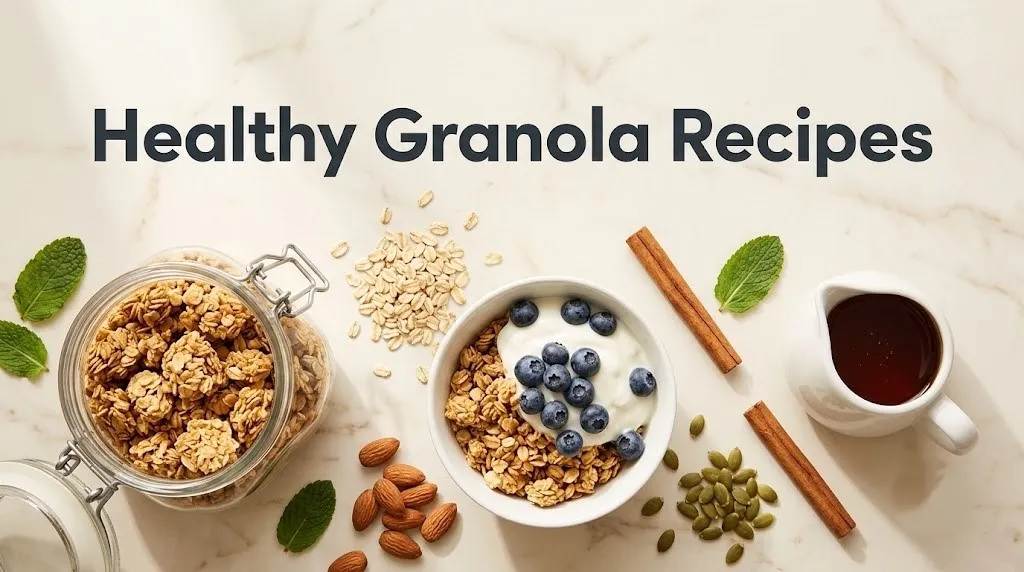
The sweetener in healthy granola should be a liquid, typically maple syrup, honey, or date syrup, rather than refined white sugar. Liquid sweeteners coat the oats and create the clusters that define good granola. White sugar does not. A quarter-cup of maple syrup across a full batch of granola that yields 5 cups means roughly 1 tablespoon of syrup per 1.25-cup serving, which translates to about 6 to 8 grams of added sugar per serving. That is a reasonable amount. It is not zero sugar, and granola is not a zero-sugar food. It is a controlled-sugar food.
The fat source should be an unsaturated oil like extra-virgin olive oil, avocado oil, or melted coconut oil. Nuts and seeds contribute additional fat, predominantly unsaturated, along with protein, fiber, magnesium, zinc, and vitamin E. A healthy granola recipe will contain roughly 2 to 3 tablespoons of added oil per 3 cups of oats. That is enough to create crispness without saturating the oats. Commercial granolas often use more oil and cheaper oils, which is one reason homemade granola can taste better and be healthier at the same time.
Key Takeaway: Healthy granola is defined by whole-grain oats, a restrained liquid sweetener, unsaturated oil, and an abundance of nuts and seeds. The ratios matter more than any single ingredient. One-quarter cup is a serving. Measure it.
The Base Healthy Granola Recipe: Customize It for Any Diet
This base recipe produces a lightly sweetened, crunchy, oat-forward granola with clusters that hold their shape. It is designed to be customized. Swap the nuts, change the seeds, adjust the spice, add dried fruit after baking. The formula works across dietary patterns including vegan, gluten-free, and dairy-free with easy substitutions.
Yield: Approximately 5 cups (20 quarter-cup servings)
Prep time: 10 minutes
Cook time: 30 to 35 minutes
Oven temperature: 300 degrees Fahrenheit
Base Ingredients:
- 3 cups (300 g) old-fashioned rolled oats, certified gluten-free if needed
- 1 cup (120 g) raw mixed nuts (almonds, pecans, walnuts, or cashews), roughly chopped
- 1/2 cup (70 g) raw pumpkin seeds or sunflower seeds
- 1/4 cup (60 ml) maple syrup or honey
- 3 tablespoons (45 ml) avocado oil or extra-virgin olive oil
- 1 teaspoon vanilla extract
- 1 teaspoon ground cinnamon
- 1/4 teaspoon fine sea salt
- 1 large egg white (optional, for extra clusters), whisked until foamy
Method:
- Preheat the oven to 300 degrees Fahrenheit. Line a large rimmed baking sheet with parchment paper.
- In a large mixing bowl, combine the rolled oats, chopped nuts, pumpkin seeds, cinnamon, and salt. Stir with a spatula to distribute evenly.
- In a small bowl, whisk together the maple syrup, avocado oil, and vanilla extract until emulsified. Pour the wet mixture over the oat mixture and stir until every piece of oat and nut is coated.
- If using the egg white, whisk it with a fork until foamy and pour it over the granola mixture. Stir to coat. The egg white helps bind the ingredients into larger clusters.
- Spread the granola in an even layer on the prepared baking sheet. Press down firmly with the spatula to compact it. A loose, scattered layer will not form clusters.
- Bake for 15 minutes. Remove the pan from the oven and stir gently, bringing the edges toward the center. Press down again with the spatula.
- Return to the oven and bake for another 15 to 20 minutes, until the granola is golden brown and fragrant. It will still feel slightly soft when hot. It crisps as it cools.
- Remove from the oven and let cool completely on the baking sheet without stirring. This is the step that sets the clusters. Stirring warm granola breaks the clusters apart.
- Once completely cool, break the granola into clusters with your hands. Store in an airtight container at room temperature for up to 3 weeks.
Nutrition per serving (1/4 cup, approximately 30 g): 155 calories, 8 g total fat, 1 g saturated fat, 17 g carbohydrates, 3 g fiber, 6 g added sugar, 4 g protein.
The egg white is optional but worth including. It adds protein and acts as a binder that creates larger, crunchier clusters. The protein in the egg white denatures during baking and forms a web that holds the oats and nuts together. Without it, you will still get granola. It will just be looser and less clustered.
Peanut Butter and Dark Chocolate Granola (Lower Sugar)
This recipe uses natural peanut butter as the primary fat and flavor, which reduces the need for added oil and sweetener. The peanut butter contributes protein, monounsaturated fat, and an intense flavor that carries the granola. A small amount of dark chocolate is added after baking so the chocolate does not burn in the oven.
Yield: Approximately 5 cups
Prep time: 10 minutes
Cook time: 25 to 30 minutes
Oven temperature: 300 degrees Fahrenheit
Ingredients:
- 3 cups (300 g) old-fashioned rolled oats
- 1/2 cup (60 g) raw peanuts, roughly chopped
- 1/4 cup (40 g) raw pumpkin seeds
- 1/3 cup (85 g) natural creamy peanut butter (ingredients: peanuts, salt)
- 1/4 cup (60 ml) maple syrup
- 2 tablespoons (30 ml) avocado oil
- 1 teaspoon vanilla extract
- 1/4 teaspoon fine sea salt
- 1/3 cup (60 g) dark chocolate chips or chopped dark chocolate (70 percent cacao or higher)
- Flaky sea salt for finishing
Method:
- Preheat the oven to 300 degrees Fahrenheit and line a baking sheet with parchment paper.
- In a large mixing bowl, stir together the rolled oats, chopped peanuts, and pumpkin seeds.
- In a small saucepan over low heat, warm the peanut butter, maple syrup, avocado oil, and salt until the peanut butter melts and the mixture stirs together smoothly. Remove from heat and stir in the vanilla extract.
- Pour the warm peanut butter mixture over the oat mixture and stir with a spatula until every dry ingredient is coated.
- Spread the granola on the prepared baking sheet and press into an even, compact layer. Bake for 12 minutes. Stir once, press again, and bake for another 12 to 15 minutes until golden and fragrant.
- Let the granola cool completely on the baking sheet. Once cool, sprinkle the dark chocolate chips over the top. Stir gently to distribute. The chocolate will stay in chip form. Finish with a pinch of flaky sea salt.
- Store in an airtight container. If your kitchen is warm, refrigerate the granola so the chocolate chips do not melt.
Nutrition per serving (1/4 cup): 170 calories, 10 g total fat, 2.5 g saturated fat, 16 g carbohydrates, 3 g fiber, 5 g added sugar, 6 g protein.
The peanut butter does the heavy lifting here for both flavor and nutrition. This granola tastes richer and more satisfying than the base recipe because of the protein and fat in the peanuts. It pairs well with plain Greek yogurt and fresh banana slices, which add natural sweetness and potassium without more added sugar.
Coconut and Almond Grain-Free Granola
This grain-free granola replaces oats with a mixture of coconut flakes, almonds, pecans, and sunflower seeds. It is higher in fat and lower in carbohydrates than oat-based granola, which makes it suitable for a ketogenic or low-carbohydrate eating pattern when the maple syrup is reduced or replaced with a sugar-free alternative.
Yield: Approximately 4 cups
Prep time: 10 minutes
Cook time: 15 to 18 minutes
Oven temperature: 325 degrees Fahrenheit
Ingredients:
- 2 cups (120 g) unsweetened large coconut flakes (not shredded coconut)
- 1 cup (120 g) raw almonds, roughly chopped
- 1/2 cup (60 g) raw pecan halves, roughly chopped
- 1/4 cup (35 g) raw sunflower seeds
- 2 tablespoons (30 ml) melted coconut oil
- 2 tablespoons (30 ml) maple syrup (or 1 tablespoon for lower carb)
- 1 teaspoon vanilla extract
- 1/2 teaspoon ground cinnamon
- 1/4 teaspoon fine sea salt
Method:
- Preheat the oven to 325 degrees Fahrenheit and line a baking sheet with parchment paper.
- In a large mixing bowl, combine the coconut flakes, almonds, pecans, sunflower seeds, cinnamon, and salt.
- In a small bowl, whisk together the melted coconut oil, maple syrup, and vanilla extract. Pour over the dry ingredients and stir until everything is coated.
- Spread the mixture in an even layer on the baking sheet. This granola burns faster than oat-based granola because of the coconut flakes and nuts. Watch it carefully.
- Bake for 8 minutes. Stir gently. Bake for another 7 to 10 minutes until the coconut flakes are golden at the edges and the almonds smell toasty.
- Let cool completely on the baking sheet. The coconut flakes will crisp as they cool. Store in an airtight container.
Nutrition per serving (1/4 cup): 210 calories, 19 g total fat, 8 g saturated fat, 9 g carbohydrates, 3 g fiber, 3 g added sugar, 5 g protein.
The saturated fat in this recipe comes from coconut, which contains medium-chain triglycerides (MCTs) that the body metabolizes differently from the long-chain saturated fats in butter and red meat. The Cleveland Clinic notes that coconut oil raises both LDL and HDL cholesterol, and the net effect on cardiovascular risk is less clear than for unsaturated fats. This granola is a good choice for someone on a grain-free eating pattern. It is not a daily staple for someone managing high LDL cholesterol.
Apple Cinnamon Granola With No Added Oil
This granola uses unsweetened applesauce to replace the oil entirely while maintaining moisture and cluster formation. The applesauce contributes natural sugars that caramelize during baking, which means you can reduce the added maple syrup. The result is a low-fat, lower-calorie granola that still delivers crunch and clusters.
Yield: Approximately 5 cups
Prep time: 10 minutes
Cook time: 35 to 40 minutes
Oven temperature: 300 degrees Fahrenheit
Ingredients:
- 3 cups (300 g) old-fashioned rolled oats
- 1/2 cup (60 g) raw walnuts, roughly chopped
- 1/4 cup (35 g) raw sunflower seeds
- 1/2 cup (120 g) unsweetened applesauce
- 3 tablespoons (45 ml) maple syrup
- 1 tablespoon ground cinnamon
- 1/2 teaspoon ground nutmeg
- 1/4 teaspoon ground ginger
- 1/4 teaspoon fine sea salt
- 1/2 cup (60 g) dried apple rings, chopped into small pieces (added after baking)
Method:
- Preheat the oven to 300 degrees Fahrenheit and line a baking sheet with parchment paper.
- In a large mixing bowl, combine the rolled oats, walnuts, sunflower seeds, cinnamon, nutmeg, ginger, and salt.
- In a small bowl, whisk together the applesauce and maple syrup. Pour over the oat mixture and stir until every piece is moistened.
- Spread the granola on the baking sheet and press into a compact layer. Bake for 18 minutes. Stir, press down again, and rotate the pan.
- Bake for another 18 to 20 minutes. The granola will feel slightly soft when hot. It crisps as it cools. Do not overbake or the applesauce’s natural sugars will burn.
- Let the granola cool completely on the baking sheet. Once cool, stir in the chopped dried apple rings.
- Store in an airtight container. Because there is no oil, this granola can dry out faster than oil-based versions. Keep the container sealed tightly.
Nutrition per serving (1/4 cup): 120 calories, 4 g total fat, 0.5 g saturated fat, 20 g carbohydrates, 3 g fiber, 5 g added sugar, 3 g protein.
This is the lowest-calorie granola in the lineup and the only one suitable for a low-fat dietary pattern like the Ornish diet or Esselstyn program. The applesauce does not produce the same rich, crisp texture as oil, but the granola is still crunchy and satisfying. It works well as a topping for oatmeal or a yogurt parfait where you are already getting fat from the other components.
How to Store Homemade Granola for Maximum Freshness
Homemade granola stays fresh for 2 to 3 weeks at room temperature in an airtight container and for up to 3 months in the freezer. The primary enemy of granola freshness is moisture, which softens the clusters and can promote mold growth if the container is not sealed properly. The secondary enemy is oxygen, which oxidizes the oils in the nuts and seeds over time, producing rancid flavors.
Granola must be completely cool before storing. A sealed container of warm granola traps steam, which condenses into water droplets that turn the granola soggy within hours. The cooling step on the baking sheet is not optional. It is a functional part of the recipe. Wait until the pan is cool to the touch before transferring the granola to a storage container.
Glass jars with rubber-sealed clamp lids are ideal for granola storage because they are airtight and do not absorb odors the way plastic containers can. A mason jar or a Weck jar works well. Plastic zip-top bags work for freezer storage. Squeeze out as much air as possible before sealing. Granola stored in the freezer does not need to be thawed before eating. It does not freeze solid because of the low moisture content. You can scoop it directly from the freezer into a bowl.
Adding dried fruit to granola changes the storage equation. Dried fruit contains moisture that will transfer to the oats and nuts over time, softening the clusters. For maximum crunch, store the granola without dried fruit and add it when you serve it. If you prefer the convenience of a fully mixed granola, the shelf life drops to about 10 to 14 days before the clusters start to soften. This is still safe to eat. It just loses the crunch that makes granola satisfying.
| Storage Method | Shelf Life | Notes |
|---|---|---|
| Airtight container, room temp | 2 to 3 weeks | Cool completely first, keep in a cool dry pantry |
| Airtight container, refrigerator | 4 to 6 weeks | Extends nut freshness, may soften clusters slightly |
| Freezer, zip-top bag | Up to 3 months | Squeeze out air, scoop directly from frozen |
| With dried fruit mixed in, room temp | 10 to 14 days | Clusters soften faster due to fruit moisture |
Frequently Asked Questions About Healthy Granola
Is granola healthy or just a sugary cereal?
Granola is healthy when made with whole-grain oats, minimal added sugar, and unsaturated fats from nuts and seeds.
Most store-bought granolas contain 10 to 15 grams of added sugar per serving, which makes them closer to a dessert than a health food.
Homemade granola with 5 to 8 grams of added sugar per serving fits comfortably into a balanced diet.
How much granola is a healthy serving?
A healthy serving of granola is 1/4 cup, roughly 30 grams or the size of a small handful.
This amount typically contains 150 to 200 calories, which is appropriate as a topping for yogurt or a small snack.
A full bowl of granola with milk can be 400 to 600 calories, which is a meal, not a topping.
Can I make granola without oil?
You can make granola without oil by substituting unsweetened applesauce, mashed banana, or aquafaba as the binding liquid.
Oil-free granola is less crisp and more prone to drying out but still produces a crunchy, satisfying result.
The apple cinnamon recipe in this article is fully oil-free and delivers clusters through the pectin in the applesauce.
Is granola gluten-free?
Granola is gluten-free when made with certified gluten-free rolled oats and gluten-free nuts, seeds, and flavorings.
Oats are naturally gluten-free but are often contaminated with wheat during growing and processing.
Look for the certified gluten-free label on oat packages if you have celiac disease or gluten sensitivity.
How do I get big clusters in my granola?
Big clusters form when you press the granola firmly into the baking sheet before baking, stir minimally during baking, and let it cool completely without touching it.
Adding an egg white to the wet ingredients acts as a binder that creates larger, crunchier clusters.
The cooling step is the most common failure point. Stirring warm granola breaks every cluster apart.
Homemade granola is one of the foods where the gap between what you can buy and what you can make is genuinely wide. A bag of commercial granola at the grocery store costs roughly $5 to $8 for 10 to 12 ounces and delivers a product that is almost always sweeter and oilier than it needs to be. A batch of homemade granola costs roughly $6 to $10 in ingredients and yields 5 cups, which is about 20 ounces, roughly double the quantity for the same price. The homemade version has less sugar, better fat quality, and a flavor that tastes like the ingredients you actually chose.
The base recipe in this guide is the one to start with. Make it once as written. Then customize it. Swap the almonds for hazelnuts. Add cardamom instead of cinnamon. Stir in dried cherries instead of raisins. Use date syrup instead of maple syrup for a deeper, less sweet flavor. Granola rewards experimentation because the formula is forgiving. As long as the ratio of oats to liquid to sweetener stays roughly consistent, the granola will work.
A quarter-cup scoop of homemade granola on a bowl of plain yogurt with whatever fruit is on the counter is a genuinely healthy breakfast that takes 30 seconds to assemble. That is what this is for. The batch you make on a Sunday afternoon pays out in weekday mornings for the next three weeks. That is a fair trade.