Pico de gallo is genuinely a healthy food, acting as a nutrient-dense, low-calorie condiment that counts toward your daily vegetable intake. A standard half-cup serving is mostly water, fiber, and a concentrated mix of vitamins that support hydration and cellular function.
Many people look at a bowl of fresh salsa and see a side dish. You should see one of the most effective flavor-delivery systems in the culinary world for weight management and metabolic health. The American Heart Association consistently ranks dietary patterns rich in fresh vegetables and low in added sodium as gold-standard strategies for long-term cardiovascular support.
We will walk through the exact nutrient numbers that matter. You will learn how the ingredients interact with your digestive system and where the sodium lines fall. We will also compare the fresh version against cooked jarred alternatives and give you a practical recipe that skips the common water-logged mistake.
Is Pico de Gallo Healthy?
Yes, pico de gallo is a fundamentally healthy food that provides high-volume satiety for very few calories. Its entire makeup is raw chopped vegetables and citrus juice, which the body processes efficiently for hydration and nutrient delivery.
The health profile of this fresh salsa relies on what is missing just as much as what is present. There are no industrial seed oils, no refined sugars, and in its authentic form, no chemical preservatives. You are essentially consuming a raw vegetable salad in a finely minced format. The absence of heavy processing means the water-soluble vitamins remain intact until you chew them.
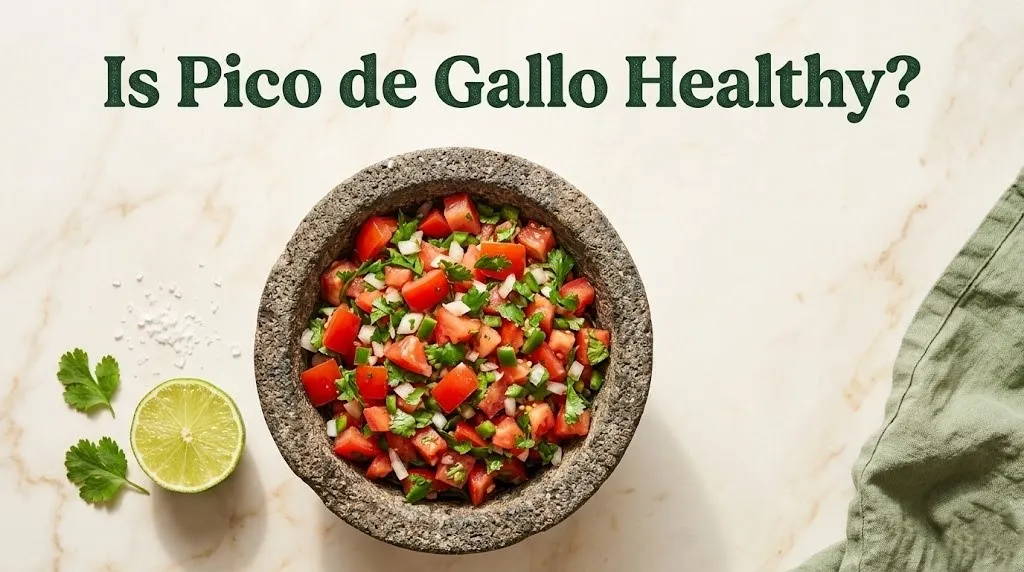
You need to watch the sodium if you are salt-sensitive, because restaurants often season it aggressively. But from a macronutrient and phytochemical standpoint, pico de gallo fits neatly into almost every medically recognized dietary pattern. It delivers the kind of fresh produce consumption that public health researchers at the Harvard T.H. Chan School of Public Health associate with reduced cellular oxidative stress.
The primary caution for people managing heartburn is the acid from the lime juice and the raw onion. You can modify the recipe to use less acidic citrus or swap the white onion for green onion tops if you have a sensitive stomach. That structural flexibility keeps it on the table for most people.
What Is Pico de Gallo?
Pico de gallo is a raw Mexican preparation known as salsa fresca, made from diced tomato, white onion, jalapeño, and cilantro, bound together by fresh lime juice and salt. The term translates loosely to “rooster’s beak,” likely referencing the pinching motion used to eat it.
The dish functions as a condiment, a topping, or a light salad, depending on how coarsely you chop the ingredients. Unlike a cooked salsa roja or a blended salsa verde, pico de gallo relies entirely on the structural integrity of the fresh produce. You are not tasting a reduction or a purée. You are tasting the distinct, individual crunch of the tomato cell walls against the sharp bite of raw allium.
Texture defines the quality of a good pico de gallo. If the tomatoes are overripe or the salt is added too early, the mixture turns into a watery soup within minutes. The goal is to maintain a suspension of firm, distinct cubes where the lime juice coats the surface without immediately breaking down the pectin holding the tomato walls together.
| Ingredient | Botanical Name | Primary Nutritional Contribution |
|---|---|---|
| Tomato | Solanum lycopersicum | Lycopene, Vitamin C, Potassium, Hydration |
| White Onion | Allium cepa | Quercetin, Allicin, Prebiotic Fiber |
| Jalapeño | Capsicum annuum | Capsaicin, Vitamin C |
| Cilantro | Coriandrum sativum | Vitamin K, Antioxidant Flavonoids |
| Lime Juice | Citrus aurantiifolia | Ascorbic Acid (Vitamin C), Citric Acid |
Pico de Gallo Nutrition Facts
According to the USDA FoodData Central, a standard 100-gram serving of pico de gallo contains approximately 19 to 25 calories, 4 to 5 grams of carbohydrates, and over 1 gram of dietary fiber. This macro profile places it firmly in the category of a high-volume, low-energy-density food.
The carbohydrate content is negligible for most metabolic concerns because it arrives packaged in a matrix of water and insoluble fiber. Your body must physically break down the raw plant cell walls to access the sugars, which slows the digestive process significantly. The protein and fat content are effectively zero, meaning you are adding micronutrients without adding any significant caloric load.
You need to adjust your expectations if you buy the product commercially. A store-bought fresh pico de gallo might list 110 milligrams of sodium or more per 2-tablespoon serving, depending on the brand. A homemade batch where you control the salt shaker often sits closer to 40 milligrams for the same volume, assuming a light sprinkle of fine sea salt.
The water content hovers around 92 percent. This makes the food a passive hydration tool, which is particularly useful for older adults or athletes who struggle to drink enough plain water. You are essentially eating your fluids while consuming a meaningful amount of vitamin C.
Pico de Gallo Calories Per Serving
A standard half-cup serving of authentic homemade pico de gallo contains roughly 18 to 25 calories total. That calorie count is so low that the thermic effect of digesting the raw fiber may nearly offset the net energy you absorb from it.
Portion control with pico de gallo operates differently than with dense foods. You can fill an entire cup with it for under 50 calories, which makes it an effective physical displacement tool on the plate. The volume quite literally pushes higher-calorie items to the side and triggers stretch receptors in your stomach that signal fullness to the brain.
You should not confuse the calorie count of plain pico de gallo with restaurant portions that are served alongside fried tortilla chips. The chips instantly transform a 20-calorie snack into a 400-calorie appetizer. The salsa itself remains low-calorie, but the delivery vehicle dictates the metabolic outcome.
Here is how the calorie load compares when you add it to different bases:
| Base Food (1 serving) | Calories (approx.) | With 1/2 Cup Pico de Gallo |
|---|---|---|
| 2 Corn Tortillas (soft) | 100 | 120 |
| 1 oz Restaurant Tortilla Chips | 140 | 160 |
| Grilled Chicken Breast (4 oz) | 180 | 200 |
| Leafy Green Salad (2 cups) | 20 | 40 |
| Cheese Quesadilla (1 slice) | 300 | 320 |
Key Takeaway: You can eat a generous volume of pico de gallo for fewer calories than a single slice of American cheese, which makes it a strategic swap for calorie-dense condiments.
Pico de Gallo Vitamins and Minerals
Pico de gallo delivers a potent dose of vitamin C, vitamin A precursor compounds, and potassium in a whole-food matrix. A half-cup serving provides roughly 30 to 40 percent of your daily recommended vitamin C intake, depending on the ripeness of the tomatoes and lime.
Vitamin C, or ascorbic acid, functions as a primary water-soluble antioxidant in the body. When you eat it in its raw form, you avoid the heat degradation that destroys this nutrient in cooked sauces. The lime juice contributes an additional burst of citric acid that stabilizes the ascorbic acid and prevents it from oxidizing rapidly before consumption.
The red color of the tomato signals the presence of lycopene, a carotenoid that the National Institutes of Health identifies as a potent quencher of singlet oxygen free radicals. Unlike vitamin C, lycopene becomes more bioavailable when the tomato cells are physically broken down. The fine dicing of pico de gallo mechanically accomplishes this breakdown more effectively than eating a whole sliced tomato.
Potassium levels in a cup of the mixture can reach 350 to 400 milligrams. That level rivals what you would find in a small banana, but with a fraction of the sugar. Potassium directly counteracts the vascular-tightening effects of sodium, which is the primary mechanism behind the DASH diet’s blood pressure recommendations.
Key Vitamins and Minerals at a Glance:
- Vitamin C (Ascorbic Acid): Supports immune cell function and collagen synthesis.
- Potassium: Regulates fluid balance and counters sodium-induced blood pressure spikes.
- Vitamin A (Beta-carotene): Supports retinal health and epithelial cell integrity.
- Vitamin K1 (Phylloquinone): Supplied by cilantro, crucial for coagulation proteins.
- Quercetin: A flavonoid found in raw onion with antihistamine-like properties in vitro.
Pico de Gallo Health Benefits
Pico de gallo supports cardiovascular function, enhances antioxidant status, and promotes digestive regularity through its unique combination of raw alliums, fresh tomato, and fiber. The health benefits are not mystical. They are mechanical and biochemical.
The first major benefit involves blood pressure regulation. The potassium-to-sodium ratio in a well-made, lightly salted batch is naturally favorable. The American Heart Association emphasizes that dietary potassium relaxes blood vessel walls, lowering systemic pressure. When you use pico de gallo to replace salty condiments like soy sauce or queso, you make a double-impact exchange that drops sodium and boosts potassium simultaneously.
The second benefit centers on the allicin in the raw white onion. Allicin is a sulfur-containing compound that forms when you slice or dice the onion and rupture the cell walls. A 2023 review in the journal Nutrients discussed allicin’s potential antimicrobial and anti-inflammatory properties, though the clinical data on the exact dose needed for a therapeutic effect in humans remains under review. You do not need a pill. You just need the raw ingredient on your plate.
The fiber component, though modest at around 1 to 1.5 grams per half-cup, works alongside the high water volume to mechanically scrub the intestinal lining. Think of soluble fiber like a gentle, slow-moving gel that softens the transit of waste, while the insoluble fiber from the tomato skins and jalapeño provides the bulk that stimulates peristalsis.
Is Pico de Gallo Good for Weight Loss?
Pico de gallo is an excellent tool for weight loss because it adds physical volume, flavor complexity, and sensory satisfaction to meals without adding a meaningful number of calories. It attacks the problem of dietary compliance from the flavor angle rather than the restriction angle.
Fat loss ultimately requires a sustained negative energy balance. The most common reason people abandon a calorie deficit is bland food fatigue. Pico de gallo delivers acidity, heat, salt, and crunch. These sensory notes directly stimulate the trigeminal nerve, which can make a plain chicken breast and greens feel like a complete meal rather than a diet chore.
The water and fiber matrix physically stretches the stomach fundus. The vagus nerve detects this distension and relays a signal of mechanical fullness to the hypothalamus. You can eat 50 calories of pico de gallo and feel a tangible gastric pressure that a 50-calorie splash of oil or dressing simply cannot provide.
For the strategy to work, you must use it as a condiment replacement, not an addition. Spooning it on top of a fully loaded burrito bowl adds nutrients but does not remove the 200 calories of sour cream and cheese already there. Replacing those calorie-dense fats with the salsa creates the deficit that leads to body fat reduction over time.
Condiment Swap Strategy:
- Replace 2 tbsp of ranch dressing (120 kcal) with 1/2 cup pico de gallo (20 kcal).
- Replace 1/4 cup of shredded cheddar (110 kcal) with 1/2 cup pico de gallo.
- Replace 2 tbsp of barbecue sauce (60 kcal sugar) with the fresh acid and heat of the salsa.
Key Takeaway: Weight loss with pico de gallo works because you are adding taste to low-calorie foods, effectively tricking your palate into enjoying a sustained energy deficit.
Is Pico de Gallo Keto and Low Carb?
Pico de gallo is inherently keto-friendly and low-carb when consumed in reasonable portions that fit standard ketogenic macronutrient limits. A quarter-cup to half-cup serving contains 2 to 4 grams of net carbohydrates, making it one of the few fresh condiments that fit cleanly into a sub-20-gram carb day.
The carbohydrates come entirely from non-starchy vegetables. Tomatoes and onions contain natural sugars, but they are locked within insoluble fiber and diluted by water. The glycemic load of a serving is practically zero. You are not inducing an insulin spike with pico de gallo the way you might with a sugary ketchup or a honey-mustard dressing.
Individuals on a strict medical ketogenic diet for epilepsy management often avoid onions and tomatoes due to cumulative carb creep. For the standard nutritional ketosis dieter aiming for under 50 grams of total carbs, pico de gallo is a safe staple. The key is precise measurement if you are in a strict induction phase. You cannot eyeball a cup of onion-heavy pico and assume zero impact.
The lime juice adds a slight citric acid load but zero sugar if you use fresh-squeezed juice. Avoid commercially jarred lime juice, which sometimes contains preservatives and added sweeteners that are not disclosed boldly on the front label.
| Keto Condiment | Serving Size | Estimated Net Carbs |
|---|---|---|
| Pico de Gallo | 1/2 cup | 4 g |
| Ketchup (sugar-free) | 1 tbsp | 1 g |
| Mayonnaise | 1 tbsp | 0 g |
| Sweet Relish | 1 tbsp | 4 g |
| Salsa Verde (cooked) | 2 tbsp | 2 g |
Pico de Gallo Sodium Content and Blood Pressure
The sodium content in pico de gallo is entirely controllable during preparation, but it can be dangerously high in restaurants where salt is used as a bulk flavoring agent and a produce preservative. A half-cup of homemade pico de gallo with a measured quarter-teaspoon of salt contains approximately 290 milligrams of sodium.
The FDA’s 2026 voluntary sodium reduction targets continue to push the food industry to cut salt levels in condiments. However, fresh pico de gallo made in a taqueria or a fast-casual chain kitchen rarely follows any strict protocol. A single ladle of restaurant pico can contain 400 to 600 milligrams of sodium, which is a quarter of the American Heart Association’s ideal daily limit of 2,300 milligrams.
If you have diagnosed hypertension or are following a DASH diet plan, you must request the salsa on the side and taste it before dousing your meal. Even better, ask for unsalted pico if the kitchen preps it fresh. The lime juice and jalapeño provide enough flavor punch that your palate can adapt to a zero-salt version within a few bites.
The vascular benefit of the potassium still matters. Even if the pico de gallo contains some sodium, the potassium from the tomatoes and the nitric oxide boost from the raw onions may partially offset the hypertensive effect. But the balance only holds if the salt load is not excessive.
Sodium Control Checklist:
- Homemade: Add salt just before serving, never during the resting phase.
- Restaurant: Ask if the batch is pre-salted; request a low-salt side portion if available.
- Store-Bought: Look for “No Salt Added” variants, but check the potassium chloride content if you have kidney concerns.
Pico de Gallo vs Salsa
Pico de gallo is a type of salsa, but when people compare the two, they are usually asking about fresh pico versus a jarred or cooked table salsa. The nutritional difference lies in the vitamin retention, sodium load, and texture-based satiety.
A jarred red table salsa has been heat-processed to achieve shelf stability. The cooking process destroys the majority of the heat-sensitive vitamin C and degrades the fresh flavor of the cilantro. Manufacturers compensate for this flavor loss by increasing the sodium and adding a small amount of sugar or citric acid. The result is a product that is still vegetable-based but nutritionally blunted and heavier on salt.
Pico de gallo provides a crisp, distinct bite that forces you to chew. Chewing is a critical satiety mechanism. Jarred salsa, being thinner and often partially puréed, slides down easily. You can consume 100 calories of chips with a runny salsa much faster than you can with a chunky fresh pico that requires deliberate scooping and crunching.
If you are looking for a cooked flavor with a smoky profile, a salsa roja made from fire-roasted tomatoes is not unhealthy. It is just a different product. The roasting process increases the lycopene bioavailability in the tomatoes, so you trade the vitamin C for a higher accessible dose of carotenoids.
| Feature | Pico de Gallo (Fresh) | Jarred Salsa (Cooked) |
|---|---|---|
| Primary Texture | Defined chunks, crisp | Puréed or semi-smooth |
| Vitamin C Status | High, raw and intact | Low, degraded by heat |
| Lycopene Status | Present, less bioavailable | Present, heat-activated |
| Typical Sodium | 0 to 300 mg (homemade) | 120 to 250 mg per 2 tbsp |
| Shelf Life | 2 to 3 days refrigerated | Months (unopened) |
| Best Use | Topping proteins, salads | Chip dipping, cooking base |
Fresh vs Store Bought Pico de Gallo
The gap between fresh homemade pico and a commercially packaged tub from the refrigerated deli section comes down to sodium, texture, and the specific preservatives used to inhibit browning. Fresh pico de gallo made in your kitchen lives for about 48 hours at peak quality. A commercial tub often lists a two-week shelf life.
Food scientists achieve that extended shelf life by manipulating the pH with additional citric acid and adding potassium sorbate or sodium benzoate. These preservatives are FDA-recognized as safe, but they alter the mouthfeel. The tomatoes often taste slightly pickled rather than fresh. The crisp cellular snap of the onion fades into a limp translucence as the acid bath continues its work inside the plastic container.
Nutritionally, the macronutrient profile remains roughly identical between the two. The carbohydrate and fiber counts do not change. The micronutrient gap is real, though. The longer the product sits in the light and oxygenated environment of a semi-permeable plastic tub, the more the vitamin C and antioxidant capacity degrade.
If you must buy store-bought, look for containers sold directly from the deli counter rather than the open-air refrigerated shelves in the center aisle. Those are often made in-house that morning and have not traveled through a long distribution chain. Check the ingredient list for the word “water” or “calcium chloride.” Calcium chloride is a firming agent added to tomatoes to keep them from turning to mush, and it is a perfectly acceptable additive if you want texture.
Store-Bought Selection Guide:
- Ingredient Order: The list should match a real recipe: tomatoes, onion, pepper, cilantro, lime juice, salt.
- Liquid Level: A pool of cloudy liquid at the top means the tomatoes have already broken down.
- Color Check: Vibrant red and green flecks. A uniformly pale red color indicates old, blended, or previously frozen product.
Key Takeaway: Pico de gallo’s nutritional power relies on the fragile, volatile compounds in raw produce. Time is the primary enemy, so whether homemade or store-bought, prioritize the absolute shortest path from chopping board to your mouth.
How to Make Healthy Pico de Gallo
Making a healthy version means controlling the sodium, maximizing nutrient extraction through proper cutting technique, and stabilizing the mixture so it does not purge water onto the plate. The process takes ten minutes, but the sequence of steps determines the final integrity of the dish.
The most common error is salting the tomatoes directly. Salt draws water out of the tomato cells via osmosis. If you salt the diced tomato before combining it with the other ingredients, the pico de gallo will be swimming in pink liquid within twenty minutes. You must salt the lime juice and onion mixture first, then fold in the tomatoes last.
The selection of the jalapeño matters for a wider nutrient profile. Red jalapeños are simply fully ripened green ones. They contain significantly more vitamin C and a slightly sweeter heat. Removing the seeds and the white pith removes the majority of the capsaicin, so leave the pith in if you want the full metabolic boost that accompanies the heat sensation.
Cilantro must be added just before the final mix. If you chop cilantro aggressively and let it sit in the acidic lime juice for hours, it oxidizes into a black, unappetizing sludge. The visual decline matches a decline in the fragile antioxidant flavonoids.
To Make a Perfect Healthy Batch:
- Juice one large fresh lime into a glass bowl, catching any seeds.
- Mince one quarter of a white onion and one jalapeño (or serrano) finely, then stir into the lime juice with a pinch of salt. Let this sit for five minutes. The acid softens the raw allium bite.
- Dice four firm Roma tomatoes into a quarter-inch dice. Remove the seed gel with your fingers if the tomatoes are overly watery.
- Chop a generous quarter-cup of fresh cilantro leaves and tender stems.
- Fold the tomatoes and cilantro into the onion-lime base gently with a silicone spatula. Do not stir aggressively.
- Adjust salt right before serving, not during the resting phase.
Frequently Asked Questions About Pico de Gallo Health
Is pico de gallo healthy to eat every day?
Yes, eating pico de gallo daily is a healthy habit that boosts your vegetable intake for very few calories.
The key limit is your personal sodium tolerance, especially if you eat at restaurants that salt it heavily.
A low-salt homemade batch is safe to eat daily as part of a balanced diet.
Is pico de gallo healthier than guacamole?
Pico de gallo is lower in calories and fat, while guacamole is higher in monounsaturated fat and fiber.
The two foods serve different nutritional purposes: one is a low-calorie antioxidant condiment, the other is a satiating source of healthy plant fat.
A side-by-side comparison shows pico de gallo at roughly 20 calories per half cup and guacamole at around 180 calories for the same volume.
Does pico de gallo raise blood sugar?
No, authentic pico de gallo has a minimal impact on blood glucose due to its low sugar and high fiber content.
The natural sugars in the tomato and onion are absorbed slowly because of the raw, intact fiber matrix.
It is generally considered a free food for anyone managing insulin resistance.
Can you eat pico de gallo on a low-sodium diet?
Yes, you can eat pico de gallo on a low-sodium diet if you make it yourself and skip the salt entirely.
The lime juice and jalapeño deliver enough flavor that you likely won’t miss the sodium after a few bites.
Always check store-bought labels, as some commercial tubs pack over 200 milligrams of sodium per small serving.
Why does my pico de gallo get watery?
Pico de gallo gets watery because salt draws the natural moisture out of the tomato cells through osmosis.
To prevent this, salt the lime juice and onion base before gently folding in the diced, deseeded tomatoes just before serving.
A watery batch is still safe to eat, just use a slotted spoon to drain the excess liquid before plating.
Pico de gallo sits at the intersection of culinary pleasure and nutritional science in a way few condiments can match. You get the crisp hydration of fresh produce, the vascular support of allium compounds, and the flavor intensity that makes lean proteins and greens genuinely satisfying.
Replace one calorie-dense condiment with a generous scoop of this fresh salsa every day for a week. Pay attention to how your palate adjusts to the brightness of the lime and the bite of the raw onion. That shift in taste preference is often the first sign that a dietary pattern change is sustainable.
Good food habits do not require you to choke down bland meals. They require you to find the flavors that make your body feel light, energized, and free from the post-meal slump. A properly made pico de gallo delivers exactly that, and it does it for less than 25 calories per serving.