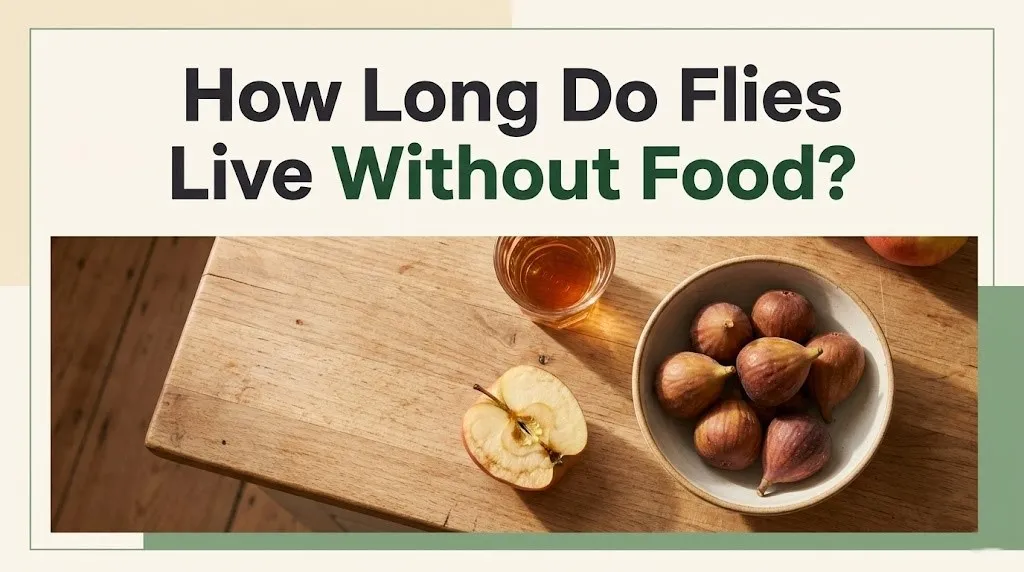
Most flies live between 2 and 4 days without food under normal room-temperature conditions. How long do flies live without food exactly depends on the species, the temperature of their environment, and whether they have access to water.
Flies are classified as mechanical vectors of foodborne pathogens by the CDC, meaning they physically transfer bacteria like Salmonella enterica and Escherichia coli from surfaces onto food without being infected themselves. Understanding their survival limits matters not just for pest control but for the safety of food in your home.
This guide covers how long common fly species survive without food, how temperature and water affect that timeline, what flies actually eat, how their lifecycle shapes their nutritional needs, and what you can do practically to reduce both fly survival and food contamination risk in your kitchen.
How Long Do Flies Live Without Food
Adult flies typically survive 2 to 3 days without food at average room temperature (around 68 to 77 degrees Fahrenheit / 20 to 25 degrees Celsius). Some individuals push closer to 4 days depending on their energy reserves at the time food access is cut off.
The biological reason is straightforward. Adult flies are ectotherms, meaning their body temperature matches their surrounding environment. Their metabolic rate scales directly with ambient temperature. At warmer temperatures, they burn through stored energy faster. At cooler temperatures, that same energy reserve lasts longer.
Flies store energy primarily as glycogen (the insect equivalent of glucose reserves) and small amounts of lipid (fat). Once those reserves are depleted, organ function collapses. Death follows within hours of that depletion point.
It’s worth noting that “living without food” is not the same as “living without any caloric input at all.” A fly resting on a surface that has microscopic sugar residue, fermentation vapors, or organic film can extract minimal caloric benefit. A truly food-free environment (sterile, clean, sealed) shortens that 2 to 3 day window noticeably.
| Condition | Approximate Survival Without Food |
|---|---|
| Room temperature (68-77°F), water available | 2 to 4 days |
| Room temperature (68-77°F), no water | 1 to 2 days |
| Warm environment (85°F+), water available | 1 to 2 days |
| Cool environment (50-60°F), water available | 4 to 7 days |
| Cold environment (below 45°F) | Dormant; starvation slows dramatically |
How Long Can a House Fly Survive Without Food
The house fly (Musca domestica) survives roughly 2 to 3 days without food when temperatures are in the typical indoor range. It’s the most studied fly species in the world, and its starvation tolerance is well documented in entomological literature.
Musca domestica is an obligate feeder. It needs caloric input daily to sustain flight muscle function, reproduction, and basic organ maintenance. The University of Florida IFAS Extension documents the house fly’s total adult lifespan at 15 to 30 days under favorable conditions. Without food, that lifespan compresses to a small fraction of its potential.
The house fly feeds by regurgitating digestive fluid onto food, liquefying it, and then using its sponging mouthpart (the labellum) to absorb the resulting liquid. This method requires already-broken-down food sources: rotting organic matter, food waste, decaying fruit, feces, and organic residue on surfaces.
Without those inputs, its energy reserves run out fast. Penn State Extension entomologists note that Musca domestica adults under controlled starvation conditions at 77°F (25°C) died at a median of 64 hours (approximately 2.7 days). Individual variation exists based on the fly’s pre-starvation nutritional status.
| House Fly Factor | Detail |
|---|---|
| Scientific name | Musca domestica |
| Normal adult lifespan | 15 to 30 days |
| Survival without food (room temp) | 2 to 3 days |
| Survival without food (cool) | Up to 5 days |
| Primary energy reserve | Glycogen and lipids |
| Feeding method | Regurgitation and absorption |
How Long Can Fruit Flies Live Without Food
Fruit flies (Drosophila melanogaster and related species) survive 2 to 4 days without food under standard laboratory and household temperatures. Their tolerance is similar to house flies but with important differences in what triggers starvation stress.
Drosophila melanogaster is the most extensively studied insect in biology. Research published in multiple issues of the Journal of Experimental Biology has tracked its starvation tolerance across temperature ranges, humidity levels, and genetic variants. The median starvation time at 25°C (77°F) for well-fed adult fruit flies is approximately 40 to 60 hours for females and 30 to 45 hours for males. Males die faster primarily because females carry greater lipid reserves for egg production.
Fruit flies are drawn to fermented sugars: overripe fruit, open wine, vinegar, beer residue, and fermenting organic material in drains. Their small body mass means their absolute energy reserves are tiny. They burn through those reserves quickly once food is unavailable.
One practical note: fruit flies can sustain themselves on surprisingly minimal caloric sources. A barely-visible film of fruit juice on a countertop or the residue inside an unwashed blender provides enough energy to extend survival meaningfully. Genuine food-free conditions are harder to create than most people expect.
- Female fruit fly starvation tolerance: 40 to 60 hours without food
- Male fruit fly starvation tolerance: 30 to 45 hours without food
- Primary food triggers: fermented sugars, overripe fruit, organic drain residue
- Body weight advantage: females survive longer due to higher lipid stores
Key Takeaway: House flies and fruit flies both die within 2 to 4 days without food at room temperature, but males die faster than females due to lower energy reserves, and any trace of organic material on surfaces counts as a food source.
How Long Do Flies Live Without Food or Water
Removing both food and water simultaneously cuts fly survival time roughly in half compared to food deprivation alone. Without water, most adult flies die within 1 to 2 days regardless of temperature.
Water is not secondary for flies. It’s directly involved in every metabolic process: digestion, temperature regulation, nerve function, and reproduction. Flies absorb water through their food (most fly food sources are high in moisture) and through direct water consumption. When food is gone, so is the primary water source.
The interaction between dehydration and starvation in flies is documented in research from the Journal of Insect Physiology. Flies deprived of both food and water show measurably accelerated decline in locomotor function within the first 12 hours. By 24 hours, flight capacity is severely reduced. Death typically occurs between 24 and 48 hours under complete food-and-water deprivation at room temperature.
This matters practically for pest control decisions. A kitchen that is cleaned of all food residue but still has standing water (a wet sponge, a dripping faucet, moisture under the sink) will support fly survival significantly longer than one that is both food-free and dry.
| Deprivation Type | Approximate Survival Time (Room Temp) |
|---|---|
| Food only removed, water available | 2 to 4 days |
| Water only removed, food available | Variable (3+ days, dehydration sets in) |
| Both food and water removed | 1 to 2 days |
| All food, water, and below 50°F | Days to weeks (dormancy slows death) |
Can Flies Survive on Water Alone
Flies cannot survive long-term on water alone, but access to water without food meaningfully extends their life compared to having neither. Water without caloric input delays death but does not prevent it.
The biological ceiling here is energy. Water supports metabolic processes, but those processes require fuel from carbohydrates and lipids. Without caloric substrates to metabolize, the fly’s cellular machinery has nothing to run on. Water keeps the system hydrated but cannot power it.
Research from entomology departments at multiple land-grant universities confirms that flies provided water but no food outlive flies with neither by roughly 12 to 24 hours on average at standard room temperature. At cooler temperatures, that extension is slightly longer because metabolic demand drops.
A practical implication: if you are trying to eliminate a fly infestation by removing food sources, also remove or eliminate standing water. A fly sustained on water alone may still live long enough to find a new food source, lay eggs, or re-establish access to your kitchen.
What Do Flies Eat to Survive
Adult flies eat liquified organic material, primarily decaying sugars, proteins, and fats, using a process of pre-oral digestion. They cannot consume solid food at all.
The fly’s feeding mechanism works like this: the fly lands on a food surface, secretes saliva loaded with digestive enzymes, waits briefly for those enzymes to begin breaking down the material, and then uses its sponge-like labellum mouthpart to absorb the resulting liquid. Think of it as eating soup that the fly made by dissolving your food with its own digestive fluid.
Preferred food sources for common fly species include:
- Rotting fruit and overripe produce (primary for fruit flies)
- Animal feces and decomposing protein (primary for house flies and blow flies)
- Garbage and food waste in bins
- Sugary residue on surfaces (spilled juice, syrup, alcohol)
- Wet organic matter in drains
- Carrion and wound tissue (primary for blow flies and flesh flies)
- Pet food left out in bowls
The WHO notes that flies feeding on contaminated organic matter and then landing on food in your home creates direct pathogen transfer risk. This is why fly biology connects directly to food safety, not just pest annoyance.
Key Takeaway: Flies can only consume liquids, which they create by dissolving food with their own enzymes. Every surface with organic residue is a potential feeding station, which is why “cleaning thoroughly” means more than what’s visible.
How Temperature Affects Fly Survival Without Food
Temperature is the single biggest variable in fly starvation survival, because flies are ectotherms and their metabolic rate scales directly with environmental temperature. Warmer conditions burn energy faster; cooler conditions preserve it longer.
At 85°F (29°C) and above, a food-deprived adult house fly may survive only 1 to 2 days before reserves are exhausted. At 50 to 60°F (10 to 15°C), that same fly may survive 5 to 7 days without food because its energy demands are dramatically reduced.
This temperature dependency is documented in studies published in the Journal of Medical Entomology. Researchers tracking house fly mortality under food deprivation across temperature gradients found a near-linear relationship: each 10-degree Celsius increase in ambient temperature reduced median starvation survival time by approximately 30 to 40 percent.
The practical kitchen implication: a warm summer kitchen with flies is actually a faster-clearing problem (all else equal) than a cool spring kitchen. The heat accelerates energy depletion. Conversely, flies in a cool basement or pantry can survive without visible food for nearly a week.
| Temperature Range | Fly Starvation Survival Estimate |
|---|---|
| Above 85°F (29°C) | 1 to 2 days without food |
| 68 to 77°F (20 to 25°C) | 2 to 3 days without food |
| 50 to 60°F (10 to 15°C) | 5 to 7 days without food |
| Below 45°F (7°C) | Metabolic slowdown; weeks to months |
How Long Do Flies Live Indoors vs Outdoors
Indoor flies generally live longer than outdoor flies when food is removed, because indoor environments offer more stable temperatures, less wind, fewer predators, and higher humidity.
Outdoor flies face constant environmental pressure: UV radiation, temperature swings, rain, predation by birds and spiders, and wind that accelerates water loss. An outdoor fly denied food faces more compounding stressors. University of Florida IFAS Extension data suggests outdoor house flies under food deprivation die 20 to 35 percent faster than indoor counterparts in warm seasons.
Indoors, the picture changes. A fly that enters your home through a window or door can find refuge in a cool corner, a cabinet, or under a refrigerator. Without food, it’s still burning through reserves, but the stable indoor environment allows it to do so more slowly.
The indoor versus outdoor distinction also matters for understanding infestation patterns. Flies enter homes primarily in search of food and egg-laying sites. If the indoor food source is eliminated, flies do not necessarily leave immediately. They may persist for days exploring surfaces, attempting to feed on trace residue, and gradually weakening.
Key Takeaway: Flies survive food deprivation longer indoors than outdoors due to reduced environmental stress. Eliminating food alone does not immediately clear an infestation; it starts a 2 to 7 day countdown depending on temperature.
Fly Lifecycle Stages and Food Needs
Fly starvation survival looks completely different at each lifecycle stage. The adult fly’s 2 to 4 day window without food is only one part of a four-stage story.
Eggs have no independent nutritional needs. They carry yolk reserves from the mother. An egg can survive without external food entirely until it hatches, typically within 8 to 24 hours at room temperature.
Larvae (maggots) require continuous protein-rich food to develop. They cannot survive starvation for more than a few hours in early instars (development stages). Maggots denied their decaying protein substrate die within 12 to 24 hours in warm conditions. This is why removing the breeding substrate, not just adult food sources, is the key to ending an infestation.
Pupae are in a sealed, non-feeding developmental stage. They do not eat. They survive entirely on energy stored during the larval stage. A pupa can last 4 to 6 days inside its casing without any external food or water input.
Adults, as covered throughout this article, survive 2 to 4 days without food at typical indoor temperatures.
| Lifecycle Stage | Food Requirement | Starvation Tolerance |
|---|---|---|
| Egg | None (uses yolk) | N/A, hatches in 8 to 24 hours |
| Larva (maggot) | Continuous protein-rich substrate | 12 to 24 hours |
| Pupa | None (uses stored energy) | 4 to 6 days |
| Adult | Daily liquid food | 2 to 4 days |
How Long Can Blow Flies Live Without Food
Blow flies (family Calliphoridae, most commonly Calliphora vomitoria and Lucilia sericata) survive approximately 3 to 5 days without food under average indoor temperatures. Their larger body mass compared to house flies gives them slightly greater energy reserves.
Blow flies are carrion specialists. Adult females use decaying protein, primarily animal flesh and waste, as both a food source and an egg-laying site. Their attraction to meat, fish, and open wounds makes them more likely than house flies to appear during food preparation involving raw animal protein.
According to data compiled by forensic entomologists (blow fly behavior is well-documented in forensic science contexts), adult blow flies can survive longer without food than house flies due to their larger lipid reserves. However, they dehydrate faster because their larger body surface area loses moisture more quickly. Without water, their survival advantage over house flies largely disappears.
For home cooks dealing with blow flies near meat or fish: the presence of blow flies near raw protein is a sign of significant food safety risk. The CDC classifies blow flies as capable of transferring Salmonella enterica and Listeria monocytogenes onto food surfaces. Cover raw meat immediately and store it in sealed containers.
- Blow fly scientific names: Calliphora vomitoria, Lucilia sericata (green bottle fly), Phormia regina (black blow fly)
- Adult survival without food: approximately 3 to 5 days
- Primary food source: carrion, decaying protein, feces
- Food safety risk: documented vectors of Salmonella and Listeria
How Long Do Flies Live in Winter Without Food
In winter, flies do not behave the same way as they do in warmer months. Most species either die off as temperatures drop, enter a dormant state called diapause, or overwinter as pupae or eggs rather than as adults.
Adult house flies at temperatures below 45°F (7°C) become lethargic and effectively cease normal activity. Their metabolic rate drops so dramatically that starvation survival extends from days to potentially weeks or months, though “survival” in this context means barely alive in a dormant state, not active and functional.
Penn State Extension entomologists document that house fly populations in temperate climates typically do not overwinter as active adults in nature. They persist as pupae in soil, debris, or sheltered organic matter. Indoors, a different picture emerges: a heated building keeps flies active year-round if food is available.
A fly that enters a heated kitchen in January and loses access to food faces the same 2 to 3 day starvation clock as its summer counterpart, because the indoor temperature reactivates its normal metabolic rate. Winter doesn’t protect a fly from starvation inside a warm home.
Key Takeaway: Blow flies have slightly more starvation endurance than house flies due to body mass. Winter cold extends fly survival dramatically outdoors but has no effect inside a heated home, where flies metabolize at their normal rate.
What Attracts Flies to Food in Your Home
Flies locate food using highly sensitive chemoreceptors located primarily on their feet and antennae. They detect volatile organic compounds (VOCs) released by fermenting, decaying, or protein-rich materials from distances of up to 50 meters in some species.
The most powerful fly attractants in a home kitchen include:
- Overripe or fermenting fruit (ethanol and acetaldehyde vapors)
- Unsealed garbage containing food waste
- Uncovered compost bins or organic waste
- Pet food left out in open bowls
- Unwashed dishes with protein or sugar residue
- Spilled beverages, especially fermented drinks (beer, wine, kombucha)
- Wet drains with organic buildup
- Raw meat or fish left uncovered at room temperature
The USDA Food Safety and Inspection Service (FSIS) recommends that raw meat and poultry should never be left uncovered at room temperature for more than 2 hours (or 1 hour above 90°F). That guideline intersects directly with fly risk: flies can transfer pathogens in a single landing lasting less than one second.
Understanding what draws flies in helps explain why food-free environments suppress fly survival so effectively. Remove the chemical signals, and flies that enter the space find no orientation cues to lead them toward a feeding site. They burn energy searching, deplete reserves faster, and die sooner.
Flies and Food Contamination: What the Science Says
Flies are documented mechanical vectors of foodborne illness, meaning they carry pathogens from contaminated sources to clean food without being infected themselves. This is not a theoretical risk; it is well-evidenced in public health literature.
According to the WHO, house flies are capable of carrying more than 100 different pathogens on their body surface, leg hairs, and gut contents simultaneously. The key pathogens of concern in home kitchen contexts include:
- Salmonella enterica: causes salmonellosis, symptoms include diarrhea, fever, and abdominal cramps
- Escherichia coli O157:H7: causes severe gastrointestinal illness and, in vulnerable populations, hemolytic uremic syndrome
- Staphylococcus aureus: produces toxins that cause rapid-onset food poisoning
- Listeria monocytogenes: of particular concern for pregnant individuals, older adults, and people with weakened immune systems
- Shigella species: associated with dysentery, transmitted readily via fly contact with fecal matter
A study published in the Journal of Medical Entomology found that a single house fly landing on food transferred detectable quantities of bacteria in laboratory conditions. The transfer occurred within the first second of contact.
The food safety implication is not that every fly landing causes illness, but that the risk is real, measurable, and preventable through simple food storage and hygiene practices.
Key Takeaway: Flies don’t need to stay on food long to transfer pathogens. A single landing transfers bacteria. This is why food covers, proper storage, and prompt cleanup matter more than trying to shoo flies away after they’ve already landed.
How to Starve Out a Fly Infestation
Starving out a fly infestation is a legitimate control strategy, but it requires eliminating every food and water source simultaneously, not just the obvious ones. It is most effective when combined with physical exclusion.
To effectively deprive flies of food and accelerate their die-off:
- Remove all exposed food. Store fruit in the refrigerator or in sealed containers. Move ripe produce off counters entirely.
- Empty and clean garbage bins daily. Use bins with tight-fitting lids. Rinse the interior with hot water and dish soap weekly.
- Clean drains thoroughly. Pour boiling water or a drain cleaner down kitchen and bathroom drains to remove organic buildup. Fruit flies breed in drain film.
- Wash dishes immediately after use. Even dishes soaking in the sink provide a food source. Drain the water and rinse residue away.
- Eliminate standing water. Fix dripping faucets. Replace damp sponges. Dry the sink completely after use.
- Clean under appliances. Flies find food debris under refrigerators, stoves, and dishwashers that humans rarely see.
- Seal or remove compost bins. Indoor compost is a concentrated fly attractant. Move it outdoors or use a sealed countertop bin.
- Wipe down all surfaces with a mild vinegar solution. This removes VOC-emitting organic residue that flies detect and target.
Integrated pest management (IPM) guidance from Penn State Extension recommends combining sanitation with physical traps (sticky traps or apple cider vinegar traps) and, if necessary, targeted insecticide application in severe cases.
How Long Does a Fly Infestation Last Without a Food Source
A fly infestation does not end the moment its food source is removed. It ends when the current generation of adults dies, any existing larvae die or fail to reach adulthood, and no new eggs are laid.
The total timeline from food removal to infestation clearance depends on what lifecycle stages are present when you begin:
- Adults only present: 2 to 4 days for die-off at room temperature.
- Adults and larvae present: 2 to 4 days for adults to die, plus up to 5 to 8 days for remaining larvae to die (if the breeding substrate is removed) or to complete development into new adults (if any substrate remains).
- Adults, larvae, and pupae present: Pupae can survive 4 to 6 days without food in their sealed casing. New adults emerging from existing pupae will immediately begin searching for food. Total clearance can take 10 to 14 days even with aggressive sanitation.
This is why pest control guidance consistently recommends finding and eliminating the breeding site, not just the food source. Garbage bins, wet drain film, rotting fruit behind appliances, and damp organic matter in hard-to-reach areas all serve as independent breeding substrates.
If sanitation efforts over 14 days do not resolve the infestation, consider contacting a licensed pest management professional. Heavy infestations may require treatment of breeding areas that are not accessible through standard household cleaning. Persistent fly problems in food-handling spaces may indicate a larger structural moisture or sanitation issue worth investigating professionally.
Key Takeaway: Removing food starts a 2 to 14 day clearance countdown depending on what lifecycle stages are already present. Targeting the breeding substrate shortens that window dramatically. Adults alone are gone in days; pupae extend the problem by nearly two weeks.
Frequently Asked Questions About Fly Survival Without Food
How long can a house fly live without food or water?
A house fly (Musca domestica) survives roughly 1 to 2 days when deprived of both food and water at room temperature.
Without water, its metabolic processes break down faster than starvation alone causes. The combined effect of dehydration and energy depletion accelerates death compared to either deprivation alone.
Do flies die faster without food or without water?
Flies die faster without water than without food, because water is involved in every metabolic function including digestion, nerve signaling, and temperature regulation.
A food-deprived fly with water access survives 2 to 4 days. A water-deprived fly with food access deteriorates faster, typically dying within 24 to 48 hours depending on temperature.
Can flies survive in a sealed room with no food?
Flies can survive briefly in a sealed room but will exhaust food reserves within 2 to 4 days if no organic material is present.
In practice, a fully sterile sealed environment is rare. Even microscopic organic residue on surfaces provides minimal caloric input that slightly extends survival. A realistically clean but sealed room results in fly death within 2 to 5 days.
Does cold temperature kill flies faster when they have no food?
Cold temperature does not kill flies faster without food; it actually extends their survival by dramatically slowing metabolic rate.
A fly below 45°F (7°C) enters near-dormancy, and its energy reserves last far longer than at room temperature. Cold slows the burn rate. A truly food-free environment at cold temperatures may preserve a fly for weeks in dormancy.
How do I get rid of flies by cutting off their food supply?
Remove all exposed food, seal garbage bins, clean drains, eliminate standing water, and wipe all surfaces to remove organic residue.
At room temperature, adult flies will die within 2 to 4 days once all food and water sources are gone. Add sticky traps to capture weakened flies still moving through the space to accelerate clearance.
Closing
Flies survive without food for 2 to 4 days under typical indoor conditions, but that window shifts meaningfully based on species, temperature, humidity, and whether any trace of organic material remains accessible. The larval stage is the real infestation driver, and removing the adult food source only starts the clock if the breeding substrate is gone too.
From a food safety standpoint, the priority is not waiting out flies but preventing contact with your food entirely. Sealed containers, covered dishes, and clean drains are not just pest control. They are practical food hygiene steps backed by CDC and WHO guidance on fly-borne pathogen transmission.
Cut off the food. Dry out the water sources. Deal with the breeding site. The biology works in your favor once those conditions are met.