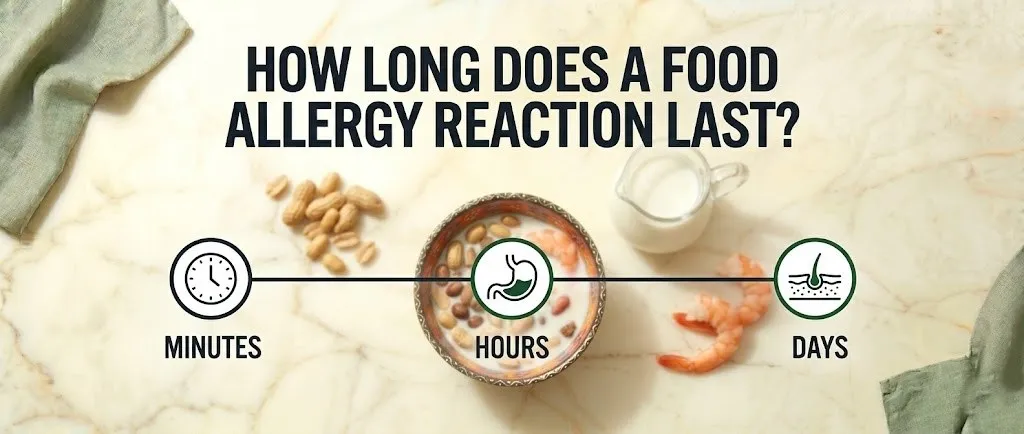
A true IgE-mediated food allergy reaction typically begins within minutes to 2 hours after consuming the trigger food, peaks within 30 minutes to 2 hours, and resolves within 6 to 24 hours for single-organ symptoms like uncomplicated hives. However, certain gastrointestinal symptoms can linger for 2 to 3 days, and severe anaphylactic reactions can follow a biphasic pattern where symptoms return after an apparent recovery.
The clock starts the moment the allergenic food protein enters your bloodstream. If you have a peanut allergy, your body has pre-manufactured Immunoglobulin E (IgE) antibodies specifically targeted at peanut proteins. These antibodies sit on the surface of mast cells in your skin, lungs, and gut like armed security guards. The moment they detect the peanut protein, they trigger the mast cells to explode, releasing histamine and other inflammatory chemicals into the surrounding tissue. This is why the reaction is so fast. The antibodies were already there, waiting.
This guide breaks down the exact timeline for each type of symptom, from hives to stomach pain to the terrifying onset of anaphylaxis. We will distinguish between a true allergy, a food intolerance, and a food sensitivity, and we will explain the biphasic reaction that can catch people off guard. This is educational information for understanding your condition. If you are experiencing throat swelling, difficulty breathing, or a drop in blood pressure, stop reading and administer epinephrine immediately.
how long does a food allergy reaction last
A food allergy reaction lasts between a few hours and three days, depending on the severity of the reaction and the specific symptoms involved. Skin symptoms like hives usually fade the fastest, often within 6 to 12 hours. Gastrointestinal symptoms like cramping and diarrhea can persist for 24 to 72 hours because the gut lining takes longer to calm down after the inflammatory assault.
The duration is dictated by the half-life of the chemical mediators that the mast cells release. Histamine, the primary culprit behind itching and hives, has a biological half-life of roughly 10 to 15 minutes in the bloodstream. However, once it has triggered the swelling and the fluid leakage in the skin, the visible hives remain until the body can reabsorb the fluid and repair the tissue. This is why antihistamines can block new histamine release but do not instantly erase existing hives.
The severity of the initial reaction also dictates the recovery window. A mild reaction limited to a few hives around the mouth resolves quickly. A severe reaction that involves projectile vomiting, widespread hives, and a drop in blood pressure is a systemic event that requires epinephrine and a longer recovery period. The body needs time to metabolize the stress hormones released during the emergency, and fatigue can last for 24 hours or more after the acute episode.
| Reaction Severity | Typical Onset | Duration of Acute Symptoms |
|---|---|---|
| Mild (Localized hives) | 5 to 30 minutes | 2 to 12 hours |
| Moderate (Widespread hives, vomiting) | 5 to 60 minutes | 6 to 24 hours |
| Severe (Anaphylaxis) | Seconds to 30 minutes | Resolves quickly with epi, but requires 4+ hours ER monitoring |
| GI-Specific (FPIES) | 1 to 4 hours | 24 to 72 hours |
how long do food allergy symptoms last
Food allergy symptoms last from a few hours for skin symptoms to several days for gastrointestinal symptoms and fatigue. The wide variation depends on whether the immune system’s attack is localized to the skin or involves the deeper tissues of the gut and the systemic circulatory system.
Hives, or urticaria, are the most common visible symptom. A single hive can appear and disappear within 30 minutes to a few hours, but new hives can continue to crop up for 6 to 12 hours as the histamine cascade cycles. The skin can remain slightly red and sensitive for a day after the raised welts disappear.
Gastrointestinal symptoms like vomiting and diarrhea last longer because the intestinal lining, the mucosa, is directly damaged by the inflammatory response. The gut has a high concentration of mast cells because it is a primary barrier against foreign invaders. When these mast cells degranulate, they cause smooth muscle contractions (cramping) and fluid secretion (diarrhea). It takes 24 to 72 hours for the intestinal lining to settle down and for the normal digestive rhythm to return.
- Hives/Rash: 2 to 12 hours.
- Facial Swelling/Angioedema: 24 to 48 hours.
- Vomiting: 2 to 6 hours (acute), lingering nausea for 24 hours.
- Diarrhea/Cramps: 24 to 72 hours.
- Fatigue/Malaise: 24 hours or more.
Key Takeaway: The skin calms down first. The gut takes the longest. If you still have stomach cramps 48 hours after a shrimp salad, that timeline fits an allergy, not food poisoning.
how long does an allergic reaction to food last
An allergic reaction to food lasts roughly 12 to 24 hours for the majority of cases, but severe reactions or those involving a large amount of the allergen can cause symptoms that wax and wane for up to 72 hours. The phrase “allergic reaction” is often used interchangeably with the peak symptomatic phase.
The dose of the allergen consumed directly impacts duration. Eating a single bite of a cookie baked with almond flour might cause a localized throat itch that resolves in 2 hours. Eating a whole bowl of pad thai cooked in peanut oil can trigger a massive systemic reaction. The more allergen that enters the bloodstream, the more mast cells are activated, and the bigger the chemical cascade that follows.
The route of exposure also matters. Inhaled allergens, like steam from cooking shellfish, cause immediate respiratory reactions that can fade within an hour once the exposure stops. Ingested allergens must travel through the digestive system. The allergen can continue to be absorbed for several hours as food moves through the intestines, prolonging the reaction. This is why anaphylaxis can sometimes last or recur over several hours even after treatment.
- Ingested allergen: Longest duration, up to 72 hours for full resolution.
- Skin contact: Shorter duration, localized reaction fades once washed off.
- Inhalation: Rapid onset, rapid resolution if exposure ceases.
how long can an allergic reaction to food last
An allergic reaction to food can last up to three days, and in rare cases, ongoing exposure to a hidden allergen can create a state of chronic, low-grade inflammation that mimics a persistent reaction lasting weeks. The “can” in this question reflects the upper boundary of what is possible.
The upper boundary exists because of the “late-phase response.” The immediate histamine reaction is just the first wave. Four to six hours after the initial reaction, a second wave of immune cells, eosinophils and neutrophils, can migrate into the affected tissues. This late-phase response causes a resurgence of swelling, redness, and discomfort, particularly in the airways and the skin. This is a normal part of the immune cascade, not a separate allergic event.
Chronic, low-grade exposure is the hidden cause of “reactions that last for weeks.” If a person with a mild dairy allergy unknowingly eats a granola bar containing milk powder every morning, they may experience daily bloating, eczema, and fatigue. They are not having a single, continuous reaction. They are triggering a new low-level reaction every 24 hours. The solution is an elimination diet to confirm the trigger, not a waiting game.
- Immediate phase: Histamine release, peaks at 30 minutes.
- Late phase: Eosinophil infiltration, peaks at 4 to 6 hours.
- Maximum duration: 72 hours for a single acute exposure.
- Chronic exposure: Daily reactions can mimic a single prolonged event.
how long do hives from food allergy last
Hives from a food allergy typically last 2 to 12 hours for an individual cluster of welts, but new crops of hives can continue to appear for 24 hours or longer as the allergic cascade runs its course. Hives are intensely itchy, raised, red welts on the skin caused by histamine leaking from local blood vessels.
Each individual hive has a short lifespan. It appears, swells, and then fades as the fluid is reabsorbed into the lymph system, usually within 30 minutes to 2 hours. However, the process does not stop with one hive. The mast cells in the skin continue to degranulate in waves. As one hive fades, another erupts a few centimeters away. This “crop and fade” pattern can last for many hours.
Antihistamines like diphenhydramine (Benadryl) or cetirizine (Zyrtec) are the first-line treatment for food allergy hives. They work by blocking the histamine receptors on the blood vessel cells, preventing the fluid leak. They do not neutralize histamine that has already been released. An antihistamine can stop new hives from forming, but the existing welts will still take 30 minutes to 2 hours to naturally fade.
- Single hive lifespan: 30 minutes to 2 hours.
- New crop duration: Up to 12 to 24 hours.
- Treatment: Oral antihistamines stop new formation. Topical creams provide cooling relief.
- Danger sign: Hives accompanied by difficulty breathing is anaphylaxis.
Key Takeaway: Hives are the quickest symptom to appear and the quickest to fade. If you are covered in hives for more than 48 hours, see an allergist to check for underlying chronic urticaria.
how long does food allergy stomach pain last
Food allergy stomach pain lasts between 2 and 72 hours, with the most intense cramping typically resolving within 4 to 6 hours and residual bloating and discomfort lingering for a day or two. The stomach and intestines are ground zero for ingested food allergies.
The pain mechanism is mechanical and chemical. Mast cells in the gut lining release histamine and leukotrienes. These chemicals cause the smooth muscle surrounding the intestines to contract violently. This is the cramping sensation. They also cause the intestinal lining to secrete fluid, leading to diarrhea and bloating. The pain is not just a sensation. It is the physical contraction of the gut muscles.
The timeline for stomach pain is longer than for skin symptoms because the allergen must physically clear the digestive tract. The gastrointestinal transit time for a solid meal is roughly 4 to 6 hours through the stomach and small intestine, and 24 to 48 hours through the colon. Until the offending food protein has completely exited the bowel, localized inflammation can persist. A bland, liquid diet (broth, water, electrolyte solutions) for the first 24 hours can help calm the gut by reducing mechanical stimulation.
- Severe cramping: 2 to 6 hours post-exposure.
- Nausea: 2 to 8 hours.
- Diarrhea: Can start within 2 hours and last 24 to 48 hours.
- Full resolution: Up to 72 hours for normal bowel movements to return.
how long does food allergy vomiting last
Food allergy vomiting usually lasts 1 to 4 hours as the body forcibly expels the offending food from the stomach. This is a protective reflex, not a digestive failure. The vomiting is intense and projectile in many cases, and it often provides relief once the stomach is empty.
Vomiting is one of the fastest ways the body can protect itself from an ingested toxin or allergen. Within minutes of the allergen binding to IgE antibodies in the stomach, the vagus nerve sends a powerful signal to the brain’s vomiting center. The stomach muscles contract, and the contents are expelled. This rapid response is characteristic of food allergies, particularly peanut and egg allergies in children.
After the stomach is empty, the active vomiting usually stops. However, the nausea can persist for several more hours, and retching or dry heaving can continue. The physical trauma of vomiting, the strain on the abdominal muscles and the irritation of the esophagus, can leave a lingering soreness for 24 hours. Do not eat solid food immediately after the vomiting stops. Sip cool water or an electrolyte solution in small amounts. A person who cannot keep clear liquids down after 4 hours may be at risk of dehydration and should be evaluated at an emergency department.
- Active vomiting: 1 to 4 hours.
- Lingering nausea: Up to 12 hours.
- Dehydration risk: Seek medical care if unable to keep liquids down for 4+ hours.
- Recovery: Clear liquids for 24 hours, then the BRAT diet (Banana, Rice, Applesauce, Toast).
how long for food allergy symptoms to go away
Food allergy symptoms usually go away completely within 24 to 72 hours for an isolated, uncomplicated reaction. The body needs this time to metabolize the histamine, repair the intestinal lining, reabsorb the fluid from hives, and recover from the systemic stress of the immune response.
The resolution timeline follows a predictable order. Hives and swelling recede first. The vomiting and acute cramping stop once the allergen is expelled. Diarrhea and bloating are the last to resolve, because the gut microbiome and the intestinal lining need time to re-establish their equilibrium. Fatigue is the final symptom to lift, often persisting for a full day after all other symptoms have resolved.
Factors that can delay the resolution include the amount of allergen consumed, the individual’s metabolic rate, and the use of medications that slow gut motility. A person who takes an opiate-based pain medication, for example, will have slower gut transit and may experience prolonged allergy-related constipation or cramping. If symptoms are not improving after 72 hours, it is time to investigate whether there is ongoing, accidental exposure to the allergen or whether another medical condition is at play.
- 24 hours: Hives fade, vomiting stops.
- 48 hours: Cramping subsides, appetite begins to return.
- 72 hours: Bowel movements normalize, energy returns.
- Beyond 72 hours: Investigate for ongoing exposure or alternative diagnosis.
Key Takeaway: If your symptoms are not fading after three days, the allergen is likely still entering your body, or you are dealing with a food intolerance rather than a single allergic reaction.
how long do food sensitivity symptoms last
Food sensitivity symptoms typically last 3 to 5 days, and sometimes up to a week, because they are driven by a slower, non-IgE immune pathway that creates lingering, low-grade inflammation rather than an immediate histamine storm. The duration difference is one of the key ways to distinguish a sensitivity from an allergy.
A food sensitivity involves the innate immune system, primarily IgG antibodies or direct T-cell activation, rather than the IgE mast cell pathway. This mechanism does not cause the massive, rapid histamine release that defines an allergy. Instead, it triggers a slower, smoldering inflammatory response. The onset is delayed, often 6 to 72 hours after eating, and the symptoms are more subtle: brain fog, joint pain, eczema, bloating, and fatigue.
The most common food sensitivity is to gluten, the protein found in wheat, barley, and rye. Non-celiac gluten sensitivity (NCGS) is not an IgE allergy, and it is not the autoimmune disease celiac. It is a distinct clinical entity where gluten triggers symptoms without damaging the small intestine. A single exposure to gluten in a person with NCGS can cause bloating, fatigue, and joint pain that lasts for 4 to 7 days. The long duration is because the inflammatory cytokines released by the innate immune system have a longer half-life and a more systemic effect than histamine.
- Onset: 6 to 72 hours after eating.
- Peak: 24 to 48 hours after onset.
- Duration: 3 to 5 days, sometimes longer.
- Symptoms: Bloating, fatigue, brain fog, joint pain, headache.
food allergy vs food intolerance duration
A food allergy reaction lasts a few hours to 2 days, while a food intolerance reaction can last 3 to 5 days, and the distinction in duration is a reliable clinical clue for patients trying to differentiate the two. The biological mechanism directly determines the timeline.
A food allergy is an immune-mediated event. The immune system identifies a food protein as a threat and launches an attack. The attack is fast, violent, and relatively short-lived once the trigger is removed. The symptoms are primarily driven by histamine, which is rapidly metabolized. A food intolerance, most commonly lactose intolerance, is a digestive enzyme deficiency. The body lacks the enzyme lactase to break down the milk sugar lactose. The lactose travels undigested into the colon, where bacteria ferment it. This produces gas, bloating, and diarrhea.
The duration difference is stark. Lactose intolerance symptoms begin within 30 minutes to 2 hours of consuming dairy and resolve within 24 to 48 hours once the lactose has passed. Celiac disease, which is an autoimmune condition, not an allergy or an intolerance, can cause symptoms that last for a week or longer after a single exposure because the immune system attacks the intestinal villi.
| Condition | Mechanism | Onset | Duration |
|---|---|---|---|
| IgE Food Allergy | Histamine release | Minutes to 2 hours | 6 to 72 hours |
| Food Intolerance (e.g., Lactose) | Enzyme deficiency | 30 minutes to 2 hours | 24 to 48 hours |
| Food Sensitivity (NCGS) | Innate immunity | 6 to 72 hours | 3 to 7 days |
| Celiac Disease | Autoimmune | Hours to days | Days to weeks |
biphasic reaction timeline
A biphasic reaction is a second wave of allergic symptoms that occurs 4 to 24 hours after the initial reaction, without re-exposure to the allergen. This second wave can be as severe as or more severe than the first. Roughly 1 to 5 percent of anaphylactic reactions are biphasic.
The mechanism of a biphasic reaction is not fully understood, but it is thought to involve the late-phase recruitment of inflammatory cells, including eosinophils and basophils, into the tissues after the initial mast cell degranulation. The initial reaction subsides, either on its own or with treatment. The patient appears to recover. Hours later, the late-arriving inflammatory cells trigger a second cascade.
The danger of a biphasic reaction is the false sense of security. A person who used their epinephrine auto-injector and felt immediate relief may believe the emergency is over. They may decline ambulance transport. Then, hours later, their airway can swell again. This is why the standard of care for anaphylaxis is to go to the emergency room and be observed for at least 4 hours. If you have risk factors for a biphasic reaction, such as a severe initial presentation, delay in receiving epinephrine, or a history of biphasic reactions, your allergist may recommend observation for a full 24 hours.
- Timing: 4 to 24 hours after initial reaction resolves.
- Risk factors: Severe initial reaction, delayed epinephrine.
- Management: Always go to the ER after using epinephrine. Do not drive yourself.
- Prevention: There is no way to prevent it. The only safety net is monitoring.
Key Takeaway: A biphasic reaction is the reason you go to the hospital after anaphylaxis, even if you feel better. The second wave is rare, but it is unpredictable and deadly.
Frequently Asked Questions About Food Allergy Reactions
Can a food allergy reaction last for days?
A true IgE-mediated food allergy reaction typically resolves within 24 to 72 hours.
Symptoms that last for a week or longer usually indicate a food sensitivity or celiac disease, not an IgE allergy.
Chronic daily exposure to a hidden allergen can mimic a single prolonged reaction.
Why is my allergic reaction getting worse again?
A reaction that worsens again after improving is likely a biphasic anaphylactic reaction.
This second wave occurs in about 1 to 5 percent of cases, 4 to 24 hours after the first wave.
This is a medical emergency and requires immediate epinephrine and hospital care.
How fast does anaphylaxis happen?
Anaphylaxis usually occurs within minutes to 30 minutes of eating the allergen, but it can take up to 2 hours.
The fastest reactions are often to injected allergens or medications, but peanut and shellfish are known for rapid, severe onset.
Symptoms can escalate from mild itching to throat closure in under 5 minutes.
Do antihistamines stop a food allergy reaction?
Antihistamines can relieve mild symptoms like hives and itching, but they do not stop anaphylaxis.
Antihistamines cannot reverse airway swelling or a dangerous drop in blood pressure.
Epinephrine is the only first-line medication for anaphylaxis.
Is it a food allergy or food poisoning?
A food allergy causes rapid, reproducible symptoms like hives, swelling, and vomiting within 2 hours every time you eat the food.
Food poisoning has a slower onset, often 6 to 24 hours, and causes fever, body aches, and prolonged vomiting.
Allergy symptoms recur with every exposure. Food poisoning is a one-time infectious event.
A food allergy reaction is a storm that hits fast and hard. The hives, the swelling, the terror of a closing throat. It peaks quickly, and for most people, it begins to recede within a few hours. The skin clears in 12 hours. The stomach settles in a day. The fatigue lifts by the third morning.
If you are past the 72-hour mark and still feel unwell, the allergic reaction has likely passed, and you are now dealing with something else: a food sensitivity, ongoing hidden exposure, or the physical exhaustion of the ordeal. An allergist can help you sort out the difference with a detailed history and appropriate testing.
The single most important takeaway is this: epinephrine works immediately, but the reaction can come back. Go to the hospital. Stay for the four-hour observation. The second wave is rare, but it is not survivable if you are alone in your living room without an auto-injector.