Colombian food is a regional, ingredient-driven cuisine built around corn, potatoes, rice, beans, tropical fruits, and slow-cooked meats shaped by Indigenous, Spanish, and African culinary traditions. What is Colombian food beyond the clichés is a story of dramatic geographic diversity: the cooking of the Andes highlands looks nothing like the seafood stews of the Pacific coast or the grilled meats of the eastern plains.
This matters because Colombian cuisine remains one of the least understood Latin American food traditions in the United States, often reduced to arepas and empanadas without context. A 2025 report from the Food and Agriculture Organization (FAO) identified Colombia as one of the most biodiverse food-producing nations on earth, with over 400 native edible plant species that appear in everyday cooking. Colombian food is not one thing. It is six distinct regional cuisines sharing a common pantry but expressing it through radically different dishes.
You will walk away from this guide knowing exactly what Colombians eat day to day, what the most iconic dishes are, how the food differs by region, what a typical breakfast looks like, which dishes are genuinely healthy, and what to order first if you walk into a Colombian restaurant or find yourself in Bogotá, Medellín, or Cartagena. No generic list of dishes. Real context from someone who has eaten across the country and read the nutritional research behind the ingredients.
What Food Is Colombia Known For?
Colombia is known internationally for arepas, bandeja paisa, ajiaco, empanadas, and its extraordinary tropical fruit diversity. These dishes represent different regions and eating occasions, from street food to holiday feasts, but they share a foundation of corn, potatoes, yuca, plantains, and slow-cooked proteins.
The global profile of Colombian food has risen sharply since 2020. Colombian restaurants in cities like Miami, New York, London, and Madrid have moved beyond casual counter-service spots to chef-driven tasting menus. Leo in Bogotá, named one of Latin America’s 50 Best Restaurants, built its reputation on biodiverse Colombian ingredients rarely seen outside the country, including copoazú (Theobroma grandiflorum), cubio (Tropaeolum tuberosum), and Amazonian pirarucú fish (Arapaima gigas).
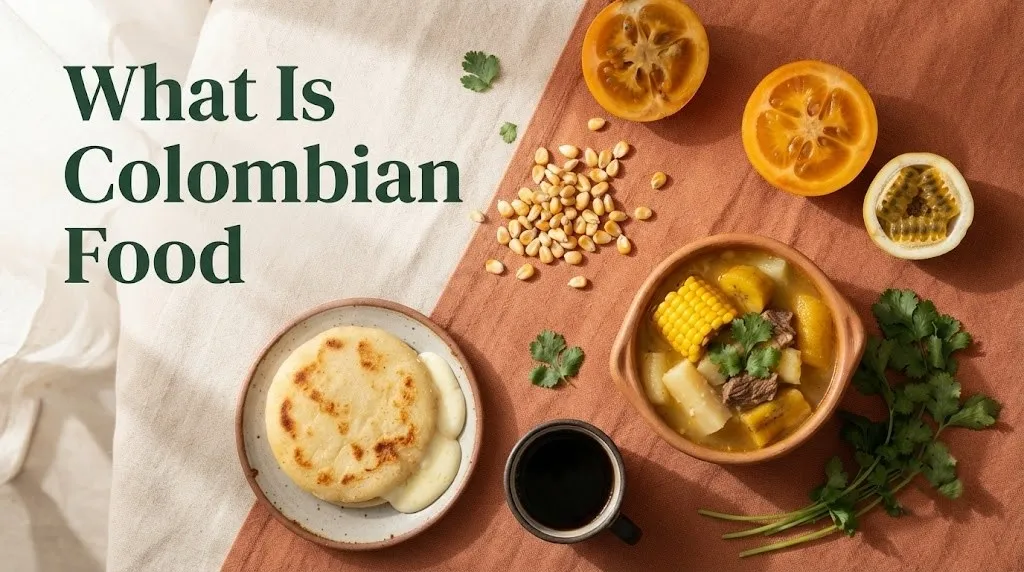
What most outsiders miss is that the dish most strongly associated with Colombia abroad, bandeja paisa, is a regional specialty from Antioquia, not a national everyday meal. Colombians outside the Paisa region might eat it once a month or less. The everyday Colombian table looks more like a bowl of sancocho, a plate of rice and beans with fried plantain and a small portion of meat, or a simple arepa with cheese and hogao, a tomato-onion sauce.
Key Fact: The Food and Agriculture Organization (FAO) reports that Colombia ranks among the top five countries globally for native potato varieties, with over 100 distinct types grown across the Andean highlands.
What Is Colombia’s Traditional Food?
Colombia’s traditional food varies by region, but dishes like sancocho, tamales, lechona, and ajiaco appear across the country in regionally adapted forms. Sancocho, a hearty soup of meat, yuca, plantain, corn, and potatoes, is the closest thing Colombia has to a universal national dish. Every region makes it differently, but the concept of a slow-simmered, starchy, one-pot meal crosses all geographic and class boundaries.
Tamales in Colombia differ from their Mexican counterparts. Colombian tamales are larger, wrapped in banana leaves rather than corn husks, and filled with a mixture of seasoned masa, pork or chicken, potatoes, carrots, chickpeas, and sometimes a piece of hard-boiled egg. They are a special-occasion food, typically eaten for weekend breakfasts or Christmas celebrations. The tamal tolimense from the Tolima region is widely considered the gold standard.
Lechona, a whole pig stuffed with rice, peas, and spices and slow-roasted for up to 12 hours, is the definitive celebration dish of the Tolima region. The skin is basted until it becomes a crackling shell. The rice inside absorbs the rendered fat and seasoning. It is served at weddings, baptisms, and major holidays. A portion of lechona with a piece of the crispy skin and a scoop of the seasoned rice can exceed 700 calories, which is part of the point. This is feast food, not weekday food.
For everyday traditional eating, the Colombian plate follows a consistent formula: a soup or broth, a serving of rice, a small piece of grilled or stewed meat, a fried plantain or boiled potato, and possibly a small salad of lettuce and tomato. The soup might be a light chicken consommé or a more substantial sancocho depending on the household budget and the day of the week.
What Is Colombian Food Like?
Colombian food is comforting, starch-forward, and built around fresh ingredients prepared simply rather than complex sauces or spice-heavy marinades. If Mexican cuisine foregrounds dried chiles and layered moles, and Peruvian cuisine emphasizes citrus and chile-heat brightness, Colombian food tends toward the gentler, slower-building flavors of long-cooked stews, grilled meats seasoned with just salt and garlic, and the natural sweetness of ripe plantains and tropical fruits.
Heat is not a defining characteristic. Ají, a fresh chile sauce made with cilantro, scallions, and lime juice, sits on the table as a condiment rather than being cooked into dishes. Colombians who enjoy spicy food add ají at the table. Those who do not simply skip it. This makes Colombian food particularly approachable for people who find the heat levels in other Latin American cuisines challenging.
Texture plays an outsized role on the Colombian plate. A typical meal might include something soft (stewed beans, mashed potatoes), something crispy (fried plantain, chicharrón), something chewy (an arepa, a piece of grilled meat), and something brothy (a soup or consomé). This textural variety is not accidental. It reflects a culinary sensibility that values contrast in every bite.
Starches anchor the meal. Rice, potatoes, yuca, plantains, corn, and legumes appear in some combination at nearly every lunch and dinner. This is not “carb-heavy” in the way nutrition discourse frames it now. It is a traditional eating pattern built around affordable, filling, energy-dense staples that sustained agricultural and working-class communities for generations. The nutrition reality is more nuanced than a simple carb count, as the specific starches and their preparation methods affect the metabolic impact.
Key Takeaway: Colombian food is regionally diverse, starch-centered, and built on simple fresh ingredients rather than complex sauces or intense chile heat. The iconic dishes most Americans know represent specific regions, not the everyday national table.
What Food Do Colombians Eat Daily?
Colombians eat rice, beans, plantains, eggs, arepas, soups, and fresh fruit on a daily basis, with meat portions that are typically smaller than what American plates feature. The daily Colombian diet is more repetitive and less elaborate than the celebration-dish reputation suggests.
Breakfast is often an arepa with cheese, a small serving of scrambled eggs, and a cup of tinto, which is black coffee taken sweet and small. In the coffee-growing region, breakfast might include calentado, yesterday’s rice and beans reheated with a fried egg on top. Hot chocolate with cheese melted into it is a breakfast ritual in the Andean interior, particularly Bogotá. The combination of sweet hot chocolate and salty cheese sounds counterintuitive to an outsider, but the contrast works in practice.
Lunch is the main meal. The almuerzo corriente (fixed-price lunch) is an institution across Colombia. For roughly 3 to 5 US dollars, a restaurant serves a set meal that typically includes a soup, rice, beans or lentils, a small piece of grilled meat or stewed chicken, fried plantain or boiled potato, and a small salad. A glass of fresh juice made from lulo (Solanum quitoense), guanábana (Annona muricata), or maracuyá (Passiflora edulis) comes with the meal. This is how the Colombian working and middle classes eat lunch every day.
Dinner is lighter. A bowl of soup, a small arepa with cheese, or leftovers from lunch. The large evening meal is uncommon in Colombian home cooking. Urban professionals in Bogotá and Medellín might eat a more substantial dinner, but the traditional pattern of a heavy lunch and light supper persists in most households.
Fruit is everywhere. Colombia’s equatorial position and range of altitudes mean that fresh fruit is available year-round at prices that shock visitors from temperate countries. Street vendors sell sliced mango with lime and salt, cups of papaya, and coconut water drunk straight from the fruit. The fruit culture in Colombia is one of its most distinctive and underappreciated food assets.
What Type of Food Do Colombians Eat by Region?
Colombian food divides into six distinct regional cuisines shaped by geography, climate, and cultural history. Understanding these regional differences explains why a dish common in Cartagena might be unknown in Bogotá and vice versa.
| Region | Geography | Signature Dishes | Key Ingredients | Cultural Influences |
|---|---|---|---|---|
| Andean | Highland mountains | Ajiaco, tamales, hot chocolate with cheese | Potatoes, corn, chicken, dairy | Indigenous Muisca, Spanish |
| Caribbean Coast | Tropical coastal | Sancocho de pescado, arroz con coco, arepa de huevo | Fish, coconut, yuca, plantain | African, Indigenous, Spanish |
| Pacific Coast | Rainforest coastal | Ceviche de camarón, encocado, tapao | Seafood, coconut, chontaduro | African, Indigenous |
| Antioquia/Paisa | Mountain valleys | Bandeja paisa, frijoles antioqueños | Beans, pork, plantain, arepa | Spanish colonial, Basque |
| Llanos Orientales | Grassland plains | Carne a la llanera (mamona), tungos | Beef, corn dough, yuca | Indigenous, Venezuelan llanero |
| Amazon | Rainforest | Pirarucú, mojojoy, casabe | River fish, yuca, Amazonian fruits | Indigenous |
The Andean region, home to Bogotá and nearly half the population, cooks with what grows in cool highland soil. Potatoes are foundational. The three potato varieties in ajiaco, papa criolla, papa sabanera, and pasta, each behave differently in the pot. The papa criolla dissolves into the broth and thickens it. The others hold their shape.
The Caribbean coast produces the food most similar to other Caribbean cuisines. Coconut rice, fried fish, and plantains recall the cooking of Panama, Cuba, and Puerto Rico. The African influence is strongest here, visible in the use of coconut, the preference for fried snacks, and dishes like sancocho de guandú made with pigeon peas.
Key Fact: The Colombian Ministry of Culture has recognized several regional food traditions as part of the nation’s intangible cultural heritage, including the traditional preparation of tamales in Tolima and the cooking methods of the Afro-Colombian Pacific communities.
What Is Colombia’s Most Famous Dish?
Bandeja paisa is Colombia’s most internationally recognized dish, though it represents a specific regional tradition from Antioquia rather than the national diet. The dish is a platter containing grilled steak or ground beef, chicharrón (crispy fried pork belly), chorizo, rice, red beans cooked with pork, a fried egg, fried plantain, an arepa, and sliced avocado.
The origins of bandeja paisa are practical. Field laborers in Antioquia’s coffee-growing hills needed a meal that delivered enough energy for a full day of physical work. The combination of animal proteins, legumes, and multiple starches was engineered for caloric density. A single bandeja paisa can deliver 1,200 to 1,800 calories depending on portion sizes and whether the diner eats every component.
This is not everyday food. Most Colombians from Antioquia eat bandeja paisa occasionally, perhaps once or twice a month at most. Outside Antioquia, it is a restaurant dish served to tourists and on special occasions. Treating it as the representative Colombian meal is like defining American food by the Thanksgiving dinner plate.
The dish has become a symbol and a source of regional pride for Paisas, the people of Antioquia and the coffee axis. It represents abundance, hospitality, and the agricultural wealth of the region. Restaurants in Medellín and the surrounding towns compete on the quality of their individual components, particularly the frijoles and the chicharrón.
Dietary sensitivity note: Bandeja paisa is high in saturated fat from the chicharrón and chorizo, high in sodium from the cured meats, and calorie-dense. Someone managing cardiovascular risk, hypertension, or type 2 diabetes should treat this as an occasional indulgence and consider eating a half portion. The beans and avocado contribute fiber and monounsaturated fat, which partially offset the heavier components.
What Are Colombian Empanadas and Street Foods?
Colombian empanadas are corn-based turnovers filled with seasoned potatoes and meat, deep-fried until the exterior is crisp and golden. Unlike Argentine empanadas made with wheat flour dough, Colombian versions use masarepa, precooked corn flour, which gives them a distinctive texture and naturally gluten-free status.
The classic filling is a mixture of mashed potatoes seasoned with hogao (a cooked tomato and onion sauce) and shredded beef or chicken. Some versions add hard-boiled egg or rice. The empanada is shaped, sealed, and fried at around 350 degrees Fahrenheit until the exterior forms a crackling, blistered crust. Vendors serve them with ají, a fresh chile sauce made from cilantro, green onion, lime juice, and sometimes a touch of vinegar.
Street food culture in Colombia runs deep and covers far more than empanadas. Common finds include:
- Arepa de huevo: An arepa split and fried with a raw egg cracked inside, then fried again until the egg sets. A specialty of the Caribbean coast.
- Buñuelos: Small, round, deep-fried cheese doughs eaten year-round but especially at Christmas.
- Aborrajados: Slices of ripe plantain stuffed with cheese, battered, and fried.
- Obleas: Thin communion-style wafers sandwiched with arequipe (dulce de leche) and sometimes jam or grated cheese.
- Cholados: Shaved ice topped with fruit syrups, condensed milk, and fresh fruit, a specialty of Cali.
- Perro caliente colombiano: Colombian hot dogs topped with an improbable combination of pineapple sauce, crushed potato chips, cheese, and pink sauce.
Safety note: Street food in Colombia is generally safe to eat when the vendor is busy (high turnover means fresh oil and fresh ingredients) and when you can see food being fried or cooked to order. Raw fruit from street vendors should be peeled by the vendor in front of you. Tap water in most Colombian cities is treated but can cause digestive upset in visitors unaccustomed to the local water supply. Bottled water is widely available and inexpensive.
Key Takeaway: Colombian street food spans empanadas to obleas and varies by region. Look for busy vendors with high turnover, and lean into the regional specialties of wherever you find yourself eating.
What Is a Traditional Colombian Breakfast?
A traditional Colombian breakfast centers on an arepa with cheese, scrambled eggs, and a cup of tinto (small black coffee) or hot chocolate, with regional variations that can include calentado, changua, or tamales on weekends.
The Bogotá breakfast differs from the coastal breakfast in ways that reflect the climate. In cold Bogotá, changua, a milk-based soup with a poached egg, scallions, and cilantro, is a breakfast staple served with a piece of stale bread for dipping. It sounds strange to anyone who has not tried it. The combination of warm milk, runny egg yolk, and fresh herbs is genuinely satisfying at 7 a.m. on a 45-degree morning.
Calentado, common in the coffee region and Antioquia, is the practical breakfast of reheating yesterday’s rice and beans and topping it with a fried egg. It is often served with a side of arepa and chorizo. The name literally means “heated up.” This is home-cooking efficiency at its most honest.
Weekend breakfasts are more elaborate. Tamales, which take hours to prepare, are a Saturday and Sunday morning tradition in many households. They are purchased from a neighbor or a specialty shop rather than made at home in most cases. The tamal vendor who sells door to door on Sunday mornings is a fixture of Colombian neighborhood life.
Fresh fruit juice accompanies breakfast in households that can afford it. Jugo de naranja (orange juice), jugo de guanábana (soursop juice), and jugo de mora (blackberry juice) are standard. The fruit is blended with water or milk and a small amount of sugar. Juice bars and street vendors also sell fresh juice throughout the morning.
What Are Colombian Arepas?
Colombian arepas are round, flat corn cakes made from masarepa (precooked corn flour), water, and salt, cooked on a griddle until golden and served plain, with cheese, butter, or as an accompaniment to meals. They are the single most important staple food in the Colombian diet, eaten at any time of day and in every region.
The distinction between Colombian and Venezuelan arepas is worth clarifying. Colombian arepas are typically thinner, often served as a bread substitute alongside a meal rather than as a stuffed sandwich. Venezuelan arepas are thicker, split open, and stuffed with fillings like shredded beef, black beans, cheese, and avocado. Both are correct. They are just different traditions.
Regional variations are extensive:
- Arepa paisa: Thin, plain, and grilled until slightly charred. Eaten as a side with everything.
- Arepa de choclo: Made from fresh sweet corn rather than masarepa, giving it a sweeter, softer texture. Often filled with cheese.
- Arepa de huevo: A Caribbean coast specialty where the arepa is fried, split, filled with a raw egg, and fried again.
- Arepa boyacense: From the Boyacá region, made with a mixture of corn and wheat flour, filled with cheese and sometimes panela.
- Arepa santandereana: Contains chicharrón ground into the dough itself along with cooked yuca.
Arepas are naturally gluten-free because masarepa is made from corn, not wheat. A plain arepa contains roughly 150 to 200 calories and provides complex carbohydrates with a small amount of protein. Adding cheese, butter, or fillings changes the nutritional profile significantly.
For the home cook, arepas are forgiving. Masarepa is widely available in Latin grocery stores and online under brands like PAN and Harina P.A.N. Mix with warm water and a pinch of salt, shape into discs, and cook on a dry or lightly oiled griddle for about 5 minutes per side. The dough should feel like soft play dough. Too dry and the arepa cracks. Too wet and it sticks.
Key Takeaway: Colombian arepas, sancocho, and daily eating patterns all reflect a cuisine built on affordable staples prepared with skill and regional pride. The everyday diet is more balanced and vegetable-forward than the famous heavy dishes suggest.
Is Colombian Food Healthy?
Colombian food can be healthy, particularly its everyday soups, bean dishes, fresh fruit, and lean proteins, though some iconic dishes are high in saturated fat, sodium, and refined starches. The answer depends entirely on which Colombian foods you are eating and how often.
The traditional daily diet has several structural strengths. Beans and lentils appear at nearly every lunch, providing fiber, plant protein, iron, and folate. The American Heart Association has long recognized legumes as beneficial for cardiovascular health. Fresh fruit consumption in Colombia is among the highest in the Americas, with the World Health Organization reporting that Colombian fruit intake exceeds the global average by a wide margin.
Soups are another nutritional asset. Colombian soups like sancocho and ajiaco are broth-based, not cream-based, and they contain a mix of starchy vegetables, corn, and lean protein in a single pot. A bowl of sancocho with chicken, yuca, and corn delivers a balanced distribution of protein, complex carbohydrates, and hydrating fluid.
The areas of concern match those in many traditional cuisines. Fried foods like empanadas, buñuelos, and chicharrón are common as snacks and celebration foods. The heavy use of salt in cured meats and hogao sauce contributes to sodium intake above the levels recommended by the Dietary Guidelines for Americans.
| Dish | Approximate Calories | Protein (g) | Notable Nutrients | Health Considerations |
|---|---|---|---|---|
| Sancocho de pollo (1 bowl) | 350 to 450 | 25 to 30 | Vitamin C from yuca, potassium | Moderate sodium from seasoning |
| Bandeja paisa (full portion) | 1,200 to 1,800 | 60 to 80 | Iron from beans, potassium from avocado | High saturated fat, high sodium |
| Ajiaco (1 bowl) | 400 to 500 | 25 to 30 | Vitamin B6 from potatoes, fiber from guasca | Moderate fat from cream garnish |
| Arepa con queso (1 unit) | 250 to 350 | 8 to 12 | Calcium from cheese | Refined carbohydrate base |
| Empanada (1 unit) | 200 to 300 | 6 to 10 | Vitamin C from potatoes, iron from meat | Deep-fried, moderate sodium |
| Fresh fruit plate (1 cup) | 80 to 120 | 1 to 2 | Vitamin C, vitamin A, fiber, potassium | Natural sugar content |
Dietary sensitivity note: Many Colombian dishes contain dairy (cheese in arepas, cream in ajiaco) and are not suitable for strict vegans or those with dairy allergies without modification. Gluten is less of a concern because corn dominates over wheat. Soy is rarely used, making Colombian food a good option for those with soy allergies.
What Nutrients Are Common in Colombian Cuisine?
Colombian cuisine delivers significant amounts of fiber, potassium, vitamin C, iron, and plant-based protein through its heavy use of legumes, tropical fruits, root vegetables, and varied starches. The nutritional profile reflects an agricultural tradition built on what grows locally rather than what ships well.
Beans deserve special attention. A half-cup serving of frijoles antioqueños (red beans cooked with tomato, onion, and sometimes pork) provides about 7 grams of protein, 8 grams of fiber, and significant iron. The Academy of Nutrition and Dietetics notes that combining beans with a vitamin C source, which Colombian meals often do via fresh juice or aji sauce, improves non-heme iron absorption.
Tropical fruits supply micronutrients that many American diets underdeliver. Guanábana (soursop) provides vitamin C and several B vitamins. Lulo, a tart orange fruit used in juices, is high in vitamin C and phosphorus. Maracuyá (passion fruit) delivers vitamin A and fiber. Chontaduro, the peach palm fruit eaten on the Pacific coast, contains vitamin A and carotenoids at levels comparable to carrots.
The root vegetables that anchor Colombian soups and sides, yuca (cassava, Manihot esculenta), ñame (yam, Dioscorea species), and arracacha (Arracacia xanthorrhiza), provide complex carbohydrates with varying amounts of fiber, potassium, and vitamin C. Yuca in particular is a staple for people with gluten intolerance or celiac disease because it provides a starchy base with zero gluten.
Guasca leaves (Galinsoga parviflora), the herb that gives ajiaco its distinctive flavor, contain flavonoids and phenolic compounds that research published in the Journal of Ethnopharmacology has identified as having anti-inflammatory properties. The herb is used fresh in cooking and contributes more than just flavor to the dish.
What Are the Best Colombian Dishes for Special Diets?
Colombian cuisine offers solid options for gluten-free, high-protein, and plant-forward eating patterns, though certain dietary needs require more navigation. The cuisine’s reliance on corn, rice, potatoes, and yuca means gluten is naturally absent from most traditional dishes.
For gluten-free eaters, Colombian food is remarkably accommodating. Arepas, empanadas (when made traditionally with masarepa), tamales, and all rice-based dishes are gluten-free by design. The only caution areas are dishes that might incorporate wheat flour as a thickener or in doughs. Always confirm with the cook, but the baseline is favorable.
For vegetarians and vegans, Colombian food requires more adaptation. Meat, chicken, and pork feature prominently in traditional cooking. However, the bean culture is strong enough that a satisfying meatless plate is possible. Frijoles antioqueños (when cooked without pork), lentil soup, rice with vegetables, fried plantain, avocado, arepa, and fresh fruit juice make a complete meal that is already on most Colombian menus.
For people managing diabetes, the heavy starch component of Colombian meals requires attention. A typical plate with rice, potato, fried plantain, and an arepa delivers multiple carbohydrate sources in one meal. The American Diabetes Association guidance on carbohydrate counting applies directly here. Reducing portions of the starch components, prioritizing beans for their fiber and protein, and starting the meal with soup can help moderate the blood sugar response.
Quick Tip for building a healthier Colombian plate:
- Keep the beans, the soup, and the fresh juice.
- Choose one starch (rice or potato or plantain, not all three) if you are watching carbohydrate intake.
- Add a larger portion of salad or cooked vegetables than the traditional small garnish serving.
- Use ají liberally for flavor without sodium.
Key Takeaway: Colombian food offers high fiber from beans, abundant vitamin C from tropical fruits, and naturally gluten-free starches. Adjust the starch portions and added fats to align with your health goals, but do not sleep on the soups and legumes.
What Is Colombian Food Culture and Eating Etiquette?
Colombian food culture centers on the midday meal as the anchor of the day, with lunch treated as a proper sit-down affair even during a workday. The culture emphasizes hospitality, fresh preparation, and the social function of shared meals over speed or convenience.
Lunch is sacred. The almuerzo ejecutivo (executive lunch) culture means even white-collar workers in Bogotá or Medellín leave their desks for a proper meal, not a sandwich eaten over a keyboard. Restaurants fill at noon and stay busy until 2 p.m. The meal includes soup, a main plate, fresh juice, and coffee. It takes 45 minutes to an hour. This is not laziness. It is a cultural value placed on eating properly.
Table manners are formal by American standards. Hands stay above the table, not in your lap. The fork goes in the left hand and the knife in the right throughout the meal, Continental style. Finishing everything on your plate is polite. Leaving food suggests the host’s cooking was not good.
Colombians do not rush meals. If you are invited to someone’s home, the meal will likely last two hours or more with conversation before, during, and after eating. Coffee follows the meal. Declining food or drink when offered can be interpreted as rejecting hospitality. If you genuinely cannot eat more, a polite “está delicioso, pero ya estoy lleno” (it is delicious, but I am full) is appropriate.
The sobremesa, the time spent talking at the table after the meal ends, is as important as the food itself. Business deals, family decisions, and friendships all happen during the sobremesa. Leaving immediately after eating is seen as rude. Give it at least 20 to 30 minutes of post-meal conversation.
What Is Colombia’s National Dish?
Colombia does not have a single legally designated national dish, but sancocho functions as the de facto national meal because it appears in every region, across all social classes, and in both everyday and special-occasion cooking. Other contenders for national status include bandeja paisa, ajiaco, and the arepa.
Sancocho’s claim is strong because no other dish spans the country’s geographic and cultural diversity as completely. In the Andean region, sancocho is made with chicken or beef and three types of potatoes. On the Caribbean coast, fish sancocho with coconut milk is the standard. In the Pacific, it might include shrimp and plantain. In the Llanos, it is made with beef and corn on the cob. Same concept, different protein, different starch profile, completely different dish in execution.
The arepa has a separate claim. It is not a dish but a food category, and it is the one edible item that every Colombian, regardless of region, class, or political affiliation, eats regularly. The arepa is democratic in a way that bandeja paisa, with its cost and heft, cannot be.
Ajiaco is the dish most strongly associated with Bogotá and the Cundiboyacense highlands, but it does not travel. The specific combination of three potato types, guasca herb, corn on the cob, and capers is distinctly Bogotano. A Colombian from Barranquilla might eat ajiaco once a year or never make it at home.
The absence of a single national dish reflects Colombia’s regionalism. The country is too geographically fragmented, and its food traditions are too distinct, for one dish to represent everyone. This is a feature, not a bug, of the cuisine.
How Has Colombian Food Evolved in 2026?
Colombian food in 2026 reflects a tension between preservation of traditional regional cooking and a new wave of chef-driven innovation spotlighting native ingredients on global stages. Both forces are active, and they push Colombian cuisine in different directions simultaneously.
The preservation side is gaining institutional support. The Colombian Ministry of Culture has expanded its intangible heritage designations to include more regional food practices. Traditional cooking schools in rural areas teach younger generations the methods their grandmothers used. The Slow Food movement has cataloged over 50 endangered Colombian food products for its Ark of Taste, including specific varieties of native potatoes, corn, and fruits.
The innovation side is visible in restaurants. Leo in Bogotá continues to receive international recognition for its tasting menu built around biodiverse Colombian ingredients. Other chefs in Medellín, Cartagena, and Cali are doing similar work, recontextualizing native ingredients in fine-dining formats. The restaurant El Chato in Bogotá, run by chef Álvaro Clavijo, has drawn attention for its modern takes on Colombian street food.
The diaspora effect is also reshaping Colombian food. Colombian communities in Miami, New York, Madrid, and London have created demand for Colombian ingredients abroad, and second-generation Colombian chefs are running restaurants that blend Colombian flavors with the food cultures of their adopted cities. Colombian-Chinese, Colombian-Peruvian, and Colombian-Italian hybrids are appearing on menus.
A 2025 report from ProColombia, the government trade agency, noted that Colombian food exports, particularly specialty coffee, panela, tropical fruit pulp, and cacao, have grown steadily as global demand for Colombian food products rises. The economic incentive to preserve and market native ingredients is now measurable in export revenue.
Key Takeaway: Sancocho functions as the de facto national dish through regional ubiquity rather than official designation. Colombian food in 2026 balances heritage preservation with chef innovation and growing global recognition.
Frequently Asked Questions About Colombian Food
What is the most popular food in Colombia?
Arepas are the most widely consumed food across all regions of Colombia.
They function as a bread substitute, a snack, and a meal component depending on how they are filled or topped.
Every Colombian, regardless of region or income, eats arepas regularly as part of the daily diet.
Is Colombian food spicy?
Colombian food is not generally spicy compared to Mexican or Peruvian cuisine.
Ají, a fresh chile sauce made with cilantro and lime, is served on the side for those who want heat.
The base flavors of Colombian cooking lean toward savory, mild, and herbaceous rather than chile-forward.
What do Colombians eat for breakfast?
Colombians typically eat arepas with cheese, scrambled eggs, and coffee or hot chocolate for a weekday breakfast.
Weekend breakfasts may include tamales, calentado (reheated rice and beans with egg), or changua (milk soup with poached egg) depending on the region.
Fresh fruit juice accompanies breakfast in many households.
What is bandeja paisa made of?
Bandeja paisa includes grilled steak or ground beef, chicharrón, chorizo, red beans, rice, a fried egg, fried plantain, avocado, and an arepa on a single platter.
It originated in the Antioquia region as a calorie-dense meal for agricultural workers.
The dish is eaten occasionally, not daily, by most Colombians.
Are Colombian empanadas different from other empanadas?
Colombian empanadas use masarepa (precooked corn flour) for the dough rather than wheat flour, making them naturally gluten-free.
The classic filling is a mixture of mashed potatoes seasoned with hogao and shredded beef or chicken.
They are deep-fried and served with ají sauce rather than baked.
What to Eat First If You Are New to Colombian Food
Start with a bowl of sancocho de gallina (hen soup), an arepa de choclo with cheese, and a glass of fresh lulo juice. These three items represent the soul of Colombian home cooking without overwhelming a newcomer with the intensity of heavier celebration dishes. The sancocho teaches you about the Colombian soup tradition. The arepa de choclo introduces you to the corn culture. The lulo juice shows you what tropical fruit can taste like when it has never seen a shipping container.
From there, work outward by region. Try ajiaco if you are drawn to Bogotá’s highland cooking. Order a bandeja paisa if you want to understand Antioquia in a single plate. Find a coastal restaurant and eat fried fish with coconut rice and patacones. The diversity of Colombian food rewards curiosity.
Colombian food is not a monolith, and the best thing you can do as an eater is approach it region by region, the same way you would approach Italian or Chinese food. The arepa is your constant companion. The rest depends on which part of Colombia you are eating through.