Most pet birds can survive 24 to 48 hours without food, though smaller species with faster metabolisms may succumb within 12 to 24 hours. The survival window is not a single number. It varies dramatically by species, body size, fat reserves, and whether the bird also lacks water.
The Association of Avian Veterinarians (AAV) emphasizes that a bird that has stopped eating is a medical emergency, not a wait-and-see situation. Birds hide illness as a survival instinct. By the time a pet bird visibly stops eating, it may already be critically ill. In the wild, a bird’s survival without food depends on its fat reserves, the ambient temperature, and whether it can enter a state of torpor to conserve energy.
This guide covers the specific fasting survival timelines for parrots, budgies, pigeons, hummingbirds, and other common species. You will find a species comparison table, a detailed explanation of bird metabolism and torpor, the signs of starvation to watch for, and exactly what to do if you find a wild bird or pet bird that is not eating.
How Long Can Birds Go Without Food?
Birds can go without food for a period ranging from a few hours to several days, depending entirely on the species, body size, fat reserves, and metabolic rate. A hummingbird may starve in 3 to 5 hours. A large raptor may survive for several days.
The critical factor is metabolic rate. Birds have the highest metabolic rates of any vertebrate animals. Their resting metabolic rate is roughly 30 to 50 percent higher than a mammal of equivalent body mass. This high metabolism powers flight, which is the most energetically expensive form of locomotion in the animal kingdom. The trade-off is that birds burn through their energy reserves far faster than mammals.
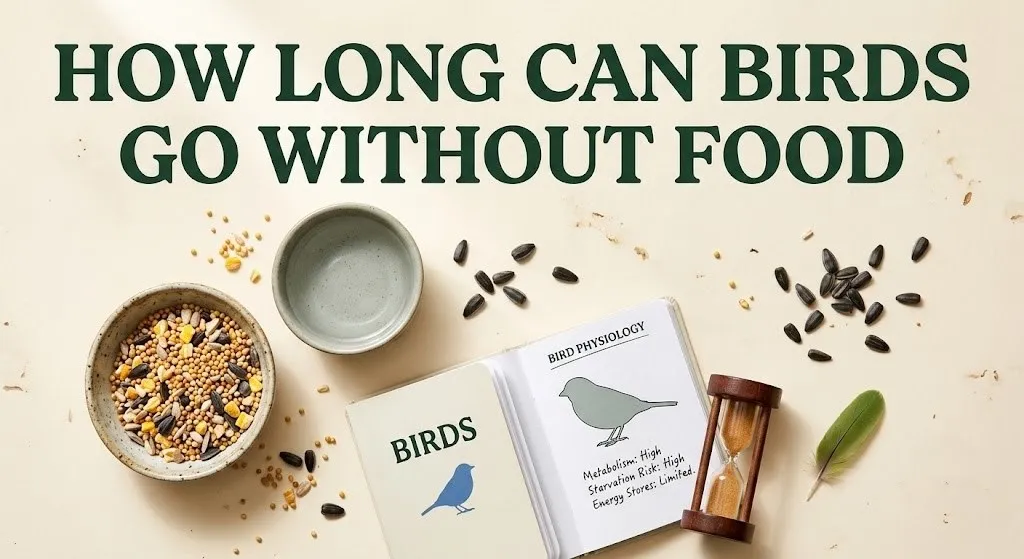
A bird’s fasting tolerance is directly related to its natural feeding frequency. Hummingbirds, which consume roughly half their body weight in nectar daily and feed every 10 to 15 minutes during daylight, have essentially no fasting tolerance. A parrot, which consumes seeds and fruits in discrete meals throughout the day, can survive a missed meal or two. A raptor, which consumes a large prey item and then fasts for a day or more while digesting, has the highest fasting tolerance of all birds.
How Long Can a Bird Survive Without Food or Water?
A bird can survive without food or water for roughly half as long as it can survive without food alone. Dehydration kills birds faster than starvation. In hot weather, a small bird without water may die within 6 to 12 hours.
Water is the limiting factor in survival without both resources. Birds lose water through respiration, excretion, and evaporation. Their excretory system produces uric acid, a semi-solid waste that conserves water compared to the urea-based urine of mammals. This adaptation helps birds survive in arid environments, but it does not eliminate the need for water. A small bird with a high metabolic rate and a large surface area relative to its body mass loses water rapidly.
In the wild, birds obtain water from drinking, from the moisture content of their food, and from metabolic water, which is water produced during the breakdown of fat and carbohydrate. Insect-eating birds and fruit-eating birds obtain a significant portion of their water from their diet. Seed-eating birds in arid environments must drink water separately. A seed-eating pet bird like a budgie that stops eating also stops drinking from food moisture, accelerating dehydration.
The combination of no food and no water in a hot environment can kill a small bird in less than a day. This is why an empty water bowl in a pet bird’s cage on a summer day is an emergency.
Key Takeaway: Dehydration kills faster than starvation. A bird without water may die in half the time of a bird without food. Water is the priority in any emergency.
How Long Can Birds Survive Without Food by Species?
How long birds can survive without food varies by orders of magnitude across species. A clear comparison table helps owners and wildlife rescuers assess the urgency of any situation.
| Bird Type | Species Example | Maximum Fasting Time (Approx.) | Key Factor |
|---|---|---|---|
| Hummingbird | Ruby-throated | 3 to 5 hours (daytime) | Extreme metabolic rate |
| Small songbird | Chickadee, finch | 12 to 24 hours | High metabolism, tiny fat reserves |
| Budgie | Budgerigar | 24 to 36 hours | Small body, fast metabolism |
| Cockatiel | Cockatiel | 24 to 48 hours | Medium-small body |
| Pigeon | Rock pigeon | 2 to 3 days | Good fat reserves, moderate metabolism |
| Medium parrot | African Grey, Amazon | 2 to 3 days | Larger body mass, moderate fat |
| Large parrot | Macaw, cockatoo | 3 to 4 days | Large body, higher fat reserves |
| Raptor | Red-tailed hawk | 3 to 7 days | Large meal sizes, digestive fasting |
| Owl | Great horned owl | 3 to 5 days | Efficient metabolism, large meals |
These maximum times assume a healthy bird with adequate fat reserves, moderate temperatures, and no additional stress. A sick bird, an injured bird, a bird in extreme heat or cold, or a bird that is already underweight will have a significantly shorter survival window. The maximum fasting time is not a safe fasting time. A bird that has not eaten for half its maximum survival window is in trouble.
How Long Can a Bird Go Without Food Before It Dies?
A bird goes without food before death for a period that depends on its body condition, species, and environment. The progression from fasting to death follows a predictable physiological sequence that moves from glycogen depletion through fat metabolism to organ failure.
In the first few hours without food, the bird depletes its glycogen stores. Glycogen is the storage form of glucose, held in the liver and muscles. Small birds deplete glycogen in 2 to 4 hours. Large birds may take 6 to 12 hours. Once glycogen is gone, the bird switches to fat metabolism. Adipose tissue is broken down into fatty acids and glycerol. The fatty acids are converted to ketone bodies, which the brain and other tissues can use for energy.
Fat metabolism can sustain a bird for hours to days depending on the size of its fat reserves. A healthy bird with adequate fat stores will lose weight steadily as fat is consumed. Once fat stores are depleted, the bird begins breaking down muscle protein for energy. This is the terminal phase. Muscle wasting includes the heart muscle. Organ failure follows.
The progression is visible. A bird that has not eaten for 24 hours appears lethargic and fluffed. At 36 to 48 hours, the bird is weak, may sit on the bottom of the cage, and has a prominent keel bone as the breast muscle wastes. By the time a bird is sitting on the cage floor, it is critically ill and requires immediate veterinary intervention.
Key Takeaway: Birds progress from glycogen to fat to muscle breakdown. A bird on the cage floor has reached the terminal phase. Immediate veterinary care is required.
Bird Metabolism and Fasting Tolerance Explained
Bird metabolism is the fastest of any vertebrate class. A bird’s resting metabolic rate is 30 to 50 percent higher than a similarly sized mammal. This high metabolism is the engine of flight and the reason birds cannot fast for as long as mammals.
The high metabolic rate is driven by several avian adaptations. Birds maintain a core body temperature of 104 to 108 degrees Fahrenheit, significantly higher than the human 98.6 degrees. They have a four-chambered heart that pumps oxygenated blood to flight muscles that can represent 15 to 25 percent of total body mass. The cellular machinery of birds is designed for aerobic efficiency, with mitochondria packed densely into muscle cells.
The energy cost of this metabolic engine is immense. A small songbird consumes roughly 40 to 60 percent of its body weight in food daily during active periods. A hummingbird can consume more than 100 percent of its body weight in nectar. A large parrot might consume 10 to 15 percent of its body weight. The smaller the bird, the higher the metabolic rate per gram of body mass, and the shorter the fasting tolerance.
The natural feeding pattern of a species predicts its fasting tolerance better than body size alone. Hummingbirds are obligate continuous feeders during daylight. Raptors are adapted for a feast-and-fast pattern, consuming a large meal and then digesting over hours or days. Seed-eating birds fall in between, with a pattern of frequent small meals throughout the day.
How Long Can a Parrot Go Without Food?
A medium to large parrot can go without food for 2 to 3 days before organ failure begins, but any period exceeding 24 hours without eating is a medical emergency requiring immediate veterinary attention.
Parrots, including African Greys, Amazons, and Eclectus, have a moderate metabolic rate relative to smaller birds. Their larger body mass provides some metabolic buffer. A healthy, well-fed parrot has fat reserves that can sustain it for a couple of days. However, parrots are also intelligent, emotionally sensitive animals. A parrot that stops eating may be doing so due to illness, stress, grief from the loss of a companion, or a change in environment. The underlying cause of the anorexia is often as serious as the fasting itself.
A parrot that has not eaten for 24 hours should be seen by an avian veterinarian. The veterinarian will assess body condition, check the crop for impaction or infection, and may perform blood work to evaluate organ function. Force-feeding, also called gavage feeding, may be required. Do not attempt to force-feed a parrot without veterinary instruction. The risk of aspiration, where food enters the trachea and lungs, is high.
The largest parrots, including macaws and cockatoos, have the longest fasting tolerance of any pet birds. A healthy hyacinth macaw might survive 4 to 5 days without food. This is not a safe window. It is a biological maximum. Veterinary care should be sought within 24 hours of the bird stopping eating.
How Long Can a Budgie Survive Without Food?
A budgie, also called a budgerigar or parakeet, can survive roughly 24 to 36 hours without food. A budgie that has not eaten for 24 hours is in critical condition.
Budgies are small birds, typically weighing 30 to 40 grams. Their metabolic rate is high relative to their body mass. They have minimal fat reserves compared to larger parrots. A budgie burns through its glycogen stores in roughly 2 to 3 hours. It transitions to fat metabolism and can sustain itself for roughly a day on stored fat. Beyond 24 hours, the budgie begins breaking down muscle protein.
Budgies are also prone to going unnoticed when they stop eating. A sick budgie fluffs its feathers, closes its eyes, and sits quietly. This can be mistaken for sleeping. The bird may continue to perch and appear relatively normal while actually being in the early stages of starvation. The keel bone, the ridge of the sternum, becomes prominent as the breast muscle wastes. This is a late sign.
A budgie’s small size makes it vulnerable to rapid decompensation. A bird that was perching in the morning can be on the cage floor by evening. The window for intervention is narrow. An avian veterinarian should evaluate any budgie that has not eaten for 12 to 18 hours.
Key Takeaway: Budgies are small, fast-metabolizing birds. They can survive roughly 24 hours without food. The window for veterinary intervention is narrow.
How Long Can a Pigeon Survive Without Food?
A pigeon can survive 2 to 3 days without food, and potentially longer in cool weather with access to water. Pigeons have better fasting tolerance than similarly sized pet birds.
Pigeons, specifically rock pigeons (Columba livia), are granivorous birds that have adapted to urban environments where food availability is intermittent. They have a crop, a storage pouch in the esophagus, that allows them to consume a large quantity of food quickly and then digest it over several hours. This adaptation provides a buffer against short-term food scarcity.
A healthy pigeon with adequate fat reserves can survive roughly 2 to 3 days without food if water is available. Without water, the survival window shortens to roughly 1 to 2 days. Pigeons produce crop milk to feed their young, a process that requires significant energy and nutrient reserves. A breeding pigeon that stops eating will deteriorate faster than a non-breeding bird.
Pigeons are often the subject of wildlife rescue calls. A pigeon sitting on the ground, fluffed, with closed eyes, and unresponsive to approach is likely in the later stages of starvation or illness. A wildlife rehabilitator should be contacted. Pigeons are not protected under the Migratory Bird Treaty Act in the United States, which means wildlife rehabilitators are generally permitted to treat them.
How Long Can Hummingbirds Go Without Food?
Hummingbirds can go without food for only 3 to 5 hours during the day before they starve. They are the birds with the shortest fasting tolerance of any avian species.
Hummingbirds have the highest metabolic rate of any vertebrate relative to body mass. Their heart rate can exceed 1,200 beats per minute. Their wingbeat frequency can reach 80 beats per second. This metabolic intensity requires a constant fuel supply. A hummingbird consumes roughly half its body weight in nectar each day, feeding every 10 to 15 minutes throughout daylight hours.
At night, hummingbirds enter a state of torpor, a controlled reduction in body temperature and metabolic rate that allows them to survive the overnight fast. Without torpor, a hummingbird would starve before dawn. During torpor, the body temperature drops from roughly 104 degrees Fahrenheit to near ambient temperature. The heart rate slows dramatically. The metabolic rate drops by 50 to 95 percent. The bird appears asleep but is physiologically in a state closer to hibernation.
A hummingbird that is prevented from feeding during daylight, for example by a injury or entrapment, will exhaust its immediate energy reserves within 3 to 5 hours. The bird will weaken, become unable to fly, and die within hours if not provided with a sugar water solution. Wildlife rehabilitators use a specific concentration of sugar water, roughly four parts water to one part white sugar, to provide emergency energy to rescued hummingbirds.
How Long Can Birds Go Without Water?
Birds can go without water for significantly less time than they can go without food. A small bird without water in moderate temperatures may survive 24 hours. In hot weather, survival may be 6 to 12 hours.
Birds lose water continuously through respiration and waste excretion. Their respiratory system, which includes air sacs distributed throughout the body, has a large surface area for gas exchange but also for evaporative water loss. Birds do not sweat, but they pant to cool themselves, which increases respiratory water loss. In hot weather, the water loss through panting can be substantial.
The water content of the bird’s natural diet affects its drinking water requirement. Nectar-eating birds like hummingbirds and lorikeets obtain most of their water from nectar. Fruit-eating birds obtain water from fruit. Seed-eating birds like budgies and finches consume dry seeds and require a separate water source. A seed-eating pet bird with an empty water bowl is at immediate risk of dehydration.
Dehydration signs in birds include sunken eyes, a dry or sticky mouth, tacky mucous membranes, and skin that tents when gently pinched and does not snap back. A dehydrated bird is often lethargic and may sit with feathers fluffed. Dehydration requires immediate veterinary care. Subcutaneous or intravenous fluids may be necessary.
Key Takeaway: Birds need water more urgently than food. Dehydration kills in hours, not days. A water source should be checked before food in any emergency.
Torpor in Birds and Energy Conservation
Torpor is a physiological state of reduced body temperature, heart rate, and metabolic rate that allows birds to survive periods when food is unavailable. It is the most effective energy conservation strategy in the avian world.
Torpor is used by many small bird species, particularly hummingbirds, swifts, nightjars, and some small songbirds. The bird allows its body temperature to drop, sometimes to within a few degrees of the ambient temperature. The heart rate slows from hundreds of beats per minute to a few dozen. The breathing rate slows. The bird appears unresponsive and may be difficult to rouse. This is a normal, adaptive state, not a sign of illness.
The energy savings of torpor are dramatic. A hummingbird in torpor reduces its metabolic rate by 50 to 95 percent. This is the difference between surviving the overnight fast and starving before morning. Some species use torpor during cold weather, food scarcity, or migration stopovers. Torpor is distinct from hibernation. It is typically shorter in duration, lasting hours rather than days or weeks, and the body temperature reduction is less extreme.
Torpor is not available to all birds. Large birds, including most parrots, raptors, and waterfowl, do not enter torpor. Their larger body mass provides enough thermal inertia and fat reserves to survive overnight fasts without dropping their metabolic rate to torpor levels.
Signs of Starvation in Pet Birds
The signs of starvation in pet birds progress from subtle behavioral changes to obvious physical wasting. Recognizing the early signs allows intervention before the bird enters the terminal phase.
The earliest sign is reduced activity and fluffed feathers. A bird that is conserving energy sits quietly, often on both feet rather than the typical one-footed resting posture. The feathers are fluffed to trap insulating air, which reduces heat loss. The bird may tuck its head under a wing during daylight, which is abnormal for a bird that is not sleeping.
The physical signs of weight loss become visible as starvation progresses. The keel bone, the ridge of the sternum that runs down the center of the chest, becomes prominent. In a healthy bird, the breast muscle on either side of the keel bone should feel plump and rounded. In a starving bird, the keel bone feels sharp and prominent, with concave depressions on either side where the muscle has wasted.
- Fluffed feathers during daylight hours
- Sitting on both feet, not one-footed resting
- Tucking head under wing during active periods
- Prominent keel bone with concave breast muscles
- Lethargy and unresponsiveness
- Sitting on the cage floor
- Green or black droppings (bile from empty digestive tract)
The droppings of a starving bird change color. When the bird is not eating, the fecal portion of the dropping becomes green or black, which is biliverdin and bile from the empty digestive tract. The urate portion may become yellow or green. These changes indicate that the bird is in a catabolic state, breaking down body tissues for energy.
Sick Bird Not Eating and Emergency Care
A sick bird that is not eating requires immediate veterinary care. Anorexia in birds is never a wait-and-see situation. The combination of illness and fasting accelerates deterioration.
Birds hide illness as an anti-predator adaptation. In the wild, a visibly sick bird is targeted by predators and may be driven away by its flock. This instinct persists in pet birds. By the time a bird owner notices that their bird is not eating, the bird has likely been ill for days. The anorexia compounds the illness. A bird with a bacterial infection that is also not eating is fighting the infection with no energy intake.
To provide emergency care for a sick bird that is not eating:
- Place the bird in a warm, quiet environment. A hospital cage or a small carrier with a heating pad under half the floor set to low provides warmth without overheating.
- Offer highly palatable, easy-to-eat foods. Millet spray, cooked rice, applesauce, or baby food (fruit or vegetable, no additives) may tempt a bird that is refusing its standard diet.
- Provide water with a small amount of electrolyte solution or unflavored Pedialyte mixed half and half with water.
- Do not force-feed without veterinary instruction. Aspiration pneumonia from food entering the trachea can kill a bird.
- Transport to an avian veterinarian or an emergency veterinary clinic that treats birds.
An avian veterinarian may administer fluids, begin gavage feeding, and run diagnostic tests to identify the underlying illness. The cost of veterinary care is significant, but the alternative is a bird that will likely not survive without intervention.
Key Takeaway: A sick bird that is not eating is an emergency. Warmth, palatable food, and immediate veterinary transport are the three critical steps.
How Often to Feed Pet Birds by Species
How often to feed pet birds depends on the species, the natural dietary pattern, and the type of food offered. Scheduled meals are generally healthier than free feeding with seed mixes.
| Bird Type | Feeding Frequency | Diet Notes |
|---|---|---|
| Budgie, cockatiel | Fresh food twice daily. Pellets available all day. | Small, frequent meals. Remove fresh food after 2 hours. |
| Parrot (medium, large) | Two meals daily plus foraging opportunities | Measured pellets, fresh vegetables, limited seeds and nuts |
| Canary, finch | Seeds or pellets available all day. Fresh food daily. | High metabolism requires constant food access. |
| Lory, lorikeet | Nectar replaced twice daily. Fresh fruit once daily. | Liquid diet spoils quickly. Hygiene is critical. |
| Pigeon, dove | Two meals daily. Pigeons can consume a full crop in one feeding. | Seeds and grains. Large crop capacity. |
Free feeding, where food is available at all times, is appropriate for small seed-eating birds with high metabolic rates, including finches and canaries. These birds would naturally graze throughout the day. For parrots, free feeding can lead to obesity and food waste. Scheduled meals with measured portions allow the owner to monitor intake and ensure the bird is eating.
Fresh foods, including vegetables, fruits, and cooked grains, should be removed from the cage after 2 hours to prevent bacterial growth. Pellets and dry seeds can remain available longer. Water should be changed daily and the water dish cleaned to prevent biofilm and bacterial growth.
How Migratory Birds Survive Long Fasts
Migratory birds survive long fasts by accumulating massive fat reserves before migration and by making strategic stopovers to refuel. The physiology of migratory fasting is one of the most extreme metabolic feats in the animal kingdom.
A bird preparing for migration enters a state called hyperphagia, where it eats voraciously and deposits fat at an accelerated rate. The fat is stored under the skin and around the abdominal organs. A migratory bird may double its body weight in the weeks before departure. The fat serves as the fuel for the migration flight, which may last hours or days without stopping.
The Ruby-throated Hummingbird crosses the Gulf of Mexico nonstop, a flight of roughly 500 miles that takes 18 to 22 hours. Before the crossing, the bird weighs roughly 3 grams. It adds roughly 2 grams of fat, increasing its body weight by nearly 70 percent. The fat is burned during the flight. The bird arrives on the other side of the Gulf with its fat reserves nearly depleted, weighing close to its pre-fattening weight.
Shorebirds like the Bar-tailed Godwit perform the longest nonstop migration of any bird, flying from Alaska to New Zealand without stopping. The flight lasts 8 to 9 days. The birds shrink their digestive organs before departure to reduce weight, then regrow them upon arrival. This is a degree of physiological remodeling that has no equivalent in mammals.
Bird Fat Reserves and Winter Survival
Birds that overwinter in cold climates survive by accumulating fat reserves each day to fuel the overnight fast and by using behavioral adaptations to reduce energy expenditure.
A small songbird in winter faces an energy challenge. The days are short, limiting feeding time. The nights are long and cold, requiring significant energy to maintain body temperature. The bird must consume enough food during roughly 8 hours of daylight to fuel roughly 16 hours of darkness. This is accomplished by intensive feeding during the day and by depositing fat reserves that are burned overnight.
The fat is deposited in discrete fat bodies under the skin. A bird that weighs 15 grams at dusk might weigh 12 grams at dawn, having burned 3 grams of fat overnight. The bird repeats this cycle daily. A single day of interrupted feeding due to a storm, ice covering food sources, or an injury can prevent the bird from accumulating the fat it needs to survive the night.
Winter bird feeding by humans can supplement natural food sources but should not replace them. The Cornell Lab of Ornithology recommends black oil sunflower seeds, suet, and nyjer seed as high-energy winter foods. Once feeding begins, it should be maintained through the winter because birds will come to rely on the food source.
Key Takeaway: Winter birds live on a daily fat cycle, gaining weight during the day and burning it overnight. One missed feeding day can be fatal.
What to Do If You Find a Starving Wild Bird
If you find a starving wild bird, the correct response depends on the bird’s condition, species, and the applicable wildlife laws. Not all birds can be legally handled, and improper care can do more harm than good.
A bird on the ground that is fluffed, unresponsive, or visibly thin requires professional wildlife rehabilitation. In the United States, most native wild birds are protected under the Migratory Bird Treaty Act, which makes it illegal for unlicensed individuals to possess them. The correct action is to contact a licensed wildlife rehabilitator. The International Wildlife Rehabilitation Council (IWRC) and the National Wildlife Rehabilitators Association (NWRA) maintain directories of licensed rehabilitators.
To contain a wild bird for transport to a rehabilitator:
- Place the bird in a cardboard box or a small pet carrier lined with a towel. The container should be dark, quiet, and ventilated.
- Do not offer food or water. A debilitated bird can aspirate liquid or choke on solid food. The rehabilitator will provide appropriate nutrition.
- Keep the bird in a warm, quiet place. Do not handle it or check on it repeatedly. Stress kills debilitated birds.
- Transport to the rehabilitator as soon as possible. Time is the critical factor.
Non-native species, including pigeons, European starlings, and house sparrows, are not protected under the Migratory Bird Treaty Act. Many wildlife rehabilitators will still accept them for care, but policies vary by facility. Call ahead to confirm.
Frequently Asked Questions About Birds and Food
How long can a pet bird go without food before it dies?
A pet bird can go without food for 24 to 48 hours before organ failure begins, depending on the species and body condition. Budgies and other small birds are at the lower end of this range. A bird that has not eaten for 24 hours requires immediate veterinary care.
Do birds need to eat every day?
Most birds need to eat every day to maintain their energy balance. Hummingbirds need to eat every few hours during daylight. Large raptors can go several days between meals after a large kill. Pet birds should have food available daily, either as scheduled meals or as a measured daily portion.
How do I know if my bird is starving?
A starving bird is lethargic, fluffed, and has a prominent keel bone with concave breast muscles. The droppings may be green or black. The bird may sit on the cage floor. These are late signs. Weight loss tracked on a gram scale is the earliest and most reliable indicator.
Can a sick bird survive without eating?
A sick bird that is not eating is at high risk of death. The combination of illness and starvation accelerates deterioration. A sick bird requires immediate warmth, support, and veterinary care. Do not wait to see if the bird starts eating on its own.
How long can a baby bird go without food?
A baby bird can go without food for only a few hours. Nestlings have minimal fat reserves and require frequent feedings from their parents. A baby bird found on the ground that is not being fed by parents should be taken to a wildlife rehabilitator immediately. Do not attempt to feed it without professional guidance.
A bird’s survival without food is a race between its metabolic rate and its fat reserves. Small birds burn through their reserves in hours. Large birds can survive days. But survival is not the same as safety. A bird that is not eating is a bird in trouble, whether it is a pet parrot or a wild hummingbird.
Check the food bowl. Check the water dish. Check the bird. If the food is untouched, the water is full, and the bird is quiet and fluffed, do not wait. The next hours matter. Call the avian veterinarian or the wildlife rehabilitator. Move quickly. Birds are built for speed in everything, including how fast they decline.