
A healthy fruit dip is a creamy accompaniment for fresh fruit made from protein-rich ingredients like Greek yogurt or nut butter, sweetened lightly with honey or maple syrup instead of relying on marshmallow creme or powdered sugar. You get the same dunkable experience that makes fruit more appealing to kids and adults, but the nutritional trade-off shifts from a sugar bomb to a snack that actually contributes something useful to your day.
The standard fruit dip recipe circulating on recipe blogs and community cookbooks combines softened cream cheese with marshmallow creme or a tub of whipped topping. A 2-tablespoon serving of that traditional dip delivers roughly 90 to 110 calories, 8 to 10 grams of added sugar, and less than 1 gram of protein. According to the American Heart Association, the daily added sugar limit for adult women is 25 grams. A single modest scoop of traditional fruit dip uses over a third of that allowance before you factor in the fruit’s natural sugars or anything else consumed that day.
This article gives you a master recipe that works, explains the food science behind why healthy dips sometimes fail, and provides variations for dairy-free, nut-based, and no-added-sugar eating patterns. You will also see exactly how the nutritional numbers compare so you can decide which version fits your goals.
healthy fruit dip
A healthy fruit dip is a snack or dessert sauce made from whole-food ingredients like strained yogurt, nut butter, or pureed cottage cheese, designed to deliver protein and healthy fats while keeping added sugar low and eliminating the ultra-processed ingredients found in conventional recipes. The goal is to complement the fruit, not drown it in a sugar sauce that cancels out the nutritional point of eating fruit in the first place.
The defining characteristic of a genuinely healthy fruit dip is the protein-to-sugar ratio. Traditional marshmallow-cream dip has a ratio approaching zero grams of protein for every 10 grams of sugar. A Greek yogurt-based dip flips that to roughly 6 grams of protein for every 3 grams of sugar. This matters because protein slows gastric emptying and triggers satiety hormones including peptide YY and glucagon-like peptide-1. You feel fuller longer after eating the same physical volume of food. For a parent sending a snack to school or an adult trying to avoid the 3 p.m. energy crash, that difference is functional, not theoretical.
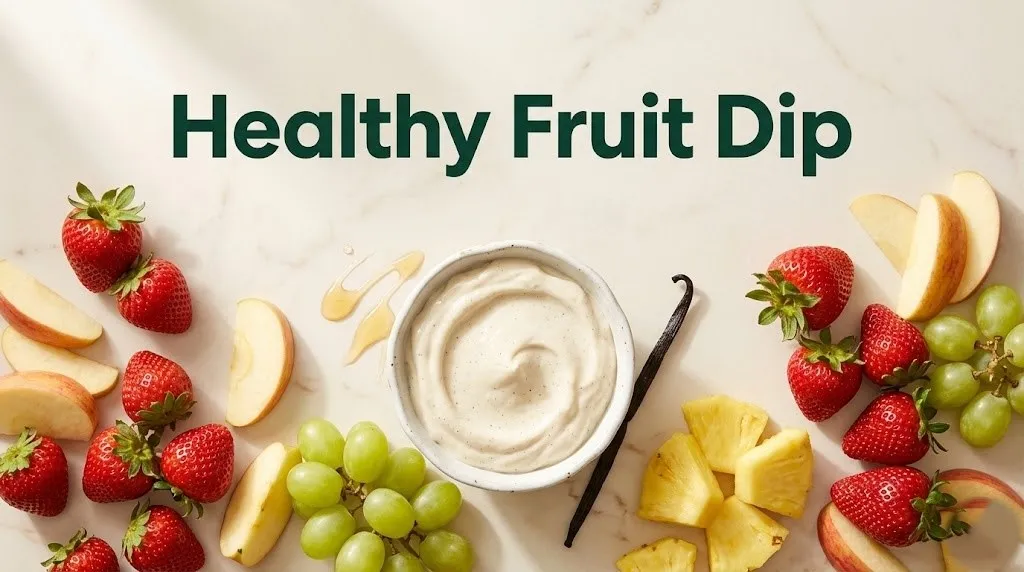
The Academy of Nutrition and Dietetics recognizes snacks as an opportunity to close nutrient gaps in the American diet, particularly for calcium, fiber, and protein. A fruit dip made from strained yogurt or nut butter adds calcium and protein to a snack that would otherwise be primarily carbohydrate and water. You are not just reducing harm. You are adding nutritional value.
healthy fruit dip recipe
This master recipe produces a thick, creamy, vanilla-scented fruit dip using Greek yogurt, a small amount of honey, and vanilla bean paste or extract. It requires five minutes of active time and benefits from a 30-minute chill in the refrigerator. The recipe yields approximately 1.5 cups, enough for 6 to 8 servings.
The choice of Greek yogurt over regular yogurt is intentional and non-negotiable for texture. Greek yogurt has been strained to remove most of the liquid whey, concentrating the protein and creating a thicker, spoonable consistency. Regular yogurt contains more water and will produce a dip that slides off fruit slices and pools liquid in the bottom of the bowl within an hour. If you only have regular yogurt, line a fine-mesh strainer with cheesecloth and let it drain over a bowl in the refrigerator for 2 hours before using.
Vanilla bean paste contains the actual vanilla seeds and contributes a visual speckle and a deeper flavor than extract. It is worth the splurge if you make this dip regularly, but extract works perfectly well. The honey is not only a sweetener. Its viscosity also contributes to the creamy mouthfeel. Maple syrup can substitute, but the dip will be slightly thinner and carry a distinct caramel note.
Ingredients:
- 1 cup plain Greek yogurt (whole-milk, 2%, or nonfat, based on your fat preference)
- 2 tablespoons honey or maple syrup
- 1 teaspoon vanilla bean paste or vanilla extract
- Pinch of fine sea salt
To prepare the dip:
- Spoon the Greek yogurt into a medium mixing bowl. If the yogurt has released any surface liquid, pour it off before measuring.
- Add the honey, vanilla, and salt.
- Stir gently with a spoon or a small whisk using a folding motion rather than vigorous whipping. Stop as soon as the ingredients are uniformly combined, about 15 to 20 strokes.
- Transfer to a serving bowl, cover with plastic wrap pressed directly onto the surface to prevent a skin from forming, and refrigerate for at least 30 minutes.
- Remove from the refrigerator, stir once gently to recombine, and serve alongside fresh fruit.
fruit dip healthy
A fruit dip qualifies as healthy when its primary ingredient is a whole, minimally processed food like yogurt or nut butter, its added sugar content stays below 4 grams per serving, and it contributes protein, calcium, or healthy fats instead of empty calories. The word “healthy” on a fruit dip label or recipe title is not regulated, so you need to read the ingredient list and the nutrition panel, not the marketing.
The nutritional contrast between a standard dip and a healthy one is stark. The USDA FoodData Central database confirms that a 2-tablespoon serving of marshmallow creme contains 60 calories, 15 grams of carbohydrate, and 10 grams of added sugar, with zero protein and zero fat. Cream cheese adds 100 calories and 10 grams of fat per 2 tablespoons, most of it saturated. Combined, the traditional base starts at 160 calories and 10 grams of added sugar for a 2-tablespoon serving. A healthy Greek yogurt dip with honey starts at 45 to 70 calories per 2 tablespoons with 3 to 5 grams of added sugar and 6 grams of protein.
The fat question deserves attention. Nonfat Greek yogurt produces the lowest-calorie dip, but the absence of fat affects satiety and the way the dip coats the mouth. Whole-milk Greek yogurt contains 3 to 4 grams of fat per serving, mostly saturated, and the dip tastes richer and feels more satisfying. The USDA Dietary Guidelines recommend limiting saturated fat to less than 10 percent of total daily calories. A serving of whole-milk yogurt dip uses about 2 percent of that limit. This is not a health trade-off worth agonizing over for most people. Choose the fat level that makes the dip enjoyable enough to eat regularly.
| Dip Type (per 2 tbsp) | Calories | Protein | Added Sugar | Saturated Fat |
|---|---|---|---|---|
| Marshmallow + Cream Cheese | 160 | <1 g | 10 g | 5 g |
| Greek Yogurt + Honey (nonfat) | 45 | 6 g | 3 g | 0 g |
| Greek Yogurt + Honey (whole milk) | 70 | 5 g | 3 g | 2 g |
| Almond Butter + Maple Syrup | 110 | 4 g | 4 g | 1 g |
healthy dip for fruit
A healthy dip for fruit is any sauce or spread with a nutritionally sound ingredient list that improves the eating experience of fresh fruit without undermining the health reasons for choosing fruit as a snack. The dip should adhere to the fruit, not slide off, and it should taste good enough that the fruit actually gets eaten.
This last point matters practically. A perfectly formulated healthy dip that nobody wants to eat is not healthier than a less perfect dip that gets a five-year-old excited about eating a plate of apple slices. The goal is compliance, not optimization. If your household will only eat a fruit dip that includes a tablespoon of chocolate hazelnut spread, stir a tablespoon of chocolate hazelnut spread into the Greek yogurt and move on. The 80 percent yogurt base still provides the protein and calcium, and the 20 percent indulgence makes the whole enterprise succeed.
The dip should also complement the fruit rather than overpower it. A heavy, intensely sweet dip makes the fruit taste bland by comparison. A lightly sweetened, tangy dip makes the fruit taste sweeter and more vibrant. This is the same principle that makes a squeeze of lemon juice improve a fruit salad. The dip should be the supporting actor, not the lead.
Key Takeaway: A healthy fruit dip is defined by what it adds (protein, calcium, satiety) and what it avoids (the double-digit added sugar of marshmallow-cream dips), but its real-world health value is zero if nobody wants to eat it.
fruit dip recipe healthy
A fruit dip recipe is healthy when it lists a protein-rich base as the first ingredient, sweetens with a whole-food source like fruit puree or a measured amount of honey, and avoids marshmallow creme, whipped topping, and powdered sugar entirely. The recipe structure itself should reflect a different set of priorities from the standard version.
The master Greek yogurt recipe earlier in this article meets that standard. It uses four ingredients, all of which you can pronounce and most of which you likely already own. The salt is not an afterthought. Salt suppresses bitterness and amplifies perceived sweetness. A pinch of fine sea salt in a yogurt-based fruit dip makes the honey taste more present without adding more honey. This is the same reason a good chocolate chip cookie recipe includes salt. It is a flavor amplifier, not a seasoning.
If you want to eliminate added sugar entirely, you can sweeten the dip with ripe banana puree or date paste. To make date paste, soak 4 pitted Medjool dates in hot water for 10 minutes, drain, and blend with 2 tablespoons of the soaking water until completely smooth. Stir 1 tablespoon of date paste into the yogurt along with the vanilla and salt. The resulting dip has zero grams of added sugar because the sweetness comes from whole fruit, which the FDA does not classify as added sugar on the Nutrition Facts label.
healthy fruit dips
Healthy fruit dips, in the plural, refers to the expanding category of fruit dip recipes that use yogurt, nut butter, cottage cheese, silken tofu, or pureed fruit as their base, each offering a different nutritional profile and flavor direction. You are not locked into a single recipe. The base can rotate depending on what is in your refrigerator and what fruit you are serving.
A nut-butter-based dip works beautifully with apple slices, pear wedges, and bananas. Whisk 1/4 cup of unsweetened creamy almond butter or peanut butter with 2 tablespoons of Greek yogurt to lighten the texture, 1 tablespoon of maple syrup, and a pinch of salt. The dip is calorie-dense at roughly 100 calories per 2 tablespoons, but the combination of protein, healthy fat, and fiber from the nut butter combined with the fruit’s fiber produces genuine and lasting satiety. A sliced apple with 2 tablespoons of almond butter dip can function as a light lunch, not just a snack.
A cottage cheese dip offers the highest protein option. Blend 1 cup of full-fat cottage cheese in a food processor until completely smooth, about 60 seconds, scraping down the sides once. Add 1 tablespoon of honey, the zest of half an orange, and a quarter teaspoon of vanilla. The result is a mousse-like dip with roughly 10 grams of protein per quarter-cup serving. The flavor is mild and slightly tangy, pairing best with strawberries, pineapple, and melon.
| Dip Base | Protein per 2 tbsp | Best Fruit Pairing | Key Nutrient |
|---|---|---|---|
| Greek yogurt (nonfat) | 6 g | Berries, grapes, melon | Calcium, probiotics |
| Almond butter | 4 g | Apples, pears, bananas | Vitamin E, magnesium |
| Blended cottage cheese | 5 g | Strawberries, pineapple | Casein protein, calcium |
| Coconut yogurt (vegan) | <1 g | Tropical fruit, mango | Medium-chain triglycerides |
healthy dips for fruit
Healthy dips for fruit encompass the full range of options from yogurt-based recipes to nut and seed butters to pureed fruit sauces, and the best choice on any given day depends on what fruit is in season and who is eating it. A dip that gets a toddler excited about strawberries is worth a gram or two of extra sugar.
Children and adults approach fruit dip differently. Kids often want sweetness and a fun, dunkable ritual. Adults tend to want something that feels substantial and prevents hunger between meals. A parent can serve the same plate of fruit with two different dips: a lightly sweetened yogurt dip for the kids and a salted almond butter dip for themselves. The labor difference is opening one extra container and stirring for 30 seconds.
Presentation affects consumption more than most nutrition articles acknowledge. A dip served in a small, colorful bowl next to fruit arranged in a pattern gets eaten. A dip served in the plastic yogurt container with fruit piled on a plate gets ignored. The five seconds it takes to transfer the dip to a serving bowl is an investment in the snack actually being consumed. This is not frivolous advice. It is practical food psychology grounded in decades of feeding research.
healthy dip for strawberries
A healthy dip for strawberries is typically a lightly sweetened Greek yogurt or a dark chocolate yogurt dip that enhances the berry’s natural sweetness and slight acidity without burying the fruit flavor. Strawberries have a high water content and can weep liquid when cut, so the dip needs to be thick enough to cling to the berry surface without sliding off.
The best strawberry-specific dip is a Greek yogurt base with a teaspoon of balsamic vinegar or a few drops of high-quality balsamic reduction added. Balsamic vinegar and strawberries share aromatic compounds that amplify each other. The combination is classic in Italian dessert cooking, and it works in a healthy snack context just as well. The vinegar adds zero calories and makes the strawberries taste more intensely strawberry-like.
For a chocolate-covered strawberry experience without the tempering and the added sugar, stir 1 tablespoon of unsweetened cocoa powder and 2 teaspoons of maple syrup into 1 cup of Greek yogurt. The dip turns a pale brown and tastes like a creamy, tangy chocolate mousse. It works with strawberries, banana chunks, and orange segments. The cocoa adds polyphenols and a small amount of iron. The total added sugar stays under 4 grams per serving.
Quick Tip for Strawberry Dips:
- Pat cut strawberries dry with a paper towel before dipping to remove surface moisture.
- The balsamic yogurt dip tastes best after 30 minutes in the fridge for the flavors to meld.
- Strawberries dipped in nut butter dip benefit from a tiny sprinkle of flaky sea salt on top.
healthy fruit dip recipes
Healthy fruit dip recipes now span dairy, dairy-free, nut-based, and no-added-sugar categories, reflecting a broader shift in home cooking toward snacks that serve a nutritional purpose beyond simple calories. The recipe collection below provides a starting point for rotating through different bases and flavor profiles across the week.
A citrus-ginger yogurt dip pairs with melon, pineapple, and mango. Stir 1 cup of Greek yogurt with the zest of one lime, 1 teaspoon of finely grated fresh ginger, 2 teaspoons of honey, and a tiny pinch of cayenne pepper. The ginger and cayenne create a warmth that contrasts with cold, sweet fruit. The lime brightens everything. This dip is particularly effective for fruit platters at brunch or outdoor gatherings where the food sits out and needs to taste vibrant at room temperature.
A spiced maple tahini dip is a vegan option that works with apples, pears, and figs. Whisk together 1/4 cup of well-stirred tahini, 2 tablespoons of warm water, 1 tablespoon of maple syrup, a quarter teaspoon of ground cinnamon, and a pinch of salt. The tahini is rich in calcium and healthy fats. The dip is thicker than a yogurt-based version and clings to fruit slices like a sauce. Add more water a teaspoon at a time if it is too stiff to dip easily.
Three recipes to rotate through:
- Vanilla Greek yogurt with honey (master recipe, works with all fruit)
- Cocoa Greek yogurt with a pinch of cinnamon (for berries and bananas)
- Maple tahini with cinnamon and a splash of water (vegan, for apples and pears)
easy healthy fruit dip
An easy healthy fruit dip is one that requires no blender, no food processor, no stovetop, and no more than three ingredients plus salt, coming together in under five minutes with a single bowl and a spoon. Ease is a feature, not a compromise, because a dip that is not easy does not get made on a Tuesday afternoon.
The easiest version is plain Greek yogurt stirred with a spoonful of fruit preserves or jam. The jam provides sweetness and fruit flavor in one ingredient. Choose a jam sweetened with fruit juice concentrate or one labeled “no added sugar” if you want to keep the added sugar count low. Stir 2 tablespoons of strawberry jam into 1 cup of yogurt. The dip is pink, sweet, and tastes like strawberry cheesecake without the cream cheese or the effort.
The second easiest version is a single-serve flavored Greek yogurt cup used directly as a dip. Many Greek yogurt cups are now sold in dessert flavors like vanilla bean, coconut, and key lime. Check the added sugar line on the label and choose one with less than 8 grams per container. Spoon it into a bowl, add a sprinkle of cinnamon or a drop of vanilla, and serve. The convenience factor is maximum, and the nutritional profile is still far better than marshmallow creme.
is fruit dip healthy
Fruit dip is healthy when it is made from yogurt, nut butter, or blended cottage cheese with minimal added sugar, and it is not healthy when it is made from marshmallow creme, cream cheese, and whipped topping with double-digit grams of added sugar per serving. The answer depends entirely on the ingredient list, not on the concept of a dip itself.
The question usually comes from someone looking at a fruit dip recipe and feeling suspicious that a food that tastes like dessert can possibly be good for you. That suspicion is well-founded for the traditional version. It is less warranted for the new generation of yogurt and nut-butter-based recipes. Those recipes are not hiding anything. They are yogurt with a little honey and vanilla. You would not ask if a bowl of yogurt with honey is healthy. Calling it a fruit dip does not change the nutritional reality.
Store-bought fruit dips are a different category and require label scrutiny. Products labeled “fruit dip” in the refrigerated section of grocery stores are often cream cheese and sugar blends with stabilizers and preservatives. A 2-tablespoon serving of a commercial fruit dip can contain 100 to 130 calories, 8 to 12 grams of sugar, and ingredients like modified corn starch, carrageenan, and artificial flavor. These are not the same product as the homemade versions described in this article. If you are buying a fruit dip, read the ingredient panel and the added sugar line before you buy.
Key Takeaway: “Fruit dip” is not inherently healthy or unhealthy. It is a category defined by its ingredients, and the difference between a Greek yogurt dip and a marshmallow-cream dip is the difference between a nutritious snack and a dessert.
healthy fruit dip without yogurt
A healthy fruit dip without yogurt uses blended silken tofu, nut butter, tahini, or pureed beans as its creamy base, providing protein and texture for people who avoid dairy due to allergy, veganism, or taste preference. The yogurt-free options are not second-class substitutes. Some of them outperform yogurt in flavor and satiety.
Silken tofu is the closest dairy-free analogue to Greek yogurt in terms of protein content and neutral flavor. Blend one 12-ounce block of shelf-stable silken tofu with 3 tablespoons of maple syrup, 2 teaspoons of vanilla extract, and a pinch of salt until completely smooth, about 60 seconds. The result is a pourable, mousse-like dip with roughly 5 grams of protein per quarter-cup serving. It tastes like nothing but sweet vanilla, making it a blank canvas for any fruit. The tofu must be silken, not firm or extra-firm. Firm tofu will not blend smooth and will produce a grainy, curdled texture.
White bean puree is a less obvious but surprisingly effective base. A can of cannellini beans, drained and rinsed, blended with 2 tablespoons of almond butter, 2 tablespoons of maple syrup, a teaspoon of vanilla, and a pinch of salt produces a dip that tastes like a creamy, nutty caramel. The beans provide fiber and protein. The almond butter masks any bean flavor. The texture is thick and spreadable, almost frosting-like. Do not reveal the bean ingredient until after guests have complimented the dip.
Dairy-free dip bases ranked by protein content:
- Silken tofu: 5 g protein per 1/4 cup
- Almond butter with a splash of oat milk: 8 g protein per 1/4 cup
- Coconut yogurt: less than 1 g protein per 1/4 cup
- White bean puree with almond butter: 4 g protein per 1/4 cup
Frequently Asked Questions About Healthy Fruit Dip
What is a healthy substitute for cream cheese in fruit dip?
Greek yogurt is the best healthy substitute for cream cheese in fruit dip because it provides a similar tangy flavor and creamy texture with a fraction of the calories and saturated fat.
Blended cottage cheese works as a higher-protein alternative with a milder flavor.
For a dairy-free option, silken tofu blended until smooth replicates the thickness of cream cheese without the dairy.
How long does healthy fruit dip last in the fridge?
A Greek yogurt-based fruit dip lasts 3 to 4 days in the refrigerator when stored in an airtight container.
Nut-butter-based dips last up to 1 week because they contain less moisture and no active bacterial cultures.
Always discard any dip that has sat at room temperature for more than 2 hours.
Is fruit dip good for weight loss?
A Greek yogurt fruit dip can support weight loss because its high protein content increases satiety compared to eating fruit alone.
A 2-tablespoon serving adds only 45 to 70 calories while contributing 6 grams of protein.
The dip makes fruit feel like a more substantial snack, which can reduce the likelihood of reaching for higher-calorie options an hour later.
Can I make a healthy fruit dip dairy-free?
You can make a dairy-free fruit dip using silken tofu, coconut yogurt, almond butter, or tahini as the base.
Silken tofu blended with maple syrup and vanilla provides the closest texture and protein content to a yogurt-based dip.
Coconut yogurt works for flavor but contains significantly less protein.
Why did my yogurt fruit dip get watery?
Your yogurt fruit dip got watery because the whey separated from the yogurt solids, a process called syneresis.
This happens when yogurt is over-stirred, when it sits for more than a day, or when the original yogurt was not fully strained.
Prevent this by using thick Greek yogurt, stirring gently, and draining any surface liquid before mixing.
A healthy fruit dip is a small intervention with an outsized impact. You take a snack that is already good, fresh fruit, and you make it more appealing and more satiating without introducing the sugar load that defines the traditional version. The time commitment is under five minutes. The ingredient list is short. The payoff is a snack that children and adults both reach for.
Keep a container of Greek yogurt and a jar of almond butter in your refrigerator as dip infrastructure. When fruit comes out, the dip comes together in the time it takes to wash the berries. Rotate through the variations in this article based on what fruit is on the counter and what flavor sounds appealing.
The single best metric for whether a healthy snack strategy is working is whether the fruit gets eaten. If a spoonful of cocoa-yogurt dip makes a bowl of strawberries disappear, you have succeeded.