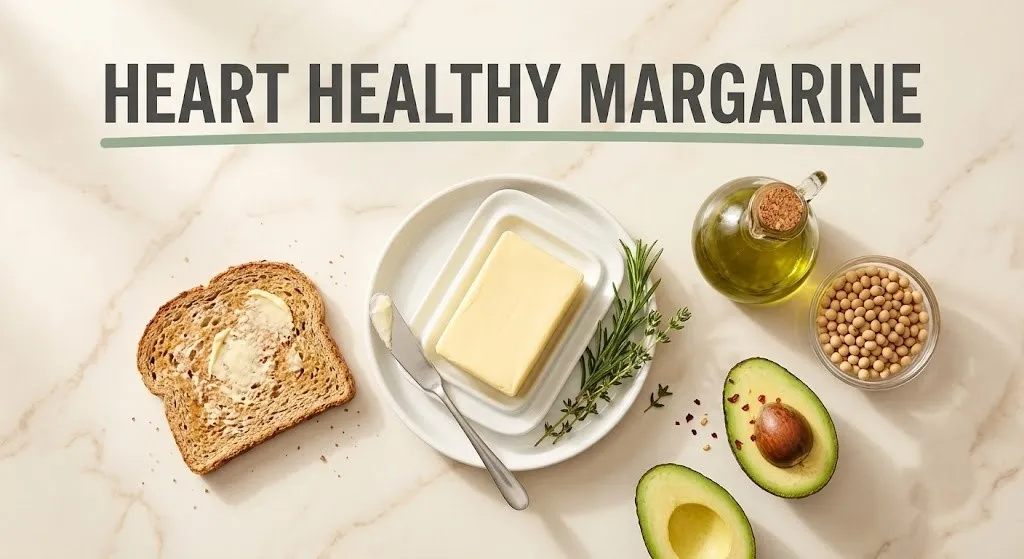
Heart healthy margarine is a vegetable oil-based spread specifically formulated to be low in saturated fat, free of trans fat, and in some cases, fortified with plant sterols or stanols that actively lower LDL cholesterol. The right margarine, meaning a soft tub or liquid version made from unsaturated oils like soybean, canola, or olive oil, is a genuinely heart-healthier alternative to butter. The wrong margarine, meaning a hard stick margarine or one made with palm oil, may offer less advantage or none at all.
The American Heart Association recommends limiting saturated fat to 5% to 6% of daily calories, which equals approximately 13 grams for a 2,000-calorie diet. A single tablespoon of butter contains 7 grams of saturated fat, over half the daily limit. A tablespoon of heart-healthy tub margarine contains 1 to 2 grams. The cumulative effect of swapping butter for margarine across all the places butter appears in a standard diet, toast, sandwiches, cooking, baking, can reduce saturated fat intake by 20 to 30 grams per week or more.
This guide explains exactly what makes a margarine heart-healthy, how to read the label to find the good ones, which brands deliver on their health claims, and how to use margarine successfully in everything from spreading to baking. You will also learn the truth about trans fat in modern margarine, the science behind plant sterol spreads, and the calorie comparison with butter that surprises most people.
Is margarine healthy
Margarine is healthy when it is a soft tub or liquid spread made primarily from unsaturated vegetable oils with low saturated fat and zero trans fat. It is unhealthy when it is a hard stick margarine that may still contain trace trans fats from the manufacturing process or when it is made from tropical oils like palm oil that are high in saturated fat. The word “margarine” on a label does not tell you whether the product is healthy. The ingredient list and the Nutrition Facts panel tell you.
The nutritional reputation of margarine suffered significant damage from the trans fat era. Before the FDA’s 2018 ban on partially hydrogenated oils, many margarines contained high levels of industrially produced trans fats that raised LDL cholesterol and lowered HDL cholesterol, making them worse for heart health than butter. That era is over. Modern margarines manufactured for the U.S. market are made without partially hydrogenated oils. They use interesterified fats or liquid oils blended with small amounts of fully hydrogenated oils, processes that do not create trans fats in significant quantities.
The Academy of Nutrition and Dietetics position on dietary fats confirms that replacing saturated fat with unsaturated fat reduces cardiovascular disease risk. Margarine made from soybean oil, canola oil, or olive oil replaces the saturated fat in butter with the unsaturated fats that have this protective effect. A 2023 meta-analysis in the Journal of the American College of Cardiology found that each 5% replacement of saturated fat calories with unsaturated fat calories was associated with a 15% to 25% reduction in coronary heart disease risk. Margarine is not a health food in the way vegetables are. It is a harm-reduction substitution that replaces a harmful fat with a neutral or beneficial one.
Key Takeaway: Modern tub margarine made from unsaturated oils is healthy. Stick margarine and margarine made from palm oil offer less advantage.
What makes margarine heart healthy
What makes margarine heart healthy is a fat profile that is low in saturated fat, high in unsaturated fat, and completely free of trans fat. The specific oils used in the margarine determine this profile. Soybean oil, canola oil, olive oil, and avocado oil are predominantly unsaturated and produce heart-healthy margarines. Palm oil and palm kernel oil are approximately 50% and 85% saturated, respectively, and produce margarines that are only marginally better than butter for heart health.
The unsaturated fat in heart-healthy margarine works through two mechanisms. Monounsaturated fats, the primary fats in olive oil and canola oil, reduce LDL cholesterol when they replace saturated fat in the diet. Polyunsaturated fats, the primary fats in soybean oil and corn oil, also reduce LDL cholesterol and may have a small additional benefit for HDL cholesterol and triglyceride levels. The American Heart Association specifically recommends replacing saturated fat with polyunsaturated and monounsaturated fats for cardiovascular risk reduction.
Plant sterols and stanols, added to some margarines as functional ingredients, provide an additional cholesterol-lowering mechanism beyond the basic fat swap. Plant sterols are structurally similar to cholesterol and compete with cholesterol for absorption in the small intestine. When you eat a plant sterol-fortified margarine with a meal, less dietary and biliary cholesterol is absorbed into the bloodstream. The FDA authorizes a health claim on products containing at least 0.65 grams of plant sterol esters or 1.7 grams of plant stanol esters per serving, stating that they may reduce the risk of coronary heart disease when consumed as part of a diet low in saturated fat and cholesterol.
Key Takeaway: Heart-healthy margarine gets its benefit from unsaturated oils that replace saturated fat. Plant sterol-fortified margarines add a cholesterol-blocking mechanism.
Margarine vs butter heart health
Margarine beats butter for heart health when the margarine is made from unsaturated vegetable oils and the butter is standard butter made from cream. A tablespoon of butter contains 7 grams of saturated fat, 31 milligrams of cholesterol, and no unsaturated fat benefit. A tablespoon of heart-healthy tub margarine contains 1 to 2 grams of saturated fat, 0 milligrams of cholesterol, and 5 to 8 grams of unsaturated fat that actively improves the blood lipid profile. The swap reduces saturated fat intake and adds beneficial unsaturated fat simultaneously.
The research supporting margarine over butter for heart health is consistent across decades of metabolic ward studies, cohort studies, and randomized controlled trials. The Nurses’ Health Study and the Health Professionals Follow-Up Study, two of the largest and longest nutritional epidemiology cohorts, found that replacing 5% of calories from saturated fat with polyunsaturated fat was associated with a 25% lower risk of coronary heart disease. A tablespoon of butter replaced by a tablespoon of soybean oil margarine represents a meaningful step in that direction.
The exception to margarine’s advantage is stick margarine made with palm oil or partially hydrogenated oils. The FDA ban on partially hydrogenated oils has removed the worst trans fat offenders from the market, but stick margarines can still contain 0.5 grams of trans fat per serving if the product is labeled as 0 grams due to rounding rules. Products with less than 0.5 grams per serving can round down to zero. If “partially hydrogenated oil” appears in the ingredient list, the product contains trans fat regardless of the Nutrition Facts panel number. No amount of industrially produced trans fat is considered safe by the FDA or the World Health Organization.
| Per 1 Tablespoon | Butter | Heart-Healthy Tub Margarine | Stick Margarine |
|---|---|---|---|
| Calories | 100 | 70-80 | 90-100 |
| Total Fat | 11g | 8-9g | 10-11g |
| Saturated Fat | 7g | 1-2g | 3-4g |
| Trans Fat | 0.3g (natural) | 0g | 0-0.5g |
| Cholesterol | 31mg | 0mg | 0mg |
| Unsaturated Fat | 3g | 6-7g | 5-6g |
Key Takeaway: Tub margarine made from unsaturated oils is better than butter for heart health. Stick margarine and palm oil margarine offer less advantage.
Is margarine healthier than butter
Margarine is healthier than butter when the margarine is a soft tub or liquid product made from unsaturated oils and the health metric is cardiovascular risk. It is not healthier than butter when the margarine is a hard stick or made from palm oil, when the consumer has a soy allergy and butter is tolerated, or when the health metric is how minimally processed the food is. Butter is made from one ingredient: cream. Margarine is an industrially formulated product with multiple ingredients. “Healthier” depends on which aspect of health is being prioritized.
The calorie comparison between margarine and butter surprises many consumers. Butter and margarine contain roughly the same number of calories per tablespoon: 100 calories for butter and 70 to 100 calories for margarine, depending on the water content. Tub margarines and “light” spreads incorporate more water and air, reducing the calorie density to 50 to 70 calories per tablespoon. Stick margarines are denser and match butter’s calorie count. If weight management is the goal, margarine offers only a modest calorie advantage with the lighter tub versions, not with the standard sticks.
The processing comparison matters to consumers who prioritize minimally processed foods. Butter is churned cream. Margarine is created through a multi-step industrial process that extracts, refines, and sometimes modifies vegetable oils, then emulsifies them with water, salt, preservatives, and fortifying nutrients. The ingredient list for butter is one item. The ingredient list for margarine is six to fifteen items. For consumers who define “healthy” by the number of ingredients and the extent of processing, butter wins. For consumers who define “healthy” by the impact on blood cholesterol and cardiovascular risk, tub margarine made from unsaturated oils wins.
Key Takeaway: Margarine is healthier than butter for cardiovascular risk reduction. Butter is less processed. The definition of “healthier” determines the winner.
Margarine nutrition facts
Margarine nutrition facts vary by product type, with tub, stick, and light margarines differing in fat content, water content, and calorie density. A standard tablespoon of full-fat tub margarine made from soybean oil provides approximately 80 calories, 9 grams of total fat, 1.5 grams of saturated fat, 0 grams of trans fat, 0 milligrams of cholesterol, and 3.5 grams of polyunsaturated fat and 3.5 grams of monounsaturated fat. Light margarines cut the fat and calories roughly in half by incorporating more water.
The saturated fat content is the number that matters most for heart health and the number that varies most across products. A tub margarine made from canola or soybean oil typically contains 1 to 2 grams of saturated fat per tablespoon. A tub margarine made from a blend that includes palm oil may contain 2.5 to 4 grams. A stick margarine, even one made primarily from soybean oil, contains 3 to 4 grams because the hydrogenation or interesterification required to make the product solid at room temperature increases the saturated fat content. Reading the label on each specific product is necessary because the category “margarine” spans a wide nutritional range.
Margarine is fortified with vitamin A and vitamin D in the United States, a practice that began during World War II when butter was rationed. A tablespoon of margarine typically provides 10% of the Daily Value for vitamin A and 5% to 10% for vitamin D. Butter provides these vitamins naturally but in smaller and more variable amounts. The fortification levels are regulated by the FDA and are nutritionally meaningful, particularly for vitamin D, which is difficult to obtain from food sources. This fortification history gives margarine a micronutrient advantage that is rarely discussed in the butter versus margarine debate.
Key Takeaway: Tub margarine provides 80 calories and 1.5 grams of saturated fat per tablespoon. Stick margarine is higher in saturated fat. Both are fortified with vitamins A and D.
Margarine saturated fat content
Margarine saturated fat content ranges from 0.5 grams in the most aggressive light formulations to 4 grams in stick margarines, per tablespoon. The saturated fat comes from two sources: the base oils used and the hardening process applied. Liquid vegetable oils like soybean, canola, and olive oil are naturally low in saturated fat. When these oils are used in tub margarines that remain soft, the saturated fat stays low. When oils are hydrogenated or interesterified to create a solid stick product, the saturated fat content rises.
The specific oil blend determines the saturated fat floor. Canola oil is approximately 7% saturated fat, the lowest among common margarine oils. Soybean oil is approximately 15% saturated. Palm oil is approximately 50% saturated. Coconut oil is approximately 90% saturated. A margarine made primarily from palm or coconut oil will always have higher saturated fat than one made from canola or soybean oil, regardless of processing method. The ingredient list reveals the oil source. The Nutrition Facts panel confirms the saturated fat total.
The American Heart Association’s 13-gram daily saturated fat limit provides the benchmark for evaluating margarine’s contribution. A tablespoon of canola oil tub margarine at 1 gram uses 8% of the daily limit. A tablespoon of butter at 7 grams uses 54%. A person who uses two tablespoons of butter across toast, cooking, and vegetables at dinner has already exceeded the daily limit. The same person using canola margarine has used 15%. The cumulative effect across all the fat-containing foods in a day makes the butter or margarine decision consequential for saturated fat management.
Key Takeaway: Tub margarines made from canola or soybean oil contain 1 to 2 grams of saturated fat per tablespoon. Stick margarines and palm oil margarines contain more.
Trans fat in margarine
Trans fat in margarine has been largely eliminated from the U.S. food supply since the FDA’s 2018 ban on partially hydrogenated oils, but trace amounts can still appear in stick margarines and some imported products. The ban removed the primary source of industrially produced trans fats. Modern margarine manufacturing uses interesterification, a process that rearranges fatty acids on the glycerol backbone without creating trans double bonds, or uses fully hydrogenated oils blended with liquid oils. Fully hydrogenated oils are saturated fats, not trans fats, because the hydrogenation is taken to completion and no double bonds remain.
The Nutrition Facts panel can list 0 grams of trans fat even when a product contains up to 0.49 grams per serving due to FDA rounding rules. For a person using multiple servings of margarine daily, these trace amounts can add up to 1 to 2 grams of trans fat per day, which is not trivial. The World Health Organization recommends limiting trans fat intake to less than 1% of daily calories, approximately 2 grams for a 2,000-calorie diet. The trace trans fats from stick margarine could consume a significant portion of that limit.
The practical way to avoid trans fat in margarine is to check the ingredient list for the words “partially hydrogenated.” If those words appear, the product contains trans fat regardless of what the Nutrition Facts panel says. If they do not appear, the trans fat content is truly negligible. Tub margarines and liquid margarines are less likely to contain even trace trans fats because they do not require the hardening processes that can create them. The FDA ban has made trans fat avoidance straightforward for consumers who read labels.
Key Takeaway: Trans fat has been largely eliminated from margarine since 2018. Check the ingredient list for “partially hydrogenated” to confirm a product is trans fat free.
Plant sterol margarine
Plant sterol margarine is a functional food product fortified with plant sterols or plant stanols, compounds that block the absorption of cholesterol in the small intestine and can lower LDL cholesterol by 5% to 15% when consumed consistently at the recommended dose. These products, sold under brand names like Benecol and Promise Activ, are margarines with an additional health claim authorized by the FDA. They work, but they are not a replacement for cholesterol-lowering medication in people who need it.
Plant sterols and stanols are structurally similar to cholesterol. When consumed with a meal, they compete with dietary and biliary cholesterol for incorporation into mixed micelles, the transport particles that carry cholesterol across the intestinal wall. Cholesterol that is not incorporated into micelles passes through the digestive tract unabsorbed and is excreted. The effective dose is 2 to 3 grams of plant sterols or stanols per day, typically achieved with 2 to 3 tablespoons of fortified margarine spread across meals. A single tablespoon taken only at breakfast will not produce the full cholesterol-lowering effect.
The clinical evidence for plant sterol margarines is strong. A 2023 meta-analysis in the American Journal of Clinical Nutrition reviewed 45 randomized controlled trials and confirmed that plant sterol intake of 2 grams per day reduces LDL cholesterol by 8% to 10% on average, with some individuals responding more and some less. The effect is additive to the LDL reduction from replacing saturated fat with unsaturated fat. A person who switches from butter to a plant sterol-fortified tub margarine gets the saturated fat reduction benefit plus the sterol cholesterol-blocking benefit. Plant sterol margarines cost more than standard margarines, typically $5 to $8 for a tub compared to $3 to $5 for standard margarine.
Key Takeaway: Plant sterol margarines lower LDL cholesterol by 8% to 10% when consumed at 2 to 3 tablespoons per day spread across meals.
Best margarine for cholesterol
The best margarine for lowering cholesterol is a plant sterol-fortified tub margarine made from unsaturated oils, used consistently at 2 to 3 tablespoons per day spread across meals. This product delivers three cholesterol-lowering mechanisms simultaneously. It replaces the saturated fat in butter with unsaturated fat. It provides plant sterols that block cholesterol absorption. It contributes zero dietary cholesterol. No other single food substitution in the American diet matches this triple effect on the lipid profile.
For consumers who do not want to pay the premium for plant sterol margarines or who find the taste unacceptable, the next best option is a standard tub margarine made from canola or soybean oil with 1 to 2 grams of saturated fat per tablespoon and no trans fat. The saturated fat reduction alone, sustained over months and years, produces a measurable LDL cholesterol reduction. A 2022 study in the Journal of Nutrition found that replacing butter with non-sterol tub margarine for 8 weeks reduced LDL cholesterol by 6% compared to baseline in adults with mild hypercholesterolemia.
The cholesterol-lowering effect of margarine depends on what it replaces and what else is in the diet. Swapping butter for margarine but continuing to eat high-saturated-fat meats, cheese, and processed foods will produce a smaller LDL reduction than expected. Swapping butter for margarine as part of a broader dietary pattern shift toward the Mediterranean diet or the DASH diet produces a larger reduction. The margarine is one component of a lipid-lowering dietary strategy, not a standalone solution.
Key Takeaway: Plant sterol-fortified margarine is the best choice for cholesterol reduction. Standard tub margarine is the next best option. Both work as part of a broader heart-healthy diet.
Best heart healthy margarine
The best heart healthy margarine in 2026 combines a liquid vegetable oil base, a saturated fat content of 1.5 grams or less per tablespoon, zero trans fat, and no palm oil or coconut oil. Products that meet this standard include Smart Balance Original (but check the label as formulations change), Earth Balance (soy-based tub version), Benecol (plant stanol-fortified), and store-brand canola oil or soybean oil tub margarines that list liquid oil as the first ingredient.
Smart Balance uses a blend of soybean, palm, and canola oils and has reformulated over the years to reduce saturated fat. The original tub version contains approximately 2 grams of saturated fat per tablespoon. Earth Balance, marketed as a vegan buttery spread, uses a blend of palm fruit, canola, soybean, flax, and olive oils. The saturated fat content is approximately 2.5 grams per tablespoon, which is low for a spread but not the lowest available. Benecol uses canola oil as its base and contains approximately 1 gram of saturated fat per tablespoon plus 0.85 grams of plant stanol esters per serving.
Store-brand tub margarines are often the nutritional equal of name brands at a lower price. A supermarket canola oil tub margarine with 1 gram of saturated fat per serving and an ingredient list that begins with “liquid canola oil” is nutritionally excellent and costs $2 to $4 per tub. The brand name does not determine the healthfulness of the margarine. The oil source, the saturated fat number on the Nutrition Facts panel, and the absence of “partially hydrogenated” in the ingredient list determine it.
Key Takeaway: Benecol, Smart Balance, and store-brand canola oil tub margarines are the best heart-healthy options. Check the saturated fat number and ingredient list.
Best healthy margarine
The best healthy margarine depends on the health goal being prioritized. For cholesterol lowering, a plant sterol-fortified margarine like Benecol is the best choice. For overall cardiovascular risk reduction at a reasonable price, a generic canola or soybean oil tub margarine is the best choice. For a margarine that avoids soy and dairy allergens, an olive oil-based spread or a soy-free formulation from Earth Balance is the best choice. “Healthy” is not one-size-fits-all.
For consumers who prioritize minimal processing and recognizable ingredients, the margarine category is fundamentally challenging. Margarine is an industrially formulated product. Even the healthiest tub margarine contains emulsifiers, preservatives, and added color. Butter is less processed but worse for heart health. The consumer who wants a minimally processed spreadable fat with a heart-healthy profile might consider simply using a pour of olive oil on bread instead of spreading anything. Olive oil is a single ingredient with the best cardiovascular evidence base of any fat source.
For baking and cooking, the healthiest margarine is one that performs the culinary function required without adding harmful fats. A tub margarine with 60% to 70% fat works for spreading and sauteing but is not suitable for pastry where butter’s solid structure and melting behavior are essential. The healthiest baking fat is the one that delivers the minimum saturated fat for the specific recipe. In cookies where butter’s flavor is central, a blend of half butter and half canola oil margarine reduces saturated fat while preserving enough butter flavor to satisfy. In muffins where the fat is structural rather than flavorful, a full swap to canola oil or canola oil margarine works without detectable difference.
Key Takeaway: The best healthy margarine depends on your health goal. Cholesterol lowering, low saturated fat, allergen avoidance, or minimal processing each point to different products.
Margarine ingredients to avoid
Margarine ingredients to avoid include partially hydrogenated oil of any kind, palm oil and palm kernel oil when listed as primary ingredients, and artificial preservatives such as TBHQ and BHA when cleaner alternatives exist. Partially hydrogenated oil is the red flag for trans fat. If it appears in the ingredient list, the product should be returned to the shelf regardless of what the Nutrition Facts panel says about trans fat.
Palm oil is a complicated ingredient. It is approximately 50% saturated fat, which makes it less heart-healthy than canola or soybean oil. It is also the most widely consumed vegetable oil globally, and its production has significant environmental consequences, including deforestation and habitat loss for orangutans and other species. The Roundtable on Sustainable Palm Oil (RSPO) certifies palm oil produced with environmental protections, but the saturated fat content is unchanged regardless of sustainability practices. Margarines that use palm oil as a secondary oil to improve texture are different from margarines that use it as the primary oil. Check the order of ingredients. The higher palm oil appears on the list, the more saturated fat the product contains.
Mono- and diglycerides are emulsifiers that appear in most margarines. They are made from vegetable oils and are considered safe by the FDA. They do not affect heart health. Potassium sorbate and sodium benzoate are preservatives that prevent mold growth in the water-containing tub product. They are safe at the levels used in food. Beta-carotene and annatto are natural colorings that give margarine its butter-like yellow color. These additives are not health concerns. The core health-relevant ingredients are the oils and the saturated fat they contain.
Key Takeaway: Avoid “partially hydrogenated oil” entirely. Limit margarines where palm oil is a primary ingredient. Emulsifiers, preservatives, and colorings are not health concerns.
Tub margarine vs stick margarine
Tub margarine is healthier than stick margarine because the soft, spreadable consistency requires less saturated fat and less processing to achieve. Tub margarines are made primarily from liquid vegetable oils with a small amount of hardened oil to provide structure. The result is a product with 1 to 2 grams of saturated fat per tablespoon. Stick margarines require a higher proportion of solid fat to maintain their shape at room temperature. The additional hardening, whether through interesterification or blending with fully hydrogenated oils, increases the saturated fat content to 3 to 4 grams per tablespoon.
The processing difference between tub and stick margarines is not just about saturated fat. The interesterification process used to create stick margarines rearranges fatty acids on the glycerol molecule. The resulting fat has different melting properties than the original oils, which allows it to be solid at room temperature. The long-term health effects of interesterified fats are still being studied. A 2023 review in Nutrition Reviews found that interesterified fats may raise blood glucose and reduce HDL cholesterol compared to the original liquid oils, though the evidence is preliminary and inconsistent. The precautionary principle suggests choosing tub margarines that require less processing over stick margarines that require more.
Culinary performance is the reason consumers still buy stick margarine. Stick margarine behaves more like butter in baking, producing flakier pie crusts and chewier cookies than tub margarine, which contains more water and less fat by weight. For spreading on toast, tub margarine is superior because it spreads directly from the refrigerator. For baking, stick margarine or butter may perform better. The healthiest choice is to use tub margarine for spreading and for cooking applications where the fat’s solidity does not matter, and to reserve stick margarine for the specific baked goods where it is necessary.
Key Takeaway: Tub margarine has less saturated fat and requires less processing than stick margarine. Choose tub for spreading and most cooking. Use stick only for specific baking needs.
How to read margarine labels
Reading a margarine label for heart health requires checking three things in sequence: the saturated fat per serving on the Nutrition Facts panel, the ingredient list for “partially hydrogenated” oil, and the first oil listed in the ingredients to identify the primary fat source. This thirty-second check separates the heart-healthy margarines from the ones that are just butter substitutes in name only.
The saturated fat line on the Nutrition Facts panel is the first stop. A heart-healthy margarine should contain 2 grams or less of saturated fat per tablespoon. Products with 0.5 to 1 gram are excellent. Products with 2 to 2.5 grams are acceptable. Products with 3 grams or more are no better than half-butter half-margarine blends and offer minimal cardiovascular advantage. The serving size is standardized at 1 tablespoon, making direct comparison between products possible.
The ingredient list is the second stop. Scan for the words “partially hydrogenated.” If they appear, the product contains trans fat. Put it back. Then look at the first oil in the ingredient list. Liquid canola oil, liquid soybean oil, or liquid olive oil as the first fat source indicate a margarine high in unsaturated fat. Palm oil, palm kernel oil, or coconut oil as the first fat source indicate a margarine higher in saturated fat. The order of ingredients on the label reflects the proportion by weight. The oil listed first is the one you are mostly eating.
The third check is optional but informative: the plant sterol or stanol content for fortified margarines. Products containing 0.65 grams or more of plant sterol esters or 1.7 grams or more of plant stanol esters per serving can carry an FDA-authorized heart health claim. This information appears near the Nutrition Facts panel or on the front of the package. If the product is a plant sterol margarine, verify the per-serving amount. The cholesterol-lowering effect requires 2 to 3 grams per day, which may mean multiple servings.
Key Takeaway: Check saturated fat per serving, scan for “partially hydrogenated,” and identify the primary oil. Three checks in thirty seconds.
Margarine for baking healthy
Margarine for baking requires a product with a fat content of at least 60% to 70% and a solid or semi-solid consistency that mimics butter’s structural role in baked goods. Tub margarines with high water content and “light” margarines with 40% to 50% fat will not work in cookies, cakes, or pie crusts because the extra water changes the dough’s behavior and produces steaming instead of browning. Stick margarine or a full-fat tub margarine specifically labeled for baking are the necessary choices.
The healthiest baking margarine is one made from canola or soybean oil with 2 grams of saturated fat or less per tablespoon and zero trans fat. Earth Balance baking sticks and Smart Balance baking sticks meet these criteria. They are formulated to have the same fat content and melting behavior as butter, allowing direct substitution in recipes. The results are not identical to butter. Cookies spread slightly more. Pie crusts are slightly less flaky. The tradeoff is a reduction of 5 grams of saturated fat per tablespoon of baking fat used. A batch of chocolate chip cookies made with baking margarine instead of butter reduces the recipe’s total saturated fat by 40 to 50 grams.
For recipes where butter’s flavor is essential and margarine’s flavor is not ideal, a half-and-half blend of butter and baking margarine works. The saturated fat reduction is smaller, 20% to 30% instead of 60% to 70%, but the flavor retention is better. Shortbread, buttercream frosting, and croissants are the baked goods most dependent on butter’s flavor and physical properties. These are worth making with butter and eating less often rather than making with margarine and being disappointed. The goal is harm reduction across the total diet, not margarine purity in every food.
Key Takeaway: Use full-fat baking margarine sticks, not light tub margarines, for baking. A half-butter half-margarine blend preserves flavor while reducing saturated fat.
Olive oil margarine
Olive oil margarine is a margarine made with olive oil as the primary or prominently featured oil, offering the flavor and monounsaturated fat benefits of olive oil in a spreadable form. Olive oil is approximately 73% monounsaturated fat, the highest among common cooking oils, and the monounsaturated fat in olive oil is well studied for its cardiovascular benefits. Olive oil margarine combines this fat profile with the convenience of a spreadable product that stays soft in the refrigerator.
The ingredient list on olive oil margarine matters because most products are blends. Olive oil is typically not the only oil in the tub. Soybean oil, canola oil, or palm oil are added to provide structure and reduce cost. If olive oil is listed first, the product delivers meaningful olive oil content. If olive oil appears third or fourth, after soybean and palm oil, the product is primarily soybean or palm oil margarine with enough olive oil added to put it on the label. The saturated fat number tells you which scenario you are buying. An olive oil margarine with 1 gram of saturated fat is predominantly unsaturated oil, likely with canola or soybean as the primary oil. One with 2.5 grams of saturated fat likely contains significant palm oil.
The flavor advantage of olive oil margarine is real for specific uses. Spread on crusty bread, the olive oil notes are detectable and pleasant. Used for sauteing, it behaves like a blend of olive oil and butter. The flavor does not work in all applications. Olive oil margarine in a vanilla cake or sugar cookies produces an off-note that butter or neutral margarines do not. The culinary context determines whether olive oil margarine is the right choice. For Mediterranean-style cooking and spreading, it is excellent. For neutral baking applications, a canola or soybean oil margarine is better.
Key Takeaway: Olive oil margarine offers monounsaturated fat and olive flavor. Check the ingredient list to confirm olive oil is the primary fat, not a minor addition.
Vegan butter vs margarine
Vegan butter and margarine overlap significantly but are not identical categories. Margarine is a water-in-oil emulsion made from vegetable oils, water, and salt. By this definition, most margarines are vegan or nearly vegan. Traditional margarine may contain dairy-derived ingredients such as whey, casein, or lactose added for flavor or browning properties. Vegan butter is a margarine specifically formulated without any animal-derived ingredients. The distinction is the exclusion of dairy, not a fundamental difference in product category.
The nutritional profile of vegan butter is similar to standard margarine, with saturated fat content varying by oil source. Earth Balance and Miyoko’s are prominent vegan butter brands. Earth Balance uses a blend of palm, canola, soybean, flax, and olive oils, with approximately 2.5 grams of saturated fat per tablespoon. Miyoko’s uses coconut oil and cashew cream, producing a product with approximately 4 to 5 grams of saturated fat per tablespoon from the coconut oil. The “vegan” label does not guarantee heart-healthy. A vegan butter made from coconut oil has more saturated fat than some non-vegan margarines made from canola oil.
For consumers who are both vegan and focused on heart health, the best choice is a vegan margarine made primarily from canola oil or soybean oil with low saturated fat. Earth Balance’s soy-based tub is a reasonable option. For consumers who are vegan, heart-health focused, and seeking minimal processing, olive oil or avocado oil as a direct spread on bread avoids the margarine category entirely. The intersection of vegan, heart-healthy, and minimally processed is a narrow target. Most products optimize for two of the three.
Key Takeaway: Vegan butter is margarine without animal-derived ingredients. Check the saturated fat content because coconut oil-based vegan butters can be high in saturated fat.
Frequently Asked Questions About Heart Healthy Margarine
Is margarine actually better for your heart than butter?
Yes, tub margarine made from unsaturated vegetable oils is better for your heart than butter because it replaces saturated fat with unsaturated fat.
A tablespoon of butter contains 7 grams of saturated fat. A tablespoon of heart-healthy tub margarine contains 1 to 2 grams.
Replacing saturated fat with unsaturated fat reduces LDL cholesterol and cardiovascular disease risk, according to the American Heart Association.
Does all margarine contain trans fat?
No, modern margarines manufactured for the U.S. market do not contain trans fat from partially hydrogenated oils, which the FDA banned in 2018.
Check the ingredient list for “partially hydrogenated oil” to confirm a product is trans fat free.
Stick margarines may contain trace trans fats from processing, so tub margarines are the safer choice.
What should I look for on a margarine label?
Look for 2 grams or less of saturated fat per tablespoon, the absence of “partially hydrogenated oil” in the ingredient list, and a liquid vegetable oil as the first ingredient.
Canola oil, soybean oil, and olive oil as primary ingredients indicate a heart-healthy product.
Avoid margarines where palm oil or coconut oil are listed first, as these are higher in saturated fat.
Can I use heart-healthy margarine for baking?
You can use full-fat stick margarine formulated for baking, but not light or low-fat tub margarines which contain too much water.
Baking margarine sticks made from canola or soybean oil work in cookies and muffins but may produce slightly different textures than butter.
A half-butter half-margarine blend reduces saturated fat while preserving more butter flavor.
What is the healthiest margarine brand?
Benecol is the healthiest brand for cholesterol lowering because it adds plant stanols that block cholesterol absorption.
Smart Balance and store-brand canola oil tub margarines are the best standard options with 1 to 2 grams of saturated fat per tablespoon.
The healthiest brand depends on your specific goal: LDL reduction, low saturated fat, or soy and dairy avoidance.
The margarine aisle is not the nutritional minefield it was thirty years ago. The trans fat era is over. The products that remain vary from excellent to mediocre, and the difference is visible on the label if you know what to check. A tub margarine made from liquid canola or soybean oil, with less than 2 grams of saturated fat and no partially hydrogenated oil in the ingredient list, is a genuinely heart-healthy product that belongs in a cardiovascular-conscious kitchen.
The most practical shift you can make is to replace your butter with a heart-healthy tub margarine for everyday spreading, cooking, and vegetable finishing. Keep butter for the baking recipes where it matters. Keep the margarine for the toast, the saute pan, and the baked potato. That one swap, sustained over months and years, reduces your saturated fat intake as much as some cholesterol medications reduce LDL. No prescription required.