Healthy cat gums are salmon pink, consistently moist, and firm to the touch. Unhealthy cat gums show color changes, bleeding, swelling, unusual odor, or abnormal dryness, and any of these changes can signal a condition that needs veterinary attention.
Oral disease is one of the most common health problems in domestic cats. According to the American Veterinary Dental College (AVDC), an estimated 50 to 90 percent of cats over four years of age show some evidence of dental disease, yet the early signs are easy to miss at home.
This guide walks through every dimension of feline gum health: what normal looks like, how to read gum color changes, how to run the capillary refill test at home, and what signs should prompt an immediate call to your veterinarian.
Healthy Cat Gums vs Unhealthy
The difference between healthy cat gums and unhealthy cat gums comes down to four things: color, texture, moisture, and smell.
Healthy gums sit in a narrow range of salmon to bubblegum pink. They feel slightly moist, spring back when pressed, and have no strong odor. Unhealthy gums shift from that baseline in at least one of those four areas, sometimes all four at once.
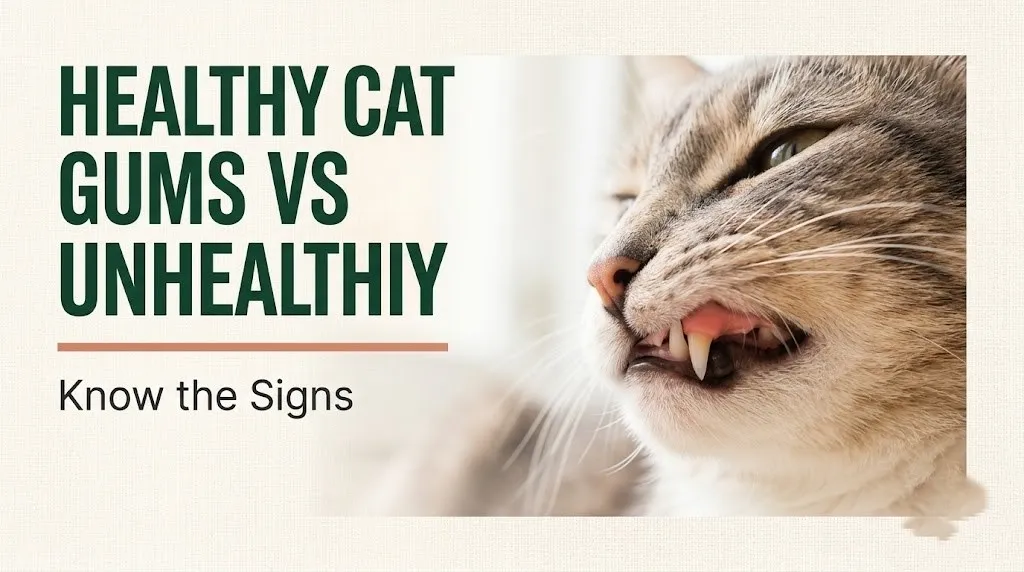
The challenge is that gum changes happen gradually. A cat’s gums don’t turn white overnight. They may fade slowly over weeks while the cat continues eating, grooming, and behaving normally. Cats are instinctively good at masking pain and discomfort. Relying on behavior alone to judge your cat’s oral health is one of the most common mistakes owners make.
| Feature | Healthy Cat Gums | Unhealthy Cat Gums |
|---|---|---|
| Color | Salmon to bubblegum pink | Pale, white, blue, yellow, or bright red |
| Texture | Firm, smooth | Swollen, spongy, or receding |
| Moisture | Lightly moist (not dripping) | Dry, tacky, or excessively wet |
| Smell | Mild or neutral | Strong, foul, or metallic odor |
| Capillary Refill Time | 1 to 2 seconds | Over 2 seconds or under 1 second |
Cats of any age, breed, or coat color can develop gum problems. The only reliable way to catch early disease is to check regularly and know what you’re looking at.
What Does a Healthy Cat Mouth Look Like
A healthy cat mouth has pink gums, white teeth with no visible brown or yellow buildup, no visible swelling around the gum line, and breath that smells mild or faintly meaty but not foul.
The gums should sit snugly against each tooth with no gaps or pockets. The gum line itself is smooth, not jagged or raised. There should be no visible red line running along where the gum meets the tooth.
Saliva should be present but not frothy or excessive. The tongue should be pink and moist. The inside of the cheeks and lips should also appear pink, not pale or spotted with unusual dark patches (unless natural pigmentation is present, which is addressed later in this guide).
Quick Tip:
- The back molars are harder to see, but they’re where tartar builds fastest
- A healthy cat mouth has no loose teeth and no visible tooth fragments
- Swallowing frequently or pawing at the mouth are behavioral signs of oral discomfort worth noting
Many cat owners have never looked inside their cat’s mouth at all. The first time you do, you’re establishing a baseline. That baseline is what makes future changes detectable.
Healthy Cat Gum Color
The correct color for healthy cat gums is salmon pink or bubblegum pink. This shade is sometimes described as “coral pink” in veterinary literature.
The color comes from blood perfusing the mucous membrane tissue. Well-oxygenated, adequately circulating blood produces that characteristic pink. Any shift away from it, whether paler, darker, redder, or an entirely different hue, reflects a change in circulation, oxygenation, tissue inflammation, or systemic organ function.
The Cornell Feline Health Center notes that gum color is one of the fastest accessible indicators of a cat’s circulatory status. Unlike blood pressure or heart rate, gum color requires no equipment and can be assessed in seconds.
Color varies slightly between individual cats. Some healthy cats run slightly deeper pink than others. What matters most is consistency for your individual cat. Learn your cat’s normal baseline so you notice when it shifts.
Key fact: Gum color reflects the state of the circulatory and respiratory systems in real time. A dramatic color change can develop within minutes during an acute health event, which is why knowing your cat’s normal is a practical safety skill.
Key Takeaway: Healthy cat gums are salmon to bubblegum pink, moist, firm, and nearly odor-free. Any shift from that color or texture baseline warrants closer attention, and a sudden dramatic change is a reason to contact a veterinarian the same day.
Healthy Cat Gums Color Chart
A gum color chart helps owners understand the full spectrum from normal to emergency, because not all abnormal colors carry the same urgency.
The table below covers all colors documented in veterinary clinical practice, what each typically indicates, and how urgently each should be addressed. This is organized from lowest to highest clinical concern.
| Gum Color | What It Typically Indicates | Urgency Level |
|---|---|---|
| Salmon or bubblegum pink | Normal, healthy circulation | No action needed |
| Slightly pale pink | Mild anemia, early dehydration, or stress | Monitor; vet within a few days if persistent |
| White or chalk pale | Severe anemia, significant blood loss, or shock | Emergency: vet immediately |
| Bright red or cherry red | Overheating, carbon monoxide exposure, or inflammation | Emergency: vet immediately |
| Brick red or dark red | Sepsis, toxin exposure, or severe infection | Emergency: vet immediately |
| Blue or purple (cyanosis) | Oxygen deprivation, respiratory failure, or cardiac crisis | Life-threatening emergency: vet within minutes |
| Yellow or jaundiced | Liver disease, bile duct obstruction, or certain toxin ingestion | Urgent: vet within 24 hours |
| Brown or muddy | Severe methemoglobinemia (often acetaminophen toxicity in cats) | Life-threatening: vet immediately |
| Gray or white with a bluish tinge | Advanced shock | Life-threatening emergency |
Acetaminophen (paracetamol) is fatally toxic to cats in very small doses. Even a fraction of a standard human tablet can cause brown or muddy gum discoloration within hours. According to the ASPCA Animal Poison Control Center, acetaminophen toxicity is one of the most common preventable causes of acute cat deaths reported annually.
Any cat showing blue, brown, white, or brick-red gums needs emergency veterinary care, not a scheduled appointment.
Healthy vs Unhealthy Cat Gums: Key Differences
The clearest way to tell healthy from unhealthy cat gums is to assess all five dimensions together: color, texture, moisture level, smell, and capillary refill time.
Healthy gums win on every single one. Unhealthy gums typically fail at least two, and often three or more simultaneously. A cat with mildly pale gums and a faintly tacky texture and bad breath is showing multiple flags at once.
| Dimension | Healthy | Unhealthy |
|---|---|---|
| Color | Salmon/bubblegum pink | Pale, white, red, blue, yellow, brown |
| Texture | Smooth and firm | Spongy, swollen, or receding |
| Moisture | Slightly moist | Dry and tacky, or unusually wet and sticky |
| Smell | Mild or neutral | Foul, sweet-sour, metallic, or ammonia-like |
| CRT | 1 to 2 seconds | Under 1 second or over 2 seconds |
Think of gum assessment like checking five warning lights on a dashboard at once. One light blinking might be a minor issue. Three lights at once means pull over now.
An important nuance: some cats have naturally darker spots on their gums from melanin pigmentation. These spots are not a disease sign and are addressed specifically in the section on age and coat color variation later in this guide. The key distinction is that pigmented spots are flat, stable over time, and don’t change the surrounding pink tissue color.
Healthy Cat Gums and Teeth
Gum health and tooth health in cats are inseparable. Dental plaque, which is a biofilm of bacteria, accumulates on tooth surfaces and migrates under the gum line within 24 to 36 hours of formation.
Once below the gum line, plaque triggers an inflammatory response in the gingival (gum) tissue. That inflammation is gingivitis: the earliest and most reversible stage of feline periodontal disease. Left unaddressed, it progresses to periodontitis, where the structures supporting the teeth, including the alveolar bone, begin to break down.
According to the American Animal Hospital Association (AAHA) 2019 Dental Care Guidelines for Dogs and Cats, periodontal disease is the most common clinical condition seen in adult cats, with most cats showing signs by age three. The guidelines specifically note that severity increases with age if preventive care is not established early.
Healthy teeth in cats are white or slightly off-white with no visible brown or yellow calculus (tartar) deposits. The gum line sits flush against each tooth. No tooth should be loose or visibly shorter than its neighbors (a sign of gum recession).
Key warning signs at the gum-tooth junction include:
- A red or inflamed line running along the gum edge (early gingivitis)
- Brown or yellow crust at the base of teeth (calculus buildup)
- Visible gaps between gum and tooth (periodontal pocketing)
- Teeth that appear longer than normal due to gum recession
- Any tooth that moves when pressed lightly
Key Takeaway: Gum and tooth health in cats are directly linked. Plaque forms within 24 to 36 hours on tooth surfaces and drives gum inflammation. Catching the red line of early gingivitis at the gum margin is the earliest point at which intervention makes the most difference.
How to Check Your Cat’s Gums at Home
Checking your cat’s gums at home takes under 60 seconds and requires no equipment beyond good lighting.
Choose a calm moment: after your cat has eaten, been petted, or is relaxed in your lap. Never attempt a mouth check when your cat is agitated, as this risks a bite and creates a negative association with the process.
To check your cat’s gums at home:
- Position your cat facing you or sitting calmly beside you with good light on their face.
- Place one hand gently over the top of the muzzle, resting your thumb and forefinger near the corners of the mouth.
- With your other hand, lift the upper lip on one side to expose the gum tissue above the upper canine teeth.
- Note the color of the gum tissue: is it the pink you expect, or does it look pale, red, or off in any way?
- Press one fingertip gently but firmly against the gum for 1 to 2 seconds, then release and count how quickly color returns. This is the capillary refill test.
- Check the other side for consistency.
- Briefly assess the lower gum line the same way, then gently close the mouth.
Quick Tip:
- Check both sides: one side can look different from the other in early localized disease
- Use your phone flashlight if natural light is limited
- Do this check once a week so your cat becomes comfortable with the process and you build a reliable baseline
Cats who have never had their mouths touched as kittens may resist at first. Short, positive sessions with a treat reward afterward help build tolerance over several weeks.
Capillary Refill Time in Cats
Capillary refill time (CRT) is the number of seconds it takes for gum tissue to return to pink after you press and release it with a finger. In a healthy cat, CRT is 1 to 2 seconds.
CRT measures peripheral circulation: how quickly blood is moving through the small vessels near the body’s surface. A fast CRT (under 1 second) can indicate high blood pressure or early shock states. A slow CRT (over 2 seconds) typically signals poor circulation, dehydration, shock, or cardiovascular compromise.
| CRT Result | What It Suggests | Action |
|---|---|---|
| Under 1 second | Possible vasodilation or early shock | Contact vet same day |
| 1 to 2 seconds | Normal circulation | No action needed |
| 2 to 3 seconds | Mild circulatory compromise or dehydration | Vet evaluation recommended within 24 hours |
| Over 3 seconds | Significant circulatory failure or shock | Emergency veterinary care immediately |
To run the test correctly: press your fingertip firmly enough to blanch the tissue white, then release and count out loud. The moment you release is second zero. Pink returning at two seconds or sooner is normal.
CRT is not a diagnosis. It’s a triage signal. A cat with a CRT of 3 seconds may be severely dehydrated, in early heart failure, or experiencing internal bleeding. All of these require a veterinarian to determine the actual cause.
Cat Gum Texture and Moisture: What’s Normal
Normal cat gum texture is firm, smooth, and lightly moist, similar in feel to the inside of a human cheek, but slightly more firm.
The moisture level should be consistent. Gums that feel dry or sticky (“tacky”) suggest dehydration. Gums that feel excessively wet or frothy may indicate nausea, hypersalivation (ptyalism), or an oral irritant.
Gum texture changes that signal problems include:
- Spongy or soft gums: Often a sign of advanced gingivitis or periodontitis
- Swollen gums around specific teeth: May indicate a localized abscess or tooth resorption
- Receding gums: Gum tissue pulling away from teeth, exposing root surfaces
- Rough or cobblestone-textured gums: Sometimes seen in feline stomatitis, a severe immune-mediated oral inflammation
- Ulcerated or raw-looking patches: Possible calicivirus, immune disease, or caustic irritant exposure
Feline stomatitis is worth naming specifically because it’s frequently misunderstood. It’s not simply bad teeth. It’s an abnormal immune response where the cat’s own immune system attacks oral tissue. Cats with stomatitis often stop eating entirely due to severe pain. According to research published in the Journal of Veterinary Dentistry, full-mouth tooth extraction resolves symptoms in approximately 60 to 80 percent of feline stomatitis cases, which illustrates how serious unchecked oral inflammation becomes.
Key Takeaway: Gum texture tells a different story from gum color. Spongy, receding, or ulcerated gum tissue signals disease progression beyond early inflammation, and changes in moisture level (too dry or too wet) are often the first physical sign of dehydration or systemic illness.
Normal Healthy Cat Gums by Age and Coat Color
Healthy cat gums are pink at every life stage, from kitten to senior, but the exact shade and any pigmentation present can vary by individual and age.
Kittens generally have very bright, deeply pink gums with high tissue perfusion. Adult cats show the standard salmon to bubblegum range. Senior cats (generally 11 years and older) may have gums that appear slightly paler as circulation naturally changes with age, though any significant pallor still warrants veterinary assessment.
Natural pigmentation is the most common source of owner confusion. Some cats, particularly those with darker fur, tortoiseshell patterns, or certain purebred lines like Bengals, develop flat, irregularly shaped brown or black spots on their gums from melanin deposits. These are equivalent to freckles and are entirely benign.
How to tell natural pigmentation from a disease sign:
| Feature | Natural Pigmentation | Pathological Change |
|---|---|---|
| Appearance | Flat, dark brown or black spots | Raised, red, white, or yellow areas |
| Location | Gum surface and lip edges | Can involve surrounding tissue |
| Change over time | Stable for months and years | New, growing, or changing |
| Surrounding tissue | Normal pink around the spot | Surrounding tissue also affected |
| Cat’s response | No sensitivity when touched | Cat pulls away or shows pain |
Senior cats are also predisposed to tooth resorption, a painful condition where the tooth structure breaks down from the root outward. The gum around an affected tooth may look inflamed or the tooth may appear to have a notch or “hole” at the gum line. Any senior cat not eating with their usual interest deserves a veterinary dental examination, even if behavior otherwise seems normal.
Unhealthy Cat Gum Colors and What They Signal
Each abnormal gum color in cats corresponds to a specific physiological problem, and knowing the difference can help owners respond with the right level of urgency.
Pale pink or white gums are the most commonly seen abnormal color. They indicate anemia (reduced red blood cell count), significant blood loss, or cardiovascular shock. According to the Cornell Feline Health Center, feline infectious anemia caused by Mycoplasma haemofelis, a blood-borne bacterial parasite, is one treatable cause of sudden pallor in cats.
Bright or cherry red gums indicate vasodilation, which occurs with hyperthermia (overheating), carbon monoxide poisoning, or in the early hyperdynamic phase of septic shock. A bright red gum in a cat that has been in a hot car or enclosed space is a heat emergency.
Blue or purple gums (cyanosis) signal oxygen deprivation at the tissue level. This is a respiratory or cardiac emergency with no home remedy. It requires oxygen and emergency veterinary intervention within minutes.
Yellow gums (jaundice or icterus) point to elevated bilirubin in the bloodstream. Causes include liver disease, bile duct obstruction, hemolytic anemia, or certain toxic exposures. Yellow gums are urgent but not necessarily an immediate minutes-level emergency; a same-day veterinary call is appropriate.
Brown or muddy gums in cats are most commonly seen with acetaminophen toxicity. Because cats lack the liver enzyme (glucuronyl transferase) needed to metabolize acetaminophen (paracetamol), even a fragment of a standard tablet can cause methemoglobinemia, where red blood cells lose the ability to carry oxygen. This is fatal without rapid treatment.
Cat Gum Inflammation and Early Dental Disease
Gum inflammation in cats almost always begins at the gum margin, the thin line where gum tissue meets tooth surface, and it starts with bacteria.
The earliest visible sign is a thin red or pink line running along the gum edge. This is gingivitis, and at this stage, it’s reversible. Remove the plaque, address the bacterial load, and the tissue can return to normal. Skip it, and it deepens into periodontitis, where the infection reaches below the gum line and begins destroying supporting structures that cannot regenerate.
Feline tooth resorption (previously called feline odontoclastic resorptive lesions, or FORLs) is a separate but related condition affecting an estimated 20 to 60 percent of cats at some point in their lives, according to research cited by the AVDC. The condition involves progressive destruction of tooth structure, often starting at the gum line. Affected teeth may appear to have a pink or red “notch” where the enamel has eroded.
Signs of early dental disease to watch for:
- Red line at the gum margin (early gingivitis)
- Yellow or brown crust at tooth bases (calculus)
- Any tooth that looks shorter or more exposed than its neighbors
- Bleeding when you gently press the gum tissue
- Localized swelling around one or two teeth
- Cat avoiding hard food or chewing only on one side
Professional dental cleanings under anesthesia are the only way to clean below the gum line. The AAHA guidelines note that anesthesia-free dental cleaning does not address subgingival disease and provides a false sense of oral health improvement.
Key Takeaway: The red line of early gingivitis at the gum margin is the most important early warning sign in feline oral health. It’s reversible with professional cleaning and home care at that stage. Waiting until the cat shows behavioral changes almost always means the disease has already progressed beyond the reversible point.
Cat Breath, Smell, and Gum Health
A healthy cat’s breath has a mild smell, sometimes faintly meaty or neutral. It should never be the first thing you notice when your cat yawns near you.
Bad breath (halitosis) in cats almost always has an oral, gastrointestinal, or systemic cause. The most common source is periodontal bacteria in the mouth. As bacteria metabolize proteins, they produce volatile sulfur compounds that smell like rotting organic matter. This is the same chemical process responsible for bad breath in humans with gum disease.
Different types of bad breath can indicate different underlying issues:
| Breath Odor | Possible Cause | Urgency |
|---|---|---|
| Foul or rotting | Periodontal disease, abscess, stomatitis | Vet evaluation recommended |
| Sweet or fruity | Possible diabetic ketoacidosis | Urgent: vet same day |
| Ammonia-like or urine-like | Possible kidney disease (uremia) | Urgent: vet same day |
| Fecal odor | Intestinal obstruction or severe GI disease | Emergency |
| Metallic | Blood in the mouth, ulceration | Vet evaluation recommended |
Ammonia-smelling breath in older cats deserves particular attention. The kidneys are responsible for filtering urea from the bloodstream. When kidney function declines, urea accumulates, and one route of excretion becomes the lungs and oral cavity. Ammonia-scented breath in a senior cat may be an early detectable sign of chronic kidney disease (CKD), which the Cornell Feline Health Center identifies as one of the most common diseases in aging cats.
Healthy Gums Cats: Prevention and Daily Care
Preventing gum disease in cats requires consistent home care between veterinary visits, because plaque doesn’t wait for your schedule.
The Veterinary Oral Health Council (VOHC) maintains a list of dental products independently tested and shown to reduce plaque or tartar in cats. Looking for the VOHC seal on cat dental products is the most reliable way to choose one that has actual supporting evidence rather than marketing claims.
Daily tooth brushing with cat-specific enzymatic toothpaste is the most effective home preventive measure. Enzymatic toothpastes contain glucose oxidase and lactoperoxidase, enzymes that generate antibacterial compounds from natural salivary components. Human toothpaste must never be used on cats; fluoride and xylitol are both toxic to cats.
Preventive care framework:
- Daily: Tooth brushing with a VOHC-approved enzymatic cat toothpaste and a soft-bristle finger brush or cat toothbrush
- Weekly: Full gum inspection using the five-point assessment (color, texture, moisture, smell, CRT)
- Monthly: Check for any new pigment spots, changes in tooth appearance, or behavioral shifts like food preference changes
- Annually: Professional veterinary dental examination; cleaning under anesthesia as recommended based on individual assessment
- By life stage: Kittens benefit from early mouth-handling habituation; adult cats benefit from consistent routine; senior cats (11 and older) may need more frequent veterinary assessment as dental and systemic disease risk both increase
Cats on wet food diets do not get the mild mechanical abrasion dry food provides, but wet food has its own advantages for hydration and kidney support. Neither diet eliminates the need for active dental care. Regardless of what your cat eats, daily brushing remains the standard most supported by veterinary evidence.
For cats who strongly resist brushing, dental rinses approved by the VOHC, water additives, and dental treats with demonstrated efficacy are secondary options, not equivalent replacements. A veterinarian familiar with your individual cat’s health history is the right person to help you choose a preventive approach that works for your cat’s specific needs, temperament, and any existing conditions.
Key Takeaway: Prevention comes down to two non-negotiables: daily brushing with cat-safe enzymatic toothpaste and annual professional veterinary dental examinations. Every other dental product is a supplement to those two, not a substitute for them.
Frequently Asked Questions About Healthy Cat Gums
What color should healthy cat gums be?
Healthy cat gums should be salmon pink to bubblegum pink, consistent across both sides of the mouth.
Any color outside that range, including pale pink, white, red, blue, yellow, or brown, indicates a change that needs veterinary evaluation.
The exact shade varies slightly between individuals, which is why knowing your own cat’s baseline color is the most useful reference point.
How do I check my cat’s gums at home?
Choose a calm moment and gently lift your cat’s upper lip on one side to expose the gum above the canine tooth.
Note the color, press one fingertip against the gum for one second and release, then count how quickly the pink returns (this is the capillary refill test; 1 to 2 seconds is normal).
Check both sides, assess the texture and moisture while you’re there, and reward your cat afterward to keep the experience positive.
What does it mean if my cat’s gums are pale?
Pale or white cat gums typically indicate anemia, blood loss, dehydration, or cardiovascular compromise affecting circulation.
Mildly pale gums that develop gradually may point to a slow-developing condition like chronic anemia or early kidney disease; dramatically white or chalk-pale gums are an emergency.
A cat with pale gums should be seen by a veterinarian the same day unless the pallor is sudden and severe, in which case emergency care is appropriate immediately.
Can a cat have dark spots on their gums and still be healthy?
Yes. Flat, stable dark brown or black spots on a cat’s gums are melanin pigmentation and are entirely normal in many cats, particularly those with darker or multicolored coats.
The key distinction from disease is that natural pigment spots are flat, have well-defined edges, don’t affect surrounding tissue, and remain stable over time.
A spot that is raised, growing, changing color, or causing the cat to react when touched is not normal pigmentation and warrants a veterinary examination.
How often should I check my cat’s gum health?
A weekly gum check is the standard most veterinarians recommend for keeping a reliable baseline, taking under 60 seconds when you know what you’re assessing.
Monthly checks are the practical minimum for owners whose cats strongly resist mouth handling, with the understanding that less frequent checks reduce the chance of catching early changes.
Any time your cat shows behavioral changes (drooling, pawing at the mouth, food preference changes, reduced appetite, or increased irritability), check the gums that day regardless of schedule.
What Knowing Your Cat’s Gums Actually Gets You
Gum color is one of the fastest clinical signals available to a cat owner without any equipment. Most systemic emergencies in cats, from shock to poisoning to respiratory failure, show up in the gums before they show up anywhere else you can easily see.
Start with one 60-second check this week. Note what your cat’s normal looks like: the exact shade of pink, the moisture level, the baseline capillary refill time. Write it down or take a photo in good lighting.
That baseline is the tool. When something changes, you’ll know it immediately, and you’ll be able to tell your veterinarian exactly what shifted and when.