The healthiest peanut butter brands contain exactly one or two ingredients: peanuts and salt. No added sugar, no hydrogenated oils, no emulsifiers. A jar of Smucker’s Natural or Teddie Organic with a layer of oil on top and a label that reads “Ingredients: Peanuts, Salt” is the gold standard.
The American Heart Association recognizes that regular nut consumption is associated with a lower risk of cardiovascular disease. The monounsaturated fat in peanut butter helps improve blood lipid profiles when it replaces saturated fat in the diet. But this benefit only holds if the peanut butter is not diluted with hydrogenated oils and corn syrup solids.
This guide names the specific brands that pass the clean-label test in 2026. We will walk through exactly what to look for on the label, which brands to grab at the store, and the one ingredient that sneaks into supposedly “natural” jars.
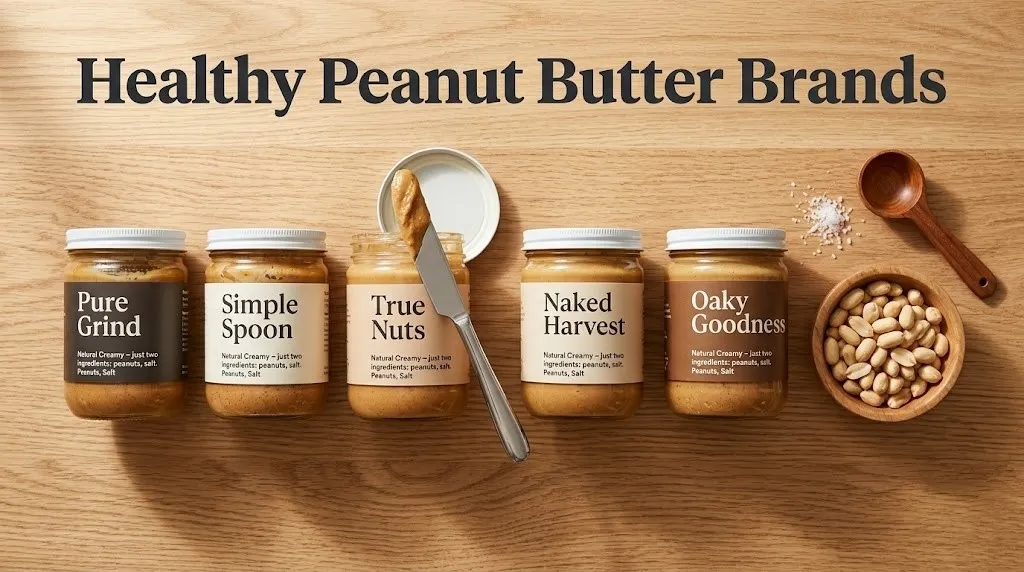
Healthy Peanut Butter Brands
The top five healthiest peanut butter brands available in major U.S. grocery stores in 2026 are Teddie Organic, Crazy Richard’s 100% Peanuts, Santa Cruz Organic, Smucker’s Natural, and Trader Joe’s Organic Valencia. Each brand lists only peanuts or peanuts and salt as its ingredients.
Teddie Organic uses U.S.-grown organic peanuts with no additives. Crazy Richard’s contains literally one ingredient: dry-roasted peanuts. Santa Cruz Organic uses organic roasted peanuts and a touch of salt with no palm oil. Smucker’s Natural is the most widely available clean-label option, found at Walmart, Kroger, and most chain grocery stores.
MaraNatha and Justin’s Classic both offer no-stir varieties that include palm oil to prevent separation. Palm oil is not hydrogenated and adds no trans fat, but it is a less pure product. The Academy of Nutrition and Dietetics notes that any added oil dilutes the nutrient density of the peanut butter and adds calories without the corresponding micronutrients found in the peanut itself.
| Brand | Ingredients | Added Sugar | Oil Added |
|---|---|---|---|
| Teddie Organic | Organic dry-roasted peanuts, salt | None | None |
| Crazy Richard’s | Peanuts | None | None |
| Santa Cruz Organic | Organic roasted peanuts, salt | None | None |
| Smucker’s Natural | Peanuts, salt | None | None |
| Trader Joe’s Organic | Organic valencia peanuts, salt | None | None |
| MaraNatha No-Stir | Dry-roasted peanuts, palm oil, salt | None | Palm oil |
Which Peanut Butter Is Healthy
A healthy peanut butter has a short ingredient list, no added sugar, and a fat profile dominated by monounsaturated and polyunsaturated fats. The first and ideally only ingredient is peanuts.
The sugar rule is straightforward. Zero grams of added sugar per serving is the target. Many conventional brands like Jif and Skippy contain 3 to 4 grams of added sugar per 2-tablespoon serving, sourced from molasses, corn syrup solids, or straight sugar. That two-tablespoon serving suddenly carries the sugar equivalent of a small cookie.
The oil rule is slightly more nuanced. Peanut oil naturally separates from the ground peanut solids. A healthy jar will have a visible layer of oil on top that requires stirring. If the label lists palm oil, fully hydrogenated vegetable oil, or mono- and diglycerides, the product has been chemically stabilized to prevent separation. This is a processing choice, not a health benefit.
Key Takeaway: A healthy peanut butter has one or two ingredients, zero grams of added sugar, and requires stirring because it contains only peanut oil, not added palm or hydrogenated oil.
Healthy Natural Peanut Butter
“Natural” on a peanut butter label is an unregulated marketing term. The FDA has no formal definition for “natural” on food products. A jar labeled “Natural” can legally contain added sugar and palm oil. The only reliable indicator of a genuinely natural product is the ingredient list on the back, not the word “Natural” on the front.
True natural peanut butter separates. The peanut solids settle to the bottom of the jar and a layer of pure peanut oil rises to the top. This is inconvenient but normal. The oil is part of the peanut. Stirring it back in is the ritual that signals you are eating a minimally processed food.
Store natural peanut butter upside down in the pantry before opening. The oil rises toward the bottom of the jar, which is technically the top when inverted. When you flip it right-side up and open it, the peanut solids are closer to the top and the stirring is far less messy.
Healthy Peanut Butter Brand
The single healthiest peanut butter brand available nationally in 2026 is Crazy Richard’s 100% Peanuts. It contains dry-roasted peanuts and nothing else. No salt, no sugar, no oil, no emulsifier. The ingredient list is one word long.
This brand is not for everyone. The absence of salt makes it taste flat to palates accustomed to Jif. It works best in smoothies, oatmeal, and baking where other ingredients provide the seasoning. For a direct spoon-to-mouth experience, Teddie or Santa Cruz with a pinch of salt are more satisfying.
Crazy Richard’s also offers a peanut butter powder, which is defatted peanut flour. This is a different product entirely. Peanut powder contains about 60 calories and 1.5 grams of fat per serving versus 190 calories and 16 grams of fat for the whole peanut butter. It is a protein booster for shakes, not a spread.
Healthy Creamy Peanut Butter
Healthy creamy peanut butter achieves its smooth texture through extended grinding of the peanuts, not through the addition of oils or emulsifiers. The peanuts are ground until their natural oils release completely and the cell walls break down into a silky paste.
Santa Cruz Organic Creamy is the best-tasting healthy creamy option in the 2026 market. It uses roasted organic peanuts and a light touch of salt. The texture is velvety and pourable after stirring. It spreads evenly on bread without tearing it, a practical consideration often overlooked.
Teddie Smooth is the budget-friendly alternative. It costs $4 to $5 per 16-ounce jar versus Santa Cruz at $7 to $8. The flavor is slightly darker because Teddie uses a deeper roast profile. Both jars require stirring and refrigeration after opening to maintain emulsion and prevent rancidity of the unsaturated fats.
Healthy Peanut Butters
The category of healthy peanut butters includes both smooth and crunchy varieties. Crunchy peanut butter is nutritionally identical to creamy within the same brand. The only difference is the inclusion of coarsely ground peanut pieces that add texture and a marginal amount of fiber.
Crunchy varieties provide a sensory advantage for satiety. The physical act of chewing peanut pieces slows the eating process. A 2018 study in the journal Appetite found that foods requiring more chewing increase satiety signals compared to liquid or pureed equivalents of the same calorie load.
The stirring requirement applies equally to crunchy and creamy. The peanut pieces in crunchy varieties tend to sink to the bottom of the jar during storage. The stirring technique, starting from the bottom of the jar and working upward, is identical. A butter knife is more effective than a spoon for breaking up the dense sediment.
Healthy Brands of Peanut Butter
Three categories of healthy brands exist in 2026. The first is the single-ingredient purist brands: Crazy Richard’s, Once Again, and certain regional co-op brands. The second is the two-ingredient classic brands: Teddie, Santa Cruz Organic, Smucker’s Natural, and Trader Joe’s Organic.
The third category is the “healthy compromise” brands that include a small amount of sustainable palm oil to achieve a no-stir texture. MaraNatha No-Stir and Justin’s Classic fall here. These are healthier than Jif or Skippy because they omit added sugar and hydrogenated oils.
Store brands are improving. 365 by Whole Foods organic peanut butter and Kroger Simple Truth organic peanut butter both offer peanuts-and-salt-only formulations at a lower price point than the national brands. Read the ingredient label anyway. Store brands change suppliers and formulations without fanfare.
Is There a Healthy Peanut Butter
Yes, there are numerous healthy peanut butters available in every major grocery store. The trick is ignoring the front label entirely and reading the ingredient list on the back. A healthy peanut butter has exactly one or two ingredients, peanuts and salt.
The nutrition facts panel provides the confirmation. Look for zero grams of added sugar. Look at the fat profile. All 16 grams of fat per serving should come from the peanut, not from added palm, soybean, or cottonseed oil. The sodium should be 100 milligrams or fewer per serving unless you choose an unsalted version.
Price is not an indicator of health. A $3 jar of Smucker’s Natural is just as healthy as a $9 jar of artisanal small-batch peanut butter. The ingredient list trumps the price tag every time. More expensive brands may use organic peanuts or different roast profiles, but they do not become “healthier” than a cheap jar that also contains only peanuts and salt.
Key Takeaway: A healthy peanut butter is defined by its ingredient list, not its brand prestige or price; Smucker’s Natural at $3 is nutritionally equivalent to a $9 artisanal jar with the same two ingredients.
Peanut Butter Healthy Brands
Peanut butters marketed as “healthy” that still contain molasses, honey, maple syrup, or agave are not in the top tier. A brand that adds natural sweeteners is making a tastier product, not a healthier one. Sugar is sugar, regardless of its source.
Jif Natural and Skippy Natural are the most common impostors. Their labels say “Natural,” but the ingredient lists include sugar, palm oil, and molasses. These products have 3 grams of added sugar per serving. They are slight improvements over the original formulas because they omit hydrogenated oil, but they are not in the healthy category.
Powdered peanut butter brands like PB2 and PBfit are healthy for specific applications. They remove 85 percent of the fat from peanuts through pressing, creating a powder with 60 to 70 calories and 6 grams of protein per serving. They are excellent in smoothies and oatmeal but are not a substitute for the creamy spread on a sandwich.
Peanut Butter Without Added Sugar
Peanut butter without added sugar tastes purely of roasted peanuts. The natural sweetness of the peanut itself is subtle but present. Peanuts contain roughly 1 gram of naturally occurring sugar per tablespoon. This is not added. It is part of the legume.
A palate accustomed to sweetened peanut butter needs a 7 to 10 day adaptation period. The sweetened version triggers a dopamine response that the unsweetened version does not match immediately. After the adjustment window, the complex roasted flavor of pure peanut butter becomes more apparent and satisfying.
Vanilla extract and a pinch of cinnamon can bridge the transition. Add these at home, not from the jar. A quarter-teaspoon of vanilla and a dusting of cinnamon stirred into an unsweetened peanut butter creates a perception of sweetness without any sugar. This is a behavioral hack, not a nutritional requirement.
Best Peanut Butter for Weight Loss
The best peanut butter for weight loss is any unsweetened, single-ingredient brand measured with a tablespoon, not eaten from the jar. The brand matters far less than the portion control.
Peanut butter is a calorie-dense food. Two tablespoons contain 190 calories. A heavy-handed scoop can easily become 3 or 4 tablespoons, adding 300 to 400 calories to a smoothie or sandwich without visual recognition. A kitchen scale that measures grams is the most accurate tool. A level, standardized measuring tablespoon is the minimum.
Powdered peanut butter is the calorie-conscious alternative for smoothies and oatmeal. A 2-tablespoon serving of PB2 provides 60 calories and 6 grams of protein versus 190 calories and 7 grams of protein for the same volume of whole peanut butter. The fat is reduced, along with the fat-soluble vitamins. It is a protein powder, not a nutrient-dense whole food.
Key Takeaway: The brand of peanut butter is almost irrelevant for weight loss; a measured, honest 2-tablespoon portion of any unsweetened brand beats an unmeasured scoop of the healthiest jar every time.
Peanut Butter Ingredients to Avoid
Hydrogenated oil, added sugar, and molasses are the three ingredients that disqualify a peanut butter from being healthy. Hydrogenated oil is added to prevent separation and extend shelf life. It introduces trans fats and is a red flag.
Palm oil is the grey-area ingredient. It is not hydrogenated and contains no trans fat. It stabilizes the peanut butter and prevents the need for stirring. The nutritional downside is a slight dilution of the peanut’s natural fat profile. The environmental downside involves deforestation concerns, though some brands use sustainably certified palm oil.
Mono- and diglycerides are emulsifiers that bind oil and solids. They are not dangerous, but they signal that the peanut butter is a highly processed product. They appear in the ingredient lists of reduced-fat peanut butters, which replace peanut oil with added sugar to compensate for the flavor loss.
- Added sugar: Look for 0g on the nutrition panel.
- Hydrogenated oil: Introduces trans fat. Avoid completely.
- Molasses: A sugar syrup. Avoid in peanut butter.
- Mono- and diglycerides: Signal heavy processing. Avoid.
- Reduced-fat label: Fat is replaced with sugar and fillers.
Frequently Asked Questions About Healthy Peanut Butter Brands
What is the healthiest peanut butter brand in 2026?
Crazy Richard’s 100% Peanuts is the healthiest brand because it contains one ingredient: dry-roasted peanuts.
Teddie Organic and Santa Cruz Organic are tied for second with only peanuts and salt on their ingredient lists.
The healthiest brand for you is the one you can afford and enjoy that contains only peanuts and salt.
Is natural peanut butter healthier than regular peanut butter?
Natural peanut butter is healthier when the ingredient list contains only peanuts and salt.
Regular peanut butter brands like Jif and Skippy contain added sugar, molasses, and hydrogenated oils.
The word “Natural” on the label is not a guarantee; read the ingredient list for confirmation.
What ingredients should you avoid in peanut butter?
Avoid hydrogenated oil, added sugar, and molasses as the primary disqualifying ingredients.
Mono- and diglycerides indicate a heavily processed product and should be avoided.
Palm oil is a grey area ingredient that is not harmful but dilutes the nutrient density of the peanuts.
Is peanut butter good for weight loss?
Peanut butter can support weight loss when eaten in measured, 2-tablespoon portions because of its protein and fiber content.
It is calorie-dense at 190 calories per serving, so unmeasured spoonfuls from the jar contribute to weight gain.
Powdered peanut butter is a lower-calorie alternative for smoothies.
How long does natural peanut butter last?
An unopened jar of natural peanut butter lasts 6 to 12 months in a cool, dark pantry.
Once opened, it lasts 2 to 3 months at room temperature or 4 to 6 months refrigerated.
Refrigeration slows the rancidity of the unsaturated fats and helps maintain the emulsion after stirring.
The best peanut butter in the store is the one with peanuts and salt on the ingredient label. The brand name on the front does not matter. The price does not matter. The word “Natural” does not matter. Flip the jar, read the back, and put back anything with sugar or hydrogenated oil.
Stir it. Refrigerate it. Measure it. The ritual of stirring a separated jar is the defining act of eating healthy peanut butter. It means you chose the real thing.
Grab the Teddie, the Santa Cruz, or the Crazy Richard’s. The clean jar with the one-ingredient label has been there all along, usually on the bottom shelf, waiting for you to stop being fooled by the front-label marketing.