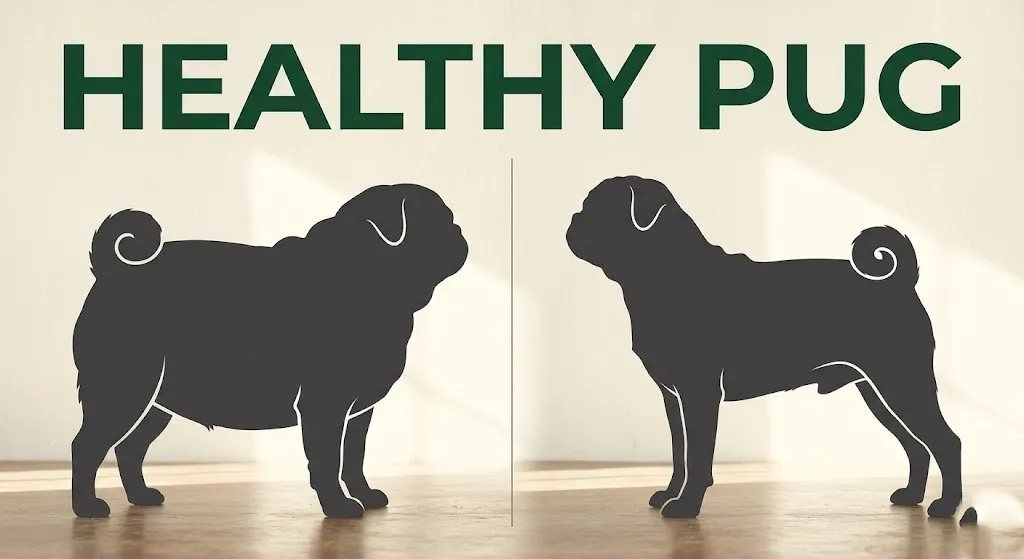
A healthy pug is a compact, square-proportioned dog with a defined waist, clear eyes free of discharge, a clean facial fold, and a distinct muzzle measuring at least 1 to 1.5 inches of protrusion from the stop to the tip of the nose. Most importantly, a healthy pug breathes quietly at rest. A pug that snorts, wheezes, or gasps while sitting still is not healthy. That pug is suffering from the anatomical defects that have been bred into the breed for decades in pursuit of an extreme flat-faced appearance.
The modern pug is a brachycephalic breed, meaning it has been selectively bred for a shortened skull. This breeding has produced severe health consequences: narrowed nostrils (stenotic nares), an elongated soft palate that blocks the airway, and a compressed nasal passage that makes every breath a struggle. The British Veterinary Association and the Brachycephalic Working Group have launched extensive campaigns in the 2020s urging breeders to select for longer muzzles and open nostrils.
This guide defines exactly what a healthy pug looks like, how much it should weigh, what it should eat, and how to find a breeder who prioritizes health over an extreme flat face. Your veterinarian is the only person qualified to assess your individual dog’s airway function and overall health.
healthy pug
A healthy pug is a dog that maintains a lean body weight of 14 to 18 pounds, breathes with a closed mouth and no audible noise at rest, has a visible waist when viewed from above, and possesses a muzzle that extends visibly beyond the forehead. The breed standard that has dominated dog shows for decades, demanding a “perfectly flat” face, is actively harmful.
The breathing of a healthy pug should be silent when the dog is resting. The nostrils should be open and wide, not pinched or slit-like. The chest should rise and fall smoothly, without the abdominal heaving that indicates the dog is using its stomach muscles to force air past an obstruction. A pug that breathes loudly at rest is compensating for an anatomical blockage. This is not a cute breed quirk. It is a sign of chronic respiratory distress.
The eyes of a healthy pug are clear, bright, and free of discharge. The prominent eyes of the breed are vulnerable to injury, corneal ulcers, and the terrifying condition of proptosis, where the eye pops out of the socket. A healthy pug does not have constant tear staining, squinting, or mucoid discharge. The facial fold over the nose should be dry and clean, not moist, red, or yeasty-smelling.
- Weight: 14 to 18 pounds, visible waist.
- Breathing: Silent at rest, wide nostrils.
- Eyes: Clear, no discharge, no squinting.
- Skin fold: Dry, clean, no odor.
what does a healthy pug look like
A healthy pug looks like a compact, muscular dog with a glossy coat, a visible tuck-up behind the ribs, and a muzzle that extends forward rather than appearing pushed into the skull. The dog should look like an athletic, miniature mastiff, not a furry coffee table.
The coat is a reliable indicator of internal health. A healthy pug’s coat is short, smooth, and glossy. A dull, brittle, or patchy coat can indicate underlying allergies, thyroid problems, or nutritional deficiencies. Pugs are heavy shedders, which is normal, but the shed hair should be replaced by healthy new growth. Bald patches, especially on the flanks, are a sign of seasonal flank alopecia, a condition common in the breed.
The body shape is the most difficult characteristic for owners to assess accurately. Pugs are naturally barrel-chested, which means they look stocky even at a healthy weight. The key visual markers are the waist and the tuck-up. Viewed from above, a healthy pug has a visible hourglass shape, with a defined waist behind the ribs. Viewed from the side, the belly tucks upward behind the ribcage. A pug that looks like a sausage from above or whose belly hangs level with its chest is overweight.
- Coat: Glossy, short, no bald patches.
- Waist: Visible hourglass from above.
- Tuck-up: Belly rises behind the ribs.
- Muzzle: Protrudes visibly from the face.
Key Takeaway: A healthy pug is a dog, not a caricature. It has a waist, a muzzle, and quiet breath.
healthy pug breed
A healthy pug breed is the result of decades of intentional, ethical breeding away from the extreme brachycephalic standard and toward a functional dog with an open airway, sound joints, and a life expectancy of 12 to 15 years. The “healthy pug breed” does not yet fully exist as a widespread standard, but in 2026, a growing number of breeders are producing dogs with longer muzzles and wider nostrils, often called “retro pugs” or “sporty pugs.”
The movement toward a healthier pug is led by breeders who prioritize function over form. These breeders select for open nostrils, a muzzle length that allows for a functional nasal passage, and a slightly less pronounced underbite. The resulting dogs do not look exactly like the pugs that win at Westminster. They look like pugs that can run on the beach without collapsing. They have a slightly longer nose, a less wrinkled forehead, and a more athletic build.
The health differences between an ethically bred pug and a standard pug are dramatic. Ethically bred pugs have significantly lower rates of brachycephalic obstructive airway syndrome (BOAS). They tolerate heat and exercise better. They are less prone to the eye injuries and skin fold infections that plague the breed. The movement is gaining momentum, but it remains a small fraction of the overall pug population.
- Ethical breeding goals: Longer muzzle, open nostrils, sound joints.
- “Retro pug” movement: Crossing pugs with small terriers or breeding older-style lines.
- Health outcomes: Reduced BOAS, better heat tolerance, fewer eye emergencies.
pug with healthy snout
A pug with a healthy snout has a muzzle that extends at least 1 to 1.5 inches from the stop to the nose, with wide, open nostrils that allow air to pass freely. The snout is not just a cosmetic feature. It is the housing for the nasal turbinates, the scroll-like bones that warm, humidify, and filter inhaled air. A snout that is too short cannot accommodate these structures, and the dog suffers for it.
The anatomy of a healthy pug snout includes three critical structures. The nares, or nostrils, should be wide and circular, not pinched into crescent-shaped slits. The nasal passages should be open and unobstructed. The soft palate, the flap of tissue at the back of the throat, should not extend past the epiglottis. In a pug with an unhealthy snout, the soft palate is too long and dangles into the airway like a curtain, vibrating with each breath.
The snout spectrum ranges from the extreme flat face, where the nose is recessed into the skull and the nostrils are nearly closed, to the retro pug snout, which approaches the muzzle length of a small terrier. The healthier end of the spectrum allows a pug to breathe, exercise, and regulate body temperature. The unhealthy end produces a dog that snorts, overheats, and requires surgery to live a normal life.
- Healthy nares: Wide, circular, open.
- Unhealthy nares: Slit-like, pinched, nearly closed.
- Healthy palate: Does not obstruct the airway.
- Unhealthy palate: Elongated, vibrating in the throat.
Key Takeaway: A healthy pug snout is not a flat disk. It is a functional nose with wide nostrils and enough length to house the structures required for breathing.
pug healthy
Maintaining a pug’s health requires a relentless focus on weight management, wrinkle hygiene, and exercise tolerance. The pug is a breed that can spiral into poor health rapidly if these three factors are neglected. A pug that is healthy today can become obese, infected, and breathless within six months if its care is not consistent.
Wrinkle hygiene is a daily requirement for pugs. The deep facial fold over the nose traps moisture, food particles, and bacteria. Without daily cleaning, this fold becomes a breeding ground for yeast and bacteria, leading to a condition called skin fold pyoderma. The infection is painful, itchy, and produces a distinct, foul odor. Clean the fold once a day with a soft, damp cloth, and dry it thoroughly. A dry fold is a healthy fold.
Exercise must be managed carefully. A healthy pug can and should exercise daily, but it cannot tolerate extreme heat or intense cardiovascular exertion. Walk a pug in the early morning or late evening during summer. Never leave a pug in a car, even with the windows cracked, even for five minutes. The breed’s compromised airway makes it exquisitely sensitive to heat stroke.
- Daily: Clean and dry the facial fold.
- Weekly: Check eyes for redness, cloudiness, or discharge.
- Monthly: Weigh the dog and adjust food portions accordingly.
- Annually: Veterinary assessment of airway function and dental health.
pug weight chart
A healthy adult pug should weigh between 14 and 18 pounds for a male and 13 to 16 pounds for a female, with the ideal weight determined by body condition score rather than the number on the scale alone. The pug’s dense, compact body can make an overweight dog appear normal to the untrained eye.
The Pug Body Condition Score (BCS) uses the same 1 to 9 scale as other dogs but requires pug-specific interpretation. A score of 4 to 5 is ideal. The ribs should be easily felt under a thin layer of fat, not visible but not buried under inches of tissue. The waist should be visible from above, an hourglass indentation behind the ribs. The abdominal tuck should be visible from the side. A pug that fails any of these checks is overweight.
The consequences of obesity in a pug are magnified by the breed’s anatomy. Excess weight places additional pressure on the already compromised airway, worsening breathing problems. It strains the joints, accelerating the development of arthritis and luxating patellas. It increases the risk of heat stroke. An obese pug is not a cute, chunky potato. It is a dog suffocating under its own weight.
| Weight Status | Rib Feel | Waist (from above) | Tuck (from side) |
|---|---|---|---|
| Underweight | Ribs visible, prominent | Extreme hourglass | Severe tuck |
| Ideal | Ribs easily felt, not visible | Visible hourglass | Visible tuck |
| Overweight | Ribs difficult to feel | Waist absent | Belly level with chest |
| Obese | Ribs impossible to feel | Waist bulging outward | Belly sagging below chest |
best food for pug health
The best food for a pug’s health is a high-protein, low-carbohydrate, moderate-fat diet with added omega-3 fatty acids, probiotics, and glucosamine, fed in strictly measured portions twice daily. The pug’s tendency toward obesity, food allergies, and joint problems makes a precision diet essential.
Protein is the foundation. A pug diet should contain at least 25 to 30 percent protein on a dry matter basis, sourced from named animal proteins like chicken, salmon, or lamb. Pugs are prone to food allergies, which manifest as itchy skin, ear infections, and anal gland issues. A limited-ingredient diet can help identify and eliminate trigger foods. Common allergens for pugs include chicken, beef, and grains.
Omega-3 fatty acids, particularly EPA and DHA from fish oil, are a non-negotiable supplement for pugs. They reduce the systemic inflammation that contributes to skin fold dermatitis, allergic reactions, and joint degeneration. A daily fish oil supplement providing 500 to 1000 milligrams of combined EPA and DHA supports a healthy coat, reduces itching, and protects the joints.
- Protein: 25 to 30 percent, named animal source.
- Omega-3s: 500 to 1000 mg EPA/DHA daily from fish oil.
- Probiotics: Support skin and ear microbiome health.
- Glucosamine and chondroitin: Protect joints and patellas.
Key Takeaway: Feed a pug like an athlete in a small, dense body. High protein, controlled portions, and omega-3s are the nutritional pillars.
pug breathing problems treatment
Pug breathing problems are treated with a combination of weight management, environmental control, anti-inflammatory medications during acute episodes, and surgical correction of anatomical obstructions. The treatment plan depends on the severity of the brachycephalic obstructive airway syndrome (BOAS).
Surgical intervention is the most effective treatment for severe BOAS. The procedure, called brachycephalic airway surgery, addresses the three primary obstructions: stenotic nares are widened by removing a wedge of tissue from the nostril, an elongated soft palate is trimmed to a functional length, and everted laryngeal saccules, the tissue that swells and obstructs the airway, are removed. This surgery is routine in 2026 at veterinary surgical centers and is often performed on young dogs to prevent a lifetime of respiratory distress.
Weight management is the most effective non-surgical treatment. Every excess pound on a pug’s frame compresses the airway and increases the work of breathing. Reducing a pug to its ideal body weight can improve its airway function by a measurable degree. Environmental control includes keeping the pug in air-conditioned spaces during hot weather, using a harness instead of a collar to avoid tracheal pressure, and avoiding over-excitement.
- Weight loss: Reduces airway compression.
- Surgery: Corrects stenotic nares, elongated palate, everted saccules.
- Harness: Use instead of a collar to protect the trachea.
- Environment: Air conditioning, limited outdoor time in heat.
how to keep a pug healthy
Keeping a pug healthy is a daily practice of weight monitoring, wrinkle cleaning, controlled exercise, and proactive veterinary care. The pug is not a low-maintenance breed. It is a breed that requires constant attention to prevent the predictable cascade of obesity, infection, and respiratory decline.
The daily checklist for a healthy pug includes cleaning the facial fold with a damp cloth and drying it thoroughly, examining the eyes for redness or discharge, and measuring food portions with a standard measuring cup, not an estimate. The weekly checklist includes ear cleaning with a veterinary-approved solution and a full-body once-over to check for new lumps, skin irritation, or paw licking. The monthly checklist includes a weight check and nail trim.
The annual veterinary visit for a pug must include a specific assessment of airway function, dental health, and joint mobility. The veterinarian should listen to the dog’s breathing at rest and after mild exercise. The eyes should be examined for corneal health and tear production. The patellas should be checked for stability. A pug that receives this level of proactive care can live a full, active life.
- Daily: Wrinkle cleaning, food portioning, eye check.
- Weekly: Ear cleaning, skin check.
- Monthly: Weight check, nail trim.
- Annually: Veterinary airway assessment, dental exam.
Frequently Asked Questions About Healthy Pugs
Why do pugs have trouble breathing?
Pugs have trouble breathing because they are brachycephalic, bred with a shortened skull that compresses the nasal passages and airway.
The three primary obstructions are narrow nostrils, an elongated soft palate, and a narrow trachea.
This condition is called brachycephalic obstructive airway syndrome and causes lifelong respiratory distress in severely affected dogs.
How much should a healthy pug weigh?
A healthy pug should weigh between 14 and 18 pounds for males and 13 to 16 pounds for females.
The ideal weight is determined by body condition, with visible ribs being a sign of being underweight and a missing waist indicating overweight.
Your veterinarian can provide a specific target weight for your individual dog.
What is the best food for a pug’s skin?
The best food for a pug’s skin is a limited-ingredient, high-protein diet supplemented with omega-3 fatty acids from fish oil.
Pugs are prone to food allergies that manifest as dermatitis and ear infections.
Omega-3s reduce the inflammation that drives skin fold infections and itching.
Can pugs have a longer snout?
Yes, breeders who prioritize health over extreme conformation produce pugs with longer muzzles, often called “retro pugs” or “sporty pugs.”
These dogs have more functional airways and fewer respiratory problems.
Buying from a breeder who selects for a longer muzzle is the single most important choice a pug owner can make.
Is it ethical to buy a pug in 2026?
It is ethical to buy a pug in 2026 if you source the dog from a breeder who actively selects for open nostrils, a longer muzzle, and respiratory health.
Avoid breeders who produce extreme flat faces and advertise “rare” colors like blue or merle, as these prioritize appearance over health.
Adoption from a breed-specific rescue is also an ethical choice.
The pug is not a lost cause. It is a breed with a devoted following, a delightful temperament, and a body that has been twisted by human aesthetic preferences into a shape that cannot function. The 2026 movement toward a healthier pug is real. It is gaining momentum. It is being led by breeders who believe that a pug should be able to run, play, and breathe without suffering.
If you own a pug, put down the treat. Pick up the leash. Walk your dog in the cool morning air. Look at your pug’s face. If the nostrils are slits, ask your veterinarian about surgical correction. If the skin fold is red and smelly, clean it. Tonight. If your pug is 20 pounds, it is obese, and the kindest thing you can do is help it lose the weight.
A healthy pug is a dog that lives well and breathes easy. Anything less is a betrayal of the breed we claim to love.