A healthy ramen noodle is any noodle that replaces the deep-fried, refined-wheat instant ramen brick with a whole-grain, air-dried, or vegetable-based alternative that reduces saturated fat, increases fiber, and serves as a foundation for a broth bowl that prioritizes nutrition alongside flavor. You are not replacing ramen. You are rebuilding it from the noodles up.
A standard 85-gram brick of instant ramen, the kind that costs a quarter and sustained you through college, delivers roughly 380 calories, 14 grams of fat, and 1,500 to 1,800 milligrams of sodium when prepared with the seasoning packet. That sodium figure is 100 to 120 percent of the American Heart Association’s ideal daily limit of 1,500 milligrams. The noodles are deep-fried in palm oil during manufacturing to dehydrate them, which is why a dry brick contains 6 to 7 grams of saturated fat before you add anything to the bowl.
This guide walks you through the best noodle alternatives that still feel like ramen, explains why the broth matters as much as the noodle, and gives you a framework for building a bowl that is genuinely nourishing. You will learn which noodles hold up in hot broth, which ones work for specific dietary patterns, and how to avoid the common mistakes that turn a healthy ramen experiment into a soggy disappointment.
healthy ramen noodle
A healthy ramen noodle is one that has not been deep-fried, is made from whole grains like buckwheat or whole wheat, or is a naturally low-calorie vegetable alternative like shirataki or zucchini, and retains enough structural integrity to sit in hot broth without dissolving into mush. The noodle must function as a noodle first. Nutrition comes second.
The frying process is the original sin of instant ramen. After the wheat dough is formed, cut, and steamed, it is deep-fried in palm oil at roughly 300 degrees Fahrenheit. This flash-frying drives off moisture, creating the porous structure that allows the noodle to rehydrate in boiling water in three minutes. It also saturates the noodle with roughly 14 to 16 grams of fat per brick, a significant portion of which is saturated. Air-dried ramen noodles skip the frying step entirely. They take slightly longer to cook but contain roughly 1 to 2 grams of fat instead of 14.
Several brands now produce air-dried, whole-grain ramen noodles. Lotus Foods makes a millet and brown rice ramen that contains 4 grams of fiber and 7 grams of protein per serving. Hakubaku produces an organic ramen noodle that is air-dried and uses whole-wheat flour. These products are available at Whole Foods, health food stores, and online. They cost roughly $1.50 to $2.50 per serving, more than the 25-cent instant brick but far less than a restaurant bowl.
healthy ramen alternative
A healthy ramen alternative is any dish or noodle swap that delivers the essential ramen experience, hot broth, chewy noodles, savory toppings, in a format with more fiber, less saturated fat, and a fraction of the sodium. The alternative can be as simple as swapping the noodle or as complete as rebuilding the entire bowl from scratch.
The most straightforward alternative is to buy the air-dried ramen noodle mentioned above and pair it with a homemade broth. The seasoning packet is where the sodium lives. A single packet of standard instant ramen seasoning contains 1,200 to 1,500 milligrams of sodium. You can make a simple dashi-based broth with 300 to 400 milligrams of sodium per serving by using low-sodium miso, a piece of kombu, and a splash of reduced-sodium tamari.
The Academy of Nutrition and Dietetics recommends that adults consume no more than 2,300 milligrams of sodium per day, with an ideal limit of 1,500 milligrams for optimal cardiovascular health. A bowl of ramen built on air-dried noodles and a controlled-sodium broth fits easily within that framework. The standard instant packet violates it entirely.
healthy alternative to ramen noodles
Healthy alternatives to ramen noodles fall into four categories: whole-grain noodles like soba and whole-wheat ramen, low-calorie shirataki and kelp noodles, vegetable noodles like zucchini and sweet potato, and gluten-free options like brown rice noodles. Each category offers a different nutritional trade-off.
Soba noodles, made from buckwheat flour, are the closest textural and culinary match to traditional ramen. They are used in Japanese cuisine for both hot and cold dishes, so they hold up beautifully in broth. A 2-ounce dry serving contains 200 calories, 3 grams of fiber, and 8 grams of protein. The flavor is nutty and earthy, complementing miso and soy-based broths. Soba labeled “juwari” is 100 percent buckwheat and gluten-free. Standard soba contains a blend of buckwheat and wheat flour and is not gluten-free.
Shirataki noodles, made from the konjac yam, are the most dramatic nutritional departure. An entire 7-ounce package contains 10 to 20 calories and 3 to 4 grams of glucomannan fiber. The noodles have a slightly bouncy, gelatinous texture that some people find off-putting and others find satisfyingly chewy. They are flavorless, absorbing the broth they are served in. They require rinsing in cold water and a brief 1-minute boil to remove the calcium hydroxide solution they are packed in, which carries a faintly fishy smell.
| Noodle Type (per serving) | Calories | Fiber | Protein | Cooked Texture |
|---|---|---|---|---|
| Instant ramen (1 brick) | 380 | 2 g | 8 g | Soft, chewy |
| Soba (2 oz dry) | 200 | 3 g | 8 g | Firm, nutty |
| Shirataki (7 oz) | 10-20 | 4 g | 0 g | Bouncy, gelatinous |
| Whole-wheat ramen (2 oz) | 200 | 4 g | 7 g | Chewy, wheaty |
| Zucchini noodles (1 cup) | 20 | 1 g | 1 g | Soft, tender |
| Brown rice noodles (2 oz) | 200 | 2 g | 4 g | Soft, slippery |
healthy noodles for ramen
Healthy noodles for ramen must meet three criteria: they must hold their texture in hot broth for at least 10 minutes, they must complement or at least not fight the flavors of the broth, and they must improve the nutritional profile of the bowl compared to a standard instant ramen brick. The best options are soba, whole-wheat ramen, and shirataki.
Soba is the best all-around choice for most people. It cooks in 4 to 5 minutes in boiling water, should be rinsed under cold water to remove surface starch and prevent clumping, and then added to the hot broth just before serving. Do not cook soba directly in the broth, or the starch will cloud the liquid. The nutritional upgrade is meaningful: soba delivers 3 grams of fiber and more magnesium and manganese than wheat noodles.
Shirataki is the best choice for people on very low-calorie or low-carbohydrate diets. The glucomannan fiber in shirataki is a soluble fiber that forms a viscous gel in the digestive tract, promoting satiety and slowing gastric emptying. A 2023 review in the journal Nutrients found that glucomannan supplementation was associated with modest reductions in body weight and LDL cholesterol, though the effect size depends on dose and consistency. The noodles themselves are not a weight-loss miracle, but they can be a useful tool for adding volume to a meal with almost no calories.
healthy alternative to ramen
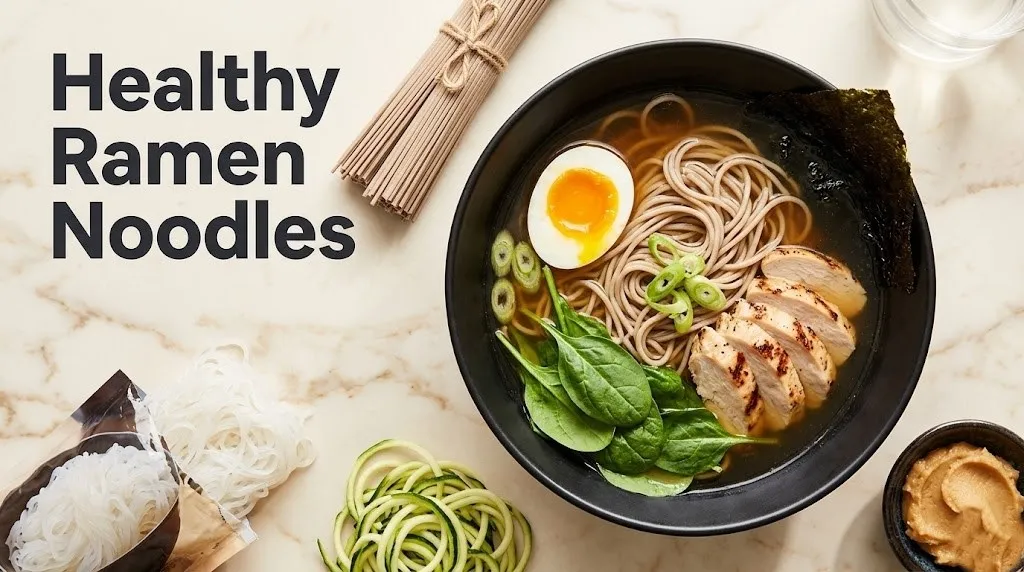
A healthy alternative to the entire instant ramen experience, packet and all, is a bowl built from scratch using air-dried whole-grain noodles, a quick dashi or miso broth, lean protein like shredded chicken or tofu, and fresh vegetables. The total sodium drops by 70 percent. The fiber doubles or triples. The saturated fat falls to near zero.
The key to a satisfying healthy ramen is not just the noodle. It is building layers of umami without relying on the seasoning packet’s monosodium glutamate and salt. Kombu, a dried kelp, provides natural glutamates. Dried shiitake mushrooms add guanylate. Miso paste adds depth and fermented complexity. A splash of fish sauce or a few drops of toasted sesame oil at the end add aroma and richness.
You can make a basic healthy ramen broth in 15 minutes. Combine 4 cups of water, a 4-inch piece of kombu, 3 dried shiitake mushrooms, a tablespoon of low-sodium soy sauce or tamari, and a teaspoon of grated fresh ginger. Bring to a bare simmer, never a rolling boil, and let it steep for 10 minutes. Remove the kombu and mushrooms. Add a tablespoon of white miso paste off heat, stirring to dissolve. This broth contains roughly 300 milligrams of sodium per cup. The standard instant seasoning packet delivers 1,200 to 1,500 milligrams.
healthy version of ramen noodles
A healthy version of ramen noodles is one where the fried wheat brick is replaced with an air-dried, whole-grain, or vegetable-based noodle, and the seasoning packet is replaced with a from-scratch broth that uses whole-food sources of umami and sodium you can measure and control. The bowl that results is not diet food. It is real food that happens to be nutritionally sound.
The nutritional comparison between a standard instant ramen bowl and a healthy rebuilt bowl is stark. The standard bowl with the seasoning packet delivers roughly 380 calories, 14 grams of fat, 52 grams of carbohydrate, 2 grams of fiber, 8 grams of protein, and 1,600 milligrams of sodium. A healthy bowl made with soba noodles, a homemade miso-ginger broth, shredded chicken breast, a soft-boiled egg, spinach, and scallions delivers roughly 420 calories, 10 grams of fat, 45 grams of carbohydrate, 6 grams of fiber, 30 grams of protein, and 500 milligrams of sodium.
Notice that the healthy bowl has more calories. This is not a problem. Calories from lean protein, whole grains, and vegetables behave differently in the body than calories from fried flour and palm oil. The healthy bowl has 30 grams of protein compared to 8 grams. It has 6 grams of fiber compared to 2 grams. It will keep you full for four hours. The instant bowl will leave you hungry in two. Health is not about minimizing calories. It is about maximizing nutritional return per calorie consumed.
Key Takeaway: A healthy ramen bowl starts with an air-dried or whole-grain noodle, uses a homemade broth to control sodium, and adds enough protein and vegetables to turn a snack into a meal.
healthy alternatives to ramen noodles
Healthy alternatives to ramen noodles, in the plural, encompass the full range of options from whole-grain wheat noodles to vegetable spirals to kelp noodles, and the best choice depends on your dietary pattern, your texture preference, and how much time you have. There is no single best noodle. There is a best noodle for your specific bowl.
For a keto or very-low-carb diet, shirataki or kelp noodles are the only viable options. Both are nearly calorie-free and carbohydrate-free. Kelp noodles are made from seaweed and have a crunchy, almost crisp texture even when heated. They do not soften in broth the way wheat noodles do. Some people enjoy the texture contrast. Others find it unsettling. Experiment with a small package before committing.
For a gluten-free diet that is not low-carb, 100 percent buckwheat soba (juwari soba) or brown rice noodles are the best choices. Both are gluten-free when processed in dedicated facilities. Brown rice noodles are softer and more slippery than soba. They work best in broths with a thicker body, like a miso or a tonkotsu-style broth, where the noodle can absorb the richness.
healthy substitute for ramen noodles
A healthy substitute for ramen noodles in terms of convenience and speed is the air-dried ramen noodle from brands like Lotus Foods or Hakubaku, which cook in 4 to 5 minutes, or a pre-spiralized zucchini noodle that requires only 60 seconds in hot broth to become tender. Convenience matters because the instant ramen brick’s primary advantage is speed.
Zucchini noodles are a surprisingly effective ramen noodle substitute. They do not taste like wheat noodles. They taste like zucchini. But in a strongly flavored miso or soy broth with garlic, ginger, and chili, the zucchini flavor recedes and the noodle shape provides the satisfying slurp factor that makes ramen fun to eat. Zucchini noodles release water into the broth as they cook, so add them directly to the hot broth at the table rather than cooking them separately.
The easiest way to make zucchini noodles is with a spiralizer, a $15 tool that turns zucchini into long, spaghetti-like strands. A single medium zucchini produces roughly 1.5 cups of noodles, which is a generous single serving. Do not salt the zucchini noodles before adding them to ramen, as you would for a pasta dish. The salt draws out moisture and makes the noodles limp. Add them directly to the hot broth.
healthy ramen noodle alternative
A healthy ramen noodle alternative that balances nutrition, texture, and flavor better than any other option is a 50/50 mix of soba noodles and zucchini noodles. The soba provides the chewy, wheaty satisfaction of a real noodle. The zucchini adds volume, fiber, and a serving of vegetables without diluting the flavor.
This combination also solves the satiety problem that occurs when you use only zucchini noodles. A bowl of zucchini noodles in broth is extremely low in calories and will leave most people hungry within an hour. Adding a half-serving of soba noodles brings the carbohydrate and protein content up to a level that sustains energy through the afternoon. The total calorie count for the mixed-noodle bowl is roughly 250 to 300 before toppings, compared to 380 for a standard instant brick.
The practical technique is to cook the soba noodles separately, rinse them, and place them in the serving bowl. Add the spiralized zucchini to the hot broth for 60 seconds just before pouring the broth over the soba. The zucchini softens without becoming mushy. The soba maintains its bite. The two textures play off each other in a way that feels intentional, not like a compromise.
healthy ramen alternatives
Healthy ramen alternatives, considered as a complete meal strategy, include the dry noodle swap, the vegetable noodle swap, the shirataki swap, and the “deconstructed ramen” approach, which turns the ramen flavor profile into a soup or salad that does not require a noodle at all. Ramen flavor does not depend on a specific starch.
Deconstructed ramen is a bowl of hot, umami-rich broth with the traditional ramen toppings, soft-boiled egg, sliced scallions, nori, menma, sesame seeds, and a protein like shredded chicken or pan-seared tofu, but no noodles. It is essentially an egg drop soup with ramen flavors. The calorie count drops by 200. The satiety remains high because of the protein and the volume of the broth. This approach works for people who want the ramen experience but are avoiding grains or are on a very low-calorie diet.
Ramen salad is a cold alternative for warm weather. Cook and cool soba noodles, toss them with shredded cabbage, carrots, edamame, and a sesame-miso dressing, and top with the same garnishes that would go on a hot ramen. The flavor profile is identical. The format is different. This is a practical meal prep option because the salad holds well in the refrigerator for three days.
ramen noodle healthy
The phrase “ramen noodle healthy” reflects the hope that ramen can be rehabilitated, and the answer is that the noodles themselves can be significantly improved by choosing air-dried, whole-grain, or buckwheat versions, but the broth and toppings determine the overall health of the bowl. A healthy noodle in a high-sodium, fatty broth is still an unhealthy meal.
The noodle is one component of a four-part system: noodle, broth, protein, and toppings. All four parts need attention. A soba noodle in a homemade miso broth with grilled chicken and steamed bok choy is a healthy meal. A soba noodle in a packaged tonkotsu broth concentrate with fried pork belly is an indulgent meal. The noodle alone does not determine the outcome.
This systems-level view is what separates a genuinely healthy ramen from a “healthier” ramen that still has 900 milligrams of sodium from the broth. Pay as much attention to the liquid as you do to the noodle. The liquid is where the sodium hides.
ramen noodles healthy alternative
Ramen noodles’ healthy alternative category has expanded significantly in the last five years, and in 2026, the best commercially available product for someone who wants a direct, no-effort swap is an air-dried, whole-grain ramen brick from Lotus Foods or Hakubaku. These products are shelf-stable, cook in 4 to 5 minutes, and contain 4 grams of fiber and 7 grams of protein without the saturated fat load of a fried brick.
The nutritional label on a Lotus Foods millet and brown rice ramen brick reads as follows: 220 calories, 1 gram of total fat, zero grams of saturated fat, 44 grams of carbohydrate, 4 grams of dietary fiber, and 7 grams of protein. Compare this to a standard Maruchan or Nissin brick at 380 calories, 14 grams of fat, 6 grams of saturated fat, 52 grams of carbohydrate, 2 grams of fiber, and 8 grams of protein. The air-dried brick saves 160 calories and 6 grams of saturated fat while doubling the fiber. The protein is comparable.
The one thing the air-dried brick does not come with is the seasoning packet. You must provide your own broth. This is a feature, not a bug. The seasoning packet is the worst part of instant ramen nutritionally. Providing your own broth puts you in control of the sodium, the fat, and the flavor intensity.
healthy ramen noodles
Healthy ramen noodles, in the comprehensive sense, are the starting point of a meal that you build with intention. The noodle is the foundation. The broth is the liquid that carries the flavor. The protein turns a snack into a meal. The toppings add texture, color, and micronutrients. Each layer is an opportunity to add nutritional value.
Building a healthy ramen bowl, step by step:
- Choose your noodle: Soba for fiber and protein, shirataki for low-calorie, whole-wheat ramen for a traditional chew, or zucchini for extra vegetables.
- Build your broth: Quick dashi with kombu and shiitake, miso dissolved in hot water, or a slow-simmered bone broth with ginger and garlic. Keep sodium under 500mg per serving.
- Add protein: Shredded rotisserie chicken, pan-seared tofu, a soft-boiled egg, or shelled edamame. Aim for at least 15 grams of protein in the bowl.
- Pile on toppings: Baby spinach that wilts in the hot broth, sliced scallions, menma, nori strips, a sprinkle of sesame seeds, and a drizzle of toasted sesame oil.
- Finish with flavor: A few drops of chili oil, a splash of rice vinegar, or fresh grated ginger. These add impact without sodium.
| Ramen Bowl Type | Calories | Protein | Fiber | Sodium |
|---|---|---|---|---|
| Standard instant (brick + packet) | 380 | 8 g | 2 g | 1,600 mg |
| Healthy soba + homemade broth + chicken + vegetables | 420 | 30 g | 6 g | 500 mg |
| Shirataki + homemade broth + tofu + vegetables | 180 | 18 g | 5 g | 450 mg |
| Whole-wheat ramen + miso broth + egg + vegetables | 380 | 24 g | 7 g | 550 mg |
Key Takeaway: A healthy ramen bowl is a system, not a single swap. Change the noodle, make your own broth, add protein and vegetables, and you turn a nutritional liability into a legitimate meal.
Frequently Asked Questions About Healthy Ramen Noodles
What is the healthiest type of ramen noodle?
Soba noodles made from 100 percent buckwheat are the healthiest ramen noodle alternative because they provide 3 grams of fiber and 8 grams of protein per serving.
Air-dried whole-wheat ramen is a close second with a more traditional ramen texture.
Shirataki noodles are the healthiest choice for very low-calorie or low-carb diets.
Can I make instant ramen healthy?
You can make instant ramen healthier by discarding the seasoning packet and using only half the noodle brick.
Replace the broth with a homemade dashi or miso base, and add plenty of vegetables and a protein source.
The noodles are still fried, but the overall bowl will have significantly less sodium and saturated fat.
Are rice noodles healthier than ramen noodles?
Rice noodles are marginally healthier than standard instant ramen because they are not fried and contain no saturated fat.
However, rice noodles have minimal fiber and protein, similar to ramen noodles.
They are a neutral swap, not a nutritional upgrade, unless you choose brown rice noodles.
Is ramen healthy without the seasoning packet?
Ramen noodles without the seasoning packet are still a fried, refined-flour product with 14 grams of fat and minimal fiber.
Removing the packet saves roughly 1,200 milligrams of sodium, which is a significant improvement.
The noodle itself is still a treat-level food, not a health food.
What can I use instead of ramen noodles that is low-carb?
Shirataki noodles made from konjac yam are the best low-carb substitute, with fewer than 5 grams of carbohydrate per serving.
Kelp noodles are another zero-carb option with a crunchier texture.
Zucchini noodles are low-carb and add a serving of vegetables but will not replicate a traditional noodle chew.
Ramen is not the enemy. The deep-fried brick and the sodium packet are the enemy. You can have a bowl of noodles in hot broth that tastes like comfort and nostalgia without eating a meal that exceeds your daily sodium limit before you finish the last slurp.
The single most effective change you can make is to buy the noodles and the broth separately. Air-dried noodles from a better brand. A quick homemade broth from ingredients you can pronounce. Protein from last night’s leftovers. Vegetables from your crisper drawer. The bowl comes together in the time it takes to boil water.
Ramen is a food worth saving. It is warm, satisfying, endlessly customizable, and culturally significant. The healthy version is not a betrayal of the original. It is a continuation of the same idea, a bowl of noodles in broth, built with ingredients that serve your body instead of working against it.