You can begin eating soft, easy-to-chew solid foods roughly three to four days after wisdom teeth removal, but true solid foods that require significant chewing like steak, raw vegetables, or crusty bread should wait until day seven or later, and your individual healing timeline may extend or shorten this window. The key is not the calendar. It is the stability of the blood clot.
The reason you cannot eat solid food immediately is not your pain level or your jaw stiffness. It is the blood clot, also called a fibrin clot, that forms in each empty tooth socket. This clot is the foundation for all healing that follows. It protects the underlying bone and nerve endings. It serves as a scaffold for new tissue growth. If that clot is dislodged by a rogue grain of rice or the suction of chewing a tough piece of bread, you get dry socket, clinically known as alveolar osteitis. The American Association of Oral and Maxillofacial Surgeons estimates that dry socket occurs in roughly 2 to 5 percent of routine extractions, but the risk rises with impacted wisdom teeth and poor post-operative compliance.
This guide provides a day-by-day food timeline based on standard oral surgery recovery protocols. Your oral surgeon’s specific instructions always take precedence because they know the complexity of your extraction, the number of teeth removed, and your personal risk factors. Use this as a framework. Confirm the details with the clinician who performed your surgery.
when can you eat solid food after wisdom teeth removal
You can begin cautiously reintroducing soft solid foods like scrambled eggs, oatmeal, and mashed potatoes roughly 72 hours after surgery, provided your bleeding has stopped completely and you can open your jaw comfortably enough to accommodate small bites. This is the three-day mark that most oral surgeons reference as the transition point from liquids and purees to mechanical soft foods.
The first 24 hours are a strict liquid and puree-only period. Your body is forming the initial clot. Any chewing motion, any suction, any food particle that finds its way into the socket can disrupt this process. The clot is fragile during this window. Think of it like a scab on your skin that has not fully dried. You would not scrub it with a washcloth. The same principle applies inside your mouth.
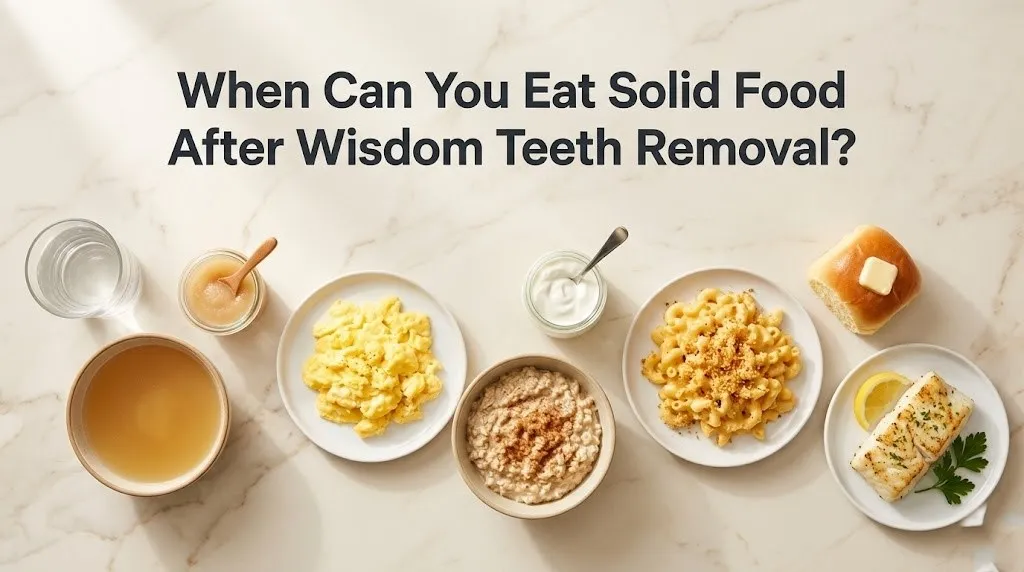
The second 24 hours, roughly day two, allow for slightly thicker foods that still require zero chewing: yogurt, smooth soups, protein shakes, thinned oatmeal. The clot is stabilizing but still vulnerable. You can introduce a spoon at this stage, but the food should be smooth enough to slide off the spoon and swallow without any tongue-pushing or cheek-suction movement. Continue to avoid all straws, spitting, and carbonated beverages.
when can i eat solid food after wisdom teeth
You can eat solid food after wisdom teeth removal when you can chew comfortably without pain, your extraction sites show visible healing rather than open holes, and you are at least five to seven days post-surgery, but the definition of “solid” matters greatly. A soft pancake is solid. A handful of tortilla chips is solid. These are not equivalent.
The transition from soft-solid to fully solid food is gradual and asymmetric. Your mouth heals from the outside in. The gum tissue closes over the socket over the course of several weeks. At day seven, the surface healing is advanced enough for most people to eat pasta, soft bread, pancakes, and tender fish. The socket beneath the gum line is still filling in with new bone and soft tissue, a process that takes months to complete, but the protective gum layer is usually intact enough to handle gentle chewing by the end of the first week.
The American Dental Association advises that patients follow their oral surgeon’s guidance on diet progression, as factors like the number of teeth removed, the degree of impaction, and whether bone grafting was performed all affect the timeline. A straightforward extraction of a fully erupted wisdom tooth heals faster than a surgical extraction of an impacted tooth that required bone removal. Your timeline is yours. Do not compare it to a friend who was eating pizza on day five.
when can i eat solid food wisdom teeth
The phrase “when can I eat solid food wisdom teeth” is how people search when they are hungry and impatient, and the answer is that most people can handle a soft-solid meal like macaroni and cheese or a soft roll by day four or five, but you must listen to your body and your extraction sites more than the calendar. If a food causes sharp pain, stop eating it immediately.
The pain test is more reliable than the calendar test. Take a small, pea-sized bite of the food you want to try. Chew it slowly with your front teeth or on the side of your mouth opposite the extraction sites. If you feel a sharp, stabbing sensation in the socket, the clot or the healing tissue is being disturbed. Swallow what is in your mouth and stop. Rinse gently with warm salt water. Wait another day or two before trying that food again.
There is no prize for eating a cheeseburger on day six. The consequence of pushing the timeline is a dry socket that will set you back at least a week in pain and require an emergency visit to the oral surgeon for a medicated packing placed directly into the exposed socket. The procedure is uncomfortable. The recovery resets. The cheeseburger was not worth it.
Key Takeaway: The safe return to solid food after wisdom teeth removal follows a gradient, not a switch. Days 1-2 are liquids and purees. Days 3-4 are soft-solids. Days 5-7 are gentle chewables. Day 7 and beyond are progressively normal foods.
when can i start eating real food after wisdom teeth
You can start eating “real food,” meaning food that resembles a normal meal rather than a medical liquid diet, around day three to four, with the understanding that “real” means soft pasta, scrambled eggs, pancakes, and tender fish rather than pizza, burgers, or crunchy tacos. The texture of the food matters far more than the category.
The psychological desire for real food after wisdom teeth removal is intense and often underestimated. A liquid diet of protein shakes and broth does not satisfy the human need to chew and experience the mouthfeel of solid food. By day three or four, most people are not only physically ready for soft-solids but also mentally desperate for them. The first plate of scrambled eggs after three days of yogurt tastes like a five-star meal.
The foods that qualify as “real” during the soft-solid phase include scrambled eggs, soft pancakes with syrup, oatmeal, cream of wheat, mashed potatoes with gravy, refried beans, well-cooked pasta with a smooth sauce, flaky fish like tilapia or cod, meatloaf, and soft casseroles. The common thread is that these foods can be broken down with minimal chewing and form a soft bolus that slides down without scraping the extraction sites.
when can i eat solid food after wisdom
You can eat solid food after wisdom teeth removal when the extraction sites no longer bleed when you brush your teeth, when the swelling has subsided enough that you can close your mouth comfortably, and when you are no longer taking prescription pain medication that could mask the sensation of a food particle irritating the socket. Pain medication is a double-edged sword in recovery.
Opioid pain relievers and even high doses of ibuprofen can dull the protective pain signals that tell you something is wrong. If you are taking medication that makes your mouth feel numb or significantly reduces your pain, you are missing critical feedback. A piece of food could be lodged in the socket, and you might not feel it until the medication wears off and the inflammation has already set in. This is why many oral surgeons recommend transitioning to over-the-counter pain relief as soon as tolerable, not only for the general health benefits but also for the sensory feedback that protects the surgical sites.
Your surgeon or dentist can provide specific guidance on when you, as an individual with a unique surgical history, can resume solid foods. Bring a list of the foods you are eager to eat to your follow-up appointment, which typically occurs one to two weeks after surgery. Ask directly: “Can I eat a sandwich? Can I eat a salad?” The answers will be more specific and useful than general guidelines.
wisdom teeth when to eat solid food
Wisdom teeth extraction patients can typically resume a normal solid food diet by day 7 to 10, with full dietary normalization taking up to two to three weeks for complex extractions. The timeline varies based on whether the extraction was simple or surgical, how many teeth were removed, and individual healing factors.
Smokers and people who use oral contraceptives have a significantly higher risk of dry socket and should extend the soft food timeline by several days to account for slower healing. Nicotine is a vasoconstrictor that reduces blood flow to the healing socket. Estrogen-containing contraceptives can interfere with clot stability through mechanisms that are not fully understood but are well documented in the oral surgery literature. If you fall into either category, err on the side of caution with your food progression.
Age also plays a role. Younger patients, teenagers and those in their early twenties, tend to heal faster than patients over 30, whose bone is denser and whose tissue turnover is slower. If you are having your wisdom teeth removed in your thirties or forties, expect the recovery timeline to extend by several days to a week compared to the standard guidance.
| Factor | Effect on Solid Food Timeline |
|---|---|
| Simple extraction (fully erupted) | Solids by day 5-7 |
| Surgical extraction (impacted) | Solids by day 7-10 |
| Bone grafting performed | Solids by day 10-14 |
| Smoker | Add 3-5 days to timeline |
| Oral contraceptive use | Add 2-4 days to timeline |
| Age over 30 | Add 3-7 days to timeline |
| Single tooth removed | Faster recovery |
| All four removed | Slower recovery |
wisdom teeth removal food timeline
The wisdom teeth removal food timeline progresses from clear liquids on day one, to full liquids and purees on day two, to soft-solids on days three through five, to gentle chewable foods on days six through ten, and finally to a normal diet after day ten. Each stage has a specific physiological purpose and a specific list of appropriate foods.
This timeline is not a suggestion. It is a clinical protocol designed to protect the blood clot during its most vulnerable phase, then to gradually reintroduce chewing forces as the gum tissue strengthens. Skipping a stage, particularly moving from purees directly to chewy or crunchy foods, is the most common cause of dry socket that oral surgeons see in the emergency room.
The timeline below is based on standard post-operative instructions from the American Association of Oral and Maxillofacial Surgeons and is appropriate for a routine extraction of all four wisdom teeth in a healthy young adult. Your oral surgeon’s instructions may differ based on your specific case.
| Days Post-Surgery | Food Stage | Examples |
|---|---|---|
| Day 1 (first 24 hours) | Clear liquids and very thin purees | Water, broth, apple juice, thinned yogurt, gelatin |
| Day 2 | Full liquids and smooth purees | Protein shakes, cream soups, applesauce, smooth yogurt |
| Days 3-4 | Soft-solids (no chew) | Scrambled eggs, oatmeal, mashed potatoes, cottage cheese |
| Days 5-7 | Mechanical soft (gentle chew) | Mac and cheese, soft pasta, flaky fish, pancakes, meatloaf |
| Days 7-10 | Progressive normal | Soft bread, tender chicken, steamed vegetables, ripe banana |
| Day 10+ | Normal diet with caution | Resume normal foods, avoid extremely crunchy foods for 2 more weeks |
what to eat after wisdom teeth removal
What to eat after wisdom teeth removal depends on which day you are on, but the guiding principle is to choose nutrient-dense, soft foods that support wound healing, specifically foods rich in protein, vitamin C, vitamin A, and zinc, while avoiding anything that requires suction, chewing, or that leaves particulate debris behind.
Protein is the single most important nutrient for surgical recovery. Collagen, the primary structural protein in gum tissue, is synthesized from the amino acids you consume. Inadequate protein intake slows wound healing. The Academy of Nutrition and Dietetics recommends that surgical patients consume 1.2 to 1.5 grams of protein per kilogram of body weight during active healing. For a 150-pound adult, that is roughly 82 to 102 grams of protein per day. Getting that much protein from liquids and purees requires planning.
Vitamin C is a required cofactor for collagen synthesis. Without it, the fibroblasts that build new tissue cannot effectively cross-link collagen fibrils. A protein shake blended with a handful of spinach or a splash of orange juice covers both protein and vitamin C in one drinkable meal. Zinc supports cell division and immune function. It is found in yogurt, cottage cheese, and smooth nut butters, all of which are safe on the soft food diet.
Nutrient-rich soft food options for the first 72 hours:
- Greek yogurt (protein, zinc, probiotics)
- Smoothies with protein powder, spinach, and banana (protein, vitamin C, potassium)
- Pureed lentil or bean soups (protein, fiber, zinc)
- Mashed avocado (healthy fat, vitamin E, calories)
- Cottage cheese (protein, calcium)
- Blended scrambled eggs (protein, vitamin D, choline)
soft foods after wisdom teeth removal
Soft foods after wisdom teeth removal include anything that can be eaten with minimal to no chewing and that does not produce sharp fragments. The category is broader than most patients realize. By day three, you can eat a substantial and satisfying diet if you think beyond applesauce and Jell-O.
The best soft foods are those that mimic the mouthfeel of real food. A bowl of well-cooked oatmeal with a swirl of smooth almond butter and a sprinkle of cinnamon feels like breakfast. A plate of buttery mashed potatoes with finely shredded cheese melted on top feels like comfort food. A smooth black bean soup topped with a dollop of sour cream feels like dinner. The goal is to stay nourished and sane while your mouth heals.
Temperature is a critical variable that many patients overlook. Hot foods and liquids increase blood flow to the surgical sites and can dissolve the protective clot. All foods should be lukewarm or cool for the first 48 hours. After day three, you can gradually introduce warmer foods, but they should never be steaming hot. Test the temperature on your wrist, the same way you would test a baby’s bottle. If it feels hot on your skin, it is too hot for your extraction sites.
| Safe Soft Foods | Foods to Modify | Foods to Avoid Entirely |
|---|---|---|
| Scrambled eggs | Pasta (overcook until very soft) | Raw vegetables |
| Greek yogurt | Bread (remove crust, dip in soup) | Chips, crackers, pretzels |
| Oatmeal/cream of wheat | Chicken (shred finely, mix with sauce) | Nuts and seeds |
| Mashed potatoes | Steamed vegetables (cook until mushy) | Popcorn |
| Smooth soups (no chunks) | Fruit (peel and mash, like banana) | Chewy or crusty bread |
| Cottage cheese | Rice (wait until day 7+) | Tough meats, jerky |
foods to avoid after wisdom teeth removal
Foods to avoid after wisdom teeth removal include any food that is crunchy, chewy, spicy, acidic, contains small hard particles, or requires significant suction or jaw force to consume. The list is long, but the logic is simple: if a food can physically disturb the blood clot, cause a particle to become lodged in the socket, or irritate the healing tissue, it is banned until cleared by your surgeon.
Popcorn is the single most dangerous food for wisdom teeth recovery. The thin, sharp hulls can slip between sutures and lodge deep in the socket. Once lodged, they are nearly impossible to remove without professional irrigation. The same applies to nuts, seeds, and granola. Even smooth nut butter should be inspected for crunchy bits before eating.
Rice and quinoa are surprisingly problematic during the first week. Individual grains are small enough to slip into the socket and difficult to remove with gentle rinsing. If a grain becomes trapped, it can cause inflammation and, in some cases, infection. Wait until at least day seven and until you have an irrigation syringe to flush the sockets effectively before attempting rice or quinoa.
Foods to strictly avoid during the first week:
- Popcorn (hulls can lodge in sockets)
- Nuts, seeds, granola, and crunchy nut butters
- Rice and quinoa until day 7
- Chips, pretzels, and crackers
- Raw vegetables and crunchy fruits
- Tough, chewy meats
- Sticky foods like caramel or gum
- Spicy foods that can irritate healing tissue
- Carbonated beverages and alcohol
- Hot liquids for the first 48 hours
what happens if you eat solid food too soon after wisdom teeth
If you eat solid food too soon after wisdom teeth removal, you risk dislodging the protective blood clot from the extraction socket, which leads to alveolar osteitis, commonly called dry socket, a condition where the underlying bone and nerve are exposed to air, food, and bacteria, causing intense, radiating pain that typically begins 48 to 72 hours after the clot is lost.
A dry socket is not a minor complication. The pain is often described as worse than the original surgical pain. It radiates from the jaw to the ear, temple, and neck on the affected side. Over-the-counter pain relievers provide minimal relief. The treatment requires a return visit to the oral surgeon, who will gently irrigate the socket to remove debris and then pack it with a medicated dressing, often containing eugenol, the active compound in clove oil, to soothe the nerve.
Beyond the physical pain, a dry socket significantly delays healing. The socket must now heal from the bottom up, a process called secondary intention healing, rather than having the protective clot serve as a scaffold for tissue regeneration. The total healing time can double from two weeks to four weeks. The financial cost of the emergency visit and the lost work or school days add insult to the injury. All of this is preventable by following the food timeline.
how to get enough protein after wisdom teeth removal
Getting enough protein after wisdom teeth removal requires deliberately incorporating protein into every meal and snack through Greek yogurt, protein-fortified smoothies, pureed meats, eggs, cottage cheese, and bone broth. It is easy to fall into a cycle of eating only applesauce and sherbet and wondering why you feel weak and foggy three days into recovery.
A high-protein smoothie is the most efficient delivery system for recovery nutrition. Blend 1 cup of milk or a milk alternative, 1/2 cup of plain Greek yogurt, 1 scoop of unflavored or vanilla protein powder, 1 tablespoon of smooth almond butter, and a ripe banana. This single smoothie delivers roughly 35 to 40 grams of protein, plus potassium, calcium, and healthy fat. Drink it slowly. Do not use a straw.
If you are vegan or avoid dairy, your protein options narrow during the liquid and puree phase. Smooth nut butters, silken tofu blended into soups and smoothies, and plant-based protein powders are your best sources. Pea protein and soy protein powders blend more smoothly than hemp or brown rice protein. Hummus, thinned with a little water or olive oil to a smooth consistency, is a savory option that provides protein, fiber, and healthy fat.
High-protein recovery foods by dietary pattern:
- Omnivore: Scrambled eggs, Greek yogurt, cottage cheese, bone broth, pureed chicken
- Vegetarian: Greek yogurt, cottage cheese, protein smoothies, blended lentil soup, eggs
- Vegan: Silken tofu smoothies, pea protein shakes, smooth hummus, blended bean soups, almond butter
signs you are ready for solid food after wisdom teeth
You are ready for solid food after wisdom teeth removal when you can open your mouth wide enough to comfortably accommodate a forkful of food, your extraction sites no longer throb or bleed when you brush your teeth, the swelling has decreased enough that your cheeks look closer to normal than to chipmunk, and you have been pain-free or nearly pain-free on over-the-counter medication for at least 24 hours.
The jaw opening test is practical and objective. Try to fit two fingers stacked vertically between your front teeth. If you cannot open that wide without pain, you are not ready for foods that require biting, like a sandwich or a whole apple. Stick to soft foods that can be cut into small pieces and eaten with a fork.
Another reliable sign is that you can perform your oral hygiene routine, including gentle salt water rinses, without triggering pain or bleeding. If a gentle rinse still stings or produces pink-tinged saliva, the tissue is not yet sealed enough to handle the friction of solid food. When you can rinse comfortably and the water comes back clear, you are likely ready to progress. Your oral surgeon or dentist can confirm readiness at a follow-up appointment by visually inspecting the socket for complete gum tissue coverage.
Key Takeaway: The return to solid food is a negotiation between your desire for normalcy and your body’s healing rate. Your body wins every argument. Listen to pain signals, check for bleeding, and confirm with your surgeon.
Frequently Asked Questions About Eating After Wisdom Teeth Removal
Can I eat mac and cheese after wisdom teeth removal?
You can eat macaroni and cheese starting around day five or six, provided the pasta is cooked very soft and the dish is lukewarm, not hot.
The small pasta shape can still pose a risk if individual pieces are firm or al dente.
Chew carefully and avoid the side of your mouth with extraction sites.
When can I eat rice after wisdom teeth removal?
You should wait until at least day seven to eat rice, and only if you have an irrigation syringe to flush the sockets afterward.
Individual rice grains are perfectly sized to slip into an extraction socket and become lodged.
If you do eat rice, irrigate the sockets gently with warm salt water immediately after the meal.
What happens if I eat a burger too soon after wisdom teeth?
Eating a burger too soon after wisdom teeth removal can dislodge the blood clot and cause a painful dry socket.
The combination of chewing force, the toughness of the meat, and the bread texture creates multiple risks simultaneously.
Wait at least seven to ten days before attempting a burger, and start with a soft, small burger on a squishy bun.
Can I eat scrambled eggs the day after wisdom teeth removal?
You can eat scrambled eggs starting on day two or three, provided they are cooked soft, cooled to lukewarm, and eaten in small, gentle bites.
Eggs are an excellent recovery food because they are high in protein and require minimal chewing.
Avoid adding cheese or crunchy ingredients that could break into sharp pieces.
When can I stop worrying about dry socket?
You can stop worrying about dry socket after the extraction sites have closed enough that you can no longer see an open hole, typically around day seven to ten.
The highest risk window is days two through five after surgery, when the clot is formed but not yet replaced by granulation tissue.
Continue to follow the food timeline and avoid straws and smoking until your oral surgeon confirms the sockets are healed.
The return to solid food after wisdom teeth removal is a test of patience, not a race. The blood clot in each socket is doing the most important work of your recovery. Protect it by following the timeline, advancing your diet only when your mouth tells you it is ready, and keeping nutrition a priority so your body has the raw materials it needs to heal.
The single best thing you can do for your recovery is to prepare before your surgery. Stock your refrigerator and pantry with Greek yogurt, protein powder, smooth nut butter, eggs, oatmeal, applesauce, and broth. Plan a progression of meals that you actually want to eat, not just what you can tolerate. The mental boost of eating a satisfying meal on day four is real and contributes to your overall well-being during a difficult recovery.
If you suspect a dry socket, if the pain suddenly intensifies after a period of improvement, if you notice a foul taste or odor from the extraction site, or if you see exposed bone in the socket, call your oral surgeon immediately. Do not wait. Do not try to treat it yourself. Dry socket is a quick fix in trained hands and a prolonged ordeal when ignored. Your surgeon would rather hear from you unnecessarily than see you in the emergency room four days late.