Healthy snack ideas for kids start with the same principle that guides adult nutrition: combine a fiber-rich carbohydrate with a protein or healthy fat. An apple with peanut butter. Carrot sticks with hummus. Greek yogurt with berries. Whole grain crackers with cheese. This combination stabilizes blood sugar, provides sustained energy, and keeps a child full longer than a carbohydrate-only snack like pretzels or fruit snacks. The snack is a mini meal. It follows the same nutritional logic.
The American Academy of Pediatrics (AAP) recommends that children consume no more than 25 grams of added sugar per day for children over age 2 and zero added sugar for children under age 2. A single pouch of fruit snacks or a granola bar can contain 10 to 15 grams of added sugar. A day’s worth of snacks built from packaged foods can easily exceed the AAP limit before dinner. Building snacks from whole foods, fruit, vegetables, dairy, whole grains, nuts, and seeds, eliminates added sugar from the snack equation and delivers the fiber, protein, and micronutrients that growing bodies need.
This guide provides snack ideas organized by age, prep time, dietary needs, and real-life parenting scenarios. It covers choking hazards by age, the snack drawer system for independent kids, store-bought options that meet nutritional standards, and specific strategies for picky eaters and food allergies. Each snack idea includes the key nutrients it delivers and the age group it suits. You will find ideas you can execute in under two minutes and ideas you can prep on Sunday for the week ahead.
Healthy Snack Ideas for Kids
The master list of healthy snack ideas for kids is organized by food group combination. Each snack pairs a produce item (fruit or vegetable) with a protein or healthy fat source. The pairing is the nutritional engine of the snack. The produce provides fiber, vitamins, and hydration. The protein or fat provides satiety and sustained energy. Together they create a snack that bridges the gap between meals without a sugar crash.
Fruit and protein pairings include apple slices with peanut butter or sunflower seed butter, banana with Greek yogurt dip, berries with cottage cheese, pear slices with string cheese, and frozen grapes with a handful of almonds for older children. Each pairing delivers fiber from the fruit and protein from the dairy, nut, or seed component. The protein slows the digestion of the fruit sugar, producing a gentler blood glucose curve.
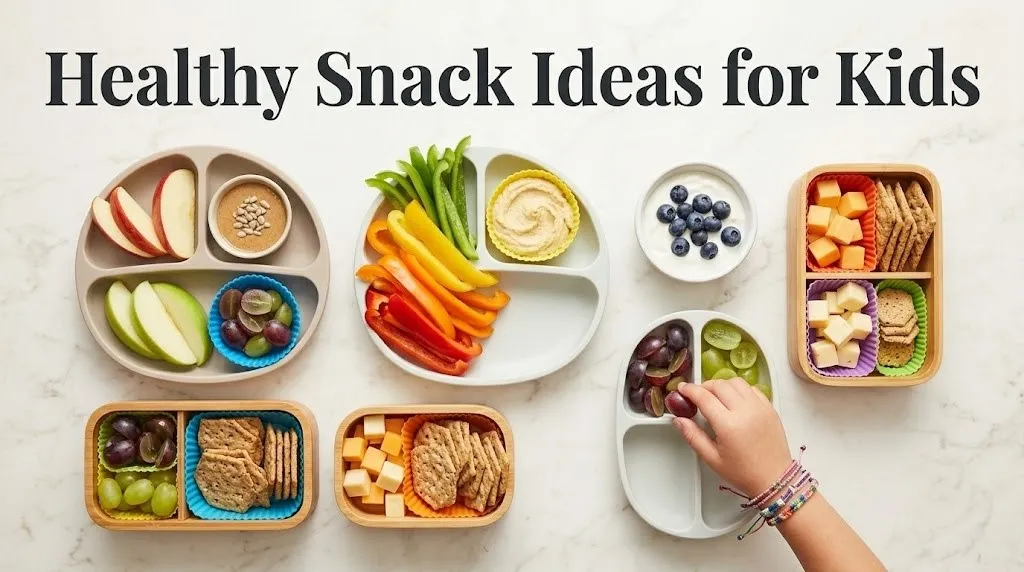
Vegetable and protein pairings include baby carrots with hummus, bell pepper strips with guacamole, cucumber rounds with cream cheese, cherry tomatoes with mozzarella balls, and celery sticks with almond butter. These pairings deliver fiber from the vegetables and protein or healthy fat from the dip. The vegetables add volume and crunch. The dips add flavor and staying power.
Whole grain and protein pairings include whole grain crackers with cheese slices, a small whole wheat pita with hummus, a rice cake with avocado and a sprinkle of salt, oatmeal with a spoonful of nut butter, and air-popped popcorn with a sprinkle of nutritional yeast. These pairings deliver fiber from the whole grain and protein or healthy fat from the topping. The whole grain provides complex carbohydrate that digests slowly.
| Food Group Combination | Example | Prep Time | Best For Ages |
|---|---|---|---|
| Fruit + Protein | Apple slices with peanut butter | 2 min | 3+ (thinly sliced for toddlers) |
| Vegetable + Protein | Carrot sticks with hummus | 2 min | 3+ (grated carrots for toddlers) |
| Whole Grain + Protein | Whole grain crackers with cheese | 1 min | 2+ (soft crackers for toddlers) |
| Dairy + Fruit | Greek yogurt with berries | 1 min | All ages (mashed berries for infants 6mo+) |
| Vegetable + Healthy Fat | Bell pepper strips with guacamole | 3 min | 3+ (cooked pepper strips for toddlers) |
| Whole Grain + Healthy Fat | Rice cake with avocado | 2 min | 2+ (mashed avocado, thin layer) |
Quick Tip:
- Build snacks using the “produce plus protein” rule. If the snack contains only one food group, it is probably not a complete snack. A banana alone is a healthy food but not a satiating snack. A banana with peanut butter is a snack that lasts until dinner.
Easy Healthy Snacks for Kids
Easy healthy snacks require two minutes or less of preparation and use ingredients that most households stock regularly. These are the snacks parents reach for when a child announces hunger and patience is measured in seconds. The snack drawer strategy, described in detail later in this guide, makes easy snacks even easier by pre-positioning the ingredients in accessible, designated spaces.
A banana with a cheese stick requires peeling and unwrapping. Total time: 30 seconds. The banana provides potassium and fiber. The cheese stick provides protein and calcium. This snack works for children over 12 months who have been introduced to dairy and have the oral motor skills to handle a cheese stick safely. For toddlers, slice the cheese stick into thin strips and slice the banana into age-appropriate pieces.
Apple slices with pre-portioned nut butter cups require slicing an apple and opening a small cup. Total time: 1 minute. Pre-portioning nut butter into small containers on shopping day turns this into an instant snack. The apple provides fiber and hydration. The nut butter provides protein and healthy fat. This snack is for children over 3 years with safe chewing skills for raw apple slices. For toddlers, grate the apple or steam thin slices until tender.
Greek yogurt from a large tub, scooped into a bowl with frozen berries, requires scooping and pouring. Total time: 1 minute. Plain yogurt eliminates added sugar. Frozen berries thaw in the yogurt within 5 minutes and create a sauce as they release their juices. This snack works for children over 6 months who have been introduced to dairy and berries. For infants, mash the berries. For older children, let them add their own berries and a sprinkle of granola.
| Easy Snack | Ingredients | Prep Time | Nutrition Highlight |
|---|---|---|---|
| Banana + cheese stick | 1 banana, 1 mozzarella string cheese | 30 sec | Potassium, protein, calcium |
| Apple + nut butter cup | 1 apple, 2 tbsp pre-portioned nut butter | 1 min | Fiber, protein, healthy fat |
| Yogurt + frozen berries | 1 cup plain Greek yogurt, 1/2 cup frozen berries | 1 min | Protein, probiotics, fiber, antioxidants |
| Crackers + cheese | 6 whole grain crackers, 1 oz cheddar cheese | 1 min | Fiber, protein, calcium |
| Baby carrots + hummus cup | 1 cup baby carrots, 1 pre-portioned hummus | 1 min | Fiber, protein, healthy fat |
| Rice cake + avocado | 1 brown rice cake, 1/4 avocado mashed | 2 min | Fiber, monounsaturated fat, potassium |
Key Takeaway: Easy healthy snacks use the “produce plus protein” rule and require two minutes or less. Banana and cheese, apple and nut butter, yogurt and berries, and crackers and cheese are the cornerstones. Pre-portion ingredients on shopping day for instant access.
Healthy Snacks for Kids School
School snacks must be shelf-stable until snack time, nut-free if the school has a nut-free policy, and easy for the child to open and eat independently. The snack also needs to survive several hours in a backpack or cubby without refrigeration. An insulated lunchbox with an ice pack expands the options to include dairy and other perishable items. Without an ice pack, the snack must be non-perishable.
Nut-free school snacks that are shelf-stable include whole fruit (apple, banana, orange, clementine), dried fruit without added sugar (raisins, dried apricots, freeze-dried berries), popcorn (air-popped or low-sodium bagged), whole grain crackers, pretzels with hummus (shelf-stable hummus cups), roasted chickpeas, and fruit and vegetable pouches with no added sugar. These items can sit in a backpack for hours without safety concern.
Nut-free school snacks that require an ice pack include cheese sticks, yogurt tubes or pouches, hummus and vegetable cups, hard-boiled eggs, and milk boxes. The ice pack keeps these items at a safe temperature below 40 degrees F until snack time. An insulated lunchbox with a frozen ice pack typically maintains safe temperature for 4 to 6 hours, which covers the window from morning departure to mid-morning or afternoon snack.
The school snack should be something the child can open independently. A kindergartener who cannot open a cheese stick wrapper will either not eat the snack or will interrupt the teacher for help. Test the packaging at home before sending it to school. Pre-open difficult packaging slightly, transfer items to easy-open containers, or choose items with peel-back lids and tear notches that small hands can manage.
| School Snack | Shelf-Stable? | Nut-Free? | Kid-Friendly Opening? |
|---|---|---|---|
| Apple (whole) | Yes | Yes | Yes |
| Banana | Yes | Yes | Yes |
| Cheese stick + crackers | No (needs ice pack) | Yes | Cheese wrapper may need pre-opening |
| Yogurt tube (frozen) | No (needs ice pack) | Yes | Yes |
| Popcorn (pre-packaged) | Yes | Yes | Yes |
| Roasted chickpeas (pre-packaged) | Yes | Yes | Yes |
| Sunflower seed butter + crackers | Yes | Yes | Pre-spread butter on crackers |
| Hummus cup + pretzels | Yes (shelf-stable hummus) | Yes | Hummus lid may need loosening |
Quick Tip:
- Freeze a yogurt tube or pouch overnight. Place it in the lunchbox frozen. It thaws by snack time and doubles as an extra ice pack for the other items in the lunchbox. The frozen tube keeps the surrounding food cold and is ready to eat by mid-morning.
Healthy Snacks for Toddlers
Toddler snacks require a different set of rules than snacks for older children. Choking is the primary safety concern. The American Academy of Pediatrics identifies the following as choking hazards for children under 4: whole grapes, raw apple chunks, raw carrot rounds, whole nuts, large seeds, popcorn, hot dogs, large chunks of meat or cheese, and hard candy. These foods must be modified or avoided entirely for toddlers.
Grapes must be quartered lengthwise, not halved. A grape half is the exact diameter of a toddler’s airway. A quartered grape is safe. Apples must be thinly sliced, grated, or steamed until tender, not served in chunks. Carrots must be grated, cooked until soft, or cut into thin matchstick strips, not served in rounds. Nuts and seeds must be ground into butter or finely chopped, not served whole. Popcorn should be avoided entirely until age 4. The hulls can be aspirated into the airway and are difficult to remove.
Toddler snacks that are safe and nutritious include quartered grapes with cheese slices, grated apple with cinnamon and a dollop of yogurt, steamed carrot sticks with hummus, whole wheat toast strips with mashed avocado, banana slices with thinned nut butter, and full-fat cottage cheese with mashed berries. The full-fat dairy is appropriate for toddlers under 2. The USDA Dietary Guidelines recommend whole milk dairy for children 12 to 24 months because the fat supports brain development. After age 2, the recommendation shifts to low-fat or nonfat dairy.
Toddler snacks also serve a developmental purpose. Snacks are an opportunity to practice self-feeding, explore new textures and flavors, and develop the oral motor skills that support speech. A variety of textures, soft, crunchy, smooth, lumpy, at snack time builds the sensory and motor experience that contributes to eating competence. The high chair or booster seat with a footrest provides the stable posture that supports safe swallowing.
| Toddler Snack (12 to 36 months) | Choking Prevention | Key Nutrients |
|---|---|---|
| Quartered grapes + full-fat cheese cubes (small) | Grapes quartered lengthwise, cheese in small cubes | Fiber, calcium, healthy fat |
| Grated apple + full-fat yogurt | Apple grated, not chunked | Fiber, protein, probiotics |
| Steamed carrot sticks + hummus | Carrots steamed until soft, cut into thin strips | Fiber, iron, plant protein |
| Whole wheat toast strips + mashed avocado | Toast cut into strips, avocado mashed smooth | Fiber, monounsaturated fat |
| Banana slices + thinned nut butter | Banana sliced, nut butter thinned with water to reduce stickiness | Potassium, protein |
| Full-fat cottage cheese + mashed berries | Berries mashed or quartered if soft (raspberries) | Protein, calcium, antioxidants |
Key Takeaway: Toddler snacks must be modified for choking safety. Quarter grapes lengthwise. Grate or steam apples and carrots. Avoid whole nuts, popcorn, and hard candy entirely until age 4. Full-fat dairy is appropriate under age 2.
Healthy After School Snacks
After-school snacks address the gap between lunch at noon and dinner at 6 or 7 PM, the longest stretch of a child’s day without a meal. The after-school snack should be substantial enough to fuel homework, play, or sports practice but not so large that it replaces dinner. A snack in the 150 to 250 calorie range with protein and fiber achieves this balance.
The timing of the after-school snack affects dinner. A snack eaten at 3:30 PM allows hunger to rebuild by 6:00 PM. A snack eaten at 5:00 PM, particularly a large one, suppresses dinner appetite. The ideal after-school snack window is within 30 minutes of arriving home. The snack is pre-planned and pre-portioned, not grazed from the pantry for an hour. Grazing undermines the structure that supports both healthy snacking and healthy meals.
After-school snack ideas that fit the 150 to 250 calorie range include a small whole wheat pita with hummus and cucumber slices (200 calories), a smoothie made with milk, half a banana, a spoonful of peanut butter, and ice (250 calories), whole grain crackers with cheese and apple slices (220 calories), a hard-boiled egg with a small handful of baby carrots (180 calories), and Greek yogurt with granola and berries (230 calories).
| After-School Snack | Calories (approx.) | Protein (g) | Fiber (g) | Prep Time |
|---|---|---|---|---|
| Small whole wheat pita + hummus + cucumber | 200 | 8 | 5 | 3 min |
| Banana peanut butter smoothie | 250 | 12 | 4 | 5 min |
| Crackers + cheese + apple slices | 220 | 10 | 4 | 2 min |
| Hard-boiled egg + baby carrots | 180 | 10 | 3 | 1 min (prep egg in advance) |
| Greek yogurt + granola + berries | 230 | 18 | 5 | 1 min |
| Turkey roll-up + bell pepper strips | 190 | 15 | 2 | 2 min |
Quick Tip:
- Hard-boil a batch of eggs on Sunday. Store them in the refrigerator unpeeled. They last up to a week. A pre-cooked egg turns a zero-prep after-school snack into a grab-and-go protein source. Label them with the date so you know when they were cooked.
Store Bought Healthy Snacks for Kids
Store-bought healthy snacks fill the gap when homemade is not an option. The key to choosing healthy store-bought snacks is reading the ingredient list and the nutrition facts panel. A healthy store-bought snack for kids has a short ingredient list (five to ten recognizable items), less than 5 grams of added sugar per serving, more than 2 grams of fiber or protein per serving, and less than 200 milligrams of sodium per serving.
The best store-bought snack categories are plain whole grain cereals (Cheerios, shredded wheat, bran flakes), plain popcorn (low-sodium bagged or microwave), cheese sticks and cheese rounds, yogurt tubes and pouches (plain or low-sugar, less than 5 grams added sugar), fruit and vegetable pouches (no added sugar, single ingredient or fruit and vegetable blends only), hummus cups with pretzel or vegetable dippers, roasted chickpea snacks, and whole grain crackers with simple ingredient lists (Triscuits, Mary’s Gone Crackers, Wasa).
The store-bought snacks to avoid include fruit snacks and fruit leathers (essentially candy with a health halo, 10 to 15 grams added sugar per pouch), granola bars (many are cookies in bar form, check the added sugar line), yogurt tubes with candy mix-ins or cookie pieces, flavored popcorn with artificial cheese or caramel coating, and vegetable chips that are fried and salted to the point where the vegetable origin is nutritionally irrelevant.
| Store-Bought Snack | Key Nutrition Check | Healthy Example |
|---|---|---|
| Cereal | Less than 5g added sugar, more than 3g fiber | Plain Cheerios, shredded wheat |
| Yogurt | Plain or less than 5g added sugar per serving | Siggi’s plain, Stonyfield plain tubes |
| Crackers | Whole grain first ingredient, less than 200mg sodium | Triscuits, Wasa, Mary’s Gone Crackers |
| Fruit pouch | No added sugar, single ingredient or fruit/veg only | Once Upon a Farm, Peter Rabbit Organics |
| Popcorn | Plain, lightly salted, less than 150mg sodium per serving | SkinnyPop, LesserEvil |
| Protein snack | More than 5g protein, less than 200mg sodium | Cheese sticks, roasted chickpeas |
Quick Tip:
- The front of the package is marketing. The back is the truth. Ignore claims like “made with real fruit” or “whole grain” on the front. Read the ingredient list and the added sugar line on the nutrition facts panel. If sugar is the second ingredient, the snack is a dessert regardless of what the front says.
Key Takeaway: Healthy store-bought snacks have short ingredient lists, less than 5 grams of added sugar, and more than 2 grams of fiber or protein. Plain cereals, cheese, yogurt, fruit pouches, popcorn, and simple crackers are the best categories.
No Cook Healthy Snacks for Kids
No-cook snacks are the backbone of realistic healthy snacking for busy families. These snacks require zero heat, zero oven preheating, and zero stovetop time. They are assembled from ingredients that are ready to eat or require only washing and slicing. They are the snacks that happen when a child is hungry right now and the answer needs to be measured in seconds, not minutes.
The no-cook snack formula is wash, slice, assemble, serve. Wash the fruit or vegetable. Slice it into age-appropriate pieces. Pair it with a protein or fat that requires no preparation. The assembly takes the time it takes to find the ingredients in the refrigerator and pantry. The snack drawer system, where healthy ingredients are pre-positioned in an accessible drawer or bin, reduces the finding time to zero.
No-cook snack combinations include grape tomatoes with fresh mozzarella balls, cucumber slices with cream cheese, bell pepper strips with pre-made guacamole, snap peas with ranch dip made from Greek yogurt and dried herbs, apple slices with pre-portioned almond butter, pear slices with prosciutto or turkey slices for older children, and a trail mix of Cheerios, freeze-dried fruit, and small cheese crackers assembled from bulk bins.
| No-Cook Snack | Ingredients | Assembly Time |
|---|---|---|
| Tomato + mozzarella skewers | Grape tomatoes, ciliegine mozzarella, basil leaves | 3 min |
| Cucumber + cream cheese rounds | Cucumber, cream cheese, everything bagel seasoning | 2 min |
| Bell pepper + guacamole | Bell pepper, pre-made guacamole cup | 1 min |
| Snap pea + Greek yogurt ranch | Snap peas, Greek yogurt, dried dill, garlic powder | 2 min |
| Apple + almond butter | Apple, pre-portioned almond butter cup | 1 min |
| Turkey + pear roll-ups | Deli turkey (low-sodium), pear slices | 2 min |
Quick Tip:
- Keep a “snack bin” in the refrigerator at child height. The bin contains pre-washed grapes, cheese sticks, yogurt tubes, pre-portioned hummus cups, and washed baby carrots. The child can access the bin independently (if age-appropriate) and choose from the pre-approved options. The autonomy reduces power struggles. The pre-selection ensures healthy choices.
Protein Snacks for Kids
Protein is the nutrient that extends the functional life of a snack. A carbohydrate-only snack like pretzels or fruit leather is digested within 30 to 60 minutes. A snack with protein lasts 90 minutes to 2 hours. For children with long gaps between meals, after-school activities, or sports practice, protein is the difference between a snack that sustains and a snack that fades.
The protein target for a children’s snack is 5 to 10 grams. This is less than an adult snack target because children have smaller stomachs and lower total daily protein requirements. Five grams of protein is roughly the amount in a cheese stick, a half cup of milk, a tablespoon of peanut butter, or a quarter cup of Greek yogurt. Ten grams is the amount in a cup of Greek yogurt, two cheese sticks, or two tablespoons of peanut butter.
High-protein snack ideas for kids include Greek yogurt with toppings, cottage cheese with fruit, a hard-boiled egg with a small handful of crackers, a cheese stick with a piece of fruit, turkey roll-ups (deli turkey wrapped around a cheese stick or pickle spear), edamame pods (steamed and lightly salted, fun to pop), a smoothie with milk, yogurt, and nut butter, and roasted chickpeas.
| Protein Snack | Protein (g) | Calories | Best For Ages |
|---|---|---|---|
| 1 cup plain Greek yogurt + berries | 23 | 150 | 2+ (thin yogurt with milk for toddlers) |
| 1/2 cup cottage cheese + peaches | 14 | 110 | 12mo+ (cottage cheese is soft, peaches diced small) |
| 1 hard-boiled egg + 5 crackers | 8 | 150 | 12mo+ (egg quartered for toddlers) |
| 1 mozzarella string cheese + apple | 7 | 180 | 12mo+ (cheese sliced for toddlers) |
| 2 turkey roll-ups (turkey + cheese) | 15 | 200 | 3+ (chew carefully, not for toddlers without modification) |
| 1/2 cup edamame (shelled) | 9 | 120 | 3+ (shelled edamame only, not whole pods) |
| Smoothie (milk, yogurt, 1 tbsp peanut butter) | 15 | 250 | 12mo+ (thin consistency for young toddlers) |
People with children who have milk protein allergy or lactose intolerance should use fortified soy yogurt, pea protein yogurt, or coconut yogurt for dairy-based snacks. The protein content of non-dairy yogurts is lower, typically 3 to 8 grams per cup, unless the product is protein-fortified. Read the label to ensure the snack meets the 5 to 10 gram protein target.
Key Takeaway: A protein snack target for kids is 5 to 10 grams. Greek yogurt, cottage cheese, hard-boiled eggs, cheese sticks, and edamame hit this target. Protein extends satiety from 30 minutes to 90 minutes or more.
Healthy Snacks for Picky Eaters
Picky eating is a normal developmental phase, not a behavioral failure. The Ellyn Satter Institute ‘s Division of Responsibility model establishes that the parent’s job is to decide what, when, and where food is served. The child’s job is to decide whether and how much to eat. This framework removes the pressure from snack time and replaces bargaining, bribing, and short-order cooking with a calm, predictable structure.
For picky eaters, the snack structure is more important than the specific snack. Serve snacks at predictable times, typically mid-morning and mid-afternoon. Do not offer snacks in response to boredom, sadness, or the immediate demand for food outside snack time. A child who knows a snack is coming at 10 AM and 3 PM is less anxious about food and more willing to try what is served. The structure creates safety.
The snack itself should include one “safe” food the child reliably eats and one “learning” food the child is still warming up to. The safe food ensures the child eats something. The learning food provides exposure without pressure. The child does not have to eat the learning food. It just has to be on the plate. Research on food neophobia shows that repeated, low-pressure exposure reduces fear of new foods over time. The number of exposures needed varies by child but can range from 8 to 15 before a new food is accepted.
| Picky Eater Strategy | What It Looks Like | Why It Works |
|---|---|---|
| Structured snack times | Snack at 10 AM and 3 PM, not on demand | Reduces food anxiety, builds trust in schedule |
| Safe food + learning food | Crackers (safe) + cucumber slices (learning) | Exposure without pressure, child eats something |
| Dip as bridge | Offer new vegetables with a familiar dip | Dip reduces novelty fear, adds flavor |
| Child involvement | Let child wash vegetables, stir yogurt, arrange plate | Ownership increases willingness to try |
| No pressure | Serve food, say nothing about eating, let child decide | Pressure creates resistance, autonomy creates acceptance |
Quick Tip:
- Dips are the picky eater’s bridge to new foods. A child who will not eat raw bell pepper strips may eat them if they can dip them in ranch, guacamole, or hummus. The dip is the familiar flavor that makes the new food approachable. Rotate dips to prevent dip fatigue.
Healthy Snacks for Kids With Allergies
Snacks for children with food allergies must eliminate the allergen entirely while still delivering the nutrition that the allergen-containing food provided. The top 9 allergens, as defined by the FDA , are milk, egg, peanut, tree nut, soy, wheat, fish, shellfish, and sesame. Each requires a specific substitution strategy. The table below provides allergen-safe snack swaps that preserve the nutritional profile of the original snack.
Milk allergy requires replacing dairy-based snacks with fortified alternatives. Fortified soy yogurt and pea protein yogurt replace Greek yogurt. Coconut yogurt is lower in protein but provides the creamy texture. Cheese is replaced with avocado, hummus, or seed-based cheese alternatives. The protein target of 5 to 10 grams per snack is harder to hit without dairy. Pay attention to the protein line on alternative products.
Peanut and tree nut allergies require replacing nut butters with seed butters (sunflower seed butter, pumpkin seed butter) and replacing whole nuts with seeds (sunflower seeds, pumpkin seeds, roasted chickpeas). Sunflower seed butter is the closest nutritional equivalent to peanut butter with similar protein, healthy fat, and calorie density. It is widely available and accepted in nut-free schools.
Egg allergy requires replacing hard-boiled eggs with other protein sources. Cheese sticks, yogurt, turkey roll-ups, hummus, and edamame are the top replacements. The protein content of a hard-boiled egg (6 grams) is matched by a cheese stick, a half cup of cottage cheese, or a quarter cup of hummus.
| Allergen | Snack to Avoid | Allergen-Free Swap | Nutrition Match |
|---|---|---|---|
| Milk | Yogurt, cheese sticks | Fortified soy yogurt, seed-based cheese | Protein, calcium (if fortified) |
| Peanut | Peanut butter, mixed nuts | Sunflower seed butter, pumpkin seeds | Protein, healthy fat |
| Tree nut | Almond butter, trail mix | Sunflower seed butter, roasted chickpeas | Protein, fiber |
| Egg | Hard-boiled egg | Cheese stick, hummus, turkey roll-up | Protein |
| Wheat/Gluten | Whole wheat crackers, pretzels | Rice cakes, gluten-free crackers, popcorn | Fiber (check GF cracker fiber content) |
| Soy | Edamame, tofu cubes | Roasted chickpeas, cheese stick | Protein |
| Sesame | Hummus (contains tahini) | Guacamole, bean dip, Greek yogurt dip | Healthy fat |
Parents of children with food allergies must read every label, every time. Ingredients and manufacturing processes change. A snack that was safe last month may not be safe this month. The Food Allergy Research and Education (FARE) organization recommends carrying the child’s prescribed epinephrine auto-injector at all times and having a written food allergy action plan signed by the child’s allergist.
Key Takeaway: Allergen-safe snacking requires swapping the allergen for a nutritionally equivalent alternative. Sunflower seed butter replaces nut butters. Fortified soy yogurt replaces dairy. Roasted chickpeas replace eggs. Read labels every time.
Healthy Sweet Snacks for Kids
Sweet snacks do not have to contain added sugar to satisfy a sweet craving. Fruit is nature’s sweet snack. The challenge for parents is that children are conditioned by the food environment to expect intense sweetness from processed snacks. A gradual recalibration of the sweet expectation, reducing added sugar over weeks, allows a child’s palate to adjust so that fruit tastes adequately sweet.
Naturally sweet snack ideas include frozen grapes (washed, dried, and frozen on a baking sheet, then stored in a freezer bag), banana “nice cream” (frozen banana chunks blended until smooth, optionally with a spoonful of cocoa powder), apple slices with cinnamon, berries with a drizzle of honey (for children over 1 year; honey is a botulism risk for infants), date and nut energy balls (dates, sunflower seed butter, and oats pulsed in a food processor and rolled into balls), and a smoothie bowl made from frozen mango, a splash of milk, and a sprinkle of unsweetened coconut.
These snacks deliver the sweet taste children crave from the natural sugars in fruit, not from added sugars. The fiber in whole fruit slows the sugar absorption, creating a gentler blood glucose response than a processed sweet snack with added sugar and no fiber. A small amount of added sugar from a drizzle of honey or a few chocolate chips is not a nutritional crisis. It is a reasonable accommodation that makes healthy snacks more appealing while keeping the total added sugar well below the AAP limit of 25 grams per day.
| Sweet Snack | Sweetness Source | Added Sugar (g) | Fiber (g) |
|---|---|---|---|
| Frozen grapes | Natural fruit sugar | 0 | 1 |
| Banana nice cream | Natural fruit sugar | 0 | 3 |
| Apple slices + cinnamon | Natural fruit sugar | 0 | 4 |
| Berries + drizzle honey | Natural fruit sugar + 1 tsp honey | 5 | 5 |
| Date energy balls | Natural date sugar | 0 | 3 |
| Smoothie bowl (mango + milk) | Natural fruit sugar | 0 | 3 |
Quick Tip:
- Freeze grapes and banana chunks on a parchment-lined baking sheet before transferring to a freezer bag. The individual freezing prevents clumping. A child can grab a small handful of frozen grapes directly from the bag. The freezing concentrates the sweetness and changes the texture to something popsicle-like.
Healthy Snacks for Teens
Teenagers have higher caloric needs than younger children due to rapid growth during puberty and, for many, higher activity levels from sports and physical activity. A teen snack needs to be more substantial than a child’s snack. The protein target rises to 10 to 20 grams. The calorie range expands to 200 to 400 calories. The snack may function as a mini meal, particularly for teens who skip breakfast or eat lunch at 11 AM and do not eat dinner until 7 PM.
Teen snacks should be quick to prepare and portable. Teenagers are often eating between activities, in the car, or while doing homework. The snack needs to be something they can assemble themselves in the time it takes to scroll through their phone. Teaching teens to build their own balanced snacks is a life skill that carries into adulthood.
Teen snack ideas with substantial protein and calories include a turkey and cheese wrap on a whole wheat tortilla (350 calories, 25 grams protein), Greek yogurt with granola, nuts, and berries (400 calories, 25 grams protein), a smoothie with milk, protein powder or Greek yogurt, peanut butter, and banana (400 calories, 30 grams protein), two hard-boiled eggs with whole grain toast and avocado (380 calories, 20 grams protein), and a bowl of cottage cheese with peaches and a sprinkle of granola (300 calories, 25 grams protein).
| Teen Snack | Calories | Protein (g) | Prep Time | Best For |
|---|---|---|---|---|
| Turkey and cheese whole wheat wrap | 350 | 25 | 5 min | After sports, between activities |
| Greek yogurt bowl (granola, nuts, berries) | 400 | 25 | 2 min | After school, filling snack |
| Peanut butter banana smoothie | 400 | 30 | 5 min | Breakfast replacement, post-workout |
| 2 hard-boiled eggs + toast + avocado | 380 | 20 | 5 min | Savory snack, homework fuel |
| Cottage cheese + peaches + granola | 300 | 25 | 1 min | Quick sweet-savory snack |
| Tuna salad + whole grain crackers | 350 | 22 | 5 min | High protein, shelf-stable with cracker pack |
Teens with eating disorders or disordered eating patterns require a different approach to snacking that should be guided by a registered dietitian who specializes in adolescent eating disorders. The nutritional priorities shift from nutrient optimization to adequate energy intake and the reduction of food rules. Parents of teens with eating disorders should seek professional support. This guide is not a treatment resource.
Key Takeaway: Teen snacks are larger and higher in protein than children’s snacks, targeting 10 to 20 grams of protein and 200 to 400 calories. Wraps, smoothies, yogurt bowls, and eggs with toast are quick, substantial options.
Healthy Snacks for Kids to Make
Teaching children to prepare their own healthy snacks builds autonomy, food competence, and a positive relationship with food. The appropriate tasks depend on the child’s age and fine motor development. A toddler can wash grapes in a colander. A preschooler can spread nut butter on toast. An elementary school child can assemble a yogurt bowl. A teenager can make a smoothie, scramble an egg, or build a wrap.
Age-appropriate snack preparation tasks for toddlers (1 to 3 years) include washing fruits and vegetables, tearing lettuce or herbs, placing pre-cut items onto a plate, stirring yogurt, and mashing avocado with a fork. These tasks require supervision but no sharp tools or heat. The child participates in the snack preparation, which increases their willingness to eat the result.
Age-appropriate tasks for preschoolers (3 to 5 years) include spreading nut butter or cream cheese with a child-safe knife, slicing soft foods (banana, avocado) with a dull knife, pouring pre-measured ingredients into a bowl, assembling a cracker and cheese plate, and arranging fruit on a plate. These tasks build fine motor skills and kitchen confidence.
Age-appropriate tasks for elementary children (6 to 12 years) include measuring ingredients, using a can opener, peeling vegetables with a peeler, making a smoothie with supervision, assembling a wrap or sandwich, and preparing simple no-cook snacks independently. By age 10 to 12, most children can follow a simple recipe without direct assistance.
| Age Group | Snack They Can Make | Skills Used |
|---|---|---|
| Toddler (1 to 3) | Wash grapes, tear lettuce, stir yogurt, mash avocado | Washing, tearing, stirring, mashing |
| Preschooler (3 to 5) | Spread nut butter, slice banana, arrange fruit plate | Spreading, slicing (dull knife), arranging |
| Elementary (6 to 8) | Assemble yogurt bowl, make trail mix, build cracker stacks | Measuring, assembling, following instructions |
| Elementary (9 to 12) | Make smoothie, assemble wrap, prepare no-cook snack independently | Blender use, wrap assembly, independence |
| Teen (13+) | Scramble eggs, build full wrap, prep snack for siblings | Stovetop, knife skills, meal prep |
Quick Tip:
- Create a “snack station” drawer in the refrigerator and a pantry bin at child height. Stock them with pre-approved healthy snack components. The child can choose one item from the refrigerator and one from the pantry to build their snack. The structure provides autonomy within boundaries. The parent defined the options. The child makes the choice.
Healthy Snacks for Kids Sports
Sports snacks serve a specific physiological purpose: they fuel performance and support recovery. The pre-game or pre-practice snack, eaten 30 to 60 minutes before activity, should be primarily carbohydrate with a small amount of protein. Carbohydrate is the body’s preferred fuel for exercise. The snack should be low in fat and fiber to prevent stomach discomfort during activity.
Pre-sport snack ideas include a banana with a small handful of pretzels, a small bagel with a thin layer of cream cheese, a granola bar with a short ingredient list and less than 10 grams of added sugar, apple slices with a cheese stick, or a fruit pouch with a small handful of dry cereal. These snacks provide quick-digesting carbohydrate with a small protein anchor.
Post-sport recovery snacks, eaten within 30 to 60 minutes after activity, should include protein for muscle repair and carbohydrate to replenish glycogen stores. Chocolate milk is the classic recovery drink because it provides the ideal carbohydrate-to-protein ratio (3:1 to 4:1) in a form children will actually drink. Other post-sport snacks include a smoothie with milk, banana, and peanut butter, Greek yogurt with granola and berries, or a turkey and cheese sandwich on whole wheat bread.
| Sports Snack Timing | Purpose | Example | When to Eat |
|---|---|---|---|
| Pre-game/practice | Fuel performance | Banana + pretzels | 30 to 60 min before |
| Pre-game/practice | Fuel performance | Small bagel + cream cheese | 30 to 60 min before |
| Post-game/practice | Recovery | Chocolate milk | Within 30 min after |
| Post-game/practice | Recovery | Smoothie (milk, banana, peanut butter) | Within 30 min after |
| Post-game/practice | Recovery | Greek yogurt + granola + berries | Within 30 to 60 min after |
| Hydration | All phases | Water | Before, during, after activity |
Hydration is part of the sports snack plan. Children should drink water before, during, and after activity. For activities lasting longer than 60 minutes or in high heat, an electrolyte replacement may be appropriate. Choose electrolyte drinks with low or no added sugar (less than 5 grams per serving). Water is sufficient for most youth sports activities under 60 minutes. The American Academy of Pediatrics recommends water as the primary hydration source for children during sports.
Choking Hazards Kids Snacks
Choking is a leading cause of injury and death in young children. The American Academy of Pediatrics identifies the following foods as choking hazards for children under 4 years: whole grapes, whole cherry tomatoes, raw apple chunks, raw carrot rounds, whole nuts and seeds, popcorn, hot dogs (unless sliced lengthwise and then into small pieces), large chunks of meat or cheese, hard candy, gummy candy, marshmallows, and chewing gum. These foods share physical characteristics that make them airway-sized and difficult to expel with a cough.
Every snack for a child under 4 must be assessed for choking risk and modified. Grapes are quartered lengthwise. Cherry tomatoes are quartered. Apples are thinly sliced, grated, or steamed. Carrots are grated, cooked until soft, or cut into thin matchsticks. Nuts and seeds are ground into butter or finely chopped. Popcorn is avoided entirely. Hot dogs are sliced lengthwise first, then into small half-moon pieces. Cheese is cut into thin strips or small shreds rather than cubes.
The modification rules apply until the child demonstrates mature chewing and swallowing skills. Age 4 is the guideline. Some children need modifications beyond age 4 if they have developmental delays, oral motor challenges, or a tendency to stuff their mouth and swallow without adequate chewing. A pediatrician or feeding therapist can provide individualized guidance.
| Choking Hazard Food | Safe Modification (Under 4 Years) |
|---|---|
| Whole grapes | Quarter lengthwise |
| Cherry tomatoes | Quarter |
| Raw apple chunks | Thinly slice, grate, or steam |
| Raw carrot rounds | Grate, cook until soft, or cut into thin matchsticks |
| Whole nuts and seeds | Grind into butter or finely chop |
| Popcorn | Avoid entirely until age 4 |
| Hot dogs | Slice lengthwise first, then into small half-moons |
| Large cheese cubes | Cut into thin strips or small shreds |
| Hard candy, gummy candy, marshmallows | Avoid entirely until age 4+ |
Children should always sit down to eat. Walking, running, or playing with food in the mouth increases choking risk. An adult should supervise snack time for young children. The supervising adult should know the difference between gagging (noisy, red face, child is moving air) and choking (silent or weak cough, blue face, child is not moving air) and know how to perform age-appropriate back blows and abdominal thrusts. The American Red Cross and the American Heart Association offer infant and child CPR courses that cover choking first aid.
Key Takeaway: Modify every snack for choking safety until age 4. Quarter grapes lengthwise. Grate or steam hard fruits and vegetables. Avoid popcorn, whole nuts, and hard candy entirely. Supervise snack time. Know choking first aid.
Frequently Asked Questions About Healthy Snacks for Kids
What is the healthiest snack for a child?
The healthiest snack combines a fiber-rich fruit or vegetable with a protein or healthy fat, such as apple slices with peanut butter, baby carrots with hummus, or Greek yogurt with berries.
This combination provides sustained energy, limits blood sugar spikes, and delivers the nutrients growing children need.
A snack that contains only one food group, like pretzels or fruit alone, is less satiating and less nutritionally complete.
How many snacks should a child eat per day?
Most children need two to three snacks per day, typically mid-morning, after school, and sometimes before bed depending on dinner timing and the child’s activity level.
Toddlers and preschoolers often need three snacks because their stomachs are small and they cannot eat enough at meals to sustain them.
The Academy of Nutrition and Dietetics recommends structured snack times rather than continuous grazing to avoid interfering with meal appetite.
What are healthy store-bought snacks for kids?
Healthy store-bought snacks have short ingredient lists, less than 5 grams of added sugar per serving, and more than 2 grams of fiber or protein.
Good options include plain Cheerios, string cheese, plain yogurt tubes, no-sugar-added fruit pouches, hummus cups, and whole grain crackers like Triscuits.
Read the nutrition facts panel and ingredient list rather than trusting front-of-package claims.
How do I get my picky child to eat healthy snacks?
Use structured snack times, offer one safe food and one learning food, and avoid pressuring the child to eat.
The Division of Responsibility model establishes that the parent decides what, when, and where food is served.
The child decides whether and how much to eat. Repeated low-pressure exposure to new foods reduces rejection over time.
What snacks should I avoid giving my toddler?
Avoid choking hazards: whole grapes, raw apple chunks, raw carrot rounds, whole nuts, popcorn, hot dogs (unless sliced lengthwise), hard candy, and gummy candy.
Avoid snacks with more than 5 grams of added sugar, such as fruit snacks, granola bars with candy mix-ins, and flavored yogurt tubes with high sugar content.
The AAP recommends zero added sugar for children under 2.
Snacks are not the problem in children’s diets. Ultra-processed snack foods are the problem. The difference between a cheese stick and a bag of cheese-flavored puffs is the distance between a whole food and an industrial formulation. The snacks in this guide are whole foods paired together. They are things a child’s great-grandmother would recognize as food. That is the simplest litmus test for a healthy snack.
Start with one change this week. Stock the snack drawer. Pre-portion the nut butter. Hard-boil the eggs. Buy the plain yogurt instead of the flavored tubes. The children will adapt. Their palates are more flexible than the snack food industry wants you to believe. The sugar craving is a learned response. It can be unlearned with consistent exposure to real food at predictable times.
The goal is not perfect snacks. It is mostly healthy snacks, most of the time, served in a calm structure with no pressure and no guilt. The occasional birthday party cupcake or movie night popcorn does not undo a consistent healthy snack pattern. The pattern is what matters. Build the pattern. The exceptions will take care of themselves.