Healthy chocolate banana bread delivers the same moist, fudgy satisfaction as the traditional version while replacing refined flour, sugar, and butter with whole grains, natural sweetness from bananas, and protein-rich Greek yogurt. A slice of this 2026 recipe provides approximately 180 calories, 7 grams of protein, 4 grams of fiber, and only 6 grams of added sugar, compared to the 300 calories, 4 grams of protein, 1 gram of fiber, and 25 grams of added sugar in a typical bakery slice. The difference is not marginal. It is the difference between a breakfast that supports your goals and a dessert that works against them.
The American Heart Association recommends limiting added sugar to 25 grams per day for women and 36 grams for men. A single slice of traditional chocolate banana bread can consume an entire day’s added sugar allowance. The healthy version uses overripe bananas for sweetness, a small amount of maple syrup or coconut sugar for depth, and dark cocoa powder for chocolate intensity that reduces the need for sugar. The nutritional upgrade is built on ingredient swaps that preserve the experience of eating chocolate banana bread while fundamentally changing what it does to your body.
This article gives you the master recipe, explains the nutritional rationale behind each ingredient choice, covers every dietary adaptation from gluten-free to vegan, and provides the techniques that make the difference between a healthy loaf that tastes like a compromise and one that you will make again. You will learn how banana ripeness affects the final product, which cocoa powder delivers the most antioxidants, and how to store and freeze this bread for weeks of healthy snacking.
Healthy chocolate banana bread
Healthy chocolate banana bread is a quick bread made with whole grain flour, overripe bananas as the primary sweetener, Greek yogurt or a plant-based alternative for moisture and protein, cocoa powder for chocolate flavor and antioxidants, and a minimal amount of unrefined sweetener. The result is a loaf that is deeply chocolatey, naturally sweet from the bananas, and structurally tender from the yogurt, with a nutritional profile closer to a protein bar than a slice of cake.
The foundation of healthy chocolate banana bread is the bananas themselves. Overripe bananas with heavily spotted or black skins are not just sweeter. They have undergone starch-to-sugar conversion that increases the free sugar content and reduces the resistant starch. This natural sugar is what allows the added sweetener to be reduced by 50% to 75% compared to traditional recipes. The bananas also contribute moisture that replaces some of the oil or butter, reducing the fat content without producing a dry loaf.
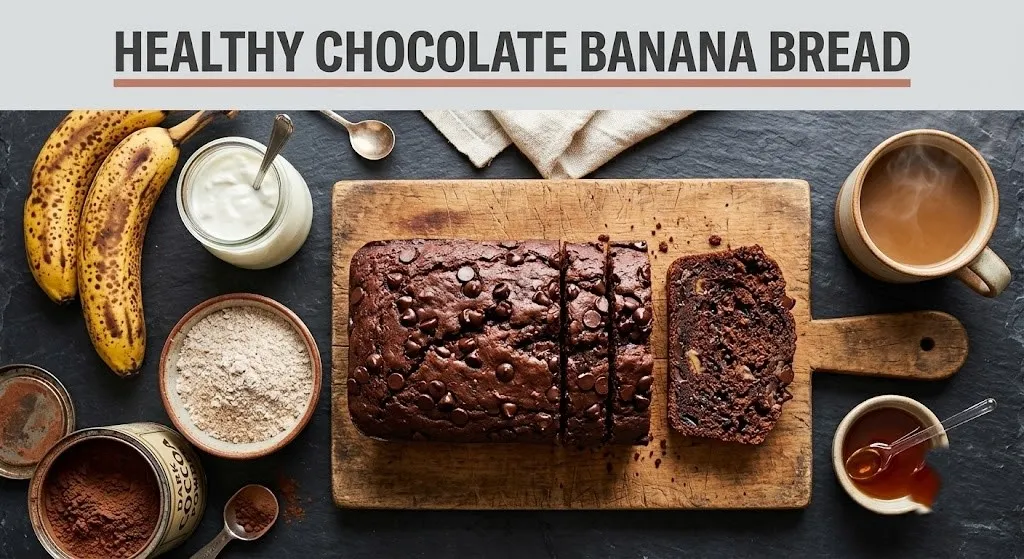
The cocoa powder in healthy chocolate banana bread does more than provide flavor. Cocoa is one of the most concentrated food sources of flavanols, a class of polyphenol antioxidants associated with improved vascular function and reduced blood pressure in clinical studies. A 2023 review in the journal Nutrients confirmed that regular consumption of cocoa flavanols is associated with a modest but consistent reduction in cardiovascular disease risk. The cocoa in your banana bread is not a health supplement. It is a real food ingredient that happens to carry nutritional benefits beyond its flavor.
Key Takeaway: Healthy chocolate banana bread uses overripe bananas for natural sweetness, whole grains for fiber, and Greek yogurt for protein, cutting added sugar by 75%.
Chocolate banana bread healthy
Chocolate banana bread becomes healthy when the core ingredients are upgraded from their traditional counterparts: refined white flour becomes whole wheat or oat flour, refined sugar becomes bananas and a small amount of natural sweetener, butter becomes Greek yogurt or a plant-based oil, and milk chocolate becomes dark cocoa powder or melted dark chocolate. Each swap serves a specific nutritional purpose.
Whole wheat flour replaces all-purpose flour to add 3 to 4 grams of fiber per slice and increase the magnesium, zinc, and vitamin E content. The fiber slows the digestion of the bread’s carbohydrates, producing a more gradual blood sugar response than refined flour banana bread. The American Diabetes Association notes that whole grains are preferable to refined grains for blood glucose management, and this swap applies that principle to a baked good that people actually eat.
Greek yogurt replaces butter or oil to add protein and calcium while reducing saturated fat and total calories. A quarter-cup of Greek yogurt in a banana bread recipe adds 6 grams of protein and 10% of the Daily Value for calcium while replacing 400 calories and 45 grams of fat from an equivalent amount of butter. The yogurt also contributes acidity that reacts with the baking soda, creating a lighter crumb. The result is a bread that is lower in fat, higher in protein, and structurally as good as or better than the butter-based version.
Key Takeaway: Whole wheat flour, Greek yogurt, and dark cocoa powder are the three ingredient swaps that transform traditional chocolate banana bread into a genuinely healthy food.
Healthy banana chocolate bread
Healthy banana chocolate bread, the same product described with a slightly different word order, follows the same nutritional principles as healthy chocolate banana bread. The emphasis is on the banana as the primary ingredient and the chocolate as the flavor modifier. The distinction in phrasing is minor and reflects natural language variation in how people search for this recipe.
The banana content in healthy banana bread is higher than in traditional recipes, typically 1.5 to 2 cups of mashed banana per loaf compared to 1 cup in standard recipes. The additional banana provides more natural sweetness, more moisture, and more potassium and vitamin B6 per slice. A loaf with more banana and less added fat and sugar is closer to a baked banana oatmeal than a cake, which is the nutritional direction that makes this bread genuinely healthy.
The chocolate in a banana-forward recipe should be intense enough to stand up to the fruit. Using dark cocoa powder or a combination of cocoa powder and melted dark chocolate (70% cocoa or higher) ensures that the chocolate flavor reads clearly against the banana. Dark chocolate contributes additional flavanols and a small amount of iron and magnesium. The darker the chocolate, the less sugar it contains and the more intense the chocolate flavor becomes.
Key Takeaway: Healthy banana chocolate bread uses extra banana for sweetness and moisture, with dark chocolate for intense flavor and added antioxidants.
Chocolate banana bread recipe healthy
A chocolate banana bread recipe that is healthy uses a specific set of ingredient swaps and techniques to produce a loaf that is nutritionally superior to traditional banana bread without sacrificing the moist, tender crumb and deep chocolate flavor that make the original worth eating. The following recipe produces one 9×5-inch loaf, approximately 10 slices, and can be adapted for dietary restrictions with the substitutions noted throughout.
Ingredients for one loaf:
- 2 cups (240g) whole wheat pastry flour or white whole wheat flour
- 1/2 cup (40g) unsweetened dark cocoa powder
- 1 teaspoon baking soda
- 1/2 teaspoon baking powder
- 1/2 teaspoon salt
- 1 teaspoon cinnamon (optional, complements both chocolate and banana)
- 1.5 cups (340g) mashed overripe banana (about 3 large bananas)
- 1/2 cup (120g) plain Greek yogurt (2% or whole milk for best texture)
- 1/4 cup (60ml) maple syrup or honey
- 2 large eggs, room temperature
- 1 teaspoon vanilla extract
- 1/3 cup (60g) dark chocolate chips (optional, 70% cocoa or higher)
To make healthy chocolate banana bread:
- Preheat the oven to 350°F (175°C) . Line a 9×5-inch loaf pan with parchment paper or grease it lightly.
- In a large bowl, whisk together the whole wheat pastry flour, cocoa powder, baking soda, baking powder, salt, and cinnamon.
- In a separate bowl, mash the bananas thoroughly with a fork until nearly smooth. Whisk in the Greek yogurt, maple syrup, eggs, and vanilla extract until fully combined.
- Pour the wet ingredients into the dry ingredients. Fold with a spatula until just combined and no flour streaks remain. Do not overmix. Overmixing develops gluten and produces a tough loaf.
- Fold in the dark chocolate chips if using. Pour the batter into the prepared pan and smooth the top.
- Bake for 50 to 55 minutes, until a toothpick inserted in the center comes out with moist crumbs but not wet batter, or until an instant-read thermometer inserted in the center reads 200°F to 205°F.
- Cool in the pan for 10 minutes, then transfer to a wire rack to cool completely. The loaf slices most cleanly when fully cooled.
Key Takeaway: This recipe uses whole wheat flour, Greek yogurt, and maple syrup for a healthier loaf with 7 grams of protein and 4 grams of fiber per slice.
How to make banana bread healthy
How to make banana bread healthy involves five specific swaps that each address a nutritional shortcoming of the traditional recipe. These swaps work in any banana bread recipe, chocolate or not, and can be adopted individually or in combination depending on your goals and the ingredients you have.
The five swaps are flour, fat, sweetener, add-ins, and flavor booster. First, replace at least half the all-purpose flour with whole wheat flour, oat flour, or almond flour. Whole wheat flour adds fiber and nutrients. Oat flour adds soluble fiber, specifically beta-glucan, that supports cholesterol management. Almond flour adds protein, healthy fat, and vitamin E.
Second, replace the butter or oil with Greek yogurt, mashed avocado, or applesauce. Greek yogurt adds protein and calcium. Mashed avocado adds heart-healthy monounsaturated fat and potassium. Applesauce reduces calories and fat but produces a slightly denser, less rich loaf. Third, reduce the added sugar by 50% to 75% and rely on overripe bananas for the remaining sweetness. If the recipe calls for 1 cup of sugar, use 1/4 to 1/2 cup of maple syrup, honey, or coconut sugar.
Fourth, add nutrient-dense mix-ins like dark chocolate chips, chopped walnuts, or chia seeds. These add protein, healthy fat, fiber, and texture. Fifth, add a teaspoon of cinnamon, vanilla extract, or espresso powder to deepen the flavor perception without adding sugar. These flavor boosters make the reduced sugar less noticeable.
Key Takeaway: Swap flour for whole grain, butter for Greek yogurt, and reduce sugar by 50% to 75%. Add nuts, seeds, and spices for nutrition and flavor depth.
Chocolate banana bread nutrition
Chocolate banana bread nutrition varies dramatically between traditional bakery versions and healthy homemade versions. A slice of traditional chocolate banana bread from a bakery or made from a standard recipe provides approximately 280 to 350 calories, 4 to 5 grams of protein, 1 to 2 grams of fiber, 35 to 45 grams of carbohydrates, and 20 to 30 grams of sugar, most of it added sugar. A slice of the healthy homemade recipe in this article provides approximately 180 calories, 7 grams of protein, 4 grams of fiber, 28 grams of carbohydrates, and 12 grams of sugar, of which only 6 grams are added sugar.
The protein improvement from 4 grams to 7 grams per slice comes primarily from the Greek yogurt and whole wheat flour. This is a 75% increase in protein content. The fiber improvement from 1 gram to 4 grams comes from the whole wheat flour. This is a 300% increase in fiber. The added sugar reduction from 25 grams to 6 grams comes from relying on bananas for sweetness and reducing the added sweetener.
The banana itself contributes meaningful micronutrients. A slice of this healthy banana bread provides approximately 10% of the Daily Value for potassium, 15% for vitamin B6, and 8% for magnesium, the last primarily from the cocoa powder. These nutrients are present in traditional banana bread as well, but the healthy version delivers them with fewer competing empty calories.
| Per Slice (1/10 loaf) | Traditional | Healthy Homemade |
|---|---|---|
| Calories | 300 | 180 |
| Protein | 4g | 7g |
| Fiber | 1g | 4g |
| Total Sugar | 28g | 12g |
| Added Sugar | 25g | 6g |
| Saturated Fat | 6g | 1.5g |
Key Takeaway: Healthy chocolate banana bread has 75% more protein, 300% more fiber, and 75% less added sugar than traditional versions.
Healthy chocolate banana bread no sugar
Healthy chocolate banana bread with no added sugar relies entirely on the natural sweetness of overripe bananas and the flavor depth of dark cocoa powder and vanilla. The bananas must be very ripe, with skins that are mostly black, to provide sufficient sweetness. Bananas at this stage have undergone extensive starch-to-sugar conversion and taste significantly sweeter than yellow bananas.
The success of a no-added-sugar chocolate banana bread depends on technique as much as ingredient selection. The cocoa powder should be high quality and Dutch-processed, which has a smoother, less bitter flavor than natural cocoa powder. A teaspoon of vanilla extract and a pinch of cinnamon amplify the perception of sweetness without adding sugar. A small amount of instant espresso powder, 1/2 teaspoon, deepens the chocolate flavor and makes the absence of added sugar less noticeable.
The texture of a no-sugar banana bread will be slightly different from a sweetened version. Sugar contributes to browning, moisture retention, and tenderness in baked goods. Without it, the bread may be slightly less moist and brown less deeply. Adding an extra tablespoon of Greek yogurt or a mashed half-banana compensates for the moisture loss. The result is a bread that tastes of bananas and chocolate in their natural state, without the cloying sweetness that characterizes traditional banana bread.
Key Takeaway: No-sugar chocolate banana bread requires fully black bananas, dark Dutch-process cocoa, and vanilla and espresso to maximize perceived sweetness without sugar.
Whole wheat chocolate banana bread
Whole wheat chocolate banana bread uses whole wheat flour instead of all-purpose flour to add fiber, B vitamins, and minerals while producing a nuttier, more complex flavor that complements the chocolate and banana. The choice of whole wheat flour type affects the final texture. White whole wheat flour is milled from a lighter variety of wheat and produces a softer, less dense loaf than traditional red whole wheat flour. Whole wheat pastry flour is milled more finely and is specifically designed for tender baked goods.
The fiber in whole wheat flour slows the digestion of the bread’s carbohydrates. A slice of whole wheat chocolate banana bread with 4 grams of fiber produces a more gradual blood glucose response than a slice made with all-purpose flour containing 1 gram of fiber. The Academy of Nutrition and Dietetics recommends making at least half of grain intake whole grains, and baking with whole wheat flour is a direct application of that guidance.
The liquid in a whole wheat banana bread recipe must be adjusted slightly. Whole wheat flour absorbs more moisture than all-purpose flour. If the batter appears stiff, add an extra tablespoon of milk, yogurt, or mashed banana to achieve the consistency of a thick cake batter. The baking time may be 2 to 5 minutes longer than for an all-purpose flour version.
Key Takeaway: Whole wheat chocolate banana bread adds fiber and nutrients. White whole wheat or whole wheat pastry flour produce the tenderest crumb.
Healthy chocolate banana bread with oats
Healthy chocolate banana bread with oats uses oat flour or rolled oats as a partial or complete replacement for wheat flour, adding soluble fiber and a tender, moist crumb. Oat flour is simply rolled oats ground in a food processor or blender until it reaches a flour-like consistency. It is naturally gluten-free, though oats are often processed in facilities that handle wheat, so certified gluten-free oats are required for those with celiac disease.
The soluble fiber in oats, specifically beta-glucan, has been shown to reduce LDL cholesterol when consumed regularly as part of a diet low in saturated fat. The FDA authorizes a health claim on oat products stating that 3 grams of beta-glucan per day may reduce the risk of coronary heart disease. A slice of oat-based banana bread provides approximately 0.5 to 1 gram of beta-glucan, a modest but meaningful contribution toward the daily target.
Oat flour banana bread has a softer, more cake-like texture than wheat flour versions. It is also more fragile and benefits from a longer cooling time before slicing. Let an oat flour banana bread cool completely, at least 1 hour, before cutting. The bread also freezes well, and slicing it frozen produces cleaner cuts.
Key Takeaway: Oat flour adds soluble beta-glucan fiber that supports cholesterol management. The texture is softer and more tender than wheat flour versions.
Healthy chocolate banana bread almond flour
Healthy chocolate banana bread with almond flour is a grain-free, higher-protein, higher-healthy-fat version suitable for gluten-free and lower-carbohydrate eating patterns. Almond flour is made from blanched, finely ground almonds and provides 6 grams of protein, 3 grams of fiber, and 14 grams of healthy monounsaturated fat per quarter-cup. It is nutritionally dense and calorically dense.
Almond flour banana bread requires recipe adjustments because almond flour behaves differently than wheat flour. It contains no gluten, so it cannot create the elastic network that gives wheat bread its structure. The eggs in the recipe become the primary structural element, and an extra egg or an additional egg white is often needed to prevent the loaf from collapsing. The baking time is also longer, typically 55 to 65 minutes, because almond flour retains moisture.
The fat content of almond flour banana bread is higher than other versions, approximately 12 to 15 grams of fat per slice compared to 5 to 8 grams in whole wheat versions. The fat is predominantly monounsaturated, the same heart-healthy fat found in olive oil. For someone on a ketogenic or low-carb diet, this fat profile is desirable. For someone counting calories, the higher calorie density of almond flour bread, approximately 250 to 300 calories per slice, is a consideration.
Key Takeaway: Almond flour banana bread is grain-free and higher in protein and healthy fat. It requires extra eggs for structure and longer baking time.
Healthy banana bread with cocoa powder
Healthy banana bread with cocoa powder uses unsweetened cocoa powder as the chocolate source, providing intense chocolate flavor and antioxidant flavanols without the added sugar and fat that come with melted chocolate. Cocoa powder is the defatted, ground solids of cacao beans and is one of the most concentrated dietary sources of polyphenol antioxidants.
The type of cocoa powder affects both flavor and nutrition. Natural cocoa powder is acidic, lighter in color, and has a sharper, fruitier flavor. It reacts with baking soda in the recipe to produce leavening. Dutch-process cocoa powder is treated with an alkali to neutralize its acidity, producing a darker color, milder flavor, and smoother mouthfeel. The Dutching process reduces the flavanol content by 60% to 90% , according to research published in the Journal of Agricultural and Food Chemistry.
For maximum antioxidant content, choose natural, non-alkalized cocoa powder. For maximum flavor smoothness, choose Dutch-process. The nutritional difference in the context of a banana bread recipe is modest. A slice made with natural cocoa might contain 50 to 80 milligrams of flavanols. A slice made with Dutch-process might contain 10 to 20 milligrams. Both are minor contributions to the daily diet. The choice is primarily about flavor preference.
Key Takeaway: Natural cocoa powder retains more flavanol antioxidants. Dutch-process cocoa has a smoother, milder flavor. Both work in healthy banana bread.
Chocolate banana bread Greek yogurt
Chocolate banana bread made with Greek yogurt uses the yogurt as a partial or complete replacement for butter or oil, adding protein, calcium, and moisture while reducing saturated fat and total calories. Greek yogurt is regular yogurt that has been strained to remove whey, concentrating the protein to approximately 15 to 20 grams per cup compared to 8 to 10 grams in regular yogurt.
The protein in Greek yogurt serves a structural function in banana bread beyond its nutritional value. The casein proteins in yogurt denature during baking and form a network that helps trap air and moisture, contributing to a tender crumb. The acidity of the yogurt also reacts with the baking soda, creating carbon dioxide that leavens the bread. This chemical reaction makes the bread rise higher and have a lighter texture than a version made with milk.
The type of Greek yogurt affects the final product. Full-fat Greek yogurt (4% to 5% milk fat) produces a richer, more tender loaf. Nonfat Greek yogurt (0% fat) works but may produce a slightly drier, less tender crumb. For the best balance of nutrition and texture, 2% reduced-fat Greek yogurt is the recommended choice. For a dairy-free alternative, coconut yogurt or almond milk yogurt work, though they contain less protein.
Key Takeaway: Greek yogurt replaces butter with protein and calcium. Full-fat or 2% yogurt produces the best texture. Nonfat works but may be less tender.
Low calorie chocolate banana bread
Low calorie chocolate banana bread reduces the calorie density of the standard healthy recipe by further cutting fat and using lower-calorie sweetener alternatives. A slice of low calorie chocolate banana bread contains approximately 120 to 150 calories, compared to 180 calories in the standard healthy version and 300 calories in a traditional bakery slice.
The calorie reduction strategies include replacing the Greek yogurt with unsweetened applesauce, which provides moisture and bulk for 25 calories per quarter-cup compared to 70 calories for nonfat Greek yogurt and 120 calories for full-fat. The egg content can be reduced to one whole egg plus two egg whites, saving 50 calories while maintaining structure. The chocolate chips can be omitted or replaced with 1 tablespoon of mini chips scattered on top rather than folded into the batter.
The tradeoff for the calorie reduction is a bread that is less rich, less tender, and less satisfying per slice. The protein content drops from 7 grams to 4 grams without the Greek yogurt. The satiety provided by the original healthy version is partially sacrificed. For someone on a strict calorie budget who wants the experience of chocolate banana bread, the low calorie version fills that role. For someone who wants a satisfying snack that keeps them full, the standard healthy version is the better choice.
Key Takeaway: Low calorie chocolate banana bread uses applesauce and egg whites to reduce calories to 120 to 150 per slice. The protein and satiety are lower.
Gluten free chocolate banana bread
Gluten free chocolate banana bread replaces wheat flour with gluten-free alternatives that must provide structure, moisture, and flavor in the absence of gluten. The most successful gluten-free banana breads use a blend of flours rather than a single substitute, because no single gluten-free flour replicates wheat flour’s properties.
An effective gluten-free flour blend for chocolate banana bread combines almond flour for moisture and fat, oat flour for structure and fiber, and tapioca starch or arrowroot for lightness and binding. A ratio of 1 cup almond flour, 3/4 cup oat flour, and 1/4 cup tapioca starch works well for a single loaf. Gluten-free all-purpose flour blends that contain xanthan gum are a convenient commercial option.
Gluten-free banana bread batter is thinner than wheat-based batter and may spread more in the pan. It also browns faster because of the higher sugar content of gluten-free flours. Covering the loaf loosely with foil after 30 minutes of baking prevents the top from burning before the center is done. The toothpick test is less reliable with gluten-free batters. An instant-read thermometer reading 205°F to 210°F is the most reliable doneness indicator.
Key Takeaway: A blend of almond flour, oat flour, and tapioca starch creates a successful gluten-free chocolate banana bread. Check doneness with a thermometer.
Vegan chocolate banana bread healthy
Vegan chocolate banana bread healthy replaces the eggs and dairy in the standard recipe with plant-based alternatives that provide similar moisture, structure, and richness. The result is a bread that is free of animal products while maintaining the nutritional improvements of the healthy version.
Flax eggs are the most effective egg replacement in banana bread. Combine 1 tablespoon of ground flaxseed meal with 3 tablespoons of water per egg, let sit for 5 minutes until gelled, and use as a direct egg substitute. The flax adds omega-3 fatty acids, lignans, and fiber to the bread. The texture of a flax egg banana bread is slightly denser and more moist than an egg-based version.
Coconut yogurt or almond milk yogurt replaces Greek yogurt with similar acidity and moisture, though with less protein. Adding 1 tablespoon of cornstarch or arrowroot to the dry ingredients compensates for the structural contribution of the missing eggs and dairy. Vegan dark chocolate chips, which are made without milk solids, provide the chocolate chunks without dairy.
Key Takeaway: Flax eggs and coconut yogurt create a successful vegan chocolate banana bread. Add a tablespoon of starch for better structure.
Sugar free chocolate banana bread
Sugar free chocolate banana bread eliminates all added sweeteners, including natural ones like maple syrup and honey, and relies entirely on bananas and the inherent sweetness of cocoa for flavor. The banana requirement for a sugar-free version is extreme: the bananas must be completely black, with skins that are shriveled and flesh that is translucent and intensely sweet.
The technique for sugar-free banana bread requires maximizing the banana flavor and sweetness. Freezing overripe bananas, then thawing them, concentrates their sweetness as the cell walls break down and release liquid that can be drained off or reduced into a syrup on the stovetop. Reducing the drained banana liquid by half creates a concentrated banana syrup that adds sweetness back to the batter without added sugar.
The texture of sugar-free banana bread is denser and less cake-like than sweetened versions. Sugar is hygroscopic, meaning it attracts and holds water. Without it, the bread dries out faster. It should be stored tightly wrapped in the refrigerator and eaten within 3 to 4 days or frozen. The flavor is banana-forward with chocolate depth, and the absence of sweetness is noticeable but not unpleasant for palates accustomed to lower-sugar foods.
Key Takeaway: Sugar-free chocolate banana bread requires fully black bananas and a flavor-maximizing technique. The texture is denser and the shelf life shorter.
Best healthy chocolate banana bread
The best healthy chocolate banana bread balances the nutritional improvements of the recipe with the sensory experience of eating banana bread. A bread that is nutritionally optimized but dry, dense, or flavorless is not the best version of anything. The best recipe is the one that delivers the nutritional wins while still being the bread that you want to slice and eat.
The factors that separate a good healthy chocolate banana bread from a great one are technique-driven. The bananas must be sufficiently ripe, with at least 50% black spotting on the skin. The cocoa powder must be fresh, not from a container that has been open for a year. The flour should be weighed rather than measured by volume for accuracy. The mixing should stop the moment the ingredients come together. These details affect the final product more than the specific flour or sweetener choice.
The best recipe is also the one you will make repeatedly. If a version with almond flour sits uneaten while a version with oat flour disappears in two days, the oat flour version is the best one for you. The nutritional differences between the whole grain flours are smaller than the difference between making the bread and not making it.
Key Takeaway: The best healthy chocolate banana bread uses proper technique, ripe bananas, and fresh ingredients. The recipe you make repeatedly is the best one.
Moist healthy chocolate banana bread
Moist healthy chocolate banana bread requires proper banana quantity, adequate fat or yogurt, and correct baking time to produce a crumb that is tender and moist rather than dry and crumbly. The moisture comes from three sources: the bananas, the Greek yogurt or fat, and the technique of not overbaking.
The banana quantity should be generous. 1.5 to 2 cups of mashed banana per loaf ensures sufficient moisture. If the bananas are smaller, add an extra half-banana rather than falling short. The Greek yogurt should be full-fat or 2% for maximum moisture contribution. Nonfat yogurt can work if the bananas are plentiful and the baking time is carefully monitored.
Overbaking is the most common cause of dry healthy banana bread. The chocolate color makes visual doneness cues unreliable. An instant-read thermometer is the solution. Remove the bread from the oven when the internal temperature reaches 200°F to 205°F. At this temperature, the starches have gelatinized, the proteins have set, and the bread is fully baked without having lost excessive moisture.
Key Takeaway: Moist healthy banana bread requires 1.5 to 2 cups of mashed banana, adequate fat from yogurt, and removing the bread from the oven at an internal temperature of 200°F to 205°F.
Frequently Asked Questions About Healthy Chocolate Banana Bread
Can I make healthy chocolate banana bread without sugar?
Yes, you can make healthy chocolate banana bread without added sugar by using fully black, overripe bananas for natural sweetness.
The bananas must be extremely ripe, with shriveled skins, to provide enough sweetness.
The texture will be denser and the flavor more banana-forward than versions with added sweetener.
Is chocolate banana bread good for weight loss?
Healthy chocolate banana bread can fit into a weight loss plan with 180 calories, 7 grams of protein, and 4 grams of fiber per slice.
The protein and fiber promote satiety, making one slice a satisfying snack or breakfast component.
Portion control matters. One slice fits a calorie budget. Three slices do not.
Can I use regular cocoa powder in healthy banana bread?
Regular unsweetened cocoa powder works perfectly in healthy banana bread. Natural cocoa powder provides more flavanol antioxidants.
Dutch-process cocoa has a smoother, milder flavor but fewer antioxidants.
Both work. The choice is about flavor preference and whether you want the antioxidant benefit.
How do I make chocolate banana bread moist without oil?
Greek yogurt, extra mashed banana, and applesauce all replace oil as moisture sources in chocolate banana bread.
Full-fat or 2% Greek yogurt provides the most moisture with added protein. Applesauce provides moisture for fewer calories.
The key to moisture is adequate banana quantity, at least 1.5 cups per loaf, and not overbaking.
Can I freeze healthy chocolate banana bread?
Healthy chocolate banana bread freezes well for up to 3 months when wrapped tightly in plastic wrap and placed in a freezer bag.
Slice the bread before freezing for easy single-serving thawing. Individual slices thaw at room temperature in about 30 minutes.
The bread can be reheated in a toaster oven or microwave for a warm, freshly baked texture.
Healthy chocolate banana bread is one of those recipes where the healthier version is genuinely better than the original, not just nutritionally superior but more interesting to eat. The whole wheat flour adds a nuttiness that complements the chocolate. The bananas taste like bananas because they are the primary sweetener. The cocoa powder brings depth without the cloying sweetness of a bakery loaf that is really a cake in disguise.
The most practical thing you can take from this article is the banana ripeness rule. Wait until the bananas are mostly black. That is when they are sweet enough to do the work of sugar. If you remember nothing else, remember that. Black bananas are not spoiled. They are the ingredient you have been waiting for.