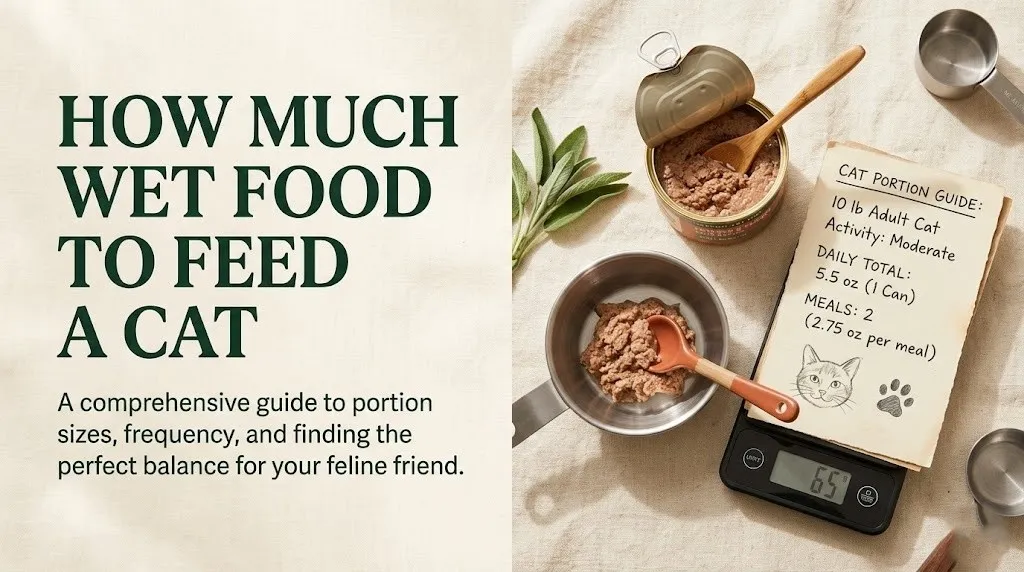
Most healthy adult cats need between 180 and 280 calories per day from wet food, which works out to roughly one to two 5.5-ounce cans depending on their body weight and the specific food’s caloric density. Knowing how much wet food to feed a cat is not just about grabbing a number from a chart and calling it done.
The portion that’s right for your cat depends on their weight, age, reproductive status, activity level, and the caloric content of the specific food you’re buying. The Association for Pet Obesity Prevention has found that between 25 and 40 percent of owned cats in the United States are overweight, and the single most common cause is unregulated portion feeding.
This guide covers everything from daily calorie targets to life-stage adjustments, mixed feeding math, label reading, and how to tell whether your cat’s current intake is on track. You’ll walk away with a clear, usable number rather than a vague range and no way to apply it.
How Much Wet Food to Feed a Cat
The baseline answer is that most adult cats need approximately 25 to 35 calories per pound of body weight per day, with the lower end applying to indoor, sedentary, or neutered cats and the higher end applying to active outdoor or intact cats.
For a 10-pound indoor adult cat, that means roughly 200 to 250 calories daily. Most standard 5.5-ounce cans of wet cat food contain between 150 and 200 calories, depending on the brand and formula. That math tells you that a single can may be close to a full day’s portion for a smaller cat, while a larger cat may need closer to one and a half cans.
What makes this more complicated than it sounds is that caloric density varies widely between brands and product lines. A grocery-store pate can may deliver 95 calories per 3 oz serving, while a premium broth-based formula from the same shelf may deliver only 60 calories for the same weight. Using the same can count for both foods will produce very different caloric outcomes.
| Cat Weight | Daily Calorie Target (Indoor/Neutered) | Daily Calorie Target (Active/Intact) |
|---|---|---|
| 6 lbs (2.7 kg) | 120 to 150 kcal | 150 to 180 kcal |
| 8 lbs (3.6 kg) | 160 to 200 kcal | 200 to 240 kcal |
| 10 lbs (4.5 kg) | 200 to 250 kcal | 250 to 300 kcal |
| 12 lbs (5.4 kg) | 240 to 300 kcal | 300 to 360 kcal |
| 15 lbs (6.8 kg) | 300 to 375 kcal | 375 to 450 kcal |
The World Small Animal Veterinary Association (WSAVA) recommends that all cat feeding decisions start with the animal’s ideal body weight, not their current weight, especially for cats who are already overweight. If your cat should weigh 9 pounds but currently weighs 12, base your calculations on the 9-pound target.
How Many Calories Does a Cat Need Per Day
Cats are obligate carnivores, meaning their bodies require specific nutrients found only in animal tissue. Their daily caloric needs are calculated using a formula called the resting energy requirement (RER).
The RER formula for cats is: RER (kcal/day) = 70 x (body weight in kg)^0.75. From that baseline, a life-stage multiplier is applied. For a neutered indoor adult cat, that multiplier is typically 1.2, giving you the maintenance energy requirement (MER).
In practice, a 10-pound (4.5 kg) neutered indoor cat has an RER of approximately 167 kcal/day and an MER of roughly 200 kcal/day. That’s a useful starting point, but it’s exactly that: a starting point, not a ceiling. Individual cats vary. The National Research Council (NRC) of the National Academies notes that caloric needs among cats of the same size and age can differ by as much as 50 percent based on genetics, body composition, and metabolic efficiency.
Key life-stage multipliers for cats:
- Neutered adult indoor cat: 1.2
- Intact adult cat: 1.4
- Underweight cat (gaining weight): 1.6 to 2.0
- Overweight cat (weight loss): 0.8
- Kitten under 4 months: 3.0
- Kitten 4 to 12 months: 2.5
- Pregnant cat: 1.6 to 2.0
- Lactating cat: 2.0 to 6.0 (depending on litter size)
- Senior cat (7 years and older): 1.1 to 1.6 depending on health status
Any cat diagnosed with chronic kidney disease (CKD), hyperthyroidism, diabetes, or another metabolic condition has altered caloric and nutrient needs that should be determined by a licensed veterinarian, not by general charts.
How Much Wet Food Should a Cat Eat a Day by Weight
The most practical way to frame daily wet food portions is by your cat’s target body weight in pounds. These figures assume a mid-range wet food with approximately 90 to 100 calories per 3 oz (85g) serving and a neutered indoor adult cat.
| Target Body Weight | Approx. Daily Wet Food Amount | Approximate Can Count (5.5 oz can, ~170 kcal) |
|---|---|---|
| 6 lbs (2.7 kg) | 2.5 to 3 oz | 0.5 to 0.75 can |
| 8 lbs (3.6 kg) | 3.5 to 4 oz | 0.75 to 1 can |
| 10 lbs (4.5 kg) | 4.5 to 5.5 oz | 1 to 1.25 cans |
| 12 lbs (5.4 kg) | 5.5 to 6.5 oz | 1.25 to 1.5 cans |
| 15 lbs (6.8 kg) | 6.5 to 8 oz | 1.5 to 2 cans |
These ranges are estimates for intact adult cats or adjust down by approximately 20 percent for neutered cats. The American Animal Hospital Association (AAHA) recommends assessing your cat’s body condition score (BCS) on a 9-point scale every month. A score of 4 to 5 out of 9 represents ideal body condition.
Body condition scoring matters more than the scale. A cat who weighs 10 pounds with visible ribs may actually be underweight, while a 10-pound cat whose ribs require firm pressure to feel may already be carrying excess fat. The BCS gives you feedback the scale alone cannot.
How Many Cans of Wet Food for a Cat a Day
The number of cans your cat needs per day depends entirely on two variables: can size and caloric density. This is where most feeding guides fall short.
A standard 3 oz (85g) can from a mid-range brand delivers roughly 70 to 95 calories. A standard 5.5 oz (156g) can typically delivers 150 to 200 calories. But a luxury or prescription formula in a 5.5 oz can might deliver only 120 calories, while a high-fat, high-protein pate might hit 230 calories in the same size can.
For a 10-pound indoor neutered cat needing approximately 200 kcal/day:
- At 70 kcal per 3 oz can: about 3 cans per day
- At 95 kcal per 3 oz can: about 2 to 2.5 cans per day
- At 170 kcal per 5.5 oz can: about 1.25 cans per day
- At 200 kcal per 5.5 oz can: about 1 can per day
The answer to “how many cans” is meaningless without knowing the caloric content of the specific can you’re using. Check the label before buying, not after you’ve been guessing for six months.
A veterinary nutritionist consultation is worth considering for cats whose weight is trending in the wrong direction despite what seems like reasonable portion control, because individual metabolic variation can significantly affect how cats use dietary energy.
How Many Ounces of Wet Food for Cat Per Day
For most adult cats in the 8 to 12 pound range, a daily wet food intake of 4 to 6 ounces (roughly 113 to 170 grams) is a reasonable starting range. That assumes the food delivers around 90 to 100 calories per 3 oz serving, which is typical for mid-range pate or shredded formulas.
Wet cat food is approximately 70 to 82 percent moisture by weight. That means a significant portion of those ounces is water, which is actually a feature and not a bug. Unlike dry kibble, wet food contributes meaningfully to a cat’s daily water intake. The Journal of Feline Medicine and Surgery has published research showing that cats eating wet food have higher urine output and more dilute urine than cats on dry-only diets, which supports urinary tract health.
In ounce terms, here is a simplified reference:
| Cat Size | Daily Wet Food (Ounces) | Daily Wet Food (Grams) |
|---|---|---|
| Small cat (5 to 7 lbs) | 2.5 to 3.5 oz | 70 to 100g |
| Medium cat (8 to 11 lbs) | 4 to 5.5 oz | 113 to 156g |
| Large cat (12 to 15 lbs) | 5.5 to 8 oz | 156 to 227g |
Cats with lower activity levels or a history of weight gain should start at the lower end of these ranges and adjust based on monthly body condition scoring rather than whether the cat acts hungry.
Key Takeaway: For the last three sections: the most accurate way to determine your cat’s daily wet food amount is to know their target body weight, calculate caloric needs using the RER formula, and check the kcal count per serving on the specific food you’re using, then work backward to a real portion.
How to Calculate Cat Food Portions from the Label
Every commercially sold wet cat food that meets AAFCO standards must print caloric content on its label, usually expressed as kcal per can or kcal per kg. This number is your most reliable tool.
To find your cat’s correct daily portion:
- Weigh your cat and determine their ideal target weight in kilograms. Divide pounds by 2.2 to convert.
- Calculate RER: multiply (target weight in kg) to the power of 0.75, then multiply by 70.
- Apply the appropriate life-stage multiplier (1.2 for a neutered indoor adult cat is the most common starting point).
- Find the kcal/can or kcal/kg number on the wet food label. If listed per kg, convert by dividing by 1,000 to get kcal per gram, then multiply by the can weight in grams.
- Divide your cat’s daily MER by the kcal per serving to get the number of servings needed per day.
- Weigh food portions on a kitchen scale rather than estimating by eye or using the label’s cup measurements.
Example: A 10-pound (4.5 kg) neutered indoor cat has an RER of approximately 167 kcal. Multiply by 1.2 to get an MER of 200 kcal/day. Your wet food delivers 95 kcal per 3 oz (85g) serving. Divide 200 by 95 and you need approximately 2.1 servings per day, or roughly 6.3 oz of that specific food daily.
This takes five minutes to calculate and is far more reliable than any generalized feeding chart.
How Many Times Should I Feed My Cat Wet Food
Most adult cats do well with wet food fed twice daily, in portions split evenly between morning and evening. This approach mirrors a more natural meal rhythm and reduces the risk of digestive upset from eating a large amount at once.
Once-daily feeding is practiced by some cat owners and is not inherently harmful to healthy adult cats. However, a single large meal delivered all at once can lead to faster eating, more vomiting, and for some cats, more pronounced hunger behavior between meals.
Feeding three times daily works well for kittens (under 12 months) and for cats recovering from illness or managing specific health conditions. For most healthy adult cats, though, twice-daily portion-controlled feeding is the standard approach recommended by most veterinary nutritionists.
Feeding frequency comparison:
| Feeding Frequency | Best For | Consideration |
|---|---|---|
| Once daily | Some healthy adults | Risk of prolonged hunger, faster eating |
| Twice daily | Most adult cats | Most practical and broadly recommended |
| Three times daily | Kittens, post-surgery, underweight cats | Requires consistent schedule |
| Free feeding (wet food left out) | Not recommended for wet food | Bacterial growth risk within 1 to 2 hours |
Free feeding wet food is not recommended. Unlike dry kibble, wet food left at room temperature supports bacterial growth rapidly. Any uneaten wet food should be discarded after a maximum of 1 to 2 hours at room temperature.
How Much Wet Food to Feed a Kitten Per Day
Kittens need significantly more calories per pound of body weight than adult cats. A kitten under 4 months old may need up to three times the caloric intake per kilogram of an adult cat of equivalent size.
For kittens aged 4 to 12 months, the NRC recommends a daily caloric intake calculated using an MER multiplier of approximately 2.5 times the RER. In practice, a 4-month-old kitten weighing 2 pounds (0.9 kg) needs roughly 100 to 130 kcal per day, which equals approximately 3 to 4 small 3 oz cans of kitten-specific wet food daily.
Kittens should be fed wet food formulated specifically for kittens or labeled as appropriate for “all life stages.” These formulas meet AAFCO’s higher minimum requirements for protein, fat, calcium, phosphorus, and taurine that support rapid growth and neurological development.
Kitten wet food feeding guide by age:
| Kitten Age | Approximate Daily Calories | Approximate Wet Food Amount | Feeding Frequency |
|---|---|---|---|
| Under 4 months | 150 to 250 kcal | 4 to 6 small 3 oz portions | 3 to 4 times daily |
| 4 to 6 months | 130 to 200 kcal | 3 to 4 small 3 oz portions | 3 times daily |
| 6 to 12 months | 120 to 180 kcal | 2 to 3 portions of 3 oz | 2 to 3 times daily |
After 12 months of age, transition to an adult formula gradually over 7 to 10 days by mixing increasing proportions of the new food with the kitten formula. Abrupt food switches can cause digestive upset in cats at any age.
How Much Wet Food for an Adult Cat
A healthy adult cat between 1 and 7 years old feeding exclusively on wet food typically needs between 1 and 1.5 cans of 5.5 oz food per day, assuming the food delivers around 150 to 180 calories per can.
The broader target, grounded in the RER formula, is approximately 200 to 250 kcal/day for a 10-pound indoor neutered adult cat. Physical activity matters here. An adult cat with outdoor access and a more active lifestyle may need 20 to 30 percent more calories than a cat who primarily sleeps indoors.
According to WSAVA nutrition guidelines, all adult cats should be body condition scored at every veterinary visit, and owners are encouraged to reassess portions every 4 to 6 weeks based on whether the cat’s BCS is trending toward underweight, ideal, or overweight. The number on the feeding label is a manufacturer’s suggestion, not a prescription.
Adult cats are particularly prone to dental disease, and while wet food is gentler on existing dental issues, it does not replace dental hygiene. If your cat has significant dental disease affecting their ability to eat, consult your veterinarian about texture modifications to their wet food.
Key Takeaway: For the last three sections: kitten caloric needs are dramatically higher per pound than adult cat needs, adult feeding amounts should be reassessed every 4 to 6 weeks using body condition scoring, and the wet food label’s feeding guide is a starting point, not a final answer.
How Much Wet Food for a Senior Cat
Senior cats, generally defined as those 7 years of age and older, have more variable caloric needs than any other life stage. Some senior cats lose muscle mass and body weight, requiring more calories. Others become less active and gain weight. There is no single “senior cat” feeding amount.
The American Association of Feline Practitioners (AAFP) notes that older cats often show reduced digestive efficiency, meaning they absorb fewer nutrients from the same amount of food compared to their younger years. A senior cat who appears to be maintaining weight may actually be losing lean muscle mass if their food is not sufficiently protein-dense.
Look for wet foods with at least 10 percent crude protein on an as-fed basis for senior cats, which corresponds to a much higher protein content on a dry-matter basis when moisture is removed from the calculation. Senior-specific formulas often contain modified phosphorus levels, which matters for cats with early-stage kidney disease, a condition affecting a notable proportion of cats over 12 years old.
Senior cat wet food adjustments:
- If BCS is below 4/9 (too thin): Increase daily portion by 10 to 15 percent and recheck in 3 weeks
- If BCS is above 5/9 (too heavy): Reduce daily portion by 10 percent and recheck in 3 weeks
- If weight loss is unexplained: Schedule a veterinary exam before adjusting food, as hyperthyroidism and CKD both cause weight loss despite normal or increased appetite
Senior cats with any diagnosed health condition should have their wet food type and amount chosen in consultation with a veterinarian rather than relying solely on general guidelines.
How Much Wet Food for an Overweight Cat
An overweight cat is typically defined as one with a body condition score of 6 or higher on the 9-point AAHA scale, which corresponds to roughly 10 to 20 percent above ideal body weight. Weight loss in cats must be gradual.
Rapid weight loss in cats carries a serious risk of hepatic lipidosis (fatty liver disease), a potentially life-threatening condition triggered when a cat’s body metabolizes fat stores too quickly. The AAHA weight management guidelines recommend targeting a weight loss rate of no more than 0.5 to 2 percent of body weight per week. For a 15-pound cat, that means losing no more than 1.2 to 2.5 ounces per week.
In practical feeding terms, an overweight cat’s MER multiplier drops to approximately 0.8 times RER rather than the standard 1.2. For a cat who should weigh 10 pounds (4.5 kg) but currently weighs 13 pounds, calculate based on the ideal weight of 10 pounds, not the current weight.
| Overweight Cat Weight Loss Protocol | Details |
|---|---|
| Target weight basis | Ideal weight, not current weight |
| MER multiplier | 0.8 to 1.0 x RER |
| Maximum loss rate | 0.5 to 2% of body weight per week |
| Recheck interval | Every 2 to 3 weeks |
| Food type | High-protein, lower-fat wet food; prescription weight-loss formula if BCS is 7 or above |
Never put a cat on a severely restricted diet without veterinary supervision. The risk of hepatic lipidosis from under-feeding is greater than the risk from moderate overfeeding.
How Much Wet Food After Spaying or Neutering
Spaying and neutering reduce a cat’s caloric needs by approximately 20 to 30 percent, typically within the first few months after the procedure. This is one of the most overlooked adjustments in cat feeding, and it is the reason many cats begin gaining weight shortly after being altered.
The mechanism is hormonal. Sex hormones, particularly estrogen in female cats and testosterone in male cats, influence metabolic rate and appetite signaling. After removal of the gonads, resting metabolic rate decreases and appetite often increases simultaneously. The result is a cat who wants more food but needs less of it.
According to a study published in the Journal of Feline Medicine and Surgery, neutered cats show a measurable reduction in energy expenditure compared to intact cats of equivalent size. The authors recommend adjusting the MER multiplier from 1.4 (intact adult) down to 1.2 (neutered adult) immediately after recovery from surgery, with further adjustment downward if weight gain is observed.
In practical terms: if your cat was eating 1 can of 5.5 oz wet food per day as an intact cat, after neutering their correct daily amount may drop to approximately 0.75 cans per day, depending on their weight and activity level. Transition the reduced portion gradually over one to two weeks to avoid hunger-related behavior issues.
Key Takeaway: For the last three sections: overweight cats need calorie calculations based on their ideal weight, not their actual weight; spaying and neutering reduce caloric needs by 20 to 30 percent and require prompt portion adjustment; senior cat needs vary widely and should be monitored monthly with body condition scoring.
Wet and Dry Food Combined: How to Split Portions
Combining wet and dry food is common and nutritionally fine as long as you account for the calories from both sources. The error most cat owners make is feeding the full daily dry kibble ration and then adding wet food on top of it, essentially double-portioning their cat.
The math is straightforward. Take your cat’s total daily calorie target. Decide what percentage you want to come from wet food and what percentage from dry. Divide each food’s daily calorie allotment by the caloric density of that specific food to get the correct weight or volume of each.
Example for a 10-pound neutered indoor adult cat needing 200 kcal/day, split 50/50 between wet and dry:
- Wet food target: 100 kcal. Your wet food delivers 95 kcal per 3 oz. Feed approximately 3.2 oz of wet food per day.
- Dry food target: 100 kcal. Your dry kibble delivers 350 kcal per 100g. Feed approximately 29g (about 2 tablespoons) of dry food per day.
| Mixed Feeding Split | Wet Food Daily Amount (10 lb cat) | Dry Food Daily Amount (10 lb cat) |
|---|---|---|
| 25% wet / 75% dry | 1.5 oz wet | 45g dry (approx. 3 tbsp) |
| 50% wet / 50% dry | 3 oz wet | 29g dry (approx. 2 tbsp) |
| 75% wet / 25% dry | 4.5 oz wet | 14g dry (approx. 1 tbsp) |
These figures assume wet food at 95 kcal per 3 oz and dry kibble at 350 kcal per 100g. Actual numbers vary by brand and must be verified on each product’s label.
How to Read the Feeding Guidelines on Wet Cat Food Labels
Every wet cat food sold in the US that claims to be “complete and balanced” must carry an AAFCO nutritional adequacy statement, which tells you whether the food was formulated to meet minimum nutrient profiles or tested in actual feeding trials. Both are acceptable; feeding trials offer slightly stronger evidence.
The caloric content must be listed on the label, usually as “X kcal ME/kg” (metabolizable energy per kilogram) or as “X kcal per can.” The ME per kg figure is the one you use for precise calculations. Divide by 1,000 to get kcal per gram, then multiply by the can’s weight in grams to get kcal per serving.
The manufacturer’s feeding guide on the label is expressed in can quantities or weight ranges and is a starting estimate, not an individualized prescription. Labels use average caloric needs for the population of cats at that weight, not your specific cat’s metabolic rate, activity level, or reproductive status.
What to look for on a wet cat food label:
- AAFCO adequacy statement: confirms the food is nutritionally complete for the stated life stage
- Ingredient list: the first ingredient should be a named animal protein (chicken, salmon, turkey), not water or a grain
- Guaranteed analysis: check crude protein (minimum) and crude fat (minimum), moisture (maximum)
- Caloric content: listed as kcal ME/kg or kcal/can. Use this number for your calculations
- Life stage designation: kitten, adult, senior, or all life stages. Match to your cat’s actual life stage
The order of ingredients on the label is by weight before cooking. Moisture-rich ingredients like chicken or fish naturally appear first in wet food because they weigh more before the moisture is cooked off.
Signs You Are Feeding Your Cat Too Much or Too Little Wet Food
Behavioral and physical cues from your cat are a reliable feedback system if you know what to look for. Think of your cat’s body condition like bread dough: you want it responsive but not puffy. When you run your hands along their sides, you should feel ribs with light pressure but not see them from across the room.
Signs of overfeeding:
- Ribs are difficult or impossible to feel under a layer of fat
- Belly sags or appears pendulous when the cat walks
- Cat is reluctant to jump or move quickly
- BCS of 6 or higher on the 9-point scale
- Leftover food in the bowl consistently (though this can also mean pickiness or a preference change)
Signs of underfeeding:
- Ribs are clearly visible or palpable with no pressure
- Spine and hip bones are prominently visible
- Cat is excessively vocal around mealtimes, particularly at non-meal times
- BCS of 3 or below
- Coat appears dull or rough
According to AAHA weight management guidelines, monthly BCS assessment at home is the most practical monitoring tool available to cat owners between veterinary visits. Weigh your cat monthly on a consistent scale and track the trend over time.
Any cat losing weight without a deliberate diet change, or gaining weight despite portion control, should be examined by a veterinarian. Unexplained weight change in cats can signal hyperthyroidism, diabetes, intestinal disease, or other conditions that require diagnosis before you adjust the food.
Key Takeaway: For the last three sections: always use caloric content printed on the label as the basis for portion math, never estimate; mixed feeding requires calculating total calories from both food types together; and body condition scoring monthly at home is more informative than weighing alone.
How to Store Opened Wet Cat Food Safely
Opened wet cat food left in the bowl at room temperature should be discarded after 1 to 2 hours maximum. Bacteria multiply rapidly in moist, protein-rich food at temperatures between 40°F (4°C) and 140°F (60°C), a range food scientists call the “danger zone.”
Leftover food from an opened but uneaten can should be transferred to an airtight container and refrigerated immediately. Refrigerated opened wet cat food stays safe and palatable for up to 5 to 7 days, according to most pet food manufacturer guidance and general food safety standards.
Many cats refuse refrigerated wet food because it lacks the aroma of room-temperature food. Warming it briefly in the microwave for 5 to 10 seconds and stirring before serving restores some aroma and increases palatability. Never serve wet food that has been microwaved unevenly, as hot spots can burn a cat’s mouth. Always stir thoroughly and test temperature before serving.
Wet cat food storage summary:
| Situation | Safe Storage Duration | Method |
|---|---|---|
| Unopened can at room temperature | Until printed “best by” date | Store in cool, dry place |
| Opened can, unrefrigerated | 1 to 2 hours maximum | Discard any remainder |
| Opened can, refrigerated | 5 to 7 days | Airtight container in fridge |
| Portioned food, frozen | Up to 1 month | Freeze in single-serve portions |
Freezing portioned wet food is an option for owners who buy in bulk. Thaw individual portions overnight in the refrigerator rather than at room temperature to maintain food safety.
Frequently Asked Questions About Feeding Wet Food to Cats
How much wet food should I feed my cat per day?
Most healthy adult cats need between 180 and 250 calories per day from wet food, which translates to roughly 4 to 6 ounces (one to one and a half 5.5 oz cans) of mid-range wet food for a 10-pound cat.
The exact amount depends on your cat’s target body weight, the caloric density of the specific food you’re using, and whether your cat is spayed, neutered, active, or sedentary.
Check the kcal per can on the label, calculate your cat’s daily calorie target using the RER formula, and divide one by the other to get a precise daily portion.
Is one can of wet food a day enough for a cat?
For a small to medium cat (8 to 10 pounds) eating a 5.5 oz can that delivers 150 to 200 calories, one can per day is often close to the correct daily ration.
If your cat is larger, more active, or if the food has a lower caloric density, one can may not be enough.
Check the label’s kcal per can figure and compare it to your cat’s calculated daily caloric needs before deciding one can is sufficient.
How many times a day should I feed my cat wet food?
Most adult cats do best with wet food served twice daily in equal portions, typically morning and evening.
Twice-daily feeding supports more stable appetite signaling and reduces the risk of digestive upset compared to a single large daily meal.
Kittens and cats recovering from illness or managing specific conditions may benefit from three smaller meals per day.
How much wet food should a kitten eat per day?
Kittens aged 4 to 12 months typically need approximately 130 to 250 calories per day from a kitten-specific wet food formula, split across two to three meals.
In can terms, that generally means 3 to 4 small 3 oz cans per day for a kitten in this age range, though exact needs vary based on growth rate and activity.
Always use a wet food labeled for kittens or “all life stages,” as these formulas meet the higher AAFCO minimum nutrient requirements for growth.
Can I mix wet and dry cat food, and how do I calculate the right amount?
Yes, mixing wet and dry food is nutritionally appropriate as long as you calculate the total daily calories from both foods combined rather than feeding full portions of each.
Determine your cat’s daily calorie target, decide what proportion comes from each food type, then divide each food’s calorie contribution by that food’s kcal per gram to find the correct weight of each.
Use a kitchen scale for the dry kibble portion in particular, as measuring by cup volume is often inaccurate by 20 to 40 percent.
Getting Your Cat’s Portions Right
Feeding your cat the correct amount of wet food is not complicated, but it does require three pieces of information working together: your cat’s ideal body weight, their daily calorie target based on life stage and reproductive status, and the caloric density of the specific food you’re buying.
Start with the label, not the chart. Calculate, don’t estimate. Reassess every four to six weeks using body condition scoring rather than waiting until annual vet visits to notice a problem.
If your cat’s weight is moving in the wrong direction despite your best efforts, a veterinarian or board-certified veterinary nutritionist can run the numbers with your specific cat’s health history in hand. That’s the most reliable version of this guide.