The best healthy snacks to buy are minimally processed, contain at least 3 grams of protein or fiber per serving, and have limited added sugar and sodium. Knowing which products actually meet those criteria, rather than just carrying health claims on the front of the package, is what separates a useful grocery run from an expensive guessing game.
The average American gets roughly 25% of their daily calories from snacks, according to data from the CDC. That makes snack choices a real contributor to overall dietary quality, not a dietary afterthought.
This guide covers 16 specific areas: what actually makes a snack nutritious, how to read labels with confidence, the best products by category, and options tailored to specific dietary needs including high protein, high fiber, low sugar, diabetic-friendly, low-sodium, kid-appropriate, and budget-friendly. You’ll walk away knowing exactly what to put in your cart and why.
Healthy Snacks to Buy
The healthiest snacks to buy combine protein, fiber, or both, alongside limited added sugar and moderate sodium. That three-part standard, protein, fiber, and limited excess nutrients, is what most packaged snacks fail when you look past the front-of-package marketing.
Think of it like this: a protein bar with 20 grams of protein but 28 grams of added sugar is doing two jobs for your body at once, one helpful and one that undermines blood sugar stability. A truly useful snack does its one job cleanly.
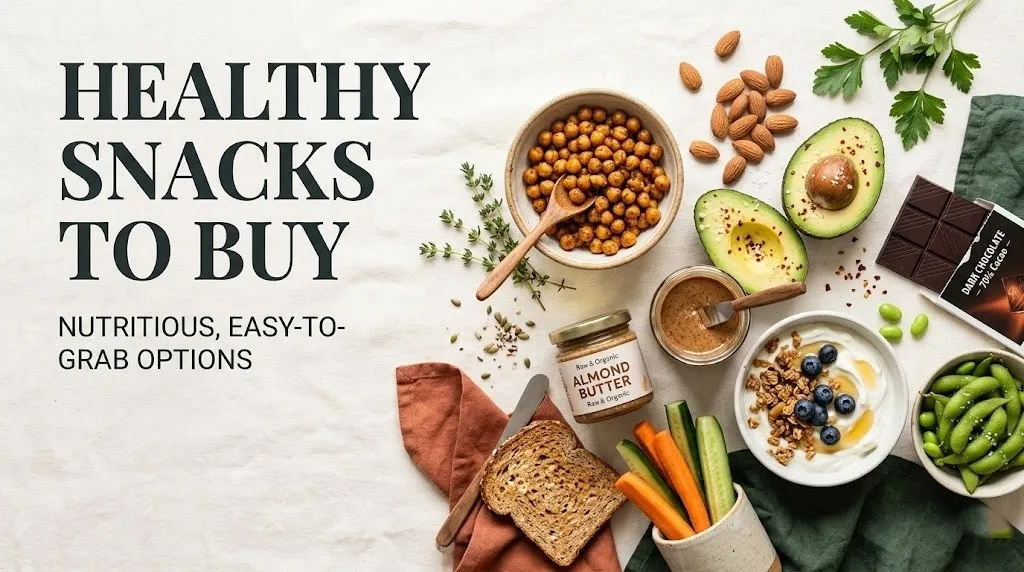
According to the USDA Dietary Guidelines for Americans 2020-2025, snacks are an appropriate part of a healthy eating pattern when they contribute whole grains, fruit, vegetables, dairy, or protein foods to the daily total. The problem is that most packaged snacks don’t fit those categories naturally.
The foods below consistently perform well against a real nutritional standard:
- Mixed nuts (almonds, walnuts, cashews): protein, unsaturated fat, magnesium
- Greek yogurt cups: protein, calcium, probiotics (where live cultures are present)
- Hard-boiled eggs: complete protein, choline, vitamin D
- Roasted chickpeas (Cicer arietinum): fiber, plant protein, iron
- Edamame (Glycine max): complete plant protein, folate, isoflavones
- String cheese: calcium, protein, low carbohydrate
- Whole grain crackers with hummus cups: fiber, plant protein, complex carbohydrates
- Seaweed snacks: iodine, low calorie, umami satisfaction without high sodium versions
People with tree nut allergies should skip mixed nuts and focus on seed-based alternatives like roasted pumpkin seeds (Cucurbita pepo) or sunflower seeds, which deliver comparable protein and mineral content without the allergen risk.
What Makes a Snack Actually Healthy
A snack is genuinely healthy when it contributes nutrients your body needs without delivering excess added sugar, sodium, or saturated fat in amounts that undermine your overall diet. The word “healthy” on a package label is a regulated term by the FDA, but its current definition allows more flexibility than most consumers realize, so verifying the Nutrition Facts panel is the only reliable check.
The FDA’s updated definition of “healthy” (finalized in 2024) requires that foods labeled as such must contain a meaningful amount of a food group from the Dietary Guidelines and must stay within specified limits for added sugar, sodium, and saturated fat. Even with this definition in place, many products that appear nutritious fail when scrutinized per serving.
A practical framework for evaluating any snack:
| Criterion | Target Range Per Serving |
|---|---|
| Calories | 150 to 250 calories |
| Protein | At least 5 grams |
| Dietary fiber | At least 3 grams |
| Added sugar | Less than 5 grams |
| Sodium | Less than 200 milligrams |
| Saturated fat | Less than 3 grams |
This table is a guide, not a rigid rule. A snack hitting 4 of 6 criteria is meaningfully better than one hitting 1. Context always matters: an athlete’s snack needs will differ from someone managing weight or blood sugar.
People with celiac disease or non-celiac gluten sensitivity need to prioritize snacks with certified gluten-free labeling, since cross-contamination in facilities handling wheat is common even when wheat isn’t a stated ingredient.
Healthy Snacks to Buy at the Store
Every major grocery store carries a solid range of genuinely nutritious snacks if you know which aisles and which product types to target. The bulk section, refrigerated section, and natural foods aisle tend to offer better options than the center-store chip and cracker aisles, though useful products exist throughout.
Refrigerated options are often overlooked. Greek yogurt (plain, low-fat), single-serve cottage cheese cups, pre-portioned hummus with vegetable dippers, and hard-boiled egg packs all require no preparation and hold up well for a workday.
The produce section is also a reliable snack source. Apple slices with individual nut butter packets, banana with a cheese stick, or pre-cut vegetable cups with guacamole packets cost less per serving than most branded snack bars and deliver significantly more fiber and micronutrients.
| Store Section | Best Snack Finds |
|---|---|
| Refrigerated | Greek yogurt, cottage cheese, hard-boiled eggs, hummus cups |
| Produce | Apple, carrot sticks, celery, pre-cut fruit cups |
| Bulk / Natural Foods | Roasted nuts, pumpkin seeds, dried fruit (unsweetened) |
| Packaged / Center Store | Whole grain crackers, rice cakes, seaweed snacks, nut bars |
| Frozen | Edamame (steam-and-eat), frozen fruit for smoothie cups |
One practical note: store layouts and product availability vary by chain, region, and season. Some refrigerated snack products rotate seasonally. Nutritional data also varies by brand, so checking the specific package you’re purchasing is always the more reliable step than relying on general category averages.
Key Takeaway: The most reliable healthy snacks to buy have at least 5 grams of protein or 3 grams of fiber per serving, less than 5 grams of added sugar, and under 200 milligrams of sodium. Use those four numbers as your store-side filter before anything else.
Healthy Snack Products Worth Buying in 2026
The packaged snack market has shifted noticeably toward products with shorter ingredient lists, less added sugar, and higher protein content. Several product types have earned genuine nutritional credibility, not just marketing credibility.
Roasted chickpea snacks are now widely available under multiple brands. A standard 1-ounce (28-gram) serving typically provides 5 to 6 grams of protein, 5 grams of fiber, and around 130 calories, with sodium varying from 100 to 250 milligrams depending on the flavor. They satisfy the crunch craving that chips address, without the high saturated fat and low nutrient density of most fried snacks.
Single-serve almond butter packets (Prunus dulcis) are another standout. One standard packet (approximately 32 grams) delivers 7 to 8 grams of protein, 3 grams of fiber, and significant amounts of tocopherol (vitamin E) and magnesium. They pair usefully with apple slices or whole grain rice cakes for a snack that crosses protein and carbohydrate without a blood sugar spike.
Notable product types performing well in 2026:
- High-protein Greek yogurt cups (plain or lightly sweetened): 15 to 20 grams of protein per 5.3-ounce serving
- Unsweetened dried fruit and nut mixes (check for added sugar on label)
- Seaweed snack packs: 25 to 35 calories per full-size pack, naturally rich in iodine
- Low-sodium beef or turkey jerky: 10 to 14 grams of protein per ounce, iron, zinc
- Dark chocolate (Theobroma cacao, 70% cacao or higher): flavonoids, magnesium, under 10 grams of sugar per 1-ounce serving
People managing dairy intolerance should note that Greek yogurt is typically not suitable. Coconut-based yogurt alternatives exist but generally contain significantly less protein unless fortified. Read the label on any yogurt alternative before assuming it matches the nutritional profile of dairy Greek yogurt.
Good Healthy Snacks to Buy With High Protein
High-protein snacks are the most effective category for controlling hunger between meals. A 2022 study published in the journal Nutrients found that protein consumption at snack time was associated with greater satiety and lower caloric intake at subsequent meals compared to high-carbohydrate or high-fat snacks consumed in the same calorie range.
Protein works by stimulating the release of satiety hormones, including peptide YY and glucagon-like peptide 1 (GLP-1), which signal fullness to the brain. This isn’t a vague claim. It’s a measurable physiological response that research has consistently documented.
The Academy of Nutrition and Dietetics recommends distributing protein intake across meals and snacks rather than concentrating it entirely at dinner. A snack with 10 to 20 grams of protein fits that distribution goal effectively.
| Snack | Protein Per Serving | Serving Size |
|---|---|---|
| Greek yogurt (plain, low-fat) | 15 to 20 grams | 5.3-ounce cup |
| Hard-boiled egg | 6 grams per egg | 1 large egg |
| Roasted edamame (Glycine max) | 11 grams | 1/2 cup shelled |
| String cheese (part-skim mozzarella) | 7 to 8 grams | 1 stick |
| Low-sodium turkey jerky | 10 to 14 grams | 1 ounce |
| Cottage cheese (2% milkfat) | 12 to 14 grams | 1/2 cup |
| Roasted pumpkin seeds (Cucurbita pepo) | 8 to 9 grams | 1 ounce |
People following a plant-based diet have strong protein options in edamame, roasted chickpeas, and hemp seeds. Whey-based protein bars and dairy products are not suitable for vegans or those with dairy allergies, so checking the protein source on the ingredient list matters as much as checking the gram count.
High-Fiber Healthy Snacks to Buy
High-fiber snacks are among the most undervalued category in the snack aisle. The USDA Dietary Guidelines for Americans recommend 25 grams of fiber per day for women and 38 grams per day for men, yet average American fiber intake sits at roughly 16 grams per day, well below both targets.
Think of dietary fiber like the slow lane on a highway for your digestive system. Soluble fiber (found in oats, apples, and legumes) dissolves in water and forms a gel that slows digestion and blunts the blood sugar rise after eating. Insoluble fiber (found in whole grains, seeds, and bran) adds bulk and keeps transit time regular. A good fiber snack delivers some of both.
Top high-fiber snack options and their fiber content per standard serving:
- Roasted chickpeas (Cicer arietinum): 5 grams fiber per ounce
- Pear with skin: 5.5 grams fiber per medium fruit
- Whole grain crackers (look for 3+ grams per serving on the label)
- Chia seed pudding cup: 10 grams fiber per 3-tablespoon serving of chia seeds (Salvia hispanica)
- Avocado (Persea americana) single-serve packs: 5 grams fiber per 2-ounce serving
- Dried figs (Ficus carica): 3 grams fiber per 2-fig serving, though naturally high in sugar, so portion matters
- Edamame (Glycine max): 4 grams fiber per 1/2 cup shelled
People with irritable bowel syndrome (IBS) should approach high-fiber snacks cautiously. Some high-fiber foods, particularly legumes and certain dried fruits, are high in fermentable oligosaccharides, disaccharides, monosaccharides, and polyols (FODMAPs), which can trigger symptoms in sensitive individuals. A registered dietitian with IBS experience can help identify which fiber sources are well-tolerated on an individual basis.
Low-Sugar Healthy Snacks to Buy
Low-sugar snacks are the category where front-of-package labels most frequently mislead shoppers. “No added sugar” means the manufacturer added no sugar during processing, but the product may still be high in naturally occurring sugars (as in dried fruit). “Low sugar” has no standardized FDA definition as a standalone claim. Only the Nutrition Facts panel gives you the actual number.
The American Heart Association recommends that women consume no more than 25 grams of added sugar per day and men no more than 36 grams per day. Many marketed “healthy” snack bars contain 12 to 18 grams of added sugar per bar, which is already half a woman’s daily target in a single snack.
Reliably low-sugar snack options:
| Snack | Added Sugar | Total Sugar | Notes |
|---|---|---|---|
| Plain Greek yogurt | 0 grams | 4 to 5 grams (lactose) | Avoid flavored varieties |
| Mixed raw nuts | 0 grams | 1 to 2 grams | Check for honey-roasted versions |
| Hard-boiled eggs | 0 grams | 0 grams | No sugar whatsoever |
| String cheese | 0 grams | 0 grams | Dairy, not suitable for vegans |
| Roasted seaweed | 0 grams | 0 grams | Check sodium instead |
| Nut butter packet (unsweetened) | 0 grams | 1 gram | Verify “no added sugar” on label |
| Celery with nut butter | 0 grams | 0 to 1 gram | Natural produce, no processing |
People managing type 2 diabetes or prediabetes should note that total carbohydrates and glycemic index matter alongside added sugar specifically. The American Diabetes Association emphasizes that even naturally occurring sugars in fruit affect blood glucose, so portion size remains important even with “no added sugar” snacks.
Key Takeaway: Low-sugar snack shopping requires looking past the front-of-package claim directly to the “Added Sugars” line on the Nutrition Facts panel. A snack with zero added sugar is meaningfully different from one marketed as “lightly sweetened” that contains 12 grams per serving.
Healthy Grab and Go Snacks to Buy
Healthy grab and go snacks need one defining characteristic beyond nutrition: they need to require zero preparation and survive a bag, desk drawer, or car without refrigeration or special handling. That narrows the field considerably, but the options that meet both criteria are genuinely solid nutritionally.
The best portable snacks strike a balance between shelf stability and nutritional value. Whole food options like a piece of fresh fruit or a hard-boiled egg are ideal but do require some planning. The packaged options below are reliable when you have no prep time at all.
Top grab and go picks that travel well and hold up nutritionally:
- Individual nut packets (almonds, cashews, walnuts): portion-controlled, shelf stable, protein and healthy fat
- Nut butter squeeze packets: no refrigeration needed, pairs with any fruit or cracker
- Roasted chickpea snack bags: crunchy, fiber-rich, shelf stable for months
- Protein bars with 10+ grams protein and under 8 grams added sugar (check the label every time, as formulas change)
- Seaweed snack packs: 25 to 35 calories, extremely portable, naturally low in calories
- Beef or turkey jerky pouches: high protein, long shelf life, choose low-sodium versions specifically
- Whole grain rice cakes in individual packs: low calorie, pair with nut butter packets
- Single-serve trail mix (unsweetened): check that it contains nuts, seeds, and minimal sweetened additions
For people with peanut (Arachis hypogaea) or tree nut allergies, roasted sunflower seed butter packets and pumpkin seed snack bags are the most practical shelf-stable alternatives that avoid cross-contamination risks from shared facilities. Always check the allergen statement on the packaging, not just the ingredient list.
Healthy Brand Snacks You Can Trust
Not all snack brands that market themselves as health-oriented actually deliver on the claim when you look at the Nutrition Facts panel and ingredient list side by side. Evaluating a brand requires looking at the full product line, not just its most prominently displayed item.
Brands that consistently perform well against genuine nutritional criteria in 2026 tend to share several characteristics:
- Ingredient lists where you can identify every item without a food science degree
- Added sugar content under 5 grams per serving across most products
- Sodium under 200 milligrams per serving for savory items
- A clear allergen statement on every package
- Protein or fiber content that meaningfully contributes to the daily target
Rather than endorsing specific commercial brands, which can change formulations without notice, here’s what to look for across snack product categories by type:
| Product Type | What a Trustworthy Version Looks Like |
|---|---|
| Protein bar | 10+ grams protein, under 8 grams added sugar, under 220 mg sodium |
| Nut-based snack mix | Nuts and seeds listed first; no added sugar; under 150 mg sodium |
| Fruit-and-nut bar | Dates or fruit as primary sweetener; under 10 grams total sugar; no artificial sweeteners |
| Roasted chickpea snack | Chickpeas as first ingredient; under 5 grams fat; under 180 mg sodium |
| Greek yogurt product | Milk and live cultures only (in plain versions); 15+ grams protein; under 5 grams added sugar |
| Crackers | Whole grain listed first; 3+ grams fiber; under 150 mg sodium per serving |
One critical caution: “natural flavors” on an ingredient list is a broad FDA-defined category that can encompass a wide range of processing-derived compounds. Its presence doesn’t make a product unhealthy, but it does mean the product is more processed than it may appear.
How to Read a Nutrition Label When Buying Snacks
Reading a nutrition label effectively takes about 30 seconds once you know the sequence, and it’s the single most transferable skill in this entire guide. No product list can follow you into every store. This skill can.
The FDA’s current Nutrition Facts panel (updated format, mandatory since 2021 for most manufacturers) lists key information in a specific order. Here’s how to read it for snack evaluation:
To evaluate any snack using the Nutrition Facts panel:
- Check the serving size first. All numbers below it are calculated per that specific serving. A “100-calorie” snack bag that lists 2.5 servings per container has 250 calories if you eat the whole thing.
- Look at total calories. For a snack, 150 to 250 calories per serving is a reasonable target for most adults.
- Find “Added Sugars” under Total Carbohydrate. This is the number that matters most for sugar evaluation. Aim for under 5 grams.
- Check sodium. Under 200 milligrams per serving is the target for a genuinely low-sodium snack.
- Look at protein grams. Under 5 grams of protein means this snack likely won’t hold hunger effectively on its own.
- Check dietary fiber. Three or more grams per serving contributes meaningfully to the daily fiber target.
- Scan the % Daily Value column. Anything at or above 20% DV for a nutrient you want to limit (sodium, saturated fat, added sugar) is considered high by FDA standards. Anything at 5% DV or below is considered low.
- Read the ingredient list. Ingredients are listed in order by weight, highest first. If sugar (in any of its many names: cane sugar, maltose, dextrose, high-fructose corn syrup, agave, honey) appears in the first three ingredients, the product is sweetener-forward regardless of front-of-package claims.
Quick Tip:
- Limit: sodium over 200 mg, added sugar over 5 grams, saturated fat over 3 grams
- Prioritize: protein over 5 grams, fiber over 3 grams, short ingredient list
- Ignore: “natural,” “wholesome,” “light,” “artisan,” “clean” (none of these are FDA-regulated nutrition claims)
Key Takeaway: The Nutrition Facts panel is the only reliable source of truth on a packaged snack. Every front-of-package claim, including “healthy,” “natural,” and “no added sugar,” requires verification against the actual numbers inside the panel before you trust it.
Healthy Treats to Buy That Satisfy Cravings
Craving-driven snacking is real and physiologically normal. Restricting all treat foods increases the likelihood of overconsumption when cravings win, which they eventually do for most people. The more useful approach is finding treat options that genuinely satisfy while delivering some nutritional value.
Dark chocolate (Theobroma cacao, 70% cacao content or higher) is the most research-supported treat option. Harvard T.H. Chan School of Public Health notes that dark chocolate contains flavonoids, specifically epicatechin and catechin, which have demonstrated associations with improved cardiovascular markers in observational studies. A standard 1-ounce serving of 70% dark chocolate contains approximately 170 calories, 3 grams of fiber, 2 to 3 grams of protein, and under 10 grams of sugar.
Other treat-style snacks worth considering:
- Frozen Greek yogurt bark (make at home or buy pre-made): satisfies the cold-and-sweet craving with protein
- Single-serve almond butter chocolate-dipped pretzels (dark chocolate dipped): choose options with under 10 grams added sugar
- Rice cakes with nut butter and a few dark chocolate chips: the crunch and sweetness combination at under 200 calories total
- Dried mango slices (Mangifera indica, unsweetened): naturally sweet, high in ascorbic acid (vitamin C), but naturally high in sugar, so a one-ounce portion is the target serving
- Popcorn with nutritional yeast: whole grain, 4 grams fiber per 3-cup serving, satisfies salty and savory cravings simultaneously
People with chocolate sensitivities, migraines triggered by tyramine, or caffeine sensitivity should note that dark chocolate contains both tyramine and caffeine (approximately 12 milligrams of caffeine per ounce). Milk chocolate contains significantly less cacao and correspondingly fewer flavonoids alongside considerably more added sugar per serving.
Healthy Snacks to Buy for Weight Management
Snacks support weight management goals when they reduce overall caloric intake at main meals, not when they simply add food volume to the day. The key mechanism is satiety: a snack that genuinely reduces hunger before the next meal serves the goal. One that doesn’t can simply add calories.
A 2022 study published in the American Journal of Clinical Nutrition found that snacks containing a combination of protein and fiber produced significantly greater reductions in subsequent meal calorie intake compared to snacks containing only carbohydrates at similar calorie levels. That’s the combination to target.
Practical weight management snack framework:
| Snack | Calories | Protein | Fiber | Satiety Score |
|---|---|---|---|---|
| Greek yogurt (plain, 5.3 oz) | 90 to 110 | 15 to 17 g | 0 g | High (protein-driven) |
| Almonds (1 oz, Prunus dulcis) | 164 | 6 g | 3.5 g | High (fat + fiber) |
| Hummus (2 tbsp) + carrot sticks | 75 to 100 | 3 g | 3 g | Moderate to high |
| String cheese + apple | 135 to 160 | 8 g | 4 g | High (protein + fiber) |
| Roasted chickpeas (1 oz) | 120 to 130 | 5 g | 5 g | High (fiber-driven) |
| Rice cakes (2 plain) | 70 | 1 g | 0.5 g | Low (without topping) |
That last row is a useful warning. Plain rice cakes are frequently cited as a “diet food,” but their near-zero protein and fiber content means they do little to hold hunger. Adding nut butter raises calorie count but meaningfully improves satiety duration.
No snack, regardless of its nutritional profile, should be described as a weight loss tool on its own. Snack choices are one variable within a total dietary pattern. Anyone with a medically supervised weight management goal should work with a registered dietitian to contextualize snack choices within their specific caloric and macronutrient targets.
Healthy Snacks to Purchase for Diabetics or Blood Sugar Control
For people managing type 2 diabetes or prediabetes, snack selection requires attention to total carbohydrates, glycemic index, and portion size, not just the sugar content line on its own. The American Diabetes Association emphasizes that total carbohydrate grams are the primary predictor of postprandial (after-eating) blood glucose response.
The glycemic index (GI) measures how quickly a carbohydrate-containing food raises blood glucose relative to pure glucose. Low-GI snacks (GI under 55) produce a slower, more gradual rise in blood glucose than high-GI options. Pairing any carbohydrate-containing snack with protein or fat slows gastric emptying and blunts the glucose response further.
Best snack options for blood sugar stability:
- Hard-boiled eggs: zero carbohydrate, high protein, no blood glucose impact
- Plain Greek yogurt (small serving, 3 to 4 ounces): low GI, high protein, minimal carbohydrate
- Roasted pumpkin seeds (Cucurbita pepo): 4 grams carbohydrate per ounce, 5 grams protein, high in magnesium (which plays a role in insulin sensitivity)
- Celery with nut butter: minimal carbohydrate, protein and fat from nut butter slow glucose absorption
- Cheese and whole grain crackers: the fat and protein from cheese buffer the carbohydrate from crackers
- Edamame (Glycine max): 7 to 8 grams net carbohydrate per 1/2 cup, 11 grams protein, GI approximately 18
Snacks to approach with caution for blood sugar management:
- Fruit smoothies and fruit juice: rapid glucose delivery without the fiber buffer of whole fruit
- “No added sugar” dried fruit: still high in naturally occurring sugar in concentrated form
- Most commercial granola bars: often 25 to 35 grams of total carbohydrate per bar
People with diabetes should confirm specific snack strategies with their healthcare team, as individual blood glucose responses vary considerably depending on medications, activity level, and overall dietary pattern. This guidance reflects general ADA principles, not a personalized plan.
Key Takeaway: For blood sugar management, pairing any carbohydrate-containing snack with protein or fat is the most practical strategy for reducing the glucose spike. Hard-boiled eggs, roasted pumpkin seeds, and small portions of Greek yogurt are reliably low-impact options backed by consistent evidence.
Low-Sodium Healthy Snacks to Buy
Sodium in packaged snacks is one of the most overlooked variables in healthy snack selection. The American Heart Association recommends no more than 2,300 milligrams of sodium per day for most adults, with an ideal target of 1,500 milligrams per day for people with hypertension. A single serving of some “healthy” crackers or flavored nuts can contain 300 to 400 milligrams, and most people eat more than one serving.
Most Americans already consume approximately 3,400 milligrams of sodium per day on average, according to AHA data. Packaged snacks are a meaningful contributor to that excess.
The FDA defines a “low-sodium” food as containing 140 milligrams or less per serving. That’s the label claim to look for. “Reduced sodium” only means the product contains at least 25% less sodium than the original version, which may still leave it at a high absolute level.
Best naturally low-sodium snack options:
| Snack | Sodium Per Serving |
|---|---|
| Raw almonds (Prunus dulcis), 1 oz | 0 to 1 mg |
| Fresh fruit | 0 to 5 mg |
| Hard-boiled egg | 63 mg |
| Plain Greek yogurt (5.3 oz) | 50 to 70 mg |
| Unsalted roasted pumpkin seeds, 1 oz | 5 mg |
| Avocado (Persea americana), 2 oz single-serve | 5 mg |
| Low-sodium beef jerky (labeled) | 80 to 120 mg |
People with hypertension, chronic kidney disease, or heart failure should prioritize these naturally low-sodium whole-food options over any packaged product claiming “reduced sodium,” since individual sodium tolerance varies and medical management goals differ significantly by condition.
Healthy Snacks to Buy for Kids
Healthy snacks for children need to deliver nutrients relevant to growth and development while being practical enough that kids will actually eat them. The CDC recommends that children’s snacks contribute to their daily requirements for calcium, iron, potassium, and dietary fiber, all of which tend to fall short in the average pediatric diet.
Children’s snack products marketed specifically for kids are worth particular scrutiny. Front-of-package characters, bright colors, and “made with real fruit” claims are consistent marketing features that frequently coexist with high added sugar content. A snack with a cartoon character and 12 grams of added sugar per pouch is not a different nutritional situation just because it’s packaged for children.
Reliable snack options for kids that avoid the marketing trap:
- String cheese: calcium, protein, portable, most children accept it readily
- Whole grain crackers with nut butter or hummus: fiber, protein, complex carbohydrates
- Cut fruit and vegetables with a dip: ascorbic acid (vitamin C), fiber, potassium
- Greek yogurt (plain with a small amount of fresh fruit): calcium, protein, low added sugar
- Popcorn (air-popped, lightly salted): whole grain, 4 grams fiber per 3-cup serving, manageable for kids over 4
- Hard-boiled eggs: complete protein, choline (important for brain development), vitamin D
- Applesauce pouches (unsweetened): 2 grams fiber, ascorbic acid (vitamin C), no added sugar
Popcorn is not appropriate for children under age 4 due to choking risk. Whole nuts and large seeds also carry choking risk for young children. For toddlers and preschoolers, nut butter spreads on soft bread or thinly sliced soft fruit are safer format options than whole nuts.
Any child with a diagnosed food allergy requires snacks verified against their specific allergen list. The eight major allergens (milk, eggs, fish, shellfish, tree nuts, peanuts, wheat, soybeans) under the FDA’s FALCPA labeling law must be declared on packaged food labels, which makes label checking more straightforward for allergic children’s snacks.
Affordable Healthy Snacks I Can Buy Anywhere
Eating well on a tight budget is genuinely possible in the snack category, but it requires prioritizing whole foods over branded packaged products. The cost difference between a branded protein bar at $2.50 and a hardboiled egg at $0.25 is real. Both deliver protein. The egg delivers it more cleanly and more affordably.
The most cost-effective healthy snacks are fresh produce, whole eggs, canned legumes, and bulk nuts and seeds. These options are available at virtually every grocery store, convenience store, or discount retailer and require no specialty health food store access.
Budget-friendly healthy snack options with approximate cost:
| Snack | Approximate Cost Per Serving |
|---|---|
| Hard-boiled egg | $0.20 to $0.35 |
| Banana | $0.20 to $0.40 |
| Carrot sticks (baby carrots, 2 oz) | $0.30 to $0.50 |
| Peanut butter (Arachis hypogaea), 2 tbsp from jar | $0.20 to $0.40 |
| Canned chickpea portion (1/2 cup) | $0.30 to $0.50 |
| Plain Greek yogurt from large container | $0.40 to $0.70 |
| Bulk almonds (Prunus dulcis), 1 oz | $0.50 to $0.80 |
| Popcorn (air-popped from kernels) | $0.10 to $0.20 |
Cost per serving is not the only budget consideration. Shelf life matters too. Bulk nuts, dried legumes, and canned goods have multi-month shelf lives and reduce waste compared to fresh produce that must be consumed within days.
People relying on SNAP benefits should know that all grocery food items (excluding hot prepared foods) are SNAP-eligible, which includes all the whole-food options listed above. Eggs, canned beans, peanut butter, and fresh fruit and vegetables are particularly high nutritional return per dollar across SNAP purchasing patterns, according to USDA food access research.
Key Takeaway: The most affordable healthy snacks are also frequently the most nutritionally straightforward: eggs, produce, legumes, bulk nuts, and plain yogurt from a large container. Branded “health snack” products rarely deliver better nutrition per dollar than these basics.
Frequently Asked Questions About Healthy Snacks to Buy
What are the healthiest snacks I can buy at the grocery store?
The healthiest snacks to buy at the grocery store are minimally processed foods combining protein and fiber.
Hard-boiled eggs, plain Greek yogurt, roasted chickpeas, mixed nuts, and fresh fruit with nut butter consistently rank well against evidence-based nutrition criteria.
These options deliver protein, fiber, and key micronutrients without excessive added sugar or sodium.
How many calories should a healthy snack have?
A healthy snack typically contains between 150 and 250 calories for most adults.
The specific range depends on your total daily caloric needs, activity level, and whether the snack is replacing a mini-meal or bridging between full meals.
Calorie count alone is a weak measure of snack quality. Protein and fiber content predict satiety far more reliably than calories do.
Are store-bought protein bars actually good for you?
Some store-bought protein bars are genuinely useful nutritionally, but many contain more added sugar and sodium than the protein content justifies.
The standard to apply is at least 10 grams of protein, under 8 grams of added sugar, and under 220 milligrams of sodium per bar.
Bars that pass those three checks can serve a real dietary purpose. Bars that don’t are often closer to a candy bar with a protein claim on the front.
What healthy snacks can people with diabetes buy?
People managing diabetes benefit most from snacks that are low in total carbohydrates and paired with protein or fat to slow glucose absorption.
Hard-boiled eggs, roasted pumpkin seeds, celery with nut butter, and plain Greek yogurt are practical options that produce minimal blood glucose impact for most people.
Individual responses vary based on medications and metabolic factors, so confirming specific snack choices with the treating healthcare provider or a registered dietitian helps align options with personal glucose management goals.
What should I look for on a nutrition label when buying snacks?
Start with the serving size, then check calories, added sugar, sodium, protein, and fiber in that order.
The targets for a healthy snack serving are: under 5 grams of added sugar, under 200 milligrams of sodium, at least 5 grams of protein, and at least 3 grams of fiber.
The ingredient list adds a second layer of clarity. If sugar appears in the first three ingredients under any of its many names (cane sugar, maltose, dextrose, agave, honey), the product is sweetener-forward regardless of what the front of the package says.
The Most Practical Thing You Can Do at the Store This Week
Buying better snacks doesn’t require a complete pantry overhaul. It requires one habit: check the Nutrition Facts panel before any packaged product goes in the cart. Added sugar under 5 grams. Sodium under 200 milligrams. Protein at 5 grams or above. Those three numbers cut through nearly all the front-of-package noise.
Start with the easiest swaps. Replace flavored crackers with plain whole grain ones. Replace a sweetened protein bar with plain Greek yogurt and a handful of nuts. Replace the vending machine choice with a pre-packed nut packet or a piece of fruit you grabbed on the way out.
Small, consistent changes in what you snack on compound meaningfully across a week, a month, and a year. That’s the actual payoff.