“Plant food” is a term that creates genuine confusion the moment you step into a garden center. The bottles and bags on the shelf all say “plant food,” but the scientific truth is that plants make their own actual food. What you are buying in those containers is technically fertilizer, a nutrient supplement that supports the plant’s own food production system.
Understanding this distinction matters because it changes how you care for every plant you own. According to the University of Minnesota Extension, plants produce their own food through photosynthesis using sunlight, water, and carbon dioxide. The glucose they create powers every cellular function, from root development to flowering. The products labeled as plant food simply supply the raw mineral nutrients plants need to keep their internal food factories running efficiently.
This article breaks down exactly what plant food really means, how it differs from fertilizer, and what your plants actually need to thrive. You will learn how to read NPK ratios, recognize when your plants are hungry, choose between liquid and granular products, and avoid the damage that comes from over-fertilizing. By the end, you will know exactly what to buy and how to use it, whether you are growing a windowsill herb garden or an entire vegetable bed.
What is plant food
Plant food, in its truest biological sense, is the glucose and other carbohydrates that plants manufacture internally through photosynthesis. This self-made energy source fuels all plant growth, repair, and reproduction. The chlorophyll in plant leaves captures sunlight energy and uses it to convert carbon dioxide from the air and water from the soil into simple sugars. These sugars are the actual food plants consume.
The term gets confusing because manufacturers use “plant food” on product labels to describe fertilizer. Fertilizer is not food. It is a blend of mineral nutrients that act more like a vitamin supplement or a multivitamin for plants. These minerals support the plant’s ability to photosynthesize and grow, but they do not directly feed the plant the way glucose does. The USDA Agricultural Research Service explains that soil nutrients are building blocks, not fuel.
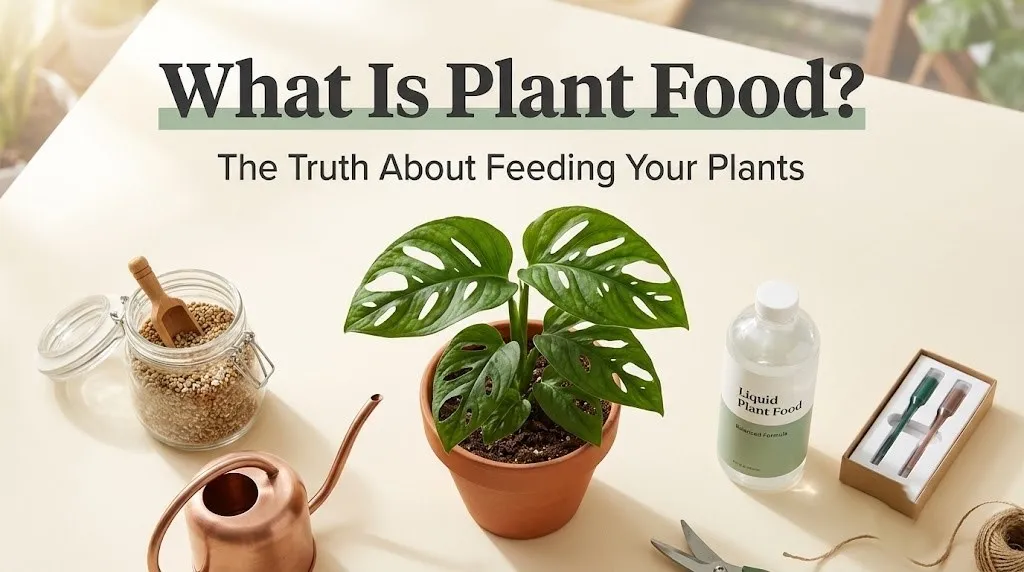
Think of it this way. A plant is a solar-powered kitchen. Sunlight runs the appliances. Carbon dioxide and water are the raw ingredients. The glucose produced is the finished meal. Fertilizer is like restocking the pantry with flour, salt, and oil. The pantry supplies enable cooking but are not the meal itself. This distinction explains why you cannot pour fertilizer onto a plant sitting in a dark closet and expect it to survive.
Key Takeaway: Plants make their own food through photosynthesis. Store-bought “plant food” is actually a nutrient supplement that keeps the plant’s internal food production system working.
How do plants make their own food
Plants make their own food through photosynthesis, a process that converts light energy into chemical energy stored as glucose. This happens inside chloroplasts, the tiny green organelles packed into leaf cells. Chlorophyll, the pigment that gives plants their green color, absorbs sunlight across red and blue wavelengths while reflecting green light back to our eyes. The absorbed energy splits water molecules drawn up from the roots, releasing oxygen into the air.
The carbon atoms needed to build glucose come from carbon dioxide gas. Plants pull CO2 from the atmosphere through tiny leaf pores called stomata. These microscopic openings open during daylight hours, allowing gas exchange while carefully controlling water loss. Once inside, the carbon combines with hydrogen from split water molecules in a series of enzyme-driven chemical reactions known as the Calvin cycle. The end product is a simple sugar molecule the plant can use immediately or store as starch.
Cornell University’s Cooperative Extension notes that photosynthesis efficiency depends on three main factors: light intensity, carbon dioxide availability, and temperature. Low light slows the entire process, which is why houseplants in dim corners grow slowly and require less supplemental nutrition. When light levels drop, the plant’s internal food production drops proportionally. This biological reality directly affects how often you should apply fertilizer and explains why over-fertilizing a plant in low light causes more harm than good.
| Factor | Role in Photosynthesis | Plant Owner Action |
|---|---|---|
| Light | Provides energy for sugar production | Match plant to available light levels |
| Carbon Dioxide | Supplies carbon atoms for glucose | Ensure air circulation around leaves |
| Water | Donates electrons and hydrogen | Water consistently, avoid drought stress |
| Nutrients | Build enzymes and chlorophyll | Apply fertilizer based on growth rate |
Key Takeaway: Photosynthesis is the plant’s internal food factory, and light availability determines how much supplemental nutrition the plant can actually use.
Is fertilizer the same as plant food
Fertilizer is not the same as plant food, despite the two terms appearing interchangeably on product labels and in gardening conversations. Actual plant food is the glucose produced through photosynthesis. Fertilizer is a mineral supplement that provides the essential elements plants need to build proteins, enzymes, and cell structures. The terminology mix-up started with early fertilizer manufacturers who used “plant food” as a marketing phrase, and the label has stuck for over a century.
The confusion matters because it leads to misuse. When a plant is struggling, many people reach for fertilizer assuming the plant needs feeding. In reality, the problem is often insufficient light, overwatering, or root damage. Adding fertilizer to a plant that cannot photosynthesize properly is like giving vitamins to someone who is not eating enough food. The supplements cannot replace the missing calories. Research from the National Gardening Association indicates that improper fertilization, not under-fertilization, is the more common problem among home gardeners.
The products on the shelf labeled “plant food” contain nitrogen, phosphorus, potassium, and often secondary nutrients like calcium and magnesium. These are mineral elements absorbed through the roots dissolved in soil water. They become part of the plant’s physical structure and metabolic machinery. They do not provide energy in the caloric sense. Only glucose from photosynthesis does that. Recognizing this distinction helps you diagnose plant problems more accurately and fertilize more strategically.
Key Takeaway: Fertilizer is a mineral supplement, not actual food. Plants create their own true food through photosynthesis.
What is the difference between plant food and fertilizer
The difference between plant food and fertilizer comes down to energy versus raw materials. Plant food, the glucose and carbohydrates produced through photosynthesis, provides the chemical energy that powers every cellular process inside a plant. Fertilizer supplies the elemental building blocks like nitrogen for chlorophyll, phosphorus for DNA and ATP energy transfer, and potassium for enzyme activation and water regulation. One is fuel. The other is construction material.
When you apply a fertilizer product, you are adding concentrated mineral salts or organic matter to the soil that roots can absorb. These minerals become integrated into plant tissue as the plant grows. A nitrogen atom from fertilizer can end up in a chlorophyll molecule that captures sunlight. A phosphorus atom can become part of the ATP molecule that transports energy within cells. But none of these minerals can substitute for the glucose that actually runs the plant’s metabolism.
The practical takeaway involves troubleshooting sick plants. Yellow leaves could indicate nitrogen deficiency, which fertilizer can fix. But yellow leaves can also mean root rot from overwatering, and adding fertilizer to waterlogged soil makes the problem worse. The University of California Extension advises testing soil moisture and examining roots before deciding that fertilization is the answer. Assuming every problem is a food shortage leads to over-fertilization and plant damage that mimics the very deficiency symptoms you were trying to solve.
Key Takeaway: Plant food is energy from photosynthesis. Fertilizer is a building material supplement. Confusing them leads to common plant care mistakes.
Is fertilizer food for plants
Fertilizer is not food for plants in the way the word “food” suggests something that provides energy. The energy plants use comes exclusively from glucose manufactured during photosynthesis. Fertilizer provides the elemental nutrients that form the plant’s physical structure and keep its metabolic systems operational. Calling fertilizer food is technically incorrect but so deeply embedded in consumer language that it persists across the gardening industry.
This misnomer creates a mental model that harms plant care. People who think of fertilizer as food tend to apply it when plants look unhealthy, assuming the plant is hungry. In many cases, the real issue is low light, compacted soil, improper watering, or temperature stress. Adding fertilizer under these conditions does not solve the underlying problem. The University of Maryland Extension reports that over-fertilization of houseplants is a leading cause of leaf tip burn, salt buildup in potting soil, and root damage.
A more accurate way to think about fertilizer is to compare it to a human multivitamin. The vitamin does not replace meals. It fills nutritional gaps that might exist even in a decent diet. Plants growing in rich, biologically active soil may need minimal supplementation because decomposing organic matter and the soil microbiome release nutrients slowly. Plants growing in sterile potting mix inside a home have no such nutrient reservoir. They depend entirely on what you add.
Key Takeaway: Fertilizer is a nutrient supplement, not a meal replacement. It supports plant health but cannot substitute for the energy plants create through photosynthesis.
What is a plant food
A plant food, in the context of consumer gardening products, is any formulated material applied to soil or foliage to supply one or more essential plant nutrients. These products fall into two broad categories: complete fertilizers that contain nitrogen, phosphorus, and potassium, and incomplete or specialty fertilizers that deliver specific elements like iron or calcium. The term “plant food” on a label is a regulated marketing phrase that must correspond to a guaranteed analysis of nutrient content printed on the package.
Commercially, plant foods appear as granular slow-release pellets, water-soluble powders, liquid concentrates, fertilizer spikes, and ready-to-use sprays. Each format releases nutrients at different rates and suits different growing situations. A granular product mixed into garden soil at planting time may feed for three to six months. A water-soluble powder mixed into a watering can delivers nutrients immediately but requires reapplication every one to two weeks during the growing season.
The guaranteed analysis label, required by state fertilizer regulations, lists the percentage by weight of nitrogen (N), available phosphate (P2O5), and soluble potash (K2O). A 10-10-10 product contains 10% of each by weight. The remaining 70% consists of carrier materials, fillers, or in the case of organic fertilizers, the natural substrate from which the nutrients derive. Understanding this label is the single most important skill for selecting the right product for your specific plants and growing conditions.
Quick Tip:
- Always check the three-number NPK ratio on the front of any plant food product before purchasing.
- Match the ratio to your plant’s growth stage: higher nitrogen for leafy growth, higher phosphorus for flowering.
Key Takeaway: A consumer plant food is a regulated nutrient supplement with a legally guaranteed minimum nutrient content printed on every label.
What is plant food made of
Plant food products are made of concentrated sources of nitrogen, phosphorus, potassium, and often secondary nutrients and micronutrients. The specific ingredients depend on whether the product is synthetic or organic. Synthetic plant foods use manufactured chemical compounds like ammonium nitrate, urea, monoammonium phosphate, and potassium chloride. These are refined from mined minerals or synthesized through industrial processes like the Haber-Bosch method that fixes atmospheric nitrogen.
Organic plant foods derive their nutrients from naturally occurring biological materials. Blood meal provides nitrogen. Bone meal supplies phosphorus. Kelp meal and greensand contribute potassium along with trace minerals. Other common organic ingredients include feather meal, alfalfa meal, cottonseed meal, fish emulsion, and bat guano. These materials release nutrients slowly as soil microorganisms break them down. The nutrient content of organic products is generally lower by percentage than synthetic options, but the nutrients come packaged with organic matter that improves soil structure.
Micronutrient sources include chelated iron, zinc sulfate, manganese sulfate, copper oxide, borax, and sodium molybdate. These elements are required in tiny quantities measured in parts per million, not percentages. Most complete plant foods include a micronutrient package, but the specific elements and concentrations vary by brand and intended use. Products formulated for acid-loving plants like azaleas and blueberries often contain higher iron and sulfur to maintain low soil pH.
Key Takeaway: Plant food is made of concentrated mineral compounds, either synthesized industrially or derived from organic biological sources like blood meal and kelp.
NPK ratios explained
NPK ratios are the three numbers printed on every plant food label that indicate the percentage by weight of nitrogen (N), phosphorus (P), and potassium (K) in the product. A 10-20-10 formulation contains 10% nitrogen, 20% phosphate, and 10% potash. The numbers always appear in that order and represent the primary macronutrients required in the largest quantities. Reading these numbers correctly lets you match fertilizer to specific plant needs at different growth stages.
Nitrogen promotes leafy green growth and is the nutrient plants demand in the highest quantity. It forms the core of chlorophyll molecules and all plant proteins. A lawn fertilizer typically carries a high first number, like 30-0-4, to drive continuous blade production. Phosphorus supports root development, flower formation, and fruit set. It plays a critical role in energy transfer within cells. Bloom-booster fertilizers often display ratios like 10-30-20 to prioritize flower production. Potassium regulates water balance, activates enzymes, and strengthens cell walls against disease and drought.
The Ohio State University Extension notes that soil testing should guide NPK selection whenever possible. Applying a balanced 10-10-10 product without knowing your soil’s existing nutrient profile leads to waste and potential environmental harm. Many garden soils already contain adequate phosphorus, and adding more contributes to runoff pollution that fuels algal blooms in waterways. Matching the NPK ratio to documented soil deficiencies is the most efficient and environmentally responsible approach.
| Growth Goal | Ideal NPK Emphasis | Example Ratio |
|---|---|---|
| Leafy growth and lawns | High N, low P and K | 24-4-12 |
| Flowering and fruiting | Moderate N, high P, moderate K | 10-30-20 |
| Overall plant health | Balanced | 10-10-10 |
| Root establishment | Lower N, higher P | 5-10-5 |
Key Takeaway: The NPK ratio tells you which nutrients the product delivers most. Match it to your plant’s growth stage and soil test results.
Micronutrients plants need
Micronutrients are the essential mineral elements plants require in very small quantities, measured in parts per million rather than percentages. The primary micronutrients include iron, manganese, zinc, copper, boron, molybdenum, and chlorine. Some plants also benefit from nickel and cobalt. Though needed in tiny amounts, each micronutrient performs specific and irreplaceable functions. Iron forms the core of chlorophyll molecules. Zinc activates growth hormones. Boron supports cell wall formation and pollen tube growth.
Deficiencies in micronutrients cause distinct and recognizable symptoms that differ from macronutrient shortages. Iron deficiency shows up as interveinal chlorosis, where leaf tissue between veins turns yellow while the veins themselves stay green. This appears on new growth first because iron is immobile within the plant and cannot be relocated from older leaves. Manganese deficiency looks similar but affects middle-aged leaves first. Zinc shortage causes dramatically shortened internodes, creating a rosette appearance where leaves cluster at the branch tip.
Cornell University’s Cooperative Extension emphasizes that micronutrient deficiencies rarely occur in soils with a pH between 6.0 and 7.0. In this range, most micronutrients remain chemically available for root absorption. Outside this window, nutrients become locked up in insoluble compounds. Adding more micronutrient fertilizer does not fix a pH problem. The nutrients simply remain unavailable. Testing your soil pH before supplementing micronutrients saves money and prevents the toxic buildup that occurs when elements like boron or copper accumulate to harmful levels.
Key Takeaway: Micronutrients are essential in tiny amounts, but pH imbalance is a far more common cause of deficiency than actual soil shortage.
Signs of nutrient deficiency in plants
Nutrient deficiency signs in plants follow predictable visual patterns that allow for diagnosis without expensive testing. Nitrogen deficiency presents as uniform yellowing of older, lower leaves while new growth remains small and pale green. The plant sacrifices its oldest leaves first, pulling mobile nitrogen upward to support new growth. Phosphorus shortage causes older leaves to develop a dark, bluish-green cast followed by purple or reddish discoloration, particularly on leaf undersides and stems.
Potassium deficiency shows up as yellowing and browning at leaf tips and edges, moving inward as the condition worsens. This looks similar to fertilizer burn but occurs on older leaves first and progresses slowly. Calcium deficiency distorts new growth, causing young leaves to emerge crinkled, cupped, or with blackened growing tips. Blossom end rot in tomatoes and peppers is a classic calcium shortage signal, though inconsistent watering often triggers the symptom even when soil calcium is adequate.
The University of California Integrated Pest Management program advises ruling out other causes before treating for deficiency. Overwatering produces yellowing leaves easily mistaken for nitrogen shortage. Compacted soil restricts root growth and creates nutrient uptake problems that look like deficiency. Pests and disease can mimic nutrient stress patterns. The most reliable diagnostic approach involves checking multiple symptoms against a deficiency key, testing soil moisture and drainage, and confirming with a soil test before applying corrective fertilizers.
Quick Tip:
- Photograph affected leaves against a white background before consulting deficiency identification guides.
- Always check soil moisture first. Overwatered roots cannot absorb nutrients properly even when soil nutrition is adequate.
Key Takeaway: Nutrient deficiency symptoms follow predictable patterns on specific leaf ages, but watering and soil structure problems mimic deficiency and must be ruled out first.
Do I need plant food and fertilizer
You need fertilizer, which is often labeled as plant food, only when your soil or potting mix cannot supply the nutrients your plants require for healthy growth. Plants growing outdoors in biologically active garden soil enriched with compost may need little to no supplemental feeding. The organic matter decomposition cycle and the soil microbiome continuously release nitrogen, phosphorus, and trace minerals in plant-available forms. Adding fertilizer to already fertile soil wastes money and risks runoff pollution.
Potted plants growing in containers are a different story. Potting mixes, particularly soilless blends based on peat moss or coconut coir, contain few inherent nutrients. Once the initial starter charge of fertilizer included by the manufacturer depletes, which typically happens in four to six weeks, the plant depends entirely on you for nutrition. The University of Minnesota Extension recommends regular feeding for container plants during the active growing season using a dilute liquid fertilizer applied every two weeks or a slow-release granular product mixed into the pot at planting time.
Vegetable gardens occupy a middle ground. Heavy-feeding crops like tomatoes, corn, and squash pull large quantities of nutrients from the soil and often benefit from supplemental feeding based on soil test results. Light feeders like beans, peas, and root vegetables fix their own nitrogen or require less overall nutrition. Knowing which crops demand more nutrients prevents both underfeeding and wasteful over-application. A basic soil test through your county extension office costs under twenty dollars and provides specific NPK recommendations for your garden.
Key Takeaway: Whether you need fertilizer depends on your growing medium, your specific plants, and the existing nutrient levels confirmed by soil testing.
Should I use plant food or fertilizer
You should use a product appropriate for your growing situation and plant needs, regardless of whether the label says plant food or fertilizer, because these terms refer to the same category of nutrient supplements. The more important distinction involves choosing between product types based on your soil condition, plant species, growth stage, and environmental priorities. The word on the front of the package matters less than the nutrient analysis printed on the back.
For most houseplants in standard potting mix, a balanced water-soluble product labeled for indoor use provides reliable results. Products with NPK ratios around 10-10-10 or 20-20-20 support general foliage health without pushing plants toward a specific growth phase. Flowering houseplants like African violets and orchids perform better with formulations higher in phosphorus, such as 8-14-9. Succulents and cacti require very dilute feeding, often at quarter strength, and only during active growth periods.
Outdoor gardeners face a broader set of choices. Vegetable gardeners may prefer organic granular fertilizers worked into the soil before planting, supplemented with liquid fish emulsion or compost tea during heavy fruiting periods. Lawn care involves high-nitrogen formulations applied at specific seasonal intervals based on grass type and regional climate. Perennial flower beds often need nothing more than a spring topdressing of compost. The product form and nutrient ratio should match the specific job, not the marketing language on the front label.
Key Takeaway: Ignore whether the label says plant food or fertilizer. Choose based on the NPK ratio and product form that matches your specific plants and growing conditions.
Liquid vs granular plant food
Liquid and granular plant foods deliver nutrients through different mechanisms and at different speeds, making each format suitable for distinct situations. Liquid plant foods, sold as concentrates or ready-to-use sprays, provide immediately available nutrients that roots or foliage can absorb within hours of application. They work well for container plants, fast-growing annuals, and correcting visible nutrient deficiencies quickly. The nutrients flush through the soil rapidly, requiring reapplication every one to two weeks during the growing season.
Granular plant foods release nutrients slowly over weeks or months. Water-soluble granular formulations dissolve quickly when watered in but still leave a nutrient reserve in the soil that persists longer than a liquid application. Slow-release or controlled-release granules use polymer coatings that respond to temperature and moisture, metering out nutrients gradually. A single application of slow-release granular fertilizer mixed into potting soil can feed a houseplant for three to six months, eliminating the need for weekly feeding schedules.
The choice between liquid and granular often comes down to control preference and plant type. Liquid feeding gives you precise control over when plants receive nutrition and at what concentration. You can stop feeding entirely during winter dormancy with no residual fertilizer in the soil. Granular products provide convenience and consistency but leave you committed to the release rate designed into the product. Over-application of granular products is harder to correct because the fertilizer is physically mixed into the soil and cannot be flushed out easily.
| Feature | Liquid Plant Food | Granular Plant Food |
|---|---|---|
| Speed of effect | Hours to days | Days to weeks |
| Application frequency | Weekly to biweekly | Monthly to seasonally |
| Control over feeding | High, adjustable | Low, predetermined release |
| Risk of over-application | Moderate, flushable | Higher, difficult to remove |
| Cost per feeding | Higher long-term | Lower long-term |
Key Takeaway: Liquid plant food offers speed and control for attentive gardeners. Granular products trade control for convenience and long-lasting nutrition.
Organic vs synthetic plant food
Organic and synthetic plant foods differ in their source materials, nutrient release mechanisms, and effects on soil health. Organic plant foods are derived from living organisms or their byproducts, including bone meal, blood meal, fish emulsion, alfalfa meal, kelp extract, and composted manure. These materials release nutrients slowly as soil bacteria and fungi decompose the organic matter. The nutrients become available in sync with biological activity, which peaks during warm weather when plants are actively growing.
Synthetic plant foods, sometimes called chemical or conventional fertilizers, are manufactured from mined minerals or synthesized through industrial processes. Ammonium nitrate, urea, and potassium sulfate dissolve readily in water and deliver nutrients in forms roots can absorb immediately. This speed makes synthetic products effective for rapid growth and deficiency correction. The nutrients arrive independent of soil temperature or biological activity, which is useful in cool spring soils before microbial life has awakened.
The environmental tradeoffs between these categories deserve honest acknowledgment. Synthetic nitrogen production through the Haber-Bosch process consumes significant fossil fuel energy. Excess synthetic nutrients that leach past the root zone contribute to groundwater nitrate contamination and surface water eutrophication. According to EPA nutrient pollution data, agricultural and residential fertilizer runoff remains a leading cause of impaired water quality in the United States. Organic fertilizers reduce but do not eliminate runoff risk. Manure-based products can still leach phosphorus if applied heavily. The organic matter they add, however, improves soil structure, water retention, and the carbon-sequestering capacity of garden soil over time.
Quick Tip:
- Organic fertilizers improve soil structure long-term. Synthetic fertilizers provide predictable, fast nutrition. Many gardeners use both strategically.
- Always follow application rate instructions on synthetic products. Twice as much does not produce twice the growth. It produces runoff and root damage.
Key Takeaway: Organic plant food feeds the soil ecosystem while feeding plants. Synthetic plant food delivers precise nutrition rapidly but offers no soil-building benefits.
Plant food for indoor plants
Plant food for indoor plants must account for the unique constraints of container growing: limited root volume, no natural nutrient cycling, and often low light conditions that reduce photosynthetic output. Houseplants growing in typical indoor light levels photosynthesize at a fraction of the rate they would achieve outdoors. Their nutrient demand scales down proportionally. Applying fertilizer at outdoor garden rates to a Fiddle Leaf Fig in a north-facing window is a reliable way to burn roots and accumulate damaging salt residues in the potting mix.
The safest approach involves feeding indoor plants at quarter to half the strength recommended on the product label during the active growing season of spring and summer. Most houseplants appreciate a complete cessation of feeding from October through February when low light and cooler temperatures slow growth dramatically. Continuing full-strength feeding through winter creates a buildup of unused nutrients that can damage roots and attract fungus gnats to the soil surface. Snake plants, ZZ plants, and cast iron plants tolerate complete winter fasting without showing any distress.
Specific houseplant groups have distinct feeding preferences. Aroids like Monstera, Pothos, and Philodendron respond well to balanced fertilizers with equal NPK numbers. Flowering houseplants like African violets and orchids benefit from formulations with elevated phosphorus. Carnivorous plants, including Venus flytraps and pitcher plants, evolved to capture insects for nutrition in nutrient-poor bog environments. Applying standard plant food to their growing medium can kill them. Always verify the specific feeding requirements of your plant species before applying any product.
Key Takeaway: Indoor plants need less plant food than outdoor plants. Feed at reduced strength, stop in winter, and match the formula to the specific plant type.
How often should I use plant food
How often you should use plant food depends on the product type, the plant’s growth rate, the season, and the growing medium. Liquid fertilizers applied to actively growing plants typically get used every two weeks during spring and summer. Slow-release granular products mixed into potting soil at the start of the growing season may need a single reapplication after three to six months. Reading and following the specific product instructions provides the baseline, but plant observation should guide adjustments.
Growth rate offers the most reliable cue for feeding frequency. A plant pushing out new leaves and stems is actively photosynthesizing and has the metabolic capacity to use supplemental nutrients. A plant sitting in a dim corner producing no new growth for weeks does not need feeding, regardless of what the calendar says. The University of Maryland Extension recommends the “active growth only” rule for houseplants: fertilize only when you see new leaves, stems, or flower buds forming. This approach prevents the most common feeding mistake, which is fertilizing a dormant or light-starved plant.
For outdoor gardens, feeding frequency aligns with the growing season and crop type. Heavy-feeding vegetables like tomatoes may receive a starter fertilizer at planting, a side-dressing when fruit begins to set, and a final feeding during peak harvest. Perennial ornamentals often need nothing more than an annual spring application of compost or a slow-release balanced fertilizer. Lawns follow a specific seasonal schedule based on grass species, with cool-season grasses receiving most of their annual nitrogen in fall and warm-season grasses fed through summer.
Key Takeaway: Feed when plants are actively growing. Stop feeding when growth stops. Let plant behavior, not calendar dates, determine feeding frequency.
Can you use too much plant food
You can use too much plant food, and over-fertilization causes damage that is often more severe than the nutrient deficiency you were trying to prevent. Excess fertilizer salts dissolved in soil water create osmotic pressure that pulls moisture out of root cells rather than allowing water to flow in. The roots desiccate and die even when the soil is wet. Above ground, this appears as wilting, leaf margin burn, and stunted growth, symptoms that inexperienced gardeners often misinterpret as thirst and respond to with more water and more fertilizer, compounding the damage.
The visible signs of fertilizer burn start at leaf tips and edges, which turn brown and crispy. This happens because water evaporates from leaf margins, concentrating the excess salts there. A white or yellowish crust on the soil surface or around drainage holes confirms salt accumulation. In severe cases, entire leaves yellow rapidly and drop, and the plant collapses. Once root tissue dies from salt burn, recovery becomes difficult. Flushing the soil with clean water can sometimes leach out excess salts before permanent damage sets in.
Preventing over-fertilization comes down to conservative product use and regular soil flushing. Never exceed the application rate on the product label. Lean toward the lower end of the recommended range. Water plants thoroughly before applying liquid fertilizer so that root cells are fully hydrated and less vulnerable to osmotic shock. For houseplants, run clear water through the pot until it drains freely every four to six weeks during the growing season. This leaching practice prevents salt buildup from reaching toxic levels.
Key Takeaway: Over-fertilization kills plants faster than under-fertilization. Apply plant food conservatively and flush container soil regularly with plain water.
Natural sources of plant nutrients
Natural sources of plant nutrients include compost, aged manure, worm castings, cover crops, and specific organic amendments that release minerals through biological decomposition. Well-made compost supplies a broad spectrum of macro and micronutrients in modest concentrations along with the organic matter that feeds soil life. The nutrient content varies depending on the materials composted but typically falls in the 1-1-1 to 3-3-3 NPK range. Compost improves soil structure and water retention while providing slow-release nutrition that does not burn roots.
Worm castings, the digested and excreted organic matter from composting worms, offer a concentrated natural nutrient source with an NPK around 1-0-0 to 5-5-5 depending on feedstock. Beyond the mineral content, castings supply beneficial microorganisms, plant growth hormones, and chitinase enzymes that help plants resist fungal pathogens. Used as a topdressing or brewed into aerated compost tea, worm castings work as both a mild fertilizer and a soil inoculant. They are safe enough to use at every repotting without burn risk.
Other targeted natural amendments address specific nutrient needs. Alfalfa meal provides a nitrogen boost and contains triacontanol, a natural growth stimulant. Kelp meal supplies potassium and over 60 trace minerals from ocean sources. Crushed eggshells add calcium slowly over months as they break down. Wood ash from hardwood fires raises soil pH and contributes potassium and calcium but must be used sparingly to avoid creating alkaline conditions. Legume cover crops like clover and vetch grown over winter capture atmospheric nitrogen in root nodules, releasing it for next season’s vegetables when turned into the soil.
Key Takeaway: Natural nutrient sources feed plants slowly while building soil health. Compost, worm castings, and targeted organic amendments replace or supplement commercial plant foods effectively.
Frequently Asked Questions About Plant Food
Is plant food the same thing as fertilizer?
Plant food and fertilizer are not technically the same thing, but the terms are used interchangeably on product labels and in gardening conversation.
True plant food is the glucose plants produce through photosynthesis using sunlight, water, and carbon dioxide.
Fertilizer is a mineral nutrient supplement that supports the plant’s ability to photosynthesize and grow but does not provide energy the way actual food does.
Do plants make their own food?
Yes, plants make their own food through photosynthesis, converting light energy, water, and carbon dioxide into glucose and other carbohydrates.
This process occurs in chloroplasts inside leaf cells and powers all plant growth and reproduction.
The mineral nutrients from soil or fertilizer support this process but are not the actual food source.
What happens if I use too much plant food?
Using too much plant food causes fertilizer burn, where excess mineral salts pull water out of root cells and desiccate plant tissue.
Symptoms include brown crispy leaf edges, wilting despite moist soil, white crust on the soil surface, and sudden leaf drop.
Severe over-fertilization can kill a plant’s root system before you notice above-ground damage, and recovery is often difficult.
Can I use outdoor plant food for my indoor plants?
You can use outdoor plant food on indoor plants if you dilute it to quarter or half strength and verify the NPK ratio is appropriate for your specific houseplant.
Outdoor formulations are typically more concentrated and release nutrients faster than indoor plants can process under low light conditions.
Full-strength application of outdoor fertilizer to houseplants frequently causes salt buildup and root damage.
What does NPK mean on plant food labels?
NPK stands for nitrogen (N), phosphorus (P), and potassium (K), the three primary macronutrients plants need in the largest quantities.
The three numbers on every plant food label indicate the percentage by weight of each nutrient, always in the order N-P-K.
A 10-20-10 product contains 10% nitrogen, 20% phosphate, and 10% potash, with the remaining percentage consisting of carrier materials or organic substrate.
The conversation around plant food, what it is and what it is not, matters more than most gardening advice suggests. Knowing that your plants make their own food changes how you troubleshoot problems. When something goes wrong, you check the light first, then the water, then the roots. You reach for the fertilizer bottle last, not first.
Start with one simple habit. Before you apply any plant food product next season, check whether your plant is actively growing. No new leaves, no new stems, no new buds means no fertilizer needed, regardless of what the schedule on the package says. This single practice prevents more plant health problems than any product on the shelf can fix.
Your plants already know how to feed themselves. Your job is to give them the light, water, and occasional mineral support they need to keep their own kitchens running.