
Sourdough bread is genuinely healthy, and it stands apart from most other breads in ways that research continues to confirm. For most people eating a balanced diet, it’s one of the better bread choices available, with documented advantages in blood sugar control, mineral absorption, and digestive tolerance.
Those advantages don’t come from marketing. They come from fermentation. The USDA Dietary Guidelines for Americans consistently point to whole grain, minimally processed breads as preferable to refined alternatives, and authentic sourdough fits that profile better than most options on the supermarket shelf.
This guide covers everything worth knowing: the real nutrition data, what fermentation actually does to the bread you eat, how sourdough performs for heart health and blood sugar, who benefits most, who should be careful, and how to tell whether what you’re buying is the genuine article.
Is Sourdough Bread Healthy?
Sourdough bread is a healthy bread choice for most adults, particularly when made through genuine long fermentation with a wild yeast starter culture.
Compared to white bread and many commercial whole wheat options, authentic sourdough offers a lower glycemic response, improved mineral bioavailability, and better digestive tolerance. The fermentation process changes the bread’s nutritional profile in ways that matter for people tracking blood sugar, managing digestive issues, or simply trying to eat better.
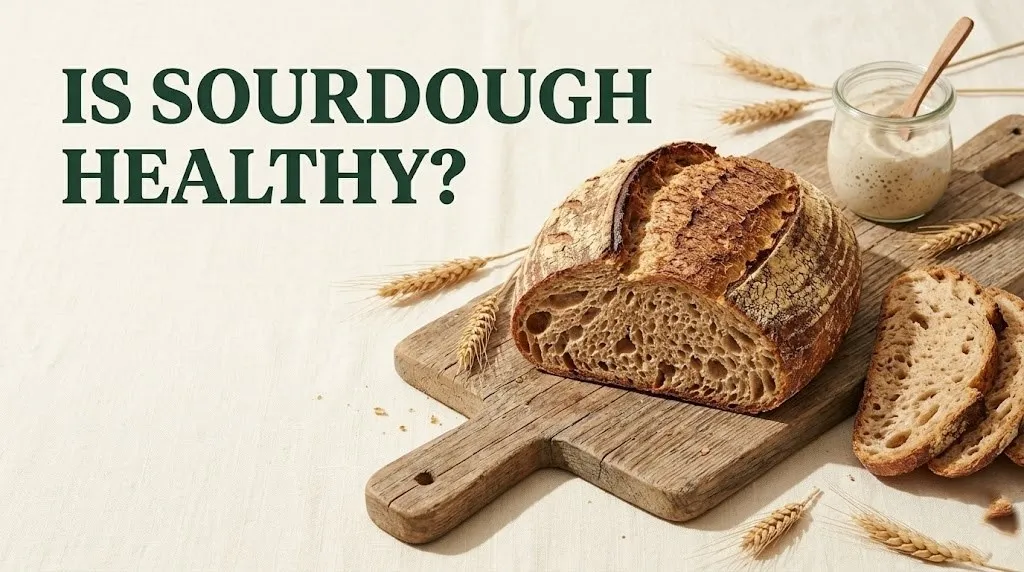
That said, sourdough is not a health food in isolation. It’s a carbohydrate-based staple food, and its health value depends on portion size, the flour used, and whether the bread was genuinely fermented or factory-produced with added vinegar to fake the flavor.
A 2020 review published in the journal Nutrients found that sourdough fermentation improves the nutritional quality of bread through multiple mechanisms, including reduced phytic acid content and altered starch structure. These aren’t trivial differences. They affect how your body processes every slice.
Key factors that determine sourdough’s health value:
- Flour type (whole grain versus refined white flour)
- Fermentation duration (longer is better; minimum 8 to 12 hours for meaningful change)
- Whether the bread uses a real live starter or commercial yeast with acid additives
- Sodium content, which varies by recipe and brand
- Serving size, which most people underestimate
What Makes Sourdough Bread Different from Regular Bread?
Sourdough bread differs from conventional bread because it is leavened through a process of wild fermentation, not commercial yeast alone.
A sourdough starter is a live culture of wild yeast (primarily Saccharomyces cerevisiae and related strains) and lactic acid bacteria (mainly Lactobacillus species). These microorganisms ferment the sugars in flour over an extended period, typically 8 to 24 hours or longer.
During that fermentation, two important things happen. First, lactic and acetic acids are produced, which give sourdough its characteristic tang and act as natural preservatives. Second, the bacteria produce enzymes, particularly phytase, that break down phytic acid in the grain.
Think of phytic acid as a locked vault around the minerals in wheat. Phytase is the key. Without fermentation, much of the iron, zinc, magnesium, and manganese in bread is bound to phytic acid and passes through your digestive system without being absorbed. Long fermentation unlocks those minerals and makes them available to your body.
Commercial bread, made with rapid-rise commercial yeast over 2 to 3 hours, doesn’t give bacteria time to produce meaningful amounts of phytase. The nutritional transformation that defines real sourdough simply doesn’t occur at speed.
The difference in a simplified comparison:
| Feature | Authentic Sourdough | Commercial Bread |
|---|---|---|
| Leavening agent | Wild yeast and bacteria | Commercial yeast only |
| Fermentation time | 8 to 24+ hours | 2 to 3 hours |
| Phytic acid level | Reduced by 40 to 60% | Largely intact |
| Glycemic index | Lower (approximately 53 to 56) | Higher (70 to 80+ for white) |
| Digestive tolerance | Better for many people | Standard |
| Flavor | Complex, tangy | Mild, neutral |
Sourdough Bread Nutrition Facts Per Slice
One medium slice of sourdough bread (approximately 56 grams, typical of what you’d find at a bakery or in a standard sandwich) provides roughly the following nutritional values, based on USDA Food Data Central figures for white flour sourdough:
| Nutrient | Amount per 56g slice |
|---|---|
| Calories | 140 to 160 kcal |
| Carbohydrates | 28 to 30g |
| Dietary fiber | 1 to 2g (white flour); up to 3g (whole wheat sourdough) |
| Protein | 5 to 6g |
| Fat | 0.5 to 1g |
| Sodium | 200 to 320mg |
| Iron | 1.5 to 2mg (10 to 15% DV) |
| Folate | 50 to 70mcg (12 to 18% DV) |
| Selenium | 15 to 20mcg (25 to 35% DV) |
| Manganese | 0.5 to 0.7mg (20 to 30% DV) |
Whole wheat sourdough adds meaningfully more fiber, B vitamins, and overall micronutrient density. The fermentation process, however, applies to both white and whole wheat varieties.
One note worth making explicit: sodium is the nutrient most people underestimate in bread. A single slice of some commercial sourdough loaves provides over 300mg of sodium, which adds up quickly if you’re eating two or three slices per meal.
People managing high blood pressure or following a low-sodium diet recommended by their physician should check the label carefully and consider low-sodium artisan options where available.
Key Takeaway: Sourdough’s fermentation process reduces phytic acid, unlocking minerals your body would otherwise miss. That’s the real nutritional story, not just the calorie count.
Sourdough Bread Fermentation Health Benefits
The health benefits of sourdough bread are almost entirely products of its fermentation process, not the bread itself in raw form.
When Lactobacillus bacteria ferment the flour, they don’t just produce acids. They partially pre-digest the starches and proteins in wheat, altering how your body processes the bread from first bite onward. According to a study published in the American Journal of Clinical Nutrition, sourdough fermentation modifies the starch structure of bread, producing more resistant starch and slowing glucose absorption compared to non-fermented bread made from the same flour.
Resistant starch behaves more like dietary fiber than like digestible carbohydrate. Your small intestine doesn’t break it down efficiently. Instead, it moves into the large intestine, where it feeds beneficial bacteria. Think of it as a slow-burning fuel source for your gut microbiome rather than a rapid blood sugar spike.
Fermentation also produces postbiotics, the metabolic byproducts of bacterial activity. Unlike live probiotics (which don’t survive baking), postbiotics remain in the finished bread. Lactic and acetic acid are the primary ones. These compounds affect gut pH, support the gut lining, and may influence immune signaling, though research on postbiotics in baked goods is still developing.
Documented fermentation benefits in sourdough:
- Reduced phytic acid content by 40 to 60%, improving mineral bioavailability
- Lower glycemic response compared to equivalent non-fermented bread
- Partial gluten breakdown, which improves digestibility for some individuals
- Production of resistant starch, which feeds beneficial gut bacteria
- Longer shelf life without chemical preservatives, due to natural acids
People with wheat sensitivities (distinct from celiac disease) sometimes find sourdough more tolerable. This is likely due to partial gluten degradation during fermentation, though this does not make sourdough safe for people with celiac disease.
Sourdough Glycemic Index and Blood Sugar
Sourdough bread has a lower glycemic index (GI) than white bread and many whole wheat breads, making it a meaningfully better choice for blood sugar management.
The glycemic index measures how quickly a carbohydrate food raises blood glucose levels on a scale of 0 to 100. White bread typically scores 70 to 80, placing it in the high-GI category. White flour sourdough scores approximately 53 to 56, firmly in the low-to-medium range. Whole wheat sourdough scores even lower, around 48 to 52.
These aren’t trivial differences. A 2008 study published in the American Journal of Clinical Nutrition specifically compared sourdough wheat bread with non-fermented bread and found that sourdough significantly reduced postprandial (after-meal) blood glucose and insulin responses in study participants. The mechanism is primarily the altered starch structure from fermentation.
For people monitoring daily blood sugar loads, the distinction matters at a practical level. Eating two slices of sourdough at lunch produces a slower, more sustained glucose rise than two slices of standard white bread, which can spike and drop quickly, often triggering hunger again within an hour or two.
Whole wheat sourdough provides the lowest GI response of the common varieties, because the bran and fiber from the whole grain add an additional buffer to glucose absorption on top of the fermentation effect.
| Bread Type | Approximate GI |
|---|---|
| White bread | 70 to 80 |
| White sourdough | 53 to 56 |
| Whole wheat bread (non-fermented) | 60 to 70 |
| Whole wheat sourdough | 48 to 52 |
| Rye sourdough | 45 to 55 |
Portion size still governs the total glucose load regardless of GI. Two low-GI slices still contain more carbohydrate than one higher-GI slice. People with prediabetes or type 2 diabetes should approach portion size as the primary variable, with bread type as a secondary consideration.
Key Takeaway: Authentic sourdough fermentation lowers the glycemic index meaningfully compared to conventional bread. The benefit is real, but it’s most powerful when combined with appropriate portion control and whole grain flour.
Is Sourdough Bread Heart Healthy?
Sourdough bread can be part of a heart-healthy diet, and emerging evidence suggests authentic sourdough may actively support cardiovascular health through several mechanisms.
The American Heart Association (AHA) recommends that whole grains make up at least half of all grain consumption for cardiovascular disease prevention. Whole wheat sourdough satisfies this guidance while offering the additional benefits of fermentation. Even white flour sourdough performs better than refined white bread on several cardiovascular markers.
The most direct heart-relevant benefit of sourdough is its fiber content, particularly in whole grain versions. The AHA reports that diets higher in dietary fiber are associated with lower rates of coronary heart disease. Fiber helps reduce LDL cholesterol absorption in the digestive tract, a well-established mechanism backed by decades of research.
Sourdough also tends to have a lower glycemic load than conventional bread. Chronic high-glycemic-load diets are associated with elevated triglycerides and increased cardiovascular risk, according to research published in the Journal of Nutrition. Eating lower-GI foods across meals supports more stable blood lipid patterns over time.
One cardiovascular concern specific to bread is sodium. A single slice of commercial sourdough can contain 200 to 320mg of sodium, and most people eat two slices minimum per sandwich. For anyone managing hypertension or following a sodium-restricted diet for heart health, this is worth tracking across the whole day rather than evaluating slice by slice.
Heart health considerations for sourdough:
- Choose whole wheat or whole grain sourdough for maximum fiber benefit
- Check the sodium content per slice, not per serving if the serving size is listed as a fraction
- Pair sourdough with heart-supportive toppings: avocado, olive oil, smoked fish, or legume-based spreads rather than processed deli meats or high-sodium condiments
- Real fermentation reduces the glycemic load, which is favorable for blood lipid management over time
Sourdough Bread and Cholesterol
Sourdough bread does not directly lower cholesterol, but it can support healthy cholesterol levels as part of a fiber-rich diet.
No study has established that eating sourdough directly reduces LDL cholesterol on its own. What the research supports is that dietary fiber, particularly soluble fiber from oats and legumes, reduces LDL absorption. Whole wheat sourdough contributes fiber to the overall diet, and over time, a consistently high-fiber dietary pattern is associated with better LDL cholesterol profiles, according to the American Heart Association.
Sourdough also contains a modest amount of beta-glucan precursors and resistant starch, neither of which affects cholesterol as directly as the soluble fiber in oats. Anyone expecting sourdough to function like a cholesterol-lowering medication will be disappointed. Its role is supportive, not therapeutic.
The indirectly cholesterol-relevant effect worth noting is the lower glycemic load. Diets chronically high in refined carbohydrates are associated with elevated triglycerides, which is a separate but related cardiovascular risk marker. Choosing sourdough over high-GI white bread at repeated meals over months can contribute to a more favorable triglyceride pattern.
For people actively managing elevated LDL cholesterol under physician guidance, sourdough can be included in a heart-supportive diet. It shouldn’t replace more direct dietary interventions like increasing soluble fiber from oats, reducing saturated fat intake, or following a DASH or Mediterranean dietary pattern. A registered dietitian can help identify where sourdough fits in the context of a broader cholesterol management strategy.
Is Sourdough Bread Good for Digestion?
Sourdough bread is better for digestion than most conventional breads, and for many people, it’s noticeably easier on the stomach.
The digestive advantage comes directly from fermentation. When Lactobacillus bacteria break down gluten proteins and alter starch structure during the long fermentation process, the resulting bread is structurally different from bread made with fast-rise commercial yeast. These changes make the bread easier for the digestive system to process.
Fermentation also reduces the level of fructans, a type of carbohydrate in wheat that belongs to the FODMAP family. FODMAPs (fermentable oligosaccharides, disaccharides, monosaccharides, and polyols) are poorly absorbed in the small intestine and are fermented rapidly by gut bacteria, causing bloating, gas, and discomfort in sensitive individuals. According to research from Monash University, which developed and maintains the FODMAP framework, sourdough bread made with a genuine long fermentation process has a substantially lower FODMAP content than standard wheat bread.
This means many people who experience bloating or discomfort after eating regular bread tolerate sourdough noticeably better. It’s not that sourdough contains probiotics (the live bacteria don’t survive baking). The benefit comes from what the bacteria did to the bread before it went in the oven.
Digestive benefits are most pronounced with longer fermentation. A sourdough that fermented for 4 hours provides less fructan reduction than one that fermented for 12 to 16 hours. This is one of the key reasons artisan sourdoughs made with long cold-proof methods (where the dough ferments overnight in the refrigerator) tend to be better tolerated by sensitive people than bakery sourdoughs made quickly.
Key Takeaway: Sourdough’s digestive advantages come from fermentation reducing fructans and altering starch structure, not from live bacteria. Longer fermentation produces greater benefit.
Sourdough Bread and IBS
Sourdough bread is often better tolerated than conventional wheat bread by people with irritable bowel syndrome (IBS), particularly when made with a genuine long fermentation process.
IBS management frequently involves following a low-FODMAP diet, an approach developed by researchers at Monash University to identify and reduce foods that trigger IBS symptoms. Standard wheat bread is high in fructans, a FODMAP that commonly triggers bloating, cramping, and altered bowel habits in people with IBS.
Research published in the journal Nutrients found that genuine sourdough fermentation reduces fructan content in wheat bread by up to 90% compared to non-fermented bread made from the same flour. This drop is large enough to move sourdough into the low-FODMAP category under Monash University’s current testing guidelines, provided the fermentation was long and authentic.
Not all commercial sourdoughs qualify. Many products labeled “sourdough” in grocery stores were fermented for only 1 to 2 hours or received acid flavoring rather than genuine long fermentation. These products retain much of their original fructan content and will not provide the same IBS benefit.
For people with IBS who want to include bread: authentic, long-fermented sourdough from an artisan bakery or home recipe is a reasonable starting point. It’s worth introducing in small amounts (one slice) and monitoring individual response before eating regularly, since IBS symptom patterns vary considerably from person to person. Anyone who suspects IBS and hasn’t had a formal assessment should discuss symptoms with a gastroenterologist or registered dietitian, since IBS diagnosis requires ruling out other conditions and the low-FODMAP protocol is most effective when guided by a professional.
Sourdough vs White Bread vs Whole Wheat: Which Is Healthier?
Whole wheat sourdough is the healthiest of the three bread types for most people, followed by white sourdough, then standard whole wheat bread, then white bread.
That ranking reflects the combined effect of fermentation and fiber content. Whole wheat sourdough gets the best of both: the mineral and fiber density of whole grain, plus the reduced phytic acid, lower GI, and improved digestibility that come from real fermentation.
Standard whole wheat bread without fermentation scores better than white bread on fiber and micronutrients, but its higher phytic acid content limits mineral absorption and its GI is still meaningfully higher than fermented versions.
| Nutrition Factor | White Sourdough | Whole Wheat Sourdough | Standard Whole Wheat | White Bread |
|---|---|---|---|---|
| Glycemic index | 53 to 56 | 48 to 52 | 60 to 70 | 70 to 80 |
| Dietary fiber per slice | 1 to 2g | 2 to 4g | 2 to 3g | 0.5 to 1g |
| Phytic acid level | Low | Low | Moderate to high | Low to moderate |
| Mineral bioavailability | Good | Best | Moderate | Moderate |
| Protein per slice | 5 to 6g | 5 to 7g | 4 to 6g | 2 to 4g |
| FODMAP fructans | Low | Low | High | Moderate |
For people who dislike the density of whole wheat bread, white sourdough is a reasonable compromise. It won’t deliver the fiber of whole wheat, but the fermentation process still provides meaningful advantages over regular white bread on glycemic response and mineral absorption.
The one area where standard whole wheat bread can outperform white sourdough is total dietary fiber. If fiber intake is the primary goal, whole wheat sourdough wins outright.
Key Takeaway: When choosing between bread types, whole wheat sourdough gives you the most nutritional value per slice. If whole wheat isn’t your preference, white sourdough is still a better choice than regular white bread on almost every measurable metric.
Is Sourdough Bread Good for Diabetics?
Sourdough bread is a better bread option for most people with type 2 diabetes than white bread or standard whole wheat bread, primarily because of its lower glycemic index and slower glucose response.
A study published in the American Journal of Clinical Nutrition found that sourdough bread produced a lower postprandial blood glucose response than non-fermented bread made from identical flour, in a controlled crossover trial with healthy adults. The mechanism, as established in multiple subsequent studies, is fermentation-altered starch structure and the production of resistant starch.
For people with type 2 diabetes, a slower glucose response means insulin demand rises more gradually, which is easier to manage. This doesn’t mean sourdough is freely eaten in unlimited amounts. The Academy of Nutrition and Dietetics notes that total carbohydrate quantity remains the primary variable for blood glucose management, with glycemic index as a secondary tool.
Practical guidance for people with diabetes who want to include sourdough:
- Choose whole wheat sourdough for the lowest available GI
- Stick to one to two slices per meal rather than larger portions
- Pair sourdough with protein (eggs, legumes, fish) and fat (avocado, olive oil) to further slow glucose absorption
- Check blood glucose response personally using a glucometer, since individual responses to specific foods vary more than population averages suggest
- If you’re managing blood glucose with medication or insulin, discuss any dietary changes with your endocrinologist or a registered dietitian who specializes in diabetes management
People with type 1 diabetes using insulin dosing strategies based on carbohydrate counting should be aware that sourdough’s altered starch structure can make glucose response less predictable than standard bread. This is worth accounting for when calculating doses.
Is Sourdough Bread Gluten Free?
Sourdough bread is not gluten free, and it is not safe for people with celiac disease.
This is one of the most common misconceptions about sourdough. The fermentation process partially degrades gluten proteins, primarily gliadin, during the long acidification process. This partial breakdown is what makes sourdough better tolerated by some people with non-celiac gluten sensitivity. But “partial degradation” is not the same as “gluten free.”
Multiple studies have confirmed that gluten remains present in sourdough bread at levels well above the 20 parts per million (ppm) threshold set by the FDA and the Codex Alimentarius for gluten-free food labeling. People with celiac disease can experience immune activation and intestinal damage from amounts of gluten far below what survives standard sourdough fermentation.
For people with non-celiac gluten sensitivity (NCGS), the picture is more nuanced. Some individuals with NCGS report tolerating sourdough better than conventional bread, and the partial gluten reduction combined with the FODMAP reduction may contribute to this. However, NCGS is a self-reported condition with significant variability, and responses differ considerably between individuals.
| Condition | Sourdough Tolerated? |
|---|---|
| No gluten issues | Yes, generally well tolerated |
| Wheat allergy | No (contains wheat protein) |
| Non-celiac gluten sensitivity | Sometimes, individual variation applies |
| Celiac disease | No, gluten remains present |
Anyone managing celiac disease who is considering sourdough based on online information should discuss the decision with their gastroenterologist first. Gluten-free sourdough made with certified gluten-free grains (buckwheat, rice, sorghum) does exist and is an option, but standard sourdough wheat bread does not qualify.
Is Store-Bought Sourdough Actually Healthy?
Many sourdough loaves sold in grocery stores are not genuinely fermented and do not deliver the health benefits of authentic sourdough bread.
This is the most under-reported fact in sourdough nutrition coverage. Commercial bakeries producing bread at scale can’t wait 12 to 24 hours per batch. Many products labeled “sourdough” or “sourdough style” are made with standard commercial yeast and then acidified with vinegar, citric acid, or lactic acid as a flavoring agent. The flavor mimics real sourdough. The nutritional transformation does not occur.
A 2020 analysis highlighted by the Real Bread Campaign in the UK found that a large proportion of commercially labeled sourdough products failed to meet criteria for genuine fermentation. While U.S. regulations on the term “sourdough” are less strict than for some other food descriptors, the FDA does require that ingredient labels accurately reflect what’s in the bread.
How to identify genuine sourdough at the store:
- Check the ingredient list. Real sourdough contains: flour, water, salt, and a sourdough culture (starter). That’s it.
- If you see: vinegar, citric acid, ascorbic acid, “natural flavors,” or a combination of commercial yeast with added acid, it was not genuinely fermented.
- Look for the phrase “long fermented” or “slow-fermented” on artisan bakery labels.
- Check the texture and crust. Genuine sourdough has a chewier, thicker crust and a more irregular crumb structure than factory-produced bread.
- Buy from a local artisan bakery where you can ask about fermentation time. A baker making real sourdough will know exactly how long their dough ferments.
For the health benefits documented in fermentation research to apply, you need bread that was actually fermented. The label alone is not sufficient confirmation.
Key Takeaway: Grocery store sourdough often isn’t genuinely fermented. Real sourdough contains only flour, water, salt, and starter. If the label shows vinegar or citric acid, it’s flavored bread, not fermented bread, and the health benefits documented in research don’t apply.
How Much Sourdough Bread Should You Eat Per Day?
Most adults can reasonably eat two to four slices of sourdough per day as part of a balanced diet, depending on overall carbohydrate intake and individual health goals.
The USDA Dietary Guidelines for Americans 2020-2025 recommend that adults consume six to eight servings of grain foods daily, with at least half coming from whole grain sources. One standard slice of sourdough counts as roughly one serving. Whole wheat sourdough satisfies the whole grain recommendation; white sourdough does not.
Two slices of whole wheat sourdough at breakfast or lunch delivers approximately 280 to 320 calories, 8 to 10g of protein, 4 to 6g of dietary fiber, and meaningful amounts of iron, selenium, and folate. That’s a solid nutritional contribution from a single bread choice.
The limiting factor for many people is sodium. Two slices of commercial sourdough can contribute 400 to 600mg of sodium before any toppings are added. For adults targeting under 2,300mg of sodium per day (the threshold the AHA recommends), this is a number worth tracking.
People managing their weight should also account for total carbohydrate load. Sourdough’s lower glycemic index doesn’t mean the carbohydrate disappears. Four slices of sourdough contain 100 to 120g of carbohydrate, which is a large portion of many people’s daily carbohydrate targets.
Practical daily sourdough guidelines:
- General healthy adult: two to four slices per day is reasonable with a balanced diet
- People managing blood sugar: one to two slices per meal, paired with protein and fat
- People on low-sodium diets: check the label; look for options under 140mg sodium per slice
- People following a low-carb or ketogenic diet: sourdough is not compatible with strict carbohydrate limits
- Children: appropriate portion sizes are smaller; one slice per meal is typical for school-age children
Who Should Avoid Sourdough Bread?
Sourdough bread is not appropriate for everyone, and certain health conditions or dietary restrictions require either avoidance or careful management.
People with celiac disease must avoid all standard sourdough bread. Gluten remains present at levels that trigger immune response and intestinal damage, regardless of fermentation duration. Certified gluten-free sourdough made from non-wheat grains is an alternative, but standard wheat sourdough is off the table entirely.
People with a wheat allergy (distinct from celiac disease) also need to avoid sourdough made from wheat flour. Fermentation does not neutralize wheat proteins responsible for allergic reactions.
| Group | Recommendation |
|---|---|
| Celiac disease | Avoid all wheat sourdough |
| Wheat allergy | Avoid all wheat sourdough |
| Non-celiac gluten sensitivity | Use caution; start with small amounts |
| Type 2 diabetes | Choose whole wheat sourdough; monitor portions |
| Hypertension (low-sodium diet) | Check sodium per slice; choose low-sodium varieties |
| IBS (low-FODMAP) | Choose only long-fermented artisan sourdough |
| Healthy adults with no restrictions | Generally well tolerated in normal portions |
People following a very low carbohydrate diet for medical reasons (such as epilepsy managed with a ketogenic diet) should recognize that sourdough, despite its lower GI, still contributes substantial carbohydrates.
Pregnant women have no specific reason to avoid sourdough, but standard pregnancy nutrition guidance recommends focusing on folate, iron, and calcium intake, and whole wheat sourdough supports all three through its micronutrient profile and improved mineral bioavailability.
Older adults may benefit from sourdough’s improved mineral absorption, particularly for iron and zinc, as mineral absorption can decrease with age. The digestive tolerability advantage is also relevant for older adults who may have more sensitive digestive systems.
Frequently Asked Questions About Sourdough Bread
Is sourdough bread healthier than whole wheat bread?
Whole wheat sourdough is generally the healthiest bread option, outperforming both standard whole wheat and white bread.
It combines the fiber and micronutrient density of whole grain with the reduced phytic acid, lower glycemic index, and improved digestibility that come from authentic fermentation.
Standard whole wheat bread without fermentation delivers more fiber than white sourdough but retains higher phytic acid levels and has a meaningfully higher glycemic index.
Can I eat sourdough bread every day?
Yes, most healthy adults can eat two to four slices of sourdough bread daily as part of a balanced diet.
Whole wheat sourdough is the better daily choice, contributing fiber, protein, selenium, folate, and iron with every serving.
The main variables to monitor with daily consumption are total sodium intake (especially with commercial sourdoughs) and overall carbohydrate load relative to your individual dietary goals.
Does sourdough bread spike blood sugar?
Genuine sourdough bread produces a lower blood sugar response than white bread or standard whole wheat bread.
Its glycemic index of approximately 53 to 56 for white sourdough (and 48 to 52 for whole wheat sourdough) means glucose rises more slowly after eating it than after eating most conventional breads.
Portion size still matters: eating four slices of low-GI sourdough produces a larger total glucose load than eating one slice of higher-GI bread.
Is sourdough bread good for people with high cholesterol?
Sourdough bread, particularly whole wheat varieties, can support a heart-healthy diet that may help manage cholesterol over time.
Its fiber content contributes to overall daily fiber intake, and higher dietary fiber intake is associated with lower LDL cholesterol levels according to the American Heart Association.
Sourdough does not directly lower cholesterol on its own; it works best as part of a broader eating pattern that reduces saturated fat, increases vegetables and legumes, and prioritizes whole grains.
Does sourdough bread cause bloating?
Authentic long-fermented sourdough is less likely to cause bloating than regular bread, because fermentation substantially reduces fructan content.
Fructans are a type of carbohydrate in wheat that commonly trigger bloating, gas, and digestive discomfort, particularly in people with IBS or fructan sensitivity.
If you still experience bloating after eating genuine sourdough, the bread may not have been properly fermented, or you may have a separate sensitivity; an assessment by a registered dietitian can help identify the cause.
Sourdough earns its reputation, but only when it’s the real thing. Authentic long-fermented sourdough made from whole grain flour is genuinely one of the better bread choices available, with documented advantages in blood sugar management, mineral absorption, digestive tolerance, and heart health support.
The practical takeaway is straightforward: look for bread with four ingredients (flour, water, salt, starter), buy from bakers who can tell you their fermentation time, and choose whole wheat when you can.
Bread doesn’t have to be complicated. Sourdough, done right, is one of the simplest ways to upgrade a food you’re already eating.