Chorizo is not a health food, but it’s not a food you need to cut out of your life either. Whether it fits your diet depends on how much you eat, how often, and what type of chorizo lands on your plate.
The World Health Organization classifies processed meat, including most commercial chorizo, as a Group 1 carcinogen based on evidence linking regular consumption to increased colorectal cancer risk. That sounds alarming. But what it actually means in practical terms is more nuanced than most articles let on.
This guide covers chorizo’s full nutritional profile, what the science actually says about its health risks, how different types compare, and what smarter eating looks like if chorizo is a regular part of your meals. You’ll also find guidance for specific situations including diabetes, pregnancy, and weight management.
Is Chorizo Healthy?
Chorizo can be part of a healthy diet when eaten in small portions occasionally, but it is not a food that supports health when eaten daily or in large amounts.
It delivers real nutritional value: complete protein, heme iron, zinc, selenium, and vitamin B12 (cobalamin). These matter. But chorizo also carries a heavy saturated fat load and sodium content that pushes up against major dietary guidelines when portions get generous.
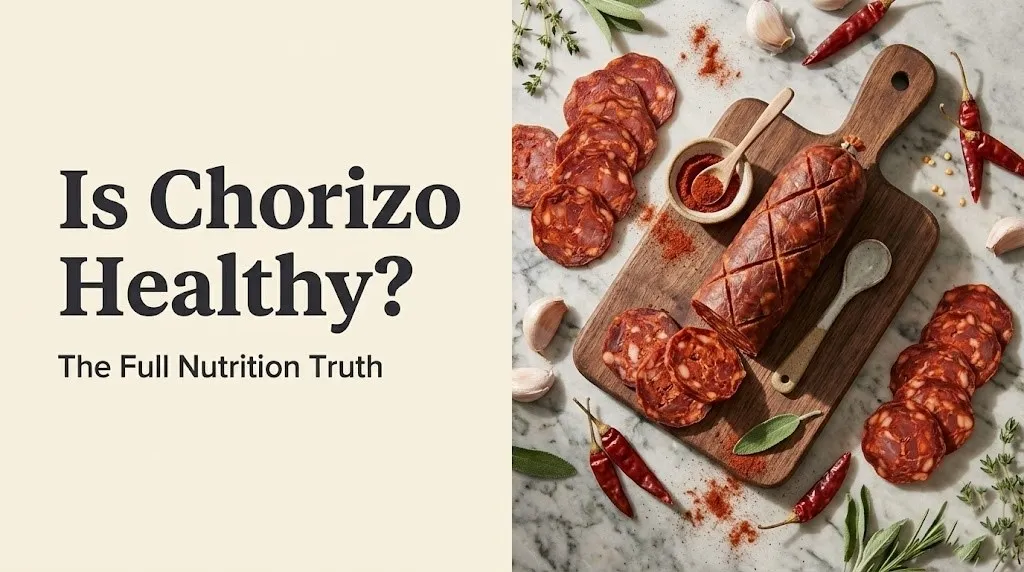
The honest answer is: chorizo is a sometimes food with genuine nutrients, real health tradeoffs, and a processing profile that requires attention. Calling it flat-out “unhealthy” ignores the protein and micronutrients. Calling it a healthy everyday choice ignores the fat, sodium, and WHO designation. The truth sits squarely in the middle, and portion size is where the conversation starts.
| Factor | What It Means for Health |
|---|---|
| High protein | Supports muscle maintenance and satiety |
| High saturated fat | Linked to LDL cholesterol increase at high intake |
| High sodium | Risk factor for hypertension and cardiovascular strain |
| Processed meat status | Associated with colorectal cancer risk at regular intake |
| Rich in B12, zinc, iron | Supports nerve function, immunity, and red blood cell production |
What Is Chorizo and How Is It Made?
Chorizo is a spiced sausage made primarily from ground pork, seasoned with smoked paprika (pimentón), garlic, and other spices, available in two very different forms: Spanish cured chorizo and Mexican fresh chorizo.
Spanish chorizo is fermented and dried. It’s a ready-to-eat charcuterie product, sliced thin and eaten cold or added to cooked dishes. The curing process involves salt, sodium nitrite, and natural fermentation, which concentrates its fat, sodium, and calorie content significantly.
Mexican chorizo is raw ground spiced pork, sold in casings or loose. It must be fully cooked before eating. Its spice blend typically includes chili peppers and garlic rather than smoked paprika, giving it a completely different flavor profile. The fat content is similar to Spanish chorizo before cooking, but draining fat during cooking changes the final nutritional picture.
Commercial production of both types typically uses sodium nitrite as a preservative. This is the same curing agent used in bacon, salami, and hot dogs. Some artisan producers use celery powder as a “natural” nitrate source, but the resulting nitrite levels in the finished product are comparable.
Quick Tip:
- Spanish chorizo is cured and ready to eat. No cooking required.
- Mexican chorizo is raw. Always cook it to an internal temperature of 160°F (71°C).
- Both types come in pork, turkey, and plant-based versions, each with a distinct nutrition profile.
Chorizo Nutrition Facts Per Serving
A standard 2 oz (56g) serving of cooked Mexican pork chorizo contains approximately 230 to 270 calories, 19 to 23g of total fat, and 12 to 16g of protein, according to USDA FoodData Central.
Spanish cured chorizo runs higher in calories per ounce because it’s dried and therefore denser. A 1 oz (28g) slice of cured Spanish chorizo typically delivers around 110 to 130 calories, 10g of fat, and 6 to 7g of protein. That’s before you’ve put it on anything.
The carbohydrate content of plain chorizo is nearly zero, typically under 1g per serving. This is largely because it contains no grains or starches in its traditional form. Commercial versions sometimes include fillers, so checking the label on packaged chorizo is worth the 10 seconds it takes.
One thing most articles skip: serving size in real life rarely matches the 2 oz reference point. A typical portion used in a taco filling or breakfast scramble is closer to 3 to 4 oz of cooked chorizo, which pushes the calorie count toward 350 to 450 and the saturated fat toward 12 to 16g in a single meal.
| Nutrient | 2 oz Mexican Chorizo (cooked) | 1 oz Spanish Chorizo (cured) |
|---|---|---|
| Calories | 230-270 | 110-130 |
| Total Fat | 19-23g | 9-11g |
| Saturated Fat | 7-10g | 3-4g |
| Protein | 12-16g | 6-7g |
| Sodium | 500-650mg | 280-380mg |
| Carbohydrates | 0-1g | 0-1g |
Key Takeaway: Chorizo delivers genuine protein and micronutrients, but a real-world serving is almost always larger than the standard reference portion, which matters considerably when you’re tracking saturated fat and sodium.
Chorizo Protein, Fat, and Calorie Breakdown
Chorizo is a high-fat, moderate-protein food with virtually no carbohydrates, making its caloric density primarily fat-driven.
The protein in chorizo is complete protein, meaning it contains all nine essential amino acids. At 12 to 16g per cooked 2 oz serving, it contributes meaningfully to daily protein intake. For reference, the Dietary Reference Intake (DRI) for protein is approximately 0.8g per kilogram of body weight for sedentary adults.
The fat breakdown matters as much as the total fat number. In pork chorizo, roughly 35 to 45% of the total fat is saturated fat, 40 to 45% is monounsaturated fat (primarily oleic acid, the same fat in olive oil), and the remainder is polyunsaturated fat. The monounsaturated fat content is genuinely worth noting. Saturated fat is the component that drives most of the cardiovascular concern.
Think of chorizo’s fat profile like a hybrid car: one engine is running on something relatively benign (oleic acid), and the other is burning something that demands more careful management (saturated fat). The ratio isn’t as clean as olive oil, but it’s also not as lopsided as butter.
- Saturated fat in chorizo: 35-45% of total fat
- Monounsaturated fat (primarily oleic acid): 40-45% of total fat
- Polyunsaturated fat: 10-20% of total fat
- Net carbohydrates: typically under 1g per serving in pure pork chorizo
Chorizo Sodium and Saturated Fat: What the Numbers Mean
Chorizo is high in both saturated fat and sodium, with a single 2 oz serving providing 35 to 55% of the American Heart Association’s recommended daily sodium limit and 35 to 50% of the recommended saturated fat ceiling.
The American Heart Association recommends no more than 2,300mg of sodium per day for most adults, with an ideal target of 1,500mg for those managing blood pressure. A 2 oz serving of Mexican chorizo already delivers 500 to 650mg of sodium. One taco with 3 oz of chorizo, cheese, and salsa can easily push past 900mg of sodium in a single item.
For saturated fat, the AHA recommends limiting intake to 5 to 6% of total daily calories. On a 2,000-calorie diet, that’s about 11 to 13g of saturated fat per day. A generous serving of pork chorizo can consume that entire budget before dinner.
This doesn’t mean chorizo is off the table. It means chorizo works best as an ingredient rather than the centerpiece of a meal. Using 1 oz of cured Spanish chorizo to season a vegetable paella is a very different dietary proposition than eating a chorizo-forward burrito for lunch three times a week.
People managing hypertension, congestive heart failure, or chronic kidney disease should be particularly careful with chorizo given its sodium density. Always reading the label on commercial brands is worth the effort because sodium levels vary by manufacturer by as much as 200mg per serving.
Chorizo Vitamins and Minerals: Iron, Zinc, and B12 Content
Chorizo is a genuinely meaningful source of heme iron, zinc, selenium, phosphorus, and vitamin B12 (cobalamin), making it more nutritionally complex than many processed meats.
Heme iron from animal sources is absorbed at a rate of 15 to 35% by the body, compared to 2 to 20% for non-heme iron from plants, according to the National Institutes of Health (NIH). For anyone at risk of iron deficiency anemia, including premenopausal women and endurance athletes, this is worth acknowledging.
Vitamin B12 is found almost exclusively in animal products. A 2 oz serving of pork chorizo can provide 20 to 35% of the daily value for B12, depending on the brand and cut used. B12 supports red blood cell formation, neurological function, and DNA synthesis. People following predominantly plant-based diets who occasionally include chorizo get a meaningful B12 contribution from a small amount.
Zinc from chorizo supports immune function and wound healing. Selenium, present in moderate amounts, acts as an antioxidant cofactor for enzymes including glutathione peroxidase. These aren’t reasons to eat chorizo daily, but they are reasons not to frame it as nutritionally empty.
| Micronutrient | Amount per 2 oz Cooked Pork Chorizo | % Daily Value (approx.) |
|---|---|---|
| Vitamin B12 (cobalamin) | 0.5-0.8 mcg | 20-35% |
| Zinc | 2-3mg | 18-27% |
| Selenium | 14-18 mcg | 25-33% |
| Phosphorus | 100-140mg | 10-14% |
| Iron (heme) | 0.8-1.2mg | 4-7% |
| Niacin (B3) | 2.5-3.5mg | 16-22% |
Key Takeaway: Chorizo’s micronutrient content, particularly its B12, zinc, and selenium, gives it genuine nutritional standing that gets overlooked when the conversation focuses only on fat and sodium.
Is Chorizo Processed Meat and What Does That Mean for Health?
Yes, commercially produced chorizo is classified as processed meat, and in 2015 the International Agency for Research on Cancer (IARC), a division of the World Health Organization, classified processed meat as a Group 1 carcinogen based on sufficient evidence linking it to colorectal cancer.
That Group 1 designation is the same category as tobacco and asbestos, and that comparison has caused considerable alarm. But the IARC classification system describes the strength of evidence, not the magnitude of risk. Tobacco causes lung cancer in roughly 15% of heavy smokers. The increased colorectal cancer risk from eating 50g of processed meat daily is approximately 18% above baseline risk, according to the IARC’s own summary.
In absolute terms: if your lifetime colorectal cancer risk is 5%, regular processed meat consumption raises that to roughly 6%. That’s a real increase. It’s not a dramatic one. And “regular” in the studies cited typically means daily consumption of 50g or more, which is about 1.75 oz every single day over many years.
The Harvard T.H. Chan School of Public Health has noted in multiple reviews that the relationship between processed meat and cancer risk is real but dose-dependent. Occasional consumption, meaning a few times per week in moderate portions, sits in a very different risk category than daily high-volume intake.
People with a personal or family history of colorectal cancer, or who carry relevant genetic risk factors, have good reason to discuss processed meat intake specifically with their gastroenterologist or registered dietitian.
Chorizo and Heart Health
Chorizo’s saturated fat and sodium content makes it a food that requires attention in the context of cardiovascular health, though the risk picture is more specific than a blanket “bad for your heart” label.
The American Heart Association links high saturated fat intake to elevated LDL cholesterol (low-density lipoprotein), which increases the risk of arterial plaque buildup and cardiovascular events. A single generous serving of pork chorizo can deliver 7 to 10g of saturated fat, approaching or exceeding the AHA’s recommended daily ceiling of 11 to 13g for a 2,000-calorie diet.
Sodium is an equally important factor. High sodium intake is associated with elevated blood pressure (hypertension), which strains the heart and blood vessels. The DASH diet (Dietary Approaches to Stop Hypertension), developed specifically to address cardiovascular risk through food choices, explicitly recommends limiting processed meats including sausages and cured meats.
Regular processed meat consumption has been associated with increased cardiovascular mortality risk in large observational studies, including a 2020 analysis published in JAMA Internal Medicine, which found that eating two servings of processed meat per week was associated with a 7% higher risk of cardiovascular disease compared to minimal intake.
People with existing cardiovascular disease, high LDL cholesterol, or hypertension should treat chorizo as an occasional ingredient in modest amounts rather than a dietary regular. Those on a low-sodium diet below 1,500mg per day will find that even a small serving of chorizo makes a large dent in their daily limit.
Spanish Chorizo vs Mexican Chorizo: Nutritional Differences
Spanish chorizo and Mexican chorizo are fundamentally different products with different preparation methods, ingredients, and nutritional profiles, despite sharing a name.
Spanish chorizo is cured and fermented. The drying process removes moisture and concentrates fat, sodium, and calories. It’s eaten at room temperature, sliced thin, and functions more like salami or prosciutto than a sausage you cook. Its flavor comes primarily from smoked paprika (pimentón de la Vera), which contains carotenoid antioxidants including capsanthin. The curing process typically uses sodium nitrite and sea salt.
Mexican chorizo is a fresh, raw sausage that must be cooked. It’s spiced with chili peppers, garlic, and vinegar rather than smoked paprika. The texture is looser and fattier than Spanish chorizo, and cooking it allows you to drain a meaningful amount of fat. Some traditional recipes use offal cuts (organ meats) alongside shoulder and belly pork, which changes the micronutrient profile.
| Feature | Spanish Chorizo | Mexican Chorizo |
|---|---|---|
| Preparation | Cured and dried | Fresh, raw |
| Main spice | Smoked paprika (pimentón) | Chili peppers, garlic, vinegar |
| Cooking required? | No | Yes (to 160°F/71°C) |
| Calories per oz | 110-130 | 90-110 (before draining) |
| Sodium per oz | 280-380mg | 250-330mg |
| Fat drainage possible | No | Yes |
| Texture | Firm, sliceable | Loose, crumbly when cooked |
From a health standpoint, Mexican chorizo gives you more control: draining the rendered fat during cooking can reduce total fat content by 20 to 30% compared to eating the raw amount. Spanish chorizo requires more attention to portion size since there’s no fat reduction step.
Key Takeaway: Spanish and Mexican chorizo are nutritionally distinct. Mexican chorizo allows you to drain fat during cooking, making portion-for-portion comparisons between the two misleading without accounting for preparation method.
Turkey Chorizo vs Pork Chorizo vs Plant-Based Chorizo
Turkey chorizo and plant-based chorizo alternatives offer meaningfully lower saturated fat than pork chorizo, but they each carry tradeoffs in protein content, sodium, and ingredient quality that are worth examining.
Turkey chorizo typically uses 93% lean ground turkey, seasoned with the same paprika and garlic blend as traditional chorizo. Per 2 oz cooked serving, turkey chorizo delivers roughly 150 to 180 calories, 8 to 11g of fat, 3 to 5g of saturated fat, and 15 to 18g of protein. That’s a reduction of roughly 35 to 40% in total fat and 40 to 50% in saturated fat compared to pork chorizo.
The tradeoff: turkey chorizo can run slightly higher in sodium depending on the brand, and the texture is drier and less rich. It’s a legitimate option for anyone specifically trying to reduce saturated fat without eliminating chorizo’s flavor profile entirely.
Plant-based chorizo, typically made from soy protein, pea protein, or textured vegetable protein (TVP), eliminates animal fat and cholesterol entirely. But plant-based versions can run surprisingly high in sodium, sometimes 600 to 800mg per 2 oz serving. They also provide 10 to 13g of protein compared to 12 to 16g in pork chorizo, and the protein is not always as bioavailable.
Plant-based chorizo is appropriate for vegans, vegetarians, and those avoiding pork for religious or cultural reasons. People with soy allergies should check labels carefully, as soy is a common base protein.
| Type | Calories (2 oz) | Total Fat | Saturated Fat | Protein | Sodium |
|---|---|---|---|---|---|
| Pork chorizo (cooked) | 230-270 | 19-23g | 7-10g | 12-16g | 500-650mg |
| Turkey chorizo (cooked) | 150-180 | 8-11g | 3-5g | 15-18g | 480-620mg |
| Plant-based chorizo | 130-160 | 7-10g | 1-2g | 10-13g | 600-800mg |
How to Cook Chorizo to Reduce Fat and Calories
Draining rendered fat during cooking is the single most effective way to reduce the calorie and saturated fat content of Mexican chorizo without sacrificing flavor.
Raw Mexican chorizo releases a significant amount of fat during cooking. Starting in a dry skillet without added oil allows the sausage to cook in its own fat. Once the meat is cooked through (internal temperature: 160°F / 71°C), tilting the pan and spooning or blotting off the rendered fat before serving reduces total fat content by an estimated 20 to 35%.
For Spanish cured chorizo, cooking method matters differently. Grilling, baking, or pan-searing Spanish chorizo slices allows some fat to render off the surface. Avoid deep-frying or cooking in oil, which adds fat rather than removing it.
To cook Mexican chorizo with reduced fat:
- Remove the sausage casing if present and crumble the raw meat into a cold skillet.
- Heat the skillet to medium. No oil is needed.
- Break up the meat into small pieces as it cooks. Cook for 8 to 10 minutes, stirring regularly.
- Check that the internal temperature reaches 160°F (71°C) with a meat thermometer.
- Tilt the skillet and spoon off the rendered fat before serving.
- Blot with paper towels for additional fat reduction if needed.
Pairing cooked chorizo with high-fiber vegetables (bell peppers, onions, spinach) or whole grains (brown rice, corn tortillas) slows digestion, moderates the blood sugar impact, and adds micronutrients that balance out the meal.
Is Chorizo Good for Weight Loss or a Weight-Loss Diet?
Chorizo can fit into a calorie-controlled diet, but its caloric density makes portion management the deciding factor in whether it supports or hinders weight loss goals.
At 230 to 270 calories per 2 oz serving, chorizo is energy-dense compared to other protein sources. The same calorie amount buys you nearly 5 oz of grilled chicken breast or a very large serving of lentils. However, chorizo’s fat and protein content does promote satiety. A small amount goes a long way in suppressing appetite compared to equal-calorie carbohydrate-heavy foods.
The practical approach: use chorizo as a flavor driver rather than the primary protein source. One ounce of chorizo crumbled into a vegetable and egg scramble delivers smoky, spiced flavor throughout the dish without the full fat and calorie load of a 3 or 4 oz chorizo-centric serving.
According to the Academy of Nutrition and Dietetics, no single food causes weight gain or weight loss in isolation. Total caloric intake, food quality across the whole diet, and physical activity patterns determine outcomes. Chorizo eaten in a 1 oz portion twice a week is meaningfully different from chorizo eaten daily in large servings, both in terms of calorie load and processed meat exposure.
Quick Tip:
- Use 1 oz of chorizo as a seasoning agent in a larger dish rather than a 3-4 oz serving as a standalone protein.
- Pairing with fiber-rich vegetables stretches the satiety without adding significant calories.
- Draining cooked Mexican chorizo removes roughly 20-35% of the fat content before eating.
Key Takeaway: Chorizo won’t derail a weight-loss effort in small portions used as a flavor component, but its caloric density makes it a food where a kitchen scale makes a genuine practical difference.
Is Chorizo Keto Friendly?
Chorizo is compatible with a ketogenic diet. Its macronutrient profile of high fat, moderate protein, and near-zero carbohydrates aligns with the standard ketogenic ratio of roughly 70% fat, 25% protein, and 5% carbohydrates.
A 2 oz serving of pork chorizo contains 0 to 1g of net carbohydrates, making it one of the few processed proteins that naturally fits ketogenic macros without adjustment. The high saturated fat content that raises concerns in a standard diet is less problematic from a macro standpoint within a well-designed ketogenic framework, though individual cardiovascular risk factors still apply regardless of dietary pattern.
The sodium consideration is worth flagging for keto dieters specifically. During the initial phase of a ketogenic diet, glycogen depletion causes the kidneys to excrete more sodium, sometimes leading to electrolyte imbalance (commonly called “keto flu”). Chorizo’s sodium density can help offset some of this loss, but very high sodium intake from processed meat is still not the recommended strategy. Whole food sodium sources like broth and pickled vegetables are preferable for electrolyte management.
Check labels on commercial chorizo carefully if following strict keto. Some brands add sugar, corn syrup, or starch fillers to extend the product or improve texture. These additions can add 1 to 3g of net carbs per serving. Plain pork chorizo from a reputable butcher or an artisan brand is the cleanest option for keto tracking.
- Net carbs: typically 0-1g per 2 oz serving (pure pork chorizo)
- Best choice for keto: artisan or butcher chorizo without added fillers or sugars
- Still applies: cardiovascular risk factors from saturated fat are not negated by ketogenic macros
Is Chorizo Safe for People With Diabetes?
People with type 2 diabetes can include small amounts of chorizo in their diet, but its sodium content, saturated fat load, and processed meat status warrant careful management of portion size and frequency.
Chorizo contains virtually no carbohydrates, so it does not directly spike blood glucose. That makes it seem like an obvious fit for carbohydrate-controlled diabetic eating plans. The complication is that high saturated fat intake is associated with insulin resistance in research published in the American Journal of Clinical Nutrition, and people with type 2 diabetes already face insulin sensitivity challenges.
High sodium intake is an additional concern for people with diabetes, who are at elevated risk for hypertension and cardiovascular disease. The American Diabetes Association recommends that most adults with diabetes target less than 2,300mg of sodium per day, a limit a generous chorizo-based meal can strain considerably.
The safest approach: use chorizo as a flavoring element in vegetable-rich, fiber-forward meals rather than as the protein centerpiece. Turkey chorizo, with its lower saturated fat content, is worth considering as a swap. Monitoring blood pressure and discussing processed meat frequency with a registered dietitian or certified diabetes educator allows for a personalized approach rather than a blanket restriction.
People with diabetic nephropathy (diabetes-related kidney disease) should be particularly attentive to chorizo’s phosphorus content, as the kidneys’ reduced filtering capacity makes high-phosphorus foods worth limiting.
Can You Eat Chorizo During Pregnancy?
Pregnant women should avoid raw or undercooked chorizo entirely and should also limit cured Spanish chorizo due to the risk of Listeria monocytogenes contamination.
Mexican raw chorizo must be cooked to a full internal temperature of 160°F (71°C) before consumption during pregnancy. The same rule applies to all raw meats during pregnancy. Listeria monocytogenes, a bacterium that causes listeriosis, can survive at refrigerator temperatures and poses particular risk during pregnancy, with potential consequences including miscarriage, premature birth, and serious illness in the newborn.
Spanish cured chorizo is technically a ready-to-eat product. However, because it is not heat-processed, the Centers for Disease Control and Prevention (CDC) and the American College of Obstetricians and Gynecologists (ACOG) recommend that pregnant women avoid cured meats, including salami, prosciutto, and cured Spanish chorizo, unless they are heated until steaming (165°F / 74°C) before eating.
Beyond food safety, the high sodium content of chorizo warrants moderation during pregnancy. Sodium intake during pregnancy is associated with fluid retention and blood pressure management. The general guidance from dietary authorities is to keep sodium intake within the standard 2,300mg per day range during pregnancy, making high-sodium processed meats a food to eat sparingly.
If chorizo is a food you genuinely love and want to keep in your pregnancy diet, discussing your specific intake pattern with your obstetric provider or a registered dietitian who specializes in perinatal nutrition gives you personalized guidance that accounts for your overall diet, health status, and trimester.
Key Takeaway: During pregnancy, fully cooked Mexican chorizo is safer than cured Spanish chorizo, but both should be eaten sparingly and any raw or undercooked form must be avoided entirely.
Chorizo Serving Size, Storage, and Food Safety
The recommended serving size for chorizo as part of a balanced diet is 1 to 2 oz per meal, with processed meat intake ideally kept below 3 to 4 oz per day across all sources.
Practically speaking, most people eat chorizo in amounts closer to 3 to 5 oz in a single dish. Recognizing that gap and using portion control tools (a kitchen scale, pre-portioning links of sausage before storing) is the most direct way to keep chorizo in a healthy eating pattern without needing to eliminate it.
For storage: raw Mexican chorizo should be kept refrigerated at or below 40°F (4°C) and used within 1 to 2 days of purchase, or frozen for up to 2 months. Opened Spanish cured chorizo should be wrapped tightly and refrigerated, where it will keep for 3 to 7 weeks depending on how dry the product is. Vacuum-sealed Spanish chorizo that has not been opened can be stored at cool room temperature in a pantry for several weeks according to manufacturer guidelines.
Food safety with raw Mexican chorizo follows the same rules as all raw ground pork. Cross-contamination is a genuine risk. Wash hands, cutting boards, and any surface the raw sausage contacts thoroughly with hot soapy water. Never partially cook chorizo and finish it later at room temperature. Always cook to the verified internal temperature using a meat thermometer.
- Raw Mexican chorizo: refrigerate and use within 1 to 2 days or freeze for up to 2 months
- Cured Spanish chorizo (opened): refrigerate and use within 3 to 7 weeks
- Safe internal cooking temperature: 160°F / 71°C for raw pork chorizo
- Do not leave cooked chorizo at room temperature for more than 2 hours (1 hour above 90°F / 32°C)
Frequently Asked Questions About Chorizo
Is chorizo healthy to eat every day?
Eating chorizo every day is not recommended based on its processed meat status and high saturated fat and sodium content.
The World Health Organization links daily consumption of 50g or more of processed meat to an increased risk of colorectal cancer over time.
Most nutrition researchers and dietary guidelines suggest limiting processed meat to occasional portions rather than making it a daily staple.
How many calories are in one serving of chorizo?
A standard 2 oz (56g) serving of cooked pork chorizo contains approximately 230 to 270 calories.
Spanish cured chorizo is denser; a 1 oz slice delivers around 110 to 130 calories.
Real-world portions in tacos, burritos, or egg dishes often reach 3 to 4 oz, placing a typical chorizo-based meal between 350 and 500 calories from the meat alone.
Is chorizo healthier than regular pork sausage?
Chorizo and regular pork breakfast sausage are nutritionally similar, with chorizo often running slightly higher in sodium due to the curing process.
The main practical difference is flavor intensity: chorizo’s paprika and spice blend means you often use less to achieve the same flavor impact, which can reduce portion size naturally.
From a processed meat and saturated fat standpoint, both fall into the same “occasional food” category.
Can I eat chorizo on a keto diet?
Yes, chorizo is keto-compatible. It contains 0 to 1g of net carbohydrates per serving, making it one of the few processed proteins that fits ketogenic macros directly.
Check labels carefully because some commercial brands add sugar, corn starch, or other fillers that raise the carbohydrate count.
Cardiovascular risk factors from saturated fat remain relevant regardless of dietary pattern, so moderation in serving frequency still applies.
Is chorizo safe to eat during pregnancy?
Raw Mexican chorizo is safe during pregnancy only when cooked to a full internal temperature of 160°F (71°C).
Cured Spanish chorizo is not recommended for pregnant women unless heated until steaming (165°F / 74°C), due to the risk of Listeria monocytogenes in ready-to-eat cured meats.
Discuss processed meat intake frequency with your obstetric provider or a registered dietitian specializing in prenatal nutrition for guidance tailored to your health profile.
Closing
Chorizo is a food with real nutritional value and real dietary tradeoffs. The protein, B12, zinc, and selenium are genuine. So is the saturated fat, sodium, and processed meat classification.
The practical path forward: treat chorizo as a flavor driver rather than a protein foundation. Use 1 oz in a vegetable-heavy dish rather than 4 oz as the centerpiece. Drain the fat when cooking Mexican chorizo. Choose turkey or plant-based versions when you want the flavor with a lower saturated fat load.
For most healthy adults, chorizo eaten a few times a week in modest portions does not represent a meaningful health risk. The trouble starts when it becomes an everyday habit in generous amounts.