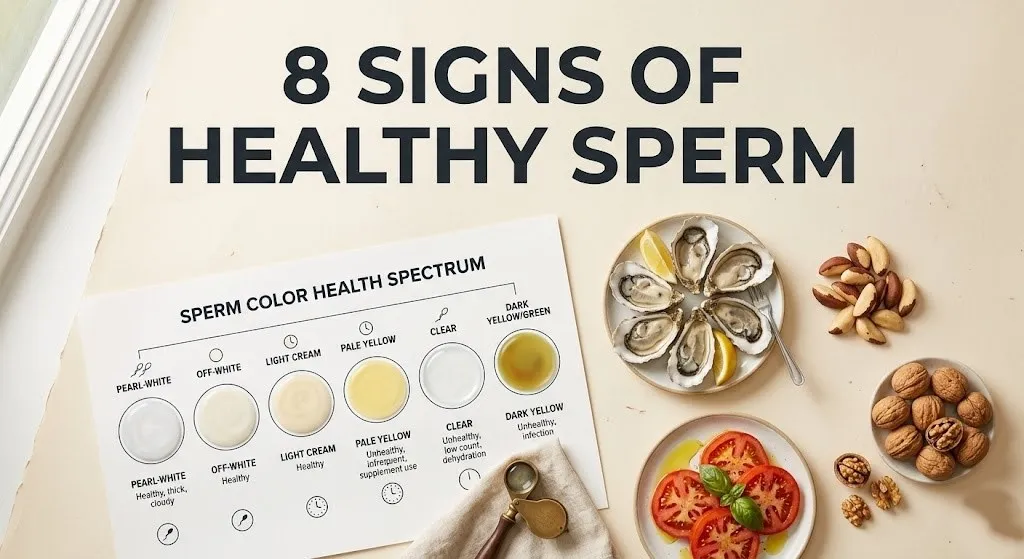
Healthy sperm is defined by eight specific characteristics: a whitish-grey or pearl-white color, a volume of 1.5 to 5 milliliters, a sperm count of at least 15 million per milliliter, a motility rate of 40 percent or higher, a normal morphology of 4 percent or higher, a pH between 7.2 and 7.8, a complete liquefaction within 20 to 30 minutes, and a smooth, slightly viscous consistency. These criteria are established by the World Health Organization (WHO) in its 2021 laboratory manual for the examination and processing of human semen, which remains the global standard in 2026.
The observable characteristics of semen are a window into male reproductive health. The color, volume, and texture of the ejaculate reflect the function of the testes, the seminal vesicles, and the prostate gland. A healthy ejaculate is a coordinated production from all three systems. Any deviation in color, consistency, or volume can signal an infection, a blockage, or a nutritional deficiency.
This guide walks you through each of the eight signs in detail, explains the visual difference between healthy and unhealthy semen, and provides the specific foods and nutrients that directly support sperm production. This is educational information for understanding your body. A formal semen analysis ordered by a healthcare provider is the only way to definitively assess fertility.
8 signs of healthy sperm
The eight signs of healthy sperm are whitish-grey color, 1.5 to 5 milliliters volume, smooth viscosity, full liquefaction within 30 minutes, pH of 7.2 to 7.8, count above 15 million per milliliter, motility above 40 percent, and morphology above 4 percent. These parameters are the global standard for a normal semen analysis.
Sign one is color. Healthy semen is whitish-grey, pearl-white, or slightly opalescent. The color comes from the sperm cells themselves and the fluid produced by the seminal vesicles and prostate. A slight yellowish tint can be normal, particularly if the man is dehydrated or has not ejaculated for several days.
Sign two is volume. A healthy ejaculate volume is between 1.5 and 5 milliliters, roughly a teaspoon to a tablespoon. Volumes consistently below 1.5 milliliters are considered low and may indicate a retrograde ejaculation, a blockage of the ejaculatory duct, or a dysfunction of the seminal vesicles. High volumes, above 6 milliliters, are rare but can dilute the sperm concentration.
- Color: Whitish-grey to pearl-white.
- Volume: 1.5 to 5 milliliters.
- Consistency: Smooth, slightly viscous.
- Liquefaction: Complete within 20 to 30 minutes.
- pH: 7.2 to 7.8.
what does a healthy sperm look like
Healthy sperm looks like a whitish-grey, slightly cloudy fluid with a smooth, uniform consistency that pours like a thin syrup and liquefies completely within 20 to 30 minutes after ejaculation. The fluid should not be lumpy, watery, or persistently jelly-like.
The visual assessment of semen is a crude but useful home screening tool. Immediately after ejaculation, healthy semen is a thick, gelatinous coagulum. This is normal. The clotting enzymes from the seminal vesicles cause this initial gel state. Over the next 20 to 30 minutes, enzymes from the prostate gland, primarily prostate-specific antigen (PSA), break down this clot. The semen becomes a thin, easily pourable liquid. This is liquefaction.
A sample that remains thick and jelly-like after 30 minutes has failed to liquefy. This is not something you can see with the naked eye about individual sperm cells. It is a characteristic of the fluid. Poor liquefaction can trap sperm and prevent them from swimming freely.
- Immediate: Thick, gelatinous coagulum.
- 20 to 30 minutes: Thin, pourable liquid.
- Failure to liquefy: Remains thick and jelly-like.
Key Takeaway: Healthy semen goes through a predictable physical change from gel to liquid within 30 minutes. A sample that stays thick has a liquefaction problem.
healthy sperm vs unhealthy sperm
Healthy sperm is whitish-grey, moderate in volume, and smooth in texture. Unhealthy sperm may be clear or transparent, yellow or green, brown or red, watery or excessively thick, and may have a foul odor. The comparison between healthy and unhealthy is often visible to the naked eye.
Clear or transparent semen that looks almost like water is a sign of low sperm concentration. The fluid is present, but the sperm cells are not. This is the seminal vesicle fluid without the normal milky contribution from the sperm and prostate. Watery semen that persists for months warrants a semen analysis.
Yellow or green semen is a sign of infection. The yellow color comes from white blood cells, the immune system’s response to bacteria in the seminal vesicles, prostate, or urethra. A sexually transmitted infection like chlamydia or gonorrhea is the most common cause. Brown or red semen indicates the presence of blood. This is called hematospermia and is usually caused by a ruptured blood vessel in the prostate or seminal vesicles.
| Characteristic | Healthy | Unhealthy |
|---|---|---|
| Color | Whitish-grey | Clear, yellow, green, brown |
| Consistency | Smooth, liquefies | Watery, thick, lumpy |
| Volume | 1.5 to 5 mL | Consistently low or absent |
| Odor | Mild, chlorine-like | Foul, fishy, or absent |
healthy sperm color pictures
Healthy sperm color is whitish-grey, pearl-white, or a pale, translucent ivory. A visual color chart can help men compare what they see against the normal range. The color is produced by the combination of sperm cells, seminal vesicle fluid, and prostatic fluid.
The color spectrum of healthy semen is surprisingly narrow. It is not pure white like paint. It is not clear like water. It is somewhere between the color of a pearl, the color of diluted skim milk, or the color of a pale grey overcast sky. A very faint yellow tint is within the normal range, particularly if the man is slightly dehydrated.
A visual chart is a reference tool, not a diagnostic test. The color of semen can vary from day to day based on hydration, frequency of ejaculation, and diet. A single off-color sample is not a cause for alarm. A persistent color change, particularly to yellow, green, brown, or clear, warrants a medical evaluation.
- Pearl-white: Ideal.
- Ivory: Normal.
- Pale grey: Normal.
- Faint yellow: Usually normal, check hydration.
healthy sperm colour chart
A healthy sperm color chart ranges from pearl-white at the ideal end, through ivory and pale grey in the normal range, to clear, yellow, green, and brown in the concerning range. The chart is a simple visual guide for home comparison.
The pearl-white to ivory range represents a healthy concentration of sperm cells mixed with the normal secretions of the accessory glands. The sperm cells themselves are microscopic and colorless. The white color comes from the sheer density of millions of cells suspended in the fluid. A man with a high sperm count will produce a whiter, more opaque sample.
The clear end of the spectrum is the most common concern. A sample that is completely transparent, like water, indicates a very low concentration of sperm. The seminal fluid is being produced, but the testes are not contributing a significant number of cells. This can result from a blockage, a hormonal deficiency, or testicular damage.
- Pearl-white: Optimal sperm concentration.
- Ivory/Pale grey: Normal, healthy.
- Clear/Transparent: Low sperm count, watery.
- Yellow/Green: Possible infection.
- Brown/Red: Blood present (hematospermia).
Key Takeaway: The whiter the semen, the higher the sperm concentration, generally speaking. Clear, watery semen suggests a low count.
healthy yellow sperm color chart
A healthy yellow sperm color chart distinguishes between a normal, pale yellow tint caused by dehydration or aging and a concerning, bright yellow or greenish-yellow color caused by infection or urine contamination. Not all yellow semen is unhealthy.
A faint, pale yellow tint is usually normal. Semen naturally develops a slightly more yellow hue with age. It also becomes more yellow if a man is dehydrated, as the concentration of all the fluids increases. A man who has not ejaculated for a week may produce a sample with a yellowish cast simply because the older sperm cells have begun to break down.
A bright, canary yellow or a greenish-yellow color is a sign of infection. The color comes from a high concentration of white blood cells, which are yellow-green in large numbers. The most common causes are bacterial prostatitis, a urinary tract infection, or a sexually transmitted infection. This type of yellow is often accompanied by pain during ejaculation or urination.
| Yellow Shade | Likely Cause | Action |
|---|---|---|
| Faint, pale yellow | Dehydration, aging, infrequent ejaculation | Drink more water, monitor |
| Bright, canary yellow | Infection, white blood cells | Medical evaluation |
| Greenish-yellow | Bacterial infection, STI | Urgent medical evaluation |
foods to improve sperm health
The best foods to improve sperm health are oysters, Brazil nuts, cooked tomatoes, walnuts, and fatty fish because they deliver the specific micronutrients, zinc, selenium, lycopene, and omega-3 fatty acids, that directly support sperm production, motility, and morphology. Diet is the most powerful tool for improving semen parameters.
Zinc is the most critical nutrient for sperm. It is concentrated in the prostate and the testes, where it is used to build the outer membrane and tail of each sperm cell. The recommended daily intake for adult men is 11 milligrams. A single oyster contains roughly 5 milligrams of zinc, so a serving of three oysters exceeds the daily requirement. Zinc deficiency causes low testosterone, low sperm count, and poor motility.
Selenium is required for the formation of the sperm’s mitochondrial sheath, the structure that powers the tail. Brazil nuts are the richest food source of selenium. A single Brazil nut provides roughly 68 to 91 micrograms, more than the entire 55-microgram daily requirement. Two nuts per day is the recommended dose. Exceeding four nuts daily can push selenium intake into the toxic range.
- Zinc: Oysters, beef, pumpkin seeds. Supports count and motility.
- Selenium: Brazil nuts, tuna, sardines. Supports morphology.
- Lycopene: Cooked tomatoes, watermelon. Reduces oxidative stress.
- Omega-3s: Walnuts, salmon, flaxseed. Improves membrane fluidity.
male fertility test at home
A male fertility test at home is a commercially available sperm test kit that measures sperm count and, in some 2026 models, motility, providing a reasonable screening tool but not a replacement for a full laboratory semen analysis. The technology has improved significantly in the past five years.
The current generation of at-home sperm tests, like the YO Home Sperm Test and the Trak Male Fertility Testing System, use smartphone-based microscopy to capture video of the sperm sample. The app analyzes the video and provides a count and a motility estimate. These tests are roughly 85 to 90 percent accurate compared to a laboratory semen analysis when performed correctly.
The limitations of at-home tests are important. They do not measure morphology, the shape of the sperm, which requires a trained andrologist with a high-powered microscope. They do not measure pH or liquefaction time. A man with a normal count but zero normal morphology will pass an at-home test with a reassuring result, when in fact he may have a severe fertility problem. A laboratory semen analysis remains the gold standard.
- Measures: Count and sometimes motility.
- Does not measure: Morphology, pH, liquefaction.
- Accuracy: 85 to 90 percent for count.
- Best use: Screening tool, not a final diagnosis.
Key Takeaway: An at-home sperm test can tell you if your count is normal. It cannot tell you if your sperm are shaped correctly. If you have been trying to conceive for 12 months, get a lab analysis.
Frequently Asked Questions About Sperm Health
What color is healthy sperm?
Healthy sperm is whitish-grey or pearl-white.
A faint yellow tint can be normal from dehydration or infrequent ejaculation.
Clear, bright yellow, green, or brown semen requires medical evaluation.
Can thick sperm be healthy?
Sperm that is thick immediately after ejaculation is healthy and normal.
It should liquefy into a thinner liquid within 20 to 30 minutes.
Sperm that remains thick and jelly-like after 30 minutes has a liquefaction problem.
How do I know if my sperm is unhealthy?
Unhealthy sperm may be clear, watery, yellow, green, or have a foul odor.
A semen analysis is the only definitive way to diagnose a sperm problem.
Any persistent change in color or consistency warrants a medical evaluation.
What are the 4 types of healthy sperm?
There are not four types of sperm.
Sperm are categorized by their movement: progressively motile, non-progressively motile, and immotile.
Healthy semen has at least 40 percent progressively motile sperm.
Can drinking water improve sperm?
Drinking water can improve sperm volume and color by increasing hydration.
Dehydration concentrates the semen and can cause a yellowish tint.
Adequate hydration supports healthy seminal fluid production but does not directly increase sperm count.
The eight signs of healthy sperm are observable, measurable, and actionable. Color, volume, consistency, and liquefaction time can be assessed at home. Count, motility, morphology, and pH require a laboratory. The home observation and the lab analysis work together to give a complete picture.
If your semen is consistently clear, yellow, or painful to produce, see a urologist. If you have been trying to conceive for a year without success, get a semen analysis. If you want to improve your parameters starting today, eat the oysters, the Brazil nuts, and the cooked tomatoes. Walk daily. Stop smoking. Keep the laptop off your lap.
Sperm are produced on a 74-day cycle. The changes you make today will not show up in the ejaculate for two and a half months. Start now. The clock is always running.