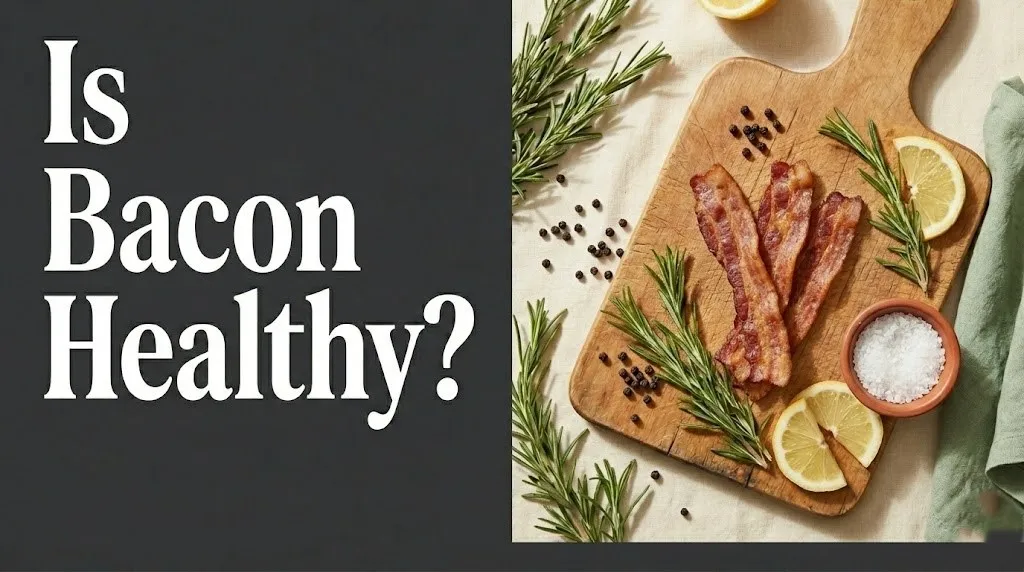
Bacon is not healthy in the way that vegetables or legumes are healthy, but it is also not the dietary catastrophe that some headlines suggest, and whether it belongs in your eating pattern depends on how much you eat, how often, and what the rest of your diet looks like. The full picture is more nuanced than either “bacon is terrible for you” or “bacon is fine.”
Processed meat, including bacon, was classified as a Group 1 carcinogen by the World Health Organization’s International Agency for Research on Cancer (IARC) in 2015, a classification that gets cited frequently but is rarely explained in terms of what it actually means for a person eating two strips on a Saturday morning. The absolute risk context matters enormously here, and most articles skip it entirely.
This article covers bacon’s complete nutritional profile per slice and per realistic serving, what the cancer and heart disease research actually shows, whether turkey bacon or uncured bacon are genuinely better choices, how cooking method affects both nutrition and safety, and how much bacon most adults can eat without meaningful risk.
Is Bacon Healthy to Eat
Bacon is not a health food, but it can be eaten in moderation by most healthy adults without meaningful harm when portion size, frequency, and overall dietary context are managed.
The two genuine nutritional concerns with bacon are its high sodium content and its classification as a processed meat with an associated, though modest in absolute terms, increased risk of colorectal cancer with frequent high consumption. Neither concern disqualifies bacon from an otherwise balanced diet. Both become more important when bacon is eaten daily in large amounts.
What bacon has in its favor: it’s a real food with a small but real nutrient profile, including B vitamins, selenium, and complete protein. It contains no carbohydrates. It’s calorie-dense relative to its weight, which means a small amount delivers meaningful satiety.
The USDA Dietary Guidelines for Americans 2020-2025 do not recommend zero processed meat consumption. They recommend limiting it within the broader context of a protein pattern that includes variety: seafood, poultry, eggs, legumes, and nuts alongside meat.
Quick Tip:
- A realistic serving of bacon is 2 to 3 cooked slices, not 6 to 8
- Frequency matters more than any single serving: occasional bacon is categorically different from daily bacon in risk terms
- The cut of pork used for bacon (belly vs. back) and the preparation method both affect the final nutritional content
Bacon Nutrition Facts: Calories, Fat, Protein, and Sodium Per Serving
One cooked slice of pork bacon (approximately 8g cooked weight) contains roughly 43 calories, 3g of protein, 3.3g of total fat, and 137 mg of sodium, according to USDA FoodData Central.
Three slices, which is closer to what most people actually eat, delivers approximately 129 calories, 9g protein, 10g fat, and 411 mg sodium. That sodium figure is worth pausing on. The American Heart Association (AHA) recommends no more than 2,300 mg of sodium per day for most adults, and less than 1,500 mg per day for people with hypertension. Three slices of bacon accounts for roughly 18% to 27% of those respective daily targets before any other food is eaten.
| Serving Size | Calories | Protein | Total Fat | Saturated Fat | Sodium |
|---|---|---|---|---|---|
| 1 cooked slice (8g) | 43 | 3g | 3.3g | 1.1g | 137 mg |
| 2 cooked slices (16g) | 86 | 6g | 6.6g | 2.2g | 274 mg |
| 3 cooked slices (24g) | 129 | 9g | 9.9g | 3.3g | 411 mg |
Source: USDA FoodData Central
Bacon shrinks substantially during cooking because fat and water render out. A raw slice that weighs approximately 28g (1 oz) before cooking becomes approximately 8 to 11g cooked, depending on thickness and cooking time. Nutrition labels on bacon packaging reflect the raw weight unless they specifically state “cooked,” which is a source of confusion when estimating actual intake.
People managing calorie intake should note that pan-fried bacon retains more fat than oven-baked bacon, because rendered fat re-coats the surface when cooked in its own drippings in a pan.
What Nutrients Does Bacon Actually Contain
Bacon contains meaningful amounts of niacin (vitamin B3), cobalamin (vitamin B12), selenium, phosphorus, zinc, and choline, though the amounts per slice are modest and bacon should not be thought of as a primary micronutrient source.
Per 1 cooked slice of pork bacon, approximate micronutrient content based on USDA FoodData Central data:
- Niacin (B3): approximately 2.3 mg (about 14% of the Daily Value)
- Selenium: approximately 5.5 mcg (about 10% of the Daily Value)
- Cobalamin (B12): approximately 0.19 mcg (about 8% of the Daily Value)
- Phosphorus: approximately 34 mg (about 3% of the Daily Value)
- Zinc: approximately 0.4 mg (about 4% of the Daily Value)
- Choline: present in meaningful amounts; pork is a known dietary choline source
Niacin (B3) supports energy metabolism by functioning as a precursor for the coenzymes NAD (nicotinamide adenine dinucleotide) and NADP, which are involved in hundreds of metabolic reactions across cells. Choline, while not a vitamin in the strict technical sense, is an essential nutrient involved in cell membrane structure, neurotransmitter synthesis, and liver fat metabolism.
The saturated fat in bacon is primarily in the form of palmitic acid and stearic acid, with a meaningful proportion of monounsaturated fat (oleic acid) as well, the same fatty acid predominant in olive oil. Roughly 50% of bacon’s fat is monounsaturated. This doesn’t make bacon a heart-healthy food, but it does make its fat profile more nuanced than the “it’s all bad saturated fat” framing suggests.
People following a strict plant-based diet will find that bacon is incompatible with their dietary framework. B12 and selenium needs for vegans require alternative sources: fortified foods and supplements for B12, Brazil nuts and legumes grown in selenium-rich soils for selenium.
Key Takeaway: Bacon’s nutritional value is real but modest per slice, its most clinically relevant numbers are sodium and saturated fat rather than total calories, and its fat profile is more mixed than most people assume since roughly half is monounsaturated oleic acid.
Is Bacon a Processed Meat and What Does That Mean
Bacon is a processed meat, defined as any meat that has been preserved through salting, curing, smoking, fermentation, or other methods that alter the original product beyond simple butchering.
The USDA and WHO both classify bacon as a processed meat. This is an objective food category description, not a health judgment in isolation. The distinction between processed meat and unprocessed red meat is important because the health research and risk associations are different for the two categories.
Conventional bacon is made by curing pork belly with a combination of sodium chloride (salt), sodium nitrite (NaNO2) and/or sodium nitrate (NaNO3), and often sugar, along with smoking or smoke flavoring. The curing process serves two functions: it preserves the meat against bacterial growth, particularly Clostridium botulinum, and it produces the characteristic pink color and flavor of cured pork.
The WHO’s IARC placed processed meat in Group 1 (carcinogenic to humans) in 2015 based on sufficient evidence of an association with colorectal cancer risk in population studies. It’s worth being clear on what Group 1 means: it confirms that the association exists and is well-documented. It does not mean that eating bacon once a week causes cancer, nor does it mean the risk is equivalent to, say, tobacco smoking, which is also Group 1.
People following kosher or halal dietary frameworks avoid pork entirely, which includes all forms of bacon. Turkey bacon (made from turkey rather than pork) may be permissible depending on how it is prepared and certified, but individuals following these dietary frameworks should verify product certification directly.
Does Bacon Cause Cancer
Eating processed meat like bacon regularly is associated with a modestly increased risk of colorectal cancer, based on research reviewed by the WHO’s IARC, but the absolute risk increase for moderate consumers is small.
The number that matters most and that most articles omit: the IARC analysis found that consuming 50g of processed meat daily (approximately 4 to 6 strips of cooked bacon) is associated with an approximately 18% increased relative risk of colorectal cancer. That sounds alarming until you translate it to absolute risk.
The baseline lifetime risk of colorectal cancer for the average person is approximately 5%. An 18% relative increase on a 5% baseline raises the absolute lifetime risk to approximately 5.9%. That’s a real increase, but it’s not the same as saying 18% of bacon eaters get colorectal cancer.
What this means practically:
- Occasional bacon (a few strips on weekends, not daily) at a lower quantity than 50g does not carry the same association as daily high-volume consumption
- The IARC analysis pooled research from populations with very high processed meat intake; results from moderate intake patterns are less definitive
- The association is strongest for colorectal cancer specifically, not for cancer in general
The NIH National Cancer Institute notes that nitrosamines, compounds formed when nitrites in cured meat react with amines (compounds naturally present in protein foods) at high cooking temperatures, are one proposed mechanism behind this association. Cooking method therefore has a genuine bearing on this risk, not just on flavor.
People with a personal or family history of colorectal cancer or colorectal polyps should discuss processed meat consumption specifically with their gastroenterologist or registered oncology dietitian, because individual risk context changes the relevant frequency guidance.
Is Bacon Bad for Your Heart and Cholesterol
Bacon’s saturated fat and sodium content are both relevant to cardiovascular health, though the relationship is more nuanced than “bacon raises cholesterol and damages the heart.”
The American Heart Association (AHA) recommends limiting saturated fat to no more than 5% to 6% of total daily calories, which on a 2,000-calorie diet equals approximately 11 to 13g of saturated fat per day. Three cooked strips of bacon contain approximately 3.3g of saturated fat, about 25% to 30% of that daily budget. That leaves room for other foods to contribute saturated fat, but not much.
Think of your daily saturated fat budget like a prepaid spending card. Three slices of bacon use up about a quarter of the card before breakfast is over. That’s manageable if the rest of your day runs on lean proteins, vegetables, and unsaturated fats. It becomes a problem if your lunch includes cheese, butter, and fatty cuts of meat on top.
Dietary cholesterol from bacon (approximately 26 mg per slice) is less of a primary concern than it was under older dietary guidance. The USDA Dietary Guidelines for Americans 2020-2025 removed the specific numerical limit on dietary cholesterol, reflecting updated evidence that saturated fat has a more predictable and consistent effect on LDL cholesterol levels than dietary cholesterol alone.
Sodium is the more direct cardiovascular concern for many people. High sodium intake is associated with elevated blood pressure, a well-established risk factor for heart disease and stroke. Three slices of bacon contributes approximately 411 mg of sodium, a meaningful amount when considered alongside all other sodium sources in a day.
Key Takeaway: Bacon’s sodium content is a more immediate cardiovascular concern for most people than its cholesterol content, and three slices use roughly a quarter of your daily saturated fat budget, which is workable in an otherwise lean day but compounds quickly if the rest of your meals are also high in saturated fat.
Is Bacon Bad for You if You Have Diabetes or High Blood Pressure
Bacon requires more careful management for people with type 2 diabetes or hypertension, primarily because of its sodium content and its classification as a processed meat.
For people with hypertension, the AHA recommends a sodium target of less than 1,500 mg per day for those with elevated blood pressure. Three slices of bacon account for approximately 27% of that target. Eating bacon daily while also consuming other sodium-heavy foods (bread, cheese, condiments, restaurant meals) makes staying within that limit genuinely difficult.
| Population Group | Primary Concern | Practical Guidance |
|---|---|---|
| Hypertension | Sodium content | Limit to 1 to 2 slices; prioritize lower-sodium days around bacon |
| Type 2 diabetes | Processed meat association; fat content | Occasional consumption; pair with high-fiber, low-glycemic foods |
| Cardiovascular disease history | Saturated fat and sodium | Discuss red and processed meat frequency with cardiologist or RD |
| Colorectal cancer history | Processed meat classification | Discuss with gastroenterologist or oncology dietitian |
| Pregnant women | Listeria risk from inadequately cooked cured meat | Cook bacon until uniformly crisp; avoid partially cooked preparations |
| Children | Sodium and processed meat caution for long-term pattern | Limit frequency; not a daily staple in children’s diets |
For people with type 2 diabetes, bacon itself doesn’t spike blood glucose because it contains almost no carbohydrates. The concern is more about the long-term dietary pattern: people who eat processed meat frequently tend to have dietary patterns associated with higher cardiovascular and all-cause mortality risk in population studies, as noted by Harvard T.H. Chan School of Public Health research on dietary patterns and chronic disease.
Pregnant women should always cook bacon thoroughly until it is uniformly crisp with no pink remaining. Listeria monocytogenes can survive in some cured and processed pork products at refrigerator temperatures. Thorough cooking eliminates this risk. The USDA recommends that pregnant women avoid eating cold deli meats, including cold bacon, for exactly this reason.
Is Turkey Bacon Healthier Than Pork Bacon
Turkey bacon is lower in total fat and saturated fat than pork bacon, but it is often comparable in sodium, and the difference in calories per serving is smaller than most people expect.
| Nutrition (3 cooked slices / approximately 42g) | Pork Bacon | Turkey Bacon |
|---|---|---|
| Calories | 129 | 105 |
| Protein | 9g | 9g |
| Total Fat | 9.9g | 7.5g |
| Saturated Fat | 3.3g | 2.1g |
| Sodium | 411 mg | 495 mg |
| Carbohydrates | 0.3g | 1.5g |
Source: USDA FoodData Central approximate values
Turkey bacon is genuinely leaner. Saturated fat is meaningfully lower, and total fat is reduced. But sodium is actually higher in most commercially available turkey bacon brands because manufacturers add more salt and flavorings to compensate for the lower fat content and different flavor profile of turkey.
Turkey bacon is still classified as a processed meat. It goes through the same curing process as pork bacon, typically including sodium nitrite and smoke flavoring. The cancer and processed meat classification concerns apply to turkey bacon in the same category as pork bacon, since the classification is based on the processing method, not the species of animal.
For people who avoid pork for religious or personal reasons, turkey bacon is a practical alternative. People following halal dietary frameworks should verify that their specific turkey bacon brand is halal-certified, as processing practices and ingredient sourcing vary by manufacturer.
Is Uncured Bacon Actually Healthier
Uncured bacon is not meaningfully healthier than conventionally cured bacon, despite the marketing language, because most uncured bacon uses celery powder or celery juice as a natural nitrate source that produces the same nitrite compounds during curing.
This is one of the most misleading claims in the packaged food aisle. “Uncured” and “no added nitrates or nitrites (except those naturally occurring in celery powder/juice)” is a labeling standard, not a safety guarantee.
Celery is naturally high in nitrates. When celery powder or celery juice is used in bacon curing, naturally occurring bacteria (or acidifying conditions) convert those nitrates to nitrites, which then perform the same preserving and coloring function as directly added sodium nitrite (NaNO2). The end product contains comparable nitrite levels to conventionally cured bacon.
The USDA requires that products using naturally derived nitrates still bear the statement “no added nitrates or nitrites (except those naturally occurring in celery powder)” on the label, but this has not prevented consumer confusion. Research published in food science journals has measured nitrite concentrations in “uncured” products and found them comparable to conventional products.
Where uncured bacon might genuinely differ:
- Some uncured products use less total sodium overall
- Some use higher-quality pork from better sourced animals
- Some skip added sugar and other curing additives
Check the actual nutrition label for sodium and the ingredient list for additives rather than relying on “uncured” as a blanket health signal.
Key Takeaway: “Uncured” bacon is primarily a marketing distinction rather than a genuine safety or health improvement, since celery-derived nitrates produce the same nitrite compounds as directly added sodium nitrite, and the cancer classification covers all processed meats regardless of how the nitrites were sourced.
Is Plant-Based Bacon a Healthier Option
Plant-based bacon alternatives are lower in saturated fat than pork bacon and contain no animal-derived nitrites, but they are still processed foods with high sodium content and often contain additives not found in pork bacon.
Plant-based bacon products are typically made from tempeh (fermented soybeans), rice paper, coconut, seitan (wheat gluten), or soy protein isolate with smoke flavoring, salt, and colorings to mimic bacon’s appearance and taste.
| Nutrition (3 slices / approximately 42g) | Pork Bacon | Turkey Bacon | Plant-Based Bacon |
|---|---|---|---|
| Calories | 129 | 105 | 80 to 120 (varies by brand) |
| Protein | 9g | 9g | 4 to 8g (varies) |
| Total Fat | 9.9g | 7.5g | 3 to 7g (varies) |
| Saturated Fat | 3.3g | 2.1g | 0.5 to 1g (varies) |
| Sodium | 411 mg | 495 mg | 350 to 600 mg (varies) |
| Carbohydrates | 0.3g | 1.5g | 3 to 8g (varies) |
Note: Plant-based bacon values vary substantially by brand and base ingredient. Always verify the specific product’s nutrition label.
The saturated fat advantage of plant-based bacon is real. Replacing pork bacon with a soy-based or tempeh-based alternative eliminates most of the saturated fat and removes the processed meat cancer classification concern.
The trade-offs are worth naming honestly. Plant-based bacon is ultra-processed by the NOVA classification system, meaning it undergoes extensive industrial processing with multiple additives. People with celiac disease or non-celiac gluten sensitivity must check whether their plant-based bacon is seitan-based (which contains wheat gluten). Soy-based products are not appropriate for people with a soy allergy. Sodium content can be as high or higher than pork bacon depending on the brand.
How Does Cooking Method Affect Bacon’s Nutrition and Safety
Cooking method affects both bacon’s final fat content and the rate at which potentially harmful nitrosamines form during high-heat cooking.
On the fat side: pan-frying bacon in its own drippings at high heat means the strips are sitting in rendered fat throughout cooking. Baking bacon on a rack in the oven at 375°F to 400°F (190°C to 204°C) allows fat to drip away from the strips as it renders, producing a cooked strip with measurably less total fat than pan-fried bacon of the same starting weight.
To cook bacon the lower-fat way in the oven:
- Preheat oven to 375°F (190°C).
- Line a rimmed baking sheet with aluminum foil for easy cleanup.
- Place a wire rack over the baking sheet. Lay bacon strips flat on the rack without overlapping.
- Bake for 15 to 20 minutes depending on thickness, checking at 15 minutes for thin-cut strips.
- Remove when uniformly browned and crisp, with no pink visible.
- Transfer to a paper-towel-lined plate to absorb additional surface fat before serving.
On the safety side: high-heat cooking accelerates the formation of nitrosamines, specifically N-nitrosamines, when nitrites in cured bacon react with secondary amines at very high temperatures. Charring bacon in a screaming-hot pan produces more nitrosamine formation than gentle oven-baking.
The NIH National Cancer Institute notes that cooking at lower temperatures and avoiding charring are practical steps to reduce nitrosamine exposure from processed meats without eliminating them from the diet.
Microwaving bacon between paper towels is also a lower-nitrosamine cooking method, as the cooking temperature remains below the threshold at which nitrosamine formation accelerates significantly.
Is Bacon Good for a Keto or Low-Carb Diet
Bacon fits a ketogenic or low-carbohydrate diet from a macronutrient standpoint, containing approximately 0.1g of carbohydrates per cooked slice and a fat-forward profile that aligns with keto macro targets.
The ketogenic diet typically targets less than 20 to 50g of net carbohydrates per day, with fat comprising 60% to 75% of total calories and protein at 15% to 30%. Bacon’s macro profile (approximately 70% fat, 28% protein, 2% carbohydrates by calorie distribution) maps directly onto keto targets.
From a purely macronutrient perspective, bacon is keto-compatible. The more relevant question for someone following keto for long-term health, rather than short-term weight loss, is whether daily bacon consumption compounds cardiovascular and cancer risk over time, given that the keto diet already tends to be high in saturated fat from multiple sources simultaneously.
Harvard T.H. Chan School of Public Health dietary research suggests that the quality of fat and protein sources within a low-carbohydrate diet has a greater effect on long-term health outcomes than the carbohydrate restriction alone. People following keto who also eat large amounts of daily processed meat are stacking two individually moderate risk patterns together.
Quick Tip:
- On a keto diet, use bacon as a flavor component rather than a primary protein source to manage processed meat exposure
- Canadian bacon (back bacon) or unprocessed pork options provide keto-compatible fat and protein with lower sodium and no processed meat classification
- People with pre-existing cardiovascular conditions using keto for medical weight management should discuss processed meat frequency with the clinician supervising their diet
Key Takeaway: Bacon fits keto macros perfectly, but eating it daily as a primary protein source while also consuming other high-saturated-fat keto staples (cheese, heavy cream, fatty cuts of meat) stacks multiple saturated fat sources in a way that may compound cardiovascular risk over the long term.
Is Bacon Good for Weight Loss
Bacon is not a weight-loss food, but it is not incompatible with a calorie-managed eating plan when eaten in realistic portions as an occasional protein and fat source.
At 43 calories per cooked slice, two strips of bacon add 86 calories to a meal. That’s less than a tablespoon of olive oil and comparable to a small handful of almonds. The calorie content of bacon is not the problem for most people. The problem is portion creep: restaurant servings routinely include 4 to 6 strips, and home cooking portions often trend similarly.
The protein and fat in bacon both contribute to satiety. A small amount of bacon alongside a high-fiber, high-protein breakfast (eggs and vegetables, for instance) can support appetite regulation for several hours. The satiety argument for including a small amount of fat in a meal is legitimate.
Where bacon actively works against weight loss is when it becomes a daily high-portion habit that also raises sodium, saturated fat, and processed meat exposure simultaneously. The dietary pattern around bacon matters as much as the bacon itself.
People counting calories should weigh bacon after cooking, not before, since raw weight values overestimate the cooked calorie contribution. Two raw slices that weigh 56g (2 oz) before cooking become approximately 16 to 22g cooked after fat and water render out, delivering approximately 86 calories total.
How Much Bacon Is Safe to Eat Per Week
Most healthy adults can eat bacon 2 to 3 times per week in 2 to 3 slice portions without meaningful elevation in health risk, provided the rest of their diet is varied and not also heavily dependent on other processed meats.
The WHO/IARC risk association for colorectal cancer was based on research at 50g of processed meat per day (daily consumption). That’s roughly 4 to 6 strips every single day. Occasional weekend bacon at a serving of 2 to 3 strips sits well below the intake levels where population-level risk associations become clear.
The USDA Dietary Guidelines for Americans 2020-2025 don’t specify a maximum number of bacon servings per week. They recommend limiting processed meats within a pattern that prioritizes a variety of protein sources. Eating bacon twice a week while also regularly eating processed deli meats, hot dogs, and sausages compounds processed meat exposure across the week in a way that eating bacon alone does not.
For specific populations, here are more tailored frequency guidelines:
- Healthy adults with no cardiovascular or cancer risk factors: Up to 2 to 3 times per week, 2 to 3 slices per serving, is a reasonable range based on available evidence.
- People with hypertension: Once a week or less, given sodium accumulation concerns. A cardiologist or registered dietitian can help set an individualized limit based on your full dietary sodium pattern.
- People with a history of colorectal cancer or polyps: Frequency should be discussed directly with a gastroenterologist or oncology dietitian, because individual risk context is different from population-level averages.
- Children: Bacon should not be a daily staple. The combination of high sodium and processed meat classification makes it a food to include occasionally rather than routinely in children’s diets.
How to Eat Bacon as Part of a Healthy Diet
Eating bacon as part of a healthy diet means treating it as a flavoring agent and occasional protein contributor rather than a dietary staple, and pairing it with foods that offset its nutritional limitations.
The most effective strategy is portion discipline. Two strips of bacon used to flavor a dish, an egg white frittata, a grain bowl, a vegetable-forward soup, contribute approximately 86 calories, 6g protein, and 274 mg sodium, all manageable within a day’s nutritional budget. Six strips eaten as the primary component of a meal change that calculation substantially.
Pairing bacon with high-fiber foods is a practical way to balance a bacon-containing meal nutritionally. Fiber slows digestion and contributes to satiety. A meal of two strips of bacon, two eggs, and sauteed spinach or sliced tomatoes is a meaningfully more complete nutritional package than bacon strips alone. High-fiber vegetables don’t neutralize bacon’s sodium or saturated fat, but they contribute micronutrients and fiber that support overall dietary quality.
Choosing lower-sodium bacon brands at retail is a real option. Sodium content varies by brand from approximately 120 mg to over 200 mg per slice. Reading the nutrition label before buying and choosing the lower-sodium option across comparable brands is one of the simplest practical steps.
For anyone managing a low-sodium dietary pattern, Canadian bacon (back bacon) made from cured pork loin is worth considering as a direct swap. It provides approximately 6g of protein per 1 oz (28g) serving at approximately 390 mg sodium per serving, but with dramatically less fat (1.6g total fat per serving) than streaky belly bacon.
People who are pregnant, immunocompromised, or managing kidney disease requiring protein restriction should discuss specific serving frequency with their managing healthcare provider, because individual medical context changes the practical frequency guidance that applies.
Frequently Asked Questions About Bacon and Health
Is bacon bad for you if you eat it every day?
Eating bacon every day is associated with meaningfully higher exposure to processed meat, which the WHO/IARC has linked to increased colorectal cancer risk with daily high-volume consumption.
Daily consumption at 50g or more per day (approximately 4 to 6 strips) was the intake level associated with approximately an 18% relative risk increase for colorectal cancer in the IARC analysis.
Occasional bacon a few times a week at 2 to 3 strips sits well below the consumption patterns where population-level risk becomes most apparent.
Is turkey bacon actually healthier than regular bacon?
Turkey bacon is lower in total fat and saturated fat than pork bacon, but it is typically higher in sodium and is still classified as a processed meat.
The cancer risk association from the WHO/IARC applies to processed meats broadly, based on the curing and processing method rather than the species of animal used.
Turkey bacon is a useful choice for people avoiding pork for dietary or religious reasons, but it is not a meaningful health upgrade in terms of cancer or cardiovascular risk classification.
How many calories are in 3 slices of bacon?
Three cooked slices of pork bacon contain approximately 129 calories, based on USDA FoodData Central values for standard thin-cut cooked bacon.
Thick-cut bacon delivers more calories per slice, approximately 55 to 70 calories, depending on fat content and thickness.
Restaurant servings frequently include 4 to 6 strips, which can reach 170 to 300 calories before any accompaniments are counted.
Is uncured bacon better for you than regular bacon?
Uncured bacon is not meaningfully better for you than conventionally cured bacon, because most uncured products use celery powder or celery juice as a natural nitrate source that converts to the same nitrites as directly added sodium nitrite during curing.
The “no added nitrates or nitrites” claim on uncured bacon labels is technically accurate but practically misleading for most health-conscious consumers.
Some uncured bacon products do have lower sodium overall, so checking the actual nutrition label for sodium content is a more reliable evaluation method than relying on the “uncured” designation alone.
Can you eat bacon on a heart-healthy diet?
Bacon can be included occasionally in an otherwise heart-healthy dietary pattern, but it should be a limited and infrequent component rather than a regular feature.
The American Heart Association recommends limiting saturated fat to 5% to 6% of daily calories and sodium to less than 2,300 mg per day (less than 1,500 mg for people with high blood pressure), and bacon contributes meaningfully to both.
For people with diagnosed heart disease or who are working with a cardiologist on a specific low-saturated-fat, low-sodium dietary plan, discussing processed meat frequency specifically with that provider gives more individualized guidance than general population recommendations.
The bottom line on bacon is genuinely more balanced than most articles make it sound. It’s a processed meat with real sodium and saturated fat content, and eating it daily at high volumes carries a documented, if modest, health risk. Two or three strips a few times a week, cooked in the oven rather than charred in a pan, and eaten alongside a varied diet, sits in a range where the evidence doesn’t justify alarm.
Choose lower-sodium brands when you can. Watch your total processed meat intake across the full week, not just from bacon. Treat it as a flavoring element that earns its place in a meal, not as a dietary cornerstone.
That’s not deprivation. That’s just how food works.