
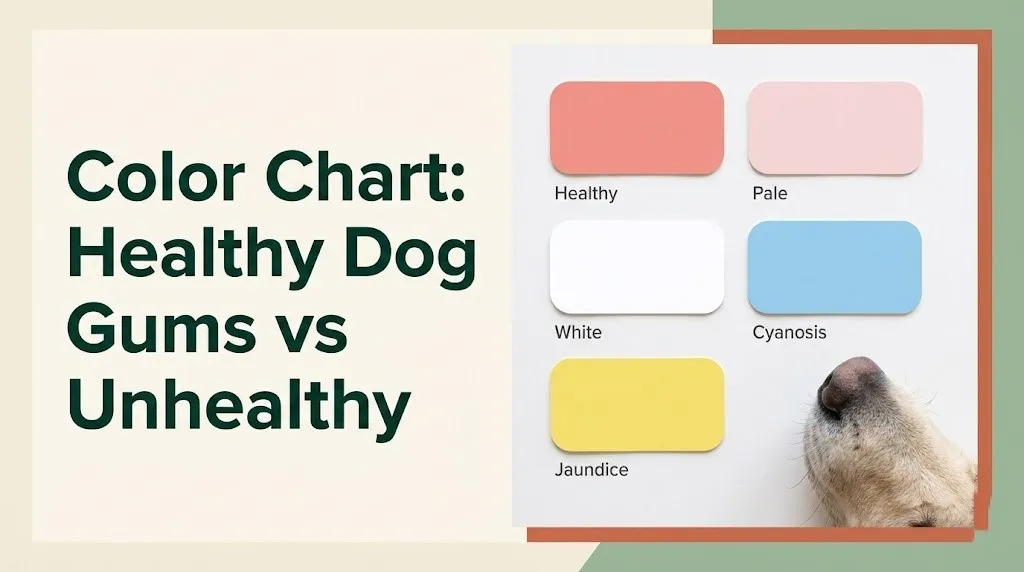
Healthy dog gums are salmon pink, moist, and slick to the touch. A color chart comparing healthy dog gums vs unhealthy gums shows a clear spectrum from that normal salmon pink all the way to white, blue, yellow, or cherry red, with each color pointing to a different health concern.
Your dog’s gums are one of the fastest windows into their circulatory and organ health. According to the American Animal Hospital Association (AAHA), mucous membrane color and moisture are standard first-line indicators in any veterinary physical exam, used to quickly assess perfusion, oxygenation, and systemic illness.
This guide covers every gum color on the spectrum, what each color means clinically, how to run a simple at-home assessment, which breeds need a different approach, and exactly when abnormal gum color warrants an emergency vet visit.
Healthy Dog Gum Color
Healthy dog gum color is salmon pink, sometimes described as bubblegum pink, and the tissue should feel slick and moist when you run a finger across it.
The exact shade can range from a pale pink to a deeper rose, depending on the individual dog’s baseline pigmentation and current body temperature. Both ends of that pink spectrum are normal, as long as color is consistent, the gums feel wet, and the dog is acting normally.
Gum color reflects the blood flow and oxygen saturation in the capillary network just beneath the mucous membrane surface. When circulation is healthy and the blood is fully oxygenated, that network gives gums their characteristic pink tone. Think of it like the blush on a peach: a reliable signal of what is happening just below the skin.
According to the Merck Veterinary Manual, normal canine mucous membranes are pink, moist, and have a capillary refill time of under 2 seconds. Those three criteria together, not color alone, constitute a normal finding.
Key Gum Health Indicators:
- Color: salmon to bubblegum pink
- Texture: slick and moist, never dry or sticky
- Capillary refill time (CRT): under 2 seconds
- Odor: mild; not foul-smelling or metallic
A dog’s individual baseline matters here. Some dogs run a slightly paler pink at rest and a deeper pink after exercise. If you know your dog’s normal, deviations become easier to spot. A veterinarian can establish your specific dog’s baseline during a routine wellness exam, which is worth knowing for breeds prone to gum pigmentation.
What Do Healthy Dog Gums Look Like
Healthy dog gums look like the inside of a ripe watermelon rind: pink, smooth, and uniformly moist across the entire surface.
The gum tissue sits tightly against the base of each tooth with no visible gaps or pockets. There should be no swelling, bleeding, or discoloration along the gum line. The inner lip tissue, which is easier to check quickly, should match the gum color closely.
Running your index finger across healthy gums produces no resistance and no stickiness. The tissue springs back slightly when pressed. A healthy dog will usually tolerate a brief gum check without distress, though some dogs need a calm introduction to the routine before they cooperate.
The Journal of Veterinary Emergency and Critical Care notes that practitioners assess gum color and moisture together because each provides a different piece of clinical information. Color reflects perfusion and oxygenation; moisture reflects hydration status. A dog can have normal-colored gums while still being mildly dehydrated if the color change hasn’t progressed yet.
What to look for on a gum check:
| Feature | Normal Finding | Concerning Finding |
|---|---|---|
| Color | Salmon to bubblegum pink | White, pale, blue, yellow, cherry red |
| Moisture | Slick, wet | Dry, tacky, or pasty |
| Texture | Smooth and firm | Swollen, bleeding, or receding |
| Smell | Mild, slightly warm | Foul, metallic, or sweetly chemical |
| CRT | Under 2 seconds | Over 2 seconds |
Note for dogs with dental disease: periodontal disease can cause localized gum redness, swelling, and recession, which is a separate concern from systemic gum color changes. Both warrant veterinary attention but signal different problems.
Color Chart: Healthy Dog Gums vs Unhealthy
The color chart for healthy dog gums vs unhealthy maps gum color to likely cause and urgency level, giving owners a fast triage reference.
Healthy sits at one end of the spectrum. At the other end are colors that indicate immediate emergencies. Between them are colors that signal developing illness, which may allow slightly more time but still need same-day or next-day veterinary evaluation.
Using a color chart is not a substitute for a veterinary exam. It is a starting point that helps you decide how quickly to act. Sudden changes, especially toward white, blue, or gray, should always be treated as emergencies until proven otherwise.
Dog Gum Color Chart: Quick Reference
| Gum Color | Likely Cause | Urgency Level |
|---|---|---|
| Salmon pink | Normal, healthy | No action needed |
| Pale pink (lighter than usual) | Mild anemia, early shock, mild illness | Vet visit within 24 hours |
| White or very pale | Severe anemia, blood loss, shock | Emergency vet immediately |
| Blue or purple (cyanosis) | Oxygen deprivation, heart failure, airway obstruction | Emergency vet immediately |
| Yellow (jaundice/icterus) | Liver disease, bile duct obstruction, hemolysis | Vet visit same day |
| Cherry red or brick red | Heatstroke, carbon monoxide poisoning, sepsis (early stage) | Emergency vet immediately |
| Gray | Late-stage shock, severe compromise | Emergency vet immediately |
| Brown or muddy | Possible toxin ingestion (e.g., acetaminophen) | Emergency vet immediately |
Each color is covered in detail in its own section below. The key principle from this chart: any color outside the pink range is a signal to act, not wait.
Key Takeaway: Healthy dog gums are salmon pink, slick, and moist, with a capillary refill time under 2 seconds. Any color outside the pink range warrants veterinary attention, and sudden changes toward white, blue, or gray are emergencies.
Healthy Dog Gum Color Chart (Full Breakdown)
A healthy dog gum color chart organizes the full pink spectrum alongside every abnormal color, matched to clinical significance and recommended owner action.
Most owners only think about their dog’s gums when something looks wrong. Building a mental reference for the full spectrum, including the normal range, makes it much easier to spot deviations quickly. The faster you recognize a color shift, the faster your dog gets help.
The pink range itself has some variation. A dog that has just exercised vigorously may have slightly redder, more flushed gums from increased blood flow. A dog that is resting in a cool room may show a slightly paler pink. Both are normal responses to physiological state, not signs of illness.
Full Dog Gum Color Chart with Clinical Context
| Color | Clinical Name | Most Common Causes | Action |
|---|---|---|---|
| Deep salmon/bubblegum pink | Normal | Healthy circulation | None needed |
| Light pink (within normal range) | Normal variant | Rest, cool temperature | None needed |
| Pale pink (outside normal) | Pallor | Mild anemia, mild dehydration | Vet within 24 hours |
| White or near-white | Pallor/blanching | Severe anemia, shock, internal bleeding | Emergency vet now |
| Blue or purple | Cyanosis | Oxygen deprivation, cardiac failure, airway emergency | Emergency vet now |
| Yellow or yellowish white | Icterus (jaundice) | Liver disease, hemolytic anemia, bile obstruction | Same-day vet |
| Bright or cherry red | Hyperemia | Heatstroke, CO poisoning, early sepsis | Emergency vet now |
| Brick red with tacky texture | Septic shock (late) | Systemic infection | Emergency vet now |
| Brown or chocolate | Methemoglobinemia | Acetaminophen/Tylenol toxicity | Emergency vet now |
| Gray | Circulatory collapse | Late shock, severe systemic failure | Emergency vet now |
The ASPCA Animal Poison Control Center specifically identifies acetaminophen (the active compound in Tylenol) as a common household toxin that causes methemoglobinemia in dogs, turning gums a distinctive muddy brown or gray. Dogs process this compound far less efficiently than humans do.
Quick Tip:
- Photograph your dog’s gums during a normal, healthy day to establish their personal baseline color.
- Recheck gum color any time your dog shows lethargy, weakness, vomiting, or rapid breathing.
- Always assess gum color alongside moisture and CRT, not as an isolated indicator.
Pale Gums vs Healthy Gums in Dogs
Pale gums in dogs differ from healthy pink gums in that the tissue appears washed out, white-adjacent, or almost colorless, indicating reduced blood flow, oxygenation, or red blood cell count.
The comparison between pale and healthy gums is one of the clearest visual distinctions a dog owner can learn. Healthy gums have an obvious pink tone with visible depth. Pale gums look like color has been drained from the tissue. Even under indoor lighting, the difference is visible.
Paleness develops when either the red blood cells responsible for delivering color to the capillary bed are reduced in number (anemia) or when blood is being shunted away from the peripheral tissues due to shock or cardiovascular compromise. Both mechanisms produce the same visual result: a gum that looks nearly white.
According to the Merck Veterinary Manual, pale or white mucous membranes in dogs are associated with conditions including hemolytic anemia, blood loss from trauma or internal hemorrhage, splenic masses that rupture, and circulatory shock from any cause. The pace at which pallor develops helps distinguish the cause: gradual pallor over days points toward a developing condition like anemia; pallor that appears within minutes suggests acute blood loss or shock.
Pale vs Healthy Gums: Side-by-Side Comparison
| Feature | Healthy Pink Gums | Pale Gums |
|---|---|---|
| Color | Salmon to bubblegum pink | Very light pink, near-white, or white |
| Moisture | Slick and wet | May be tacky or dry |
| CRT | Under 2 seconds | Over 2 seconds in many cases |
| Dog’s demeanor | Alert, energetic | Often lethargic, weak, or trembling |
| Urgency | No action needed | Vet within 24 hours to emergency, depending on speed of onset |
Dogs with hemolytic anemia, where the immune system destroys its own red blood cells, may develop pale gums over several days before the owner notices. Any dog showing pale gums alongside weakness, collapse, rapid breathing, or a distended abdomen needs emergency evaluation immediately.
What Color Are Unhealthy Dog Gums
Unhealthy dog gum colors include white, pale, blue, purple, yellow, cherry red, brown, and gray, each linked to a specific category of systemic problem.
The range of abnormal gum colors is wider than most owners realize. Each color represents a different physiological failure, which is why treating “abnormal gums” as a single category and waiting to see if it resolves is genuinely dangerous. Color is diagnostic information, not just a cosmetic concern.
White or pale gums point to blood loss or cardiovascular compromise. Blue or purple gums indicate oxygen deprivation. Yellow gums signal liver involvement. Bright red or cherry-colored gums often mean heatstroke or toxin exposure. Each of these requires a different response from the owner, and most require rapid veterinary intervention.
One factor many owners miss: gum color changes can occur in localized patches before spreading. A dog whose gums are partly white and partly pink has a gum color that is already abnormal. Partial pallor is not reassuring.
Abnormal Dog Gum Colors by Category:
| Category | Gum Color | Key Conditions Indicated |
|---|---|---|
| Reduced circulation | Pale pink to white | Anemia, shock, internal bleeding |
| Oxygen deprivation | Blue, purple | Heart failure, airway obstruction, drowning |
| Liver/blood breakdown | Yellow, yellowish-white | Jaundice, hemolysis, liver disease |
| Overheating/toxin | Cherry red, brick red | Heatstroke, CO poisoning, early sepsis |
| Systemic collapse | Gray | Late shock, multi-organ failure |
| Toxin-specific | Brown, muddy brown | Acetaminophen poisoning, nitrate toxicity |
A dog that has naturally darker-pigmented gums due to breed genetics does not fit cleanly into this framework. For those dogs, see the section on breed-specific gum pigmentation further below. If you are unsure whether your dog’s gum color is a breed trait or a health change, a veterinarian can clarify that at a wellness visit.
Dog Gums White or Pale: What Does It Mean
White or pale dog gums mean that blood is not adequately perfusing the gum tissue, signaling conditions including severe anemia, internal hemorrhage, or cardiovascular shock.
This is one of the most urgent findings on the gum color spectrum. White gums in a dog are not a “wait and see” situation. If you press the gum tissue and it does not return to pink within 2 seconds, and the color remains white or near-white, the dog needs emergency veterinary care right now.
The three most common causes of white or near-white gums are severe blood loss, severe anemia, and shock. Internal bleeding from a ruptured splenic mass is a frequent cause in middle-aged and older large-breed dogs, particularly Golden Retrievers and German Shepherds, where hemangiosarcoma (a type of blood vessel tumor) is more prevalent. A dog can bleed internally with no visible external signs other than pale gums, weakness, and abdominal distension.
A 2022 review in the Journal of Veterinary Emergency and Critical Care noted that dogs presenting with pale mucous membranes, elevated heart rate, and weak pulse should be presumed to be in shock until diagnostic testing rules it out.
Causes of White or Pale Gums in Dogs:
- Severe hemolytic anemia (immune-mediated destruction of red blood cells)
- Blood loss from internal bleeding (splenic rupture, trauma)
- Anticoagulant rodenticide poisoning (e.g., warfarin-based rat poison)
- Severe dehydration leading to circulatory compromise
- Cardiac failure reducing peripheral blood flow
- Anaphylactic shock following a severe allergic reaction
Any dog with white gums that appeared suddenly should be taken to an emergency veterinary clinic immediately, not scheduled for a regular appointment the next day. Speed matters significantly in cases of active internal bleeding.
Key Takeaway: White or pale gums are a veterinary emergency when they appear suddenly, because they indicate severe blood loss, anemia, or shock. Do not wait to act.
Dog Gums Blue or Purple Emergency
Blue or purple dog gums, medically called cyanosis, indicate that the blood is not carrying enough oxygen to the peripheral tissues, and this is a life-threatening emergency.
Cyanosis occurs when deoxygenated hemoglobin is present in high enough concentrations to give blood and the tissues it flows through a bluish-purple tint. The same phenomenon is visible in humans whose lips turn blue in extreme cold or during a cardiac event. In dogs, it is always serious.
The most common causes include upper airway obstruction (choking or severe laryngeal paralysis), lower airway disease (pneumonia, pleural effusion, pulmonary edema), and cardiac conditions that prevent proper oxygenation of blood. Brachycephalic breeds including English Bulldogs, French Bulldogs, and Pugs are at higher baseline risk for airway compromise, meaning their owners should be especially vigilant about gum color.
According to the American Veterinary Medical Association (AVMA), cyanosis in companion animals is a medical emergency requiring immediate oxygen supplementation and diagnostic workup. Any delay worsens outcomes significantly.
Conditions Associated with Blue or Purple Gums:
| Condition | Speed of Onset | Key Additional Signs |
|---|---|---|
| Airway obstruction (choking) | Sudden | Pawing at mouth, gagging, distress |
| Laryngeal paralysis | Gradual to sudden | Noisy breathing, voice change |
| Heart failure (congestive) | Gradual | Exercise intolerance, cough |
| Pulmonary edema | Can be rapid | Labored breathing, coughing fluid |
| Severe pneumonia | Gradual | Fever, lethargy, nasal discharge |
| Near-drowning or suffocation | Immediate | Unresponsive or barely responsive |
If you see blue or purple gums, call the nearest emergency veterinary clinic while you travel there. Do not attempt to give water or food. If the dog appears to be choking, a veterinarian or trained professional should perform any airway clearance maneuver.
Dog Gums Yellow: Jaundice in Dogs
Yellow or yellowish-white dog gums indicate jaundice (medically called icterus), a condition caused by excess bilirubin accumulating in the tissues due to liver disease, bile duct problems, or rapid red blood cell destruction.
Bilirubin is a breakdown product of hemoglobin. Normally the liver processes and excretes it efficiently. When the liver is diseased, bile flow is blocked, or red blood cells are being destroyed faster than the liver can handle, bilirubin builds up. It deposits into the mucous membranes, skin, and whites of the eyes, turning tissues yellow.
In dogs, the inner eyelids (conjunctival membranes) often show jaundice before the gums do. If you notice your dog’s eyes looking yellowish alongside pale or yellowish gums, that combination warrants a same-day veterinary call, not a wait-and-see approach.
Causes of Yellow Gums in Dogs:
- Liver disease (hepatitis, hepatic lipidosis, cirrhosis)
- Leptospirosis, a bacterial infection transmitted through contaminated water or rodent urine that damages the liver and kidneys
- Immune-mediated hemolytic anemia (IMHA), where red blood cell destruction releases bilirubin faster than the liver can clear it
- Biliary obstruction from gallbladder disease or pancreatic inflammation
- Toxin ingestion, including certain mushrooms and blue-green algae
The Merck Veterinary Manual classifies jaundice in dogs as pre-hepatic (from hemolysis), hepatic (from liver failure), or post-hepatic (from bile obstruction). Distinguishing among these requires blood work and often imaging, which is why a veterinary exam is not optional here.
Leptospirosis deserves a specific note: it is a zoonotic disease, meaning it can spread from dogs to humans. If your dog shows jaundice alongside fever, vomiting, and lethargy, inform the veterinary team of any potential leptospirosis exposure (standing water, wildlife contact, travel to flood-prone areas) when you call ahead.
Dog Gums Bright Red: What Does It Mean
Bright red or cherry-colored dog gums indicate that the capillaries are abnormally dilated and engorged with blood, most often due to heatstroke, carbon monoxide poisoning, or early-stage sepsis.
Cherry-red gums look almost too pink, like the tissue is flushed and pressurized. This is different from the post-exercise flush, which fades quickly. Cherry-red gums that persist, or that appear alongside panting, confusion, or collapse, are a warning sign.
Heatstroke is the most common cause seen in summer months. Dogs cannot sweat through their skin the way humans do. They rely almost entirely on panting to offload heat. When the environment overwhelms that system (a hot car, a concrete yard with no shade, a humid day with vigorous exercise), core body temperature rises and the cardiovascular system responds by dilating peripheral blood vessels, flooding the gums with blood. At that point the gums turn bright red or even a deep brick red.
According to the AVMA, dogs left in cars on warm days can reach dangerous core temperatures within 10 minutes, even on days that feel mild to humans outside.
Carbon monoxide poisoning produces cherry-red gums through a different mechanism: CO binds to hemoglobin in place of oxygen, forming carboxyhemoglobin, which has an artificially bright red color. A dog in a closed garage with a running vehicle, or near a faulty furnace, can develop CO poisoning silently.
Causes of Bright Red or Cherry-Red Gums:
| Cause | Key Setting or Trigger | Other Signs |
|---|---|---|
| Heatstroke | Hot environment, confinement | Panting, drooling, disorientation |
| Carbon monoxide poisoning | Closed space, vehicle or furnace | Weakness, vomiting, seizures |
| Early sepsis | Recent infection or wound | Fever, rapid heart rate, lethargy |
| Polycythemia | Overproduction of red blood cells | Often a chronic finding |
For suspected heatstroke: move the dog to shade or air conditioning immediately, apply room-temperature (not ice-cold) water to the paw pads and groin, and transport to a veterinary clinic without delay. Ice water causes peripheral vasoconstriction and can worsen outcomes.
Key Takeaway: Bright red or cherry gums alongside panting and confusion usually mean heatstroke. Move the dog to a cool environment immediately and get to a vet, because body temperature above 104°F (40°C) causes organ damage that escalates fast.
How to Check Dog Gums at Home
You can check your dog’s gums at home by gently lifting the upper lip, pressing one finger against the gum tissue, and observing color, moisture, and how quickly the color returns after pressure.
Making this a regular part of your routine means you will recognize your dog’s normal baseline quickly. A healthy dog that is comfortable with handling will tolerate a brief gum check without stress. Building that comfort while the dog is healthy and calm makes it far easier to assess them when they are feeling unwell and may be more resistant.
Choose good lighting. Natural daylight or a bright room gives you the most accurate color reading. Fluorescent lighting can make pink gums look slightly paler than they are. A phone flashlight held alongside the gum is a useful tool.
Step-by-Step At-Home Dog Gum Check:
- Position your dog in a comfortable seated or standing position with their head at a reachable height.
- Approach calmly. Speak in a low, steady voice to keep the dog relaxed.
- Gently lift the upper lip on one side to expose the gum tissue above the upper teeth.
- Look at the color first: is it salmon pink, pale, white, blue, yellow, or red?
- Run one clean finger across the gum surface. Does it feel slick and wet, or dry and sticky?
- Press one fingertip firmly against the gum tissue for 2 seconds, then release.
- Watch how quickly the white pressure mark returns to pink. Under 2 seconds is normal.
- Check the inner lower lip for the same color and moisture, as a second reference point.
- Note the smell: mild is normal; foul, metallic, or chemical odors are worth reporting to a vet.
- Release the lip gently and reward the dog with calm praise or a small treat.
Quick Tip:
- Check gums once a month during a regular calm grooming session to normalize the routine.
- If your dog resists gum checks consistently, ask a veterinarian or trainer to help establish tolerance before a health emergency makes it necessary.
- Never force a gum check on a dog showing pain, extreme distress, or aggression. Ask a professional to assist.
Dog Gum Capillary Refill Time Test
The capillary refill time (CRT) test measures how quickly blood returns to the gum tissue after brief pressure, with a normal result under 2 seconds and anything over 2 seconds requiring veterinary evaluation.
CRT is the single most important at-home assessment tool in the gum-check toolkit. Color tells you what is happening now. CRT tells you how well the cardiovascular system is compensating. Together, they give a more complete picture than either indicator alone.
Think of the CRT test like pressing your thumb into a ripe piece of fruit: a healthy peach springs back quickly. Old or compromised fruit blanches and takes a long time to recover its color. Your dog’s gum tissue works the same way; a well-perfused capillary bed refills rapidly after the pressure is removed.
How to Perform the CRT Test:
- Lift your dog’s upper lip to expose the gum above the upper canine tooth.
- Press one finger firmly against the gum tissue and hold for exactly 2 seconds.
- Release the pressure and watch the white or pale spot where you pressed.
- Count the seconds until the normal pink color returns to that spot.
- Under 2 seconds: normal, consistent with adequate cardiovascular function.
- 2 to 3 seconds: borderline, warrants a veterinary phone call to describe symptoms.
- Over 3 seconds: slow, indicating reduced peripheral perfusion; seek veterinary care.
- Instantaneous (under 1 second): may indicate abnormally elevated blood pressure or early sepsis; also worth a veterinary call.
CRT Interpretation Reference:
| CRT Result | Interpretation | Recommended Action |
|---|---|---|
| Under 2 seconds | Normal | No action needed |
| 2 to 3 seconds | Borderline slow | Monitor and call vet |
| Over 3 seconds | Slow, reduced perfusion | Vet visit urgently |
| Instantaneous | Abnormally fast | Veterinary evaluation |
The Veterinary Emergency and Critical Care Society (VECCS) includes CRT as a standard component of rapid patient assessment in emergency triage. Practicing this test monthly when your dog is healthy means you can perform it accurately and confidently when it actually matters.
Dog Gums Tacky: Dehydration Signs
Tacky or sticky dog gums are a sign of dehydration, indicating that the body’s fluid balance has shifted enough to reduce the normal slickness of the mucous membranes.
Healthy gums feel like the inside of your own cheek: wet, smooth, and slightly slippery. Tacky gums feel as though there is resistance when you run a finger across them, almost like dragging across dry plastic. Severely dehydrated gums may feel almost paste-like or rough.
Dehydration in dogs occurs when fluid losses exceed fluid intake. Vomiting, diarrhea, excessive urination, fever, heatstroke, and simply not drinking enough water in hot weather can all push a dog toward dehydration quickly. Puppies, seniors, and small breeds are more vulnerable to rapid dehydration than healthy adult dogs of medium or large size.
Dehydration Assessment Beyond Gum Moisture:
| Test | Method | Normal Result | Dehydrated Result |
|---|---|---|---|
| Gum moisture | Run finger across gum | Slick, wet | Tacky, dry, or pasty |
| Skin turgor (tent test) | Gently pinch skin at neck scruff and release | Springs back immediately | Slow to return to flat |
| Eye appearance | Look at eyes | Bright, moist | Sunken or dull |
| CRT | Press gum, release | Under 2 seconds | May be 2+ seconds |
A dog showing tacky gums alongside lethargy, loss of skin elasticity, and sunken eyes is at least 5% dehydrated, which is the clinical threshold where intravenous or subcutaneous fluid therapy is often indicated, according to veterinary clinical guidelines.
Mild dehydration from one episode of loose stools may resolve with encouraging water intake. But a dog that refuses water, cannot keep water down, or shows other signs alongside tacky gums needs veterinary assessment the same day. Dehydration that progresses to severe levels causes organ damage quickly in dogs.
Key Takeaway: Tacky, sticky gums are your dog’s first physical warning sign of dehydration. Combine the gum moisture check with the skin turgor test for a more accurate picture of how much fluid the dog has lost.
Healthy Puppy Gums vs Unhealthy
Healthy puppy gums are the same salmon pink as adult dog gums, though they may appear slightly lighter in the first few weeks of life as pigmentation develops, and they should always feel moist and refill within 2 seconds.
Puppies under eight weeks old have slightly thinner skin and less developed pigmentation overall, which can make their gum color appear a touch paler than an adult dog’s. This is a normal developmental finding, not a health concern, as long as the puppy is alert, nursing actively, gaining weight, and showing no distress.
By the time a puppy reaches 8 to 12 weeks of age, their gum color should firmly match the adult standard: pink, moist, and quickly refilling. A puppy that consistently shows pale, white, or gray gums at any age should be seen by a veterinarian promptly. Puppies have smaller blood volumes than adults, which means any condition causing anemia or blood loss escalates faster in a young animal.
Healthy vs Unhealthy Puppy Gums:
| Sign | Healthy Puppy | Needs Vet Attention |
|---|---|---|
| Gum color | Pink to salmon | Pale, white, gray, or blue |
| Gum moisture | Wet and slick | Dry, tacky, or cracked |
| CRT | Under 2 seconds | 2 seconds or longer |
| Activity | Alert, nursing well, gaining weight | Lethargic, refusing to nurse, losing weight |
| Crying | Occasional | Persistent, high-pitched |
One concern specific to young puppies is fading puppy syndrome, a poorly understood condition in which seemingly healthy newborns decline rapidly in the first two weeks of life. Pale or gray gums in a newborn puppy are one of the early physical indicators seen in this condition.
Breed-specific note: some breeds, including Chow Chows and Shar Peis, begin developing dark gum and tongue pigmentation within the first few weeks. In these breeds, a combination of pink tissue and dark spots is normal by 8 to 12 weeks. A veterinarian familiar with the breed can confirm what is normal pigmentation development for individual puppies.
When to Go to the Emergency Vet for Dog Gum Color
Go to an emergency vet immediately if your dog’s gums are white, blue, purple, gray, or cherry red, or if any color change appeared suddenly and is accompanied by lethargy, collapse, labored breathing, or vomiting.
The gum color decision tree is actually quite simple: pink means watch and assess; anything else means act. The speed with which you need to act depends on the color and the accompanying signs.
Sudden changes are almost always more urgent than gradual ones. A dog whose gums have shifted from pink to pale over three days likely has a developing condition. A dog whose gums turned white within an hour may be hemorrhaging internally. Speed of change is as diagnostically important as the color itself.
Emergency vs. Same-Day vs. Scheduled Visit Guide:
| Gum Color | Onset | Other Signs Present | Action |
|---|---|---|---|
| White or pale | Sudden (under 1 hour) | Weakness, collapse, distended abdomen | Emergency vet now |
| White or pale | Gradual (days) | Mild lethargy, reduced appetite | Vet visit today |
| Blue or purple | Any | Labored breathing, gasping | Emergency vet now |
| Cherry red | Alongside panting | Hot environment, disorientation | Emergency vet now |
| Yellow | Any | Vomiting, lethargy, dark urine | Vet visit same day |
| Brown or muddy | Sudden | Known or possible toxin access | Emergency vet now, call ASPCA Poison Control |
| Gray | Any | Collapse, unresponsiveness | Emergency vet immediately |
| Pale pink (slightly lighter) | Gradual | Mild, dog otherwise normal | Schedule vet within 48 hours |
The ASPCA Animal Poison Control Center operates a 24-hour hotline for potential toxin ingestion. If you suspect your dog has eaten something toxic and the gums are changing color, contact them and your nearest emergency clinic simultaneously.
For dogs with naturally dark-pigmented gums that make color assessment difficult, assess the inner lower eyelid membrane (conjunctiva) as an alternative. Pull the lower eyelid down gently and look at the inner surface. It should be pink and moist regardless of skin or gum pigmentation.
Frequently Asked Questions About Dog Gum Color
What color should a healthy dog’s gums be?
Healthy dog gums should be salmon pink or bubblegum pink, moist to the touch, and return to pink within 2 seconds after gentle pressure.
The exact shade varies slightly between individual dogs, but the tissue should always look visibly pink rather than pale, white, yellow, or tinged blue.
A veterinarian can confirm your dog’s specific normal baseline during a routine wellness exam.
What does it mean when a dog’s gums are white or pale?
White or pale dog gums mean that blood is not adequately reaching the gum tissue, usually because of severe anemia, blood loss, or circulatory shock.
This finding requires emergency veterinary care when it appears suddenly, because internal hemorrhage, splenic rupture, or acute cardiovascular compromise can all cause rapid pallor.
A dog with gradually developing pale gums over several days may have a developing chronic condition like immune-mediated hemolytic anemia, which still requires prompt veterinary evaluation.
How do I check my dog’s capillary refill time at home?
Press one finger firmly against your dog’s upper gum for 2 seconds, release, and count how quickly the pink color returns.
A refill time under 2 seconds is normal; 2 to 3 seconds is borderline; over 3 seconds indicates reduced perfusion and warrants a vet visit.
Practice this test monthly when your dog is healthy so you can perform it accurately when it matters.
Can some dog breeds naturally have black or dark gums?
Yes. Breeds including the Chow Chow, Shar Pei, Akita, and some Rottweilers and Doberman Pinschers naturally develop dark blue-black gum and tongue pigmentation, which is a breed-standard trait, not a health problem.
For these dogs, assess the inner lower eyelid (conjunctiva) instead, which should be pink regardless of skin or gum pigmentation.
A veterinarian can confirm what is breed-normal for your specific dog and recommend the best alternative assessment point.
How quickly should I act if my dog’s gums turn blue?
Blue gums in a dog are a veterinary emergency and you should head to the nearest emergency clinic immediately without waiting to see if the color improves.
Cyanosis means the blood is not carrying adequate oxygen, which can result from airway obstruction, heart failure, severe pneumonia, or other acute respiratory or cardiac crises.
Call the emergency clinic while you are on the way so they can prepare to receive the dog.
Reading Your Dog’s Gums Takes Minutes and Can Save a Life
Your dog cannot describe chest tightness or tell you they feel dizzy. Their gums are one of the few physical indicators they have that you can read directly without any equipment.
Learn your dog’s normal. Take a photograph of their healthy pink gums during a calm afternoon. Run the CRT test once a month as part of grooming. That 60-second routine is the fastest early-warning system most dogs will ever have.
When something looks wrong, trust that assessment. A dog with pink gums and a CRT under 2 seconds in a bright, alert body is doing fine. A dog with any other color combination is worth a phone call to your veterinarian at minimum.