
You hear scratching inside the wall at 2 a.m. You have seen droppings under the kitchen sink. A mouse has moved in, and you want it gone. The first question that crosses your mind is how long can a mouse live without food. If you just seal up every crumb and stop feeding it, will the problem solve itself.
A mouse can live 2 to 4 days without food but rarely more than 24 hours without water. That is the short answer. The practical reality inside a house is far messier. A mouse living in your wall has access to condensation on pipes, water in sink traps, and food debris you cannot see. It will not starve just because you put the cereal in airtight containers. Waiting for a mouse to die of hunger inside your home is a losing strategy.
What surprises most people is that a dead mouse inside a wall is often a worse problem than a live one. The odor from a decomposing rodent can last two weeks or longer. Blowflies and carpet beetles arrive to feed on the carcass. The legal consequences for a landlord who ignores a known infestation can be immediate and expensive.
Mice do not simply go away because food gets scarce. They adapt, find new sources, and reproduce faster than you think. The biology of mouse survival, and the legal framework that governs pest infestations in rental properties, both point to the same conclusion. Waiting does not work.
how long can a mouse live without food
A house mouse can survive 2 to 4 days without any food at all. This is shorter than most people assume. Mice have extremely fast metabolisms. A typical house mouse burns through its body weight in energy roughly every 24 hours. Without constant caloric intake, the mouse’s body begins consuming its own fat stores, then muscle tissue, and organ failure follows rapidly.
The 2 to 4 day window is for a mouse with zero food access. In a real home, a mouse almost never faces true starvation conditions. It finds crumbs under appliances, grease residue on range hoods, pet food in bowls left on the floor, and food debris in garbage disposals. A single spilled teaspoon of flour under a refrigerator can sustain a mouse for days.
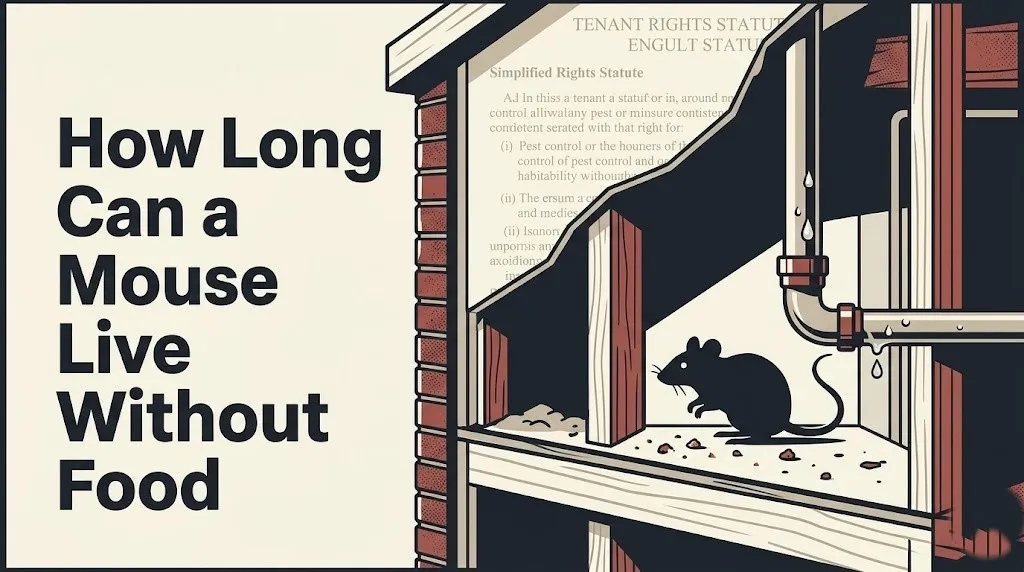
Temperature also changes the survival math. A mouse living in a cold garage or unheated crawl space burns calories faster to maintain body heat. In cold conditions below 50 degrees Fahrenheit, the survival window without food shrinks to 1 to 2 days. In a warm house at 70 degrees, the full 2 to 4 day range applies. This is why mice seek heated indoor spaces in winter. The warmth itself extends their survival.
The bigger survival factor is water, not food. A mouse without water dies in less than 24 hours regardless of how much body fat it has. Mice get most of their water from the food they eat. Dry grains and seeds provide little hydration. In a home with no standing water but plenty of dry food, a mouse can still die of dehydration within a day.
how long can mice go without food
Mice can go 2 to 4 days without food under ideal conditions. The biological limit is set by the animal’s metabolic rate, which is among the fastest of any mammal relative to body size. A mouse’s heart beats roughly 500 to 600 times per minute. Its resting metabolic rate burns energy at a rate that would be catastrophic for a larger animal.
The term “go without food” means total caloric deprivation. In a house, total deprivation rarely happens. Mice are opportunistic feeders. They forage constantly, eating small amounts 15 to 20 times per day. A mouse does not sit down to meals. It grazes. That grazing behavior means it is always finding something, even in a house that appears spotless.
What this means for pest control is straightforward. You cannot starve out a mouse infestation by simply putting away food. The mice will find the food you miss. They will chew through cardboard and thin plastic. They will eat soap, candle wax, glue from book bindings, and even the paste behind wallpaper. Their definition of food is far broader than yours.
Starvation as a pest control method has a historical precedent that explains why it fails. In agricultural settings, mice populations crash when grain stores are emptied or fields are harvested. But a modern home is not a grain silo. It is a complex environment with hundreds of micro-food sources. The mouse always finds something.
Key Takeaway: Mice cannot survive total food deprivation for more than a few days, but total food deprivation almost never occurs inside a home. The mouse always finds a calorie source you missed.
how long can mice live without food
Mice live 2 to 4 days without food, but this number describes a laboratory condition, not a real house. In a lab, a mouse in a clean cage with no bedding, no water, and no food has a measurable survival window. In your kitchen, that same mouse finds the grease on the back of the stove, the crumbs in the toaster tray, and the pet food under the dog’s bowl.
The house mouse, Mus musculus, evolved alongside humans for roughly 10,000 years. Its entire biology is optimized for living in human structures and eating human food supplies. The species can survive on remarkably little. An adult house mouse needs only about 3 to 4 grams of food per day, roughly the weight of a single shelled peanut. A single spilled granola cluster sustains a mouse for a full day.
Water access is the real limiter. Mice can extract some moisture from food, especially fresh fruits, vegetables, and meats. But dry grains, cereals, and seeds provide almost no water. If a mouse eats only dry food, it must find a water source within 24 hours or it will die of dehydration. The water does not have to be a puddle. Condensation on a cold water pipe, a drip from a faucet, or water in a sink trap is enough.
This is why kitchen and bathroom infestations are the most common. Those rooms have both food debris and water access. A mouse living behind a dishwasher has everything it needs within a few square feet. The food, water, warmth, and nesting materials are all right there.
how long can a mouse go without food
A single mouse can go 2 to 4 days without eating anything. This number is surprisingly low to most homeowners who assume the animal can tough it out for a week or more. The mouse’s metabolism simply does not allow for extended fasting. It is a small mammal with a high surface-area-to-volume ratio, which means it loses body heat rapidly and must replace that energy constantly.
The surprising twist is that a pregnant or nursing female mouse has an even shorter survival window. Gestation in house mice lasts 19 to 21 days. A pregnant female needs roughly 20 percent more calories than a non-pregnant female. If food disappears for even 36 hours, she may resorb the embryos or abandon the nest to search for food. Nursing females need even more calories and water. They rarely survive more than 24 hours without both.
This biological vulnerability is why mice never nest far from a reliable food source. A mouse nest is almost always within 10 to 30 feet of where the mouse feeds. If you find droppings in a kitchen cabinet, the nest is likely inside the wall behind that cabinet, under the floor, or in the ceiling directly above. The mouse will not establish a nest in an attic at the far end of the house if the food is in the kitchen.
The close relationship between nest location and food source is the most useful fact for anyone trying to locate an infestation. Follow the droppings. The nest is nearby. That is where the traps or bait stations need to go.
Legal Bottom Line: In landlord-tenant law, a mouse infestation is not a minor inconvenience. It is a habitability issue. Courts have consistently ruled that landlords must address rodent infestations within a reasonable time, typically 3 to 14 days depending on the state.
how long can a mouse survive without food
A mouse survives 2 to 4 days without food under normal conditions. The word “survive” here means the biological endpoint. After 48 hours without calories, the mouse becomes lethargic. After 72 hours, its body temperature drops and organ function begins to fail. By day 4, death from starvation is almost certain.
But in a home, the mouse never reaches day 2 of true starvation. It finds something. A single crumb of bread, a smear of peanut butter on a jar lid, a piece of dried pasta that rolled under the stove. The mouse’s foraging behavior is relentless and effective. It explores its territory constantly, covering the same paths night after night.
Mice also hoard food. A mouse will carry food back to its nest and store it in small caches. If you suddenly remove all food sources, the mouse may have a hidden stash that buys it an extra day or two. This hoarding instinct is an evolutionary adaptation to unpredictable food availability. In the wild, mice survive periods of scarcity by relying on stored food. The same behavior operates inside your walls.
The survival window changes if the mouse is sick or injured. A mouse with a damaged tooth, which happens from gnawing on hard materials, cannot eat efficiently. A mouse weakened by poison baits may stop eating before death. These factors shorten survival time, but they are unpredictable. You cannot rely on a mouse dying naturally in a predictable timeframe.
how long can a mouse live without food and water
A mouse lives less than 24 hours without both food and water. Water is the critical limiting factor. Dehydration kills a mouse far faster than starvation. The mouse’s kidneys concentrate urine efficiently, but the animal still loses water through respiration and urine production. Without replacement water, organ failure begins within a day.
This fact has direct implications for pest control. If you can eliminate all water sources, you can accelerate mouse mortality. Fix leaky pipes. Dry out sink basins overnight. Empty pet water bowls before bed. Put stoppers in all drains. Do not leave glasses of water on nightstands. A house with zero accessible water is lethal to mice within a day.
The challenge is finding every water source. Mice drink from condensation on toilet tanks, water in the bottom of potted plant saucers, drips from refrigerator ice makers, and the film of water inside a dishwasher after a cycle. They need only about 1 milliliter of water per day, roughly a fifth of a teaspoon. That tiny amount is easy to find in even a seemingly dry house.
The water deprivation strategy works best in combination with trapping. Dry out the house, set traps near where you have seen droppings, and bait the traps with something that has a strong odor and high moisture content, like a small piece of raisin or a smear of chocolate syrup. The mouse, already stressed by dehydration, will be drawn to the bait’s water content.
how long can mice live without water or food
Mice live less than 24 hours without water and 2 to 4 days without food. When both are absent, water determines the timeline. The 24-hour dehydration limit overrides the longer starvation limit. A mouse without water dies before it starves.
This biological vulnerability is well documented in laboratory research. Studies on Mus musculus metabolism consistently show that water deprivation causes rapid weight loss, kidney stress, and circulatory collapse. The mouse’s small body mass means it has almost no water reserves. A human can survive about 3 days without water. A mouse, roughly 2,000 times smaller, has a proportionally tiny reserve.
In a home, simultaneous deprivation of food and water is rare. Kitchens and bathrooms provide both. Even a spotless kitchen has water in the sink trap and food residue in the drain. Mice will enter drain pipes to lick moisture and food particles from the interior walls. This is one reason why infestations are so stubborn. The mouse finds sustenance in places you never think to clean.
The legal significance of the water factor is that an infestation indicates a water source problem, not just a food problem. A landlord who only addresses food storage but ignores a leaky pipe under the bathroom sink has not fixed the condition that attracts mice. Tenants can argue that a failure to repair plumbing leaks constitutes a failure to address the root cause of the infestation.
Key Takeaway: Water kills faster than hunger. A house with accessible water will support mice indefinitely even if food is scarce. Fix leaks and eliminate standing water as the first step in any mouse control plan.
how long can mouse live without food
A mouse lives 2 to 4 days without food. This is the same biological answer as all previous variations of the question. The consistency matters because the survival window is well established in mammalian biology and does not change based on how the question is phrased.
The reason this question gets searched repeatedly with slight wording differences is that people want a loophole. They want to know if there is a scenario where the mouse simply dies on its own. There is not. The mouse in your wall is not going to starve. It has food, water, and shelter. It is, by the standards of its species, thriving.
The more useful framing is not how long the mouse survives without food. It is how long the mouse survives with the food it can find in your home. That answer is indefinitely. A breeding pair of mice with access to a typical kitchen’s food debris will produce a litter of 5 to 12 pups every 3 weeks. The population grows exponentially. Starvation does not factor into the equation.
Mice also have a behavioral adaptation that makes starvation unlikely. They are neophobic, meaning they fear new objects in their environment. But they are not neophobic about food sources they already know. Once a mouse has established a feeding route, it returns to that route every night. Even if you remove the obvious food source, the mouse will explore until it finds a replacement. It does not give up and wait to die.
how long can a mice go without food
Mice, plural, can go 2 to 4 days without food. The survival window is the same for a single mouse or a population. What changes with multiple mice is the competition for resources. A larger population depletes available food faster, which can shorten the survival window if no new food is introduced.
In an infested home, competition between mice actually works against the homeowner’s goal. When food becomes scarce, dominant mice push subordinate mice into new territory. The subordinate mice explore farther, finding new rooms, new floors, and new food sources. What started as a kitchen infestation becomes a whole-house problem because the mice spread out to reduce competition.
This territorial expansion is why early intervention matters. A small infestation confined to one room is manageable with traps and exclusion. A large infestation that has spread to multiple rooms, the attic, and the crawl space requires professional pest control. The legal obligation to address the problem also escalates. A landlord who ignores a report of mice in the kitchen may face greater liability when the tenant later reports mice in the bedroom.
The EPA’s integrated pest management guidelines recommend addressing infestations when they are small and localized. The guidelines emphasize exclusion, sanitation, and trapping over chemical rodenticides, which pose risks to children, pets, and non-target wildlife. Many states have incorporated these EPA standards into their housing codes.
how long can a mouse survive without food and water
A mouse survives less than 24 hours without both food and water. Water is the limiting factor. The combined deprivation is more severe than either alone, and the survival clock starts ticking immediately.
From a legal perspective, the rapid dehydration timeline is relevant because it demonstrates that a mouse infestation cannot be ignored for weeks while a landlord deliberates. A mouse that is trapped inside a wall after exclusion work has been done will die within a day if it has no access to water. The resulting carcass creates a nuisance odor that can render a rental unit uninhabitable for days or weeks.
The implied warranty of habitability, recognized in every US state, requires that rental properties be fit for human habitation. A dead rodent decomposing inside a wall, producing odor and attracting insects, violates that standard. Landlords have a duty to remove dead animals from the premises. The cost and difficulty of cutting into drywall to extract a carcass is the landlord’s responsibility, not the tenant’s.
State Spotlight: In California, Civil Code Section 1941.1 requires landlords to keep buildings in a condition that does not endanger tenant health. Rodent infestations are explicitly listed as a condition that makes a dwelling untenantable. In Texas, Property Code Section 92.052 requires landlords to remedy conditions that materially affect the physical health or safety of an ordinary tenant. In Florida, Statute 83.51 requires landlords to exterminate rats, mice, and other pests in multi-family dwellings.
how long does a mouse live without food
A mouse lives 2 to 4 days without food. The question uses the singular “does,” but the answer does not change. The biology is consistent across individual mice, assuming the animal is healthy and living at normal indoor temperatures.
The more important timeline for a homeowner is not how long the mouse lives without food, but how long the mouse infestation lasts without intervention. That timeline is indefinite. Mice reproduce faster than they die. A single female produces 5 to 10 litters per year, with 5 to 12 pups per litter. The pups reach sexual maturity at 6 weeks. The math is relentless.
Consider a house with one pregnant female mouse. She gives birth to 8 pups. Six weeks later, those pups are breeding. In 12 weeks, the original mouse is a grandmother. The population can grow from 1 to 200 in under 4 months if food and shelter are abundant. The question of how long one mouse lives without food becomes irrelevant when you have hundreds.
This reproductive rate is why public health agencies treat mouse infestations as urgent. The CDC warns that mice spread hantavirus, salmonella, and leptospirosis through their droppings, urine, and saliva. The health risk compounds as the population grows. A single mouse is a nuisance. A breeding colony is a public health hazard.
how long can mice live without food and water
Mice live less than 24 hours without food and water combined. The water deprivation kills them before starvation does. This biological fact is the foundation of one of the oldest pest control strategies: remove water to drive mice to baited traps.
The strategy works in controlled environments. In a commercial kitchen that is thoroughly dried out at closing time, mice become desperate for moisture within hours. They will seek out any water source, including the water in a baited trap. This is why pest control professionals often recommend fixing leaks and drying surfaces before setting traps.
In a residential setting, complete water elimination is harder. Bathrooms are humid. Pipes sweat. Toilet tanks hold gallons of water. Dishwashers retain water in their sumps. A determined mouse finds moisture. But reducing water access still increases trap effectiveness. The more you limit the mouse’s options, the more likely it is to approach a trap baited with a moisture-rich food.
The legal parallel is that landlords who fail to repair water leaks are creating conditions that attract and sustain pests. A tenant who reports a leaky pipe and a mouse infestation simultaneously has documented two related habitability issues. If the landlord fixes only the mice and not the pipe, the infestation will return. Courts have found that failure to address the underlying cause of an infestation constitutes a failure to provide habitable premises.
Legal Bottom Line: A landlord cannot fix a mouse problem by setting traps alone. The conditions that sustain the infestation, including water leaks and structural gaps, must be repaired. Partial remediation is not legal compliance.
how long can a mouse survive without food or water
A mouse survives less than 24 hours without food or water. The “or” in the keyword means both are absent. The survival window is the shortest of any scenario discussed so far. Total deprivation of both resources is lethal within a day.
This is the scenario that plays out when a mouse is trapped inside a wall cavity during exclusion work. If a pest control company seals entry holes without removing the mice already inside, the trapped animals die of dehydration within a day. The homeowner then discovers the problem through the smell of decomposition.
The legal liability for botched exclusion work falls on the pest control operator. Licensed exterminators are expected to follow integrated pest management protocols that include checking for trapped animals after sealing entry points. A company that seals mice inside walls and walks away has created a nuisance and possibly breached its contract.
For renters, the timeline matters in a different way. If you report a mouse infestation and the landlord’s response is to seal a hole under the sink without setting traps or removing the mice already inside, the problem just moved into the walls. The tenant should document the landlord’s action, photograph the sealed hole, and report any new scratching sounds or odors immediately. The legal record protects the tenant if the problem escalates.
how long can a mouse go without food and water
A mouse can go less than 24 hours without food and water combined. The phrase “go without” implies voluntary or circumstantial deprivation. In a home, a mouse never voluntarily goes without both resources. It finds them or dies trying.
The biological desperation of a dehydrated mouse changes its behavior. A mouse that cannot find water becomes bolder. It moves during daylight hours. It ventures into open spaces. It approaches areas with human activity. This is why sightings of mice during the day are a sign of a severe infestation. The population is large enough that subordinate, desperate animals are being pushed into risky behavior.
Daytime mouse sightings are also a legal warning sign. They indicate that the infestation has reached a level where the property may violate local health codes. Many municipal housing codes classify a rodent infestation as an immediate health hazard that requires correction within 72 hours of notification. A tenant who sees mice during the day should report it to the landlord in writing and, if the landlord does not respond, to the local code enforcement office.
The CDC’s guidance on rodent control emphasizes that prompt removal of food waste, water sources, and clutter reduces rodent harborage. The guidance is not just practical advice. It is the basis for the legal standard of reasonable pest prevention. A landlord who fails to follow CDC-recommended sanitation practices in common areas is not meeting the standard of care.
how long can mice live in walls without food
Mice living in walls without food survive 2 to 4 days if they have no access to food at all. But mice living in walls almost never have zero food access. They travel through wall voids to reach kitchens, pantries, and garbage areas. The wall is the highway, not the destination.
A mouse inside a wall cavity can travel between floors through the gaps around pipes, electrical conduits, and ductwork. In a typical wood-frame house, a mouse in the basement wall can reach the kitchen on the first floor and the bathroom on the second floor without ever leaving the wall. It emerges only at the point closest to food or water.
The wall cavity itself provides no nutrition. Mice do not eat drywall, though they will gnaw through it to create passageways. They do not eat insulation, though they will shred it for nesting material. The wall is shelter, not sustenance. The mouse must leave the wall to eat and drink.
This behavioral pattern is what makes trapping inside walls ineffective. The mouse does not live its whole life in the wall. It commutes. Traps set in the attic or basement may catch the mouse in transit, but traps inside the wall cavity are unlikely to intercept it. The better strategy is to identify exit points and set traps there.
Key Takeaway: Mice in walls are not trapped. They commute to food and water daily. Sealing entry holes without first removing the mice guarantees dead rodents inside the walls.
how long can mouse go without food
A mouse goes 2 to 4 days without food. This is the same answer, stated plainly. The consistency across all these keyword variations exists because mouse metabolism is a fixed biological reality, not a variable.
The redundancy in the keyword cluster tells you something about the searcher. People ask this question hoping for a different answer. They want to hear that the mouse will die on its own in a week. That the problem will solve itself. That they do not need to call an exterminator or confront a landlord.
The answer does not change. The mouse will not starve in a house with a kitchen. The mouse will not die of thirst in a house with plumbing. The mouse will reproduce. The infestation will grow. The legal obligations will compound. The only variable is how long you wait before acting.
Waiting for a mouse to die naturally is not a pest control strategy. It is a decision to let an infestation grow while you hope for a biological outcome that will not occur. The mouse will find food. The mouse will find water. The mouse will breed.
how long mice live without food
Mice live 2 to 4 days without food. This is the plural form of the question. The answer is the same for one mouse or many. The biological limit does not scale with population size.
What scales with population size is the speed at which the infestation causes damage. A single mouse produces roughly 50 droppings per day and chews constantly to wear down its incisors. That chewing damages wiring, insulation, drywall, and stored items. Ten mice produce 500 droppings per day. One hundred mice produce 5,000.
The property damage from a mouse infestation can be substantial. Mice cause an estimated 20 to 25 percent of undetermined-origin house fires by chewing through electrical wiring, according to the National Fire Protection Association. The fire risk alone makes a mouse infestation an urgent safety issue, not just a cleanliness concern.
For renters, the fire risk from gnawed wiring is a habitability issue that justifies immediate landlord action. A tenant who reports mice and documents chewed wiring has escalated the problem from a nuisance to a safety hazard. Landlords who ignore reports of gnawed wiring may face negligence liability if a fire occurs.
how long mouse live without food
A mouse lives 2 to 4 days without food. The question drops the “can” and “a,” making it the most conversational phrasing in the cluster. Someone typed this into a search bar while looking at a mouse hole in their baseboard.
The conversational phrasing matches the real-world urgency. The person searching this is not a biologist. They are a frustrated resident who wants a straight answer about whether ignoring the problem will make it go away. The straight answer is no.
The actionable answer is not about mouse metabolism. It is about human responsibility. If you own the home, you need traps, exclusion work, and possibly a professional exterminator. If you rent the home, you need to document the infestation, notify the landlord in writing, and know your state’s timeline for required landlord response.
The law provides remedies when landlords fail to act. Tenants can, depending on the state, withhold rent, repair and deduct the cost from rent, or break the lease without penalty. These remedies require proper documentation and adherence to state-specific procedures. They are not DIY legal maneuvers. But they exist because legislators understood that a rodent infestation makes a home uninhabitable.
Common Questions About How Long a Mouse Lives Without Food
Will a mouse die in my wall if I stop leaving food out?
No, a mouse will not die in your wall just because you stop leaving food out.
Mice find food you cannot see, including crumbs under appliances, grease on surfaces, and food in unsealed packages.
They also hoard food in hidden caches inside walls.
The mouse will survive on hidden food and will travel farther to find new sources before starving.
How do I know if a mouse has died inside my wall?
A dead mouse in a wall produces a strong, rotting odor that lasts 1 to 2 weeks.
You may notice an increase in blowflies or carpet beetles near the wall where the carcass is located.
The odor peaks around day 3 to 5 after death and then gradually fades.
If the smell persists beyond two weeks or insects appear, contact a pest control professional or your landlord.
What legal rights do tenants have if the landlord ignores a mouse infestation?
Tenants have the right to a habitable living space under the implied warranty of habitability recognized in every state.
If a landlord ignores a mouse infestation, tenants can typically send a written notice demanding repairs, withhold rent, or repair and deduct the cost.
State laws set specific timelines for landlord response, usually between 3 and 14 days.
Document every communication and photograph all evidence of the infestation to support your case if legal action becomes necessary.
Can a landlord charge me for pest control if I have a mouse problem?
A landlord generally cannot charge a tenant for pest control if the infestation is not caused by the tenant’s negligence.
Mice entering through structural gaps or plumbing penetrations are the landlord’s responsibility.
If the tenant’s unsanitary conditions attracted the mice, the landlord may argue the tenant is liable.
The burden of proof for tenant-caused infestation usually falls on the landlord.
How fast does a dead mouse start to smell?
A dead mouse begins to smell within 1 to 2 days after death.
The odor comes from decomposition gases, including putrescine and cadaverine, released as bacteria break down the tissue.
The smell intensifies for 3 to 5 days and can linger for up to two weeks.
The duration depends on the size of the mouse, the temperature inside the wall, and humidity levels.
The one thing to take from all of this is that a mouse will not starve to death inside your home. The biology makes it nearly impossible. The legal framework makes waiting a bad strategy anyway. Act fast, document everything if you are a renter, and do not hope the problem solves itself.
If you own the home, set traps today, seal entry points, and fix every water leak. If you rent, notify the landlord in writing tonight and follow up every few days. The clock starts now. Every day you wait, the infestation grows and the damage compounds.
Mice are survivors. The law gives you tools to push back. Use them.