You are at a coastal restaurant, staring at a chilled bowl of lime-marinated fish glistening with diced peppers and cilantro. It looks fresh. It feels virtuous. But somewhere in the back of your mind, a small voice asks whether raw fish cured in citrus is actually safe, let alone healthy. The question is ceviche healthy has layers. The short answer is yes, with real caveats.
Ceviche is a high-protein, low-calorie dish made from raw fish or shellfish cured in citrus juice. A standard serving delivers 30 to 40 grams of protein, heart-healthy omega-3 fatty acids, and a dose of vitamin C from the lime. It is one of the leanest seafood preparations available. But the health answer splits into two tracks: nutrition and safety. You need both to make a smart choice.
The safety track is where most food guides stop short. The United States has specific federal regulations requiring that fish intended for raw consumption be frozen to kill parasites. Restaurants must keep records of that freezing. State health codes vary on how ceviche is classified. The fish in your bowl may or may not have met the same safety standards as the fish in a sushi roll.
What surprises most people is that the citrus juice does not cook the fish in any way that kills pathogens. The acid denatures proteins, turning the flesh opaque and firm. It does nothing to bacteria or parasites. The safety of ceviche depends entirely on what happened to the fish before it hit the lime juice.
is ceviche healthy
Yes, ceviche is healthy by almost every standard nutritional measure. It is high in complete protein, low in saturated fat, naturally rich in several vitamins and minerals, and contains omega-3 fatty acids that support cardiovascular and brain health. A six-ounce serving of traditional fish ceviche contains roughly 200 to 280 calories, 35 to 42 grams of protein, and 4 to 8 grams of fat depending on the fish species.
The nutritional density of ceviche comes from its ingredient list. The fish provides protein, omega-3s, selenium, and vitamin B12. The lime juice supplies vitamin C and flavonoids. The onions and peppers add fiber, vitamin C, and quercetin, a compound with anti-inflammatory properties. The cilantro contributes antioxidants and a small amount of vitamin K. This is a whole-food dish with no fillers, no refined carbohydrates, and no added sugars in its traditional form.
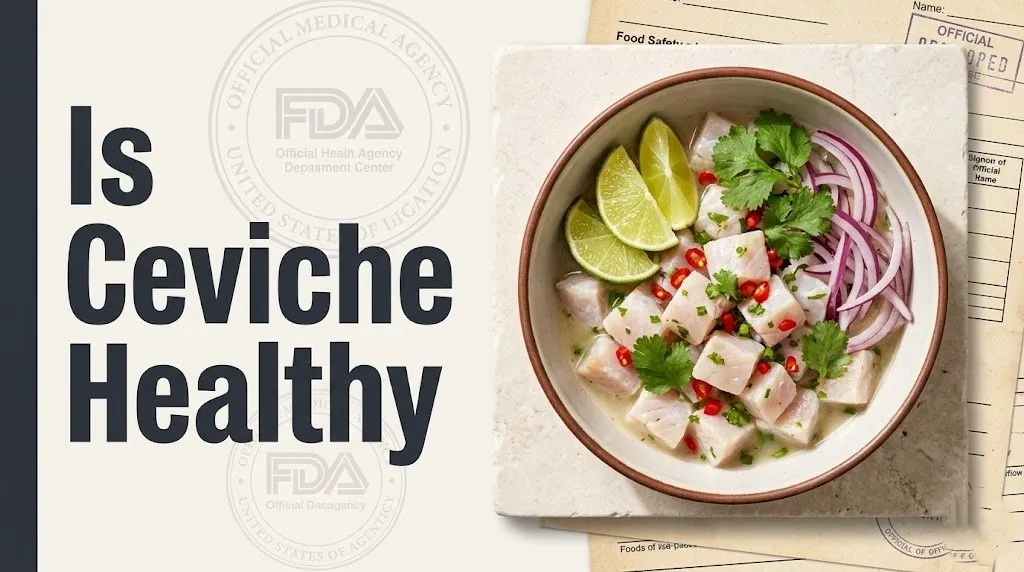
The absence of cooking oil is what separates ceviche from most other seafood preparations. A piece of grilled fish typically picks up oil from the grill surface and any basting fat. Fried fish absorbs significant cooking oil. Ceviche uses no heat and no cooking fat. The fish is cured in citrus juice alone. That makes it one of the few ways to eat seafood with no added fat calories.
The tradeoff is sodium. The marinade, known as leche de tigre, contains lime juice, salt, and the liquid released by the fish. Restaurant ceviche is typically salted at multiple stages. The fish gets salted before marinating. The leche de tigre gets seasoned. The final dish gets a finishing salt. The result can be 800 to 1,500 milligrams of sodium per serving before any chips or tostadas enter the picture.
is ceviche healthy for you
Ceviche is healthy for you if you are a generally healthy adult with no compromised immune function and you eat it from a reputable source that follows federal seafood safety guidelines. The “for you” in this question is doing more work than most people realize. Ceviche’s health value is not universal. It depends on who you are and where you got the fish.
The nutritional benefits apply broadly. Protein supports muscle maintenance and repair. Omega-3 fatty acids, specifically eicosapentaenoic acid (EPA) and docosahexaenoic acid (DHA), reduce inflammation and support brain function. The American Heart Association recommends eating two servings of fish per week for cardiovascular health. Ceviche fits that recommendation neatly.
The safety profile, however, is not universal. The FDA advises that people with compromised immune systems, liver disease, diabetes, or chronic gastrointestinal conditions should not consume raw or partially cooked seafood. The acid in ceviche does not kill bacteria. Vibrio, Listeria, and Salmonella all survive the citrus marinade. If the fish carried a pathogen load when it went into the bowl, that load is still there when you eat it.
The parasite question is more nuanced. Federal law requires that fish sold for raw consumption be frozen to specific temperatures that kill parasites. The FDA Food Code specifies freezing at minus 4 degrees Fahrenheit for 7 days or minus 31 degrees Fahrenheit for 15 hours. Fish that meets this standard is effectively parasite-free. The problem is that not all ceviche is made from fish that was frozen to this standard, and state enforcement varies.
is shrimp ceviche healthy
Shrimp ceviche is healthy by the same nutritional standards as fish ceviche, with a few key differences. Shrimp is lower in omega-3 fatty acids than oily fish like mackerel or tuna. It is higher in cholesterol, containing roughly 150 to 190 milligrams per six-ounce serving. It is also slightly higher in protein per ounce than most finfish.
The cholesterol in shrimp was once considered a dietary concern. That thinking has shifted. The USDA Dietary Guidelines for Americans removed the 300-milligram daily cholesterol limit in 2015 after research showed that dietary cholesterol has a smaller effect on blood cholesterol than saturated fat and trans fats. For most people, the cholesterol in shrimp ceviche is not a health concern.
Shrimp ceviche has one safety advantage over fish ceviche. Shrimp are less likely to carry the Anisakis parasite that infects finfish. Anisakis is a nematode that embeds in the muscle tissue of fish. It does not typically infect crustaceans. The parasite risk in shrimp ceviche is lower than in fish ceviche, though bacterial risks remain the same.
The preparation method for shrimp ceviche differs from fish ceviche in one important way. Shrimp are often blanched briefly in boiling water before being marinated. This step kills surface bacteria and firms the texture. If you are making shrimp ceviche at home, a 30-second blanch in boiling water followed by an ice bath significantly improves safety without meaningfully changing the dish’s nutritional profile.
Key Takeaway: Shrimp ceviche has a lower parasite risk than fish ceviche. The bacteria risk remains. Blanching shrimp before marinating adds a safety margin without sacrificing the dish’s health benefits.
is fish ceviche healthy
Fish ceviche is healthy in direct proportion to the quality and handling of the fish. The nutritional profile is excellent. The safety profile depends on sourcing. A ceviche made from fish that was properly frozen to kill parasites and handled under FDA seafood HACCP standards is a safe, nutritious meal. A ceviche made from never-frozen fish purchased at an unregulated market is a gamble.
The best fish for ceviche are lean, firm-fleshed white fish. Species commonly used include corvina (sea bass), snapper, halibut, flounder, and tilapia. These fish are high in protein and low in saturated fat. Oily fish like mackerel and tuna are also used in some regional ceviche styles. They bring more omega-3s but also a higher risk of histamine formation if the fish was not kept cold enough.
Histamine, also called scombrotoxin, is a compound that forms when certain fish species are stored at improper temperatures. Tuna, mackerel, mahi-mahi, and related species are particularly susceptible. Histamine is not destroyed by the citrus marinade. It causes scombroid poisoning, a reaction that mimics an allergic response with flushing, headache, and gastrointestinal distress. The CDC reports that scombroid poisoning is one of the most common seafood-borne illnesses in the United States.
The FDA requires that fish in the scombroid family be maintained at or below 40 degrees Fahrenheit throughout the supply chain. Restaurants are supposed to verify that their fish suppliers follow these cold-chain requirements. When you order fish ceviche, you are trusting that the restaurant’s supply chain was intact. There is no way to check this yourself.
is ceviche healthy for weight loss
Ceviche is an excellent food for weight loss. It is high in protein, which promotes satiety and preserves lean muscle mass during a calorie deficit. It is low in calories relative to its volume. A generous bowl of ceviche with vegetables can run 250 to 350 calories while delivering enough protein and fiber to keep you full for hours.
The satiety factor is the key advantage. Protein is the most satiating macronutrient. A serving of ceviche containing 40 grams of protein triggers a stronger and longer-lasting fullness signal than an equivalent calorie load from carbohydrates or fats. This means you are less likely to snack between meals or overeat later in the day.
The vegetable content helps too. Traditional ceviche includes onions, peppers, tomatoes, and cilantro. These add volume and fiber with almost no additional calories. The fiber slows digestion slightly, extending the protein’s satiety effect. The vegetables also add micronutrients that support metabolic health during weight loss, including vitamin C, potassium, and various antioxidants.
The weight loss case for ceviche collapses if you eat it with fried tortilla chips. A basket of chips alongside ceviche can add 400 to 600 calories and 20 to 30 grams of fat. The chips are also easy to eat mindlessly. A person trying to lose weight should eat ceviche as a standalone dish or with a side of fresh vegetables, not chips.
Legal Bottom Line: Restaurants are not required to list calorie or sodium content on menus unless they have 20 or more locations under FDA menu labeling rules. Local cevicherias and single-location restaurants may not provide nutrition data. You have to estimate.
how healthy is ceviche
On a scale of common seafood preparations, ceviche ranks near the top for healthiness. It is leaner than fried fish, less processed than canned tuna, and lower in mercury risk than large predatory fish eaten in large portions. The main health mark against it is the sodium content and the raw-food safety risk.
Comparing ceviche to other seafood dishes puts its nutritional value in perspective. A six-ounce portion of fried fish and chips contains roughly 600 to 800 calories, 30 to 40 grams of fat, and 1,200 milligrams of sodium. A six-ounce portion of ceviche contains 200 to 280 calories, 4 to 8 grams of fat, and 800 to 1,500 milligrams of sodium. The ceviche wins on calories and fat. The sodium is a draw or worse depending on the restaurant.
The nutrient density per calorie is what makes ceviche stand out. You get high-quality protein, omega-3s, vitamin C, B vitamins, and several minerals in a package that costs you very few calories. This is the definition of nutrient-dense food. The Academy of Nutrition and Dietetics uses nutrient density as a core concept in its dietary guidance, and ceviche exemplifies the principle.
The mercury risk from ceviche is generally low because it is typically made from smaller fish species like corvina, snapper, and tilapia. These fish are lower on the food chain and accumulate less mercury than tuna, swordfish, and shark. If ceviche is made from tuna or mackerel, the mercury risk increases and portion size should be limited, especially for pregnant women and children.
is ceviche healthy to eat every day
Ceviche is not healthy to eat every day, primarily because of the raw fish safety risk and the sodium load. Even if the fish is perfectly sourced, the cumulative risk of pathogen exposure increases with frequency. The sodium content of daily ceviche would also push most people above the American Heart Association’s recommended limits.
The AHA recommends a sodium limit of 2,300 milligrams per day with an ideal limit of 1,500 milligrams. A single restaurant serving of ceviche can contain 800 to 1,500 milligrams of sodium. Eating that every day leaves little room for sodium from other meals. Exceeding the sodium limit regularly raises blood pressure and increases cardiovascular risk.
The raw fish risk compounds with frequency. The FDA’s parasite destruction standards are effective but not perfect. Freezing kills parasites. It does not kill bacteria. A daily consumer of raw fish has a higher lifetime probability of encountering a pathogen than an occasional consumer. This is a statistical reality, not a commentary on any individual restaurant’s practices.
The nutritional profile of daily ceviche is actually quite good. You would get abundant protein, omega-3s, and micronutrients. The problem is not the nutrition. It is the food safety and sodium math. A reasonable frequency for ceviche consumption is 1 to 3 times per week from a trusted source, which fits within the American Heart Association’s twice-weekly fish recommendation while leaving room for cooked seafood and other protein sources.
is ceviche healthy during pregnancy
No, ceviche is not healthy or safe during pregnancy. The FDA, CDC, and American College of Obstetricians and Gynecologists all recommend that pregnant women avoid raw and undercooked seafood. The citrus marinade does not kill bacteria or parasites that can cause infections dangerous to a developing fetus.
Listeria monocytogenes is the primary concern. Pregnant women are roughly 10 times more likely to contract listeriosis than the general population. Listeria can cross the placenta and cause miscarriage, stillbirth, premature delivery, or life-threatening infection in the newborn. The bacterium survives refrigeration and can grow at temperatures as low as 32 degrees Fahrenheit. It is not killed by citrus acid.
Toxoplasma gondii is another pathogen of concern. It is found in raw or undercooked meat and seafood. Congenital toxoplasmosis can cause vision loss, hearing loss, and developmental delays. The citrus marinade has no effect on Toxoplasma cysts.
The parasite risk is also relevant. Anisakis parasites are killed by proper freezing, but the standard household freezer does not reach the required temperature. Only commercial blast freezers and freezers holding at minus 4 degrees Fahrenheit for 7 days meet the FDA standard. Pregnant women cannot rely on home freezing to make fish safe for ceviche. Cooked seafood is the safe alternative during pregnancy. The FDA recommends cooking fish to an internal temperature of 145 degrees Fahrenheit.
Key Takeaway: Pregnant women should avoid all ceviche regardless of how the fish was sourced. The risk is not worth it. Cook seafood to 145 degrees Fahrenheit instead.
is restaurant ceviche healthy
Restaurant ceviche can be healthy, but you are placing significant trust in the establishment’s sourcing, handling, and sanitation practices. The nutritional profile is the same as homemade ceviche. The safety profile depends on factors you cannot see and the restaurant may not disclose.
A reputable restaurant serving ceviche should be able to tell you three things. First, the species of fish being used. Second, whether the fish was previously frozen to FDA parasite destruction standards. Third, when the ceviche was prepared relative to when it is served. Ceviche should be made to order or within a few hours of service, not the day before.
State health codes vary on how they regulate ceviche service. Some states classify ceviche as a raw fish product subject to the same parasite destruction documentation requirements as sushi. Other states classify it differently because the acid marinade changes the appearance of the fish. In those states, ceviche may fall into a regulatory gray area where the parasite destruction rules are not explicitly applied.
This regulatory variation means that the safety of restaurant ceviche depends partly on which state you are in. A ceviche served in California, which has some of the strictest retail food codes in the country, is held to a higher regulatory standard than one served in a state with less specific raw fish requirements. The consumer cannot easily verify which rules apply. Asking the server whether the fish was commercially frozen for parasite destruction is a reasonable question that a legitimate restaurant should be able to answer.
is homemade ceviche healthy
Homemade ceviche can be healthy and safer than restaurant ceviche if you follow specific sourcing and handling protocols. You control the fish source, the sanitation of your kitchen, the sodium level, and the time between preparation and consumption. You also control whether the fish was properly frozen.
The FDA recommends that home cooks use commercially frozen fish for ceviche. Fish labeled “sushi-grade” or “sashimi-grade” has typically been frozen to parasite destruction standards. These labels are not federally regulated, so they are not a guarantee. But reputable fishmongers and seafood markets use these terms to indicate fish that has been frozen in accordance with FDA guidelines.
Home freezing in a standard freezer is not sufficient. Most home freezers operate at 0 degrees Fahrenheit. The FDA requires minus 4 degrees Fahrenheit for 7 days for parasite destruction. The 4-degree difference matters. If you want to make ceviche from never-frozen fish, freeze it at minus 4 degrees for 7 days, which requires a freezer thermometer to verify.
Sodium control is the other advantage of homemade ceviche. You can salt the fish lightly or use a low-sodium alternative like potassium chloride salt blends. You can also skip the finishing salt. A homemade ceviche can easily contain 400 to 600 milligrams of sodium, less than half of a typical restaurant portion. This makes homemade ceviche a better fit for people monitoring their sodium intake.
is ceviche healthy compared to cooked fish
Ceviche is roughly as healthy as cooked fish from a nutritional standpoint, with the added risk of raw consumption. The protein, fat, and micronutrient profiles are similar. The acid marinade does not destroy nutrients. Some water-soluble vitamins, including vitamin C from the lime juice, are present in ceviche but absent from cooked fish.
The protein in ceviche is denatured by acid rather than heat. Denaturation is the process by which proteins unfold and change shape. Heat denatures proteins. Acid denatures proteins. The nutritional result is similar. The amino acids are the same. Your body absorbs them the same way. The acid-curing does not make the protein more or less bioavailable than cooking with heat.
Vitamin C is a nutritional advantage of ceviche over cooked fish. Fish contains no vitamin C naturally. The lime juice in ceviche provides 20 to 30 percent of the daily recommended vitamin C intake per serving. Cooked fish with a squeeze of lemon after cooking provides some, but the lime juice in the ceviche marinade is consumed in full. You drink the leche de tigre.
The safety comparison is the tradeoff. Cooked fish heated to 145 degrees Fahrenheit is free of live bacteria and parasites. Ceviche fish carries the raw-food risk profile. If the fish was properly handled and frozen, the risk is low but not zero. If you are immunocompromised, pregnant, or have a condition that makes infection more dangerous, cooked fish is the better choice.
Legal Bottom Line: The FDA Food Code classifies ceviche as a raw animal food requiring a consumer advisory on menus. Restaurants must post a disclosure reminding you that consuming raw or undercooked animal products increases your risk of foodborne illness.
is octopus ceviche healthy
Octopus ceviche is healthy, with a nutritional profile similar to fish ceviche but higher in protein and lower in fat. Octopus is extremely lean. A six-ounce serving contains roughly 50 grams of protein and 2 to 3 grams of fat. It is also rich in iron, copper, and vitamin B12.
The texture of octopus ceviche is different from fish ceviche because octopus must be cooked before marinating. Raw octopus is too tough to eat. It is typically simmered or braised until tender, then sliced and marinated in citrus. The pre-cooking step eliminates the raw-food safety risk. Bacteria are killed during cooking. The citrus marinade is for flavor, not curing.
This pre-cooking makes octopus ceviche the safest ceviche from a foodborne illness perspective. It is not raw. It is cooked seafood dressed in citrus. The same is true of shrimp ceviche when the shrimp are blanched first. If you are concerned about raw fish risk but want the ceviche experience, octopus or cooked shrimp ceviche is your best option.
The sodium concern remains. Octopus ceviche is salted during cooking, during marinating, and during finishing. Restaurant versions can still push 1,000 milligrams of sodium per serving. Homemade versions can be controlled. The cooking liquid should be salted modestly, and the marinade can use citrus, herbs, and chili heat for flavor with less salt.
is ceviche healthy without chips
Yes, ceviche without chips is significantly healthier. The chips are the least healthy component of a ceviche meal. Removing them eliminates refined carbohydrates, added fat from frying, and several hundred calories. A bowl of ceviche eaten as a standalone dish or with vegetables is one of the healthiest seafood meals available.
A typical restaurant serving of tortilla chips alongside ceviche contains 400 to 600 calories and 20 to 30 grams of fat, much of it from the frying oil. The chips also add 300 to 500 milligrams of sodium. This means the chips can nearly double the calorie load of the meal while adding no protein, no beneficial fatty acids, and minimal micronutrients.
Better alternatives to chips include cucumber slices, jicama sticks, bell pepper strips, or a side salad. These add volume and fiber without the calorie and fat load. Some cevicherias in coastal regions serve ceviche with a side of sweet potato or boiled corn, which are traditional accompaniments that add complex carbohydrates and fiber rather than fried refined carbs.
If you cannot give up the crunch, consider baked tortilla chips or a small portion of plantain chips. Both are still calorie-dense but avoid the frying oil. The key is portion control. A handful of chips, roughly one ounce, adds about 140 calories and makes the meal feel complete without overwhelming it. A basket of chips eaten mindlessly while talking adds more calories than the ceviche itself.
is ceviche healthy for a low sodium diet
No, traditional ceviche is not healthy for a low sodium diet unless you make it yourself and control the salt. Restaurant ceviche is one of the higher-sodium seafood preparations available. The curing process, the marinade seasoning, and the finishing salt combine to push sodium levels into territory that does not fit a low-sodium eating plan.
A person on a low sodium diet is typically aiming for 1,500 to 2,000 milligrams of sodium per day. A single restaurant ceviche serving can contain 800 to 1,500 milligrams, consuming half to the entire day’s sodium allowance in one dish. When chips are added, the meal can exceed 2,000 milligrams of sodium by itself.
Homemade ceviche can be made low sodium by using the minimum salt needed for flavor, skipping the finishing salt, and using potassium chloride salt substitutes. The acid from the lime provides enough brightness that salt can be reduced without making the dish taste flat. Fresh herbs, chili peppers, garlic, and ginger add flavor that compensates for less salt.
The marinade itself, the leche de tigre, is where most sodium hides. In restaurants, this liquid is heavily seasoned. At home, you can make a low-sodium version with lime juice, a small amount of salt, and plenty of aromatics. The fish will still cure. The flavor will still be bright. The sodium will be a fraction of what a restaurant serves.
Key Takeaway: Restaurant ceviche is a high-sodium food. Homemade ceviche can be made low sodium without sacrificing flavor by controlling the salt in the marinade and using herbs and chili for taste.
is ceviche healthy for your heart
Ceviche is heart healthy when made from fish rich in omega-3 fatty acids and when sodium is controlled. The omega-3s in fish reduce inflammation, lower triglycerides, and slightly decrease blood pressure. The American Heart Association specifically recommends eating fish twice per week for cardiovascular benefit.
The type of fish used in the ceviche determines the omega-3 content. Oily fish like mackerel, tuna, and sardines deliver 1,000 to 2,000 milligrams of combined EPA and DHA per serving. Lean white fish like tilapia, corvina, and snapper deliver 200 to 500 milligrams. The heart benefit is proportionally larger from oily fish ceviche.
The sodium variable complicates the heart health equation. High sodium intake raises blood pressure, a major cardiovascular risk factor. A ceviche made from omega-3-rich mackerel but loaded with salt may wash out the blood pressure benefit. A ceviche made from lean white fish with controlled sodium provides a net heart health benefit, just a smaller one.
The saturated fat content of ceviche is negligible, which is a point in its favor. The AHA recommends limiting saturated fat to reduce LDL cholesterol. Ceviche, made without butter, cream, or cheese, contains almost no saturated fat. It replaces a potential saturated fat protein source with a lean one. That substitution alone supports heart health.
is ceviche healthy after a workout
Ceviche is an excellent post-workout meal. It delivers high-quality protein for muscle repair, is easy to digest, and replaces fluids lost through sweat. The protein is highly bioavailable, meaning your body absorbs and uses a large percentage of it for muscle protein synthesis.
The protein in ceviche is already partially denatured by the acid marinade. This makes it slightly faster to digest than cooked fish protein that has been heat-denatured into a tighter structure. The difference is small, but for someone trying to get amino acids into muscle tissue quickly after training, the speed of digestion matters.
The fluid replacement aspect is often overlooked. Ceviche is a wet dish. The leche de tigre is mostly water with lime juice and dissolved fish proteins. Eating ceviche after a sweaty workout replaces fluid and electrolytes. The sodium in the dish, normally a concern, is actually beneficial after significant sweat loss. Sodium is the primary electrolyte lost in sweat, and it needs to be replaced.
The low fat content of ceviche makes it digest quickly compared to a fatty post-workout meal like fried fish or a cheeseburger. Fat slows gastric emptying. Protein consumed without much fat reaches the small intestine faster and amino acids appear in the bloodstream sooner. For optimal post-workout recovery, eat ceviche within 60 to 90 minutes of finishing your training session.
is ceviche healthy for people with diabetes
Ceviche is healthy for people with diabetes because it contains almost no carbohydrates, is high in protein, and has a minimal effect on blood glucose. The dish does not trigger an insulin response the way a carbohydrate-heavy meal does. It can be eaten as a standalone meal or as part of a balanced plate.
The protein in ceviche helps with blood sugar management in two ways. It slows the absorption of any carbohydrates eaten alongside the ceviche, blunting blood sugar spikes. It also promotes satiety, which helps prevent overeating and snacking between meals. Both effects are useful for someone managing type 2 diabetes.
The absence of refined carbohydrates in traditional ceviche is a major advantage. Many convenient foods are carb-heavy. Ceviche is not. The vegetables in the dish, onions, peppers, tomatoes, and cilantro, add fiber and micronutrients without spiking blood sugar. Even the lime juice, while acidic, has negligible sugar content.
The sodium caution applies to people with diabetes as well. Diabetes increases cardiovascular risk, and high sodium intake compounds that risk. Choosing a lower-sodium ceviche or making it at home is the smart approach. Avoid the chips and the sugary beverages that often accompany ceviche at restaurants. The ceviche itself is blood-sugar friendly. What you eat with it may not be.
is ceviche healthy for the mediterranean diet
Ceviche fits the Mediterranean diet pattern well, even though it is not a traditional Mediterranean dish. The Mediterranean diet emphasizes seafood, fresh vegetables, citrus, herbs, and healthy fats. Ceviche contains all of these. It aligns with the diet’s principles of whole-food ingredients and minimal processing.
The Mediterranean diet, as described by the Harvard T.H. Chan School of Public Health and the Oldways Preservation Trust, prioritizes fish and seafood over red meat, uses olive oil as the primary fat, and includes abundant vegetables and herbs. Ceviche uses fish, lime rather than olive oil as the primary flavor, and plenty of vegetables. It is a close cousin to Mediterranean seafood salads dressed with lemon and olive oil.
The missing component is olive oil. Traditional Peruvian ceviche does not include olive oil. Some modern versions do drizzle oil over the finished dish. Adding a teaspoon of extra virgin olive oil to ceviche brings it closer to the Mediterranean fat profile without adding meaningful calories. The oil also carries fat-soluble flavors from the herbs and chili.
For someone following the Mediterranean diet, ceviche is a good option when eating out or cooking at home. It provides the fish serving that the diet recommends, it is vegetable-forward, and it avoids the refined carbohydrates and processed ingredients that the Mediterranean pattern excludes.
Key Takeaway: Ceviche is one of the healthiest seafood preparations available. It is high in protein, low in calories and saturated fat, and rich in micronutrients. The health risks are food safety from raw fish and sodium from restaurant preparations. Control the fish source and the salt, and ceviche is an excellent addition to a healthy eating pattern.
Common Questions About Ceviche Health and Safety
Is ceviche safe to eat because the lime juice cooks it?
No, lime juice does not cook ceviche in any way that kills pathogens.
The acid denatures the fish proteins, which changes the texture from translucent to opaque, but it does not kill bacteria, parasites, or viruses.
Only proper freezing to FDA standards or heat cooking to 145 degrees Fahrenheit makes raw fish safe.
The term “cooking with acid” is a culinary description, not a food safety process.
Can you get parasites from eating ceviche?
Yes, you can get parasites from ceviche if the fish was not properly frozen before preparation.
The Anisakis parasite infects many species of finfish and can cause severe gastrointestinal illness.
The FDA requires fish sold for raw consumption to be frozen at minus 4 degrees Fahrenheit for 7 days or minus 31 degrees for 15 hours.
Restaurants are supposed to maintain records of this freezing, but enforcement varies by state.
How many calories are in a bowl of ceviche?
A standard bowl of fish ceviche, roughly 6 ounces of fish plus vegetables and marinade, contains 200 to 280 calories.
Shrimp ceviche is similar, at roughly 180 to 240 calories for the same serving size.
The calorie count rises if the ceviche is served with avocado, tortilla chips, or tostadas.
A bowl of ceviche without fried accompaniments is a low-calorie, high-protein meal.
What is the healthiest fish to use for ceviche?
Lean white fish like corvina, snapper, halibut, and flounder are healthy choices that are high in protein and low in saturated fat.
Oily fish like mackerel and tuna provide more omega-3 fatty acids but carry a higher histamine risk if the cold chain was broken.
The healthiest fish is one that was commercially frozen to FDA parasite destruction standards and handled under proper refrigeration.
Ask your fishmonger or server about sourcing and freezing before choosing.
Is ceviche healthier than sushi?
Ceviche and sushi are comparably healthy, with ceviche having a slight edge because it contains no refined white rice.
Sushi rice adds carbohydrates and calories that ceviche does not have.
Both dishes rely on raw fish and carry the same food safety risks.
The health comparison depends more on fish sourcing, sodium content, and what accompaniments are served than on the core preparation method.
The most important fact about ceviche is that the lime juice does not make it safe. The safety comes from what happened to the fish before it touched the acid. Properly frozen fish from a reputable source makes ceviche a healthy, nutrient-dense meal. Improperly handled fish makes it a health risk.
When you order ceviche, ask whether the fish was commercially frozen for parasite destruction. A good restaurant can answer that question. When you make it at home, use commercially frozen fish or freeze it yourself at the correct temperature. Control the salt. Skip the fried chips.
Ceviche earns its reputation as a healthy dish. High protein, low fat, rich in omega-3s and vitamin C, and naturally free of refined carbohydrates. It is as healthy as the fish it is made from.