Most oral surgeons and general dentists recommend waiting at least 7 to 10 days before eating spicy food after wisdom teeth removal. For patients who had a surgical extraction (meaning the tooth was cut from below the gum line), the Cleveland Clinic’s post-operative guidelines suggest waiting closer to 2 full weeks before reintroducing anything that could irritate the healing socket.
That timeline matters because spicy food does more than just sting. It triggers an active inflammatory response at the extraction site, raises the risk of dislodging the blood clot protecting the socket, and can introduce heat and acidity into a wound that has not yet closed. The American Dental Association notes that complications from improper post-extraction diet are one of the leading preventable causes of delayed healing after wisdom tooth surgery.
This guide covers the full picture: why spicy food is genuinely problematic (not just uncomfortable), a week-by-week food guide for your entire recovery, the real risk of dry socket, what individual factors change your timeline, and how to get flavor back into your meals while you wait.
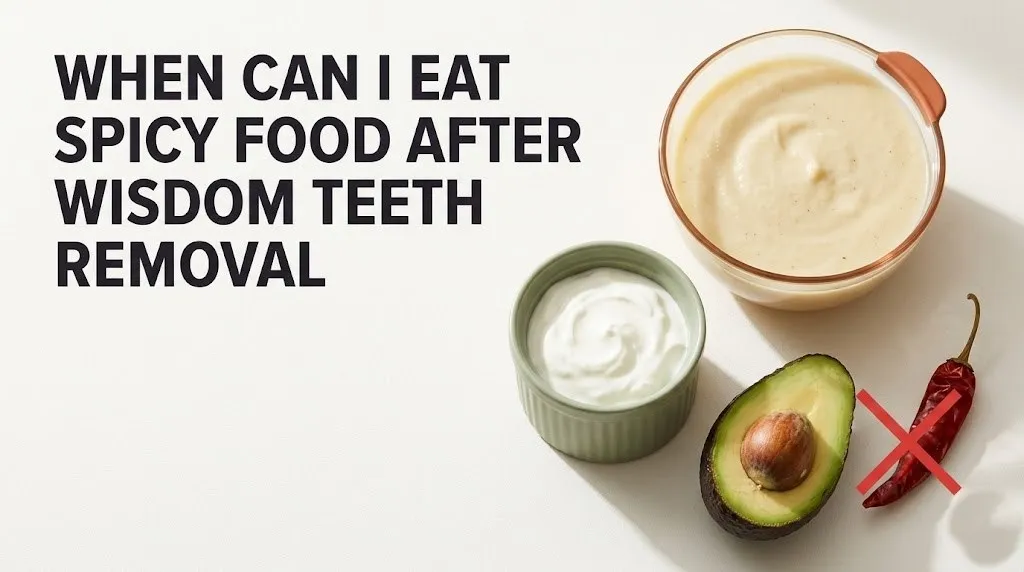
When Can I Eat Spicy Food After Wisdom Teeth Removal
You can eat spicy food after wisdom teeth removal once the extraction socket has formed a stable layer of granulation tissue, which typically takes 7 to 14 days from the surgery date.
The 7-day mark applies to patients who had an uncomplicated, simple extraction of one or two teeth with no stitches and no signs of complications. The 14-day mark is more appropriate for surgical extractions, impacted wisdom teeth removed in pieces, or cases involving multiple simultaneous extractions.
Neither timeline is a guarantee. The only reliable confirmation is a visual check by your oral surgeon or dentist at your follow-up appointment. If you are healing ahead of schedule, they may clear you earlier. If there is any sign of inflammation, delayed clotting, or early-stage alveolar osteitis (dry socket), the timeline extends significantly.
What “spicy” means also matters here. A dish with a trace of black pepper behaves differently at a wound site than a bowl of chili made with fresh Scotch bonnets. The mechanism behind each type of spice-based heat is distinct, and they carry different risk levels. The sections below explain those differences.
| Recovery Stage | Days Post-Surgery | Spicy Food Status |
|---|---|---|
| Acute healing | Days 1 to 3 | Strictly avoid all spicy food |
| Active clot protection | Days 4 to 7 | Avoid spicy food |
| Granulation tissue forming | Days 7 to 14 | Avoid; may cautiously reintroduce mild spice at day 10 with clearance |
| Soft tissue closure | Days 14 to 21 | Mild spice generally tolerable; confirm with provider |
| Full soft tissue healing | Day 21 and beyond | Most spicy foods safe for most patients |
Why You Can’t Eat Spicy Food After Wisdom Teeth Removal
Spicy food is restricted after wisdom teeth removal because of three overlapping mechanisms that all work against a healing extraction socket.
The first is capsaicin’s effect on pain receptors. Capsaicin (8-methyl-N-vanillyl-6-nonenamide), the active compound in chili peppers (Capsicum annuum), binds to TRPV1 (transient receptor potential vanilloid 1) receptors in nerve tissue. These receptors respond by triggering a pain signal and stimulating local vasodilation, meaning increased blood flow and inflammatory activity at the site. An open socket has exposed nerve endings, which makes this response dramatically more intense than it would be in an intact mouth.
The second mechanism is thermal and chemical irritation. Many spicy dishes are also served hot, and hot liquids or foods are independently contraindicated after extraction because heat disrupts clot formation. Vinegar-based hot sauces add acetic acid to the equation, with pH levels typically between 2.5 and 4.0, which can soften and break down the fibrin matrix holding the blood clot in place.
The third issue is mechanical disruption from eating behavior. Chewing spicy, textured foods involves tongue movement, jaw pressure, and suction-like mouth actions that can physically dislodge a clot. The combination of these three factors makes spicy food one of the higher-risk categories after extraction.
- Capsaicin activates TRPV1 receptors, triggering pain and local inflammation
- Acetic acid in vinegar-based hot sauces degrades the blood clot’s fibrin structure
- Heat from hot food disrupts platelet aggregation at the clot surface
- Chewing mechanics create pressure and suction that dislodge the clot
What Happens If You Eat Spicy Food Too Soon After Extraction
Eating spicy food too soon after wisdom teeth removal most commonly causes one of three outcomes: sharp localized pain, delayed healing, or the development of dry socket (alveolar osteitis).
The pain response is immediate and usually severe. Because the socket has exposed bone and nerve tissue in the early days, any capsaicin contact triggers an intense burning sensation that can last 30 to 90 minutes and may be followed by throbbing pain as the local inflammatory response peaks.
Delayed healing is a less obvious consequence. According to research published in the Nutrients journal, chronic low-grade inflammation at a wound site impairs the migration of fibroblasts, the cells responsible for laying down new connective tissue. Every episode of chemical irritation from capsaicin or acid sets that process back.
The most serious consequence is dry socket. This occurs when the protective blood clot at the base of the socket is dislodged or dissolves prematurely, leaving the underlying bone exposed. The pain from dry socket is described consistently in oral surgery literature as a deep, throbbing ache that radiates to the jaw, ear, and temple. It requires clinical treatment, typically irrigation of the socket and placement of a medicated dressing by your oral surgeon.
Key finding: A study in the Journal of Oral and Maxillofacial Surgery identified diet as one of the modifiable risk factors for post-extraction complications, alongside smoking and inadequate clot formation.
Key Takeaway: Wait at least 7 to 14 days before eating spicy food after wisdom teeth removal. The exact timeline depends on the type of extraction and your individual healing rate, confirmed at your follow-up appointment.
How Spicy Food Affects the Blood Clot and Healing Site
The blood clot that forms in your extraction socket within the first few hours after surgery is not just there to stop bleeding. It is the biological scaffold on which all subsequent healing depends.
This clot, made of fibrin and platelets, protects the exposed bone and nerve tissue below it. Over days 2 through 5, the body begins converting this clot into granulation tissue, a mixture of new blood vessels, fibroblasts, and collagen that eventually closes the socket from the bottom up.
Spicy food threatens this process at multiple points. Capsaicin promotes local vasodilation, which increases blood pressure at the wound site and can cause minor bleeding that physically displaces the clot. The NIH’s wound healing research database notes that any repeated trauma to a healing socket, including chemical irritation, resets the inflammatory phase and delays the transition to the proliferative (tissue-building) phase.
Vinegar-based hot sauce presents a specific additional risk. The acetic acid in standard commercially produced hot sauce can temporarily lower the pH of oral fluid at the socket site. The fibrin network holding the clot together is pH-sensitive, and acid exposure weakens its structural integrity.
Think of the blood clot like the scaffolding on a building under construction. Remove it too early, and the work that was already done collapses. Every time capsaicin or acid hits the site, it is like shaking that scaffolding before the concrete has set.
Can Spicy Food Cause Dry Socket
Yes, spicy food can contribute to dry socket (alveolar osteitis), though it is rarely the sole cause.
Dry socket occurs when the blood clot protecting the extraction socket is lost or fails to form properly. It affects approximately 2 to 5% of routine tooth extractions and up to 20% of lower wisdom tooth extractions, according to estimates cited in oral surgery literature.
Spicy food fits into the dry socket risk framework in two ways. Chemically, capsaicin-driven vasodilation and acid-induced fibrin degradation both weaken the clot. Mechanically, the eating behavior required to consume most spicy meals (chewing, suction, tongue pressure) creates physical forces that can dislodge a clot that is not yet fully integrated with the surrounding tissue.
It is worth being clear: dry socket is not caused by one bite of mild salsa on day 8. The risk is highest in the first 72 hours after extraction, when the clot is newest and most fragile. The risk drops substantially after day 5, though it does not disappear until the socket has closed with granulation tissue.
| Risk Factor | Increases Dry Socket Risk? |
|---|---|
| Spicy food in first 72 hours | Yes, meaningfully |
| Smoking | Yes, strongly |
| Drinking through a straw | Yes, strongly |
| Oral contraceptive use | Yes, modest increase |
| Surgical complexity | Yes, more complex = higher risk |
| Mild spice at day 10+ | Low risk for most patients |
Signs of Dry Socket You Should Not Ignore
Dry socket produces a distinct and recognizable symptom pattern. The primary sign is severe, throbbing pain that begins 2 to 4 days after extraction, after a period when pain seemed to be improving.
This is the most important detail to understand. The pain of dry socket does not begin immediately after surgery. It starts when the clot fails or dislodges, typically a few days in. If your post-extraction pain was getting better and then suddenly gets significantly worse, that reversal is the signal to call your oral surgeon that day.
Other signs include:
- A visible empty-looking socket where the dark blood clot should be visible
- Pain radiating to the jaw, ear, or temple on the affected side
- A bad taste or odor from the socket that does not resolve with gentle rinsing
- Sensitivity to cold air or liquid in that area of the mouth
Dry socket requires professional treatment. A dentist or oral surgeon will irrigate the socket, remove any debris, and place a medicated dressing (typically zinc oxide-eugenol-based) that provides relief within minutes of application. The dressing is replaced every few days until healing progresses.
Do not attempt to self-treat dry socket with clove oil or home remedies without first confirming the diagnosis with your provider. Eugenol (the active compound in clove oil) can be effective in a controlled clinical concentration, but inappropriate application at home can cause chemical burns to surrounding tissue.
Key Takeaway: Spicy food is one of several risk factors for dry socket, and the danger is highest in the first 72 hours. Reversal of pain improvement, 2 to 4 days post-surgery, is the signature warning sign that requires immediate professional attention.
What to Eat After Wisdom Teeth Removal: Day-by-Day Guide
The goal of post-extraction eating is to get adequate calories, protein, and micronutrients to support healing without putting any mechanical, thermal, or chemical stress on the extraction site.
Day 1 is liquid only. Cold or room-temperature liquids are safest. The Mayo Clinic’s post-surgical nutrition guidance supports prioritizing protein in the early liquid stage, since amino acids from protein are the primary raw material for granulation tissue formation.
From days 2 through 5, soft, blended, or mashed foods are appropriate. The key is texture: nothing that requires real chewing, nothing with small particles that can enter the socket (like seeds or grains), and nothing acidic or spicy.
From days 5 through 10, most patients can begin introducing soft solids: soft scrambled eggs, tender-cooked pasta, well-cooked fish, soft tofu, and ripe banana.
| Day Range | Food Examples | Temperature | Spicy Food |
|---|---|---|---|
| Day 1 | Broth, protein shakes, water, diluted juice | Cold or room temp | Strictly no |
| Days 2 to 3 | Yogurt, applesauce, blended soup, mashed potato | Room temp | Strictly no |
| Days 4 to 5 | Soft scrambled eggs, ripe banana, soft tofu, avocado | Warm (not hot) | Strictly no |
| Days 6 to 7 | Tender fish, soft pasta, well-cooked vegetables | Warm | No |
| Days 8 to 10 | Most soft foods, tender meat, soft bread | Normal | Mild only, with clearance |
| Days 14+ | Most foods | Normal | Generally safe, confirm with provider |
One group to flag: people with diabetes should be especially careful with the high-sugar options in early recovery (fruit juice, applesauce). Choosing plain Greek yogurt, protein shakes made with unsweetened almond milk, and savory blended soups keeps both blood sugar and healing on track.
Soft Foods That Actually Help You Heal After Wisdom Teeth Removal
The best soft foods for wisdom teeth recovery are not just tolerable; they actively support the healing process through specific nutrients.
Protein is the most important recovery nutrient. According to the NIH’s wound healing research, inadequate dietary protein directly impairs collagen synthesis and slows the proliferative phase of healing. Greek yogurt provides approximately 17 grams of protein per 170-gram serving and requires no chewing. Soft-cooked eggs deliver 6 grams of protein each, along with leucine, the amino acid most directly associated with muscle and tissue repair signaling.
Vitamin C (ascorbic acid) is the second priority. Collagen formation requires ascorbic acid as a cofactor for the enzyme prolyl hydroxylase, which stabilizes the collagen triple helix. Smooth blended foods made from ripe mango, kiwi (blended), or papaya deliver meaningful ascorbic acid without requiring any chewing or acidity that would irritate the socket.
Zinc is a third key nutrient for this phase. Research published in the Nutrients journal confirms that zinc deficiency measurably delays wound healing. Soft-cooked lentil soup and plain hummus are both zinc-dense and socket-friendly.
Strong healing food options include:
- Plain Greek yogurt (protein, calcium, probiotics for oral microbiome balance)
- Smooth mashed sweet potato (beta-carotene, vitamin C, soft texture)
- Silken tofu blended into soups (complete protein, very soft texture)
- Well-cooked lentil soup (zinc, iron, protein, fiber)
- Ripe avocado (healthy monounsaturated fats, vitamin E, potassium)
- Cold bone broth (gelatin, glycine, collagen precursors)
Foods to Avoid After Wisdom Teeth Removal Beyond Spicy Food
Spicy food gets the most attention in post-extraction diet advice, but several other food categories carry equal or higher risk in the first week.
Crunchy and hard foods are the most mechanically dangerous. Chips, crackers, nuts, raw vegetables, and toast with a hard crust all create fragments that can enter the socket, cause trauma, and interrupt clot integrity. The risk from a chip fragment entering a socket is arguably more immediate than the risk from mild spice.
Hot liquids and foods are independently problematic. Hot coffee, hot soup, and hot tea all carry thermal risk. Heat dilates blood vessels at the wound site and can cause renewed bleeding, even after the initial clot has formed. Room-temperature broth is always a better choice than a steaming bowl.
Alcohol is frequently overlooked in recovery diet advice. Ethanol is a vasodilator. It also interacts with standard post-extraction pain medications (acetaminophen, ibuprofen, and especially narcotic analgesics), and it can dehydrate oral tissue, impairing the saliva production that naturally cleans and buffers the socket environment.
Foods to avoid in the first week:
- Spicy food of any kind
- Crunchy foods (chips, crackers, nuts, raw vegetables, popcorn)
- Hot liquids and hot meals
- Alcohol
- Carbonated drinks (suction from fizz and the pressure created by bubbles)
- Foods with small particles or seeds (sesame seeds, rice, granola, corn)
- Chewy foods (bagels, tough meat, gummy candy) that require sustained jaw pressure
- Citrus and acidic foods (lemon, tomato sauce, vinegar-based dressings)
Key Takeaway: Crunchy, hot, and alcohol-containing foods can be just as damaging as spicy food after wisdom teeth removal; the full avoidance list is longer than most recovery guides acknowledge.
When Can I Eat Normally After Wisdom Teeth Removal
Most patients can return to a relatively normal diet by 3 to 4 weeks after wisdom teeth removal, though full bone healing beneath the gum line continues for 3 to 6 months.
The soft tissue milestone is the practical one for eating. Once the gum tissue has closed over the socket and granulation tissue has filled the void, the physical vulnerability to food trauma drops dramatically. For most uncomplicated extractions, this soft tissue closure occurs between days 14 and 21.
Returning to normal eating should be gradual, not sudden. Reintroduce one new food category at a time, starting with softer versions of foods you are considering. If a food causes pain, pressure, or bleeding, pull back and wait another few days.
Spicy food specifically can be reintroduced in a mild form around days 10 to 14 for most patients, and in full heat intensity at 3 weeks for patients with no complications. This is a general guideline. Confirming with your oral surgeon at your scheduled follow-up visit, typically at 7 to 10 days post-surgery, gives you personalized clearance based on what they observe at your actual extraction site.
Patients with impacted wisdom teeth that required bone removal (not just soft tissue removal) should expect the 3-to-4-week timeline on the longer end, as bone repair takes precedence over soft tissue healing and is inherently slower.
How Long to Avoid Spicy Food After Tooth Extraction
The standard clinical recommendation is to avoid all spicy food for a minimum of 1 week after any tooth extraction, with 2 weeks recommended for surgical wisdom tooth removals.
This timeline aligns with the general guidance from the American Dental Association’s patient care resources and is consistent with the post-operative instructions issued by most oral surgery practices in 2026.
“Spicy food” for these purposes means anything containing capsaicin (chili-based spice), concentrated piperine (high-dose black pepper), acidic hot sauces, horseradish (Armoracia rusticana), or mustard in amounts that would register as noticeably hot or sharp in the mouth.
Minimal amounts of mild spice, such as a pinch of paprika in a soft-cooked dish, carry a much lower risk than a Sichuan stir-fry. But in the first 7 days, the safer default is to avoid the entire spicy category entirely and use mild herbs like basil, oregano, or a small amount of fresh ginger to add flavor.
| Extraction Type | Minimum Spicy Food Wait |
|---|---|
| Simple single tooth extraction | 7 days |
| Simple wisdom tooth extraction (no impaction) | 7 to 10 days |
| Surgical extraction (impacted wisdom tooth) | 14 days |
| Multiple simultaneous extractions | 14 to 21 days |
| Extraction with significant bone involvement | 21+ days (confirm with surgeon) |
How Individual Factors Change Your Spicy Food Timeline
Not everyone heals on the same schedule, and the standard 1-to-2-week guideline is a population average. Individual factors can shift your actual safe date meaningfully in either direction.
Age is one of the most consistent variables. Younger patients (teens and early twenties) typically heal faster because of higher baseline cellular regeneration rates. Adults over 40 often experience slower granulation tissue formation. According to research reviewed by the NIH, wound healing rate declines measurably with age, though the effect is gradual rather than cliff-like.
Smoking is the most impactful modifiable factor. Nicotine causes vasoconstriction, reducing blood flow to the extraction site and directly impairing the oxygen delivery that granulation tissue formation requires. Smokers have a 3 to 4 times higher risk of dry socket compared to non-smokers, according to data cited in the Journal of Oral and Maxillofacial Surgery. For smokers, the spicy food wait should extend to at least 2 weeks regardless of extraction type.
Medical conditions that affect healing include:
- Type 1 or Type 2 diabetes: Elevated blood glucose impairs neutrophil function and slows the inflammatory and proliferative phases of wound healing. Diabetic patients should confirm their specific timeline with their oral surgeon.
- Autoimmune conditions: Conditions like lupus or rheumatoid arthritis, and the medications used to treat them (corticosteroids, immunosuppressants), can slow wound closure.
- Blood thinners (anticoagulants): These extend the initial bleeding phase and can alter clot architecture, affecting stability.
- Oral contraceptive use: Associated with a modestly increased dry socket risk, likely through estrogen-related effects on clotting factors.
Key Takeaway: Smoking, diabetes, age over 40, and complex surgical extractions all extend the safe spicy-food timeline beyond the standard 1-week baseline; confirm your personal timeline with your oral surgeon at your follow-up appointment.
How to Speed Up Healing After Wisdom Teeth Removal
The fastest healing after wisdom teeth removal comes from three things done consistently: protecting the clot, eating the right nutrients, and avoiding the known risk behaviors.
Clot protection is non-negotiable in the first 72 hours. No straws, no smoking, no rinsing forcefully, no spitting, and no poking at the site with tongue or fingers. Gentle salt water rinses, using approximately half a teaspoon of table salt in 8 ounces of warm (not hot) water, can begin on day 2 to keep the site clean. The Cleveland Clinic recommends rinsing after every meal starting on day 2, using a swishing motion so gentle it does not create suction.
Nutrition accelerates healing in measurable ways. Research published in the Nutrients journal confirmed that patients with higher dietary protein intake during wound healing had faster granulation tissue formation and shorter recovery times. Prioritizing protein at every soft-food meal, targeting at least 60 to 80 grams of protein daily during recovery, gives the body the raw materials it needs.
Sleep and rest matter more than most people expect. During deep sleep, the body’s production of human growth hormone peaks, and cellular repair processes run at full speed. Staying up late, drinking caffeine late in the day, or returning to strenuous exercise before day 5 all compromise this repair window.
Quick tips for faster recovery:
- Sleep with your head elevated on the first two nights to reduce swelling
- Apply an ice pack for the first 24 hours: 20 minutes on, 20 minutes off
- Switch to heat (warm cloth compress) from day 3 onward to promote circulation
- Stay well-hydrated; saliva is your natural wound buffer
- Avoid ibuprofen if your surgeon said to avoid anti-inflammatories (some prefer acetaminophen-only post-ops to allow normal clotting)
When Is the Wisdom Teeth Extraction Site Fully Healed
The soft tissue over a wisdom tooth extraction site is typically fully closed by 3 to 6 weeks after surgery. The underlying bone, however, takes 3 to 6 months to fully remodel and fill in.
For practical purposes like eating spicy food, the relevant milestone is soft tissue closure, not bone healing. Once the gum has closed and there is no longer an open socket visible, the major dietary restrictions lift for most patients.
Your oral surgeon can confirm this visually at a follow-up appointment. Most practices schedule a check at 7 to 10 days post-surgery. If healing is progressing normally, the site at that point will show pink, firm granulation tissue that is beginning to contract over the socket. Full closure is typically visible by week 3 to 4.
The bone remodeling that continues for months beneath the surface is not affected by spicy food once the soft tissue has closed. This means the 3-to-6-month figure, while real, does not extend your dietary restrictions. It is a background healing process that does not require dietary modification.
| Healing Milestone | Typical Timeframe | Dietary Implication |
|---|---|---|
| Initial clot stabilization | Hours 1 to 24 | Liquid diet only |
| Granulation tissue beginning | Days 3 to 5 | Soft foods only |
| Socket partially filled | Days 7 to 14 | Soft diet, mild spice possible at 10+ days |
| Soft tissue closed | Weeks 3 to 6 | Most foods safe, including full-heat spicy foods |
| Full bone remodeling | Months 3 to 6 | No dietary restriction from this process |
Frequently Asked Questions About Eating After Wisdom Teeth Removal
Can I eat mildly spicy food one week after wisdom teeth removal?
For many patients, mildly spicy food at the 7-day mark carries a low risk if healing is progressing normally and there are no signs of dry socket.
“Mildly spicy” means food with a small amount of paprika, mild chili flakes, or gentle seasoning, not fresh chilis or hot sauce.
Confirm with your oral surgeon at your follow-up visit before reintroducing any spice.
Will eating spicy food give me dry socket?
Spicy food can contribute to dry socket if eaten too soon after extraction, but it is rarely the sole cause.
Dry socket results from the blood clot being dislodged or dissolved, and spicy food can trigger both chemical and mechanical disruption of the clot.
The risk is highest in the first 72 hours; spicy food is far less likely to cause dry socket after day 7 if the clot is stable.
What spicy foods are the most dangerous after tooth extraction?
Vinegar-based hot sauces (such as Tabasco or Frank’s RedHot) are among the most risky because they combine capsaicin with acetic acid.
Fresh chili peppers (Capsicum annuum) carry high capsaicin loads and direct tissue contact.
Dishes with visible chili oil, curry paste, or sriracha should also be avoided until the soft tissue has closed.
How do I know when my extraction site is healed enough for spicy food?
A healed extraction site will show pink, firm, and fully closed gum tissue with no visible open socket.
There should be no swelling, no spontaneous pain at rest, and no tenderness when food or liquid contacts the area.
Your oral surgeon can confirm this at your follow-up appointment; a visual check is more reliable than any time-based rule alone.
Can I eat black pepper after wisdom teeth removal?
Black pepper (Piper nigrum) contains piperine, which operates on a different receptor pathway than capsaicin and is generally less irritating to extraction sites.
A very small amount of ground black pepper in cooked food is unlikely to cause significant problems after day 5 for most patients.
If the pepper is visible or concentrated, such as a pepper-crusted dish, the mechanical and chemical contact risk still applies, so caution is warranted in the first week.
Closing
The honest answer to when you can eat spicy food after wisdom teeth removal is this: wait at least a week, get cleared by your oral surgeon at your follow-up, and reintroduce mild spice first before going back to full heat. The standard 7-to-14-day window exists because your extraction site goes through a precise biological sequence that spicy food genuinely disrupts.
Use the recovery period to eat foods that actively help you heal: protein-rich, soft, mild, and nutrient-dense. Greek yogurt, blended soups, soft eggs, and avocado do more good than most people expect.
When the spicy food does come back, it will taste exactly the same as before. The wait is short. The recovery is worth protecting.