Kittens can start eating dry food at around 7 to 8 weeks of age, once their deciduous (baby) teeth have erupted and their digestive system has matured enough to handle solid kibble. Before that window, their jaws, teeth, and gut simply are not ready for hard food.
Getting this timing right matters more than most new cat owners realize. According to the American Animal Hospital Association (AAHA), improper weaning or premature food introduction is one of the leading causes of digestive distress and failure to thrive in young kittens. The difference between a week or two can genuinely affect a kitten’s early development.
This guide covers the full weaning timeline, what happens biologically at each stage, how to make the dry food transition smoothly, which nutrients to look for in kitten kibble, and how feeding needs change as your kitten grows through their first year.
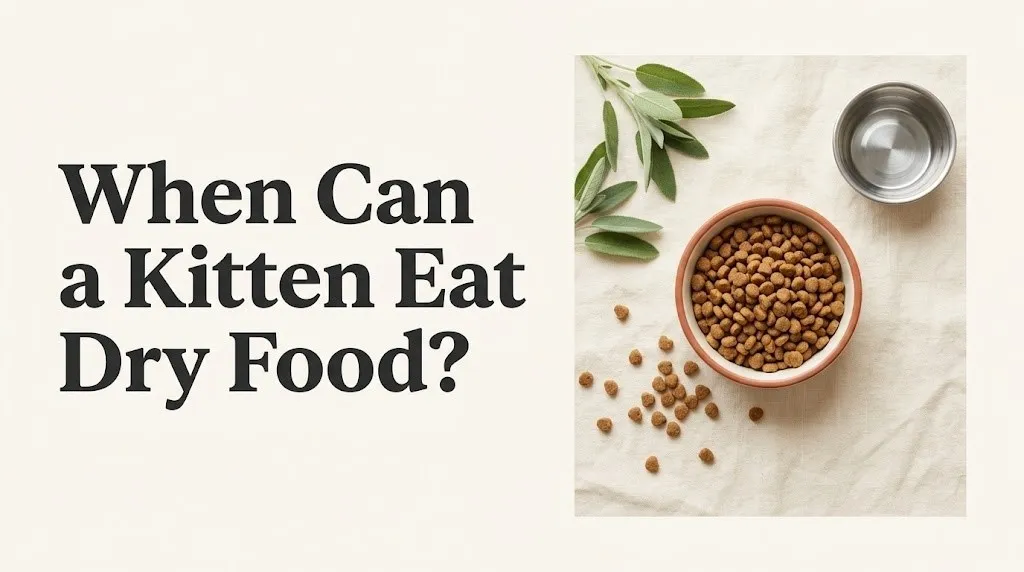
When Can a Kitten Eat Dry Food
Kittens can begin eating dry food between 7 and 8 weeks of age, provided their baby teeth are in and they have already been introduced to solid food through wet or moistened food first.
This is not an arbitrary number. It reflects the developmental window when three things align: the deciduous teeth have emerged enough to break down kibble, the digestive enzymes needed to process solid protein and fat are sufficiently active, and the kitten has learned the mechanics of eating from a bowl rather than nursing.
Dry food offered before this point is not just hard to eat. A kitten’s gastrointestinal tract at 4 or 5 weeks still depends heavily on the enzymes and antibodies in mother’s milk or commercial milk replacer. Introducing hard kibble too early can cause vomiting, diarrhea, or inadequate calorie absorption at a stage when growth is rapid and every nutrient counts.
The Cornell University College of Veterinary Medicine recommends beginning the weaning process with wet food or gruel at 3 to 4 weeks, then gradually shifting toward dry food over the following weeks as the kitten’s abilities develop. Dry food becomes fully appropriate once the kitten is eating solid food reliably and showing no digestive distress.
| Kitten Age | Feeding Stage | Dry Food Status |
|---|---|---|
| 0 to 3 weeks | Mother’s milk or commercial milk replacer only | Not appropriate |
| 3 to 4 weeks | Begin introducing wet food or moistened kibble gruel | Not yet |
| 5 to 6 weeks | Wet food or softened kibble as supplement | Dry only with moisture added |
| 7 to 8 weeks | Transition to solid kibble with fresh water available | Appropriate |
| 8 to 12 weeks | Full dry kitten food diet acceptable | Yes |
| 12 weeks and beyond | Consistent dry kitten food feeding | Yes |
At What Age Can Kittens Eat Dry Food
Most kittens are physically ready for dry food at 7 to 8 weeks old. This is when veterinarians and feline nutrition specialists generally mark the safe start point for unmoistened kibble.
The 7 to 8 week milestone is grounded in dental and digestive development. A kitten’s deciduous incisors typically erupt around 2 to 3 weeks, but the canines and premolars needed to actually crack and chew dry kibble come in between 3 and 8 weeks. Until the full set of 26 deciduous teeth has emerged, hard kibble is genuinely difficult for a kitten to process mechanically.
Age alone, however, is not the only indicator. A kitten who reaches 8 weeks but is underweight or was born prematurely may need a longer weaning period with wet food before dry food becomes practical. Individual readiness varies, and if a kitten at 8 weeks is still struggling with wet food consistency, that is a sign to go slower, not faster.
Quick Tip:
- Check that the kitten is eating wet food reliably from a bowl before introducing dry kibble.
- Weigh your kitten weekly during weaning. Healthy kittens gain roughly 100 grams per week in the first months of life.
- If weight gain stalls during any food transition, consult a veterinarian who can assess the kitten’s specific development and adjust the feeding plan.
When Do Kittens Start Eating Dry Food
Kittens naturally begin showing interest in solid food at 3 to 4 weeks old, though the transition from interest to reliably eating dry food takes several more weeks of gradual introduction.
Think of the weaning process like training wheels on a bicycle. The kitten starts with liquid, moves to a mushy gruel that blends milk replacer with wet or softened food, then progresses to increasingly solid textures as coordination, tooth development, and digestive capacity all improve simultaneously. Trying to skip stages is where owners run into trouble.
The biological driver behind this progression is enzyme production. Kittens are born with high lactase activity, the enzyme needed to digest lactose in mother’s milk. As they grow, lactase activity naturally declines and other digestive enzymes that handle solid protein and fat ramp up. This enzymatic shift is part of what makes the 6 to 8 week window the practical transition zone for solid food.
According to research published in the Journal of Feline Medicine and Surgery, the gastrointestinal microbiome of kittens also undergoes significant changes during weaning. The microbial community shifts from one suited to liquid nutrition toward one capable of fermenting and processing solid food components. Rushing this process by introducing dry food too early can disrupt that microbial development.
Key Takeaway: Kittens are biologically ready for dry food between 7 and 8 weeks, but the transition begins much earlier with wet food at 3 to 4 weeks. Rushing the timeline risks digestive distress and poor nutrient absorption.
Can 6 Week Old Kittens Eat Dry Food
A 6 week old kitten can eat dry food only if it has been softened with warm water to a soft, gruel-like consistency. Hard, unmoistened kibble at 6 weeks is difficult to chew and carries a real risk of digestive upset.
At 6 weeks, most kittens are still completing their deciduous tooth eruption. The back premolars, which do most of the crushing work on hard kibble, may not be fully in yet. Even if all teeth are present, a 6 week old kitten has a small jaw and limited bite force. The result is that dry kibble often goes down partially unchewed, which puts unnecessary strain on a digestive system that is still maturing.
What 6 week old kittens can handle is moistened kibble. Adding warm water to dry kitten food until it softens to a porridge-like texture gives the kitten the caloric density and nutritional profile of kitten kibble without demanding mature chewing ability. As the kitten moves toward 7 and then 8 weeks, the amount of water added can be gradually reduced until the kitten is eating dry kibble comfortably on its own.
Key Fact: The Association of American Feed Control Officials (AAFCO) defines a separate nutritional profile for “growth and reproduction” stage cat foods. This profile requires higher minimum levels of crude protein (30% on a dry matter basis), fat (9%), and specific nutrients like taurine and DHA compared to adult maintenance formulas. Using an AAFCO-compliant kitten food at this stage, whether wet or moistened dry, matters nutritionally.
When Can Kittens Eat Hard Food
Kittens can eat unmoistened hard (dry) kibble reliably starting at 7 to 8 weeks, once all deciduous teeth have erupted and the kitten is chewing confidently.
“Hard food” and “dry food” mean the same thing in practice. What changes at 7 to 8 weeks is not just the teeth. The jaw muscles have strengthened enough to generate the bite force needed to crack a piece of kibble. At 4 to 5 weeks, the same jaw is barely strong enough to handle a lick of wet food from a spoon.
Kibble size also matters for young kittens. Standard adult-size kibble can be too large for a kitten’s mouth. Many kitten-specific dry food formulas address this by using smaller kibble pieces designed for growing cats’ jaw proportions. If you are feeding a kibble not specifically formulated for kittens, always check that the piece size is appropriate for the kitten’s age and size.
Large-breed kittens such as Maine Coons and Ragdolls can take longer to develop the jaw strength and body size needed for standard kibble. Owners of large-breed kittens should monitor chewing ability closely and consider extending the moistened-kibble phase until 9 to 10 weeks if needed. A veterinarian familiar with the breed can give a more precise assessment for individual animals.
| Developmental Milestone | Typical Age | Dry Food Implication |
|---|---|---|
| Incisors erupt | 2 to 3 weeks | Wet food introduction can begin |
| Canine teeth erupt | 3 to 4 weeks | Soft gruel becomes appropriate |
| Premolars erupt | 4 to 6 weeks | Moistened dry food possible |
| Full deciduous set in place | 6 to 8 weeks | Gradual hard kibble introduction |
| Full jaw muscle coordination | 8 to 10 weeks | Unmoistened dry kibble routine |
When Should a Kitten Start Eating Dry Food
A kitten should start eating dry food between 7 and 8 weeks of age, after a gradual transition through wet food and moistened kibble beginning at around 3 to 4 weeks.
“Should” is the key word in this question. There is a difference between the earliest a kitten can tolerate dry food and the ideal time to introduce it as part of a stable, reliable feeding routine. The ideal window is when the kitten eats confidently, maintains weight, and shows no signs of digestive distress during the transition.
Signs a kitten is ready for dry food include:
- Eating wet food from a bowl independently and without assistance
- Chewing rather than just licking at food
- Maintaining steady weight gain (approximately 100g per week)
- Showing interest in dry food when it is placed nearby
- No vomiting, loose stool, or food refusal during the previous week of wet feeding
Signs a kitten is not yet ready include persistent refusal of wet food, weight below expected range for age, any illness or parasite infection that should be cleared up before a food change, or confirmed premature birth.
According to the American Veterinary Medical Association (AVMA), kittens should remain with their mother until at least 8 weeks of age for optimal social and nutritional development. A kitten weaned earlier, whether by necessity or circumstance, may need additional support with commercial milk replacer before dry food becomes appropriate.
Key Takeaway: The right time to start dry food is when the kitten shows all the readiness signals, not just when the calendar says 7 weeks. Individual variation is real, and a kitten’s behavior and weight are more reliable guides than age alone.
How to Transition a Kitten to Dry Food
Transitioning a kitten to dry food should take 7 to 10 days, using a gradual process that moves from moistened kibble to progressively drier textures.
Abrupt switches from wet to dry food are the most common cause of transitional digestive upset in kittens. The digestive system needs time to adjust to the different moisture content, fiber level, and texture. A slow transition allows the gut microbiome to shift gradually without producing loose stools or vomiting.
To transition a kitten to dry food:
- Days 1 to 2: Mix 1 part dry kitten kibble with 3 parts warm water. Allow the kibble to absorb water for 5 minutes until fully softened to a thick gruel. Serve at room temperature.
- Days 3 to 4: Reduce water to 2 parts water per 1 part kibble. The texture should still be soft but slightly more formed.
- Days 5 to 6: Move to a 1:1 ratio of kibble to water. The kibble will be soft but recognizable as individual pieces.
- Days 7 to 8: Reduce to 1 part water per 2 parts kibble. The kibble should be slightly moist but mostly firm.
- Days 9 to 10: Offer dry kibble with no added water, but always alongside a fresh bowl of water. The kitten should now be chewing dry food comfortably.
Throughout the transition, watch for:
- Loose or watery stool lasting more than 2 days (slow the transition)
- Refusal to eat at the drier stage (add slightly more water and hold at that ratio for an extra day)
- Vomiting after eating (pause at the current moisture level and consult a vet if it persists)
Wet Food vs. Dry Food for Kittens
Wet food and dry food both have a legitimate place in a kitten’s diet, but they differ significantly in moisture content, caloric density, and palatability.
Wet food contains roughly 75 to 80% moisture, which closely mirrors the water content of prey animals in the wild. This makes it inherently more hydrating than dry food, which runs at only 8 to 10% moisture. For young kittens whose kidneys are still developing, higher moisture intake supports urinary tract health and reduces the risk of concentrated urine causing early renal strain.
Dry food, on the other hand, is calorie-dense, easy to store, and stays fresh in a bowl longer than wet food, which can spoil within hours at room temperature. For busy owners or households with multiple cats, the practical advantages of dry food are real.
| Feature | Wet Kitten Food | Dry Kitten Food |
|---|---|---|
| Moisture content | 75 to 80% | 8 to 10% |
| Calories per 100g | 70 to 100 kcal | 350 to 400 kcal |
| Shelf life (opened) | 24 to 48 hours refrigerated | Months in sealed packaging |
| Palatability | Generally higher | Variable by formula |
| Dental effect | Minimal | Mild mechanical cleaning (limited evidence) |
| Cost | Higher per serving | Lower per serving |
| Hydration support | Strong | Requires supplemental water |
Many veterinary nutritionists recommend a combination approach for kittens: wet food as the primary diet with dry food introduced gradually and served alongside a fresh water source at all times. This approach supports hydration while building the kitten’s tolerance for dry food as a long-term dietary staple.
Key Takeaway: Neither wet nor dry food is categorically superior for every kitten. The most practical approach during weaning is wet food first, then a gradual introduction of dry food with water available constantly throughout.
What Nutrients Does Kitten Dry Food Need
Kitten dry food must meet the AAFCO nutrient profile for growth and reproduction, which requires higher minimum levels of protein, fat, and specific amino acids than adult cat food.
Cats are obligate carnivores. This is not a lifestyle choice. It means cats cannot synthesize several nutrients that other mammals produce internally, so those nutrients must come directly from animal-based dietary sources.
The nutrients that make kitten-specific dry food distinct from adult cat food include:
- Taurine: An essential amino acid for cats. Required for cardiac function, retinal development, and reproductive health. The AAFCO minimum for kitten dry food is 0.1% taurine on a dry matter basis. Deficiency causes dilated cardiomyopathy (heart disease) and retinal degeneration in cats.
- Docosahexaenoic acid (DHA): An omega-3 fatty acid that supports neurological and retinal development in growing kittens. Not a required AAFCO nutrient but commonly included in quality kitten formulas and recommended by feline nutrition researchers.
- Arachidonic acid: An omega-6 fatty acid that cats cannot synthesize from linoleic acid the way dogs and humans can. Must come from animal fat in the diet.
- Vitamin A (retinol): Cats cannot convert beta-carotene from plant sources into active vitamin A. Retinol from animal liver or added supplements is required.
- Calcium and phosphorus: The ratio matters as much as the absolute amounts. AAFCO recommends a calcium-to-phosphorus ratio between 1:1 and 2:1 for kitten growth formulas to support skeletal development without causing mineral imbalance.
- Crude protein: Minimum 30% on a dry matter basis for kitten growth stage foods, compared to 26% for adult maintenance.
A kitten with a known food sensitivity to a specific protein source (chicken, fish, beef) should be fed a kitten formula using a different primary protein. Transitioning protein sources should be done gradually, the same way any food change is managed.
How Much Food Should a 4 Month Old Kitten Eat
A 4 month old kitten typically needs between 200 and 250 calories per day, split across three to four meals, though the exact amount depends on the kitten’s body weight and the caloric density of the specific food being fed.
At 4 months, kittens are in a phase of rapid growth. Their energy needs per unit of body weight are significantly higher than those of an adult cat. A 4 month old kitten weighing approximately 1.5 to 2 kg (3.3 to 4.4 lbs) needs roughly two to three times the caloric intake per kilogram that an adult cat requires.
The packaging of AAFCO-compliant kitten foods includes feeding guidelines based on body weight. These are starting points, not strict rules. Kittens vary in activity level, metabolism, and growth rate. A kitten that is consistently leaving food in the bowl or gaining excess fat may need slightly less; one that seems hungry between meals and is lean for its size may need slightly more.
| Kitten Age | Approximate Body Weight | Daily Calorie Needs | Meals per Day |
|---|---|---|---|
| 8 to 10 weeks | 0.7 to 1.0 kg | 130 to 200 kcal | 4 |
| 3 months | 1.2 to 1.5 kg | 180 to 230 kcal | 3 to 4 |
| 4 months | 1.5 to 2.0 kg | 200 to 250 kcal | 3 |
| 5 to 6 months | 2.0 to 3.0 kg | 230 to 280 kcal | 3 |
| 6 to 12 months | 3.0 to 4.5 kg | 250 to 300 kcal | 2 to 3 |
For dry food specifically at this age: a typical kitten kibble runs 350 to 380 calories per 100 grams. A 4 month old kitten eating dry food needs roughly 55 to 70 grams of dry kibble per day, divided across meals. Always confirm with the specific food’s packaging and adjust based on the kitten’s individual body condition score, which a veterinarian can assess at a routine checkup.
How Often to Feed a Kitten Dry Food
Kittens under 6 months old should be fed dry food three to four times per day, spaced evenly throughout the day to maintain steady blood glucose and support the high metabolic rate of rapid growth.
Adult cats can often manage on twice-daily feeding. Kittens cannot. Their stomachs are small, their growth rate is fast, and their energy needs are proportionally enormous. Spacing meals every 4 to 6 hours ensures continuous nutrient availability during the growth window.
Between 6 and 12 months, as growth begins to slow, most kittens can shift to two to three meals per day. After 12 months, when a cat is considered an adult by most veterinary standards, twice-daily feeding is generally sufficient for maintenance.
Free-choice feeding (leaving a full bowl available at all times) is sometimes recommended for young kittens under 12 weeks because their stomach capacity is truly tiny. After 12 weeks, scheduled meal feeding is generally preferred. It makes it easier to monitor how much a kitten is eating, catch early signs of illness, and prevent overeating-related weight gain as the kitten matures.
Key Takeaway: Feed kittens under 6 months three to four meals per day. Transition to twice-daily feeding gradually between 6 and 12 months, and always adjust portion size based on the kitten’s actual weight and body condition rather than a fixed guideline.
Can Kittens Eat Adult Dry Cat Food
Kittens should not eat adult dry cat food as their primary diet because adult formulas do not meet the higher nutritional requirements for growth that kitten-specific foods must satisfy under AAFCO guidelines.
The difference is not subtle. Adult cat food meets the AAFCO maintenance profile, which allows lower minimum levels of crude protein (26%), lower fat content, and does not require the higher concentrations of taurine, DHA, and calcium that support skeletal and neurological development in young cats. A kitten fed only adult cat food over weeks and months can develop nutritional deficiencies even when eating adequate calories.
There is one exception. Some cat foods carry an AAFCO statement that they are “formulated to meet the nutritional levels for all life stages, including growth.” These foods meet kitten nutritional requirements even though they are not labeled as kitten-specific. The AAFCO statement on the packaging is the reliable indicator.
In a pinch, a single meal of adult dry cat food will not harm a healthy kitten. It becomes a problem when adult food replaces kitten-appropriate food as the consistent diet over weeks or months during the growth period, which runs from birth through approximately 12 months of age for most cat breeds.
Quick Tip:
- Always read the AAFCO nutritional adequacy statement on the packaging.
- Look for the phrase “formulated for growth” or “all life stages” to confirm kitten suitability.
- Large breeds like Maine Coons reach full size at 3 to 4 years. Some veterinarians recommend keeping them on kitten or “all life stages” food longer than standard.
Best Dry Food for Kittens: What to Look For
The best dry food for kittens is one that carries an AAFCO nutritional adequacy statement for growth or all life stages, lists a named animal protein as the first ingredient, and contains added taurine and DHA.
Beyond the regulatory baseline, there are practical markers of quality in kitten kibble. Here is what to look for on the label:
- First ingredient: A named animal protein, such as chicken, turkey, salmon, or lamb. “Meat meal” or “poultry by-product meal” are not automatically inferior (meal concentrates protein significantly), but the protein source should be identifiable.
- Crude protein: At least 30% on a dry matter basis for a growth-stage formula.
- Fat content: At least 9% on a dry matter basis, with animal fat or fish oil as a source of arachidonic acid and DHA.
- Taurine: Listed explicitly in the ingredients or guaranteed analysis.
- Kibble size: Small enough for a young kitten to pick up and chew without difficulty. Most kitten-specific formulas address this, but it is worth checking if using a non-kitten-labeled food.
- No artificial preservatives as the primary preservation method: Vitamin E (mixed tocopherols) and vitamin C (ascorbic acid) are common and safe alternatives to ethoxyquin.
Grain-free kitten foods are widely marketed, but grains are not inherently problematic for kittens. The U.S. Food and Drug Administration (FDA) has investigated a potential link between grain-free diets high in legumes and dilated cardiomyopathy in dogs, though feline evidence remains less established. Unless a kitten has a diagnosed grain intolerance, a grain-inclusive kitten kibble with quality ingredients is entirely appropriate.
Orphaned Kitten Feeding and Dry Food Readiness
Orphaned kittens without access to a nursing mother may not follow the standard weaning timeline and require careful management with commercial milk replacer before any solid food is appropriate.
An orphaned kitten under 3 to 4 weeks has no tolerance for solid food at all. Their entire nutritional intake must come from a commercial kitten milk replacer (KMR), never cow’s milk, goat’s milk, or human infant formula. Cow’s milk lacks the protein-to-fat ratio kittens need and is high in lactose relative to queen’s milk, which causes diarrhea and dehydration in very young kittens.
From 3 to 4 weeks, orphaned kittens can begin the same gruel-to-moistened-kibble progression as mother-reared kittens, but they may need an extra week or two at each stage because they have not had the developmental benefit of a nursing mother stimulating their appetites and guiding their transition.
The readiness signs for orphaned kittens moving to dry food are the same as for mother-reared kittens: consistent eating from a bowl, steady weight gain, and confident chewing of softened food. Given that orphaned kittens are often underweight or have had inconsistent early nutrition, a veterinarian should assess their development before the dry food transition begins.
- Orphaned kittens under 3 weeks: commercial kitten milk replacer via bottle, every 2 to 3 hours
- 3 to 4 weeks: introduce gruel made from KMR and wet kitten food
- 5 to 6 weeks: transition to moistened kitten kibble, reducing KMR gradually
- 7 to 8 weeks: dry kibble alongside fresh water, if developmental readiness is confirmed
Dry Food Safety for Kittens: Risks, Choking, and Hydration
The two main safety considerations with dry food for young kittens are choking risk from oversized kibble and dehydration risk from the low moisture content of dry food.
On the choking question: young kittens, particularly those under 10 weeks, can struggle with standard-size or oversized kibble pieces. Kibble designed for adult cats can be too large for a kitten’s jaw and throat. Kitten-specific formulas use smaller pieces. If you are using a non-kitten-labeled food, breaking or moistening larger pieces for young kittens reduces this risk.
Dehydration is the more chronic and widely underestimated concern. Dry food contains only 8 to 10% water compared to 75 to 80% in wet food. Cats evolved as desert animals with a low thirst drive and historically obtained most of their water from prey. A kitten eating exclusively dry food needs to compensate by drinking significantly more water from a bowl, which does not always happen reliably.
Inadequate hydration during the early months of life can put strain on developing kidneys. The Journal of Feline Medicine and Surgery has published research noting that cats eating dry-food-only diets consistently have lower total water intake than those eating wet food or a combination diet, with long-term implications for urinary and renal health.
Safety practices for feeding dry food to kittens:
- Always provide a fresh, clean water bowl separate from the food bowl.
- Some kittens prefer running water from a pet fountain, which can increase voluntary drinking.
- Consider a combination of wet food at one or two meals plus dry food at other meals to support hydration.
- If a kitten eating dry food shows signs of dehydration (lethargy, dry gums, skin that does not spring back quickly when gently pinched), contact a veterinarian promptly.
Key Takeaway: Dry food is safe for kittens from 7 to 8 weeks onward, but it requires a constant fresh water source. A combination diet of wet and dry food reduces dehydration risk and is often the most practical long-term approach.
Frequently Asked Questions About Kitten Dry Food
Can a kitten eat dry food at 6 weeks old?
A 6 week old kitten can eat dry food only if it has been softened thoroughly with warm water to a gruel-like texture.
Unmoistened hard kibble is too firm for a 6 week old kitten’s still-developing jaw and premolar teeth to handle reliably.
Begin softening kibble with water and reduce the water ratio gradually over the following 1 to 2 weeks until the kitten tolerates unmoistened dry food at 7 to 8 weeks.
How do I switch my kitten from wet food to dry food?
Switch gradually over 7 to 10 days by slowly reducing the water or wet food content mixed with dry kibble.
Start with 75% wet to 25% dry and shift the ratio every 2 days until the kitten is eating dry food with no added moisture.
Watch for any loose stool, vomiting, or food refusal during the transition and slow down the process if those signs appear.
What happens if a kitten eats dry food too early?
A kitten that eats unmoistened dry food before 6 to 7 weeks may experience vomiting, diarrhea, or inadequate calorie absorption.
The primary risks are mechanical (kibble too hard to chew properly) and digestive (gut enzymes not yet adapted for solid food).
A single accidental exposure to dry food is unlikely to cause lasting harm, but consistent dry feeding before the developmental window closes can disrupt growth.
Is dry food or wet food better for kittens?
Neither wet nor dry food is universally superior for all kittens in all situations.
Wet food provides significantly more hydration and is often more palatable for young kittens, while dry food is more calorie-dense and easier to manage for multi-meal daily feeding.
Many veterinary nutritionists recommend a combination approach during the first year of life to balance hydration, palatability, and practical convenience.
How much dry food should I feed my 3 month old kitten?
A 3 month old kitten weighing approximately 1.2 to 1.5 kg typically needs 180 to 230 calories per day from their food.
Most kitten dry foods provide roughly 350 to 380 calories per 100 grams, so a 3 month old kitten needs approximately 50 to 65 grams of dry kibble daily, divided across 3 to 4 meals.
Always cross-reference with the feeding guidelines on the specific food’s packaging, and adjust based on the kitten’s weight trend over successive weeks.
The Bottom Line on When Kittens Can Eat Dry Food
Seven to eight weeks is the well-documented window when a healthy kitten’s teeth, jaw, and digestive system align to handle dry kibble. Respecting that timeline, and the gradual transition process leading up to it, is how you avoid the digestive setbacks that slow a kitten’s early development.
Start with wet food or gruel at 3 to 4 weeks. Moisten dry kibble progressively from 5 to 6 weeks onward. Offer unmoistened kibble with fresh water available from 7 to 8 weeks forward. Choose a food with an AAFCO growth-stage statement and confirmed taurine and DHA content.
If your kitten is orphaned, premature, underweight, or showing any signs of difficulty during the transition, a veterinarian should guide the feeding plan rather than a general timeline. Every kitten is an individual, and the signs your kitten shows you matter more than any chart.