Catalina Crunch is not a health food in the way a bowl of steel-cut oats is, but it is a useful, processed dietary tool for specific goals. It delivers high protein, zero sugar, and a satisfying crunch for people avoiding grains and traditional carbohydrates. This makes it a strategic stand-in, not a foundational staple.
The average American consumes over 17 teaspoons of added sugar daily, according to the American Heart Association. A significant portion of that comes from sweetened breakfast cereals. Products like Catalina Crunch have emerged to fight that statistic, but their long ingredient lists and premium price tags demand scrutiny. You need to know if the nutritional promises hold up.
We’ll take apart every layer of this cereal. You’ll learn exactly how the ingredients interact with your body, why the fiber source is both its superpower and its weakness, and who genuinely benefits from eating it. Consider this your no-hype, research-backed field guide to the grain-free cereal aisle.
Is Catalina Crunch Cereal Healthy?
Whether Catalina Crunch is healthy depends entirely on what you are comparing it to and your personal digestive tolerance. It is a healthier choice than sugary children’s cereals and a practical option for a low-carbohydrate diet. It is not healthier than a minimally processed whole food breakfast of eggs and vegetables.
The product’s health halo comes from what it removes: grains, gluten, and sugar. Its nutritional reality is built on processed plant proteins, isolated fibers, and a specific zero-calorie sweetener. These ingredients serve a functional purpose. They create a shelf-stable, crunchy, sweet product with 0 grams of sugar and 11 grams of protein per serving.
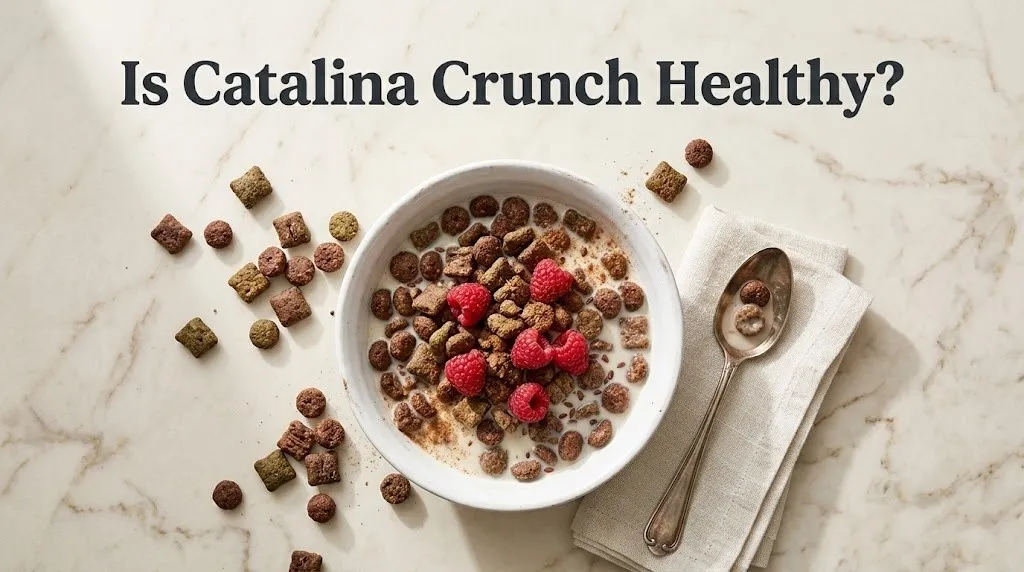
The Academy of Nutrition and Dietetics acknowledges that fortified processed foods can help fill nutrient gaps in a modern eating pattern. Catalina Crunch fits this description. It delivers iron, vitamin D, vitamin E, and calcium in a convenient format. The trade-off for that convenience is a product that can disrupt sensitive digestive systems because of its high concentration of chicory root fiber.
| Cereal Type (per 1/2 cup serving) | Protein (g) | Sugar (g) | Fiber (g) | Primary Sweetener |
|---|---|---|---|---|
| Catalina Crunch (Cinnamon Toast) | 11 | 0 | 9 | Allulose, Monk Fruit |
| Standard Sugary Cereal (e.g., Cinnamon Toast Crunch) | 2 | 14 | 1 | Sugar, Maltodextrin |
| Plain Shredded Wheat | 5 | 0 | 6 | None |
| Keto Cereal (e.g., Magic Spoon) | 13 | 0 | 1 | Allulose, Monk Fruit |
What Is Catalina Crunch?
Catalina Crunch is a grain-free, low-carbohydrate ready-to-eat breakfast cereal launched by founder Krishna Kaliannan. The product line includes crunchy cereal bites, snack mixes, and sandwich-style cookies. The original cereal was designed to replicate the sweet, crunchy breakfast experience for people following a ketogenic diet after Kaliannan used the diet to manage his own health.
The manufacturing process uses a blend of plant proteins and fibers to create a textured, crunchy bite. Instead of corn, wheat, or oats, the base is a proprietary mix of pea protein, potato fiber, and chicory root fiber. This base is then baked, not extruded, which the brand emphasizes for a better texture.
The finished product is sweetened with allulose, a rare sugar found naturally in figs and jackfruit. It tastes similar to table sugar but contributes almost no calories because the human body does not metabolize it fully. Monk fruit extract boosts the sweetness without adding any sugar or aftertaste, according to the company’s formulation.
Key Takeaway: Catalina Crunch is a highly engineered, grain-free alternative to traditional cereal, built for a low-carb lifestyle but not a whole-food nutritional powerhouse.
Catalina Crunch Nutrition Facts
A single 36-gram serving of the Cinnamon Toast variety contains 110 calories, 11 grams of fat, 11 grams of protein, and 14 grams of total carbohydrate. The carbohydrate figure drops to 5 grams of net carbs when you subtract the 9 grams of dietary fiber. This macronutrient ratio is extremely different from grain-based cereals.
The fat profile comes primarily from high oleic sunflower oil. This oil is rich in monounsaturated fat, the same heart-healthy fat found in olive oil. It is used for its neutral flavor and stability during baking. The protein is plant-based, coming almost entirely from pea protein isolate, which is the protein extracted from yellow split peas.
Micronutrient fortification is a significant part of the label. One serving provides 10% of the Daily Value for calcium, 15% for iron, 20% for vitamin D, and 25% for vitamin E. This is a deliberate attempt to add back nutrients often lost when grains are removed from the diet. Someone eating this for breakfast should still seek out whole food sources of these vitamins elsewhere in their day.
The ingredient list is long and functional. It includes baking powder for rise, natural flavors for taste, and calcium carbonate and tocopherols for freshness and nutrient density. There are no artificial dyes, which is why the cereal has a muted, brownish appearance rather than bright colors. This is a multi-component processed food, and the label is transparent about that fact.
Catalina Crunch Protein Content
Catalina Crunch delivers 11 grams of plant protein per serving. That is comparable to two large eggs or a standard scoop of protein powder. For a breakfast cereal, this is an unusually high protein load that directly affects satiety and muscle maintenance.
The protein source is pea protein isolate. It contains all nine essential amino acids, though it is slightly low in methionine. It is a viable protein for building and repairing muscle tissue. Research published in the Journal of the International Society of Sports Nutrition shows that pea protein promotes muscle thickness gains similarly to whey protein when combined with resistance training.
This protein punch changes how your body handles the meal. A high-protein breakfast reduces ghrelin, the hunger hormone, and slows gastric emptying. You stay physically full longer. A bowl of this cereal with milk or a milk alternative provides a morning protein total that can easily exceed 20 grams, which is a threshold many dietitians recommend for appetite control.
- 11 grams of protein per 1/2 cup cereal only.
- 19 to 20 grams of protein when served with 1 cup of unsweetened ultra-filtered milk.
- 15 to 17 grams of protein when served with 1 cup of unsweetened almond milk.
Catalina Crunch Fiber Source
The 9 grams of dietary fiber in Catalina Crunch come primarily from chicory root fiber, a form of inulin. Inulin is a soluble prebiotic fiber. Your body does not digest it in the small intestine. It travels to the large intestine where it feeds your gut bacteria, specifically Bifidobacteria.
This fermentation process is the mechanism behind the digestive benefits. Fed bacteria produce short-chain fatty acids like butyrate, which nourish the cells lining the colon. A healthy concentration of these beneficial microbes supports regularity and a resilient gut environment. This is the positive side of the fiber equation.
The challenge is the dose. Nine grams of inulin in a single sitting is a clinically significant amount. A 2010 study in the Journal of the American Dietetic Association found that gastrointestinal tolerance for inulin varies widely between individuals. Some people tolerate 10 grams easily. Others experience discomfort at 5 grams.
Think of your gut microbiome like a muscle that adapts to training. Introducing 9 grams of inulin all at once to an untrained digestive system is like running a marathon with zero preparation. The result is predictable gas, bloating, and cramping for a subset of people until their bacterial colonies adapt and strengthen over one to two weeks of consistent, low-dose exposure.
Key Takeaway: Catalina Crunch’s powerful fiber fraction can reshape your digestion for better or worse; its benefit is wholly dependent on a slow, intentional introduction.
Is Catalina Crunch Keto?
Catalina Crunch is formulated specifically for a standard ketogenic diet. A single serving contains 5 grams of net carbohydrates. The keto diet typically restricts total daily net carbohydrate intake to 20 to 50 grams. This cereal uses less than a quarter of the strictest daily allowance.
The net carb calculation is straightforward. Total carbohydrates are 14 grams. Dietary fiber accounts for 9 grams. The brand does not use sugar alcohols like erythritol in its core cereal, which simplifies the math for those who subtract fiber but not all sugar alcohols. The sweetness comes from allulose, which has a negligible glycemic impact.
The high fat content of 11 grams per serving also aligns with a keto macronutrient ratio. The fats from sunflower oil provide the caloric density that a high-fat, moderate-protein diet demands. Someone strictly tracking their macros can easily fit this cereal into their daily numbers without complex adjustments.
Not all keto-friendly foods support a well-formulated ketogenic diet equally. A plate of salmon, avocado, and leafy greens provides more micronutrient density than a bowl of this cereal. Catalina Crunch is a convenient, shelf-stable keto option, but it should rotate with whole-food meals. Relying on it as a daily breakfast cornerstone makes a keto diet less nutrient-diverse than it could be.
Catalina Crunch Blood Sugar
Catalina Crunch has a minimal impact on blood glucose for most healthy individuals. A product that contains 0 grams of sugar and 9 grams of fiber creates a very low glycemic load. The protein and fat content further delay any minor glucose absorption from the remaining starch component.
The sweetener allulose is central to this metabolic response. Human studies, including a 2018 trial in the journal Nutrients, show that small doses of allulose can actually blunt the post-meal blood sugar spike when consumed with other carbohydrates. It does this by influencing enzymes involved in carbohydrate digestion. For someone with insulin resistance, this is an attractive sweetener profile.
People with diabetes should still test their personal response. Biological individuality means any processed food can produce an unexpected blood sugar reading. The product is not a diabetes treatment. It is a food that fits a low-carbohydrate eating plan used to manage blood glucose.
A common mistake is eating multiple servings. The glycemic load is low per serving, but two or three servings double or triple the small amounts of digestible carbohydrate present. The crunch and small serving size can make it easy to overconsume straight from the bag. Portioning into a small bowl or container is a practical strategy to keep blood sugar responses predictable.
Does Catalina Crunch Cause Gas?
Yes, Catalina Crunch can cause significant gas and bloating in a large percentage of new consumers. The high concentration of chicory root inulin is directly responsible. Your gut bacteria ferment the inulin rapidly, which produces hydrogen, carbon dioxide, and methane gas as a natural byproduct.
This is not an allergic reaction or a sign that the food is spoiled. It is a predictable physiological response to a potent prebiotic fiber dose. The gas production is temporary for most people. A gradual adaptation period of 7 to 14 days allows the bacterial colonies in the gut to shift and the intestinal volume to adjust to the increased fermentation.
The wrong way to start is with a full 1/2 cup serving on day one. The right way is to start with 2 tablespoons, which is roughly a quarter serving, and eat that amount for three days. If that feels fine, increase to 1/4 cup for another three days. Continue this slow titration until you reach a full serving without discomfort.
- Start with a 2-tablespoon serving for the first 3 days.
- Increase to 1/4 cup for days 4 to 7.
- Progress to 1/3 cup for days 8 to 11.
- Reach a full 1/2 cup serving by day 12, if tolerated.
- Discontinue or stay at a low dose if severe pain or prolonged bloating occurs.
Key Takeaway: Catalina Crunch’s gas problem is a dosing and adaptation problem, not a product flaw; a slow, two-week ramp-up prevents most digestive fallout.
How to Eat Catalina Crunch
Treat Catalina Crunch as a protein and fiber booster, not the entire meal. A dry half-cup serving is only 110 calories. That is too low for a sustaining breakfast for most adults. Building a balanced breakfast around the cereal creates a functional, nutritionally complete meal.
The simplest upgrade is pairing it with a high-protein dairy or plant-based milk. Unsweetened ultra-filtered milk can add another 8 grams of protein and only 40 calories. A cup of Two Good or Ratio yogurt at the bottom of the bowl adds 12 to 15 grams of protein and a creamy texture contrast to the crunch. This takes the meal from a snack to a genuine satiety driver.
Adding fresh or frozen low-glycemic fruit improves the nutritional quality. A quarter cup of raspberries or blackberries adds 2 to 3 grams of additional fiber, vitamin C, and polyphenols without a significant sugar load. The acidity of the berries cuts through the richness of the sunflower oil and complements the cinnamon or chocolate flavors.
To build a complete Catalina Crunch power bowl:
- Pour 1/2 cup of Catalina Crunch into a bowl.
- Add 3/4 cup of plain, high-protein yogurt or cottage cheese.
- Top with 1/4 cup of fresh raspberries or sliced strawberries.
- Sprinkle 1 tablespoon of hemp seeds for extra omega-3 fatty acids.
- Eat immediately while the cereal remains fully crunchy.
Catalina Crunch Cereal Review
The taste and texture of Catalina Crunch are divisive and specific. It does not taste like a bowl of traditional sugary cereal, and it is not trying to. It delivers an intensely crunchy texture that stays crisp in milk for an unusually long time. The sweetness is present but muted compared to a standard breakfast cereal.
The Cinnamon Toast variety has a warm, pleasant spice note that most accurately mimics its conventional counterpart. The Dark Chocolate and Fruity varieties taste more artificial to some palates. The aftertaste from the monk fruit and pea protein is faint but detectable. It presents as a slightly earthy, flat finish on the back of the tongue.
The texture is the product’s strongest sensory asset. Unlike many grain-free cereals that turn to mush instantly, these pieces maintain their structural integrity for five to ten minutes in cold liquid. This makes it a legitimate cereal-eating experience rather than a race against sogginess. The baking process creates irregular, bubbled pieces that look like tiny, matte-finish Chex.
The cereal is enjoyable for what it is. A person expecting Honey Nut Cheerios sweetness will be disappointed. A person searching for a crunchy, low-carb vehicle for berries and yogurt will likely find it satisfying. Setting sensory expectations correctly prevents the most common flavor complaint: “it’s not sweet enough.”
Catalina Crunch vs Magic Spoon
Catalina Crunch and Magic Spoon are the two dominant players in the direct-to-consumer keto cereal market, but they use fundamentally different nutritional strategies. Magic Spoon is a high-protein, whey-based cereal with almost no fiber. Catalina Crunch is a high-fiber, plant-protein cereal with a different textural outcome.
| Feature | Catalina Crunch | Magic Spoon |
|---|---|---|
| Protein Source | Pea protein isolate | Milk protein isolate (whey and casein) |
| Fiber per Serving | 9 grams | 0 to 1 gram |
| Net Carbs per Serving | 5 grams | 4 to 5 grams |
| Sweetener | Allulose + Monk fruit | Allulose + Monk fruit |
| Texture | Dense, long-lasting crunch | Airy, crispy, dissolves faster |
| Allergen Profile | Legume, nut-free facility warning | Dairy |
A person with a dairy allergy or sensitivity will gravitate toward Catalina Crunch. A person who struggles with digestive reactions to fiber and inulin will find Magic Spoon far easier to tolerate. The satiety equation is also different. Catalina Crunch’s fiber creates a physical fullness sensation. Magic Spoon’s high protein creates a more hormonal satiety response.
Flavor experience is a key differentiator. Magic Spoon aims to replicate the fruity loops and cocoa puffs of childhood. Its flavors are sweeter and more nostalgic. Catalina Crunch markets itself as an adult palate cereal with less sweet, more grain-like flavor profiles. Your preference will come down to whether you want a Flintstones vitamin taste or a grown-up granola alternative.
Key Takeaway: Choose Catalina Crunch for fiber and dairy-free protein; choose Magic Spoon for a protein-forward, low-fiber, kid-cereal taste with a dairy base.
Catalina Crunch vs Granola
Conventional granola is a sugar and calorie-dense food masquerading as a health staple. A typical 1/2 cup of oat-based granola with clusters contains 200 to 250 calories, 12 to 20 grams of sugar, and 4 to 5 grams of protein. Catalina Crunch flips that macro profile completely on its head.
The calorie comparison is deceptive. Catalina Crunch is lower in calories per half-cup (110 vs. 200+). But granola is often a crumble topping. Catalina Crunch’s high protein and fiber make it substantially more satiating per calorie eaten. A bowl of oat granola can leave you hungry in two hours. The protein and fiber combo in Catalina Crunch extends the fullness window significantly.
The ingredient philosophy is the core divide. Traditional granola is whole rolled oats, nuts, seeds, oil, and a sweetener. It is a less processed food. Oats contain beta-glucan, a cholesterol-lowering soluble fiber with a robust body of clinical evidence. Catalina Crunch’s fiber is isolated inulin. One is a whole food matrix. The other is a recombined functional food matrix. Both have merit in different contexts.
For a person who can digest oats and does not limit carbs, a low-sugar traditional granola made with nuts and seeds is arguably a more nutrient-rich whole food choice. For a person with a grain sensitivity, a celiac diagnosis, or a strict low-carb target, Catalina Crunch provides a granola-like crunch and versatility that oat granola cannot match.
Catalina Crunch Cost
Catalina Crunch is expensive. A standard 9-ounce bag costs between $9.99 and $11.99 and contains about 7 servings. This works out to roughly $1.40 to $1.70 per serving. That is two to three times the per-serving cost of a mid-range organic granola and five times the cost of plain bulk oats.
The premium pricing reflects the cost of specialty ingredients. Pea protein isolate and allulose are significantly more expensive commodities than wheat flour or cane sugar. The brand positions itself as a premium, functional food. It is not competing on price with General Mills. It is competing for the grocery budget of someone already buying specialty keto and paleo products.
Value must be measured against alternatives. A homemade keto granola made from almond flour, coconut flakes, nuts, and allulose costs between $0.90 and $1.10 per serving in ingredient costs when bought in bulk. That homemade version takes time and planning. The packaged version buys convenience and a tested, replicable texture.
The product is frequently on sale through the company’s direct website and on Amazon’s Subscribe & Save. Stocking up during site-wide sales of 20% off or more brings the per-serving cost closer to $1.10, a more justifiable premium for a weekly breakfast staple. Paying full retail price for a bag you eat in three days is a luxury food expenditure, not a pragmatic staple.
Is Catalina Crunch Healthy for Weight Loss?
Catalina Crunch supports weight loss because of its high protein and fiber content, which promote satiety in a calorie-controlled diet. A single 110-calorie serving with a protein shake or yogurt can create a filling 250 to 300-calorie breakfast that provides 30 grams of protein. That is an exceptionally high satiety-per-calorie ratio.
The mechanism is straightforward. Protein and fiber both slow gastric emptying and increase the release of satiety peptides like PYY and GLP-1. A 2020 study in the Journal of Nutrition found that high-protein breakfasts reduce evening snacking on high-fat, high-sugar foods compared to a low-protein breakfast or skipping breakfast entirely. Catalina Crunch makes hitting that high-protein target easy.
The psychological component is also real. A person who feels deprived of crunchy, sweet breakfast foods often abandons a weight loss plan. This cereal provides a legal, on-plan alternative that mimics the sensory experience of a “forbidden” food. That behavioral substitution helps adherence. It is not the cereal’s magic fat-burning property. It is the cereal’s role in preventing a complete dietary derailment.
Weight loss is still determined by a consistent calorie deficit over time. Catalina Crunch is calorie-dense for its volume. The 1/2 cup serving looks small in a standard cereal bowl. Dumping a double serving adds 220 calories before adding milk. Someone not weighing or measuring a portion can easily erase their deficit. The cereal is weight-loss compatible, but only with deliberate portion control.
Key Takeaway: Catalina Crunch is an effective weight management tool because of its satiety punch, but its small serving size demands a disciplined measuring hand.
Who Should Eat Catalina Crunch
A person following a low-carb, keto, or grain-free dietary pattern who misses the ritual of cereal for breakfast is the ideal consumer. It serves a specific craving and nutritional gap that few other foods fill without compromising the diet’s rules. A busy parent packing a work breakfast or a student with limited cooking equipment will find its shelf-stable convenience genuinely useful.
Someone actively managing type 2 diabetes with a low-carb approach can use it as a predictable, zero-sugar breakfast base. Its macronutrient stability makes blood sugar forecasting easier than a variable carbohydrate meal. This does not make it a medical treatment. It makes it a practical food for a specific dietary protocol prescribed by a care team.
There are clear groups who should avoid or severely limit it. Anyone with irritable bowel syndrome following a low-FODMAP diet should avoid chicory root fiber inulin entirely during the elimination phase. People with a legume allergy to peas cannot consume it. Someone with a history of disordered eating who fixates on “clean” keto processed replacements should be cautious about elevating any highly processed food to a daily staple status.
It is not a food for young children. Their caloric and nutrient needs rely on nutrient density, not low-carb math. A child’s breakfast of oatmeal with milk and fruit provides more growth-supporting nutrition than a bowl of grain-free protein cereal. Keep Catalina Crunch in the adult toolbox for which it was designed.
Frequently Asked Questions About Catalina Crunch
What are the side effects of Catalina Crunch?
The primary side effect is gas, bloating, and digestive cramping from the chicory root inulin fiber.
This reaction occurs when gut bacteria rapidly ferment the high fiber load.
Starting with a small two-tablespoon serving and increasing slowly over two weeks usually prevents this issue.
Is Catalina Crunch good for diabetics?
Catalina Crunch has a minimal direct impact on blood glucose because it contains 0 grams of sugar and 9 grams of fiber.
It can be a useful breakfast option for a diabetic low-carbohydrate eating plan.
Individual blood glucose responses vary, so testing with a meter after the first serving is always a sound practice.
How many net carbs are in Catalina Crunch?
A standard 1/2 cup serving contains 5 grams of net carbohydrates.
This is calculated by subtracting the 9 grams of dietary fiber from the 14 grams of total carbohydrates.
The 5 grams of net carbs come from the remaining starch and the small amount of non-fiber carbohydrate in the pea protein blend.
Does Catalina Crunch have heavy metals?
Independent third-party testing from consumer advocacy groups has not flagged Catalina Crunch for unsafe levels of heavy metals as of mid-2026.
Pea protein isolate, its primary ingredient, can uptake heavy metals from soil, which is why sourcing and quality control matter.
The company states they test for heavy metals, but publishing those transparency reports would further strengthen consumer trust.
Can you eat Catalina Crunch every day?
You can eat it every day if you tolerate the fiber well and you do not let it displace whole-food meals.
A daily breakfast of Catalina Crunch and high-protein milk products can provide a functional, low-carb morning meal.
Rotating in whole-food breakfasts like eggs with vegetables several times a week will improve your overall nutrient diversity.
This cereal earns its place in a specific dietary playbook. It is a purpose-built food that solves a real problem for people who miss crunchy breakfasts on a grain-free protocol. Use it when you need that fix. Pair it with real dairy or fruit to round out its nutritional gaps.
The price and the fiber both demand respect. Buy it on sale and start with a smaller bowl than you think you need. Your digestive system and your grocery budget will both thank you for that patience. A strategic eater uses this as a tool, not a daily crutch.
It will not magically make you healthier than a plate of eggs and spinach. But on a morning when you need a fast, crunchy, sweet bite that keeps your insulin quiet and your stomach full, it does exactly what it promises. That is enough to make it a smart occasional choice for the right person in 2026 and beyond.