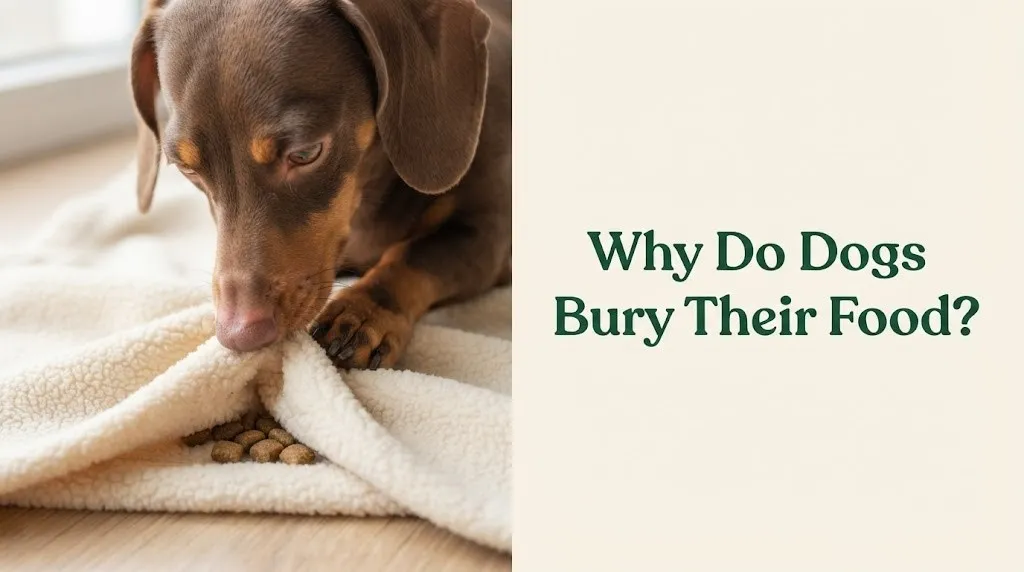
Dogs bury their food because they are acting on a powerful ancestral caching instinct inherited from their wild canid ancestors, who buried surplus kills to protect the meat from scavengers and to create a food reserve for lean periods. Your dog is not confused or ungrateful for the kibble. They are running a survival program written into their DNA thousands of generations before the first dog bowl was ever manufactured.
A study published in the journal Applied Animal Behaviour Science found that food caching behaviors appear in domestic dogs even when the dog has never experienced a day of food scarcity in its life. The behavior is not learned. It is inherited and then triggered by specific environmental or emotional conditions in the modern home.
This article walks you through exactly why the burying instinct persists in your well-fed house pet, which breeds dig and hide with the most enthusiasm, what your dog is telling you when they nudge a blanket over the food bowl, the difference between normal caching and anxiety-driven hiding, and the practical steps you can take to manage the behavior without punishing your dog for doing exactly what thousands of years of evolution trained them to do.
Why Do Dogs Bury Their Food
Dogs bury their food primarily because they retain the food caching instinct of their gray wolf ancestors, who buried surplus meat to hide it from competitors and preserve it for future consumption when hunting was unsuccessful.
This behavior is technically called food caching or scatter hoarding. In the wild, a wolf pack might bring down a large ungulate like an elk, consume as much as possible immediately, and then cache the remaining carcass pieces in shallow holes dug into cool earth. The soil insulates the meat, slows bacterial decomposition, and hides the scent from ravens, coyotes, and other wolves who would steal the resource. Your domestic dog has never faced this exact scenario, but the neural circuitry that drives the burying sequence is intact. When a trigger fires that circuit, the dog responds.
The triggers vary. A dog who receives more food than they can eat in one sitting may treat the surplus exactly as a wolf treats the remains of a kill. A dog who perceives competition for a high-value resource, even if that competition is just another placid house dog across the room, may cache the item to secure it. A dog who is fed in a chaotic or stressful environment may cache food as a way of relocating the resource to a safer consumption site. None of these scenarios reflect a broken dog. They all reflect a normal brain executing a normal behavior under conditions that feel, to the dog, like a valid reason to cache.
Ancestral Food Caching Instinct in Domestic Dogs
The food caching instinct in domestic dogs is a direct behavioral inheritance from the gray wolf and, further back, from the shared ancestor of all modern canids, who evolved caching as a survival adaptation during the Pleistocene epoch when food availability was unpredictable.
Wolves are not the only canids that cache. Coyotes, foxes, and jackals all bury surplus food. The behavior is so deeply embedded that it appears across the entire canid family tree, which suggests it evolved in an early common ancestor rather than arising independently in each species. A red fox will cache a single mouse or a bird with the same head-nudging and dirt-pushing motions that your dachshund performs on the living room rug. The motor pattern is conserved because it worked.
Domestication did not erase caching. It muted some components and amplified others depending on the breed. Dogs who were selectively bred to work independently and make their own decisions about resource use, such as terriers bred to hunt and dispatch vermin without human direction, tend to show stronger caching behavior than breeds developed for close cooperative work with humans, such as retrievers who were selected to deliver retrieved game directly to the handler without damaging or hiding it. The caching instinct is present in all dogs, but breed history determines whether it surfaces easily or requires a stronger trigger.
Dog Breeds Most Likely to Bury Their Food
Terriers, hounds, and northern breeds are the dog groups most likely to bury their food, because these breeds were developed for independent hunting, tracking, or survival work that rewarded individuals who managed their own resources without waiting for human instruction.
The dachshund is arguably the most enthusiastic food cacher in the domestic dog world. Bred to hunt badgers underground and make independent decisions in a dark tunnel where no human could direct them, dachshunds retain a fierce resource-guarding instinct that frequently manifests as blanket-burying, pillow-stashing, and even attempting to bury food in the crevice between couch cushions. Owners of dachshunds routinely report finding kibble hidden in bedding, laundry piles, and the gaps behind furniture.
Beagles and other scent hounds also cache frequently, though their burying is often tied to the value of the item rather than a generalized hoarding drive. A beagle may eat regular kibble without ceremony but will attempt to cache a high-value chew or a stolen piece of human food with focused determination. Siberian huskies and other northern breeds, who evolved in environments where frozen ground made digging difficult but snow caching was possible, often show a modified version of the behavior that involves nosing snow or loose substrate over the food item. Terriers as a group, including the Jack Russell terrier and the rat terrier, cache with high frequency because their working history rewarded independent kill management. In contrast, retrievers, herding dogs, and many companion breeds show lower baseline caching rates, though individual dogs within any breed may cache under the right conditions.
| Breed Group | Caching Tendency | Typical Caching Style |
|---|---|---|
| Terriers | High | Bury in soft substrate, dig at hard floors |
| Hounds | Moderate to High | Cache high-value items, nose nudging |
| Northern Breeds | Moderate | Snow or dirt burying, nose-pushing |
| Working/Herding | Low to Moderate | Situational, often stress-related |
| Retrievers | Low | Rare; more likely to carry than cache |
| Toy/Companion | Variable | Blanket burying common in small spaces |
Why Does My Dog Try to Bury Food in the Couch
Your dog tries to bury food in the couch because soft, loose substrate mimics the soil or leaf litter that wild canids use for caching, and the crevice between cushions provides the enclosed, hidden space that a successful cache requires.
From the dog’s perspective, a couch is an excellent caching location. It is soft enough to nudge and paw, the cushions create natural pockets that conceal the food item, and the fabric holds the dog’s scent while masking the food’s odor from potential competitors. The dog does not understand that kibble in the couch is a problem for you. They understand that the couch meets the substrate criteria their brain is scanning for: pliable material, concealment potential, and a location inside the den that feels secure.
This behavior intensifies in dogs who are fed near the couch or who are allowed on the furniture during or immediately after meals. If the food bowl sits on the floor next to the sofa and the dog has learned that the couch is a safe, comfortable resource zone, the caching circuit may fire and direct the dog to carry a mouthful of kibble to the nearest acceptable cache site. The solution is not to punish the couch caching but to remove the trigger by feeding the dog in a designated area away from soft furniture and providing an acceptable alternative cache location, a topic covered later in the management section.
Key Takeaway: Your dog is not misbehaving when they cache food. They are executing a deeply programmed survival behavior triggered by their breed history, their feeding environment, or their emotional state. Understanding the cause is the first step toward redirecting the behavior into safer, more acceptable outlets.
Dog Pushing Nose to Bury Food Bowl Meaning
When a dog pushes their nose against the floor near the food bowl as if trying to bury it, they are performing the “nose nudging” component of the caching sequence, which in the wild would push soil or leaves over a cached food item to cover it.
This behavior looks strange to human observers because there is no actual substrate to push. The dog lowers their head, presses the top of their muzzle or the side of their nose against the floor, rug, or even the bare tile, and makes a repeated pushing or shoveling motion that moves nothing. In some dogs, the motion is so vigorous that they abrade the skin on their nose, a condition owners sometimes call “kennel nose” when it appears on rescue dogs who have spent time pushing at cage bars or concrete floors.
The nose-pushing behavior is a fixed action pattern, which means the dog’s brain runs the motor program to completion even when the environmental conditions that make it functional are absent. It is the same principle that makes a dog circle before lying down on a flat, perfectly comfortable dog bed. The circling motor pattern evolved to flatten tall grass or snow, and the brain runs it anyway. Nose-pushing at the food bowl means the caching sequence has been triggered but the dog lacks access to loose substrate, so the motor program runs against whatever surface is available. This behavior is normal unless it is so persistent that it causes skin injury, in which case a veterinary behaviorist should evaluate the dog for compulsive disorder.
Overfeeding and Food Burying Connection in Dogs
Overfeeding is one of the most common environmental triggers for food burying because the dog’s brain interprets surplus food exactly as a wolf’s brain interprets an uneaten portion of a kill: as a resource to cache for later.
If you are feeding your dog more calories than they need, or if you are using a free-feeding method where the bowl remains full and available all day, the dog encounters surplus daily. The caching circuit fires. The dog removes a portion of the food and attempts to bury it. This is not a comment on the food’s quality or the dog’s affection for you. It is a straightforward input-output response: surplus detected, cache initiated.
The Association for Pet Obesity Prevention reports that approximately 59 percent of dogs in the United States are classified as overweight or obese by their veterinarians, which indicates that overfeeding is widespread in the pet population. Reducing the daily portion to match the dog’s actual caloric requirement often reduces or eliminates food caching behavior within a few weeks. Work with your veterinarian to determine the correct daily caloric intake for your dog’s breed, age, body condition score, and activity level. Do not rely on the feeding chart printed on the kibble bag, which often overestimates portions for sedentary house dogs. Feed measured meals on a schedule rather than keeping the bowl full. The behavior may not disappear entirely in breeds with a strong caching drive, but it will usually decrease noticeably.
Food Burying as Resource Guarding in Multi-Dog Homes
In a home with multiple dogs, food burying often signals low-level resource guarding where the caching dog perceives a threat to their food access from the other dog, even if the other dog has shown no active interest in stealing the food.
Resource guarding is a spectrum of behaviors that range from subtle body blocking and quick eating to overt growling, snapping, and biting. Food caching sits on the subtle end of that spectrum. A dog who carries kibble away from the bowl and attempts to hide it in another room is engaging in a conflict-avoidance strategy. Rather than guard the bowl directly and risk a confrontation with the other dog, they relocate the resource to a cache site where they believe it will remain undiscovered.
This behavior is especially common in homes where dogs are fed in close proximity, where one dog eats faster than the other and then approaches the slower dog’s bowl, or where a new dog has been recently introduced and the resident dog feels uncertain about resource security. The management solution is to feed dogs in separate rooms or in crates with solid barriers between them, not just across the kitchen from each other. Each dog should be able to eat their entire meal without seeing, hearing, or being approached by the other dog. Feeding time should end when the slower dog finishes, with bowls removed immediately so no dog hovers near another dog’s feeding station. If the caching behavior persists after separation, or if any growling or snapping accompanies meals, consult a board-certified veterinary behaviorist or a certified applied animal behaviorist for an in-person evaluation. Resource guarding can escalate, and professional intervention is the safest path.
Anxiety-Related Food Hiding Behavior in Dogs
Dogs with generalized anxiety, separation anxiety, or noise phobia may cache food as a displacement behavior or as an attempt to secure resources when their environment feels unpredictable and unsafe.
An anxious dog’s brain operates in a heightened state of threat surveillance. The dog is constantly scanning for danger and may interpret the act of eating in an exposed location as a risky behavior. Carrying food to a hidden cache site allows the dog to consume it in a more secure position, often behind furniture, under a table, or in a corner where the dog can put their back against a wall and watch the room. This is not the same as the casual surplus-caching of a well-adjusted terrier. The anxious dog’s caching is driven by fear, not by abundance.
Triggers for anxiety-related caching include loud construction noise, fireworks, a recent move to a new home, the addition or loss of a family member, or unpredictable disruptions to the household routine. If the caching appears suddenly in an adult dog with no prior history of the behavior, or if it coincides with other anxiety signs such as panting, pacing, trembling, destructive behavior, or housesoiling, the dog needs a veterinary evaluation. A veterinarian can rule out medical causes for the behavior change and prescribe anti-anxiety medication if indicated. The American Veterinary Medical Association emphasizes that behavior problems are medical problems and should be treated with the same diagnostic rigor as a limp or a skin condition.
Food Insecurity in Rescue Dogs and Burying Behavior
Rescue dogs who experienced food scarcity before adoption frequently develop intense food caching behaviors that can persist for months or years after they arrive in a home where food is consistently available.
The brain of a dog who has starved, competed for limited food at a hoarding situation, or survived as a stray scavenging for calories, has learned that food is never guaranteed. When that dog encounters a full food bowl in their new home, the surplus does not register as “I am safe now.” It registers as “I must secure as much of this as possible before it disappears.” The caching behavior is a trauma response, not a personality quirk.
Owners of rescue dogs with food insecurity should avoid correcting or punishing caching behavior, because punishment adds stress to a situation the dog already finds emotionally charged. Instead, feed small, frequent meals on a rigid schedule so the dog learns through repetition that food arrives predictably and does not need to be hoarded. Provide a secure, enclosed feeding space such as a crate with the door left open, where the dog can eat without feeling exposed. Some dogs with severe food insecurity benefit from having a designated “cache box,” a low-sided cardboard box filled with old towels, placed near the feeding area. The dog can bury items in the cache box and then retrieve them later. This accommodation strategy reduces the dog’s stress while preventing food from ending up in furniture or carpet. A veterinary behaviorist can design a desensitization protocol for dogs whose food insecurity does not improve with environmental management alone.
Key Takeaway: The same burying behavior can spring from opposite emotional states: a confident terrier with too much food caches out of instinctive surplus management, while a traumatized rescue dog with enough food caches out of fear that the food will vanish. Identify the driver before you decide on a management strategy.
Why Does My Dog Bury Treats but Not Kibble
A dog who buries high-value treats but eats regular kibble without caching is demonstrating resource valuation, which is the same decision-making process a wild canid uses when deciding whether to consume an item immediately or cache it for later.
In a 2022 study published in Animals, researchers found that domestic dogs adjust their caching behavior based on the perceived value of the food item. High-value items such as meat, cheese, dental chews, and rawhide were cached at higher rates than standard kibble. The researchers concluded that dogs make a cost-benefit calculation: a low-value item is consumed immediately because the cost of caching it is not worth the future benefit, while a high-value item is worth the energy expenditure and the risk of moving it to a secure cache site.
This explains why your dog eats breakfast normally but frantically hides a greenie or a bully stick. The treat is a high-value windfall. The dog’s brain classifies it the way a wolf’s brain classifies a fresh deer haunch: too valuable to consume casually, better to secure it for later. You can reduce treat caching by offering high-value items in an enclosed feeding area where the dog feels no pressure to relocate the resource. Breaking large treats into smaller pieces that can be consumed in a single sitting also eliminates the surplus that triggers caching. If your dog regularly caches long-lasting chews, provide those chews only in a crate or a gated area from which the chew cannot be relocated.
Do Puppies Grow Out of Burying Their Food
Puppies often begin food burying behavior between three and six months of age, and while some puppies reduce the behavior as they mature, others retain it for life depending on breed, environment, and feeding history.
The developmental window when caching first appears coincides with weaning and the transition to solid food. During weaning, puppies compete with littermates for access to the dam’s milk and then for access to the solid food offered by the breeder. A puppy who was the runt of a large litter and had to compete harder for nipple access may develop a stronger early caching drive. A puppy who was free-fed in a communal bowl with littermates may learn that surplus disappears quickly and begin caching before eight weeks of age.
Breeders and early environment shape the behavior. A responsible breeder who feeds puppies in individual bowls and ensures every puppy receives adequate nutrition may reduce early food anxiety, but they cannot eliminate a genetic caching predisposition. A dachshund puppy from the best breeder in the country will still likely cache as an adult. A golden retriever puppy from a neglectful background may cache heavily at first and then reduce the behavior as trust in the new owner grows. There is no universal “grow out of it” age. Monitor the behavior through adolescence. If it intensifies or becomes compulsive, intervene with management strategies rather than waiting for it to disappear on its own.
How to Stop a Dog from Burying Food Indoors
You stop a dog from burying food indoors by removing the trigger conditions that fire the caching circuit and by redirecting the burying drive into acceptable outlets, not by punishing a behavior the dog does not consciously choose.
Punishment does not work for instinctive caching because the dog is not making a deliberate decision to misbehave. Yelling, shoving the dog away from the bowl, or rubbing the dog’s nose in the cached food will increase anxiety and may escalate the behavior into a more problematic resource guarding response. Instead, address the root triggers methodically.
To reduce indoor food burying:
- Feed measured meals on a schedule rather than leaving food available all day.
- Reduce portion size to the dog’s actual caloric requirement as determined by your veterinarian.
- Feed the dog in a designated area with hard flooring, away from couches, beds, and carpet.
- In multi-dog homes, feed dogs in separate rooms with solid barriers between them.
- Pick up the food bowl after 20 minutes whether the dog has finished or not.
- Provide a cache box: a low cardboard box containing old towels or fleece strips placed in the feeding area where the dog is allowed to bury items.
- Increase daily exercise and mental enrichment. A dog with an under-stimulated brain is more likely to express caching behavior excessively.
- Use puzzle feeders or snuffle mats at mealtime to engage the dog’s foraging drive productively.
Dog Burying Food in Yard Benefits and Risks
Allowing a dog to bury food in the yard provides an acceptable outlet for the caching instinct but introduces risks including bacterial contamination of the cached food, ingestion of spoiled meat that can cause gastrointestinal illness, and excavation of buried items by wildlife or other household dogs.
The benefit of yard caching is straightforward. It allows a dog with a strong burying drive to express the behavior naturally without destroying furniture or hiding food in your bed. The dog gets to dig, cache, cover, and later return to retrieve the item, which is a complete behavioral sequence that provides mental satisfaction. A dog who is allowed to cache appropriate items in a designated digging zone may show reduced indoor caching overall.
The risks demand careful management. Food buried in soil is exposed to bacteria including Salmonella, Clostridium perfringens, and various soil-borne pathogens. When the dog digs up and consumes the item days or weeks later, the bacterial load can cause vomiting, diarrhea, and in severe cases, hemorrhagic gastroenteritis. Raw meat or meaty bones cached in warm soil are particularly dangerous because the soil acts as an incubator. If you allow yard caching, monitor what gets buried and where. Restrict caching to non-meat items that will not rot dangerously, such as hard nylon chews or specifically designated toys. Never allow a dog to cache raw meat, cooked bones, or any food item that can spoil. A veterinarian should evaluate any dog who develops vomiting or diarrhea after retrieving a cached item from the yard, and you should mention the caching history during the exam so the veterinarian can consider food-borne bacterial infection in the differential diagnosis.
When Is Food Burying a Problem Behavior in Dogs
Food burying becomes a problem behavior when it is accompanied by weight loss from uneaten meals, when the dog guards cache sites with growling or biting, when the nose-pushing motion causes skin abrasion, or when the behavior consumes so much of the dog’s day that it interferes with normal activity.
Normal caching is intermittent. The dog takes a mouthful, hides it, and resumes normal behavior. Problem caching is persistent and emotionally charged. A dog who spends 20 minutes frantically nosing at the floor around the food bowl after every meal, who cannot settle, who loses weight because they cache all their food and never retrieve it, or who growls and snaps when anyone approaches a cache site needs professional evaluation.
A board-certified veterinary behaviorist can distinguish between instinctive caching, generalized anxiety disorder, and canine compulsive disorder, which is a diagnosis of exclusion reserved for repetitive behaviors that occur out of context and interfere with normal function. Canine compulsive disorder sometimes responds to selective serotonin reuptake inhibitors such as fluoxetine, combined with behavior modification. A veterinarian should always perform a physical exam and baseline blood work to rule out medical causes for a sudden onset of intense caching behavior. Gastrointestinal discomfort, dental pain, and neurological conditions can all produce behavior changes that look like anxiety-driven caching.
Spoiled Buried Food Health Risks for Dogs
Dogs who retrieve and consume spoiled cached food risk bacterial gastroenteritis, food-borne intoxication, gastrointestinal obstruction from bone fragments, and in severe cases, botulism from decaying animal tissue.
The stomach of a domestic dog is more acidic than a human stomach, which provides some protection against food-borne bacteria. This acidity is an adaptation to a scavenging evolutionary history. It is not a guarantee of safety. A dog who eats meat that has been buried in warm soil for several days can still develop severe bacterial enteritis. Symptoms include acute vomiting, bloody diarrhea, lethargy, fever, and abdominal pain. These dogs often require veterinary hospitalization for intravenous fluids, antiemetics, and antibiotics.
Bones cached in the yard present a different danger. Cooked bones, which should never be fed to dogs, become brittle and splinter during the caching and retrieval process. A splintered bone fragment can perforate the esophagus, stomach, or intestine, creating a surgical emergency. Raw bones carry a lower splinter risk but a higher bacterial load. If your dog has a history of caching food in the yard, inspect the yard weekly for cached items and remove any that appear spoiled or dangerous. Inform your veterinarian about your dog’s caching history so it is documented in the medical record. If your dog is a known yard cacher, mention it specifically during any visit for vomiting or diarrhea.
Key Takeaway: A dog who buries food is not broken, anxious, or ungrateful. They are a domestic animal running inherited software in a modern environment. Your job is not to delete the software. Your job is to update the operating conditions so the software runs in safe, nondestructive ways.
Puzzle Feeders and Enrichment for Dogs That Bury Food
Puzzle feeders and environmental enrichment redirect the burying drive into structured foraging behaviors that satisfy the dog’s caching instinct without resulting in hidden food in your furniture or spoiled meat in your yard.
A snuffle mat is a fabric mat with long fleece strips that hide kibble. The dog uses their nose and paws to forage the kibble out of the fleece, which engages the same sensory and motor circuits as caching. The dog is not burying per se, but they are working to locate and extract food from a substrate, which occupies the brain pathway that would otherwise fire the caching sequence. Snuffle mats are particularly effective for small breed dogs who blanket-bury, such as dachshunds and miniature poodles.
Kong-style rubber toys stuffed with kibble and sealed with a small amount of peanut butter or wet food provide a different outlet. The dog must manipulate the toy to extract the food, and the remaining stuffed Kong can be carried to a bed or crate and “cached” without food scattering everywhere. A slow feeder bowl with ridges and channels reduces eating speed and increases the time the dog spends working for the meal, which can lower the surplus signal that triggers caching. For dogs who are strongly driven to cache outdoors, a designated digging box filled with sand or loose soil in a corner of the yard provides an acceptable location. Bury appropriate non-spoiling items in the digging box to teach the dog that this is the caching zone.
Quick Tip:
- Rotate puzzle feeders weekly so the dog does not habituate to a single enrichment device.
- Feed all meals from enrichment devices for dogs with moderate to strong caching drives.
- Supervise the first session with any new puzzle feeder to ensure the dog does not destroy and ingest non-food components.
Frequently Asked Questions About Dogs Burying Food
Why does my dog try to bury his food with his nose?
Your dog is performing the nose-nudging motor pattern that wild canids use to push soil or leaves over a cached food item to conceal it.
This is a fixed action pattern that runs even when there is no actual substrate to push, which is why the dog will nudge at bare floor or carpet.
The behavior is normal unless it causes skin abrasion on the nose, in which case a veterinarian should evaluate the dog.
Is it normal for dogs to bury their food in the house?
Yes, indoor food burying is a normal expression of the inherited caching instinct, especially in breeds with strong working histories like terriers and hounds.
It becomes a concern only if the behavior is compulsive, accompanied by weight loss, or involves guarding the cache sites with aggression.
Most indoor burying can be managed with scheduled feeding, portion control, and providing an acceptable cache box.
Should I stop my dog from burying food in the yard?
You should manage yard caching carefully rather than stopping it outright if the behavior provides a satisfying outlet and the cached items are non-spoiling.
Never allow a dog to cache raw meat, cooked bones, or any food item that will rot in the soil and create a bacterial risk.
Inspect the yard regularly for cached items and remove anything spoiled, and inform your veterinarian about the behavior.
Do certain dog breeds bury food more than others?
Yes, terriers, hounds, and northern breeds show significantly higher rates of food caching than retrievers, herding dogs, and companion breeds.
Dachshunds are particularly known for enthusiastic blanket and cushion burying due to their history as independent underground hunters.
However, any individual dog of any breed may cache food under the right trigger conditions.
Can burying food be a sign of anxiety in dogs?
Yes, food burying can be a displacement behavior or a resource-securing response in dogs with generalized anxiety, separation anxiety, or noise phobia.
Anxious caching is often accompanied by other stress signals such as panting, pacing, trembling, or attempting to hide.
A veterinarian or veterinary behaviorist should evaluate dogs whose caching appears suddenly alongside other behavior changes.
Closing Section
Your dog buries food because a thousand generations of wild ancestors encoded caching into the canine brain, and that code does not disappear just because the food now comes from a bag. You do not need to extinguish the behavior entirely. You need to direct it away from your couch cushions and toward a snuffle mat, a puzzle toy, or a supervised yard cache that will not send anyone to the emergency vet.
Watch your dog this week during meals. Note whether the caching fires when the bowl is too full, when another dog is nearby, when the treat is especially high-value, or when the house is chaotic. The trigger is the information you need. Adjust the trigger, and the behavior shifts.
A dog who buries is not ungrateful, neurotic, or broken. They are a dog doing a dog thing. Give them a safer place to do it, and they will repay you with a calmer, more settled presence in your home.