Eating well on a tight budget is genuinely possible, and cheap healthy snacks are one of the best places to start. Many of the most nutritious foods you can snack on cost less than $1 per serving when you know what to buy and how to prepare them.
The average American spends roughly $153 per week on food, according to the USDA Economic Research Service. Snacks often represent the most impulsive, highest-markup portion of that spend. Choosing the right ones can lower costs without reducing nutritional quality.
This guide covers 35 snacks organized by type, purpose, and audience. You’ll find options for work, travel, kids, meal prep, and anyone trying to eat more protein or fiber without spending more money.
Cheap Healthy Snacks: What Actually Makes a Snack Both Good and Affordable?
A genuinely cheap healthy snack delivers meaningful nutrition per calorie and costs $1 or less per serving at standard grocery store prices.
Not every cheap food is a good snack. A bag of chips costs roughly $0.30 per serving but delivers almost no protein, fiber, or micronutrients. The goal is to find foods where the cost-per-nutrient ratio actually works in your favor.
The Academy of Nutrition and Dietetics defines a nutritious snack as one that provides protein, fiber, or both, with limited added sugar and sodium. Using that standard, the best budget snacks tend to be minimally processed whole foods rather than packaged products marketed as healthy.
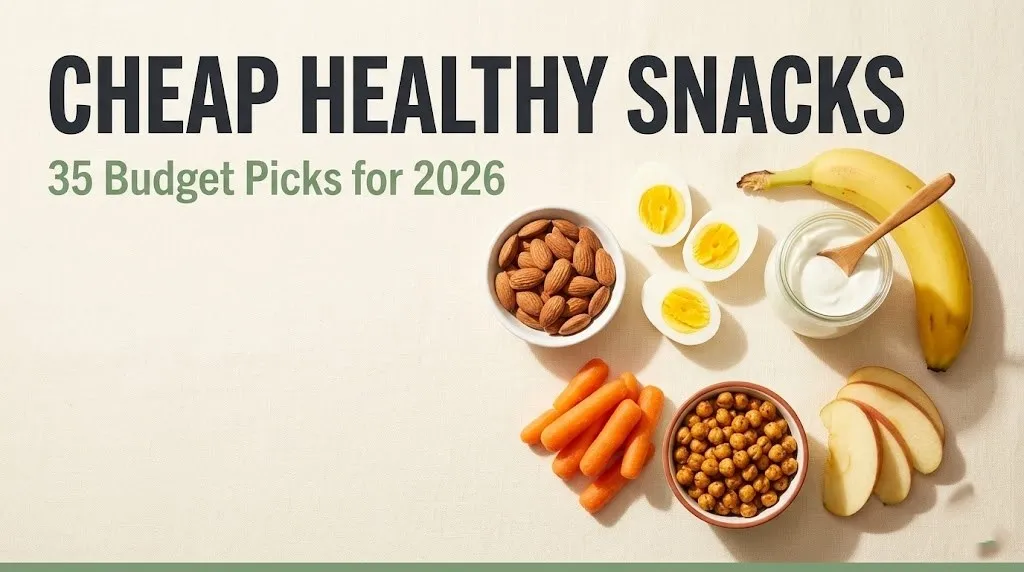
Think of the difference between a $3 bag of “protein bites” and a $2 bag of raw almonds. The almonds deliver 6 grams of protein and 3.5 grams of dietary fiber per ounce, with no added sugar, at a lower price per serving.
Key factors that determine whether a snack is both cheap and genuinely healthy:
- Cost per serving: Under $1 is the practical benchmark
- Protein content: At least 5 grams per serving helps with satiety
- Fiber content: At least 2 to 3 grams per serving supports blood glucose stability
- Added sugar: Ideally under 5 grams per serving
- Sodium: Under 200 milligrams per serving for most people
- Processing level: Whole or minimally processed foods over ultra-processed products
People managing conditions such as type 2 diabetes, hypertension, or food allergies should evaluate snacks against their specific dietary targets, ideally with guidance from a registered dietitian.
Affordable Healthy Snacks You Can Buy at Any Grocery Store
Affordable healthy snacks are widely available at standard grocery stores, dollar stores, and warehouse clubs without requiring specialty retailers or health food stores.
The price gap between healthy and unhealthy snacking is smaller than most people expect. A medium banana costs roughly $0.20 to $0.25. A can of chickpeas (Cicer arietinum) that roasts into four servings of crunchy snacks costs about $0.99. A container of plain Greek yogurt provides four to five servings for around $4.
| Snack | Approx. Cost Per Serving | Protein | Fiber |
|---|---|---|---|
| Banana | $0.22 | 1g | 3g |
| Hard-boiled egg | $0.25 | 6g | 0g |
| Canned chickpeas (1/4 cup roasted) | $0.25 | 4g | 3g |
| Plain Greek yogurt (3/4 cup) | $0.80 | 15g | 0g |
| Raw almonds (1 oz) | $0.35 | 6g | 3.5g |
| Baby carrots (3 oz) | $0.30 | 1g | 2g |
| Cottage cheese (1/2 cup) | $0.55 | 14g | 0g |
| Peanut butter (2 tbsp) | $0.22 | 7g | 1g |
Cost estimates based on average U.S. grocery store prices in 2026. Prices vary by region and retailer.
Warehouse clubs like Costco and Sam’s Club reduce per-unit costs further for high-volume buyers. Buying raw, unsalted versions of nuts and seeds rather than flavored varieties consistently delivers better nutritional value at a lower price point.
People with nut allergies should note that almonds and peanut butter are tree nut and legume products respectively, and carry significant allergen risk. Sunflower seed butter (from Helianthus annuus) is a strong cost-comparable alternative.
Best Cheap Healthy Snacks Ranked by Nutrition and Cost
The best cheap healthy snacks are the ones that score high on both nutritional density and low cost per serving simultaneously, not just one or the other.
Ranking snacks by both criteria reveals a clear top tier. Hard-boiled eggs consistently top lists from registered dietitians for good reason: they cost roughly $0.25 per egg, deliver 6 grams of complete protein, and contain vitamin B12, choline (essential for brain function), and vitamin D. The USDA reports that eggs are one of the few foods that naturally contain vitamin D.
Canned tuna (Thunnus spp.) offers perhaps the best protein-per-dollar ratio available. A 5-ounce can costs between $1 and $1.50 and delivers roughly 25 to 27 grams of protein. Choosing low-sodium, water-packed varieties keeps saturated fat and sodium in check. People who are pregnant or managing mercury exposure concerns should limit tuna intake and choose light tuna over albacore, as light tuna generally contains less methylmercury according to FDA guidance.
Rolled oats (Avena sativa) are an underrated snack base. A half-cup of dry oats costs less than $0.15, provides 5 grams of protein and 4 grams of dietary fiber, and contains beta-glucan, a soluble fiber that research published in the American Journal of Clinical Nutrition has linked to reduced LDL cholesterol levels.
| Snack | Nutrition Score | Cost Score | Overall Rank |
|---|---|---|---|
| Hard-boiled eggs | Excellent | Excellent | 1 |
| Canned tuna (water-packed) | Excellent | Excellent | 2 |
| Plain Greek yogurt | Excellent | Good | 3 |
| Rolled oats | Very Good | Excellent | 4 |
| Raw almonds | Very Good | Good | 5 |
| Canned chickpeas | Good | Excellent | 6 |
| Cottage cheese | Very Good | Good | 7 |
People with celiac disease or non-celiac gluten sensitivity should look for oats labeled certified gluten-free, as conventional oat processing facilities often share equipment with wheat products.
Key Takeaway: Hard-boiled eggs, canned tuna, and plain Greek yogurt offer the strongest combination of protein, micronutrients, and low cost per serving. These three alone can anchor a solid weekly snacking plan.
Cheap Healthy Snack Ideas for Every Craving
The best cheap healthy snack ideas match the type of craving you’re actually experiencing rather than assuming every snack need is the same.
Cravings fall into a few predictable patterns: sweet, salty, crunchy, creamy, and filling. Matching snack choices to craving type reduces the chance of reaching for a more expensive or less nutritious option.
For sweet cravings:
- Apple slices (Malus domestica) with 2 tablespoons of peanut butter: roughly $0.55 total, provides 4 grams of fiber and 7 grams of protein
- Frozen banana sliced and frozen overnight: $0.22, delivers 3 grams of fiber and natural sweetness from fructose
- Plain Greek yogurt with a drizzle of honey and cinnamon: under $1, provides 15 grams of protein
For salty and crunchy cravings:
- Roasted chickpeas (Cicer arietinum): toss rinsed, dried chickpeas in olive oil and salt, roast at 400°F for 25 to 30 minutes. Cost: roughly $0.30 per serving. Delivers 6 grams of protein and 5 grams of fiber.
- Sunflower seeds (Helianthus annuus), dry-roasted and unsalted: $0.25 per ounce, provides 5.5 grams of protein and is a good source of vitamin E (tocopherol)
- Brown rice cakes with a thin layer of cottage cheese: under $0.60 per serving
For filling, creamy options:
- Hummus (2 tablespoons) with baby carrots: roughly $0.45 combined, delivers 2 grams of protein and 2 grams of fiber
- Cottage cheese (1/2 cup) with sliced cucumber and black pepper: $0.55, provides 14 grams of protein
People with soy allergies should avoid edamame-based hummus variants. Standard hummus is made from chickpeas and sesame tahini, with sesame being a top-9 allergen under current FDA food labeling law.
The Best Cheap Healthy Snacks to Buy Right Now
The best cheap healthy snacks to buy in 2026 are whole foods in their least processed form, available in the produce, canned goods, and dairy sections of any standard grocery store.
You don’t need to shop at specialty health stores. The produce aisle and the canned goods aisle are where the real value lives. Packaged snacks marketed as “healthy” consistently cost more per serving while delivering less nutritional value than their whole-food counterparts.
Here’s a practical grocery list organized by store section:
Produce Section:
- Bananas (buy by the bunch for lowest per-unit cost)
- Baby carrots (a 1-pound bag yields roughly 5 snack servings for under $2)
- Apples (seasonal varieties are cheapest)
- Celery stalks (pair with peanut butter; a bunch costs under $2)
Canned and Dry Goods:
- Canned chickpeas, black beans (Phaseolus vulgaris), and kidney beans
- Canned tuna and canned salmon (Oncorhynchus spp.) in water, low-sodium
- Rolled oats and plain puffed rice
- Raw almonds, sunflower seeds, and pumpkin seeds (pepitas)
- Natural peanut butter (ingredients list: peanuts, salt only)
Dairy Section:
- Plain Greek yogurt (full-fat or 2% provides better satiety per serving)
- Cottage cheese (low-fat, low-sodium preferred for most people)
- Part-skim mozzarella string cheese
- Large eggs
The Harvard T.H. Chan School of Public Health recommends prioritizing whole foods over processed alternatives when managing both diet quality and food budget simultaneously. This holds consistently across income levels in dietary pattern research.
Key Takeaway: Shop the produce, canned goods, and dairy sections first. Those three areas contain the most nutritionally dense, budget-friendly snack options available at any conventional grocery store.
Cheap High-Protein Snacks That Actually Keep You Full
Cheap high-protein snacks are ones that deliver at least 7 to 10 grams of protein per serving for under $1, using whole or minimally processed protein sources.
Protein is the macronutrient most directly linked to satiety. Research published in the American Journal of Clinical Nutrition found that increasing protein intake to 25 to 30 percent of total daily calories reduced appetite and late-night snacking in study participants. The mechanism involves protein’s effect on ghrelin (the hunger hormone) and peptide YY (a satiety signal).
Think of a high-protein snack like a slow-burning fuel log compared to a high-carb snack that burns fast and hot. The protein keeps your appetite regulated for longer between meals.
| High-Protein Snack | Protein Per Serving | Approx. Cost |
|---|---|---|
| Hard-boiled egg (1 large) | 6g | $0.25 |
| Canned tuna (2 oz) | 11g | $0.50 |
| Cottage cheese (1/2 cup) | 14g | $0.55 |
| Plain Greek yogurt (3/4 cup) | 15g | $0.80 |
| Peanut butter (2 tbsp) | 7g | $0.22 |
| Edamame (1/2 cup shelled) | 8g | $0.55 |
| String cheese (1 stick) | 7g | $0.40 |
| Roasted pumpkin seeds/pepitas (1 oz) | 9g | $0.45 |
Edamame (Glycine max) deserves specific attention here. It’s one of the only plant foods that qualifies as a complete protein, meaning it contains all nine essential amino acids. A half-cup of shelled edamame costs roughly $0.55 from frozen bags and takes about three minutes to microwave. It’s also a good source of folate and iron.
People with soy allergies cannot consume edamame. Those following a low-purine diet for gout management should consume legumes in moderation and discuss specific intake targets with a healthcare provider.
Cheap High-Fiber Snacks for Better Digestion and Appetite Control
Cheap high-fiber snacks are foods that provide at least 3 grams of dietary fiber per serving at a cost under $1, without relying on added fiber supplements or fortified products.
The USDA Dietary Guidelines for Americans 2020-2025 recommend that adults consume 22 to 34 grams of dietary fiber per day, yet the average American intake falls around 15 grams daily. High-fiber snacks are one of the most practical ways to close that gap.
Dietary fiber works through two mechanisms. Soluble fiber (found in oats, beans, and apples) forms a gel in the digestive tract that slows glucose absorption and reduces LDL cholesterol reabsorption. Insoluble fiber (found in carrots, celery, and whole grains) adds bulk to stool and supports regular bowel transit.
| High-Fiber Snack | Fiber Per Serving | Type of Fiber |
|---|---|---|
| Rolled oats (1/2 cup dry) | 4g | Soluble (beta-glucan) |
| Apple with skin (1 medium) | 4.4g | Mixed |
| Canned chickpeas (1/2 cup) | 6g | Soluble and insoluble |
| Baby carrots (3 oz) | 2.5g | Insoluble |
| Pear with skin (1 medium) | 5.5g | Mixed |
| Sunflower seeds (1 oz) | 3g | Insoluble |
| Edamame (1/2 cup shelled) | 4g | Mixed |
| Black beans (1/2 cup, canned) | 7.5g | Soluble and insoluble |
Black beans (Phaseolus vulgaris) are an underused snack option. A half-cup of rinsed, drained canned black beans delivers 7.5 grams of fiber and 7.5 grams of protein for roughly $0.25. Served cold with a squeeze of lime and a pinch of cumin, they’re a filling snack that requires zero cooking.
People transitioning to a higher-fiber diet should increase intake gradually and drink adequate water to avoid gas and bloating. Sudden large increases in fiber, particularly from legumes, can cause digestive discomfort in some individuals.
Key Takeaway: Canned beans, oats, and fruit with skin are the cheapest, most fiber-dense snack options available. A half-cup of black beans provides more fiber than most packaged “high-fiber” snack bars at a fraction of the cost.
Cheap Low-Calorie Snacks That Don’t Leave You Hungry
Cheap low-calorie snacks that actually satisfy hunger combine low calorie density with high volume, fiber, or protein, rather than simply being small portions of regular foods.
Calorie density is the key concept here. Foods with low calorie density deliver more food volume per calorie, which means your stomach physically fills up even though your calorie intake stays low. A 3-ounce serving of baby carrots contains only about 35 calories but takes real time to eat, provides meaningful crunch, and delivers 2.5 grams of fiber.
| Low-Calorie Snack | Calories Per Serving | Protein | Fiber |
|---|---|---|---|
| Baby carrots (3 oz) | 35 | 1g | 2.5g |
| Celery sticks (3 stalks) | 25 | 0.7g | 2g |
| Cucumber slices (1 cup) | 16 | 0.7g | 0.5g |
| Apple (1 medium, with skin) | 95 | 0.5g | 4.4g |
| Hard-boiled egg (1 large) | 70 | 6g | 0g |
| Plain Greek yogurt (1/2 cup) | 65 | 10g | 0g |
| Rice cake (1 plain) | 35 | 0.7g | 0.4g |
The egg and Greek yogurt entries on that table demonstrate that low-calorie doesn’t have to mean low-protein. The combination of an egg and a half-cup of plain Greek yogurt totals 135 calories but delivers 16 grams of protein, a combination that research from Harvard T.H. Chan School of Public Health has consistently linked to improved appetite regulation.
Plain rice cakes are extremely low calorie but provide minimal protein or fiber on their own. They work better as a base paired with cottage cheese or peanut butter than as a standalone snack.
People following a low-potassium diet due to kidney disease should be cautious with bananas, potatoes, and legumes, as these foods are high in potassium. Dietary restrictions for kidney disease are highly individual, and a registered dietitian specializing in renal nutrition is the appropriate resource for specific guidance.
Cheap Healthy Snacks for Weight Loss: What the Research Actually Shows
Cheap healthy snacks support weight loss by maintaining energy levels between meals, reducing overeating at main meals, and supplying protein and fiber that regulate hunger hormones.
The evidence around snacking and weight management is more specific than most lists acknowledge. A 2023 analysis in the journal Nutrients found that mid-morning and mid-afternoon snacks high in protein or fiber were associated with lower overall daily caloric intake in adults. The benefit came from reducing the severity of hunger before main meals, not from the snacks themselves being “fat-burning.”
Portion size matters here. The same food can either support or undermine a calorie deficit depending on how much of it you eat. A single tablespoon of natural peanut butter (Arachis hypogaea) contains about 95 calories and 4 grams of protein. Two tablespoons contain 190 calories and is still a reasonable snack. Four tablespoons adds up to 380 calories, which is a full small meal.
Weight loss-supportive snack features to prioritize:
- High protein (7g or more): Reduces ghrelin (hunger hormone) release between meals
- High fiber (3g or more): Slows gastric emptying, extending fullness
- Low energy density: High volume per calorie helps with satiety without high caloric load
- Minimal added sugar: Prevents rapid blood glucose spikes and subsequent hunger rebounds
- Low palatability trap risk: Highly palatable snacks (sweet, salty, crunchy, and fatty simultaneously) are harder to portion control
Best cheap snacks for weight loss by these criteria:
- Hard-boiled eggs ($0.25, 70 calories, 6g protein)
- Plain Greek yogurt ($0.80, 65 to 130 calories per 1/2 to 3/4 cup, 10 to 15g protein)
- Apple with peanut butter ($0.45, 185 calories combined, 11g fiber + protein combined)
- Roasted chickpeas ($0.30, 120 calories per 1/4 cup, 6g protein, 5g fiber)
People with a history of disordered eating or calorie anxiety should focus on nutrient quality over calorie counting. A registered dietitian can help develop a snacking approach that supports weight goals without triggering restrictive patterns.
Key Takeaway: High-protein and high-fiber cheap snacks work for weight management not through any metabolic magic, but because protein and fiber are the two dietary factors most consistently linked to reduced hunger between meals in published research.
Easy Cheap Healthy Snacks You Can Prep in Under 10 Minutes
Easy cheap healthy snacks that require minimal prep can be ready in under 10 minutes using standard kitchen equipment and common pantry items.
“Quick” means different things depending on your kitchen confidence and equipment. The options below are straightforward for most home cooks, require no specialized tools, and can be batch-prepped ahead of time for the week.
5-Minute No-Cook Options:
- Apple slices with peanut butter
- Cucumber rounds topped with cottage cheese and cracked pepper
- Carrot sticks with hummus
- Banana with a handful of raw almonds
- Greek yogurt with a sprinkle of ground cinnamon and a few walnuts
10-Minute Prep Options:
To make overnight oats (makes 1 serving):
- Add 1/2 cup rolled oats to a jar or container.
- Pour in 1/2 cup plain Greek yogurt and 1/2 cup water or milk.
- Add a pinch of cinnamon and a drizzle of honey if desired.
- Stir well and seal the container.
- Refrigerate for at least 4 hours. Keeps for up to 4 days.
To make roasted chickpeas (makes 4 servings):
- Drain and rinse one 15-ounce can of chickpeas.
- Spread onto a clean kitchen towel and pat completely dry. Moisture is the enemy of crispiness.
- Toss with 1 tablespoon olive oil, 1/2 teaspoon salt, and any spice you prefer (cumin, smoked paprika, garlic powder).
- Spread in a single layer on a baking sheet.
- Roast at 400°F (204°C) for 25 to 30 minutes until deeply golden and crunchy.
The biggest mistake in roasting chickpeas is under-drying them before the oven. Wet chickpeas steam rather than roast, and you’ll end up with soft, rubbery results instead of the crunch you’re after.
Cheap Healthy Snacks for Work: What Holds Up Through a Full Shift
Cheap healthy snacks for work need to be portable, require no or minimal refrigeration, produce minimal odor in shared spaces, and still deliver meaningful nutrition through a full workday.
The shared workspace factor eliminates a surprising number of otherwise excellent snacks. Hard-boiled eggs and canned fish are top-tier nutritionally but create real friction in open offices. Knowing the environment matters.
Office-Friendly Options (No Strong Odor, Easy Transport):
- Raw almonds in a small container (no refrigeration needed)
- Banana or apple (built-in packaging)
- Brown rice cakes with individual peanut butter packets
- String cheese (stays fine for several hours in a lunch bag with an ice pack)
- Plain rice cakes with small single-serve hummus cups
- Overnight oats in a sealed jar (refrigerate until you leave home)
Desk-Drawer Shelf-Stable Options:
- Individual packets of natural peanut butter or sunflower seed butter
- Single-serve packets of roasted almonds or mixed nuts (unsalted)
- Dried fruit (unsweetened): apricots, figs, raisins. Note that dried fruit is calorie-dense; 1/4 cup of raisins contains roughly 120 calories. Portion control matters.
- Whole grain crackers with no added sugar (check labels)
The Academy of Nutrition and Dietetics notes that planning snacks in advance reduces impulsive vending machine purchases, which typically offer ultra-processed options at 3 to 5 times the cost of equivalent whole foods.
People working physically demanding shifts (construction, healthcare, manual labor) may need snacks with higher caloric density, making nut-based options more suitable than low-calorie produce-only choices.
Key Takeaway: Almonds, string cheese, bananas, and overnight oats are the four most practical cheap snacks for a full workday. They’re portable, require minimal or no refrigeration for short periods, and deliver meaningful protein or fiber.
Cheap Healthy Snacks for Kids: Safe, Appealing, and Parent-Approved
Cheap healthy snacks for kids should be age-appropriate in texture and size, nutritionally balanced, and free from choking hazards for children under the age of 4.
Children’s nutritional needs differ from adults. The USDA Dietary Guidelines for Americans recommend that children aged 2 to 5 consume 1 to 1.5 cups of fruit per day and 1 to 1.5 cups of vegetables per day, with snacks contributing meaningfully to those totals. Snacks that double as produce servings are especially efficient for busy parents.
Age matters for texture and form. Whole grapes, large chunks of hard vegetables like raw carrots, and whole nuts are choking risks for children under 4. Grapes should be halved or quartered lengthwise. Carrots for toddlers should be steamed soft or grated.
Budget-Friendly Snack Ideas for Kids by Age:
| Age Group | Snack Option | Prep Note |
|---|---|---|
| Toddlers (1-3) | Steamed carrot sticks, soft banana pieces | Cut small, soft texture required |
| Ages 4-8 | Apple slices with peanut butter | Nut-free schools: use sunflower seed butter |
| Ages 9-12 | Greek yogurt with fresh fruit | Choose plain, add fruit to control sugar |
| Teens | Hard-boiled eggs, string cheese, rice cakes with hummus | Most adult options suitable |
Many schools have nut-free policies due to the prevalence of peanut and tree nut allergies in children. Sunflower seed butter (from Helianthus annuus) is the most practical cost-comparable substitute. It delivers similar protein and fat profiles without the allergen risk.
String cheese is one of the most parent-friendly cheap snacks. A single stick provides 7 grams of protein and roughly 200 milligrams of calcium for around $0.40. Children aged 9 to 18 need 1,300 milligrams of calcium per day according to the NIH Office of Dietary Supplements, making calcium-rich snacks particularly relevant for growing kids.
Cheap Healthy Road Trip Snacks That Travel Well
The best cheap healthy road trip snacks are shelf-stable for at least 4 to 6 hours, don’t require cutlery, produce minimal mess, and hold up nutritionally even at room temperature.
Road trips eliminate refrigeration, often delay meal timing, and introduce boredom eating as an added variable. Planning ahead with the right snacks prevents highway rest stop impulse purchases that average $3 to $5 per item for low-nutrition options.
Road-Trip Ready Snacks That Hold for 6+ Hours at Room Temperature:
- Raw almonds or mixed unsalted nuts (sealed bag or container)
- Whole apples, bananas, or oranges (natural packaging keeps them fresh)
- Whole grain crackers (check that the ingredient list has no partially hydrogenated oils)
- Individual peanut butter packets (no refrigeration needed)
- Dried figs or apricots (unsweetened; rich in potassium and iron)
- Roasted chickpeas (homemade batch in an airtight container)
- Beef or turkey jerky (low-sodium varieties; note that most commercial jerky is high in sodium, typically 400 to 600 milligrams per ounce)
Snacks That Hold 4 to 6 Hours in a Cooler with Ice Packs:
- Hard-boiled eggs (pre-peeled in a container)
- String cheese or mini babybel-style portions
- Plain Greek yogurt in individual cups
- Pre-portioned hummus with pre-cut vegetables
The American Heart Association recommends keeping sodium under 2,300 milligrams per day for most adults. On a road trip, the combination of jerky, crackers, and convenience store purchases can easily push sodium intake well beyond that in a single day. Building your snack bag before departure gives you control.
People with cardiovascular conditions or on low-sodium diets should prioritize raw, unsalted options and avoid most commercially prepared jerky products.
Key Takeaway: Raw nuts, whole fruit, and home-roasted chickpeas are the cheapest and most nutritionally complete road trip snacks. They require no refrigeration, are portion-controllable, and cost a fraction of highway convenience store alternatives.
Cheap Protein Snacks That Need No Refrigeration
The best cheap protein snacks that need no refrigeration deliver at least 7 grams of protein per serving, cost under $1 per serving, and stay safe at room temperature for several hours to several days depending on the product.
Refrigeration-free protein snacks are essential for travel, desk storage, gym bags, school lunches, and situations where a fridge isn’t accessible. The options are more plentiful than most people realize.
| Shelf-Stable Protein Snack | Protein | Approx. Cost | Notes |
|---|---|---|---|
| Raw almonds (1 oz) | 6g | $0.35 | Best kept in an airtight container |
| Pumpkin seeds/pepitas (1 oz) | 9g | $0.45 | Good iron source |
| Peanut butter packet (1.15 oz) | 7g | $0.40 | Legume, not a tree nut |
| Sunflower seeds (1 oz) | 5.5g | $0.25 | Good vitamin E source |
| Low-sodium beef jerky (1 oz) | 9g | $0.80 | Check sodium content |
| Roasted chickpeas (1/4 cup) | 6g | $0.30 | Make at home for best value |
| Whole grain crackers + peanut butter | 9g combined | $0.55 | Balanced macro snack |
| Canned fish (if eating immediately) | 11g per 2 oz | $0.50 | Open only when ready to eat |
Pumpkin seeds (pepitas, from Cucurbita pepo) are one of the most nutrient-dense seeds you can buy at a low price. One ounce provides 9 grams of protein, 2.2 milligrams of iron (roughly 12% of the daily value for adult men, 6% for adult women), and meaningful amounts of magnesium and zinc. They also contain tryptophan, a precursor to serotonin, which is a relevant detail for people monitoring mood and sleep patterns.
People with tree nut allergies should confirm that pumpkin seeds are processed in a tree-nut-free facility. While pumpkin seeds are not tree nuts botanically, cross-contamination in processing plants is a documented risk.
Healthy Snacks for Meal Prep on a Budget
Healthy snacks for meal prep on a budget are foods that can be prepared in bulk once per week, stored properly, and deployed as ready-to-eat portions throughout the week without losing nutritional value or food safety integrity.
Meal prepping snacks reduces the daily decision fatigue that leads to impulsive, expensive, or nutritionally poor food choices. The NIH notes that food environment, specifically having nutritious options pre-positioned and accessible, is one of the most reliable predictors of healthier eating patterns.
Weekly Snack Prep Plan (Total Cost: Under $15 for 5 Days of Snacks):
| Prep Item | Weekly Cost | Servings | Per Serving Cost |
|---|---|---|---|
| 12 hard-boiled eggs | $2.50 | 12 | $0.21 |
| 2 cups roasted chickpeas | $1.00 | 8 | $0.13 |
| 5 overnight oat jars | $3.50 | 5 | $0.70 |
| 1 kg plain Greek yogurt | $4.00 | 5 | $0.80 |
| 1 lb baby carrots + hummus | $3.00 | 5 | $0.60 |
| Total | $14.00 | 35 snack portions | $0.40 avg |
Storage guidance for each:
- Hard-boiled eggs: refrigerate in shell for up to 7 days, or peeled in water for up to 5 days
- Roasted chickpeas: store at room temperature in an airtight container for up to 4 days before they soften
- Overnight oats: refrigerate sealed for up to 5 days
- Greek yogurt: keep refrigerated and consume by the printed date
- Pre-cut vegetables: store in water in sealed containers in the fridge for up to 4 days
The USDA Food Safety and Inspection Service sets hard-boiled egg refrigeration safety at 7 days maximum. Beyond that, quality and food safety both decline meaningfully.
People with latex-fruit syndrome should be aware that certain fruits (avocado, banana, kiwi) used in snack prep may trigger cross-reactive allergic responses. This affects a subset of people with latex allergies and is worth flagging if unexplained food reactions occur.
Key Takeaway: Prepping a week of snacks in one session costs roughly $14 and produces 35 snack portions at $0.40 each. That’s a fraction of the cost of packaged alternatives and ensures nutritious options are always within reach without daily effort.
Frequently Asked Questions About Cheap Healthy Snacks
What are the cheapest healthy snacks you can buy at a grocery store?
Bananas, canned chickpeas, hard-boiled eggs, raw almonds, and plain Greek yogurt are consistently among the cheapest healthy snacks available at standard grocery stores.
Most of these cost between $0.20 and $0.80 per serving and deliver meaningful amounts of protein, fiber, or both.
Buying produce in season, choosing store-brand canned goods, and purchasing nuts and seeds from bulk bins (where available) reduces costs further.
What are good high-protein snacks that are actually cheap?
Hard-boiled eggs, canned tuna, cottage cheese, edamame, and plain Greek yogurt are the best cheap high-protein snack options.
Each delivers at least 6 grams of protein per serving for under $1, with most falling between $0.25 and $0.80.
Canned tuna in water is especially efficient, providing roughly 11 grams of protein per 2-ounce serving for around $0.50.
Are rice cakes a healthy snack?
Plain rice cakes are low in calories (roughly 35 calories each) but provide minimal protein and fiber on their own.
They become a more nutritionally complete snack when paired with peanut butter, cottage cheese, or hummus, which adds protein and fat.
People with celiac disease or gluten sensitivity should confirm that the rice cake brand uses a gluten-free production facility, as some are made on shared equipment.
What healthy snacks can I eat for weight loss on a budget?
Hard-boiled eggs, plain Greek yogurt, roasted chickpeas, and apple slices with peanut butter are the strongest budget-friendly snacks for managing caloric intake.
Each combines protein or fiber (or both) to reduce hunger hormone activity between meals, which research from the American Journal of Clinical Nutrition links to lower daily caloric intake.
Portion control matters equally; even nutritious snacks consumed in excess will exceed a calorie target.
What cheap snacks don’t need refrigeration?
Raw almonds, pumpkin seeds, sunflower seeds, whole fruit (bananas, apples, oranges), peanut butter packets, roasted chickpeas, and low-sodium jerky are all shelf-stable snacks that need no refrigeration.
These hold at room temperature for several hours to several days depending on the item and storage conditions.
For multi-day travel or desk storage, nuts and whole fruit are the most practical combination of cost, nutrition, and shelf stability.
The Bottom Line
Cheap healthy snacks exist at every grocery store. You don’t need specialty products, premium brands, or a large food budget to snack well.
The best options consistently cluster around the same categories: whole eggs, Greek yogurt, canned legumes, raw nuts and seeds, fresh fruit, and baby vegetables. Most cost under $0.80 per serving and take under five minutes to prepare when you have them on hand.
Start with one batch-prep session per week. Pre-boil a dozen eggs, roast a can of chickpeas, and portion out a few overnight oat jars. That one hour of preparation creates a week’s worth of grab-and-go options that cost less than a single gas station snack run.