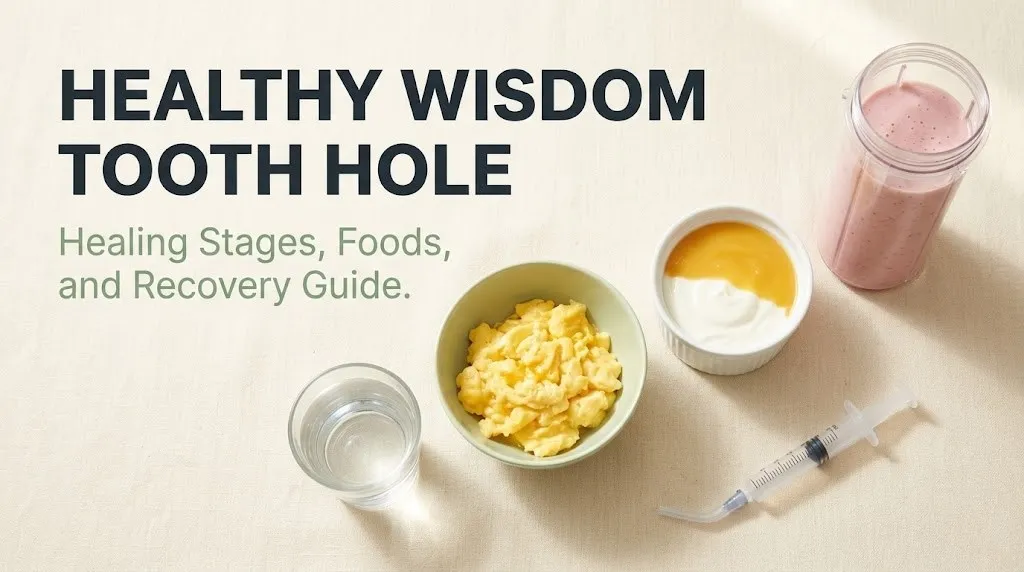
A healthy wisdom tooth hole progresses through predictable healing stages marked by a stable dark red blood clot, gradual formation of whitish granulation tissue, and slow closure of the socket over several weeks, supported by the right foods and wound-healing nutrients.
Seeing a hole where your tooth used to be is unsettling. The first time you peek at the extraction site with a flashlight, you might feel genuine alarm. That gap looks raw, deep, and worryingly vulnerable. Understanding what a healing socket should look like, what foods help it close properly, and what signs mean trouble is the difference between a calm recovery and days of unnecessary anxiety.
The American Association of Oral and Maxillofacial Surgeons reports that most wisdom tooth extractions heal without complication when patients follow post-operative care instructions. Nutrition plays a direct role in that outcome. Specific nutrients fuel the cellular machinery that rebuilds gum tissue and bone. This article walks you through every stage of healing, exactly what your socket should look like, what to eat, and when to call your surgeon.
What Is a Healthy Wisdom Tooth Hole
A healthy wisdom tooth hole is an extraction socket in which a stable blood clot has formed within the first 24 hours, followed by the gradual development of granulation tissue that fills the socket from the bottom up over several weeks while gum tissue closes over the top.
After a wisdom tooth is removed, the jawbone is exposed. The body immediately begins a sequence of events that has evolved over millions of years to close wounds. Blood fills the socket and coagulates into a clot that serves as both a protective covering for the underlying bone and a scaffold for healing cells.
This blood clot is not a problem. It is the foundation of healing. The clot contains platelets, growth factors, and signaling molecules that attract fibroblasts and osteoblasts to the site. Fibroblasts produce collagen, the structural protein that forms new connective tissue. Osteoblasts begin laying down new bone. The clot must remain undisturbed. Losing it too early exposes bone and nerve endings, a condition called alveolar osteitis or dry socket that is painful and delays healing.
Over the next several days, the clot is gradually replaced by granulation tissue. This tissue is rich in new blood vessels, immune cells, and collagen-producing cells. It appears whitish or yellowish and fills the socket from the bottom upward. By the end of the first week, the socket walls begin to collapse inward as gum tissue grows across the top. Complete closure of the gum surface typically takes two to four weeks. Bone remodeling beneath the gum continues for several months.
Key Takeaway: A healthy wisdom tooth hole is one where a stable blood clot stays in place, granulation tissue fills the socket gradually, and gum tissue closes the opening over a period of weeks without signs of infection.
Wisdom Tooth Hole Healing Stages and Timeline
Wisdom tooth hole healing follows a predictable four-stage timeline beginning with blood clot formation in the first 24 hours and ending with complete gum closure and bone remodeling over three to six months.
Each stage looks different and requires different care. Knowing the timeline helps you distinguish between normal healing and a problem that needs attention.
| Healing Stage | Timeframe | What Happens | What You See |
|---|---|---|---|
| Hemostasis and Clot Formation | First 24 hours | Blood fills socket and coagulates; platelets release growth factors | Dark red or maroon clot filling the socket; mild oozing; surrounding gum tissue swollen |
| Inflammation and Granulation | Days 2 to 7 | Immune cells clear debris; fibroblasts produce collagen; new blood vessels form | Whitish or yellowish-gray tissue replacing the dark clot; socket size begins decreasing; swelling peaks day 2 to 3 then subsides |
| Proliferation and Epithelialization | Weeks 2 to 4 | Gum tissue grows across socket surface; collagen matrix strengthens | Pink gum tissue closing over the hole; socket appears smaller and shallower; whitish tissue replaced by pink tissue |
| Bone Remodeling | Months 1 to 6 | Osteoblasts fill socket with new bone; socket fully integrates with jaw | Gum surface smooth and closed; slight indentation may remain; no visible hole |
The timeline varies by individual factors. Younger patients generally heal faster. Mandibular (lower) extractions tend to heal more slowly than maxillary (upper) ones because the lower jaw bone is denser. Impacted teeth that required surgical sectioning create larger sockets that take longer to close. Smoking, diabetes, and certain medications slow every phase of wound healing.
The first 24 to 72 hours are the window of highest risk for dry socket. The clot is most vulnerable during this period because the fibrin mesh that stabilizes it has not fully cross-linked. After day 4, the risk drops sharply as granulation tissue begins anchoring to the socket walls.
Quick Tip:
- Mark your calendar at day 1, day 3, day 7, and day 14 post-extraction. These are the key checkpoints for evaluating whether healing is on track. Photographing the socket with your phone at each checkpoint gives you an objective record of progress.
What Does a Healthy Wisdom Tooth Hole Look Like
A healthy wisdom tooth hole changes appearance predictably over the healing period, starting as a dark red or maroon blood clot that transitions to whitish granulation tissue by day 4 to 7 and finally to pink gum tissue closing the opening by week 3 to 4.
Here is what to expect at each visual checkpoint:
Day 1: The socket looks like a hole filled with dark red or maroon jelly-like material. This is the blood clot. It may rise slightly above the gum line or sit flush with it. The surrounding gum tissue appears red and swollen. A small amount of blood-tinged saliva is normal. The socket should not look empty, and there should not be visible white bone at the bottom.
Day 2 to 3: The clot darkens to a deeper maroon or brownish color. A thin whitish film may begin appearing on top of the clot. This film is fibrin, a protein involved in clot stabilization, and it is normal. Swelling of the cheek and jaw peaks during this period. The socket may look slightly larger as swelling distorts the surrounding tissue.
Day 4 to 7: The whitish or yellowish-gray granulation tissue becomes more prominent. This is new healing tissue filled with collagen and tiny blood vessels. It looks different from the original clot, creamier and more opaque. Some patients mistake granulation tissue for pus and worry about infection. The distinguishing features are that granulation tissue is firmly attached, does not wipe away, and is not accompanied by increasing pain or foul odor.
Day 7 to 14: The socket appears noticeably smaller. Pink gum tissue is visible at the edges growing inward. The whitish granulation tissue is still visible at the center of the socket but is being covered from the edges by new epithelium. The hole looks shallower. Food particles may collect in the socket during this period, which is why irrigation with a syringe is often recommended starting around day 5 to 7.
Week 3 to 4: The gum surface is mostly or completely closed. A slight depression or indentation remains where the socket was. The tissue is pink and firm. The hole is no longer a hole. The underlying bone continues to fill in for months.
Day-by-day visual summary:
| Day | Normal Appearance |
|---|---|
| Day 1 | Dark red/maroon clot filling socket; swollen gums |
| Day 2-3 | Darker clot; whitish fibrin film possible; peak swelling |
| Day 4-5 | Granulation tissue (whitish/yellowish) replacing clot surface |
| Day 6-7 | Granulation tissue predominant; gums less swollen; socket smaller |
| Day 7-14 | Pink gum edges closing in; socket shallower |
| Week 3-4 | Gum surface closed; slight indentation remains |
| Month 3-6 | Smooth gum; bone remodeling beneath surface |
Key Takeaway: A healing socket naturally changes from dark clot to whitish tissue to pink gum. The progression is gradual. Sudden changes, increasing pain, or an empty-looking socket are reasons to call your surgeon.
Healthy Wisdom Tooth Hole vs Dry Socket
A healthy wisdom tooth hole contains a visible blood clot or granulation tissue and produces steadily decreasing pain, while a dry socket appears as an empty hole with exposed whitish bone at the bottom and causes severe, radiating pain that worsens between days 2 and 4 after extraction.
Dry socket, formally called alveolar osteitis, occurs when the blood clot dislodges or dissolves before healing tissue can form. The underlying bone and nerve endings are exposed to air, food, and fluid. The pain is intense, often described as a deep ache radiating to the ear, temple, or neck on the same side of the face. Pain medication that controlled discomfort on day 1 often fails to touch dry socket pain.
Here is a direct comparison:
| Feature | Healthy Healing Socket | Dry Socket |
|---|---|---|
| Appearance | Dark clot or whitish granulation tissue filling hole | Empty hole with visible grayish-white bone |
| Pain level | Decreasing daily after day 3 | Severe, increasing, peaks day 3-5 |
| Pain quality | Dull ache, well-controlled with medication | Sharp, throbbing, radiating to ear and jaw |
| Bad taste | Mild or none | Foul taste, bad breath |
| Onset | Improving steadily | Sudden worsening day 2-4 |
| Response to pain medication | Responds well | Poor response to over-the-counter medication |
The incidence of dry socket after wisdom tooth extraction ranges from 2 to 5 percent for routine extractions and up to 20 to 30 percent for impacted mandibular third molars, according to a 2021 review in the Journal of Oral and Maxillofacial Surgery. Risk factors include smoking, oral contraceptive use, traumatic extraction, lower jaw extraction, and failure to follow post-operative instructions.
Dry socket is treatable. An oral surgeon cleans the socket and places a medicated dressing that provides rapid pain relief. The dressing is changed every few days until granulation tissue forms. Dry socket does not resolve on its own and should prompt a call to your surgeon immediately, not a wait-and-see approach.
Dietary Sensitivity Note: Patients who develop dry socket may need to return to a liquid or very soft diet for several additional days while the medicated dressing is in place, even if they had progressed to softer solid foods.
Best Foods to Eat After Wisdom Teeth Removal
The best foods after wisdom tooth removal are nutrient-dense, soft or liquid items that require no chewing, contain no small particles that could lodge in the socket, and provide protein, vitamin C, zinc, and vitamin A to fuel wound healing.
Eating after oral surgery is not just about avoiding pain. Food choices directly affect how fast you heal. The body’s metabolic rate increases after surgery. Protein requirements rise because amino acids are the building blocks of new tissue. Vitamin C is a cofactor for enzymes that cross-link collagen fibers, literally strengthening the new tissue forming in the socket. Zinc supports the cell division needed to replace damaged tissue. Vitamin A regulates epithelial cell growth, helping gum tissue close the wound.
Here are the top healing foods organized by nutrient function:
| Nutrient | Function in Healing | Best Post-Extraction Food Sources |
|---|---|---|
| Protein | Collagen and tissue synthesis | Greek yogurt, scrambled eggs, cottage cheese, bone broth, silken tofu, protein smoothies |
| Vitamin C | Collagen cross-linking, antioxidant | Blended cantaloupe, mango puree, thinned applesauce, pureed sweet potato, smoothie with strawberries |
| Zinc | Cell proliferation, immune defense | Pureed lentils, thinned hummus, scrambled eggs, pumpkin seed butter thinned with milk |
| Vitamin A | Epithelial cell formation | Pureed carrots, pureed sweet potato, blended mango, soft scrambled eggs |
| Omega-3 fatty acids | Inflammation modulation | Mashed avocado, thinned flaxseed pudding, salmon mousse or puree |
| Calories and fluids | Energy for healing, hydration | Smoothies, broths, full-fat yogurt, pudding, meal replacement shakes |
Temperature matters during the first 48 hours. Hot foods and liquids dilate blood vessels and can restart bleeding. Lukewarm or cool foods are safest. After 48 hours, warmth is generally well-tolerated and can be soothing.
Hydration supports every phase of healing. Dehydration thickens the blood, impairs nutrient delivery to the wound site, and worsens post-operative fatigue. Water is ideal. Sip from a cup. Never use a straw. The suction created by a straw is one of the most common causes of blood clot dislodgement and dry socket.
Quick Tip:
- Prepare a batch of smoothies the day before surgery and freeze them in small portions. As they thaw, they reach the ideal cool, drinkable temperature and provide a ready source of nutrients when you have no energy to prepare food.
Nutrients That Speed Up Wisdom Tooth Hole Healing
The nutrients most directly involved in speeding up wisdom tooth hole healing are protein, vitamin C, zinc, and vitamin A, each supporting a specific phase of tissue repair from initial clot stabilization to final gum closure.
Healing a surgical wound is metabolically expensive. The body diverts amino acids, vitamins, and minerals to the extraction site. Inadequate intake of any of these nutrients slows the process. The Academy of Nutrition and Dietetics identifies protein-energy malnutrition and micronutrient deficiencies as factors that impair surgical wound healing across all types of procedures.
Protein provides the amino acids needed for collagen synthesis. Collagen is the primary structural protein in gum tissue and the matrix on which bone mineralizes. Arginine and glutamine, two conditionally essential amino acids, are particularly important for wound healing. A 2020 study in the journal Nutrients found that arginine supplementation improved wound healing outcomes in surgical patients. Food sources of arginine include dairy products, eggs, and pumpkin seeds. Glutamine is abundant in bone broth, yogurt, and soft-cooked eggs.
Vitamin C, also known as ascorbic acid, is a cofactor for prolyl hydroxylase and lysyl hydroxylase, the enzymes that cross-link collagen fibrils. Without adequate vitamin C, collagen is structurally weak. The National Institutes of Health recommends 75 to 90 milligrams daily for healthy adults, but surgical healing may increase demand. A cup of blended mango provides approximately 60 milligrams. Pureed sweet potato provides 20 milligrams per half-cup. A strawberry smoothie with half a cup of berries provides about 50 milligrams.
Zinc functions as a cofactor for over 300 enzymes, many involved in cell division and protein synthesis. The proliferative phase of wound healing, when granulation tissue forms, is zinc-dependent. The NIH Office of Dietary Supplements reports that zinc deficiency impairs wound closure. Soft food sources of zinc include scrambled eggs (0.6mg per egg), thinned hummus made from chickpeas and tahini, and Greek yogurt.
Here is a daily target guide for wound healing nutrients during the first two weeks of recovery:
| Nutrient | Daily Target During Healing | Food to Reach Target |
|---|---|---|
| Protein | 1.2-1.5g per kg body weight (approx 80-100g for most adults) | 3 scrambled eggs (18g) plus 1 cup Greek yogurt (20g) plus protein smoothie with milk and protein powder (30g) |
| Vitamin C | 100-200mg | Blended mango (60mg) plus strawberry smoothie (50mg) plus pureed sweet potato (20mg) |
| Zinc | 15-20mg | 3 scrambled eggs (2mg) plus hummus (2mg) plus pumpkin seed butter (2mg); consider supplement |
| Vitamin A | 900mcg RAE | Pureed sweet potato (1,400mcg in 1/2 cup) or pureed carrots (900mcg in 1/2 cup) |
Dietary Sensitivity Note: Patients who follow a vegan diet can meet protein needs with silken tofu smoothies, pea protein powder, and thinned lentil purees. Zinc from plant sources is less bioavailable, so a short-term zinc supplement may be appropriate. Discuss supplementation with your oral surgeon.
Key Takeaway: Protein, vitamin C, zinc, and vitamin A are the four nutrients that directly fuel the tissue repair happening in your wisdom tooth hole. Getting enough of each through soft foods every day of recovery is one of the most actionable things you can do to heal faster.
Soft Foods to Eat the First 24 Hours
During the first 24 hours after wisdom tooth extraction, you should consume only cool or lukewarm liquids and completely smooth, no-chew foods that require zero jaw movement and contain no particles that could disturb the newly formed blood clot.
The first 24 hours are about protecting the clot. The clot is fragile. The fibrin mesh that will stabilize it over the coming days has not yet formed. Any suction, chewing motion, or food particle lodging in the socket risks dislodging it. Bleeding is still active in some patients, and the gauze pressure protocol may still be in progress.
Foods appropriate for the first 24 hours include:
- Smoothies made with yogurt, milk or milk alternative, protein powder, and seedless fruit, blended until completely uniform with no chunks
- Broths, bone broth or vegetable broth, cooled to lukewarm, sipped from a cup
- Greek yogurt, plain or blended with pureed fruit, with no seeds or fruit chunks
- Applesauce, completely smooth, no chunks, served cool
- Pudding and gelatin, pre-made or instant, cool temperature
- Meal replacement shakes, ready-to-drink or powder blended smooth
- Thinly pureed soups, strained to remove any fiber or particles, served lukewarm
- Ice cream and sorbet, without nuts, chocolate chips, or cookie pieces
- Cottage cheese blended smooth with a little milk if the curds are large
Foods and actions to strictly avoid during the first 24 hours:
- Hot foods or liquids (causes vasodilation and bleeding)
- Straws (suction dislodges clot)
- Spitting or vigorous rinsing (dislodges clot)
- Any food requiring chewing
- Carbonated beverages (bubbles can disturb the clot)
- Alcohol (interferes with clotting and interacts with pain medication)
- Small grains like rice or quinoa that can lodge in the socket
- Spicy foods (irritate the surgical site)
Pain and swelling typically peak on day 2. The first 24 hours are often the easiest pain-wise because local anesthesia and prescribed pain medication are still active. This is the window to get ahead of nutrition before discomfort makes eating more difficult. Eating enough in the first 24 hours also prevents the nausea that can occur when taking pain medication on an empty stomach.
Quick Tip:
- A smoothie with Greek yogurt, milk, protein powder, and a seedless fruit puree provides protein, calories, and fluids in a completely safe format for the first 24 hours. Make two and keep the second one in the refrigerator for when pain medication wears off and preparing food feels impossible.
Day 2 to 3 Foods After Wisdom Tooth Extraction
On days 2 to 3, you can introduce slightly thicker soft foods that still require no chewing but provide more substance and satiety as the initial anesthesia fully wears off and appetite begins returning.
The clot is more stable by day 2, but it is still vulnerable. The fibrin network is forming but can be disrupted by mechanical force. Chewing motions on the extraction side should still be avoided completely. The swelling and discomfort typically peak during this window, which naturally limits what feels possible to eat.
Foods appropriate for days 2 to 3 include everything from the first 24 hours plus:
- Scrambled eggs, cooked soft with no browning, cooled to lukewarm, eaten in small spoonfuls
- Mashed potatoes, thinned with milk or broth to a smooth consistency with no lumps
- Pureed soups, blended until completely smooth, such as tomato soup, butternut squash soup, or cream of broccoli soup with no fibrous pieces
- Oatmeal or cream of wheat, cooked thin and smooth, with no added nuts, seeds, or dried fruit
- Mashed avocado, ripe and smooth, eaten plain or blended into smoothies
- Hummus, thinned with olive oil or water to a very smooth consistency
- Ricotta cheese or cottage cheese blended smooth
- Refried beans, thinned with water and warmed gently
- Banana mashed to a completely smooth paste
Texture is the primary concern. Any lump, chunk, or fiber strand can find its way into the socket. The socket is still an open hole at this stage. Food particles that lodge in it are difficult to remove without irrigation, and rinsing too vigorously risks the clot.
Protein intake becomes more important on days 2 to 3. The inflammation phase of healing is underway, and the body needs amino acids to produce immune cells and begin collagen synthesis. Scrambled eggs, Greek yogurt, protein smoothies, and pureed lentil soup all deliver protein in a safe texture.
Here is a sample day 2 to 3 meal structure:
| Meal | Food | Key Nutrients |
|---|---|---|
| Breakfast | Smoothie: Greek yogurt, milk, banana, protein powder, mango puree | Protein, vitamin C, potassium |
| Mid-morning | Applesauce with a spoonful of thinned almond butter stirred in | Calories, healthy fat, vitamin E |
| Lunch | Cream of tomato soup with pureed silken tofu blended in for protein | Protein, vitamin C, lycopene |
| Afternoon | Scrambled egg (1 or 2), cooked soft and cooled | Protein, vitamin A, zinc |
| Dinner | Mashed potatoes thinned with bone broth, pureed carrots on the side | Carbohydrates for energy, vitamin A |
| Evening | Pudding or full-fat yogurt | Calcium, calories |
Dietary Sensitivity Note: For patients who are lactose intolerant, scrambled eggs and bone broth are lactose-free protein sources. Lactose-free yogurt and milk alternatives like oat milk and soy milk work in smoothies. Vegan patients can rely on silken tofu, pea protein, and thinned bean purees for protein.
Day 4 to 7 Recovery Foods
By days 4 to 7, the extraction socket is filled with granulation tissue and the gum edges are beginning to close, allowing a wider range of soft foods that require minimal, gentle chewing on the side opposite the extraction.
The socket is visibly smaller and the granulation tissue provides some protection for the underlying bone. Pain should be decreasing each day. If pain is increasing instead, contact your oral surgeon to rule out dry socket or infection before advancing your diet.
Foods appropriate for days 4 to 7 include everything from earlier stages plus:
- Soft pasta, overcooked slightly, with a smooth sauce, cut into small pieces that can be swallowed with minimal chewing
- Flaked fish, poached or baked until very tender, such as tilapia, cod, or salmon, flaked into small pieces and moistened with sauce or broth
- Soft meatballs or meatloaf, finely ground, moist, and cut into pea-sized pieces
- Macaroni and cheese, cooked soft, with the pasta pieces small enough to swallow whole
- Pancakes or soft bread soaked in milk or syrup until very soft
- Soft tofu, steamed or simmered in broth, cut into small cubes
- Avocado slices, ripe enough to mash against the roof of the mouth
- Soft cheeses in small pieces
- Overcooked vegetables, soft enough to mash with a fork, such as carrots, zucchini, or squash
Chewing must be done on the side opposite the extraction. If you had all four wisdom teeth removed, the front teeth are the only safe chewing surface, and the jaw motion should be minimal. Cut food into very small pieces before putting it in your mouth.
The irrigation syringe typically comes into use around day 5. After each meal, fill the syringe with warm salt water, place the tip just inside the socket opening without touching the tissue, and gently irrigate to flush out any food particles. The American Association of Oral and Maxillofacial Surgeons recommends starting irrigation on day 5 to 7 or whenever your surgeon instructs.
Key Takeaway: Days 4 to 7 mark the transition from completely no-chew foods to very soft foods that can be gently manipulated with the front teeth. The socket is sturdier but not healed. Continue avoiding anything crunchy, chewy, or particulate.
When Can I Eat Solid Food After Wisdom Teeth
Most patients can begin reintroducing soft solid foods that require moderate chewing around day 7 to 10, with a full return to normal eating by day 14 to 21, depending on individual healing speed and the complexity of the extraction.
The transition to solid food is gradual, not sudden. One good meal on day 8 does not mean all foods are back on the table. The socket is still closing, and gum tissue is still fragile. Rushing the return to hard, crunchy, or chewy foods risks tearing the new tissue and setting healing back.
Here is a graduated texture reintroduction guide:
| Days Post-Extraction | Food Texture | Examples |
|---|---|---|
| 1 | Liquids and thin purees only | Smoothies, broth, yogurt, pudding |
| 2-3 | Thick purees, no chewing | Scrambled eggs, mashed potatoes, oatmeal |
| 4-7 | Soft foods, minimal front-teeth chewing | Soft pasta, flaked fish, pancakes in milk |
| 7-10 | Soft solids, gentle chewing opposite side | Soft bread, tender chicken shredded small, steamed vegetables |
| 10-14 | Regular soft foods, normal chewing with caution | Pasta with sauce, rice dishes, ground meat, soft fruit |
| 14-21 | Most normal foods | Chewy bread, tender meat, raw soft fruit, cooked vegetables |
| 21-plus | All foods as tolerated | Crunchy foods, nuts, chips, tough meat |
The socket may still be an indentation when you return to eating normally. Food particles will collect in it. Continue irrigating after meals until the socket is fully closed and food no longer traps. This may take three to six weeks.
Pain is the most reliable guide. If a food causes pain at the extraction site when you chew or swallow, it is too hard, too hot, or too textured for your current stage. Back up to softer foods for another day or two and try again.
Dietary Sensitivity Note: If your extraction was particularly traumatic, involved sectioning of the tooth, or required extensive bone removal, your surgeon may recommend a longer soft food period. Follow your surgeon’s specific timeline, not a general guideline.
Foods to Avoid After Wisdom Teeth Removal
Avoid any food that is crunchy, chewy, sticky, spicy, very hot, particulate, or requires suction to eat during the entire active healing period of at least two weeks after wisdom tooth extraction.
Certain foods pose specific risks to the healing socket. The risks include mechanical disruption of the clot or granulation tissue, lodging of particles in the socket, thermal injury to healing tissue, and chemical irritation that increases inflammation.
Foods to avoid and the specific reason for each:
- Nuts, seeds, and popcorn: Small hard particles lodge in the socket and are difficult to irrigate out; sharp edges can cut granulation tissue
- Chips, crackers, and crunchy snacks: Sharp edges; require significant jaw force that stresses the extraction site
- Rice, quinoa, and small grains: Individual grains wedge perfectly into healing sockets and are hard to flush out completely
- Chewy bread and tough meat: Chewing motion stresses jaw and socket; bread dough can stick to healing tissue
- Sticky foods like caramel, taffy, and gum: Can adhere to sutures or healing tissue and pull on removal
- Spicy foods: Capsaicin and other irritants increase inflammation and pain at the surgical site
- Very hot foods and beverages: Heat causes vasodilation, which increases bleeding risk in the first 48 to 72 hours and may increase swelling
- Carbonated beverages: Carbonation bubbles can physically disturb the clot; many sodas are also acidic and may sting
- Alcohol: Interferes with clotting, healing, and pain medication metabolism; increases bleeding risk; dehydrates
- Straws of any kind: The suction created reliably dislodges blood clots; responsible for a significant percentage of preventable dry sockets
- Smoking and vaping: Nicotine is a vasoconstrictor that reduces blood flow to healing tissue; the suction action dislodges clots; smoking dramatically increases dry socket risk
Tobacco use is the single strongest modifiable risk factor for dry socket. A 2022 study in the Journal of Oral and Maxillofacial Surgery found that smokers had a dry socket rate of 12 to 25 percent compared to 2 to 5 percent in non-smokers. The combination of nicotine-induced vasoconstriction and the mechanical suction of inhalation creates a dual risk. Oral surgeons universally recommend complete tobacco cessation for at least 72 hours post-extraction and ideally for the entire healing period.
Quick Tip:
- If you accidentally eat something with small particles and feel them lodge in the socket, irrigate gently with warm salt water using the syringe your surgeon provided. Do not use a toothpick, fingernail, or any solid object to try to remove particles. If irrigation fails, your surgeon can remove trapped food safely.
How to Keep a Wisdom Tooth Hole Clean
Keeping a wisdom tooth hole clean involves gentle salt water rinses starting 24 hours after surgery, irrigation with a syringe beginning around day 5, and continued normal brushing of all other teeth while avoiding the extraction site directly.
Oral hygiene after extraction is a balancing act. The socket must be kept free of food debris to prevent infection, but the clot must not be disrupted by aggressive rinsing or brushing. The protocol shifts as healing progresses.
First 24 hours: No rinsing, no spitting, no brushing near the extraction site. The clot is forming and must not be disturbed. If blood or saliva builds up and feels unpleasant, let it dribble out of your mouth rather than spitting forcefully. Brush your front teeth carefully if needed, but avoid the back of your mouth entirely.
Days 2 to 5: Begin gentle salt water rinses. Mix half a teaspoon of table salt in eight ounces of warm water. Take a mouthful and gently tilt your head from side to side. Do not swish vigorously. Let the water fall out of your mouth into the sink. Do not spit. Do this after each meal and before bed. Continue brushing all teeth except those immediately adjacent to the extraction sites.
Days 5 to 7 and onward: Begin irrigation if your surgeon has provided a syringe. Fill the curved-tip irrigation syringe with warm salt water. Place the tip just inside the socket opening. Do not insert it deeply. Gently depress the plunger. The water will flush out food particles. Repeat until the water runs clear. Irrigate after every meal and continue until the socket is fully closed and no longer traps food.
Brushing gradually returns to normal. By day 7, you can usually brush the teeth next to the extraction site with a soft-bristled toothbrush and gentle pressure. If it hurts, wait another day or two. The gum tissue around the socket will be tender for one to two weeks.
Here is the daily oral hygiene schedule:
| Time | Action |
|---|---|
| Morning | Brush front teeth gently; rinse with salt water after if needed |
| After breakfast | Salt water rinse or irrigation (after day 5) |
| After lunch | Salt water rinse or irrigation |
| After dinner | Salt water rinse or irrigation |
| Before bed | Gentle brushing of all accessible teeth; salt water rinse; irrigation of sockets |
Key Takeaway: The socket cleaning routine evolves from no rinsing at all on day 1, to gentle salt water rinses on days 2 to 5, to syringe irrigation after day 5. Consistent cleaning prevents infection, but aggressive cleaning causes the dry socket you are trying to prevent.
Signs of Infected Wisdom Tooth Hole
Signs of an infected wisdom tooth hole include increasing pain after day 3, pus or discharge from the socket, foul odor or taste that worsens rather than improves, spreading redness and swelling, fever, and swollen lymph nodes under the jaw or in the neck.
Infection after wisdom tooth extraction is uncommon but requires prompt treatment. The incidence of post-extraction infection is approximately 1 to 5 percent in healthy patients, according to a 2023 review in the British Journal of Oral and Maxillofacial Surgery. Higher rates occur in patients who are immunocompromised, have diabetes, smoke, or had pre-existing infection at the time of extraction.
Here is how to distinguish normal healing from infection:
| Symptom | Normal Healing | Possible Infection |
|---|---|---|
| Pain | Decreasing daily after day 3 | Increasing or returning after day 3 |
| Appearance of socket | Whitish granulation tissue, firmly attached | Thick yellow or green discharge, loose |
| Odor/taste | Mild odd taste, improves with rinsing | Foul, worsening odor despite cleaning |
| Swelling | Peaks day 2-3, then decreases | Spreading or returning swelling after day 4 |
| Gum color | Pink to red, fading to normal | Bright red, spreading beyond socket |
| Body temperature | Normal | Fever above 100.4 degrees Fahrenheit |
| Lymph nodes | May be slightly tender immediately after surgery | Swollen, tender nodes under jaw or neck |
| Bleeding | Minimal after day 1 | Pus mixed with blood |
The most common confusion is mistaking normal granulation tissue for pus. Granulation tissue is whitish or yellowish and firmly attached to the socket walls. It does not wipe away. Pus is looser, may drain from the socket, and is accompanied by other signs of infection like increasing pain and foul odor.
If you suspect infection, contact your oral surgeon. Do not wait to see if it improves. Post-extraction infections are treated with antibiotics, socket irrigation and debridement by the surgeon, or both. Leaving an infected socket untreated risks spread of infection to deeper tissue spaces, including potentially the submandibular or parapharyngeal spaces, which is a medical emergency.
Dietary Sensitivity Note: If you are prescribed antibiotics for a socket infection, some antibiotics require food in the stomach to prevent nausea. If eating is difficult, a smoothie or yogurt immediately before the dose helps. Some antibiotics interact with dairy; ask your pharmacist whether your specific prescription requires dairy avoidance around dosing times.
How Long for Wisdom Tooth Hole to Close Completely
A wisdom tooth hole closes at the gum surface within two to four weeks for most patients, but complete closure including bone fill beneath the gum takes three to six months, with the socket remaining a food-trapping indentation for the first several weeks even after the surface appears closed.
The timeline depends on extraction complexity, age, and overall health. A straightforward fully-erupted wisdom tooth removal closes faster than an impacted tooth that required bone removal and surgical sectioning.
Here is the detailed closure timeline:
| Timeframe | Gum Surface Status | Bone Status | Food Trapping? |
|---|---|---|---|
| End of week 1 | Hole still visible, granulation tissue inside | Blood clot replaced by early granulation tissue | Yes, significant |
| End of week 2 | Gum edges growing inward, hole noticeably smaller | Granulation tissue filling lower portion of socket | Yes, moderate |
| End of week 3 | Often nearly closed, small opening may remain | Early bone formation at socket base | Yes, minor |
| End of week 4 | Usually fully closed at surface | Bone fill progressing upward | Minimal to none |
| Months 2-3 | Smooth, healed surface | Bone density increasing on X-ray | No |
| Months 4-6 | Fully healed | Complete or near-complete bone fill | No |
Younger patients heal faster. A healthy 18-year-old may have complete gum closure by day 14. A 35-year-old with an impacted mandibular wisdom tooth may still have a small opening at week 4. Both are within normal range.
The socket may close at the surface while still being an indentation below. Food can trap in this indentation even though there is no longer a visible hole. Continue irrigating until food no longer collects after meals. This is typically three to four weeks but may be longer for larger sockets.
You will know the hole is fully closed when:
- The gum surface is smooth and pink with no visible opening
- Irrigation produces no food particles or debris
- You can eat all foods without food trapping at the site
- There is no tenderness when you press gently on the area with a clean finger
If a visible hole persists beyond four weeks, or if you can still see an opening after the gum surface has otherwise healed, schedule a follow-up with your oral surgeon. Rarely, a small communication between the mouth and the maxillary sinus (for upper extractions) or a small bone fragment working its way out can delay closure. Both are treatable.
Wisdom Tooth Extraction Recovery Meal Plan
A recovery meal plan organized by healing day removes the guesswork from eating after wisdom tooth extraction by pairing the right food textures with the nutritional demands of each healing stage.
This plan covers the first seven days, the period when texture restrictions and nutritional needs are most critical. Portion sizes are general recommendations. Eat to your appetite, which may be reduced in the first few days.
Day 1 (Liquids and thin purees only):
| Meal | Food | Notes |
|---|---|---|
| Breakfast (after surgery if afternoon) | Greek yogurt smoothie: yogurt, milk, banana, protein powder | Blend until completely smooth; serve cool |
| Mid-morning | Applesauce pouch, no added sugar | Convenient, no preparation needed |
| Lunch | Bone broth, lukewarm, sipped from cup | Sip slowly; warmth should be gentle |
| Afternoon | Vanilla pudding cup | Cool, calories, easy to swallow |
| Dinner | Pureed butternut squash soup, lukewarm | Blend thoroughly, strain if needed |
| Evening | Chocolate ice cream, no chunks or nuts | Cold helps with swelling; calories for healing |
Day 2 to 3 (Thick purees, no chewing):
| Meal | Food | Notes |
|---|---|---|
| Breakfast | Scrambled eggs, 2, cooked very soft, cooled | First protein-dense meal; chew on front teeth if needed |
| Snack | Full-fat Greek yogurt, plain or vanilla | High protein, smooth, cool |
| Lunch | Cream of tomato soup with pureed silken tofu blended in | Protein boost in familiar comfort food |
| Snack | Mashed avocado, ripe, with a pinch of salt | Healthy fats, potassium, no chewing |
| Dinner | Mashed potatoes thinned with bone broth, smooth applesauce side | Soft, warm, satisfying carbohydrate |
| Evening | Ricotta cheese blended with a little honey | Protein and calories before sleep |
Day 4 to 5 (Soft foods, minimal front-teeth chewing):
| Meal | Food | Notes |
|---|---|---|
| Breakfast | Oatmeal cooked thin with mashed banana stirred in | Soft, warm, fiber for digestion |
| Lunch | Macaroni and cheese, pasta cooked very soft, small pieces | Comfort food in safe format |
| Snack | Cottage cheese, small curd or blended smooth | Protein between meals |
| Dinner | Poached salmon, flaked fine, with very soft steamed carrots | Omega-3s for inflammation; protein |
| Evening | Pudding or soft serve ice cream | Calories, easy |
Day 6 to 7 (Expanded soft foods, gentle chewing):
| Meal | Food | Notes |
|---|---|---|
| Breakfast | Soft scrambled eggs with cheese melted in, soft pancake in milk | More substance, still no crust or edges |
| Lunch | Tuna salad made with mashed avocado instead of celery, soft bread with crusts removed | Protein; no crunchy celery or onion |
| Snack | Hummus, very smooth, with soft pita bread center | Plant protein; avoid seeded or whole grain pita |
| Dinner | Meatballs in marinara, cut into small pieces, with overcooked soft pasta | Near-normal meal in safe format |
| Evening | Milkshake, no straw, eaten with a spoon | Calories, protein if made with milk |
Dietary Sensitivity Note: This plan includes dairy. For dairy-free recovery, substitute: oat milk or soy milk for smoothies, silken tofu for yogurt, coconut milk-based pudding, bone broth for protein, and dairy-free ice cream. Vegan patients can replace eggs with soft scrambled tofu, fish with pureed lentils or thinned refried beans, and meatballs with soft lentil patties.
Key Takeaway: A structured meal plan that matches food texture to healing stage takes the guesswork out of eating after wisdom tooth extraction and ensures you get enough protein, vitamins, and calories to heal efficiently.
Frequently Asked Questions About Wisdom Tooth Holes
What color should a healing wisdom tooth hole be?
A healing wisdom tooth hole starts dark red or maroon from the blood clot on day 1.
By day 4 to 7, it transitions to whitish or yellowish-gray as granulation tissue forms.
By week 3 to 4, it becomes pink as gum tissue closes the opening. Whitish tissue is normal and not a sign of infection unless accompanied by increasing pain, foul odor, or discharge.
How do I know if my wisdom tooth hole is healing properly?
Your wisdom tooth hole is healing properly if pain decreases each day after day 3, the socket fills with whitish granulation tissue by day 5 to 7, and gum tissue gradually closes the opening over two to four weeks.
Swelling that peaks at day 2 to 3 and then subsides is normal.
Increasing pain after day 3, an empty-looking socket with visible bone, or foul odor are signs of a problem that requires your surgeon’s evaluation.
When can I stop worrying about dry socket?
The risk of dry socket drops sharply after day 4 and is very low after day 7.
The blood clot is most vulnerable during the first 48 to 72 hours before granulation tissue anchors it in place.
If you reach day 7 with steadily decreasing pain and no empty socket, dry socket is unlikely. Continue avoiding straws and smoking for at least two weeks as a precaution.
Can I eat scrambled eggs the day after wisdom teeth removal?
Yes, scrambled eggs are an ideal food for the day after wisdom tooth extraction.
Cook them soft with no browning, let them cool to lukewarm, and eat them in small spoonfuls without chewing on the extraction side.
Eggs provide high-quality protein for wound healing and are soft enough to swallow with minimal jaw movement.
How long does it take for wisdom tooth holes to close completely?
Gum surface closure typically takes two to four weeks, while complete bone fill beneath the gum takes three to six months.
The hole may appear closed at the surface by week 3 or 4 while still being a food-trapping indentation underneath.
Continue irrigating the socket until food no longer collects after meals, which may be three to four weeks or longer for larger surgical sites.
Healing a wisdom tooth hole is mostly a waiting game, but waiting works better when you give your body what it needs. A stable blood clot, the right soft foods, enough protein and vitamin C, and gentle cleaning are the four pillars that determine whether your recovery is smooth or stressful.
Watch the socket. A dark clot turning to whitish tissue over the first week is healing. An empty hole with escalating pain is dry socket. Call your surgeon if you are unsure which one you are looking at. A quick look from the person who did the surgery is always better than three days of anxious Googling.
For the next two weeks, eat like healing is your job. Smoothies, scrambled eggs, yogurt, bone broth, and soft fish are not exciting, but they are effective. The sooner the socket closes, the sooner you return to normal food. A little patience with soft foods now means a healed socket and a fully restored menu later.