Are BelVita biscuits healthy? The honest answer is that they are a processed convenience food that sits somewhere in the middle of the nutrition spectrum, better than a doughnut or a sugary granola bar but nowhere near as healthy as a bowl of oatmeal or a slice of whole grain toast with a protein source. They are not poison, and they are not a health food. They are engineered to be a shelf-stable, portable breakfast that checks enough nutritional boxes to make a reasonable marketing case while containing more added sugar and fewer intact whole grains than the packaging graphics might lead you to believe.
The American Heart Association recommends that adult women consume no more than 25 grams of added sugar per day, and men no more than 36 grams. A single four-biscuit pack of BelVita Blueberry Breakfast Biscuits contains roughly 9 to 11 grams of added sugar, which consumes about 40 percent of the daily limit for women and close to 30 percent for men, all before 9 a.m. This is not a food that should be evaluated in isolation. It matters what it displaces and what it adds to your total daily intake.
This article walks you through the actual nutrition facts panel, the ingredient list in plain English, the glycemic implications of those “slow-release carbs,” and how BelVita stacks up against the breakfast foods it is designed to replace. You will finish with a clear picture of whether these biscuits belong in your morning routine or whether they are a habit worth upgrading.
Are BelVita Biscuits Healthy
BelVita biscuits are a moderately processed breakfast option that provides whole grains, a small amount of fiber, and fortification vitamins, but they are not a genuinely healthy whole food because they contain multiple forms of added sugar, refined flour, and industrial seed oils that offset the nutritional value of the whole grain wheat flour listed first on the ingredient panel. The word “biscuit” is doing a lot of work here. In the United States market, these are cookies, structurally and nutritionally, engineered to pass as breakfast.
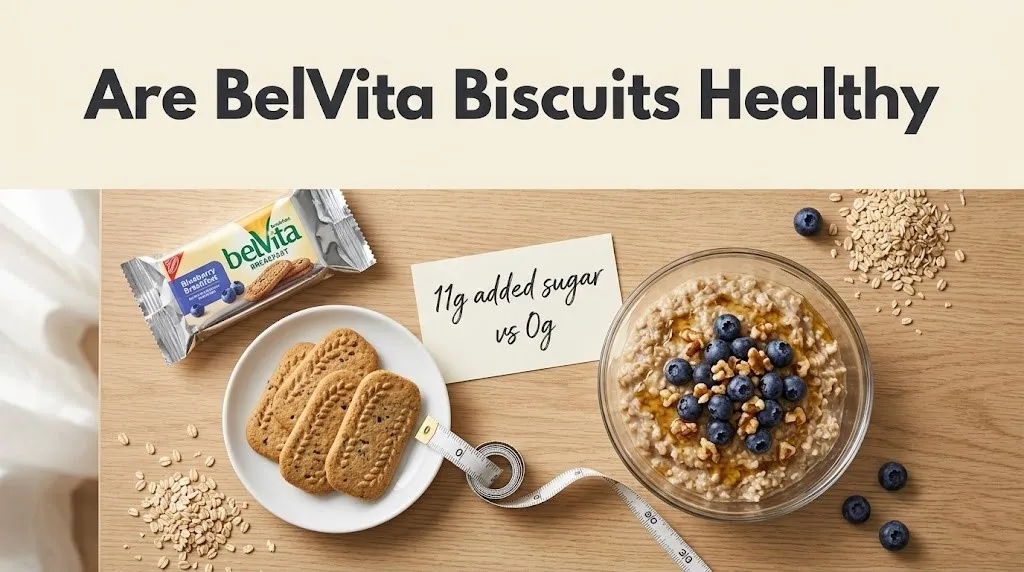
The product occupies a specific niche. It is a packaged, shelf-stable carbohydrate source that requires zero preparation and can be eaten in a car, at a desk, or while walking to a train platform. For someone whose alternative is skipping breakfast entirely or buying a gas station cinnamon roll, BelVita biscuits are a clear nutritional upgrade. For someone who has the time and resources to prepare oatmeal with berries or spread peanut butter on whole grain toast, BelVita biscuits are a nutritional downgrade. The health assessment depends entirely on the comparison frame.
The Academy of Nutrition and Dietetics emphasizes that a healthy breakfast includes whole grains, lean protein, and fruit or vegetables. BelVita checks the whole grains box, partially and imperfectly. It does not check the lean protein box at 4 grams per pack. It does not check the fruit or vegetables box at all, the fruit flavors come from dried fruit powders and natural flavors, not actual fruit. A breakfast that meets the Academy’s criteria is going to be a bowl of steel-cut oats with walnuts and blueberries or scrambled eggs on whole grain toast with spinach. BelVita is a compromise, not an equivalent. It is the breakfast you eat when the real thing is not possible, not the breakfast you choose because you think it is the best option.
| Breakfast Option | Calories | Protein | Fiber | Added Sugar | Whole Food Status |
|---|---|---|---|---|---|
| BelVita Blueberry (1 pack) | 230 | 4g | 3g | 9 to 11g | Ultra-processed |
| Steel-cut oats with berries | 220 | 7g | 6g | 0g | Whole food |
| Whole grain toast with peanut butter | 280 | 12g | 5g | 2g | Minimally processed |
| Greek yogurt with granola and fruit | 250 | 18g | 3g | 7g | Minimally processed |
Key Takeaway: BelVita biscuits are a better choice than skipping breakfast or grabbing a pastry, but they are a compromise food, not a health food, and they fall short on protein, intact fiber, and added sugar compared to simple whole-food breakfasts.
Are BelVita Breakfast Bars Healthy
The BelVita breakfast bar varieties, including the soft-baked and sandwich biscuit formats, are nutritionally similar to the original crunchy biscuits, with slightly more added sugar in many flavors and the same fundamental reliance on refined flour, added sugar, and industrial oils, making them a convenience food rather than a health food. The format changes but the formula does not.
The soft-baked bars and filled sandwich varieties often contain more sugar per serving than the original crunchy biscuits. A pack of BelVita Soft Baked Oats and Chocolate Breakfast Biscuits contains approximately 12 grams of added sugar, about half a day’s recommended limit for women. The sandwich varieties, which layer a sweet filling between two biscuits, read more like an Oreo engineered for the morning than a legitimate breakfast item. The filling is typically made from sugar, palm oil, and modified food starch, the same structural template as a packaged cream-filled cookie.
Mondelez International positions these products as breakfast food by emphasizing the “4 hours of steady energy” claim, which is based on the company’s own commissioned research rather than independent peer-reviewed studies. The claim refers to the glycemic response of the specific carbohydrate blend, not to a feeling of physical energy or mental focus. A stable blood sugar curve is a real nutritional concept, but the company’s research does not compare BelVita to oatmeal, eggs, or Greek yogurt. It compares the biscuit response to a baseline or to a fasted state. Without an active comparator to a real whole-food breakfast, the claim is technically accurate but practically meaningless for making informed food choices.
- Soft-baked BelVita bars often contain more added sugar than the crunchy original.
- The sandwich biscuit format adds a sweet filling layer that increases sugar and saturated fat.
- The “4 hours of steady energy” claim is based on company-funded glycemic response research, not independent peer-reviewed studies.
BelVita Biscuits Nutrition Facts
A standard 50-gram pack of BelVita Blueberry Breakfast Biscuits contains approximately 230 calories, 4 grams of protein, 8 grams of total fat, 35 grams of total carbohydrate, 3 grams of dietary fiber, 11 to 13 grams of total sugars, and 9 to 11 grams of added sugars. The fat profile includes roughly 1 gram of saturated fat, 4 grams of polyunsaturated fat, and 3 grams of monounsaturated fat.
The calorie density is moderate. At 230 calories, the pack provides enough energy to qualify as a small breakfast or a substantial snack for a moderately active adult. The problem is not the calorie count. It is what those calories are made of. More than half the calories come from carbohydrates, and of those carbohydrates, roughly one-third are added sugars. The protein content at 4 grams is low enough that it will not meaningfully contribute to satiety or muscle maintenance. The fat content is moderate and comes primarily from canola oil, a refined seed oil that provides omega-6 fatty acids but none of the fat-soluble vitamins or phytonutrients found in whole-food fat sources like nuts, seeds, or avocado.
The micronutrient panel reflects the FDA’s enrichment standards for refined wheat flour. The biscuits contain added thiamin, riboflavin, niacin, folic acid, and reduced iron. These are the same nutrients added to white bread and breakfast cereals to replace what was lost when the wheat germ and bran were stripped away during milling. The presence of these added vitamins does not make the food a nutritional powerhouse. It means the manufacturer is legally required to add back what processing removed. A bowl of intact whole grain oatmeal contains these nutrients naturally, in their food-matrix form, without requiring fortification. The nutrition facts panel of BelVita is the story of a food trying to look like whole grain bread while wearing the nutritional profile of a fortified cookie.
| Nutrient | Per 50g Pack | Percentage of Daily Value (2,000 cal diet) |
|---|---|---|
| Calories | 230 | 11.5 percent |
| Total Fat | 8g | 10 percent |
| Saturated Fat | 1g | 5 percent |
| Total Carbohydrate | 35g | 13 percent |
| Dietary Fiber | 3g | 11 percent |
| Total Sugars | 11 to 13g | Not established |
| Added Sugars | 9 to 11g | 18 to 22 percent of 50g DV |
| Protein | 4g | 8 percent |
| Iron | 1.8mg | 10 percent |
BelVita Sugar Content per Serving
A single four-biscuit pack of BelVita Breakfast Biscuits contains 9 to 11 grams of added sugar, depending on the flavor, which represents roughly 18 to 22 percent of the FDA’s daily value of 50 grams for added sugars. The sugar comes from multiple sources, including regular sugar, malt syrup, and in some flavors, invert sugar or dried cane syrup.
The added sugar content varies by flavor. The Blueberry, Golden Oat, and Cranberry Orange varieties cluster around 9 grams per pack. The Chocolate, Cinnamon Brown Sugar, and filled sandwich varieties push closer to 11 to 12 grams. The FDA requires added sugars to be listed separately on the nutrition facts panel as of the 2020 labeling update, so this number is now transparent and easy to find. What the label cannot tell you is how that sugar impacts your body when it is consumed first thing in the morning on an empty stomach.
When you eat 9 to 11 grams of added sugar in a single sitting, your blood glucose rises. The magnitude of the rise depends on your individual insulin sensitivity, activity level, and what else you are eating. If BelVita biscuits are your entire breakfast, consumed with black coffee and nothing else, the refined carbohydrates and added sugars will be absorbed rapidly, even with the small amount of fiber present. The American Heart Association’s recommended limit of 25 grams of added sugar per day for women means one pack of BelVita consumes close to 40 percent of the daily sugar budget. For men, the 36-gram limit means the biscuits use roughly 28 percent. This is not an alarm-bell level of sugar, but it is a meaningful allocation of a limited nutritional budget. Spending 40 percent of your daily added sugar allowance on a packaged breakfast biscuit before 9 a.m. leaves very little room for the rest of the day.
Key Takeaway: One pack of BelVita uses roughly a third of your daily added sugar budget. If the rest of your day includes a soda, a sweetened yogurt, or an afternoon cookie, you will blow past the American Heart Association’s limit without realizing it.
BelVita Ingredients List Analysis
The ingredient list for BelVita Blueberry Breakfast Biscuits begins with whole grain wheat flour, which is a positive, but then lists sugar, canola oil, enriched wheat flour, blueberry pieces made with added sugar, malt syrup, and baking soda, among other ingredients, revealing a product that is significantly refined despite its whole grain positioning. The ingredient panel tells a more honest story than the front-of-pack claims.
Whole grain wheat flour appears first, which means it is the predominant ingredient by weight. This is the strongest nutritional argument in BelVita’s favor. However, enriched wheat flour, which is refined white flour with synthetic vitamins added back, appears further down the list. The combination of whole grain and enriched flour means the product contains less intact grain structure than something like a slice of dense whole grain bread or a bowl of steel-cut oats. The grain has been milled into flour, which speeds digestion and reduces the fiber matrix that slows carbohydrate absorption. The physical structure of the grain matters for satiety and glycemic response, not just the fact that whole grain was used at some point in the manufacturing process.
The added sugars appear under multiple names. Sugar, malt syrup, and invert sugar or dried cane syrup depending on the flavor are all listed. When manufacturers split added sugar across multiple ingredient names, it allows each to appear lower on the list, creating the impression that sugar is not a dominant ingredient even when the combined total is substantial. The oils are canola oil and soybean oil, both refined industrial seed oils high in omega-6 fatty acids. These oils are inexpensive, neutral-tasting, and shelf-stable, which is why they appear in virtually every packaged baked good. They are not inherently toxic, but they displace the more stable and nutrient-rich fats found in whole foods.
- Whole grain wheat flour is first, but enriched wheat flour also appears, indicating a blend of whole and refined grains.
- Added sugars are split across multiple names: sugar, malt syrup, invert sugar.
- Canola oil and soybean oil provide most of the fat content, standard for shelf-stable baked goods.
- Soy lecithin functions as an emulsifier and is a common allergen for those with soy sensitivity.
Are BelVitas Healthy for Weight Loss
BelVita biscuits are not an optimal food for weight loss because their moderate calorie count is paired with low protein, modest fiber, and enough added sugar to potentially trigger a blood sugar crash that stimulates appetite within a few hours. A food that leaves you hungry 90 minutes after eating it is not helping a weight loss effort.
The calorie math looks reasonable at first glance. At 230 calories per pack, a BelVita breakfast fits within most weight loss calorie budgets. The problem is the macronutrient distribution. Research on satiety consistently finds that protein is the most filling macronutrient, followed by fiber and intact whole food structure. BelVita delivers 4 grams of protein and 3 grams of fiber, both low for a 230-calorie food. A comparable calorie portion of Greek yogurt with berries delivers 18 grams of protein and 3 grams of fiber, with less added sugar and more volume. The volume matters. BelVita biscuits are small and dense. They are four crisp cookies that you can eat in less than two minutes, providing minimal oral processing time and limited stomach distention, both of which contribute to satiety signaling.
For weight loss, the practical concern with BelVita is what nutrition researchers call the “rebound hunger” effect. A carbohydrate-rich, low-protein breakfast can produce a rapid postprandial blood glucose rise followed by a reactive insulin surge that drives blood sugar below baseline, triggering hunger and cravings within two to three hours. This is not unique to BelVita. It is a well-documented response to refined carbohydrate consumption on an empty stomach. If eating BelVita at 8 a.m. leads you to snack aggressively at 10:30 a.m., the effective calorie cost of that breakfast choice is the 230 calories from the biscuits plus whatever you eat to manage the hunger crash. A more protein-rich breakfast might cost the same 230 calories but prevent the mid-morning snack entirely.
BelVita Blood Sugar Effect and Glycemic Index
The blood sugar response to BelVita biscuits is likely to be a moderate to rapid rise in blood glucose followed by a decline, particularly in individuals with normal insulin sensitivity, because the combination of milled whole wheat flour, enriched wheat flour, and added sugars digests relatively quickly despite the small amount of fiber present. The “slow-release carbohydrate” claim is a relative comparison to more rapidly digested carbohydrates, not an absolute guarantee of glycemic stability.
Mondelez International’s “4 hours of steady energy” claim is based on research measuring the glycemic response to BelVita biscuits compared to a fasted state or a standard glucose solution. In these controlled conditions, the specific carbohydrate blend in BelVita produces a more gradual rise and fall in blood glucose than a slug of pure sugar. This is true of almost any food that contains fat, protein, and fiber compared to pure glucose. The relevant question for a consumer is not whether BelVita produces a gentler curve than a glucose tolerance test drink. It is whether BelVita produces a gentler curve than the breakfast foods it is designed to replace, such as oatmeal, whole grain toast, or eggs.
Independent glycemic index data for BelVita specifically is limited. Extrapolating from similar products, wheat-based breakfast biscuits with added sugar and some whole grain content, the estimated glycemic index likely falls in the 60 to 70 range, which is considered medium to high. Steel-cut oats, by comparison, have a glycemic index around 42 to 55. Whole grain sourdough toast clocks in around 50 to 55. For someone with insulin resistance, prediabetes, or type 2 diabetes, that 10- to 20-point difference on the glycemic index scale is the difference between a breakfast that keeps blood glucose in a healthy range and one that produces a spike requiring medication management. The American Diabetes Association recommends that breakfast meals emphasize protein, fiber, and whole intact grains, not milled grain flours with added sugar, for this exact reason.
Quick Tip:
- If you have prediabetes or diabetes and want to test your individual response to BelVita, use a continuous glucose monitor or a finger-stick glucometer 90 minutes after eating.
- Compare your blood glucose response to BelVita versus a protein-rich breakfast like eggs on whole grain toast.
- The individual glycemic response to any food varies more than the published glycemic index suggests, so personal testing is the most reliable guide.
Key Takeaway: BelVita’s “slow-release” claim is a relative measure against pure sugar, not an absolute guarantee of stable blood glucose. For anyone managing insulin resistance, oatmeal or eggs are a safer bet.
Is BelVita a Healthy Snack
BelVita biscuits can function as an occasional, portion-controlled snack for a healthy adult who is active and eats an otherwise whole-food-based diet, but they are not a health-promoting snack in the way that an apple with almonds or Greek yogurt with berries would be. A snack that contains 9 grams of added sugar and 4 grams of protein is a treat, not a nutritional intervention.
The snack context is slightly more forgiving than the breakfast context for BelVita. A mid-afternoon snack does not need to carry someone through four hours of morning meetings and concentration. It just needs to bridge the gap between lunch and dinner. At 230 calories, a full pack of BelVita is on the high end for a snack but not unreasonable for someone who is physically active. The problem is that the nutritional quality does not align with the calorie cost. A snack of a medium apple with a tablespoon of peanut butter costs roughly the same 230 calories but delivers more fiber, more protein, more volume, more micronutrients from the fruit, and zero added sugar.
For a child’s snack or a snack packed in a lunchbox, BelVita is a marketing-shaped box of cookies, and children do not need 9 grams of added sugar in a snack any more than adults do. The American Academy of Pediatrics recommends limiting added sugar for children to less than 25 grams per day. A single pack of BelVita in a lunchbox uses close to half that budget. An occasional treat is one thing. A daily lunchbox staple is another.
BelVita Protein Content
BelVita biscuits contain only 4 grams of protein per 50-gram pack, which is low for a food positioned as a breakfast replacement and insufficient to drive the satiety signaling required to keep a person full until their next meal. The protein content is one of the weakest nutritional attributes of this product.
Protein at breakfast matters for multiple reasons. It slows gastric emptying, which physically delays the exit of food from the stomach into the small intestine, prolonging fullness. It stimulates the release of satiety hormones including peptide YY and GLP-1, while suppressing ghrelin, the hunger hormone. It provides the amino acid substrates for muscle protein synthesis, which matters for anyone trying to maintain or build lean mass. Four grams of protein at breakfast provides none of these benefits at a meaningful level. A cup of milk poured over a bowl of cereal adds 8 grams of protein. A single egg adds 6 grams. A container of Greek yogurt adds 15 to 18 grams.
The protein content of BelVita comes from the wheat flour, not from any added protein source like whey, soy isolate, or nuts. Wheat protein is low in lysine, making it an incomplete protein source for muscle synthesis purposes, though this is a minor issue in the context of a varied diet. The more practical concern is that 4 grams of protein will not keep anyone full. If you eat BelVita for breakfast and find yourself genuinely hungry before 10 a.m., the low protein content is the most likely explanation. Adding a protein source on the side, such as a hard-boiled egg, a piece of string cheese, or a small container of yogurt, transforms the nutritional profile of the meal more than any other single modification you could make.
- BelVita Blueberry: 4 grams of protein per pack.
- BelVita Soft Baked Oats and Chocolate: 4 grams of protein per pack.
- BelVita Sandwich Biscuits: 3 to 4 grams of protein per pack.
- Recommended protein minimum at breakfast for an adult: 15 to 25 grams.
BelVita Fiber Content
BelVita biscuits provide 3 grams of dietary fiber per 50-gram pack, which is roughly 11 percent of the daily value of 28 grams, a modest contribution that comes from a blend of whole grain wheat fiber and isolated fibers such as chicory root extract or soluble corn fiber rather than exclusively from intact whole grains. The source of the fiber matters as much as the quantity.
Intact fiber from whole grains, legumes, vegetables, and fruits arrives in the digestive system embedded in a food matrix that slows digestion and requires chewing. This structural complexity contributes to satiety and provides a substrate for colonic fermentation that produces short-chain fatty acids. Isolated fibers such as inulin from chicory root or soluble corn fiber are extracted from their original food source and added to processed foods to boost the fiber number on the nutrition facts panel. They function as prebiotics and are fermented by gut bacteria, which is a genuine benefit, but they do not provide the same food-matrix benefits as intact fiber. A biscuit fortified with inulin digests faster and requires less chewing than a bowl of steel-cut oats, even if the fiber grams are identical on paper.
The fiber in BelVita is a nutritional positive. Three grams of fiber at breakfast is better than zero grams, and many Americans fall well short of the daily fiber recommendation. The Academy of Nutrition and Dietetics reports that the average American adult consumes only 15 to 17 grams of fiber per day, well below the recommended 25 to 38 grams. In that context, every gram helps. The qualifier is that 3 grams of fiber can be obtained from half an apple, a slice of whole grain bread, or a small handful of almonds, all of which deliver that fiber without the added sugar and refined oils. BelVita’s fiber is real, but it is a processed-food solution to a whole-food problem.
Key Takeaway: The 3 grams of fiber in BelVita are a genuine benefit in a fiber-poor food environment, but the fiber comes from isolated sources added to a refined product, not from the intact grain structure that would also slow digestion and improve satiety.
BelVita vs Oatmeal Healthy Breakfast
A bowl of steel-cut oatmeal with fresh berries and a sprinkle of nuts is a significantly healthier breakfast than a pack of BelVita biscuits, providing more intact fiber, more protein, less added sugar, no refined oils, and a lower glycemic impact for a comparable calorie count. The oatmeal wins on every nutritional metric that matters.
A 230-calorie bowl of oatmeal made with half a cup of dry steel-cut oats cooked in water, topped with a quarter cup of blueberries and a tablespoon of chopped walnuts, delivers approximately 7 grams of protein, 7 grams of fiber, zero grams of added sugar, and a mix of healthy fats from the walnuts. The fiber is entirely intact whole grain fiber, not isolated fiber added to a processed product. The blueberries provide vitamin C, anthocyanins, and other phytonutrients. The walnuts contribute alpha-linolenic acid, a plant-based omega-3 fatty acid. The meal requires chewing, which triggers satiety signaling, and the volume is larger, which promotes stomach distention and fullness.
The convenience gap is real. Oatmeal takes five to ten minutes to prepare, even for quick-cooking steel-cut oats, and it cannot be eaten while driving. BelVita requires zero minutes of preparation and is fully portable. This is not a trivial difference for a parent getting children out the door or a shift worker running late. The practical question is not which breakfast is healthier on paper. Oatmeal wins that comparison easily. The practical question is whether you can bridge the convenience gap with meal prep. Overnight oats require two minutes of assembly the night before and are grab-and-go in the morning. A batch of hard-boiled eggs and whole grain toast is portable with minimal morning effort. BelVita is not the only quick breakfast in existence. It is just the one most aggressively marketed.
| Criterion | BelVita (1 pack) | Oatmeal with Berries and Nuts |
|---|---|---|
| Calories | 230 | 230 to 250 |
| Protein | 4g | 7 to 8g |
| Intact Fiber | Minimal (isolated fiber added) | 6 to 7g (intact) |
| Added Sugar | 9 to 11g | 0g |
| Glycemic Impact | Medium to high (estimated) | Low to medium |
| Preparation Time | 0 minutes | 5 to 10 minutes (or overnight prep) |
BelVita for Diabetics
BelVita biscuits are a suboptimal breakfast choice for people with diabetes because the milled flour and added sugar content can produce a blood glucose elevation that is difficult to manage, particularly when eaten alone without a protein source, and the product does not align with the American Diabetes Association’s emphasis on intact whole grains and lean protein at breakfast. Individual blood glucose monitoring is the only way to know for certain how any specific person responds.
The American Diabetes Association’s Standards of Medical Care in Diabetes emphasize that breakfast meals for people with diabetes should prioritize protein, non-starchy vegetables, and intact whole grains that require chewing and digest slowly. BelVita fails on protein at 4 grams, provides no vegetables, and uses milled flour rather than intact grains. The 3 grams of fiber are not nearly enough to slow the absorption of the 35 grams of total carbohydrate, of which 9 to 11 grams are added sugars. A person with type 2 diabetes eating this product for breakfast may see a postprandial glucose excursion exceeding 40 to 60 milligrams per deciliter, depending on their degree of insulin resistance and residual beta-cell function.
The “slow-release carbohydrate” claim on BelVita packaging is not regulated by the FDA as a health claim and does not mean the product has been certified as low glycemic or suitable for diabetes management. The FDA allows structure-function claims about carbohydrate release as long as they are truthful and not misleading, but the standard of evidence for such claims is lower than the standard for a health claim. A person with diabetes should not rely on front-of-pack claims about energy release. They should look at the total carbohydrate, added sugar, and fiber on the nutrition facts panel, and they should eat the food and test their own blood glucose response. If BelVita fits into their individual glycemic management plan and they enjoy the product, occasional use is a personal choice. It is not the most diabetes-friendly breakfast available, but it may be workable in the context of an otherwise tightly managed diet for someone who does not experience a problematic glucose spike.
Are BelVita Cookies Healthy
BelVita biscuits are structurally and nutritionally closer to a packaged cookie than to a health food, and while the marketing frames them as breakfast, they are sweet, crunchy, flour-based products with added sugar and oil that fit the cookie category more accurately than the health food category. The term “breakfast biscuit” is a marketing designation, not a nutritional classification.
In the United States, the legal standard of identity for a cookie and a biscuit is loose enough that a manufacturer can call a product a breakfast biscuit if it chooses to position it for morning consumption. In the United Kingdom and Australia, a biscuit is what Americans call a cookie, and the marketing is simply less euphemistic. A British consumer looking at a pack of BelVita sees a packet of sweet breakfast cookies and evaluates them accordingly. The American version of the packaging, with sunrise imagery, whole grain claims, and the word “breakfast” in prominent text, creates a health halo that the ingredient list does not support.
The texture, sweetness level, and ingredient composition of BelVita are nearly identical to a graham cracker or a digestive biscuit. The primary differences are the whole grain wheat flour appearing first and the fiber being boosted with isolated fiber sources. The addition of 3 grams of fiber to a cookie does not transform it into a health food. It makes it a cookie with added fiber. If you would not consider a graham cracker a healthy breakfast, you should apply the same standard to BelVita, because the nutritional differences between the two are marginal. This does not mean BelVita is “bad.” It means it should be categorized honestly and eaten accordingly. An occasional pack as a convenient snack or a busy-morning compromise is a reasonable choice. Eating it daily under the impression that it is equivalent to a bowl of oatmeal is not.
Added Sugar in BelVita Biscuits
A single pack of BelVita Blueberry Breakfast Biscuits contains 9 to 11 grams of added sugar, sourced from sugar, malt syrup, and invert sugar, which accounts for roughly 40 percent of the American Heart Association’s recommended daily limit of 25 grams for women. The added sugar comes in multiple forms, a common food industry strategy that distributes sugar across several ingredient names so no single source dominates the list.
The added sugar contributes roughly 36 to 44 calories per pack, about 16 to 19 percent of the total calorie content. This is not an extreme sugar load compared to a frosted doughnut or a bowl of sweetened children’s cereal, but it is high for a product that markets itself with whole grain imagery and “breakfast” positioning. The FDA’s new labeling rules require added sugars to be listed as a separate line item below total sugars, which makes this number transparent. Before the 2020 labeling update, consumers had to guess how much of the total sugar was added versus naturally occurring from the whole grain wheat and fruit pieces. The updated label reveals that the vast majority of the sugar in BelVita is added, not intrinsic to the whole grains.
The sugar in BelVita serves multiple functions for the manufacturer. It sweetens the product, obviously. It also contributes to the Maillard browning reaction during baking, creating the golden-brown color and toasted flavor. It helps with texture, keeping the biscuits crisp and tender rather than hard. And it serves as a preservative by binding water, reducing water activity and extending shelf life. Sugar is a functional ingredient in packaged baked goods, not just a sweetener. This does not make it healthier. It simply explains why it is there in the quantity it is. A homemade whole grain muffin would use less sugar and spoil faster, which is the trade-off that packaged food manufacturers navigate on an industrial scale.
Key Takeaway: The 9 to 11 grams of added sugar in one pack of BelVita uses a substantial chunk of your daily sugar budget, and multiple sweeteners are listed to distribute the sugar across the ingredient panel.
Processed Food Classification BelVita
BelVita biscuits fall firmly into category 4 of the NOVA food classification system, which is ultra-processed food, defined as formulations of ingredients, mostly of industrial use, that result from a series of manufacturing processes. This classification is not a moral judgment. It is a technical description of how far a food has traveled from its original agricultural form.
The NOVA system, developed by researchers at the University of Sao Paulo and used by the Food and Agriculture Organization of the United Nations, categorizes foods into four groups: unprocessed or minimally processed, processed culinary ingredients, processed foods, and ultra-processed foods. Ultra-processed foods are characterized by ingredients not typically found in home kitchens, including isolated fibers, protein isolates, hydrogenated oils, high-fructose corn syrup, invert sugar, emulsifiers, and artificial flavors. BelVita contains isolated chicory root fiber, invert sugar, soy lecithin, and natural flavor, all markers of ultra-processed food manufacture.
Epidemiological research has associated high consumption of ultra-processed foods with increased risk of obesity, type 2 diabetes, cardiovascular disease, and all-cause mortality. These are association studies, not randomized controlled trials, and they cannot prove causation. The mechanism is not that any single ultra-processed food is toxic. It is that a dietary pattern dominated by ultra-processed foods tends to be higher in added sugar, lower in fiber, lower in protein, and higher in calories per gram of food weight than a pattern built on whole foods. BelVita is not uniquely harmful. It is one of thousands of ultra-processed products that, if consumed occasionally in the context of a whole-food diet, is unlikely to be the deciding factor in anyone’s long-term health. The concern is with dietary displacement. Every time you eat ultra-processed breakfast biscuits, you are not eating oatmeal, eggs, fruit, yogurt, or whole grain toast. The cumulative opportunity cost of ultra-processed convenience foods is the nutritional liability, not the individual product.
BelVita Calories per Pack
A standard 50-gram pack of BelVita Breakfast Biscuits contains 230 calories, which is an appropriate calorie count for a light breakfast or a substantial snack for an adult consuming a 2,000-calorie diet. The calorie count itself is not the concern. The issue is how those calories are distributed across macronutrients and what satiety they deliver for the cost.
At 230 calories, BelVita provides 11.5 percent of a 2,000-calorie daily intake. For a breakfast food, this is on the low end of what a registered dietitian would recommend for an adult. A breakfast of 300 to 400 calories that includes protein, fiber, and some healthy fat is more likely to sustain energy and concentration through the morning. If 230 calories is your breakfast budget, the question is how to spend it most effectively. Two eggs scrambled with spinach and a slice of whole grain toast comes in around 250 calories and delivers 15 to 18 grams of protein, 3 to 4 grams of fiber, and no added sugar. A container of plain Greek yogurt with berries and a tablespoon of granola comes in around 230 calories and delivers 18 grams of protein and 3 grams of fiber. Both alternatives outperform BelVita on protein and satiety per calorie.
The calorie count of BelVita is not deceptive or harmful on its own. The problem is the nutritional return on that calorie investment. A food that costs 230 calories and leaves you hungry two hours later is a poor calorie value, regardless of how reasonable the number looks on paper. If you find BelVita satisfying and it carries you to your next meal without snacking, the calorie equation works for you. If you find yourself raiding the office snack drawer by 10 a.m., the effective calorie cost of your BelVita breakfast is the 230 calories from the biscuits plus the 200 calories from the desperate muffin you ate to manage the hunger.
Best Time to Eat BelVita Biscuits
The best time to eat BelVita biscuits, from a purely practical nutritional standpoint, is as a pre-workout carbohydrate source 30 to 60 minutes before exercise, or as an emergency shelf-stable breakfast when no other options are available, rather than as a daily default breakfast. The context determines whether the product is a reasonable choice or a missed opportunity.
Before a workout, the priority is rapidly digesting carbohydrate that will be burned for fuel during the exercise session. BelVita fits this profile. The 35 grams of carbohydrate provide muscle glycogen that will be utilized within the hour, and the small amount of protein and fat slows absorption slightly without interfering with exercise performance. The added sugar that is a liability at a sedentary desk job becomes a functional fuel source on a run or in a gym session. Consumed 30 to 60 minutes before moderate to vigorous exercise, BelVita is a reasonable and convenient pre-workout snack.
As an emergency breakfast, stuffed in a glove box, desk drawer, or travel bag for the morning when everything goes wrong, BelVita is a better option than a gas station pastry, a vending machine candy bar, or skipping breakfast entirely. The whole grain content, modest as it is, provides more nutritional value than a Pop-Tart or a frosted doughnut. The shelf stability is a genuine advantage. The biscuits will survive a hot car or a cold office without spoiling. This is the appropriate use case for BelVita. It is the breakfast you eat when you cannot eat the breakfast you planned. It is not the breakfast you plan to eat every day.
- Pre-workout fuel: 30 to 60 minutes before exercise, BelVita provides usable carbohydrates.
- Emergency backup: keep a pack in your desk or car for the morning when you oversleep.
- Travel breakfast: better than an airport cinnamon roll when you are rushing to a gate.
Key Takeaway: BelVita works best as a pre-workout carb source or an emergency shelf-stable backup, not as a daily breakfast staple that displaces whole foods.
BelVita vs Granola Bar Comparison
BelVita breakfast biscuits and a typical chewy granola bar are nutritionally similar, with comparable calorie counts, sugar content, and fiber levels, though BelVita generally contains slightly more whole grain and fiber while many granola bars contain slightly more protein if they include nuts or soy protein. The differences between them are too small to declare either product a clear nutritional winner.
A standard chewy chocolate chip granola bar contains approximately 200 to 220 calories, 3 to 5 grams of protein, 2 to 3 grams of fiber, and 7 to 12 grams of added sugar. BelVita contains 230 calories, 4 grams of protein, 3 grams of fiber, and 9 to 11 grams of added sugar. The numbers are functionally identical. The primary difference is that BelVita lists whole grain wheat flour as the first ingredient, while many granola bars list oats or a grain blend that may be more or less intact depending on the brand. BelVita markets itself as breakfast. Granola bars market themselves as snacks. The nutritional reality is that they are both processed grain-and-sugar products in a portable format.
A granola bar made from whole rolled oats, nuts, seeds, and dried fruit with minimal added sugar, such as a Lara Bar or a homemade oat-and-nut bar, is a meaningfully healthier product than either a standard granola bar or a pack of BelVita. These bars use intact grains and whole-food ingredients rather than milled flours and isolated fibers. The protein and healthy fat content from the nuts and seeds provide satiety that a wheat-flour-based biscuit cannot match. If you are choosing between a BelVita and a standard grocery store granola bar, the differences are marginal. If you are choosing between a BelVita and a handful of almonds and an apple, the whole-food option wins.
| Attribute | BelVita (1 pack) | Chewy Granola Bar | Whole-Food Nut Bar |
|---|---|---|---|
| Calories | 230 | 200 to 220 | 210 to 240 |
| Protein | 4g | 3 to 5g | 6 to 10g |
| Fiber | 3g | 2 to 3g | 4 to 6g |
| Added Sugar | 9 to 11g | 7 to 12g | 3 to 5g |
| First Ingredient | Whole grain wheat flour | Oats or grain blend | Dates or nuts |
| Whole Food Status | Ultra-processed | Ultra-processed | Minimally processed |
Frequently Asked Questions About BelVita Biscuits
Do BelVita biscuits really give you steady energy for four hours?
The “4 hours of steady energy” claim is based on company-funded glycemic response research and refers to a measured blood glucose curve, not a guaranteed subjective feeling of energy or focus.
Individual responses vary based on activity level, metabolism, and what else is eaten with the biscuits, and many people report feeling hungry well before the four-hour mark.
The claim is a relative comparison against pure sugar, not an absolute guarantee that every consumer will feel energized for exactly four hours.
Are BelVita biscuits good for weight loss?
BelVita biscuits are not an optimal weight loss food because they deliver 230 calories with only 4 grams of protein, which is insufficient to drive satiety and prevent mid-morning hunger that often leads to additional snacking.
A breakfast with 15 to 25 grams of protein and more intact fiber is more likely to support a calorie deficit by keeping you full until lunch.
If you enjoy BelVita and they fit your calorie budget, pairing them with a protein source like Greek yogurt or a hard-boiled egg improves their weight loss compatibility.
Can I eat BelVita biscuits every day?
Eating BelVita biscuits daily is not recommended as a long-term breakfast habit because it means a substantial portion of your daily added sugar budget is consumed through a processed food rather than whole foods.
The biscuits do not contain any toxic ingredients that make daily consumption dangerous, but the nutritional opportunity cost of choosing them over a more protein-rich, higher-fiber whole-food breakfast accumulates over time.
If you rely on them daily for convenience, consider adding a protein source on the side and rotating in whole-food breakfasts on days when time allows.
What is the healthiest breakfast biscuit?
The healthiest breakfast biscuit would be one made primarily from intact whole grains with minimal added sugar, no refined oils, and a meaningful protein source from nuts or seeds, but such a product is rare in the commercial market.
Homemade oat-based breakfast bars or muffins using mashed banana, eggs, oats, and nuts are a healthier alternative that can be batch-prepared and frozen for convenience.
Among commercial options, look for products with whole grains as the first ingredient, less than 5 grams of added sugar per serving, and at least 5 grams of protein and fiber each.
Are BelVita biscuits processed food?
Yes, BelVita biscuits are classified as ultra-processed food under the NOVA food classification system because they contain industrially processed ingredients including isolated chicory root fiber, invert sugar, soy lecithin, and natural flavors.
Ultra-processed foods are not automatically harmful in isolation, but a dietary pattern heavy in these products is associated with higher risk of obesity and metabolic disease.
The biscuits are more processed than a bowl of oatmeal or a slice of whole grain toast, and they should be understood as a convenience product rather than a whole-food breakfast.
BelVita biscuits are not a nutritional villain and not a health food. They are a well-marketed, ultra-processed convenience product that provides calories, some whole grain, a modest amount of fiber, and a significant amount of added sugar in a portable, shelf-stable format. The most honest way to use them is as an occasional emergency backup, a pre-workout fuel source, or a travel breakfast when the alternative is a gas station pastry or skipping the meal entirely.
If you currently eat BelVita every morning and you have the time and resources to upgrade, the single most impactful change you can make is to add protein. Eat the biscuits with a container of Greek yogurt, a hard-boiled egg, or a piece of string cheese. This will not reduce the added sugar content, but it will dramatically improve satiety and balance the macronutrient profile. Even better, batch-prep overnight oats or whole grain egg sandwiches on Sunday and grab those instead of a foil packet of biscuits on weekday mornings.
The packaging will continue to show you sunlit wheat fields and the word “breakfast” in warm, golden type. That is marketing doing its job. Your job, as the person actually eating the food, is to read the ingredient list, check the added sugar grams, and decide honestly whether this product is serving your health goals or just serving your schedule.