The best healthy school snacks combine protein, fiber, and limited added sugar to keep kids focused and energized through the school day. Choosing well here matters more than most parents realize: what a child eats at snack time directly affects their concentration, behavior, and hunger levels for the rest of the afternoon.
According to the USDA Dietary Guidelines for Americans (2020-2025), children ages 4 through 13 consume between 15 and 25 percent of their daily calories from snacks. That makes snack time a genuine nutritional opportunity, not just a gap-filler between meals.
This guide covers what actually makes a school snack healthy, which store-bought options deliver real nutritional value, how snack needs shift by age, and how to handle common obstacles like nut-free classrooms and picky eaters. Every recommendation is grounded in current dietary research, not marketing claims.
Healthy School Snacks: What They Are and Why They Matter
Healthy school snacks are foods that provide meaningful nutrition within an appropriate calorie range for a child’s age, activity level, and growth stage, without excessive added sugar, sodium, or saturated fat. They’re not just “not junk food.” They serve an active nutritional role.
The American Academy of Pediatrics (AAP) notes that children’s stomachs are small relative to their calorie needs, which means snacks function as necessary mini-meals rather than extras. A child who skips breakfast or has an early lunch genuinely needs a mid-morning or mid-afternoon snack to maintain blood glucose and cognitive performance.
Research published in the British Journal of Nutrition found that schoolchildren who ate structured snacks with protein and fiber showed better attention and working memory scores in the afternoon compared to children who ate high-sugar, low-fiber snacks. That distinction between a sugar spike and sustained energy is the core reason the composition of the snack matters as much as the calorie count.
The word “healthy” on a package means very little on its own. Marketers apply it to products with 12 grams of added sugar per serving. What actually matters is the fiber-to-sugar ratio, the presence of real protein, and the quality of the fat content.
Key facts every parent should know:
- School snacks should ideally contain 3 to 5 grams of fiber per serving to slow glucose absorption
- 5 grams or more of protein per serving supports satiety between meals
- Less than 8 grams of added sugar per serving keeps blood glucose stable
- Under 200 milligrams of sodium per serving is appropriate for school-age children
What Makes a Snack Actually Healthy for Kids?
A snack is genuinely healthy for kids when it provides at least two of three key nutritional components: protein, fiber, and healthy fat, without relying on added sugar as the primary energy source. One nutrient alone doesn’t qualify a food as a solid snack choice.
The Academy of Nutrition and Dietetics recommends pairing a carbohydrate source with either protein or fat to slow the digestion rate and prevent the rapid blood sugar rise and crash that causes afternoon fatigue. A plain rice cake has minimal fiber and no protein; a rice cake with two tablespoons of sunflower seed butter (from Helianthus annuus) becomes a nutritionally complete snack with approximately 7 grams of protein and 3 grams of fiber.
Think of it like fuel blends. High-sugar snacks are like lighter fluid: they ignite fast and burn out fast. Protein-and-fiber combinations are more like hardwood: they burn slower and keep the heat consistent. That slower energy release is exactly what a child sitting in a classroom needs.
| Nutritional Target | Per-Snack Goal (Ages 5-12) | Why It Matters |
|---|---|---|
| Calories | 100 to 200 kcal | Bridges meals without replacing them |
| Protein | 5g or more | Satiety, focus, muscle maintenance |
| Dietary fiber | 3g or more | Slows glucose absorption |
| Added sugar | Under 8g | Prevents energy spike and crash |
| Sodium | Under 200mg | Appropriate for growing cardiovascular health |
| Saturated fat | Under 3g | Supports heart health long term |
Children with Type 1 or Type 2 diabetes need their snack carbohydrate content reviewed specifically with their diabetes care team. The general targets above do not substitute for individualized carbohydrate management plans.
Best Healthy Snacks for Kids: The Definitive List
The best healthy snacks for kids balance real nutrition with flavors and textures children actually accept. Nutritional perfection means nothing if the snack comes home untouched.
Below are the top options across five food categories, with nutritional data per standard serving:
| Snack | Serving Size | Calories | Protein | Fiber | Added Sugar |
|---|---|---|---|---|---|
| String cheese | 1 stick (28g) | 80 kcal | 6g | 0g | 0g |
| Greek yogurt (plain, low-fat) | 3/4 cup (170g) | 100 kcal | 12g | 0g | 0g |
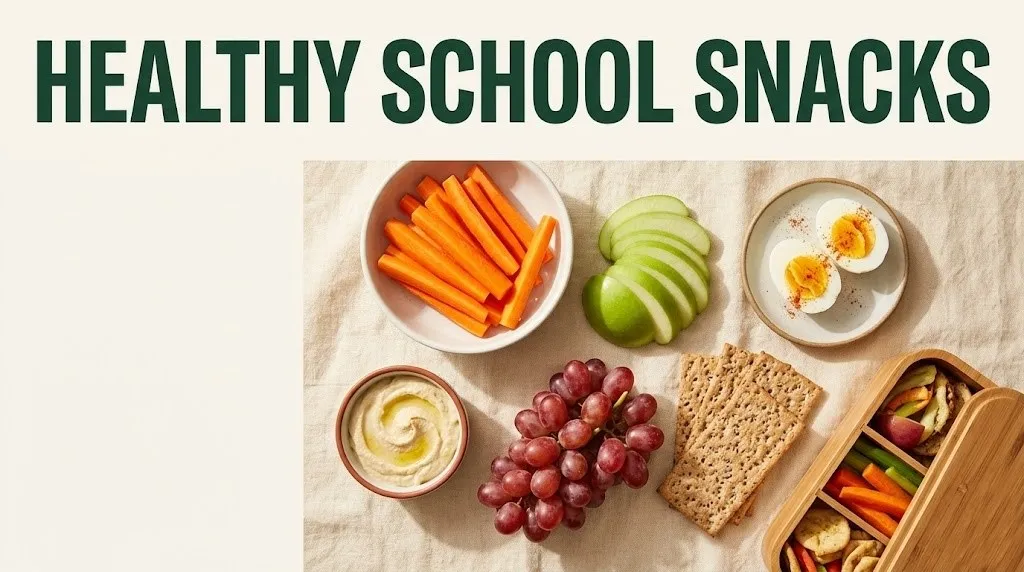
| Apple with almond butter | 1 medium + 1 tbsp | 180 kcal | 4g | 5g | 0g added |
| Hummus with carrot sticks | 2 tbsp + 1/2 cup | 80 kcal | 3g | 3g | 0g |
| Edamame (shelled) | 1/2 cup (85g) | 100 kcal | 9g | 4g | 0g |
| Whole grain crackers + cheddar | 5 crackers + 1 oz cheese | 160 kcal | 7g | 2g | 0g |
| Hard-boiled egg | 1 large | 70 kcal | 6g | 0g | 0g |
| Banana | 1 medium | 105 kcal | 1g | 3g | 0g added |
Edamame is a soy product derived from immature Glycine max (soybean). Children with soy allergies must avoid it. Almond butter comes from Prunus dulcis and contains tree nut allergens; substitute sunflower seed butter in nut-free settings.
Hummus made from Cicer arietinum (chickpeas) is also a legume and should be approached with care by children with legume sensitivities, though peanut allergy does not automatically mean chickpea allergy.
Key Takeaway: A school snack earns its place when it delivers at least 5 grams of protein or 3 grams of fiber per serving, with less than 8 grams of added sugar. That combination, not the word “healthy” on the label, is what actually sustains a child’s energy and focus.
Healthy Snacks From the Store: What to Look For
Healthy snacks from the store are easy to find once you know how to read the nutrition facts panel rather than the front-of-package claims. The front of the package is marketing. The back is data.
The first thing to check is the serving size. Many packaged snacks list nutrition facts for a single serving that is far smaller than what a child will actually eat. A bag labeled “only 100 calories” may contain two or two-and-a-half servings. Reading the total container size against the serving size is the first screening step.
Next, look at the added sugar line, which appears separately from total sugar on all nutrition labels updated to comply with the FDA’s 2020 labeling rules. Total sugar includes natural sugars from fruit or dairy; added sugar is what’s been incorporated during manufacturing. The American Heart Association recommends children ages 2 through 18 consume less than 25 grams of added sugar per day. A single “healthy” granola bar can use up half that budget.
The ingredients list also tells a story. Ingredients are listed in descending order by weight. If sugar, corn syrup, or glucose syrup appears in the first three ingredients, that product is primarily a sugar delivery vehicle, regardless of what the front label says.
Quick Tips for Store Snack Shopping:
- Look for whole grain as the first ingredient in crackers, cereals, and bars
- Choose snacks with 5 ingredients or fewer as a reliable shortcut for less processing
- Prioritize snacks with a protein-to-sugar ratio of at least 1:2 (e.g., 5g protein to 10g sugar or better)
- Avoid “natural flavors” as a primary ingredient; it’s a legal catch-all that reveals nothing about nutritional quality
Healthy Snacks You Can Buy at the Store: Best Picks by Category
Reliable healthy snacks you can buy at most grocery stores fall into six categories, and knowing which specific products to reach for saves significant time in the snack aisle. Not every brand in these categories is worth buying; the distinctions matter.
| Category | Strong Store-Bought Pick | What to Look For | What to Avoid |
|---|---|---|---|
| Dairy | Plain Greek yogurt pouches | Under 10g total sugar, live cultures listed | Flavored yogurts with 20g+ sugar |
| Cheese | Individual mozzarella sticks | Real cheese (not “cheese product”) | Cheese crackers with vegetable oil base |
| Fruit/Veggie | Unsweetened applesauce cups | “No added sugar” clearly labeled | Fruit snacks/gummies (minimal real fruit) |
| Grain-based | Whole grain rice cakes | Brown rice as first ingredient | Puffed rice cakes with coating or syrup |
| Protein | Roasted chickpeas | Under 3g added sugar, 5g+ protein | Pork rinds marketed as “protein snacks” |
| Seed butter | Individual sunflower seed butter packets | Seed as first ingredient, no added oil | Nut butter brands with hydrogenated oil |
Roasted chickpeas (Cicer arietinum) are a standout store-bought option. They deliver roughly 6 grams of protein and 5 grams of fiber per 1-ounce serving. They’re shelf-stable, nut-free, and available in most major supermarkets. Children with legume allergies or sensitivities should avoid them.
Harvard T.H. Chan School of Public Health nutrition researchers consistently note that minimally processed whole foods outperform fortified ultra-processed foods for children’s micronutrient absorption, even when the label nutrients look comparable on paper.
Healthy Back to School Snacks: How to Start the Year Right
Healthy back to school snacks work best when they’re planned and prepped once or twice per week rather than assembled daily at 7 a.m. under time pressure. The decision-making happens at the grocery store; the execution happens the night before.
The back-to-school period is a natural time to introduce new snack foods alongside familiar ones. Research from the Journal of Nutrition suggests children require between 8 and 15 exposures to a new food before they reliably accept it. Introducing one new snack per week starting in September gives most kids three to four genuine exposures by October without triggering mealtime resistance.
A practical two-week back-to-school snack rotation keeps variety high and prep time low:
Week 1 Rotation:
- Monday: String cheese + grapes
- Tuesday: Whole grain crackers + hummus
- Wednesday: Greek yogurt + sliced strawberries
- Thursday: Apple + sunflower seed butter packet
- Friday: Hard-boiled egg + cucumber slices
Week 2 Rotation:
- Monday: Edamame (shelled, chilled) + mandarin orange
- Tuesday: Roasted chickpeas + banana
- Wednesday: Cottage cheese + cherry tomatoes
- Thursday: Rice cake + avocado mash
- Friday: Trail mix (seeds, dried cranberries, oats)
Each of these combinations meets the protein-fiber target. None requires cooking on a weekday morning.
Children with dairy allergies or lactose intolerance can substitute dairy-free yogurt alternatives made from coconut, oat, or almond bases. Check that the alternative is fortified with calcium (at least 15% DV) and vitamin D (at least 10% DV), since these nutrients are naturally low in non-dairy bases.
Healthy Snacks to Take to School: Portability and Safety Guide
Healthy snacks to take to school must survive the commute, stay safe at room temperature or inside a lunch bag, and arrive in edible condition. Nutrition is only one part of the equation; food safety is the other.
The USDA Food Safety and Inspection Service (FSIS) states that perishable foods left between 40°F (4°C) and 140°F (60°C) enter what food safety specialists call the “danger zone,” where bacterial growth accelerates rapidly. A cheese stick or yogurt pouch sitting in a warm backpack without refrigeration for three hours can reach unsafe bacterial levels.
The practical rule: any snack containing dairy, cut fruit, hummus, or cooked protein needs an insulated lunch bag with a properly frozen ice pack. A single standard ice pack keeps the interior of a well-insulated bag below 40°F for approximately four hours, which covers most school morning schedules.
Shelf-stable snacks that require no refrigeration:
- Whole fresh fruit (apples, bananas, mandarin oranges, grapes in a sealed container)
- Individual nut or seed butter packets
- Shelf-stable roasted chickpeas or edamame crisps
- Whole grain crackers in a sealed bag
- Unsweetened dried fruit (in controlled portions; see the sugar section below)
- Sunflower seeds or pumpkin seeds (Cucurbita pepo) in small containers
Packaging matters for portability. Soft snacks like banana slices or cut melon don’t travel well without a rigid container. A small reusable container with a snapping lid prevents crushing and contamination. Glass containers are not appropriate for school-age children’s bags.
Key Takeaway: The two biggest factors that determine whether a school snack actually works are food safety (keeping perishables below 40°F) and realistic portability. A nutritionally perfect snack that arrives spoiled or crushed is not a snack at all.
Healthy Afternoon Snacks for Kids: Beating the Energy Slump
Healthy afternoon snacks for kids should address the specific physiological cause of the 3 p.m. energy slump: a drop in blood glucose following a lunch that was likely dominated by carbohydrates. The right snack reverses this without triggering another cycle.
The mechanism is straightforward. When blood glucose drops, the brain signals fatigue and reduced focus. A high-sugar snack temporarily raises blood glucose, but without fiber or protein to slow absorption, the glucose peaks quickly and drops again within 30 to 45 minutes. The child ends up more tired than before.
Protein and fiber together are the afternoon snack’s functional tools. Protein slows gastric emptying. Dietary fiber slows glucose absorption in the small intestine. Together they produce a flatter, more sustained blood glucose curve.
Best afternoon snack combinations specifically for the post-lunch energy window:
- Cottage cheese (113g) with sliced pear: 14g protein, 2g fiber, approximately 140 calories
- Hard-boiled egg with whole grain crackers (5 pieces): 8g protein, 2g fiber, approximately 130 calories
- Plain Greek yogurt (3/4 cup) with a tablespoon of ground flaxseed (Linum usitatissimum): 13g protein, 3g fiber, approximately 115 calories
- Edamame (1/2 cup shelled): 9g protein, 4g fiber, 100 calories
- Roasted pumpkin seeds (1 oz) with an apple: 5g protein, 6g fiber, approximately 185 calories
Children with insulin-dependent diabetes need their afternoon snack timed and composed in coordination with their care team, since the post-lunch blood glucose curve interacts with both insulin timing and physical activity after school.
Healthy Preschool Snack Ideas: What Little Kids Need
Healthy preschool snack ideas need to account for small stomach capacity, developing motor skills, emerging food preferences, and very specific choking hazard risks. Preschool-age children (typically ages 3 to 5) need snacks in smaller portion sizes with softer textures and no whole round foods that could obstruct the airway.
The American Academy of Pediatrics identifies specific choking hazards that should be avoided for children under 5: whole grapes, whole cherry tomatoes, whole hot dogs, whole nuts, raw carrots in large pieces, and large spoonfuls of nut butter eaten without a carrier food. These foods must be cut, quartered, or reformatted before serving to this age group.
Nutritionally, preschoolers need approximately 1,200 to 1,400 calories per day according to USDA MyPlate guidance, with snacks providing roughly 200 to 300 of those calories across one or two snack occasions.
Appropriate preschool snack ideas:
- Quartered grapes + soft cheese cubes (about 1 oz total cheese)
- Banana slices + 1 tablespoon smooth sunflower seed butter spread on each slice
- Steamed broccoli florets (cooled, small) + plain hummus for dipping
- Whole milk plain yogurt (1/3 cup) + mashed soft fruit (banana, peach)
- Mini whole grain pancakes (made ahead, no syrup needed) + applesauce for dipping
- Soft-cooked pasta (penne or similar, cooled) with a small amount of olive oil (Olea europaea) and grated parmesan
Children with wheat or gluten sensitivity can use certified gluten-free oat pancakes or rice-based pasta alternatives in all of the above.
Key Takeaway: Preschool snacks need to solve two problems at once: small stomachs that need calorie-dense foods in modest portions, and developing swallowing mechanics that require foods be cut, softened, or reformatted to eliminate choking risk.
Healthy Snacks for 8 Year Olds: Meeting Bigger Nutritional Needs
Healthy snacks for 8-year-olds need to be more calorie-dense and nutrient-complete than preschool options, because children at this age are in active growth phases and typically engaged in significantly more physical activity. An 8-year-old’s snack requirements are closer to a small meal than to a nibble.
According to USDA MyPlate guidance, children ages 6 through 9 need approximately 1,400 to 1,600 calories daily, with the higher end appropriate for more active children. Snacks should contribute 200 to 250 calories from a combination of protein, healthy fat, and complex carbohydrates.
Iron and zinc deserve specific attention at this age. The American Academy of Pediatrics reports that iron deficiency is one of the most common nutritional deficiencies in school-age children in the United States, and it directly impairs concentration and physical stamina. Zinc supports immune function and growth.
| Nutrient | Why It Matters at Age 8 | Good Snack Sources |
|---|---|---|
| Calcium | Bone density development peak period | Cheese, yogurt, fortified oat milk |
| Iron | Cognitive function, energy, oxygen transport | Edamame, fortified cereal, pumpkin seeds |
| Zinc | Immune support, growth, taste perception | Pumpkin seeds, cheese, chickpeas |
| Vitamin D | Calcium absorption, immune regulation | Fortified dairy or plant milk, eggs |
| Omega-3 fatty acids (DHA) | Brain development, visual processing | Walnuts (where allowed), flaxseed, fatty fish |
Docosahexaenoic acid (DHA) deserves mention because it remains important through middle childhood, not just infancy. Children with tree nut allergies cannot eat walnuts; ground flaxseed (Linum usitatissimum) provides alpha-linolenic acid (ALA), which the body partially converts to DHA.
High-Protein School Snacks That Keep Kids Focused
High-protein school snacks keep kids focused by providing amino acids that support neurotransmitter production and by slowing the gastric emptying rate, which prevents the energy crash associated with carbohydrate-only snacks. Protein does not spike blood glucose.
A study published in the American Journal of Clinical Nutrition found that school-age children who consumed higher-protein snacks (10 grams or more) in the afternoon reported greater satiety and consumed fewer total calories at dinner compared to those who ate lower-protein snacks at the same calorie level. That finding has practical implications for both hunger management and overall daily intake.
High-protein snack options with per-serving data:
- Greek yogurt (3/4 cup, plain, low-fat): 12g protein, 100 calories
- Shelled edamame (1/2 cup): 9g protein, 100 calories
- Hard-boiled egg (1 large): 6g protein, 70 calories
- String mozzarella (1 stick, 28g): 6g protein, 80 calories
- Cottage cheese (1/2 cup, low-fat): 14g protein, 90 calories
- Sunflower seed butter (2 tbsp) on whole grain crackers: 7g protein, 190 calories combined
- Roasted chickpeas (1 oz): 6g protein, 120 calories
Children who follow vegan diets can meet protein targets with edamame, roasted chickpeas, sunflower seed butter, and fortified plant-based yogurt alternatives. Vegans should confirm that calcium and vitamin B12 are included in their child’s overall daily intake, since plant-based school snacks typically don’t cover both.
Healthy Snacks Kids Will Actually Eat: Solving the Picky Eater Problem
Healthy snacks kids will actually eat require a combination of familiar base foods, acceptable textures, and at least some element of control or choice on the child’s part. Research consistently shows that children are more likely to eat foods they helped select or prepare.
The Academy of Nutrition and Dietetics recommends a “division of responsibility” model developed by registered dietitian Ellyn Satter: parents decide which nutritious foods are offered; children decide whether and how much to eat. Applying this to snacks means offering two or three options within the healthy range rather than presenting a single “correct” snack that the child may refuse.
Texture is frequently the overlooked variable in picky eating. Many children who reject a vegetable in raw form accept it roasted, pureed, or served at room temperature rather than cold. A child who rejects cold broccoli may happily eat roasted broccoli florets served at room temperature with hummus.
Practical strategies that work:
- Offer dipping sauces with vegetables: hummus, guacamole (from Persea americana, avocado), plain yogurt ranch, or sunflower seed butter
- Serve deconstructed combinations rather than mixed foods (crackers, cheese, and grapes separately rather than as a layered snack)
- Use small portions of new foods alongside established favorites; a single new item paired with something the child already eats reduces rejection rates
- Allow limited customization: let the child choose which fruit goes with their yogurt, or which cracker style pairs with their cheese
- Introduce cold-pressed fruit pouches as a bridge food for children who reject whole fruit textures; then gradually transition toward whole fruit as acceptance builds
Children who show extreme food restriction beyond typical picky eating (fewer than 20 accepted foods, gagging at food smells, or rigid mealtime rituals) may benefit from an evaluation with a pediatric feeding specialist, as this can signal sensory processing differences that require specific therapeutic approaches.
Key Takeaway: Picky eating at snack time is usually a texture and autonomy problem, not a flavor problem. Offering dips, deconstructed combinations, and limited choice within healthy options resolves most school-age snack refusals without a battle.
School Snack Ideas Without Added Sugar
School snack ideas without added sugar center on foods where natural sweetness from fruit, vegetables, or dairy meets nutritional needs without any sweetening agents added during processing. “Without added sugar” is a specific, label-verifiable standard, not a vague aspiration.
The FDA requires that added sugars be listed separately on nutrition facts panels as of 2020. Any packaged food with 0 grams of added sugar on the label has not had sucrose, high-fructose corn syrup, honey, agave, maple syrup, cane juice, or any other caloric sweetener added during manufacturing or processing. Natural sugars from whole fruit and plain dairy do not count as added sugar.
Zero-added-sugar snack options by category:
Fruit-Based:
- Whole fresh fruit: apples, pears, bananas, oranges, kiwi, grapes (quartered for under-5s), berries
- Unsweetened applesauce cups (labeled “no added sugar”)
- Freeze-dried fruit (100% fruit, no added ingredients)
Dairy-Based:
- Plain whole milk or low-fat yogurt (no flavoring; flavor with fresh fruit instead)
- String cheese, cheese cubes, cottage cheese
- Plain kefir (fermented milk drink with naturally tart flavor; rich in probiotic cultures)
Vegetable-Based:
- Baby carrots, cucumber slices, celery sticks, bell pepper strips, cherry tomatoes (halved for under-5s)
- Steamed and cooled edamame
Grain and Protein-Based:
- Plain rice cakes (brown rice variety, unflavored)
- Hard-boiled eggs
- Roasted chickpeas (check label; some brands add honey or sugar)
- Plain sunflower seed butter (no added sugar variety; check ingredients)
Children managing blood sugar for any reason, including hypoglycemia without diabetes, should still consider the total carbohydrate content of zero-added-sugar snacks, because natural sugars in fruit do affect blood glucose, just more gradually than added sugars do.
Nut-Free Healthy School Snacks: Safe Options for Every Classroom
Nut-free healthy school snacks are required in a growing number of school districts due to the prevalence of peanut and tree nut allergies among children. Peanut allergy affects approximately 1 to 2 percent of children in the United States, according to the American Academy of Allergy, Asthma, and Immunology, and tree nut allergies affect a similar percentage.
Both peanuts (Arachis hypogaea) and tree nuts (including almonds/Prunus dulcis, cashews/Anacardium occidentale, walnuts/Juglans regia, and others) are classified as top-9 major food allergens under the Food Allergy Safety, Treatment, Education, and Research (FASTER) Act of 2021. Any product containing these ingredients must declare them on the label.
The practical challenge is that many high-protein, portable snack foods rely on nuts or are processed in shared facilities. Sunflower seed butter (from Helianthus annuus), pumpkin seed butter (from Cucurbita pepo), and tahini (from Sesamum indicum, sesame) are the most practical protein-rich nut substitutes, though sesame is itself a top-9 allergen in the U.S. as of 2023.
| Nut-Free High-Protein Alternatives | Protein per Serving | Allergen Status |
|---|---|---|
| Sunflower seed butter (2 tbsp) | 7g | Nut-free; check sesame cross-contact |
| Roasted chickpeas (1 oz) | 6g | Nut-free; legume allergen possible |
| Shelled edamame (1/2 cup) | 9g | Nut-free; soy allergen |
| Cottage cheese (1/2 cup) | 14g | Nut-free; dairy allergen |
| Hard-boiled egg (1 large) | 6g | Nut-free; egg allergen |
| Pumpkin seed butter (2 tbsp) | 8g | Nut-free; check for cross-contact |
Always check that the chosen snack is manufactured in a nut-free facility rather than just “may contain traces.” Many schools require the stricter facility-level assurance for classroom snacks, particularly in rooms with children who carry epinephrine auto-injectors.
Key Takeaway: Nut-free school snacks don’t require sacrificing protein. Sunflower seed butter, roasted chickpeas, cottage cheese, and edamame all deliver competitive protein levels without peanuts or tree nuts, and most are available at mainstream grocery stores.
Healthy Packaged Snacks for School: Reading Labels Like a Pro
Healthy packaged snacks for school are available in virtually every major grocery store, but the gap between a genuinely good packaged option and one that merely looks healthy on its front panel is wider than most shoppers realize. Label literacy is the practical skill that closes this gap.
The FDA’s updated Nutrition Facts label, now required across all packaged foods, contains the information you need. Work through it in this order:
To evaluate any packaged school snack:
- Check the serving size first. Compare it against how much a child will realistically eat at one sitting.
- Look at calories per serving. Aim for 100 to 200 calories for a school snack for ages 5 to 12.
- Find the added sugar line (separate from total sugar). Anything above 8 grams per serving warrants scrutiny.
- Look at protein. Under 3 grams means the snack is primarily carbohydrate-based. Aim for 5 grams or more.
- Check dietary fiber. Under 2 grams combined with low protein means a likely blood sugar spike.
- Read the ingredients list. Sugar aliases to watch for: corn syrup, dextrose, maltose, evaporated cane juice, fruit juice concentrate.
- Check the sodium line. Over 200mg per serving is high for a child’s snack.
- Note the allergen declaration. “Contains: milk, wheat, soy” tells you the major allergens present.
Granola bars are the single most commonly misread packaged snack. Many popular children’s granola bars contain 10 to 15 grams of added sugar per bar, roughly half the American Heart Association’s daily limit for children. A bar with a photo of berries and whole grains on the front may have more sugar per serving than a small cookie.
Children following halal or kosher dietary guidelines should check for certification symbols on packaged snacks, since gelatin (derived from pork in some products), certain emulsifiers, and flavoring agents can conflict with dietary law requirements.
Frequently Asked Questions About Healthy School Snacks
What are the healthiest snacks to send to school with kids?
The healthiest school snacks combine protein, fiber, and healthy fat with minimal added sugar.
Top options include Greek yogurt, string cheese, hard-boiled eggs, hummus with vegetables, edamame, apple slices with sunflower seed butter, and roasted chickpeas.
Choosing snacks with at least 5 grams of protein and 3 grams of fiber per serving keeps children fuller longer and prevents the mid-afternoon energy drop.
How many calories should a school snack have for a child?
A school snack for children ages 5 through 12 should generally contain between 100 and 200 calories per serving.
Preschool-age children (ages 3 to 5) may need slightly less, around 100 to 150 calories, due to smaller stomach capacity.
More active children or those who eat an early lunch may need snacks at the higher end of this range to bridge the gap to dinner.
What snacks are good for kids without refrigeration?
Shelf-stable school snacks include whole fresh fruit, individual sunflower seed butter packets, whole grain crackers, unsweetened dried fruit, roasted chickpeas, rice cakes, and pumpkin seeds.
These foods are safe at room temperature for a full school day without an ice pack.
Avoid putting dairy products, cut fruit, hard-boiled eggs, or hummus in a lunch bag without a properly frozen ice pack, as these can reach unsafe temperatures within three to four hours.
Are store-bought granola bars actually healthy for kids?
Most popular children’s granola bars contain between 8 and 15 grams of added sugar per bar, which is not a genuinely healthy choice for daily school snacking.
Look for bars with 5 or fewer grams of added sugar, 5 or more grams of protein, and whole grain as the first ingredient to find options that perform more like real food.
Brands vary widely; reading the nutrition label rather than the front-of-package claims is the only reliable way to evaluate any individual product.
What snacks can kids with nut allergies take to school?
Children with peanut or tree nut allergies can safely eat sunflower seed butter, pumpkin seed butter, roasted chickpeas, edamame, hard-boiled eggs, cottage cheese, string cheese, fresh fruit, and rice cakes.
Always verify that the product is manufactured in a nut-free facility rather than just “made without nuts,” since shared equipment cross-contact can cause severe reactions.
Confirming the specific school’s nut-free policy with the teacher or nurse ensures the chosen snacks meet that classroom’s allergy management requirements.
The Bottom Line on School Snacks
The best school snacks aren’t complicated. They’re whole or minimally processed foods that deliver real protein and real fiber in a portion that fits a child’s actual appetite, packaged or prepared in a way that survives the school day intact.
Start with two or three reliable combinations that your child already accepts. Build from there by introducing one new option per week alongside a familiar one. Within a month, most families have a rotation of six to eight snacks that work nutritionally and practically.
The label is your sharpest tool. Added sugar, protein, and fiber are the three numbers that separate a genuinely useful school snack from one that’s dressed up in health language.