You are standing in front of the sausage section at the grocery store. Breakfast links, Italian sausages, smoked kielbasa, chicken sausages with spinach and feta, plant-based sausages in recyclable packaging. You want something that tastes good but you also want to know whether any of this belongs in a healthy diet. The question is sausage healthy does not have one answer because sausage is not one thing.
Sausage can range from a minimally processed fresh meat product to a highly processed cured and smoked product with significant sodium, saturated fat, and preservatives. The health answer depends on the type of sausage, how it was made, what animal it came from, and how often you eat it. A fresh chicken sausage with simple ingredients is a reasonable protein source. A mass-produced smoked sausage with sodium nitrite and high saturated fat is a food to limit.
What surprises most people is that the word “sausage” has a legal definition in the United States. The USDA Food Safety and Inspection Service maintains standards of identity for different sausage products. “Fresh pork sausage” means something specific. “Italian sausage” means something specific. These legal definitions control what can go into the product and what the label can say.
The health profile of the sausage on your plate is partly determined by these federal standards. Knowing what the label actually tells you, and what it does not, changes how you shop for sausage.
is sausage healthy
Sausage is a mixed nutritional picture. It delivers high-quality protein, B vitamins, and minerals like iron and zinc. It also delivers saturated fat, sodium, and, in many varieties, chemical preservatives linked to long-term health risks. Whether sausage is healthy depends on the type, the serving size, and how it fits into your overall dietary pattern.
A single fresh pork sausage link contains roughly 80 to 120 calories, 5 to 7 grams of protein, and 7 to 9 grams of fat. Two links provide a reasonable protein portion with a fat load that fits into most diets if the rest of the day’s meals are lean. The problem is that sausage is rarely eaten in moderation. A breakfast plate with three sausage links, two eggs, and buttered toast delivers a saturated fat load that can exceed half the daily recommended limit.
The protein in sausage is complete, meaning it contains all nine essential amino acids. Pork, beef, chicken, and turkey sausages all provide high biological value protein. The iron in red meat sausages is heme iron, which is more absorbable than the non-heme iron in plant foods. For people with iron-deficiency anemia, this is a nutritional benefit. For people with hemochromatosis or high iron stores, it is a reason to limit intake.
The saturated fat content is the primary nutritional concern. The American Heart Association recommends limiting saturated fat to 5 to 6 percent of daily calories, roughly 13 grams on a 2,000-calorie diet. Two pork sausage links can deliver 6 to 9 grams. Three links can push past the daily limit before any other food is eaten.
Key Takeaway: Sausage is a reasonable protein source with a saturated fat and sodium problem. The type of sausage and the portion size determine where it falls on the healthy-to-harmful spectrum.
are sausages healthy
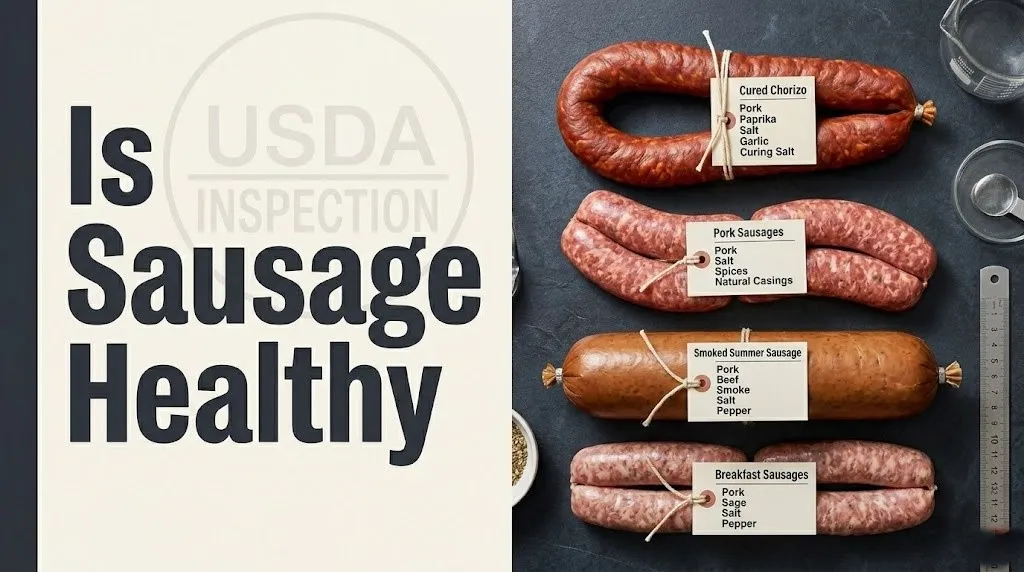
Sausages, as a broad food category, are not uniformly healthy or unhealthy. The category includes fresh sausages made from whole muscle meat and simple spices, and ultra-processed sausages made from mechanically separated meat, fillers, binders, and chemical preservatives. These products sit at opposite ends of the health spectrum.
The World Health Organization’s International Agency for Research on Cancer classified processed meat as a Group 1 carcinogen in 2015. This classification applies to meats that have been transformed through salting, curing, fermentation, smoking, or other processes to enhance flavor or improve preservation. Sausages that are cured, smoked, or fermented fall into this category. Fresh sausages with no curing agents do not.
The distinction between processed and unprocessed sausage is the single most important health consideration. A fresh sausage made from ground pork, salt, pepper, and fennel is nutritionally similar to a pork chop with seasoning. A smoked sausage made with sodium nitrite, phosphates, and added sugars is a different product with a different health risk profile.
The USDA enforces labeling rules that help consumers distinguish between these products. Fresh sausage must be labeled as such. Cured sausage must declare curing agents like sodium nitrite or celery powder in the ingredients list. Smoked sausage must indicate the smoking process. Reading the label carefully reveals which category the product falls into.
is sausage healthy for you
Sausage is healthy for you if you choose fresh, minimally processed varieties, limit your portion to one or two links, and eat it as part of a diet rich in vegetables, whole grains, and unsaturated fats. It is not healthy for you if you eat cured or smoked sausages daily, consume large portions, or have a health condition that makes saturated fat and sodium particularly risky.
The “for you” in this question is doing real work. A healthy adult with normal cholesterol and blood pressure can eat fresh sausage once or twice a week without measurable harm. A person with hypertension, high LDL cholesterol, or a family history of colorectal cancer should be more cautious. The same food has different health implications for different people.
Sodium is the variable that changes fastest based on sausage type. A fresh pork sausage link contains roughly 200 to 300 milligrams of sodium. A cured smoked sausage link contains 500 to 800 milligrams. The difference comes from curing salts and added sodium compounds like sodium phosphate and sodium erythorbate. For someone on a sodium-restricted diet, this difference is the deciding factor between a food that fits and a food that does not.
The Academy of Nutrition and Dietetics recommends that people evaluate individual foods within the context of their total dietary pattern. Sausage is not inherently good or bad. It is a food with a specific nutritional profile that either supports or undermines your health goals depending on how you use it.
is beef sausage healthy
Beef sausage is higher in saturated fat and heme iron than pork or poultry sausage, which gives it a less favorable nutritional profile for cardiovascular health. A typical beef sausage link contains 8 to 10 grams of total fat, with 3 to 4 grams of saturated fat. The protein content is roughly 6 to 7 grams per link.
The higher heme iron content in beef sausage is a double-edged nutritional factor. Heme iron is well absorbed and helps prevent iron-deficiency anemia. For menstruating women, children, and people with diagnosed iron deficiency, this is a benefit. For adult men and postmenopausal women who already have adequate iron stores, excess heme iron intake has been associated with increased oxidative stress in some observational studies.
Beef sausage also tends to be higher in zinc than poultry sausage. Zinc supports immune function and wound healing. A single beef sausage link provides roughly 1.5 to 2 milligrams of zinc, about 15 to 20 percent of the daily recommended intake. This is a meaningful contribution for a small food item.
The tradeoff is the saturated fat. Beef fat is more saturated than pork fat or poultry fat. The USDA nutrient database shows beef sausage averaging 3.5 grams of saturated fat per link compared to 2.5 grams for pork sausage and 1.5 grams for chicken sausage. If you are monitoring saturated fat intake, beef sausage is the least favorable choice among common sausage types.
can sausage be healthy
Yes, sausage can be healthy if you choose fresh, lean varieties with simple ingredient lists and eat them in moderate portions. The healthiest sausages are made from whole muscle meat, contain no added nitrates or nitrites, use natural casings, and are seasoned with herbs and spices rather than sodium-heavy flavoring blends.
The clean-label sausage trend that accelerated in the early 2020s has produced grocery store options that are nutritionally distinct from traditional processed sausage. These products use celery powder instead of sodium nitrite for curing, though the chemical result is similar. They use real spices instead of artificial flavors. They avoid phosphates and fillers. They still contain saturated fat and sodium, but the overall nutritional profile is better.
Making sausage at home is the most reliable way to control the health profile. Ground pork or chicken mixed with salt, pepper, garlic, fennel, and paprika produces a sausage that is comparable to a seasoned ground meat patty. You control the salt level. You control the fat content by choosing the cut of meat. You avoid all industrial processing inputs.
The practical barrier to homemade sausage is time and equipment. A stand mixer with a grinding attachment and a sausage stuffer makes the process efficient. Without those tools, shaping seasoned ground meat into patties produces a sausage-like product that skips the casing step entirely. The health benefit is the same. You know exactly what is in it.
Legal Bottom Line: The USDA requires that all sausage labels list ingredients in descending order by weight. A sausage with “pork, water, salt, spices” is fundamentally different from one with “mechanically separated chicken, pork, water, corn syrup, salt, sodium phosphate, sodium erythorbate, sodium nitrite, natural flavors.” Both are legal. One is a whole food. The other is an ultra-processed product.
how healthy is sausage
On a scale of protein sources, fresh sausage falls in the middle range. It is healthier than bacon and hot dogs. It is less healthy than a skinless chicken breast or a piece of grilled fish. The ranking depends on the processing level and the animal source.
Comparing sausage to other common protein foods clarifies its place in a healthy diet. A three-ounce serving of fresh pork sausage contains roughly 250 calories, 18 grams of fat, and 15 grams of protein. A three-ounce serving of skinless chicken breast contains 140 calories, 3 grams of fat, and 26 grams of protein. The sausage delivers more than half the protein with more than five times the fat.
The comparison to bacon is more favorable to sausage. Bacon is higher in saturated fat per ounce and delivers less protein. Sausage, especially fresh sausage, has a better protein-to-fat ratio than bacon. The comparison to hot dogs is also favorable. Hot dogs are emulsified products made from meat trimmings, fat, water, and binders. Fresh sausage is a coarser grind that retains more of the original muscle structure and typically contains fewer additives.
The health ranking also depends on the cooking method. Sausage cooked on a grill over high heat develops polycyclic aromatic hydrocarbons (PAHs) and heterocyclic amines (HCAs), compounds formed when meat is charred. These compounds are classified as probable human carcinogens. Pan-frying at moderate heat produces fewer of these compounds. Boiling or steaming produces almost none.
are sausage healthy
Sausage, treated as a single category, is not healthy enough to be a dietary staple for most people. The saturated fat and sodium content of even the best sausage varieties are high relative to unprocessed meat. Sausage is better understood as an occasional food than a daily protein source.
The frequency question matters more than the yes-no binary. Eating fresh chicken sausage once a week is unlikely to affect long-term health outcomes. Eating smoked beef sausage every day probably will. The dose makes the poison. The problem with asking “are sausage healthy” is that it invites a yes or no answer to a question that requires a frequency and type response.
The American Heart Association’s dietary guidance does not single out sausage specifically. It recommends limiting processed meat and saturated fat. A fresh sausage with simple ingredients counts as unprocessed meat under most definitions. A cured or smoked sausage counts as processed meat. The AHA guidance points toward limiting the latter but does not prohibit the former.
A practical approach is to treat sausage as a flavoring ingredient rather than the center of the plate. Crumbling a small amount of fresh sausage into a vegetable-heavy pasta sauce or a bean stew distributes the flavor and protein while keeping the per-serving saturated fat and sodium low. This is how sausage is used in many traditional cuisines, as a seasoning meat rather than a main course.
is pork sausage healthy
Pork sausage is moderately healthy when fresh and minimally processed. It delivers high-quality protein, thiamin, selenium, and zinc. It also delivers saturated fat and sodium. A fresh pork sausage link is nutritionally similar to a portion of pork shoulder with added salt. The health profile is reasonable in moderation.
Pork is particularly rich in thiamin (vitamin B1), containing more per ounce than beef or chicken. Thiamin is essential for carbohydrate metabolism and nerve function. A single pork sausage link provides roughly 0.2 to 0.3 milligrams of thiamin, about 15 to 25 percent of the daily recommended intake. This is a genuine nutritional strength of pork sausage.
The fat content of pork sausage depends on the cut used. Sausage made from pork shoulder, the traditional choice, contains about 20 to 25 percent fat. Sausage made from leaner cuts like pork loin contains less fat but can be dry and crumbly. The fat carries flavor and provides the sausage texture. Very low-fat pork sausage is often an inferior product that relies on binders and additives to compensate.
The USDA standard of identity for fresh pork sausage allows up to 50 percent fat by weight. No commercial sausage approaches that limit. Most fresh pork sausage falls between 20 and 30 percent fat. Check the nutrition facts panel for the actual fat content. A sausage with 8 grams of fat per link is a moderate-fat product. One with 15 grams is not.
Key Takeaway: Fresh pork sausage is a moderate-fat protein source with a good micronutrient profile. The health impact depends on the fat content, the curing status, and how often you eat it.
is chicken sausage healthy
Chicken sausage is generally healthier than pork or beef sausage. It contains less saturated fat, fewer calories, and comparable protein. A typical chicken sausage link has 100 to 140 calories, 6 to 8 grams of fat, and 10 to 14 grams of protein. The leaner nutritional profile makes it a better daily protein option than red meat sausage.
The fat in chicken sausage is mostly unsaturated, which is a meaningful health advantage. Chicken fat has a fatty acid profile closer to olive oil than to beef fat. It contains more monounsaturated fat and less saturated fat. This matters for blood cholesterol. Replacing saturated fat from red meat with unsaturated fat from poultry is a dietary strategy supported by the American Heart Association for cardiovascular risk reduction.
The sodium content of chicken sausage is often higher than expected. Manufacturers compensate for the lower fat content with increased seasoning. A chicken sausage link can contain 400 to 600 milligrams of sodium, similar to a cured pork sausage. The “healthy halo” of chicken sausage leads consumers to overlook the sodium panel. Always check the label.
Chicken sausage is also more likely to contain binders and fillers than pork or beef sausage. Chicken meat is lean and can be dry. Some manufacturers add starches, gums, or vegetable proteins to improve texture. These additives are not harmful, but they indicate a more processed product. A chicken sausage with an ingredient list of “chicken, water, salt, spices” is a whole-food product. One with a longer list of binders is not.
is turkey sausage healthy
Turkey sausage is nutritionally similar to chicken sausage and shares the same health advantages over red meat sausage. It is low in saturated fat, high in protein, and moderate in calories. A turkey sausage link contains roughly 100 to 130 calories, 5 to 7 grams of fat, and 11 to 13 grams of protein.
Turkey sausage has one nutritional weakness that chicken sausage does not. Turkey meat is lower in iron than chicken or red meat. A turkey sausage link provides roughly 0.5 milligrams of iron, about 3 percent of the daily recommended intake. Chicken sausage provides about twice that. Pork sausage provides three to four times that. If iron intake is a concern, turkey sausage is not the best choice.
The flavor of turkey sausage depends heavily on seasoning. Plain turkey is mild to the point of blandness. Manufacturers add salt, spices, and sometimes sugar to build flavor. The added sugar in some turkey sausage products is a hidden nutritional issue. A “maple turkey sausage” can contain 3 to 5 grams of added sugar per link. Check the added sugars line on the nutrition facts panel.
Turkey sausage is often marketed as a health food, but the health claim only holds for fresh, minimally processed versions. Turkey hot dogs and turkey smoked sausage are still processed meats with sodium nitrite and high sodium levels. The “turkey” label does not automatically make a sausage healthy. The processing method matters as much as the animal source.
is sausage healthy for weight loss
Sausage can fit into a weight loss diet if you choose lean varieties, control portions strictly, and account for the calorie density. The protein in sausage supports satiety and muscle preservation during a calorie deficit. The fat content, however, makes sausage calorie-dense relative to leaner protein sources.
A single sausage link contains 80 to 140 calories depending on the type. Two links with eggs and toast push a breakfast into 500 to 700 calorie territory. That can fit into a weight loss calorie budget, but it uses a significant portion of the day’s calories on a small volume of food. Leaner protein sources like egg whites, Greek yogurt, or fish provide more protein for fewer calories.
The satiety advantage of sausage protein is real. A breakfast containing 20 to 30 grams of protein reduces hunger hormones and decreases subsequent meal intake more effectively than a high-carbohydrate breakfast. Sausage contributes to that protein total. The question is whether the fat calories that come with the protein are worth the satiety benefit compared to leaner protein sources.
If you are tracking calories for weight loss, weigh your sausage portions. A “link” is not a standard unit. One brand’s link is 55 grams. Another’s is 85 grams. The nutrition facts panel gives data per serving, usually one link of a specified weight. Weighing the actual sausage against the stated serving size prevents the calorie underestimation that stalls weight loss progress.
is sausage healthy for your heart
Sausage is not heart healthy when it is high in saturated fat and sodium. Regular consumption of traditional pork or beef sausage, especially cured or smoked varieties, raises LDL cholesterol and blood pressure, two major cardiovascular risk factors. Lean poultry sausage in moderation is a better choice for heart health.
The saturated fat mechanism is well established. Saturated fat increases LDL cholesterol, which contributes to arterial plaque formation. The American Heart Association’s position, reaffirmed in its 2021 dietary guidance, is that replacing saturated fat with unsaturated fat reduces cardiovascular events. Sausage, as a source of saturated fat, is a food to limit rather than eliminate for heart health.
Sodium is the other heart health variable. High sodium intake raises blood pressure, a leading risk factor for heart attack and stroke. The average American consumes about 3,400 milligrams of sodium per day. The AHA recommends 2,300 milligrams with an ideal limit of 1,500 milligrams. A breakfast with two sausage links, eggs seasoned with salt, and buttered toast can deliver 1,200 to 1,800 milligrams of sodium in one meal.
For someone with diagnosed hypertension, heart failure, or a history of heart attack, the sodium in cured sausage is particularly dangerous. Fluid retention from excess sodium increases the workload on the heart. The recommendation for these individuals is to choose fresh, low-sodium sausage or avoid sausage entirely.
Legal Bottom Line: The USDA does not require front-of-package sodium labeling on sausage products. The nutrition facts panel on the back is the only required sodium disclosure. A sausage labeled “lower sodium” must contain at least 25 percent less sodium than the regular version under FDA rules.
is plant based sausage healthy
Plant based sausage is a mixed nutritional product. It is typically lower in saturated fat than pork or beef sausage and contains no cholesterol. It is also usually highly processed, with long ingredient lists that include isolated proteins, oils, starches, and binders. The health profile depends on the specific product.
The protein in plant based sausage comes from soy protein isolate, pea protein, wheat gluten, or a blend of these. The protein content is comparable to meat sausage, typically 10 to 15 grams per link. The protein quality is lower because plant proteins have less favorable amino acid profiles than animal proteins. Manufacturers blend protein sources to improve the amino acid balance.
The fat in plant based sausage comes from added oils, usually coconut oil, canola oil, or sunflower oil. Coconut oil is high in saturated fat, which surprises consumers who assume plant based means low saturated fat. Some plant based sausages contain as much saturated fat as pork sausage. Check the label.
The sodium content of plant based sausage is often high, matching or exceeding meat sausage. The processing required to create a meat-like texture and flavor involves significant salt. A plant based sausage link can contain 400 to 600 milligrams of sodium. The health advantage over meat sausage is not automatic. It depends on the specific product formulation.
Key Takeaway: Plant based sausage can be healthier than meat sausage or less healthy. Read the label. Look at saturated fat, sodium, and the ingredient list length. A plant based sausage with coconut oil and 500 milligrams of sodium is not a health food. It is a processed food with a different protein source.
is processed sausage healthy
Processed sausage, meaning sausage that has been cured, smoked, or fermented, is not healthy as a regular dietary staple. The World Health Organization classifies processed meat as a Group 1 carcinogen, meaning there is sufficient evidence that it causes cancer in humans. The primary cancer risk is colorectal cancer.
The WHO classification was based on a review of over 800 studies by the IARC. The review found that each 50-gram portion of processed meat eaten daily increases colorectal cancer risk by approximately 18 percent. A typical sausage link weighs 50 to 85 grams. The risk is dose-dependent. Occasional consumption carries minimal risk. Daily consumption over years carries measurable risk.
The mechanisms behind the cancer link are not fully understood but involve several compounds. Sodium nitrite, used in curing, can form N-nitroso compounds in the digestive tract. These compounds are carcinogenic in animal models. Heme iron from red meat promotes the formation of N-nitroso compounds. High-heat cooking produces PAHs and HCAs, which are also carcinogenic.
The USDA does not prohibit the use of sodium nitrite in sausage. It regulates the amount. The maximum allowable concentration is 200 parts per million in finished products. The regulation is based on preventing botulism, not long-term cancer risk. The FDA considers nitrite safe at regulated levels. The IARC classification reflects a different standard of evidence based on long-term epidemiological data.
is fresh sausage healthy
Fresh sausage is healthier than processed sausage because it contains no added nitrates or nitrites and is not smoked or fermented. It is essentially seasoned ground meat in a casing. The nutritional profile is similar to the whole muscle meat it is made from, with the caveat that sausage is typically higher in fat.
The USDA defines fresh sausage as sausage that has not been cured, smoked, or cooked. It must be kept refrigerated and cooked thoroughly before eating. The ingredient list for fresh sausage is typically short: meat, water, salt, spices, and sometimes sugar. There are no curing agents, no phosphates, and no smoke flavoring.
The health advantage of fresh sausage is the absence of N-nitroso compound formation risk from added nitrites. The saturated fat and sodium content are still higher than unprocessed meat, but the carcinogen classification does not apply. Fresh sausage is unprocessed meat in the regulatory and epidemiological sense.
The cooking requirement for fresh sausage also affects safety. Fresh sausage must be cooked to an internal temperature of 160 degrees Fahrenheit for pork and beef, 165 degrees for poultry. This kills Trichinella spiralis, a parasite historically associated with undercooked pork, and Salmonella and Campylobacter from poultry. The thorough cooking eliminates the raw meat pathogen risk.
is smoked sausage healthy
Smoked sausage is not healthy as a regular food. The smoking process adds polycyclic aromatic hydrocarbons to the meat surface. These compounds are formed when wood smoke deposits particles on the sausage. PAHs are classified as probable human carcinogens. Smoked sausage is also typically cured with sodium nitrite, adding the processed meat cancer risk.
The smoking process varies in intensity and method. Traditional cold smoking exposes sausage to smoke at temperatures below 85 degrees Fahrenheit for hours or days. Hot smoking cooks the sausage while smoking it. Both methods deposit PAHs, though the levels depend on the type of wood, the smoke density, and the duration. The USDA does not regulate PAH levels in smoked meat products.
Smoked sausage is often also cured. The combination of smoking and curing gives smoked sausage a double processed-meat risk profile. The nitrite provides the cured pink color and prevents botulism during smoking and storage. The smoke provides flavor and additional preservation. Both processes contribute to the long-term health risk.
For consumers who enjoy smoked sausage, the harm reduction strategy is frequency and portion control. Eating smoked sausage once a month as part of a dish like jambalaya or bean soup distributes a small amount of the sausage across multiple servings. Eating a whole smoked sausage on a bun every week concentrates the exposure.
Legal Bottom Line: The USDA requires that smoked sausages be labeled as such. The term “smoked” on the label indicates the product was exposed to smoke. “Smoke flavor added” indicates the product was not smoked but has added smoke flavoring, which does not carry the same PAH risk.
is sausage healthy during pregnancy
Sausage can be safe and healthy during pregnancy if it is fresh, thoroughly cooked, and eaten in moderation. Cured, smoked, or fermented sausages that are eaten cold or undercooked pose risks from Listeria monocytogenes, Toxoplasma gondii, and excessive sodium. The cooking status matters more than the sausage type.
The primary pregnancy concern with sausage is listeriosis. Listeria can cross the placenta and cause miscarriage, stillbirth, or severe neonatal infection. Pregnant women are roughly 10 times more likely to contract listeriosis than the general population. The bacteria are killed by heat. Fresh sausage cooked to 160 degrees Fahrenheit is safe. Cold smoked sausage, like some kielbasa or summer sausage eaten without reheating, is not.
Cured sausages that are not cooked before eating, such as certain salamis and pepperoni, should be avoided during pregnancy unless they are heated until steaming. The curing process does not kill Listeria. Only heat does. The CDC recommends that pregnant women avoid all deli meats and cured sausages unless they are reheated to 165 degrees Fahrenheit.
The sodium content of sausage is an additional concern during pregnancy. Excess sodium contributes to fluid retention and can worsen pregnancy-induced hypertension. Fresh sausage with controlled sodium is a better choice than highly processed cured sausage. Iron in red meat sausage is beneficial during pregnancy, when iron needs increase. The benefit must be weighed against the saturated fat and sodium.
is sausage healthy for people with diabetes
Sausage can be part of a diabetes-friendly eating pattern if it is fresh, lean, and eaten in controlled portions. The protein and fat in sausage do not directly raise blood glucose. The saturated fat and sodium, however, increase cardiovascular risk, which is already elevated in people with diabetes.
The carbohydrate content of sausage is negligible, usually less than 1 gram per link, unless the sausage contains added sugars or fillers. This makes sausage a blood-sugar neutral food in isolation. It does not cause a post-meal glucose spike the way a carbohydrate-heavy breakfast would.
The cardiovascular risk is the limiting factor. People with type 2 diabetes have a two to four times higher risk of cardiovascular disease than the general population. The saturated fat and sodium in sausage contribute to that risk. The American Diabetes Association recommends limiting saturated fat and sodium for people with diabetes, which means choosing lean poultry sausage over fatty red meat sausage and limiting cured or smoked varieties.
Some sausages contain added sugars, usually in the form of dextrose, corn syrup solids, or maple syrup. These are present in small amounts, usually 1 to 3 grams per link, and are used for flavor rather than bulk. Check the added sugars line on the nutrition facts panel. The small amount of sugar in a sausage link is unlikely to affect blood glucose meaningfully, but it is worth knowing about.
Key Takeaway: For people with diabetes, fresh poultry sausage is the best choice. It provides protein without the saturated fat and processing compounds that compound cardiovascular risk. Portion size and frequency matter more than the simple yes or no of whether sausage is allowed.
Common Questions About Sausage and Health
What is the healthiest type of sausage to eat?
Fresh chicken or turkey sausage with a short ingredient list is the healthiest sausage choice.
These sausages are lower in saturated fat than pork or beef sausage and contain no curing agents.
Look for products with meat, water, salt, and spices as the only ingredients.
Avoid products with sodium nitrite, phosphates, corn syrup, or fillers if you want the healthiest option.
Is sausage a processed meat?
Some sausage is processed meat and some is not.
Fresh sausage made from ground meat and spices with no curing agents is not classified as processed meat under WHO and USDA definitions.
Cured, smoked, or fermented sausage is processed meat because it has been transformed through salting, curing, or smoking.
The ingredient list tells you which category a sausage falls into.
Does sausage cause cancer?
Processed sausage, meaning cured, smoked, or fermented sausage, is classified as a Group 1 carcinogen by the World Health Organization based on evidence linking it to colorectal cancer.
The risk is dose-dependent. Occasional consumption carries low risk.
Fresh sausage with no curing agents is not included in this classification.
Cooking sausage at high heat until charred adds additional carcinogenic compounds from the charring process.
How often can I eat sausage?
Fresh sausage can be eaten 1 to 3 times per week as part of a balanced diet for most healthy adults.
Cured or smoked sausage should be limited to occasional consumption, roughly once or twice a month.
The frequency recommendation changes for people with hypertension, high cholesterol, diabetes, or a family history of colorectal cancer.
Those individuals should choose fresh poultry sausage and limit all sausage consumption.
Is chicken sausage actually healthier than pork sausage?
Yes, chicken sausage is generally healthier than pork sausage.
It contains less saturated fat and fewer calories for a comparable amount of protein.
The sodium content of chicken sausage can be as high as pork sausage, so check the label.
The health advantage comes from the fat profile, not automatically from the poultry source.
The one thing to understand about sausage is that the word covers a huge range of products. A fresh chicken sausage with four ingredients is a different food from a mass-produced smoked sausage with twenty. The label tells you which one you are buying.
Read the ingredient list. Choose fresh over cured or smoked. Pick poultry over red meat if saturated fat is a concern. Limit your portion to one or two links. Treat sausage as a flavoring ingredient or an occasional protein, not a daily staple.
Sausage is not poison and it is not a health food. It is a food with a specific nutritional profile that you can manage once you know what to look for.