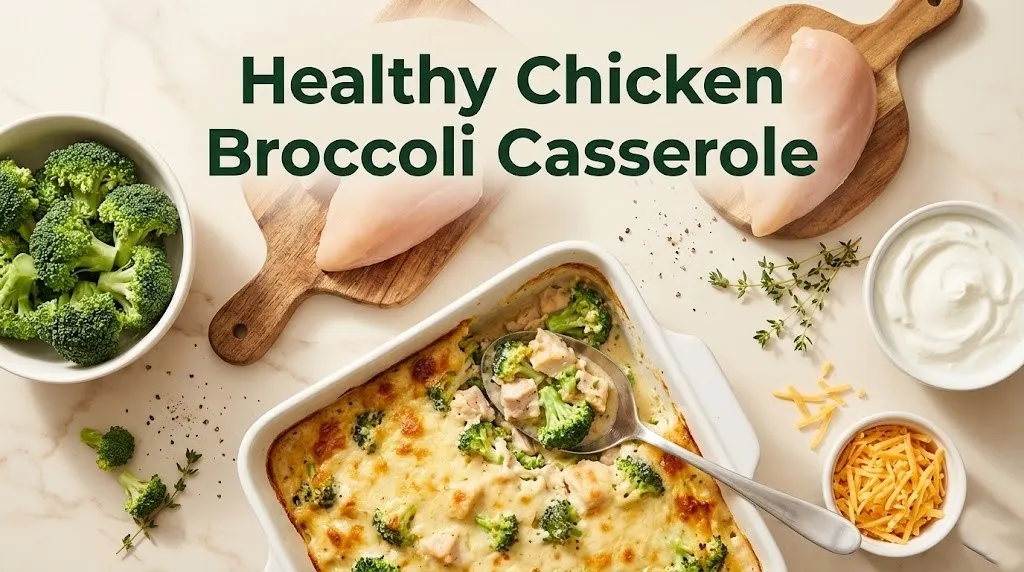
A healthy chicken broccoli casserole is a baked one-dish meal that replaces canned cream soups and heavy cream with a from-scratch sauce made from Greek yogurt or a dairy-free alternative, uses lean chicken breast or thighs, and keeps the broccoli vibrant and tender instead of cooking it into olive-green mush. You get the same creamy, cheesy comfort you remember from childhood, built on a nutritional foundation that supports your goals rather than working against them.
The traditional version of this casserole, the one built on a can of condensed cream of chicken soup, a can of cream of mushroom soup, and a blanket of cheese, delivers roughly 450 to 550 calories per serving with 1,200 to 1,500 milligrams of sodium and 20 to 28 grams of saturated fat. The American Heart Association recommends limiting saturated fat to no more than 13 grams per day and sodium to 1,500 milligrams for ideal cardiovascular health. One serving of the traditional casserole can exceed those limits before you eat anything else that day.
This article gives you a master recipe that has been tested for texture, flavor, and freezer stability. You will learn the technique for keeping broccoli bright green and pleasantly firm, how to build a creamy sauce without a can opener, and how to adapt the recipe for dairy-free, gluten-free, and vegetarian eating patterns.
healthy chicken broccoli casserole
A healthy chicken broccoli casserole is a baked dish combining pre-cooked chicken, briefly blanched broccoli, and a creamy Greek yogurt-based sauce, topped with a measured amount of cheese and baked until bubbly. The sauce is made from scratch using chicken broth, Greek yogurt, and a small amount of cornstarch instead of relying on condensed soups that are high in sodium and low in protein.
The protein content of a properly constructed healthy chicken broccoli casserole is one of its strongest nutritional features. A 1.5-cup serving delivers roughly 30 to 35 grams of protein from the chicken, the Greek yogurt, and the cheese. This protein load triggers satiety hormones and supports muscle maintenance, making the casserole a legitimate post-workout meal or a dinner that keeps you full until morning. The Academy of Nutrition and Dietetics identifies protein-rich meals as an important strategy for appetite regulation and weight management.
The sodium reduction is the other headline nutritional improvement. A serving of traditional canned-soup casserole contains 1,200 to 1,500 milligrams of sodium, largely from the condensed soups and the cheese. The healthy version uses low-sodium chicken broth, unsalted Greek yogurt, and a restrained hand with the cheese. The total sodium per serving drops to roughly 400 to 550 milligrams, depending on how heavily you salt the cooking water and the sauce. This is a reduction of roughly two-thirds.
healthy chicken and broccoli casserole
A healthy chicken and broccoli casserole is the same dish by a slightly different name, and the recipe that follows produces a creamy, golden-topped casserole that serves six and reheats beautifully for lunches throughout the week. The active preparation time is about 20 minutes. The oven does the rest.
The choice of chicken cut affects both texture and nutrition. Boneless, skinless chicken breast is the leanest option, delivering roughly 26 grams of protein and 3 grams of fat per 3-ounce cooked serving. Boneless, skinless chicken thighs contain slightly more fat, roughly 7 grams per serving, but the meat stays juicier through the bake and reheating process. Either cut works. If you are meal-prepping and plan to microwave portions throughout the week, thighs hold up better and taste less dry on day three.
The broccoli must be cut into uniform, bite-sized florets. Pieces larger than about 1.5 inches across will not cook evenly during the brief blanch, and they will be awkward to eat in a casserole format. The stem is edible and nutritious. Peel the tough outer skin with a vegetable peeler and slice the tender inner stem into half-inch coins. This reduces waste and adds fiber and a pleasant water-chestnut-like crunch to the casserole.
Ingredients:
- 1.5 pounds boneless, skinless chicken breast or thighs, cooked and diced into half-inch cubes
- 5 cups fresh broccoli florets and sliced peeled stems, cut into bite-sized pieces
- 1 tablespoon olive oil or avocado oil
- 1 small yellow onion, finely diced
- 3 cloves garlic, minced
- 2 tablespoons cornstarch or arrowroot powder
- 1.5 cups low-sodium chicken broth
- 1 cup plain Greek yogurt (whole-milk or 2% for best texture)
- 1 teaspoon Dijon mustard
- 1/2 teaspoon salt
- 1/4 teaspoon black pepper
- 1/4 teaspoon paprika
- 1 cup shredded sharp cheddar cheese, divided
- 1/4 cup grated Parmesan cheese
To prepare the casserole:
- Preheat the oven to 375 degrees Fahrenheit and lightly grease a 9×13-inch baking dish.
- Bring a large pot of salted water to a boil. Add the broccoli and cook for exactly 60 seconds. Drain immediately and transfer to a bowl of ice water to stop the cooking. Drain again and set aside.
- Heat the olive oil in a medium saucepan over medium heat. Add the onion and cook until softened and translucent, about 4 minutes. Add the garlic and cook for 30 seconds until fragrant.
- Whisk the cornstarch into the cold chicken broth in a small bowl until completely dissolved, then pour the mixture into the saucepan with the onions.
- Bring the broth to a gentle simmer while whisking continuously. Cook until the mixture thickens enough to coat the back of a spoon, about 2 to 3 minutes. Remove from heat.
- Let the sauce cool for 2 minutes, then whisk in the Greek yogurt, Dijon mustard, salt, pepper, and paprika until smooth. Stir in half of the shredded cheddar cheese and all of the Parmesan.
- Spread the diced chicken and blanched broccoli evenly in the prepared baking dish. Pour the sauce over the top and stir gently to coat everything.
- Sprinkle the remaining cheddar cheese over the surface. Bake for 25 to 30 minutes, until the edges are bubbling and the top is golden.
- Let the casserole rest for 5 minutes before serving to allow the sauce to set slightly.
healthy chicken and broccoli bake
A healthy chicken and broccoli bake is a slightly broader term that can include rice, quinoa, or pasta as a base, but the core principle remains the same: a protein-rich, vegetable-forward baked dish with a from-scratch sauce. The addition of a whole grain turns the casserole into a complete one-dish meal that requires no sides.
Adding cooked brown rice or quinoa to the casserole increases the fiber content and makes the dish more filling without adding significant saturated fat or sodium. One cup of cooked quinoa adds roughly 220 calories, 8 grams of protein, and 5 grams of fiber to the entire casserole, spread across six servings. If you add a grain, increase the sauce by half a cup to account for the grain’s absorption, or the casserole will be dry.
The bake format also works well for meal prep in a different way than the standard casserole. You can assemble the entire dish in the baking pan, cover it tightly, and refrigerate it for up to 24 hours before baking. Add 5 to 7 minutes to the bake time to account for starting from a cold dish. This make-ahead capability is the reason casseroles have survived decades of food trends. They fit into real schedules.
healthy chicken broccoli bake
A healthy chicken broccoli bake differs from a casserole primarily in the topping, often using a crunchy breadcrumb or crushed nut layer instead of melted cheese, though cheese remains common. The bake format gives you an opportunity to add texture contrast that the standard casserole sometimes lacks.
A topping made from almond flour and grated Parmesan produces a golden, crunchy crust with more protein and less carbohydrate than a breadcrumb topping. Combine 1/2 cup of almond flour, 1/4 cup of grated Parmesan, 1 tablespoon of melted butter or olive oil, and a pinch of garlic powder. Sprinkle the mixture over the casserole before baking. It browns in the same 25-minute window and adds a nutty, savory crunch.
For a gluten-free breadcrumb topping, crush plain rice cakes or use store-bought gluten-free panko. Toss the crumbs with a small amount of olive oil and a pinch of salt before sprinkling. The oil helps the crumbs brown evenly and prevents them from burning while the casserole finishes cooking.
healthy chicken broccoli casserole recipes
Healthy chicken broccoli casserole recipes now span a range of dietary patterns including dairy-free, gluten-free, low-carb, and higher-protein versions, reflecting a broader shift toward casseroles that serve specific nutritional goals rather than just convenience. The recipe variations below rotate through different sauce bases and mix-ins.
A dairy-free version uses full-fat canned coconut milk as the sauce base, thickened with cornstarch or arrowroot powder. Saute the onion and garlic in oil, add the coconut milk and broth mixture, and proceed as directed. Use a dairy-free cheese alternative or skip the cheese entirely and use the almond-Parmesan topping instead. The coconut flavor is mild and largely masked by the savory ingredients. Use refined coconut oil if you are sensitive to coconut taste.
A higher-protein version adds an extra cup of diced chicken and replaces half the Greek yogurt with blended cottage cheese. Cottage cheese must be blended smooth in a food processor or blender before adding to the sauce. Unblended cottage cheese curds will not melt and will leave the sauce with a grainy, separated texture.
Three variations to rotate through:
- Dairy-free: Coconut milk base, dairy-free cheese, almond-Parmesan topping
- High-protein: Extra chicken, blended cottage cheese in the sauce
- Grain-added: 1.5 cups cooked quinoa or brown rice folded into the casserole
Key Takeaway: The master recipe is a template, not a rule. Swap the sauce base, the protein, the vegetable, and the topping based on what you have and what your household needs.
broccoli chicken bake healthy
A broccoli chicken bake qualifies as healthy when it replaces canned soups with a from-scratch sauce, uses lean protein, keeps the broccoli texturally intact, and limits the cheese to a flavoring role rather than a structural one. The “broccoli chicken” word order often signals recipes where the vegetable is the star or co-star, not an afterthought.
Positioning broccoli as a main ingredient rather than a scattered green accent changes the nutritional math. Five cups of broccoli florets, the amount in this recipe, delivers roughly 25 grams of fiber, 550 percent of the Daily Value for vitamin C, and 450 percent of the Daily Value for vitamin K across the full casserole. Even divided six ways, each serving provides meaningful amounts of these nutrients. Broccoli also contains sulforaphane, a sulfur-containing compound studied for its potential anti-cancer properties, though the blanching step reduces sulforaphane content somewhat compared to raw broccoli.
The USDA Dietary Guidelines recommend that adults consume 2.5 to 3 cups of vegetables daily. A serving of this casserole provides nearly a full cup of broccoli, making it a legitimate vegetable-delivery vehicle rather than a cheese-and-chicken dish that happens to contain a few green flecks.
healthy chicken and broccoli casserole recipes
Healthy chicken and broccoli casserole recipes share a structural template that you can adapt endlessly: a lean protein, a green vegetable, a creamy binder, and a topping, all baked together in a single dish. The ratio of these components determines whether the casserole feels like a balanced meal or a heavy indulgence.
The ideal ratio for a balanced casserole is roughly equal parts protein and vegetable by volume, with the sauce acting as a binder rather than a flood. Two parts chicken to two parts broccoli to one part sauce creates a casserole where each forkful contains protein, vegetable, and a coating of creaminess. When the sauce dominates, the casserole becomes soup. When the cheese dominates, it becomes a gratin. Neither is wrong, but the equal-ratio version is the one that best supports everyday eating.
The sauce itself should be thick enough to cling to the other ingredients without pooling. If your sauce seems thin after adding the yogurt, return it to low heat for an additional minute while whisking. The cornstarch will continue to thicken as it reaches a simmer. If the sauce seems too thick, thin it with a tablespoon of broth at a time until it reaches a pourable, gravy-like consistency.
healthy broccoli and chicken casserole
A healthy broccoli and chicken casserole that foregrounds the broccoli uses slightly more vegetable than the standard ratio, roughly three parts broccoli to two parts chicken. This version is lighter in calories, higher in fiber, and a deeper green on the plate. The sauce quantity stays the same because broccoli, being more porous than chicken, absorbs more sauce.
The visual appeal of a broccoli-forward casserole depends entirely on the blanching step. Broccoli that has been properly blanched and shocked stays bright green through the bake. Broccoli that goes into the oven raw turns a dull olive-brown from the extended exposure to heat, which breaks down chlorophyll into pheophytin. The flavor is the same. The appearance is not. If you are serving this casserole to anyone who eats with their eyes first, the blanching step is non-negotiable.
This version of the casserole pairs well with a squeeze of fresh lemon juice added at the table. The acid brightens the creamy sauce and complements the broccoli’s natural flavor. A pinch of red pepper flakes added to the sauce provides warmth without changing the nutritional profile.
chicken broccoli casserole recipes healthy
Chicken broccoli casserole recipes become healthy when the ingredient list shifts from processed convenience foods to whole-food components and the sodium and saturated fat numbers drop by half or more compared to the traditional version. The comparison table below shows exactly what changes when you make the swap.
The condensed soup that forms the base of the traditional casserole is the single biggest nutritional liability. A half-cup of condensed cream of chicken soup contains 870 milligrams of sodium, roughly 58 percent of the American Heart Association’s ideal daily limit. The casserole uses a full can, sometimes two. The sodium load is not from the chicken, the broccoli, or the cheese. It is from the can.
| Component (per serving) | Traditional Casserole | Healthy Casserole |
|---|---|---|
| Calories | 450-550 | 320-380 |
| Protein | 25 g | 30-35 g |
| Saturated Fat | 12-14 g | 4-6 g |
| Sodium | 1,200-1,500 mg | 400-550 mg |
| Fiber | 2 g | 4-5 g |
| Sauce Base | Condensed soup | Greek yogurt + broth |
chicken and broccoli bake healthy
A chicken and broccoli bake that earns the “healthy” label serves a specific nutritional purpose in a weekly meal rotation: it is a high-protein, fiber-rich dinner that reheats well, pleases multiple age groups, and does not require a side dish to feel complete. The convenience of a one-dish meal is part of its health value because convenience determines whether you cook or order takeout.
The reheating quality of this casserole is a practical advantage worth noting. Unlike many healthy meals that turn dry and unappealing in the microwave, the Greek yogurt sauce retains moisture through multiple reheat cycles. The broccoli softens slightly on day two and three, but the initial blanch means it starts from a firmer baseline and never reaches the texture of baby food. Individual portions reheated in a microwave for 90 seconds to 2 minutes taste nearly as good as the fresh bake.
For maximum convenience, bake the casserole on a Sunday and portion it into individual containers for the week. Store the containers in the refrigerator if you will eat them within four days, or freeze them for up to three months. The casserole is a complete meal in a single container, which eliminates the need to pack separate sides for lunch.
what makes this casserole healthy
Three specific recipe decisions make this chicken broccoli casserole healthier than the traditional version: replacing condensed soup with a Greek yogurt sauce, using pre-cooked chicken and blanched broccoli, and measuring the cheese as a flavoring rather than a main ingredient. Each decision changes the nutritional numbers and the final texture.
The Greek yogurt sauce provides the same creamy mouthfeel as condensed soup with a fraction of the sodium and a significant protein boost. The cornstarch stabilizes the yogurt so it does not curdle when heated, a common problem when adding yogurt directly to hot liquid. The Dijon mustard adds depth that replaces some of the savory notes lost when the MSG and yeast extract in canned soup are removed.
The cheese decision is about psychology as much as nutrition. A cup of shredded cheddar distributed across six servings provides roughly 1 ounce of cheese per person, which is a reasonable portion by any standard. Blanketing the casserole in a thick layer of cheese, as many traditional recipes do, can push the cheese per serving above 3 ounces, at which point the dish becomes more about the cheese than anything else.
Key Takeaway: The health improvements in this casserole are not about deprivation. They are about proportion: more protein, more fiber, less sodium, and cheese as a supporting actor rather than the lead.
how to keep broccoli from getting mushy in casserole
Broccoli turns mushy in a casserole because it continues to cook from the moment it enters the hot oven until the casserole cools on the plate, a process that can take an hour or more. The solution is a technique called blanching and shocking, which pre-cooks the broccoli just enough to soften it while deactivating the enzymes that drive further breakdown.
Blanching works by exposing the broccoli to boiling water for a short, precise period, typically 60 seconds for bite-sized florets. The heat destroys the cell walls just enough to make the broccoli tender-crisp. The immediate transfer to ice water, called shocking, halts the cooking process and sets the bright green chlorophyll color. The broccoli is now partially cooked and enzyme-stable. It will soften slightly during the 25-minute bake, but it will not break down into mush.
Broccoli that goes into a casserole raw releases water as it cooks. That water pools in the bottom of the dish and thins the sauce. The broccoli also steams rather than bakes, producing a texture that is simultaneously waterlogged and undercooked. Pre-cooking the broccoli solves both problems at once. The water release happens in the blanching pot, not in the casserole.
To blanch broccoli for casserole:
- Bring a large pot of generously salted water to a rolling boil.
- Add the broccoli florets and stem pieces all at once.
- Set a timer for 60 seconds immediately after adding the broccoli.
- Drain the broccoli into a colander and immediately transfer it to a large bowl filled with ice water.
- Let the broccoli sit in the ice water for 2 minutes, then drain thoroughly and pat dry with a clean kitchen towel before adding to the casserole.
healthy sauce for chicken broccoli casserole
A healthy sauce for chicken broccoli casserole is built from a base of chicken broth thickened with cornstarch or arrowroot powder, enriched with Greek yogurt for creaminess and protein, and seasoned with Dijon mustard, garlic, and onion. It delivers the same cling-to-the-fork texture as a condensed-soup sauce with none of the sodium, preservatives, or stabilizers.
The cornstarch slurry technique is the key to a lump-free sauce. Cornstarch must be dissolved in cold liquid before being added to hot liquid. If you dump dry cornstarch directly into hot broth, it will clump instantly and you will spend the next five minutes trying to whisk out lumps. Dissolve 2 tablespoons of cornstarch in the cold broth, whisk until completely smooth, then pour the mixture into the hot saucepan with the sauteed aromatics. Bring to a gentle simmer while whisking continuously.
Arrowroot powder works as a one-to-one substitute for cornstarch and has the advantage of freezing and thawing more reliably. Cornstarch-thickened sauces can become slightly spongy after freezing. Arrowroot-thickened sauces maintain a smoother texture through the freeze-thaw cycle. If you plan to freeze portions of this casserole, use arrowroot powder instead of cornstarch.
Quick Tip for Dairy-Free Sauce:
- Replace Greek yogurt with full-fat canned coconut milk plus an extra teaspoon of cornstarch.
- The sauce will be slightly thinner. Let it simmer for an additional minute to thicken.
- Add 1 tablespoon of nutritional yeast for a savory, cheese-like flavor without dairy.
Frequently Asked Questions About Healthy Chicken Broccoli Casserole
Can I use frozen broccoli in a chicken broccoli casserole?
You can use frozen broccoli, but the texture will be softer and the color duller than fresh blanched broccoli.
Thaw the frozen broccoli completely and press out as much liquid as possible with paper towels before adding it to the casserole.
Skip the blanching step entirely. The frozen broccoli has already been blanched before freezing.
How many calories are in a healthy chicken broccoli casserole?
A serving of healthy chicken broccoli casserole contains roughly 320 to 380 calories, depending on the cheese quantity and the fat content of the yogurt.
The protein content ranges from 30 to 35 grams per serving.
A traditional canned-soup version contains 450 to 550 calories per serving.
Can I make chicken broccoli casserole dairy-free?
You can make a dairy-free version by replacing the Greek yogurt with full-fat canned coconut milk and using a dairy-free cheese alternative.
Increase the cornstarch by 1 teaspoon to compensate for the thinner coconut milk base.
Add a tablespoon of nutritional yeast to the sauce for a savory, cheese-like flavor without dairy.
How long does chicken broccoli casserole last in the fridge?
Chicken broccoli casserole lasts 3 to 4 days in the refrigerator when stored in an airtight container.
Reheat individual portions in the microwave for 90 seconds to 2 minutes.
The casserole can also be frozen for up to 3 months. Thaw overnight in the refrigerator before reheating.
Can I freeze chicken broccoli casserole?
You can freeze chicken broccoli casserole either before or after baking, and both methods work well.
For unbaked freezing, assemble the casserole completely, cover tightly with foil, and freeze for up to 3 months. Thaw overnight in the refrigerator and bake as directed, adding 10 minutes to the bake time.
For baked freezing, cool the casserole completely, portion into containers, and freeze. Thaw and reheat individual portions as needed.
A healthy chicken broccoli casserole is one of the most practical recipes in a home cook’s repertoire. It is affordable, it feeds a family with leftovers, it reheats beautifully, and it delivers protein and vegetables in a format that even selective eaters will accept. The shift from canned soup to a from-scratch sauce is the only real technique you need to learn, and once you have done it twice, it becomes automatic.
Keep a bag of frozen broccoli and a container of cooked shredded chicken in your freezer, and you are 20 minutes of active time away from this casserole on any weeknight. The blanching step is worth the extra pot to wash. The bright green broccoli and the non-mushy texture are what separate this version from every disappointing casserole you have eaten at a potluck.
The single best indicator that you have made this recipe correctly is that the casserole disappears faster than you expected and someone asks for the recipe. That is the metric that matters.