Yes, healthy meatballs are absolutely real, and they are built on a specific protein choice, a moisture-locking panade, and a cooking method that renders fat away from the meat rather than soaking it in oil. A properly constructed turkey or chicken meatball delivers 25 to 30 grams of protein for under 250 calories per serving.
The standard Italian-American meatball is a delicious calorie bomb of beef, pork, fried breadcrumbs, and melted cheese. You do not have to abandon the comfort. You just need to re-engineer the matrix that holds the meatball together. The American Heart Association consistently recommends replacing high-saturated-fat meats with lean poultry to manage LDL cholesterol, and the humble meatball is an easy place to apply that swap.
We will walk through the exact protein comparisons, the food science that stops poultry meatballs from turning into dry hockey pucks, and the precise internal temperature that keeps your family safe. You will also get a meal-prep blueprint that puts 24 healthy meatballs in your freezer by Sunday afternoon.
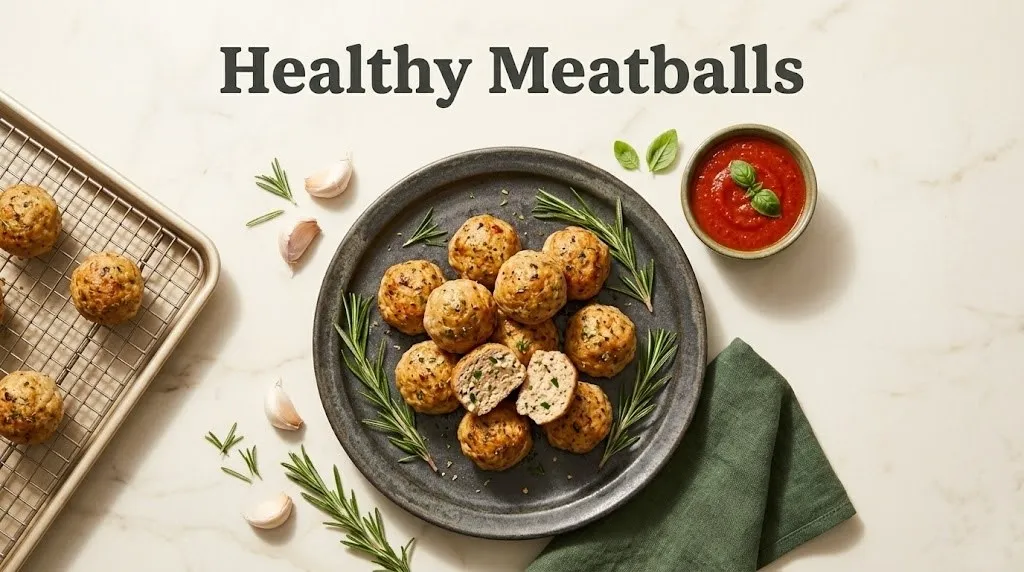
Healthy Meatballs
A healthy meatball is a re-engineered protein sphere that prioritizes lean ground poultry, a properly hydrated starch binder, and a dry-heat cooking method that avoids frying, all while delivering a complete amino acid profile for roughly half the saturated fat of a traditional beef-pork blend. The health of a meatball is not determined by a single ingredient. It is the ratio of protein to saturated fat and the absence of a deep-fried oil crust.
The traditional meatball formula is roughly 50 percent ground beef, 50 percent ground pork, egg, breadcrumbs soaked in whole milk, and a pile of Parmesan and Pecorino. That blend yields a meatball that is undeniably juicy but carries 4 to 6 grams of saturated fat per three-ounce serving. A meatball built from 93/7 lean ground turkey (Meleagris gallopavo) drops the saturated fat to 1.5 to 2 grams for the same size serving, while keeping the protein count nearly identical.
The binder is the hidden health leverage point. A panade, a paste made from whole-wheat panko breadcrumbs and a small amount of milk, is not filler. It is a functional food-science tool. The starch granules in the breadcrumbs absorb liquid and swell during cooking, physically trapping moisture inside the contracting meat proteins. Without the panade, the protein strands tighten and squeeze out water. With the panade, you get a tender meatball without adding lard or butter.
You can also use vegetables as a partial binder and extender. Finely grated zucchini (Cucurbita pepo) or chopped spinach (Spinacia oleracea) adds volume, water, and potassium without adding any saturated fat. A half-cup of grated zucchini folded into a pound of ground turkey adds less than 10 calories but holds an additional two tablespoons of moisture inside the meatball during cooking.
Are Turkey Meatballs Healthy
Yes, turkey meatballs are a genuinely healthy protein choice because they provide the same complete amino acid profile as red meat meatballs but with roughly 60 to 70 percent less saturated fat and a comparable amount of iron and zinc when made from dark meat turkey. The health profile splits depending on the specific turkey blend you buy.
The fat content of ground turkey ranges from 99 percent fat-free breast meat to 85/15 dark meat blends. The 99 percent lean breast meat yields a meatball that is almost pure protein, clocking in at roughly 26 grams of protein and only 1.5 grams of fat per 4-ounce serving. The downside is textural. Straight breast meat, without a panade, will be dry and crumbly. The 93/7 blend is the sweet spot for a healthy turkey meatball. It has just enough intramuscular fat to keep the meatball tender and flavorful while still being classified as a lean protein by FDA labeling standards.
The micronutrient comparison holds up well. According to the USDA FoodData Central, a 4-ounce serving of 93/7 ground turkey provides roughly 1.5 milligrams of iron, 3.5 milligrams of zinc, and 25 micrograms of selenium. A comparable beef meatball provides more iron but less selenium. For a person managing their saturated fat budget, the turkey meatball is the objectively better cardiovascular choice.
The one caution with turkey meatballs is the food safety standard. Ground turkey must be cooked to an internal temperature of 165 degrees Fahrenheit to eliminate Salmonella and Campylobacter. Ground beef can be safely pulled at 160 degrees Fahrenheit. The extra 5 degrees makes the panade technique even more necessary, because the meat will spend more time at a higher temperature, increasing the risk of moisture loss.
| Meatball Type (4 oz serving) | Calories | Protein (g) | Saturated Fat (g) | Iron (mg) |
|---|---|---|---|---|
| 93/7 Turkey | 180 | 26 | 1.5 | 1.5 |
| 92/8 Chicken | 190 | 25 | 1.8 | 1.2 |
| 90/10 Beef | 240 | 24 | 4.5 | 2.5 |
| Beef-Pork Blend (50/50) | 290 | 22 | 7.0 | 2.0 |
Healthy Meatballs for Weight Loss
Healthy meatballs support weight loss because they provide a high-protein, high-volume, portion-controlled protein unit that triggers satiety hormones and allows you to eat a satisfying meal for under 400 calories when paired with a vegetable and a light sauce. The weight loss mechanism is physical and hormonal, not magical.
A standard serving of four turkey meatballs delivers roughly 28 grams of protein. That protein dose stimulates the release of cholecystokinin, a gut hormone that signals the brain to stop eating. It also has a high thermic effect. About 20 to 30 percent of the calories in that protein are burned during digestion itself. You are effectively consuming fewer net calories than the label states.
The portion control is built into the meatball format. A meatball is a pre-portioned protein unit. You scoop them with a specific-size disher, and you know exactly how many grams of protein each sphere contains. When you are tracking macros for weight loss, this predictability is a practical advantage over slicing a chicken breast and guessing the weight on the fork.
The key to keeping the weight-loss benefit intact is avoiding the calorie-dense toppings that erase the deficit. A half-cup of Rao’s Homemade Marinara adds 90 calories. A half-cup of a standard Alfredo adds 240 calories and 20 grams of fat. The sauce choice is the fork in the road between a weight-loss meal and a maintenance meal.
Healthy Meatballs with Ground Chicken
Healthy meatballs made with ground chicken (Gallus gallus domesticus) are structurally similar to turkey meatballs and offer a slightly milder flavor and a finer texture that works particularly well in Asian-flavored meatball recipes, such as chicken meatball pho or teriyaki-glazed meatballs. The macronutrient profile is nearly identical to 93/7 turkey.
Ground chicken is often available in a 92/8 lean-to-fat ratio at most grocery stores. This is slightly fattier than the leanest turkey but still well within the lean protein category. The flavor is more neutral than turkey, which means it takes well to aggressive seasoning. Chicken meatballs with ginger, scallions, garlic, and a splash of coconut aminos taste like a completely different dish from the Italian-style turkey meatball, even though the base nutrition is the same.
The texture of ground chicken is finer and softer than ground turkey. The muscle fibers are shorter and less dense, so the raw mixture feels stickier and more paste-like. This is an advantage for meatball formation because the mixture binds to itself more readily without needing as much egg or binder. The sticky myosin protein that releases during mixing acts as a natural glue.
A chicken meatball is an excellent vehicle for finely minced vegetables. Grated carrot, minced water chestnut, and finely chopped shiitake mushrooms can replace up to 25 percent of the meat volume without the meatball falling apart. This vegetable extension further reduces the calorie density and adds soluble fiber, which blunts the post-meal glucose response.
Key Takeaway: The health of your meatball is determined by the protein you select and the panade you build. A 93/7 turkey or 92/8 chicken meatball with a properly hydrated starch binder cuts saturated fat by more than half while keeping the protein nearly identical to beef.
Low Carb Healthy Meatballs
Low-carb healthy meatballs replace traditional breadcrumb binders with almond flour, crushed pork rinds, or finely grated hard cheese to keep the meatball structurally sound while dropping the carbohydrate content to under 2 grams per serving. The binder swap is the entire strategy.
A standard meatball made with a quarter-cup of panko breadcrumbs contains roughly 10 to 12 grams of carbohydrates per serving from the starch. For someone following a standard ketogenic diet with a 20 to 30 gram daily carb limit, those breadcrumbs consume half the day’s allowance in four meatballs. The binder must be replaced with a zero-carb alternative that performs the same moisture-trapping function.
Almond flour is the most reliable low-carb binder. It is composed of finely ground blanched almonds, which are mostly fat and fiber with very little digestible carbohydrate. A quarter-cup of almond flour contains roughly 3 grams of net carbs, compared to 20 grams in the same volume of panko. Almond flour does not absorb liquid as efficiently as wheat starch, so you need to use half the amount and add an extra egg yolk to compensate for the lost binding power.
Pork panko, which is crushed pork rinds, is a zero-carb binder that works brilliantly. It mimics the texture of breadcrumbs almost perfectly, absorbs liquid well, and adds a subtle savory flavor that complements the meat. The trade-off is that it adds saturated fat and sodium. If you are already managing a high-sodium intake from other sources, almond flour is the cleaner choice.
Healthy Meatballs No Breadcrumbs
Making healthy meatballs without breadcrumbs relies on either a dairy-based binder like ricotta or Parmesan, or a vegetable-based binder like cooked quinoa or cauliflower rice, which provides the starch or fiber matrix necessary to physically interrupt the meat proteins and trap steam. The breadcrumb is not just filler. It is a structural spacer.
When you mix ground meat with salt, the myosin proteins begin to cross-link and form a dense, springy network. If you roll that pure meat paste into a ball and cook it, the proteins contract into a tight, rubbery mass. The breadcrumbs physically separate the protein strands, creating tiny pockets where steam collects during cooking. Those steam pockets are what you perceive as tenderness and juiciness.
If you are avoiding breadcrumbs entirely, you must find another spacer. Ricotta cheese is an excellent Italian-compatible alternative. A quarter-cup of full-fat ricotta mixed into a pound of ground turkey adds moisture, fat, and a creamy texture without any gluten or starch. The whey proteins in the ricotta also denature and set during cooking, helping the meatball hold its shape.
Cooked and cooled quinoa is a whole-food, gluten-free binder that adds fiber, protein, and a subtle nutty flavor. A half-cup of cooled quinoa folded into the meat mixture provides the same physical spacing as breadcrumbs, plus an extra 4 grams of protein and 3 grams of fiber. The meatball will be slightly softer and more delicate, so baking on a wire rack is recommended over pan-frying.
Healthy Meatball Recipe Baked
Baking healthy meatballs on a wire rack set over a sheet pan is the healthiest cooking method because it allows the rendered fat to drip away from the meat, creates an all-over Maillard crust without any added oil, and eliminates the mess and hazard of pan-frying. The oven does the work.
The baking temperature is critical. You need 400 degrees Fahrenheit for a convection oven or 425 degrees Fahrenheit for a conventional oven. This high initial heat sets the exterior crust quickly, trapping the moisture inside. If you bake at 350 degrees Fahrenheit, the meatball slowly warms through and releases its juices before the crust forms, resulting in a dry, pale sphere.
A wire rack is non-negotiable for this method. Place the rack over a rimmed baking sheet lined with foil for easy cleanup. The rack elevates the meatballs, allowing the hot air to circulate completely around them. The bottom of the meatball cooks via convection, not by sitting in its own rendered fat. The result is a uniformly browned, firm meatball with a slightly crisp exterior and a juicy interior.
Portion the meatballs using a 2-tablespoon disher scoop. This ensures uniform size, which means uniform cooking. A 2-tablespoon scoop yields roughly a 1.5-ounce raw meatball. Baked at 400 degrees Fahrenheit, the meatball reaches the safe internal temperature in 14 to 16 minutes. You do not need to flip them. The wire rack does the work on both sides simultaneously.
The 2026 Baked Turkey Meatball Recipe:
- Preheat the oven to 400 degrees Fahrenheit. Set a wire rack over a foil-lined baking sheet.
- Make the panade: In a large bowl, combine 1/2 cup whole-wheat panko breadcrumbs with 3 tablespoons milk. Let it sit for 5 minutes to hydrate fully.
- Add to the panade bowl: 1 large egg, 1/4 cup finely grated Parmesan cheese, 2 tablespoons finely chopped fresh parsley, 1 teaspoon garlic powder, 1/2 teaspoon kosher salt, and 1/4 teaspoon black pepper. Whisk into a slurry.
- Add 1.5 pounds of 93/7 lean ground turkey. Mix gently with your hands until just combined. Do not overwork the meat.
- Using a 2-tablespoon disher scoop, portion the meatballs onto the wire rack. You should yield 24 meatballs.
- Bake for 14 to 16 minutes, or until an instant-read thermometer inserted into the center of a meatball registers 165 degrees Fahrenheit.
- Rest for 3 minutes, then serve or cool for meal prep.
Healthy Meatballs Air Fryer
An air fryer produces the crispiest exterior on a healthy meatball with the least amount of effort, because the intense, concentrated convection heat of the air fryer basket browns the surface faster than a standard oven, sealing in juices before the center overcooks. The air fryer is a countertop convection oven optimized for small batches.
The cooking temperature should be set to 375 degrees Fahrenheit. Unlike the oven method, the air fryer’s fan is closer to the food and circulates air more violently. A 400-degree Fahrenheit setting on some air fryer models will burn the exterior of the meatball before the center reaches a safe temperature. Start at 375 degrees Fahrenheit and adjust based on your specific appliance’s behavior.
You must leave space between the meatballs in the air fryer basket. The basket should not be crowded. If the meatballs touch, the contact points will steam instead of brown. A standard 5-quart air fryer basket fits roughly 10 to 12 meatballs comfortably. Cook in two batches if you are making a full recipe.
The air fryer does not require a wire rack because the basket itself is perforated. The fat drips down into the bottom chamber, away from the meatball. This is exactly what you want for a healthy meatball. Cook for 10 to 12 minutes, shaking the basket once at the 6-minute mark to rotate the meatballs. Check the internal temperature before serving.
How to Keep Turkey Meatballs from Drying Out
Keeping turkey meatballs from drying out requires a properly hydrated panade, a gentle mixing technique that prevents overworking the meat proteins, and an absolute refusal to overcook them beyond the 165-degree Fahrenheit internal temperature mark. The dryness is a protein problem, not a fat problem.
The panade is the moisture insurance policy. The starch granules in the breadcrumbs absorb liquid and swell. When the meatball cooks, the starch gelatinizes, turning into a soft gel that physically separates the contracting meat fibers. This gel holds water that would otherwise be squeezed out. The panade must be fully hydrated before it enters the meat mixture. If you add dry breadcrumbs and milk separately to the meat, the breadcrumbs will pull moisture directly out of the turkey and never form the protective gel.
The mixing method is the second critical step. Overmixing ground turkey turns it into a dense, rubbery paste. The salt and the mechanical action extract the myosin protein from the muscle cells. Myosin is a sticky, glue-like protein that cross-links into a tight network when cooked. You want just enough myosin to bind the meatball, not so much that it turns into a bouncy ball. Mix the seasoning and the panade into the meat until just combined, roughly 30 seconds of gentle folding.
The final step is carrying over the cooking. Pull the meatballs from the oven or air fryer when the internal thermometer reads 160 to 162 degrees Fahrenheit. The residual heat inside the meatball will coast the temperature up to the safe 165 degrees Fahrenheit mark during the 3-minute rest. If you wait until 165 in the oven, the carryover will push the meatball to 170 or higher, and the moisture will be gone.
Ground Turkey Internal Temperature Meatballs
According to the USDA Food Safety and Inspection Service, all ground poultry products, including turkey meatballs, must be cooked to a minimum internal temperature of 165 degrees Fahrenheit to instantly kill Salmonella, Campylobacter, and other pathogenic bacteria. This temperature is non-negotiable for food safety. An instant-read probe thermometer inserted into the center of the largest meatball is the only reliable way to verify this temperature.
The visual indicators of doneness are unreliable. Ground turkey can appear fully cooked and have no pink color while still being under the safety threshold. The opposite is also true. A meatball can retain a slight pink hue from the myoglobin in the thigh meat and still be safely above 165 degrees Fahrenheit. Color is chemistry. Temperature is safety. Trust the thermometer, not your eyes.
The thermometer probe must be inserted into the thermal center of the meatball, which is the geometric midpoint. If you touch the probe to the pan or the wire rack, you will get a falsely high reading. If you measure the outside edge, you will get a falsely low reading. Insert the probe horizontally into the side of the meatball until the tip sits in the exact center.
For meal prep, you must also manage the cooling safety curve. Cooked meatballs must be cooled from 140 degrees Fahrenheit to 70 degrees Fahrenheit within 2 hours, and then from 70 to 40 degrees Fahrenheit within an additional 4 hours. This means you should spread the cooked meatballs out on a plate, not stack them in a deep container, when cooling them for the refrigerator or freezer.
Healthy Meatballs Meal Prep
A healthy meatball meal prep session produces 24 fully cooked, portioned protein units in under 40 minutes, which can be frozen flat on a sheet tray and then bagged for individual use over the next three months. The meatball is the ideal meal-prep protein because it freezes without texture degradation.
The workflow is the key. You start by mixing and baking the meatballs as a single batch. While they are in the oven, you prepare your sauce, cook your vegetable side, and pull out your portioning containers. When the meatballs come out of the oven, you let them cool on the wire rack for exactly 10 minutes, then immediately portion them into the containers while they are still slightly warm but safe to handle.
Freezing the meatballs properly is what makes the system work. Lay the cooked, cooled meatballs on a parchment-lined baking sheet in a single layer, not touching. Place the sheet in the freezer for 2 hours until the meatballs are rock hard. Then transfer them to a labeled gallon freezer bag. This flash-freeze method prevents the meatballs from sticking together into a solid block, so you can pull out exactly four meatballs for a Wednesday dinner without thawing the entire batch.
Reheat the frozen meatballs directly in simmering marinara sauce for 6 to 8 minutes, or in the microwave on a microwave-safe plate with a damp paper towel draped over them for 90 seconds. The damp towel creates a steam environment that prevents the meatball from turning into a dry, chewy lump.
Meal Prep Container Blueprint:
- Protein: 4 turkey meatballs (roughly 28g protein).
- Sauce: 1/2 cup low-sodium marinara, spooned into the container alongside the meatballs.
- Vegetable: 1 cup steamed green beans or roasted broccoli.
- Carb (optional): 1/2 cup cooked whole-wheat spaghetti or spaghetti squash.
- Storage: 4 days refrigerated, 3 months frozen.
Key Takeaway: The safest, juiciest turkey meatball is pulled from the heat at 162 degrees Fahrenheit and rested until it hits 165, and the most efficient way to eat healthy all week is to freeze a batch of 24 on a Sunday and pull portions as you need them.
Best Sauce for Healthy Meatballs
The best sauce for healthy meatballs is a low-sodium, no-sugar-added marinara, such as Rao’s Homemade Marinara, which delivers the acidity and herbal depth to complement the poultry without adding 500 milligrams of sodium and 12 grams of added sugar to the bowl. The sauce is where the health profile of the meal lives or dies.
Standard jarred marinara sauces are a nutritional minefield. Many popular brands contain 400 to 600 milligrams of sodium per half-cup serving and 8 to 12 grams of added sugar. That sugar is not from the tomatoes. It is added cane sugar or high-fructose corn syrup used to balance the acid. A plate of healthy turkey meatballs drowned in a sugary sauce is no longer a health food.
Rao’s Homemade Marinara is the gold standard in the 2026 grocery aisle because it contains no added sugar, no tomato paste filler, and a relatively modest 340 milligrams of sodium per half-cup. The ingredient list is recognizable: Italian tomatoes, olive oil, onions, garlic, basil, salt. That is it. You can also look for no-salt-added crushed tomatoes and make a quick 10-minute sauce by simmering them with garlic, dried oregano, and a splash of good olive oil.
For a non-Italian option, a coconut aminos and ginger glaze works beautifully with chicken or turkey meatballs. Coconut aminos are a low-sodium, slightly sweet alternative to soy sauce. Whisk together coconut aminos, grated fresh ginger, a splash of rice vinegar, and a teaspoon of toasted sesame oil. Brush this glaze on the meatballs during the last 3 minutes of baking for an Asian-inspired flavor.
Frequently Asked Questions About Healthy Meatballs
Can I use ground beef for healthy meatballs?
Yes, you can use ground beef for healthy meatballs if you choose a 90/10 or leaner blend and focus on portion control.
A 90/10 beef meatball still contains more saturated fat than a 93/7 turkey meatball, roughly 4.5 grams versus 1.5 grams per serving.
The beef meatball provides more heme iron, so if you have a clinical iron deficiency, the trade-off may be medically appropriate.
Are frozen meatballs healthy?
Most commercially frozen meatballs are not healthy because they are made from a beef-pork blend, contain soy protein concentrate as a cheap filler, and pack 500 to 700 milligrams of sodium per serving.
Look specifically for frozen turkey meatballs with a recognizable ingredient list and a sodium content under 400 milligrams per serving.
Homemade frozen meatballs, where you control the salt and the binder, are always the healthier option.
How many calories are in a healthy turkey meatball?
A single 1.5-ounce baked turkey meatball made from 93/7 lean ground turkey contains approximately 55 to 65 calories.
A standard serving of four meatballs clocks in around 220 to 260 calories before sauce.
The exact count depends on the amount of Parmesan and the specific panade ingredients used.
Why are my turkey meatballs rubbery?
Your turkey meatballs are rubbery because you overmixed the meat, causing excessive myosin cross-linking that created a dense, bouncy protein network.
You may also have omitted the panade, which means the meat proteins contracted without any starch spacer to trap moisture.
Mix the meatball ingredients just until combined, no more than 30 to 45 seconds of gentle folding.
Can I freeze healthy meatballs after cooking?
Yes, healthy meatballs freeze beautifully after cooking if you freeze them in a single layer on a sheet tray first, then transfer them to a sealed bag.
This flash-freeze method prevents them from sticking together into a solid block.
Frozen meatballs can be reheated directly in simmering sauce for 6 to 8 minutes without thawing.
A healthy meatball is not a compromise. It is a deliberate construction project where lean protein, a well-hydrated panade, and an accurate thermometer do more work than a quarter-cup of rendered pork fat ever could.
Make a batch of 24 this Sunday. Use the wire rack. Check the internal temperature at 160 degrees Fahrenheit and let them coast to safety on the counter. Portion them into containers with Rao’s marinara and a pile of steamed green beans.
You will have a fridge full of high-protein, portion-controlled meals that taste like a Friday night spaghetti dinner but work like a Tuesday afternoon weight-loss strategy. That is the real promise of a healthy meatball. You eat the comfort food and the macronutrient math takes care of the rest.