Provolone cheese is a reasonably healthy food when eaten in appropriate portions, offering solid protein, bone-supporting calcium, and key vitamins in every one-ounce serving. Like most full-fat cheeses, it carries notable amounts of saturated fat and sodium, which makes portion awareness genuinely important rather than optional.
The USDA reports that dairy foods, including cheese, contribute a meaningful share of calcium, phosphorus, and vitamin B12 to the average American diet. For many adults, cheese is one of the few everyday foods that reliably delivers these nutrients in one bite.
This article covers provolone’s full nutritional profile, how it compares to similar cheeses, what the research actually says about its fats, and which specific health conditions call for closer attention to how much you eat.
Is Provolone Cheese Healthy?
Provolone cheese is a healthy choice for most people when eaten in standard serving sizes of one to two ounces at a time. It delivers meaningful protein, calcium, phosphorus, and B vitamins without an excessive calorie cost per serving.
The bigger picture is portion size. One ounce of provolone provides about 98 calories, 7.2 grams of protein, and roughly 21% of the daily value for calcium. Those are real nutritional contributions. Eat four ounces in one sitting, however, and you’re looking at close to 400 calories and over 900 milligrams of sodium before the rest of your meal.
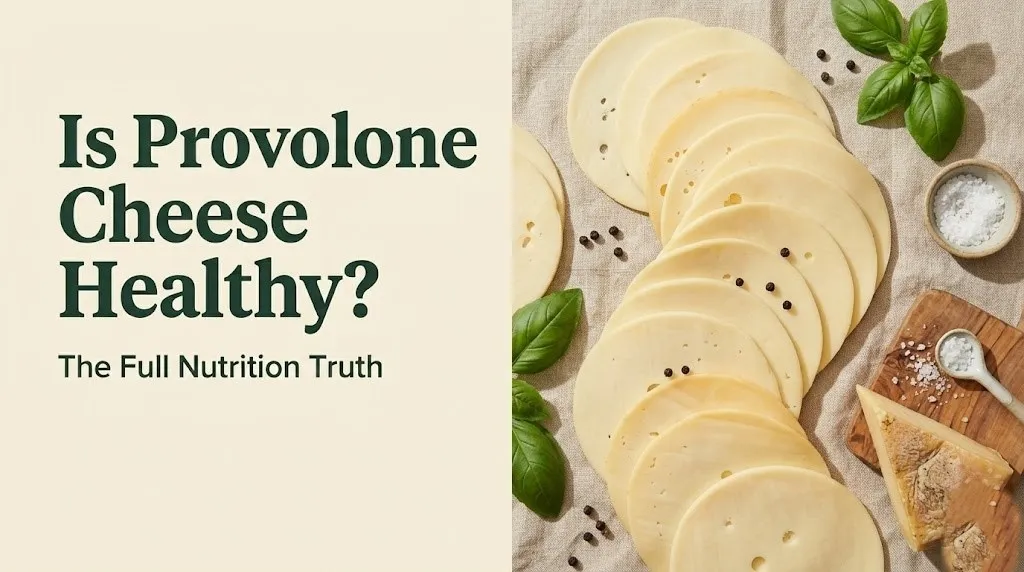
Provolone is an Italian semi-hard cheese made from cow’s milk. It has a smooth, slightly elastic texture and a flavor that ranges from mild and buttery in its younger form to sharp and pungent when aged. Most of what you find on American deli counters is the younger, milder style.
The question of whether provolone is healthy doesn’t have a single yes or no answer. It depends on how much you eat, how often you eat it, what else is in your diet, and whether you have specific health conditions like hypertension or high LDL cholesterol that require closer attention to saturated fat and sodium.
Key points about provolone in a balanced diet:
- One ounce is a nutritionally efficient source of protein and calcium
- Regular moderate intake fits within the USDA Dietary Guidelines’ recommendation of three servings of dairy per day
- People without cardiovascular or kidney concerns can include provolone regularly without risk
- Portion creep is the main practical issue, not the cheese itself
Provolone Cheese Nutrition Facts
Per one-ounce (28-gram) serving, provolone cheese delivers a concentrated package of protein, fat, and key micronutrients.
According to USDA FoodData Central, a standard one-ounce serving of provolone cheese contains:
| Nutrient | Amount per 1 oz (28g) | % Daily Value |
|---|---|---|
| Calories | 98 kcal | 5% |
| Total Fat | 7.5g | 10% |
| Saturated Fat | 4.8g | 24% |
| Protein | 7.2g | 14% |
| Carbohydrates | 0.6g | 0% |
| Sodium | 248mg | 11% |
| Calcium | 214mg | 21% |
| Phosphorus | 141mg | 11% |
| Vitamin B12 | 0.4mcg | 17% |
| Vitamin A | 75mcg RAE | 8% |
| Zinc | 0.9mg | 8% |
These figures represent a standard deli-style provolone. Aged provolone (piccante) will have somewhat higher sodium and fat concentrations because moisture loss during aging concentrates both.
No meaningful carbohydrates means the lactose has been largely broken down during the cheese-making and aging process. This makes provolone a workable option for people who are mildly lactose sensitive, though it doesn’t make it lactose-free.
One other note: provolone contains casein, the primary milk protein. People with a diagnosed milk protein allergy should avoid it regardless of lactose tolerance.
Provolone Cheese Calories Per Slice
A typical deli slice of provolone cheese weighs approximately 21 to 28 grams, putting its calorie range at roughly 80 to 100 calories per slice.
Thicker deli cuts and full rounds sliced at home can easily reach 1.5 to 2 ounces per slice, which raises the calorie count to 147 to 196 calories before any other ingredients. That’s a meaningful difference if you’re adding two or three slices to a hot sandwich.
| Serving Size | Weight | Approximate Calories |
|---|---|---|
| Thin deli slice | 21g (0.75 oz) | 73 kcal |
| Standard deli slice | 28g (1 oz) | 98 kcal |
| Thick-cut slice | 42g (1.5 oz) | 147 kcal |
| Two standard slices | 56g (2 oz) | 196 kcal |
| Quarter-cup shredded | 28g (1 oz) | 98 kcal |
Think of a provolone slice the way you’d think about olive oil. Both are genuinely nutritious. Both also add up quickly if you’re not measuring with any intention. A tablespoon of olive oil and a slice of provolone are calorie-dense in similar proportions, and neither is a problem at normal serving sizes.
For calorie-conscious eaters, one standard deli slice on a sandwich contributes less than 100 calories while adding almost 30% of the protein in a two-egg breakfast. That’s a solid caloric trade-off.
Quick Tip:
- Ask for slices at the 0.75-oz setting at the deli counter to keep portion size naturally controlled
- Shredding provolone rather than slicing it lets you use less while covering more surface area on a dish
- Pre-portioning into one-ounce servings when cooking reduces unintentional overuse
Key Takeaway: Provolone cheese is a nutritionally dense food with meaningful protein and calcium per serving. Its calories, saturated fat, and sodium all scale directly with portion size, making serving awareness the single most useful habit when eating it regularly.
Provolone Cheese Protein Content
Provolone cheese contains approximately 7.2 grams of protein per one-ounce serving, making it one of the more protein-efficient cheeses in the deli case.
That protein is primarily casein, a slow-digesting milk protein. Casein releases amino acids gradually over several hours after eating, which is why dairy proteins are sometimes associated with longer satiety compared to faster-digesting proteins like whey. The Academy of Nutrition and Dietetics recognizes dairy protein as a high-quality complete protein source, meaning it contains all nine essential amino acids.
For context, one ounce of provolone delivers roughly the same protein as one large egg (about 6 grams), and slightly more than one ounce of most lunch meats. It’s not a high-volume protein source the way chicken breast or legumes are, but it contributes meaningfully to daily protein goals without requiring a large calorie spend.
| Protein Source | Protein per 1 oz | Calories per 1 oz |
|---|---|---|
| Provolone cheese | 7.2g | 98 kcal |
| Cheddar cheese | 7.0g | 114 kcal |
| Mozzarella (part-skim) | 6.3g | 72 kcal |
| Large egg (1 whole) | 6.3g per egg | 72 kcal per egg |
| Chicken breast (cooked) | 8.8g | 47 kcal |
For vegetarians who eat dairy, provolone is a practical protein contributor. Two one-ounce servings across a day provide about 14 grams of complete protein, which can support a balanced plant-forward diet that includes dairy.
People following a high-protein eating pattern can include provolone as a between-meal protein snack without significantly disrupting calorie targets, as long as portions stay at one to two ounces at a time.
Provolone Cheese Calcium and Bone Health
Provolone cheese provides approximately 214 milligrams of calcium per ounce, covering about 21% of the daily value for most adults based on a 1,000 mg reference intake from the NIH Office of Dietary Supplements.
Calcium is the primary mineral in bone tissue, and adequate intake over time is directly associated with maintaining bone mineral density. The NIH reports that most Americans fall short of recommended daily calcium intake, making dairy foods like provolone a practical gap-filler for people who eat them regularly.
Provolone also contains phosphorus (approximately 141mg per oz), which works alongside calcium in bone formation and maintenance. This pairing matters. Calcium absorption and bone metabolism depend on adequate phosphorus and vitamin D acting together. Getting calcium and phosphorus from a single food source like provolone makes the combination convenient.
A 2022 review published in Nutrients found that regular consumption of dairy foods was associated with improved bone mineral density in adults over 50, particularly when dairy intake was part of a broader diet that included adequate vitamin D. Provolone’s calcium contribution is relevant here, though no single food works in isolation.
One practical note: calcium from dairy sources (like provolone) is generally well absorbed, with bioavailability estimated at around 30 to 32% according to NIH data. That makes it one of the more efficient dietary calcium sources available, compared to some plant-based forms like spinach which contain oxalates that reduce absorption.
For people managing osteoporosis risk or building bone density in their 30s and 40s, provolone is a realistic daily contributor. Adults managing hypercalcemia or kidney stones with a calcium oxalate history should speak with a nephrologist or registered dietitian before increasing dairy intake, as individual calcium needs and tolerances vary considerably.
Provolone Cheese Sodium Content
One ounce of provolone cheese contains approximately 248 milligrams of sodium, which is moderate for a natural cheese but can add up quickly across a day.
The American Heart Association recommends limiting sodium intake to no more than 2,300 milligrams per day for most adults, and ideally closer to 1,500 milligrams for people with high blood pressure or cardiovascular disease risk. Two ounces of provolone on a sandwich already contributes close to 500 milligrams, or roughly 22% of the AHA’s recommended upper limit.
| Cheese Type | Sodium per 1 oz |
|---|---|
| Provolone | 248mg |
| Cheddar | 176mg |
| Part-skim mozzarella | 175mg |
| Swiss cheese | 54mg |
| Parmesan (grated) | 454mg |
| American processed cheese | 406mg |
Provolone sits in the mid-range for sodium among popular cheeses. It’s substantially higher than Swiss and mozzarella, but considerably lower than Parmesan or processed American cheese slices.
The sodium concern isn’t about a single serving being dangerous. It’s about the cumulative effect when provolone is layered onto other naturally salty foods: cured meats, bread, condiments, soups. A deli-style sandwich with provolone, salami, mustard, and pickles can easily reach 1,200 to 1,500 milligrams of sodium in one meal. That’s before dinner.
Quick Tip:
- Pairing provolone with low-sodium bread and fresh vegetables keeps the meal’s total sodium in a reasonable range
- Swiss cheese is a practical lower-sodium swap when sodium management is a priority
- Checking the specific brand’s nutrition label matters; sodium content in provolone can vary by 30 to 50mg per ounce between producers
Key Takeaway: Provolone’s sodium content is meaningful but not extreme compared to other cheeses. The real risk comes from stacking it with other high-sodium ingredients, which is where daily totals climb past recommended limits without obvious single-food culprit.
Provolone Cheese Saturated Fat and Heart Health
Provolone cheese contains approximately 4.8 grams of saturated fat per one-ounce serving, which represents 24% of the daily value based on a 2,000-calorie diet reference.
The USDA Dietary Guidelines for Americans 2020-2025 recommend keeping saturated fat intake below 10% of total daily calories, which translates to fewer than 22 grams per day on a 2,000-calorie diet. Two ounces of provolone provides about 9.6 grams of saturated fat, or roughly 44% of that cap before anything else in the day.
The conversation around saturated fat in dairy has shifted considerably over the past decade. Harvard T.H. Chan School of Public Health researchers and multiple large cohort studies have found that the relationship between dairy-sourced saturated fat and cardiovascular outcomes is more nuanced than earlier guidance suggested. The fats in cheese don’t behave identically to the saturated fats in, say, processed red meat.
Provolone, like other aged cheeses, contains conjugated linoleic acid (CLA), a naturally occurring fatty acid found in dairy fat from ruminant animals. Research published in the American Journal of Clinical Nutrition has suggested CLA may have potential metabolic and immune-modulating properties, though the evidence base is still developing and current intake levels from normal cheese consumption are far below the doses studied in clinical trials.
This doesn’t make provolone’s saturated fat content irrelevant. For people who already have elevated LDL cholesterol or established cardiovascular disease, keeping saturated fat intake controlled remains the guidance from the American Heart Association, and provolone should be eaten in measured portions accordingly. For people without those risk factors and eating a generally balanced diet, two ounces of provolone daily is unlikely to be the factor that drives cardiovascular risk.
Provolone Cheese Vitamins and Minerals
Provolone cheese is a meaningful source of several vitamins and minerals beyond calcium, with vitamin B12, riboflavin (vitamin B2), vitamin A, zinc, and selenium all present in measurable amounts.
Vitamin B12 (cobalamin) stands out. One ounce of provolone provides approximately 0.4 micrograms, covering about 17% of the daily value set by the NIH. B12 is essential for neurological function and red blood cell production, and it’s found almost exclusively in animal-sourced foods. For people who eat dairy but not meat, provolone is a practical B12 contributor.
| Vitamin/Mineral | Amount per 1 oz | % Daily Value |
|---|---|---|
| Vitamin B12 | 0.4mcg | 17% |
| Riboflavin (B2) | 0.09mg | 7% |
| Vitamin A (RAE) | 75mcg | 8% |
| Vitamin K2 (est.) | 2-4mcg | varies |
| Zinc | 0.9mg | 8% |
| Selenium | 4.5mcg | 8% |
| Phosphorus | 141mg | 11% |
Vitamin K2 (menaquinone-4) is present in aged dairy fats at low but measurable levels. K2 plays a role in directing calcium into bones and teeth rather than soft tissues, according to emerging research reviewed in the British Journal of Nutrition. The amounts in a single ounce of provolone are modest, but regular consumption across a varied dairy-inclusive diet may contribute to the overall K2 intake.
Selenium and zinc both support immune function. Neither is present in large quantities per ounce, but they contribute to daily totals in people eating provolone regularly as part of a varied diet.
For people following vegetarian diets that include dairy (lacto-vegetarians), provolone covers several nutrients that can be difficult to source without meat, particularly B12, zinc, and selenium.
Dolce vs Piccante Provolone: What’s the Difference?
Dolce provolone is the mild, young style aged for two to three months, while piccante provolone is the sharp, aged style that can be cured for anywhere from three months to over a year.
This distinction matters nutritionally. Moisture loss during extended aging concentrates every nutrient in the cheese, including fat, protein, sodium, and calories, per gram. A one-ounce serving of piccante provolone will have a slightly higher fat and sodium content than the same weight of dolce provolone, because less water remains in the structure.
| Characteristic | Dolce (Young) | Piccante (Aged) |
|---|---|---|
| Aging period | 2-3 months | 3 months to 1+ year |
| Flavor | Mild, buttery, smooth | Sharp, pungent, complex |
| Texture | Soft, pliable | Firmer, drier |
| Fat per oz (approx.) | 7.5g | 8-9g |
| Sodium per oz (approx.) | 245-250mg | 260-290mg |
| Best culinary use | Melting, sandwiches | Grating, cheese boards |
The original Provolone Valpadana, a protected designation of origin (PDO) product from the Po Valley region of northern Italy, comes in both dolce and piccante styles under strict production guidelines. Most provolone sold at American deli counters is a dolce-style product made domestically.
From a health standpoint, neither style is dramatically better or worse. The differences in fat and sodium per ounce are small enough that choosing between them on nutritional grounds alone doesn’t make practical sense. Choose based on flavor preference and culinary use, then manage portion size.
Key Takeaway: Dolce and piccante provolone differ in flavor intensity and aging time, with piccante having slightly more concentrated fat and sodium per ounce. The gap is modest, and portion size matters far more than which style you choose.
Provolone vs Mozzarella and Cheddar
Provolone occupies a middle ground nutritionally between lower-fat mozzarella and higher-calorie cheddar, making it a reasonable everyday cheese choice that doesn’t require compromise on flavor.
Part-skim mozzarella is the lighter option, with roughly 72 calories, 4.5g fat, and 175mg sodium per ounce. Its melt properties are similar to provolone, which makes it the obvious lower-calorie swap on pizzas and hot sandwiches. The trade-off is less flavor depth and slightly less protein per ounce.
Cheddar runs higher in calories and fat, with approximately 114 calories and 7g fat per ounce, plus saturated fat content that matches or exceeds provolone. It’s also lower in sodium than provolone in its natural form.
| Cheese | Cal/oz | Fat/oz | Sat Fat/oz | Protein/oz | Sodium/oz | Calcium/oz |
|---|---|---|---|---|---|---|
| Provolone | 98 | 7.5g | 4.8g | 7.2g | 248mg | 214mg |
| Part-skim mozzarella | 72 | 4.5g | 2.9g | 6.3g | 175mg | 183mg |
| Cheddar | 114 | 9.4g | 5.9g | 7.0g | 176mg | 204mg |
| Swiss | 108 | 7.9g | 5.0g | 7.6g | 54mg | 221mg |
| Gouda | 101 | 7.8g | 5.0g | 7.1g | 232mg | 198mg |
Swiss cheese is worth highlighting for comparison. It offers comparable protein and calcium to provolone but with dramatically lower sodium (54mg per oz versus 248mg). For people managing blood pressure who still want a full-flavored hard cheese, Swiss is the better choice on that specific metric.
Provolone’s advantage over cheddar is lower calories and fat per ounce. Its advantage over part-skim mozzarella is richer flavor, which often means using less of it to feel satisfied. That’s a real practical benefit: stronger-flavored cheeses tend to be used more sparingly, which naturally controls portion size without active restriction.
Provolone Cheese for Weight Loss
Provolone cheese can fit into a weight-loss eating plan when portions are controlled, typically at one ounce per meal occasion.
At roughly 98 calories per ounce, provolone is calorie-dense relative to its volume but protein-rich relative to its calorie count. Protein supports satiety by triggering the release of fullness-signaling hormones, and the 7.2 grams of protein in a one-ounce serving contribute meaningfully to that response. A 2019 review in Advances in Nutrition found that higher-protein meals consistently produced greater satiety and reduced subsequent calorie intake compared to lower-protein equivalents.
The case for provolone in a weight-loss context is not that it’s a low-calorie food, because it isn’t. The case is that one ounce added to a salad, grain bowl, or egg dish adds flavor, protein, and satiety without dramatically increasing the calorie total.
Where weight management and provolone come into conflict is in high-calorie delivery formats: thick-layered pizza, calzone fillings, loaded deli subs, and grilled cheese with multiple slices. The cheese isn’t the sole problem in those contexts, but it contributes meaningfully to the total calorie load.
Quick Tip:
- Shredding provolone finely rather than slicing it thick lets you use less for similar flavor coverage
- Pairing one ounce of provolone with high-fiber vegetables extends satiety without adding significant calories
- Using provolone as a flavor accent rather than a primary ingredient keeps calorie contributions reasonable
People following calorie-tracked eating plans should weigh portions rather than estimate, as slice thickness varies considerably. One moderate deli slice is not always one ounce.
Is Provolone Good for High Blood Pressure?
Provolone cheese is not the best cheese choice for people actively managing high blood pressure because of its relatively high sodium content at 248mg per ounce.
The American Heart Association’s guidance for people with hypertension is to keep sodium below 1,500 milligrams per day. Two slices of provolone on a sandwich takes roughly 500 milligrams of that allocation, and that’s before bread, condiments, or any other processed ingredients in the meal.
That said, “not the best choice” is different from “must be avoided.” People managing blood pressure through diet can still include provolone in smaller amounts (one ounce, less frequently) as part of a broader eating pattern that keeps overall sodium in range. The DASH (Dietary Approaches to Stop Hypertension) diet, which the National Institutes of Health has studied extensively for blood pressure management, does not prohibit cheese. It recommends limiting total sodium intake and emphasizes fruits, vegetables, whole grains, and low-fat dairy.
If blood pressure management is a current dietary goal, Swiss cheese is a substantially lower-sodium alternative to provolone, with 54mg of sodium per ounce compared to provolone’s 248mg. Part-skim mozzarella at 175mg is another moderate step down.
Anyone under a formal low-sodium dietary restriction from a physician or registered dietitian should factor provolone’s sodium content into their daily tracking rather than treating it as a free food. Individual sodium sensitivity varies, and what matters most is the cumulative daily total, not any single food in isolation.
Key Takeaway: For people managing high blood pressure, provolone’s sodium content requires attention, particularly when it’s layered with other salty foods. Swiss cheese is the strongest lower-sodium swap in the same flavor and texture category.
Provolone Cheese for Keto and Low-Carb Diets
Provolone cheese is an excellent fit for ketogenic and low-carb eating plans, containing less than 1 gram of carbohydrate per one-ounce serving.
The standard ketogenic diet targets roughly 20 to 50 grams of net carbohydrates per day. Provolone contributes negligible carbohydrates to that budget while delivering fat and protein in a ratio that supports ketosis. Its full-fat profile, with 7.5 grams of total fat per ounce, makes it one of the more suitable dairy foods for keto-aligned eating.
| Macronutrient | Per 1 oz provolone | Keto relevance |
|---|---|---|
| Net carbs | 0.6g | Negligible; no impact on ketosis |
| Fat | 7.5g | Supports keto macros |
| Protein | 7.2g | Moderate; fits within protein targets |
| Calories | 98 kcal | Calorie-dense; portion still matters |
One note on lactose: provolone’s low carbohydrate count reflects the fact that most of its lactose has been consumed by bacteria during fermentation and aging. People who experience digestive sensitivity to lactose generally tolerate aged cheeses like provolone much better than fresh dairy. This makes provolone a practical option for lactose-sensitive individuals following low-carb diets, though tolerance varies individually.
People following carb-restricted diets for blood sugar management (Type 2 diabetes, prediabetes) will find provolone’s near-zero carbohydrate content compatible with their goals. The saturated fat content is the variable worth monitoring in that context, as cardiovascular health is a co-priority for many people managing blood sugar. Choosing one-ounce portions over larger servings keeps the saturated fat contribution manageable.
Who Should Be Cautious with Provolone Cheese?
Several specific groups should eat provolone in moderation or consult a qualified healthcare provider before including it regularly in their diet.
People with a milk protein (casein) allergy must avoid provolone entirely. This is different from lactose intolerance. A casein allergy triggers an immune response to the milk protein itself, not the sugar. Provolone contains significant casein and is not safe for anyone with this allergy regardless of preparation method.
People managing cardiovascular disease or elevated LDL cholesterol should be mindful of provolone’s saturated fat content. The American Heart Association recommends that people with established cardiovascular disease keep saturated fat intake below 6% of total daily calories, which is approximately 13 grams per day on a 2,000-calorie diet. Two ounces of provolone accounts for nearly 75% of that allowance.
| Group | Specific Concern | Recommended Action |
|---|---|---|
| Milk protein allergy | Casein triggers immune response | Avoid completely |
| Hypertension | High sodium per serving | Limit to 1 oz; choose lower-sodium alternatives |
| Cardiovascular disease | Saturated fat content | Limit servings; discuss with a cardiologist or RD |
| Pregnancy | Pasteurization status | Confirm product is pasteurized; avoid raw-milk varieties |
| Kidney disease | Phosphorus and sodium load | Discuss intake limits with a nephrologist or dietitian |
| Lactose sensitivity | Low but non-zero lactose | Most tolerate aged cheeses; monitor individual response |
Pregnant women should confirm that any provolone they eat is made from pasteurized milk. Most commercially produced provolone in the United States uses pasteurized milk and is safe during pregnancy. Artisan, imported, or specialty cheese shop products should be verified, as raw-milk provolone does exist in some specialty markets and carries a risk of Listeria monocytogenes and other pathogens that pose specific risks during pregnancy.
People with chronic kidney disease (CKD) need to manage both phosphorus and sodium intake carefully. Provolone contains both in meaningful amounts. A registered dietitian specializing in renal nutrition is the right person to help determine whether and how much cheese fits into a CKD-specific meal plan.
Frequently Asked Questions About Provolone Cheese
How many calories are in a slice of provolone cheese?
A standard deli slice of provolone contains approximately 80 to 100 calories, depending on slice thickness.
A slice at the thinner deli setting (about 0.75 oz) runs closer to 73 calories, while a standard 1-oz slice comes in at 98 calories.
Thick-cut slices or double slices from a home block can easily reach 140 to 200 calories total.
Is provolone cheese good for you if you have high cholesterol?
Provolone contains 4.8 grams of saturated fat per ounce, which is meaningful for people managing LDL cholesterol levels.
The American Heart Association advises keeping saturated fat below 6% of daily calories for people with cardiovascular risk factors.
One-ounce portions occasionally are generally manageable, but regular multiple-serving consumption should be discussed with a physician or registered dietitian.
Can you eat provolone cheese on a keto diet?
Yes, provolone is well-suited for ketogenic diets, with less than 1 gram of net carbohydrates per ounce.
Its fat-forward macro profile (7.5g fat, 7.2g protein, 0.6g carbs) aligns naturally with keto targets.
Portion control still applies, as provolone is calorie-dense even when it’s carbohydrate-minimal.
Is provolone cheese high in sodium?
Provolone contains approximately 248 milligrams of sodium per one-ounce serving, which is moderate compared to other cheeses.
It’s notably higher in sodium than Swiss (54mg) or part-skim mozzarella (175mg), but lower than Parmesan or processed American slices.
People following sodium-restricted diets should track it carefully, particularly when combining it with other salty sandwich or meal components.
Is provolone healthier than mozzarella?
Part-skim mozzarella is lower in calories, fat, saturated fat, and sodium than provolone per ounce, making it the lighter option on those specific metrics.
Provolone delivers slightly more calcium and protein per ounce and a richer flavor, which may naturally lead to smaller portions.
Neither is universally “healthier”: the better choice depends on your specific dietary priorities and how each fits into the full meal.
Provolone cheese earns its place in a balanced diet when you treat it as a genuine food with real nutrition, not just a calorie concern to minimize. One to two ounces per sitting gives you substantial protein, calcium, B12, and real flavor without a meaningful dietary trade-off.
Watch the sodium if cardiovascular health is a priority, keep portions at one ounce if calories matter, and choose Swiss or part-skim mozzarella on the days when either of those factors needs more room in your daily totals.
Provolone isn’t a problem food. It’s a portion food. That’s a much easier thing to manage.