You can buy genuine school cafeteria food through specialty restaurant supply stores, online wholesale resellers, and select big-box membership clubs, but you cannot walk into a standard grocery store and find the exact same USDA-formulated products that a public school district receives. The school-specific stock keeping units are trapped inside the food service distribution chain.
The reason involves a massive federal bureaucracy. The USDA National School Lunch Program (NSLP) spends billions annually on commodity foods and tightly regulated processed items. These products carry specific “Child Nutrition” or CN labels that certify they meet the mandatory whole-grain-rich and sodium-target standards. Those exact SKUs are not sold at Kroger.
We will trace the path from the factory to the cafeteria line, show you where the supply chain leaks into the consumer market, and tell you exactly which specific items you can buy, down to the brand name and the retailer. We will also show you why that rectangle pizza hits differently and whether it is actually a healthier choice for your kid’s plate.
Where to Buy School Cafeteria Food
The most reliable places to buy authentic school cafeteria food for home are Gordon Food Service (GFS) Marketplace stores, the WebstaurantStore website, and select Costco Business Centers, which all carry food-service-size products that overlap with the K-12 supply chain. These are not the standard grocery aisles. They are designed for small restaurants and caterers.
The key difference is the pack size. A school buys a 72-count case of frozen whole-grain-rich chicken patties. A standard supermarket sells a box of 4. The food-service store sells the 72-count case, and that bulk quantity is often the exact same product that the local elementary school receives from its regional distributor. You are cutting out the middleman, but you need the freezer space to handle the volume.
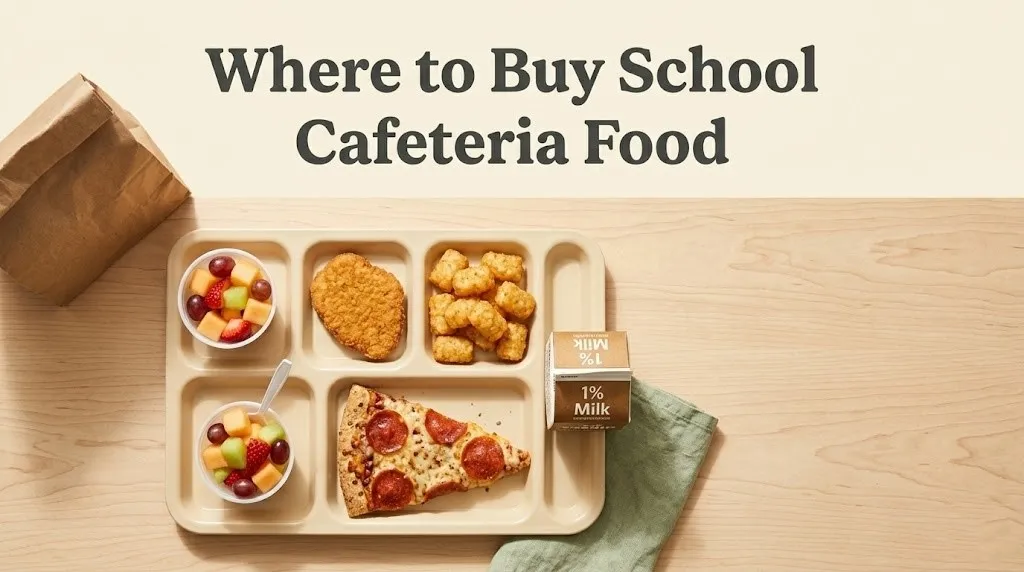
You can also buy directly from specialty online retailers who repack school food items into smaller bundles. These businesses buy the full cases from the distributor, break them down, and sell them in packs of 10 or 12 to consumers at a markup. The markup is steep, often 200 to 300 percent over the wholesale price, but it is the only way to buy a reasonable quantity without committing to a case that feeds 72 people.
Local restaurant supply depots in your city are another option. Stores like Chef’Store or Restaurant Depot carry food-service brands that overlap with school cafeteria suppliers. You will need a business license or a membership with a tax ID to shop at some of them, but others have opened to the general public in the 2025 to 2026 retail landscape.
Can You Buy School Cafeteria Food for Home
Yes, you can buy school cafeteria food for home, but you are almost never buying it through the same federal contract pricing or the exact same supply chain that a public school district uses, unless you are purchasing a full institutional case from a food-service distributor that also supplies schools. The “school food” you buy is the same manufacturer’s product, just sold through a different channel.
The USDA does not sell directly to the public. The commodity chicken, beef, and cheese that the federal government purchases to support American agriculture are distributed exclusively to schools, food banks, and tribal organizations. You cannot buy a pallet of USDA commodity mozzarella. However, the processors that turn that commodity food into finished products operate their own retail brands.
A company like Tyson Foodservice sells a “K-12 Whole Grain Chicken Patty” to schools under a CN-labeled contract. That exact product also appears on the WebstaurantStore website as the “Tyson Whole Grain Breaded Chicken Patty,” usually without the specific “K-12” label on the front but with the identical ingredient deck. You are buying the same patty from the same factory, but it bypasses the USDA oversight chain, so the price and the box design are different.
The practical question is freezer management. A full case of school-sized burritos or breakfast pizza is 48 to 96 individual units. If you have a deep freezer in the garage, this is a viable way to stock up for an entire school year of breakfasts. If you live in an apartment with a standard refrigerator-top freezer, you need to split a case with neighbors or stick to the online repack resellers.
Where Do Schools Buy Their Food
Schools buy their food primarily through three channels: USDA Foods (commodity) entitlement allocations, broadline food service distributors like Sysco and US Foods, and direct contracts with manufacturers for specific high-volume items like pizza and breaded proteins. The school nutrition director is managing a complex procurement puzzle.
The USDA Foods program is the public backbone. The federal government buys surplus agricultural products directly from American farmers and ranchers. This includes raw beef, chicken, pork, cheese, and fresh produce. The food is sent to schools as an “entitlement” based on the number of lunches served. The school then either receives the raw commodity and cooks it from scratch or, more commonly, sends the commodity food to a processor.
The processing model explains why your school’s chicken patty tastes unique. The school sends its allocation of USDA raw chicken to a company like Tyson or Bake Crafters. The processor turns the commodity chicken into a finished breaded patty that meets the USDA whole-grain and sodium standards. The school pays the processor a conversion fee for the manufacturing. This patty is built to a federal specification. It is not the same product that Tyson sells to Applebee’s.
The broadline distributors fill in the gaps. Sysco, US Foods, and Gordon Food Service sell everything from fresh produce to canned beans to the schools under a bid contract. These distributors also carry the finished CN-labeled products from the processors. A school nutrition director might buy the commodity-processed chicken patty through Tyson and the bulk frozen mixed vegetables through Sysco on the same weekly order.
School Cafeteria Food Suppliers List
The major manufacturers that supply the finished CN-labeled products to US school cafeterias are a concentrated group of food-service giants, including Tyson K-12, Schwan’s Food Service, Rich Products, Bake Crafters, and Conagra Foodservice. These are the names behind the nostalgic items you remember.
Tyson K-12 dominates the hot protein category. They produce the whole-grain-rich chicken patties, spicy chicken fillets, popcorn chicken bites, and the breakfast sausage patties found on school breakfast lines. Their school-specific formulations use whole grain breading, reduced sodium seasoning blends, and standardized portion sizes that deliver exactly 2 ounce-equivalent meat/meat alternate servings. The “K-12” designation on the box is your confirmation that the product was designed for the school market.
Schwan’s Food Service owns the pizza category. Under the Tony’s and Big Daddy’s brands, they manufacture the rectangular 16-inch pizzas with the specific low-fat mozzarella and whole-grain-rich crust that have been the defining lunch item for two generations. Schwan’s also produces the breakfast pizza and the stuffed-crust varieties. The key is that the school formulation uses a different cheese blend and a different crust than the retail Tony’s pizza sold in the grocery freezer aisle.
Bake Crafters is the hidden giant of the breakfast program. They make the whole-grain-rich French toast sticks, the mini pancakes, the cinnamon rolls, and the bulk sandwich bread. Most people have never seen a Bake Crafters box because they are a pure food-service brand with zero retail presence. You can only buy their products through food-service distributors or online resellers who have cracked open the cases.
Rich Products owns the thaw-and-serve category. Their MaxStix (branded as “Bosco Sticks” in many regions) are the cheese-filled breadsticks that appear as an entree or a side. Rich’s also produces the bulk cookie dough, the brownie batter, and the soft pretzel programs that schools use for a la carte and snack sales.
| Supplier | Flagship Product | Consumer Access Point |
|---|---|---|
| Tyson K-12 | Whole Grain Chicken Patty | WebstaurantStore, GFS Marketplace |
| Schwan’s (Tony’s) | Rectangle Pizza | Schwan’s Home Delivery, GFS |
| Rich Products | MaxStix / Bosco Sticks | WebstaurantStore, Online Resellers |
| Bake Crafters | French Toast Sticks | Online Repack Resellers Only |
| Conagra Foodservice | WG-Rich Breaded Fish | Costco Business Center, GFS |
USDA School Lunch Program Food for Sale
USDA school lunch program food is not sold directly to the public under the federal commodity label, but the finished processed products made from those commodities are legally sold through food-service resellers to anyone with the cash to buy a full case. The “USDA Foods” stamp itself is a distribution marker, not a retail brand.
The federal commodity program is a domestic farm support mechanism disguised as a nutrition program. The USDA purchases surplus beef, pork, chicken, and cheese to stabilize wholesale prices. The purchased food is then offered to school districts as a free entitlement. A school might receive 1,000 pounds of frozen chicken leg quarters. The nutrition director then sends that chicken to a USDA-approved processor, pays a processing fee, and receives back 5,000 breaded chicken patties.
The processed product now carries a CN label. That CN label is a legal certification that the finished product meets the specific meal pattern requirements, including the ounce-equivalent protein, the whole grain content, and the sodium cap. Once the patty is processed and boxed, it enters the commercial food-service stream. The manufacturer can sell the identical CN-labeled product to a restaurant, a caterer, or a consumer-facing wholesale store.
The direct commodity raw ingredients never reach consumers. You cannot buy the 40-pound block of USDA commodity cheddar cheese that the school lunch program uses. But you can buy the “School Foodservice Whole Grain Cheese Pizza” made from that commodity cheese through the reseller channels. The finished product is the consumer access point.
Key Takeaway: School food is a parallel food system that runs on bulk cases, commodity ingredients, and federally mandated nutritional profiles. The products are physically the same as those sold to the public, but the packaging, the label, and the buyer’s procurement process are entirely different.
CN Labeled Food for Sale
A Child Nutrition (CN) label is a USDA-authorized certification on a food service product box that guarantees the product meets the meal pattern requirements for the National School Lunch Program, and these labeled products are legally sold to the public through wholesale distributors. The CN label is not a marketing gimmick. It is a legal document.
The CN label statement explicitly lists how many ounce-equivalents of meat or meat alternate the product contributes. For example, a box of school chicken patties will state “Provides 2.00 oz equivalent meat/meat alternate for the Child Nutrition Meal Pattern Requirements.” This statement means the USDA has reviewed the formulation and certified that one patty fulfills the protein requirement for that component of the reimbursable meal.
CN-labeled products are inherently healthier than their grocery store equivalents in one specific way: they must meet the current USDA sodium and saturated fat targets. The grocery store frozen chicken patty operates under no such restriction. The store patty can contain 600 milligrams of sodium. The 2026 school patty must meet the Target 1A sodium limit, which caps the sodium content significantly lower, typically around 400 to 500 milligrams depending on the specific product category.
You can identify a CN-labeled product even when buying as a consumer by looking for the USDA shield and the specific “CN” statement on the product page or the box. WebstaurantStore often includes the CN documentation in the product images or the specification sheets. If you care about the nutritional profile, the CN label is your guarantee that the product meets a higher standard than the average frozen food aisle option.
Wholesale School Food Distributors
The primary wholesale school food distributors that occasionally sell to the general public are Gordon Food Service Marketplace, US Foods Chef’Store, and Sysco’s cash-and-carry outlets in select regions, but you will not have access to the full K-12 contract catalog that a school nutrition director sees. You get the retail-facing subset of the warehouse.
Gordon Food Service (GFS) is the most consumer-accessible of the major broadline distributors. Their GFS Marketplace stores are open to the public with no membership requirement. The stores carry a significant overlap with the K-12 catalog, including the rectangle pizza, the whole-grain-rich chicken patties, and the breakfast items. You can walk in and buy a single case without a tax ID or a business license.
Costco Business Center is a sleeper pick for school food. The business center is a separate entity from the standard Costco warehouse and carries a vastly expanded frozen and food-service section. The chicken patties, the bulk tater tots, and the bulk breakfast items in the business center often come from the same manufacturing lines as the school products. A standard Costco membership grants access to the business center, though the locations are limited to major metro areas.
WebstaurantStore is the online solution. This website is a direct-to-consumer restaurant supply retailer. It carries the largest selection of CN-labeled and school-specific products available to a non-institutional buyer. The shipping is expensive because the products ship frozen on a pallet via freight, but the per-unit cost before shipping is often near wholesale. This is where you buy the exact Tony’s school pizza and the MaxStix in consumer-viable quantities.
Buy School Pizza Rectangles
To buy the authentic school rectangle pizza, you need to purchase the Tony’s Whole Grain Rich 16-Inch Rectangle Cheese Pizza through Schwan’s Home Delivery, Gordon Food Service, or WebstaurantStore, because this specific SKU is a food-service product not stocked at Kroger or Walmart. The rectangle shape is not just nostalgia. It is a tray-efficiency design.
The rectangular pizza is cut into 6 or 8 slices per sheet and baked at 375 degrees Fahrenheit on a perforated pizza pan. The perforations allow the hot air to circulate under the crust, creating the characteristic crispy bottom that a solid sheet pan does not achieve. The whole-grain-rich crust contains a blend of whole wheat flour and enriched flour, giving it the slightly nutty, denser texture that distinguishes it from a standard delivery pizza.
The cheese blend is a low-moisture part-skim mozzarella processed specifically to melt evenly across a 16-inch surface without pooling grease. The tomato sauce is a USDA-compliant formulation that contributes a quarter-cup of red-orange vegetable per slice to meet the meal pattern requirement. This is a vegetable-delivery device dressed up as a pizza.
Schwan’s Home Delivery offers this pizza directly to consumers in most zip codes, though you are purchasing the “Tony’s 16-Inch School Pizza” under a slightly different retail name. GFS Marketplace stores typically carry the rectangle pizza in the frozen aisle in cases of 4. WebstaurantStore sells the case and ships it with dry ice.
School Chicken Patties Where to Buy
You can buy the authentic school chicken patty through WebstaurantStore under the Tyson Whole Grain Breaded Chicken Patty listing, or at GFS Marketplace under the “School Foodservice” or “K-12” label on the frozen case. This specific patty is a whole-muscle, whole-grain-breaded, oval-shaped portion designed to fit a standard school hamburger bun.
The school patty has a distinctive peppery, savory flavor profile because the breading includes a specific blend of black pepper, onion powder, and paprika. The retail grocery store version of the same Tyson patty uses a different seasoning blend and a refined flour breading that lacks the whole grain bite. The school version also weighs precisely 2.4 ounces cooked to deliver the required 2-ounce meat equivalent.
The cooking method at home is critical to replicating the cafeteria texture. Schools run these patties through a convection oven at 350 degrees Fahrenheit for 12 to 15 minutes from frozen. Your home oven, which is a conventional radiant-heat oven, will not deliver the same crisp unless you use a wire rack set over a sheet pan to allow airflow underneath. Without the rack, the bottom of the patty steams against the metal pan and turns soft.
A standard case contains 72 patties and costs between $45 and $65 on WebstaurantStore before shipping. The per-patty cost lands around 70 to 90 cents, which is roughly half the price of a 4-count box of retail frozen chicken patties at the grocery store.
School Breakfast Program Food Items
The most sought-after school breakfast program items are the Bake Crafters Whole Grain French Toast Sticks, the Rich’s Breakfast Pizza, and the Tyson Whole Grain Breakfast Sausage Patty, all of which are accessible through WebstaurantStore or GFS Marketplace. The breakfast program is a separate federal meal program with its own nutritional standards.
The French toast sticks are a whole-grain-rich bread product that is formulated to deliver 2 ounce-equivalent grains per serving. Schools cook them from frozen in a conveyor oven and serve them with a cup of syrup or a packet of powdered sugar. At home, you can bake them at 375 degrees Fahrenheit for 10 minutes on a parchment-lined sheet pan. They emerge with a crisp exterior and a soft, custardy interior that the retail frozen French toast sticks do not replicate because the retail versions use a different batter formulation.
The breakfast pizza is a unique item. It consists of a rectangular whole-grain crust, a thin layer of turkey sausage or egg, and a blanket of low-fat mozzarella cheese. The standard breakfast pizza delivers 2 ounce-equivalent meat and 2 ounce-equivalent grain in a single slice. Rich Products and Schwan’s both manufacture versions. The Schwan’s version is easier to find for home delivery.
The breakfast sausage patty from Tyson is a disk-shaped, whole-muscle patty with a mild sage seasoning. It is not the greasy link sausage sold at grocery stores. The school version is baked, not fried, and has a firmer, drier texture that holds its shape on a biscuit sandwich. A case contains 100 patties and fits neatly into a standard upright freezer.
| Breakfast Item | Brand | Cook Temp | Cook Time (Conventional Oven) |
|---|---|---|---|
| French Toast Sticks | Bake Crafters | 375°F | 10 min from frozen |
| Breakfast Pizza | Schwan’s/Rich’s | 350°F | 15 min from frozen |
| Sausage Patty | Tyson K-12 | 350°F | 12 min from frozen |
| Mini Pancakes | Bake Crafters | 375°F | 8 min from frozen |
| Cinnamon Roll | Rich’s | 325°F | 18 min from thawed |
School Cafeteria Brands Grocery Store
Most authentic school cafeteria brands are not sold in a standard grocery store, but you can find the next closest retail equivalents from the same parent manufacturers, specifically the Tyson and Tony’s retail product lines that sit in the freezer aisle. The grocery store product is the manufacturer’s commercial recipe, not the school-specific formulation.
The key distinction is that the grocery store product is optimized for a household consumer. It has a higher sodium content because the home cook is not bound by USDA sodium targets. It uses a refined white flour breading because most home consumers do not actually want the nutty taste of whole grain breading on their frozen chicken patty. The grocery product is also packaged in a small, colorful box with a much higher per-unit price.
The grocery store brands that get closest to the school taste are the Tyson Fully Cooked Crispy Chicken Strips and the Tony’s Original Crust Cheese Pizza. These are the siblings of the school products. The chicken strip uses a similar white-meat chicken and a similar breading texture, but it is a strip shape instead of a patty. The Tony’s retail pizza uses a similar cheese blend but on a round, thinner crust.
For the purest available grocery store school lunch experience, look for the Schwan’s Home Delivery service. Schwan’s does not sell through grocery stores. They deliver directly to your door, and their frozen food catalog is heavily derived from their food-service manufacturing lines. The Schwan’s Tony’s pizza and their chicken patties are the closest direct-to-consumer proxy for the actual school product.
How to Reheat School Cafeteria Food Safely
To reheat school cafeteria food safely at home, you must take the frozen product to an internal temperature of 165 degrees Fahrenheit using either a convection oven setting or a conventional oven with a wire rack, because simply microwaving it will produce a rubbery, steaming-hot exterior with a frozen center. The FDA Food Code establishes this 165-degree Fahrenheit threshold for all reheated poultry and processed products.
The microwave is the enemy of the school food texture. School cafeteria items are designed for convection ovens that circulate dry, hot air. The microwave steams the breading from the inside, causing it to separate from the meat and become a soggy layer. If you must use a microwave for speed, you should finish the patty or pizza slice in an air fryer or a toaster oven for two to three minutes to re-crisp the exterior.
The proper home reheating protocol starts with a preheated 375-degree Fahrenheit conventional oven and a wire rack set over a sheet pan. Place the frozen items directly on the rack without overlapping. The wire rack allows the hot air to flow completely around the product, mimicking the convection currents of a commercial school oven. Bake until a probe thermometer inserted into the thickest part of the item reads 165 degrees Fahrenheit, which typically takes 12 to 18 minutes depending on the item density.
Food safety requires that you not let the thawed leftovers sit in the “danger zone” between 40 degrees Fahrenheit and 140 degrees Fahrenheit for more than two hours. If you have opened a bulk case of school chicken patties, you must keep the unused portions sealed in the original bag, pressed flat to remove air, and stored in a deep freezer at 0 degrees Fahrenheit or below. The patties can be cooked directly from frozen without thawing first.
Reheating Quick Reference:
- Chicken Patty: 375°F, 15 min, wire rack, target 165°F internal.
- Rectangle Pizza: 375°F, 12 min, perforated pan, target 165°F.
- French Toast Sticks: 375°F, 10 min, parchment-lined pan, serve immediately.
- Bosco Sticks: 350°F, 8 min, parchment, let rest 1 min before eating.
Key Takeaway: Buying school cafeteria food is a game of bulk purchasing, freezer space, and knowing the specific food-service product name, not the grocery store brand name, because the USDA-formulated product lives in an entirely separate distribution channel.
Frequently Asked Questions About Buying School Cafeteria Food
Can I buy directly from a school cafeteria supplier?
No, major suppliers like Sysco and US Foods generally do not sell to individuals without a business tax ID and a minimum order history.
However, the retail-facing arms like Gordon Food Service Marketplace and WebstaurantStore carry the exact same products without requiring a business account.
You are buying the same supplier’s product, just through a consumer-accessible storefront.
Why does school cafeteria pizza taste different?
School cafeteria pizza tastes different because the crust is a whole-grain-rich formulation, the cheese is a reduced-fat blend, and the sauce is a USDA-compliant vegetable serving.
The specific manufacturing process and the convection oven cooking method create a crispier, denser texture than standard retail frozen pizza.
Your taste memory is also processing a specific sodium level that is lower than what you find in a standard commercial pizza.
Is school cafeteria food healthier than grocery store frozen food?
Yes, CN-labeled school cafeteria food is generally healthier than the standard grocery store frozen equivalent because it must legally meet strict USDA whole-grain, sodium, and saturated fat targets.
A grocery store frozen chicken patty can legally contain 600 milligrams of sodium, while the school version is capped at a lower level.
The school version also uses whole-grain breading that adds more fiber than the refined flour used in most retail frozen products.
What is a CN label on school food?
A CN label is a USDA-authorized certification on a food-service product box that guarantees the item meets the specific meal pattern requirements for the National School Lunch Program.
The label states the exact ounce-equivalent contribution of meat, grain, or vegetable that the product provides toward a reimbursable school meal.
You can use the presence of a CN label as a shortcut to identify the authentic school formulation.
Where can I buy Bosco sticks in bulk?
Bosco sticks, officially branded as MaxStix by Rich Products, can be purchased by the case through WebstaurantStore or Gordon Food Service Marketplace.
Schwan’s Home Delivery also sells a very similar cheese-filled breadstick that is manufactured for the school channel.
A standard case contains 100 sticks and costs between $35 and $50 before shipping.
Buying school cafeteria food is a hunt for the right SKU, not the right brand. The brand name on the box is less important than the specific product code that tells the distributor this is the school formulation, not the retail one.
Check your nearest Costco Business Center or GFS Marketplace store first. Walk the frozen aisles and look for the boxes that say “K-12” or carry the USDA CN label. That is the product you are chasing. If you do not have a local wholesale store, open a WebstaurantStore tab, search for the brand names we listed, and plan to store a case of 72 chicken patties in the deep freezer.
Your kid will not know the difference between a grocery store patty and the school patty unless they are old enough to have the nostalgia. But you will taste the whole grain in the crust, and you will notice the lower salt level, and you will understand that this specific product was built to a federal standard that the brightly colored retail box simply is not.