Adult cats should eat wet food at least twice a day, roughly every 12 hours. Kittens need three to four meals daily, and senior cats often do best with three smaller meals to support aging kidneys and maintain consistent hydration.
The American Association of Feline Practitioners (AAFP) recommends meal feeding over free-feeding because it mimics the natural feline pattern of hunting and consuming multiple small prey items throughout the day. Cats are obligate carnivores. Their digestive systems evolved to process frequent, small, moisture-rich meals, not a constant supply of dry, carbohydrate-dense kibble.
This guide covers exactly how often to feed wet food at every life stage, how to calculate portions, and how to transition a kibble-addicted cat to a wet food schedule. You will find a full feeding timeline table, a wet versus dry food comparison, and clear, practical advice on food safety, brand selection, and the specific health conditions that make wet food not just a preference but a medical recommendation.
How Often Should I Feed My Cat Wet Food?
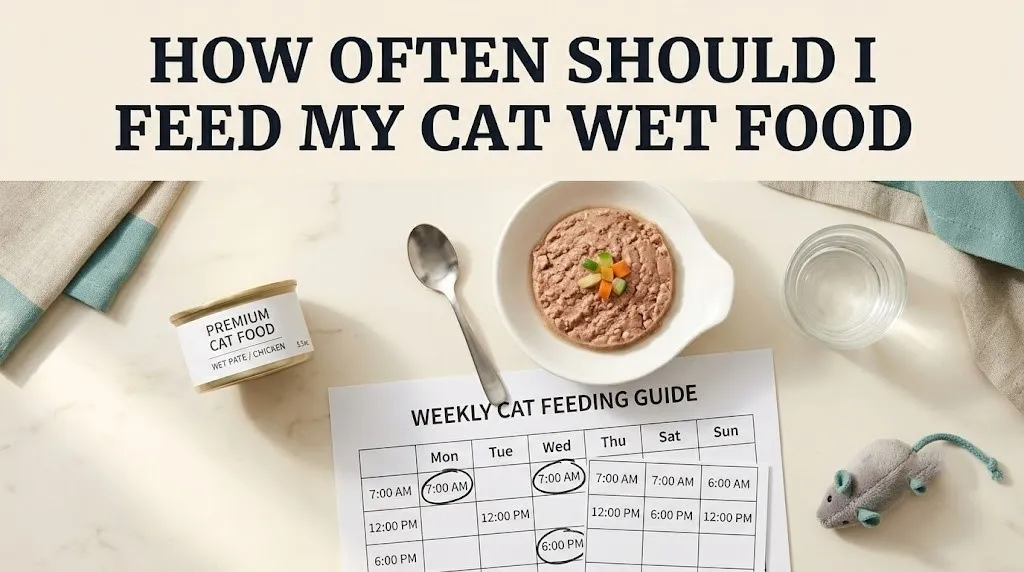
Adult cats should be fed wet food two to three times per day, with meals spaced roughly 8 to 12 hours apart. This frequency matches the feline digestive physiology and helps prevent the prolonged fasting periods that can contribute to gastric hyperacidity and nausea.
A cat’s stomach empties in roughly 4 to 6 hours after a wet food meal. After 12 hours without food, some cats begin to produce excess stomach acid, which can lead to vomiting bile or food refusal, a condition sometimes called bilious vomiting syndrome. Feeding at least twice daily prevents this cycle.
The frequency recommendation of two to three times daily is supported by the AAFP’s consensus statement on feline feeding programs. The statement emphasizes that cats are solitary hunters in the wild, consuming small prey like mice and birds throughout the day. A single mouse provides roughly 30 to 35 calories. A cat might eat 8 to 10 such prey items in a 24-hour period. Replicating this pattern with two or three measured wet food meals is a reasonable domestic approximation.
How Often to Feed Cat Wet Food for Adults
Feed an adult cat wet food two to three times daily. The simplest schedule that works for most households is a morning meal and an evening meal, roughly 12 hours apart.
An adult cat is defined as 1 to 7 years old, physically mature, and not pregnant or nursing. The daily caloric requirement for a typical 10-pound adult cat is approximately 200 to 250 calories, though this varies with activity level, body condition score, and individual metabolism. A standard 5.5-ounce can of wet cat food contains roughly 150 to 200 calories. Two cans per day, split into two meals, is a common baseline.
A three-meal schedule works better for some cats. A morning meal, an afternoon or early evening meal, and a late-night meal before bed spaces calories evenly and prevents the long overnight fast that can trigger early-morning hunger and disruptive behavior. This schedule requires someone to be home midday or the use of an automatic timed feeder with an ice pack compartment to keep the food fresh.
Key Takeaway: Two meals 12 hours apart is the minimum. Three meals is closer to the natural feline grazing pattern. Choose the schedule your household can sustain consistently.
How Often Should Cats Get Wet Food at Different Ages?
Cats should get wet food with a frequency that changes across their lifespan. Kittens need the most frequent meals. Adult cats need consistency. Senior cats often benefit from returning to more frequent, smaller meals.
The guiding principle across all life stages is that cats are designed for multiple small meals. A kitten’s stomach is physically small and cannot hold enough food in one sitting to sustain the rapid growth rate. A senior cat’s kidney function and appetite regulation may decline, making smaller, more palatable meals easier to consume and utilize.
| Life Stage | Age Range | Meals Per Day | Key Consideration |
|---|---|---|---|
| Kitten | 0 to 6 months | 4 to 6 | High energy demand, small stomach |
| Junior | 6 to 12 months | 3 | Transitioning to adult frequency |
| Adult | 1 to 7 years | 2 to 3 | Maintenance, weight stability |
| Senior | 7+ years | 3 to 4 | Hydration, kidney support, appetite |
| Pregnant/Nursing | Adult | 4+ or free access | Caloric demand doubles or triples |
These are general veterinary guidelines. Breed size affects caloric needs. A 20-pound Maine Coon has different requirements than an 8-pound Siamese. Body condition score, a physical assessment of fat coverage over the ribs and waist, is a more reliable feeding guide than a number on a scale. A veterinarian can teach you how to assess body condition score at home.
How Often Should You Feed Your Cat Wet Food per Day?
You should feed your cat wet food two to three times per day. The two-meal schedule is the most practical for working households. The three-meal schedule is physiologically more ideal.
The two-meal schedule works well for cats who are not prone to hunger-related vomiting and who maintain a healthy weight. Feed the first meal in the morning, roughly 12 hours before the second meal. Consistency matters more than the exact clock time. Cats have strong internal clocks and anticipate food. Feeding at wildly different times day to day creates stress.
The three-meal schedule is superior for cats who wake their owners at 4 AM demanding food, cats who vomit bile between meals, and cats who eat too quickly and regurgitate when meals are too large. Adding a late-night meal, even a small one, shortens the overnight fast. An automatic feeder with ice packs can dispense the overnight or midday meal if you are asleep or at work.
A four-meal schedule is reasonable for cats with specific medical needs. Diabetic cats often need meals timed with insulin injections. Cats with chronic kidney disease may eat more consistently when offered small, frequent meals because nausea can suppress appetite. Cats recovering from illness or surgery may need encouragement to eat small amounts frequently.
How Often Should a Cat Have Wet Food vs Dry Food?
A cat should have wet food as the primary diet, with dry food used sparingly as a supplemental snack or training treat, not as the nutritional foundation. The moisture content difference between wet and dry food is the most important nutritional distinction in feline diets.
Cats evolved from desert-dwelling ancestors and have a low thirst drive compared to other mammals. Their natural prey, small rodents and birds, are roughly 70 to 75 percent water. Wet cat food is approximately 75 to 78 percent water. Dry cat food, also called kibble, is approximately 10 percent water. A cat eating exclusively dry food must drink significantly more water to achieve the same hydration status. Many cats simply do not.
A study published in the Journal of Feline Medicine and Surgery found that cats fed a wet food diet consumed roughly double the total water intake compared to cats fed dry food, even when the dry food cats had unlimited access to fresh water. The chronic low-grade dehydration associated with dry food diets is implicated in the development of feline lower urinary tract disease (FLUTD) and may contribute to the progression of chronic kidney disease (CKD).
Key Takeaway: Wet food should be the dietary mainstay. Dry food is a supplement, not a substitute. The moisture in wet food directly supports urinary tract and kidney health.
Why Wet Food Is Good for Cats
Wet food is good for cats because it aligns with their evolutionary biology as obligate carnivores. It delivers high protein, high moisture, and low carbohydrate content in a form that their digestive systems are built to process.
The macronutrient profile of wet food is closer to a cat’s natural prey than dry food. A mouse is roughly 55 percent protein, 35 percent fat, and 5 to 10 percent carbohydrate on a dry matter basis. High-quality wet cat food is often 40 to 50 percent protein, 20 to 30 percent fat, and 10 to 15 percent carbohydrate on a dry matter basis. Dry cat food requires starch, often from corn, wheat, or potatoes, to maintain the kibble structure. The carbohydrate content of dry food can exceed 30 percent on a dry matter basis. Cats have no dietary requirement for carbohydrate.
The high moisture content directly supports kidney function. Cats with chronic kidney disease (CKD) lose the ability to concentrate their urine. They lose water and need to consume more to maintain hydration. Wet food delivers that water in a palatable form. A 2016 study in the Journal of Veterinary Internal Medicine found that increased water intake in cats with CKD was associated with slower disease progression.
Wet food also tends to be more palatable to cats with dental disease, senior cats with diminished sense of smell, and cats recovering from illness. The strong aroma and soft texture encourage eating when appetite is suppressed.
Cat Wet Food Feeding Schedule by Age
A cat wet food feeding schedule by age provides clear, actionable guidance for every life stage. The table below summarizes the recommended meal frequency, portion guidance, and special considerations for each stage.
| Age Group | Meals/Day | Daily Wet Food (5.5 oz cans) | Notes |
|---|---|---|---|
| Kitten (2 to 3 months) | 4 to 6 | 1.5 to 2 cans | Weaned, very small stomach |
| Kitten (3 to 6 months) | 3 to 4 | 2 to 2.5 cans | Rapid growth phase |
| Kitten (6 to 12 months) | 3 | 2 to 3 cans | Transition to adult portions |
| Adult (1 to 7 years) | 2 to 3 | 1.5 to 2.5 cans | Based on weight, activity |
| Senior (7+ years) | 3 | 1.5 to 2 cans | Smaller, more frequent meals |
| Pregnant/Nursing | Free access | 3 to 5 cans | Demand-driven feeding |
These can counts assume a standard 5.5-ounce can containing approximately 160 to 180 calories. Caloric density varies significantly between brands. Pate-style foods are generally more calorie-dense than shredded or gravy-style foods. Always check the label for the caloric content per can and use that number, not the can count, to determine portions.
The feeding guidelines on the can are a starting point. They are based on population averages and do not account for individual metabolism, activity level, or body condition. A cat who runs circuits around the house and a cat who sleeps 20 hours a day will have different caloric needs even if they weigh the same.
How Much Wet Food to Feed a Cat per Day
The amount of wet food to feed a cat per day is calculated based on body weight, body condition score, and the caloric content of the specific food. The general starting point is 20 to 25 calories per pound of body weight for adult maintenance.
A 10-pound adult cat at ideal body weight needs roughly 200 to 250 calories per day. A standard 5.5-ounce can of wet cat food contains between 150 and 200 calories. A 3-ounce can contains 70 to 100 calories. The math is straightforward once you know your cat’s target weight and the food’s caloric density.
To calculate your cat’s daily portion:
- Weigh your cat or use the last recorded weight from a veterinary visit.
- Determine body condition score. A score of 5 out of 9 is ideal. A score of 7 or above indicates the cat is overweight and needs fewer calories for weight loss.
- Check the can for the kilocalories (kcal) per can. This is on the nutritional label.
- Multiply your cat’s target weight in pounds by 20 to 25 calories. This is the daily caloric target.
- Divide the daily caloric target by the calories per can. This is the daily can count.
- Divide the daily can count by the number of meals. This is the amount per meal.
A veterinarian should confirm your cat’s target weight and caloric needs. Cats with hyperthyroidism, diabetes, or other metabolic conditions have altered energy requirements. Guessing can lead to underfeeding or overfeeding.
Key Takeaway: The formula is simple: body weight times 20 to 25 calories equals daily target. Divide by can calories to get portion size. A veterinarian should set the target for cats with health conditions.
Mixing Wet and Dry Cat Food: A Complete Schedule
Mixing wet and dry cat food is a practical compromise for many households. The wet food provides hydration and high-quality protein. The dry food provides cost-effective calories and the convenience of being left out for grazing if needed.
The healthiest mixed feeding approach prioritizes wet food for the majority of calories and uses dry food as a supplement. A 75 percent wet, 25 percent dry split is a reasonable target. A 10-pound cat on this split might receive one 5.5-ounce can of wet food (roughly 180 calories) split across two meals, plus a small measured portion of dry food, about 2 tablespoons or 50 calories, given as a midday snack or placed in a puzzle feeder.
The risk of mixed feeding is overfeeding. Dry food is calorie-dense. A quarter cup of dry cat food can contain 100 to 120 calories. If the dry food portion is not measured, the total daily calories creep up. Use a measuring cup or a kitchen scale. The cat’s body condition score is the ultimate feedback mechanism. If the cat is gaining weight, reduce the dry food portion.
Do not mix wet and dry food in the same bowl and leave it out. The wet food will spoil at room temperature within 2 hours. The dry food will absorb moisture from the wet food and become unpalatable. Serve wet food meals on a schedule. Offer the dry food portion separately in a puzzle feeder or timed dispenser.
Kitten Wet Food Frequency and Portions
Kittens need wet food more frequently than adult cats because their stomachs are small and their energy demands for growth are high. Kittens from weaning to 6 months should eat 4 to 6 meals per day.
A 2-month-old kitten may weigh 2 pounds and need roughly 200 to 250 calories per day, nearly the same as a 10-pound adult cat, but packed into a body one-fifth the size. The only way to deliver that many calories safely is through small, frequent meals. A feeding schedule for a young kitten might be 7 AM, 11 AM, 3 PM, 7 PM, and 10 PM. This schedule is demanding but temporary.
To feed a kitten enough wet food:
- Weeks 4 to 8 (weaning): Offer wet food mixed with kitten milk replacer to a gruel consistency. 4 to 5 small meals daily.
- Months 2 to 3: 1.5 to 2 cans of 5.5-ounce kitten-specific wet food, divided into 4 to 5 meals.
- Months 3 to 6: 2 to 2.5 cans daily, divided into 3 to 4 meals.
- Months 6 to 12: 2 to 3 cans daily, divided into 3 meals.
Kitten-specific wet food is formulated to meet AAFCO growth and reproduction standards. It contains higher protein, fat, calcium, and phosphorus than adult maintenance food. Kittens should stay on kitten food until 12 months of age. Switching to adult food too early can result in nutritional deficiencies during a period of continued skeletal growth.
Wet Food for Senior Cats With Health Issues
Senior cats, defined as 7 years and older, benefit from wet food more than any other age group. The high moisture content supports aging kidneys. The soft texture accommodates dental issues. The strong aroma stimulates appetites dulled by age-related sensory decline.
Chronic kidney disease (CKD) is the most common health condition of senior cats, affecting an estimated 30 to 40 percent of cats over 10 years old. The standard veterinary nutritional management of CKD includes a prescription renal diet that is lower in phosphorus and moderate in high-quality protein. Most renal diets are available in wet formulations. The moisture in the food helps maintain hydration, which reduces the workload on already compromised kidneys.
Senior cats with hyperthyroidism lose weight despite eating ravenously. They need more frequent meals and higher caloric density. A three or four meal schedule with a calorie-dense wet food helps maintain body weight during treatment. Senior cats with dental disease, including tooth resorption and periodontal disease, may find dry food painful. Wet food eliminates the mechanical pain of chewing hard kibble.
A veterinarian should guide dietary decisions for any senior cat with a diagnosed health condition. Prescription diets exist for renal disease, diabetes, urinary crystals, and gastrointestinal disorders. These diets are formulated to manage the specific pathophysiology. Over-the-counter wet food, even high-quality brands, may not be appropriate.
Key Takeaway: Senior cats gain the most from wet food. Hydration for kidneys, soft texture for teeth, and aroma for appetite. A veterinarian should prescribe the specific formulation if a health condition is present.
Wet Cat Food for Urinary Tract Health
Wet cat food supports urinary tract health primarily through its high moisture content, which dilutes the urine and reduces the concentration of minerals that can form crystals and stones. This is the single most important dietary factor in preventing feline lower urinary tract disease (FLUTD).
Cats on dry food diets produce more concentrated urine. Concentrated urine means higher levels of struvite and calcium oxalate precursors, the minerals that form the most common types of urinary crystals. It also means less frequent urination, which allows crystals more time to form and aggregate in the bladder. A 2011 study in the Journal of the American Veterinary Medical Association found that increased water intake was associated with a reduced risk of urinary tract disease in cats.
Prescription urinary diets formulated for FLUTD management achieve their effect partly through controlled mineral levels and pH modulation, but also through increased sodium content that stimulates thirst and water intake. A wet formulation of a urinary diet delivers water directly, without relying on the cat’s thirst drive.
Not all wet foods are equal for urinary health. Fish-flavored wet foods, particularly tuna, can be high in phosphorus and magnesium, which are precursors to struvite crystals. A balanced, complete, and balanced wet food from a brand that meets WSAVA guidelines is a safer daily choice than fish-heavy boutique brands. Cats with a history of urinary blockages or recurrent FLUTD should be on a veterinarian-prescribed urinary diet, not an over-the-counter food.
Transitioning Your Cat From Dry to Wet Food
Transitioning a cat from dry food to wet food can take days, weeks, or months, depending on the cat’s level of food neophobia, which is the fear of new foods. Patience and a gradual approach prevent food aversion.
Cats imprint on the texture and flavor of their early diet. A cat who has eaten dry kibble for years may not recognize wet food as edible. The texture is strange. The temperature from the refrigerator is off-putting. The strong smell can be initially overwhelming. A sudden switch can cause the cat to refuse food entirely, which is dangerous because cats can develop hepatic lipidosis after as little as 48 hours of significant calorie restriction.
To transition a cat from dry to wet food:
- Start by offering a pea-sized amount of wet food on a separate plate alongside the regular dry food. Do this for 3 to 4 days.
- Warm the wet food slightly. Cold food from the refrigerator has less aroma. Body temperature or slightly warmer increases the smell and palatability.
- Once the cat eats the pea-sized sample reliably, increase to a teaspoon. Place it in a separate bowl next to the dry food bowl.
- Over 7 to 10 days, gradually increase the wet food portion while slightly decreasing the dry food portion.
- For stubborn cats, crush a few pieces of dry food and sprinkle the powder on top of the wet food. The familiar smell can trigger eating.
- Once the cat is eating a full wet meal, transition to a twice-daily schedule.
Do not starve a cat into eating wet food. A hunger strike can trigger hepatic lipidosis, a life-threatening liver condition. If the cat refuses wet food after two weeks of consistent, patient effort, consult your veterinarian. Some cats will never fully transition, and a mixed feeding approach or a prescription dry diet for specific health concerns may be the realistic outcome.
Key Takeaway: Transition is measured in weeks, not days. Start with pea-sized amounts. Warm the food. Sprinkle familiar dry food on top. Never starve a cat into accepting new food.
How Long Can Wet Cat Food Sit Out Safely?
Wet cat food can sit out at room temperature for no more than 2 hours, according to FDA pet food safety guidelines. After 2 hours, the risk of bacterial growth, particularly Salmonella and Clostridium species, increases to an unacceptable level for a carnivore with a short, acidic digestive tract.
The 2-hour rule applies to opened canned food, food on a plate, and food in a timed feeder that does not have active refrigeration. In hot weather above 90 degrees Fahrenheit, the safe window shortens to 1 hour. Wet food spoils visibly. It develops a dry, crusted surface. It smells sour. Cats are generally good at rejecting spoiled food, but hungry cats or cats with diminished sense of smell may eat it anyway.
Opened cans of wet food should be covered with a tight-fitting lid, either the original plastic lid or a pet food can cover, and refrigerated immediately. Refrigerated wet food should be used within 5 to 7 days. Before serving, let the portion warm to room temperature or warm it slightly. Cold food from the refrigerator is less aromatic and may be rejected.
Quick Tip:
- Divide a large can into portions using a spoon. Store portions in small covered containers rather than repeatedly opening and closing one large can.
- Use an automatic feeder with freezer packs for midday meals when you are at work.
- If your cat does not finish a meal within 30 minutes, discard the leftovers. Do not re-refrigerate food that has been sitting out.
Best Wet Cat Food Brands With High Protein in 2026
The best wet cat food brands prioritize animal-source protein, named protein sources, and nutritional adequacy per AAFCO standards. The brand landscape in 2026 continues to emphasize high-protein, low-carbohydrate formulations.
Veterinary professionals generally recommend brands that meet WSAVA guidelines, including conducting feeding trials, employing board-certified veterinary nutritionists, and publishing nutritional analyses. Brands that meet these criteria include Hill’s Science Diet, Royal Canin, and Purina Pro Plan. These are not boutique brands. They are large companies with research budgets, quality control infrastructure, and veterinary oversight.
Wellness, Tiki Cat, Weruva, and Instinct are popular higher-protein options that use named meat sources and avoid artificial colors and preservatives. Tiki Cat, in particular, formulates many recipes to mimic the macronutrient profile of prey, with protein content above 50 percent on a dry matter basis.
The label term “high protein” is not regulated. You must read the guaranteed analysis. To compare protein content across brands with different moisture levels, convert to dry matter basis. A food with 10 percent protein and 78 percent moisture has 10 / (100 minus 78) = 45 percent protein on a dry matter basis. Aim for 40 percent or higher on a dry matter basis.
Cat Dehydration Signs and Why Water Intake Matters
Cat dehydration signs include skin tenting, dry or sticky gums, sunken eyes, lethargy, and decreased urine output. Chronic low-grade dehydration from a dry food diet may not cause these acute signs but still stresses the kidneys over months and years.
The skin tent test is a simple at-home dehydration check. Gently pinch the skin between the shoulder blades, lift it, and release. In a well-hydrated cat, the skin snaps back immediately. In a dehydrated cat, the skin stays tented or returns slowly. This test is less reliable in senior cats, who lose skin elasticity with age regardless of hydration status. Gums are a better indicator. Moist, slick gums suggest good hydration. Tacky or dry gums suggest dehydration.
Water intake from wet food is the most effective way to maintain feline hydration because it bypasses the cat’s naturally low thirst drive. A cat on a solely dry food diet would need to drink roughly one cup of water per day to achieve the same total water intake as a cat on wet food. Many cats drink significantly less than this.
Cats who are chronically dehydrated concentrate their urine to conserve water. Highly concentrated urine is a risk factor for crystal formation and may accelerate the decline of kidney function in cats with early, undiagnosed CKD. The easiest prevention is feeding wet food.
Key Takeaway: Wet food is the most effective hydration strategy for cats. Skin tenting and gum moisture are at-home hydration checks. Chronic dehydration from dry food stresses kidneys silently.
Homemade Cat Food Safety and Veterinary Guidelines
Homemade cat food can be nutritionally complete and safe, but it must be formulated by a board-certified veterinary nutritionist. Online recipes and general pet food cookbooks are frequently deficient in taurine, calcium, and other essential nutrients.
Cats require specific nutrients that are abundant in animal tissues but easily lost or destroyed in home cooking: taurine, an amino acid critical for heart and eye health; arachidonic acid, an essential fatty acid; and preformed vitamin A, which cats cannot convert from plant beta-carotene. A homemade diet missing any of these can cause severe, irreversible health damage over weeks to months.
The AAFCO nutritional adequacy standards for cat food are the minimum requirements. A homemade diet that meets AAFCO standards must be formulated with precision. The safest approach is to consult a veterinary nutritionist, either through a referral from your primary veterinarian or through a university veterinary teaching hospital. The nutritionist will take your cat’s age, weight, health conditions, and your ingredient preferences and provide a precise recipe with gram-level measurements and specific supplement products.
Do not feed a cat a diet consisting solely of cooked muscle meat. This is a common well-intentioned mistake. Muscle meat alone lacks calcium, taurine, and several B vitamins. The result, over time, is nutritional secondary hyperparathyroidism, a painful bone condition caused by calcium deficiency.
Frequently Asked Questions About Feeding Cats Wet Food
Is it OK to feed my cat wet food only?
Feeding a cat a 100 percent wet food diet is not only OK, it is often recommended by veterinarians, particularly for cats with urinary tract disease, kidney disease, or diabetes. The high moisture content supports hydration and urinary health. The high protein and low carbohydrate profile matches the obligate carnivore metabolism.
How many cans of wet food should a cat eat a day?
A 10-pound adult cat needs roughly two 5.5-ounce cans of wet food per day, split into two or three meals. A 3-ounce can contains less, so a cat of the same size would need three to four of the smaller cans. Check the caloric content on the specific can, as calories vary by formula and brand.
Can I leave wet cat food out overnight?
Wet cat food should not be left out overnight. It should be discarded after 2 hours at room temperature due to the risk of bacterial growth. An automatic feeder with a freezer pack can keep a meal cool for several hours and is the safest way to provide an overnight meal.
Why is my cat always hungry on wet food?
A cat who seems constantly hungry after switching to wet food may be adjusting to scheduled meals after free-feeding, or may simply prefer the taste. Ensure the daily caloric portion is correct. A veterinarian can rule out medical causes of increased appetite, including hyperthyroidism and diabetes.
Should I feed my cat wet food in the morning or at night?
Feed wet food at both times. A cat should eat at least twice daily, so a morning meal and an evening meal, roughly 12 hours apart, is the minimum. Adding a small late-night meal can prevent early-morning hunger and the associated unwanted wake-up calls.
Your cat’s food bowl is a direct connection to 10,000 years of feline evolution. The mouse that a wild ancestor ate was 70 percent water. The wet food you spoon into the bowl today carries that same moisture, that same high-protein architecture. Feeding your cat wet food two or three times a day is not a luxury. It is a return to the biological baseline.
Start with the morning and evening meals. Keep them consistent. Measure the portions. Pay attention to the body condition and the litter box output. If you are switching from dry food, be patient. The transition might take weeks. The payoff is a better-hydrated, healthier cat with a diet that actually makes sense for a desert-dwelling obligate carnivore.