
Most healthy adult aquarium fish can survive without food for 3 to 7 days with no adverse effects, and many larger species can endure fasts of 10 to 14 days. The exact survival window depends on the species, the fish’s age, its fat reserves, and the temperature of the water. A large, well-fed goldfish in a cool pond can go weeks without eating. A small, fast-metabolizing tropical tetra in a warm tank may show signs of stress after just 48 hours.
Fish are ectothermic, or cold-blooded, which means their metabolic rate is determined by the temperature of their environment. A fish in a tropical tank at 78°F has a metabolic rate roughly twice as high as a fish in a cold-water tank at 60°F. The warmer the water, the faster the fish burns through its energy reserves. This is why tropical fish have shorter fasting tolerances than goldfish or koi.
This guide covers the exact fasting timelines for the most common aquarium species, the biological stages of starvation, and the safe strategies for feeding your fish while you are on vacation. This is educational information for responsible fish keeping. If your fish is already sick, injured, or underweight, a prolonged fast can be dangerous, and you should consult an aquatic veterinarian for specific guidance.
how long can fish survive without food
A healthy adult fish can survive without food for 5 to 14 days, depending on its body mass, species, and water temperature. Fish do not starve quickly. Their ectothermic metabolism allows them to slow their energy consumption dramatically when food is scarce. Survival time is determined by how much stored energy, primarily glycogen and body fat, the fish has when the fast begins.
The biological process of fasting in fish follows three distinct stages. In the first 24 to 48 hours, the fish burns through glycogen, the stored carbohydrate in its liver and muscle tissue. This is the same energy source that fuels a fish’s daily activity between feedings. The fish behaves normally during this stage. It will search the substrate and glass for food, but it is not yet in distress.
Once glycogen stores are depleted, the fish transitions to lipolysis, the breakdown of stored body fat. This stage can last for days to weeks, depending on the fish’s body condition. A plump, healthy fish with visible body mass can sustain itself on fat reserves for an extended period. A skinny or sick fish has little fat to burn and will enter the third stage, muscle catabolism, much sooner. Muscle catabolism is the breakdown of the fish’s own muscle tissue for energy. This is starvation, and at this point, the fish begins to suffer permanent health consequences.
| Fish Type | Safe Fasting Window | Maximum Survival |
|---|---|---|
| Large goldfish/koi | 10 to 14 days | 4 to 6 weeks (cool water) |
| Small tropical tetras | 3 to 5 days | 7 to 10 days |
| Bettas | 4 to 7 days | 10 to 14 days |
| GloFish | 3 to 5 days | 7 to 10 days |
| Fry and juveniles | 12 to 24 hours | 48 to 72 hours |
how long can aquarium fish go without food
Most aquarium fish can go without food for 3 to 7 days with no health consequences. A weekend trip from Friday to Sunday requires zero preparation for a healthy tank. A week-long vacation falls within the safe window for most adult fish, though smaller species and fry may need supplemental feeding arrangements.
The aquarium environment itself provides a small amount of natural food. Even a clean, well-maintained tank contains microscopic biofilm, algae, and tiny invertebrates like copepods and detritus worms. Grazing fish, like many catfish and livebearers, will actively forage on these natural food sources during a fast. This is not enough to sustain them indefinitely, but it provides a meaningful caloric buffer for the first several days.
The primary danger during a long fast is not starvation. It is the water quality crash that can occur if the filter bacteria die off. The beneficial bacteria that convert toxic ammonia to nitrite and then to nitrate are also living organisms that require a food source. In a heavily stocked tank, a week without fish waste can cause the bacterial colony to shrink. When the owner returns and feeds heavily, the reduced bacteria cannot handle the sudden ammonia load, causing a dangerous spike.
- 1 to 3 days: Safe for all healthy adult fish. No preparation needed.
- 4 to 7 days: Safe for most adult fish. Feed well before leaving.
- 8 to 14 days: Manageable for large species. Use an automatic feeder or a pet sitter.
- 14+ days: Requires a reliable feeding solution. Vacation feeder blocks are unreliable.
Key Takeaway: The safe fasting window for most aquarium fish is one week. Beyond that, the risk shifts from starvation to water quality collapse when you return and feed them again.
how long can pet fish go without food
Pet fish can go without food for 3 to 7 days in most cases, with larger species tolerating up to 14 days. The term “pet fish” encompasses the most common aquarium species, goldfish, bettas, guppies, tetras, and cichlids, each with its own metabolic profile and fasting tolerance.
Goldfish are the champions of fasting among pet fish. They are cold-water cyprinids with a physiology designed for seasonal food scarcity. In a pond environment, goldfish naturally go weeks with minimal food during winter months when their metabolism slows. In a heated aquarium, their metabolic rate is higher, but they still retain significant fasting tolerance. A healthy adult goldfish can fast for 10 to 14 days with no health effects.
Bettas are at the opposite end of the spectrum among pet fish. They are tropical anabantids with a relatively high metabolic rate. However, bettas are also solitary fish that are often overfed by their owners. A betta in a small tank with no tank mates and no natural food sources has a safe fasting window of 4 to 7 days. A betta that is already thin or sick should not be fasted for more than 48 hours without a feeding plan.
- Goldfish: 10 to 14 days.
- Bettas: 4 to 7 days.
- Guppies/Endlers: 3 to 5 days.
- Tetras/Rasboras: 3 to 5 days.
- Cichlids (Oscars, Angelfish): 7 to 10 days.
can fish go 3 days without food
Fish can go 3 days without food without any adverse effects. A 3-day fast is well within the safe window for every healthy adult aquarium fish species, from tiny neon tetras to large oscars. A long weekend trip requires zero feeding arrangements.
The 3-day mark is significant because it falls squarely within the glycogen-burning phase of the fast. The fish depletes its stored liver glycogen but has not yet begun significant fat burning. The fish will be hungry when you return. It will rush to the surface or the glass when it sees you, expecting food. This is normal begging behavior. It is not a sign that the fish was starving.
The one exception to the 3-day rule is fry. Baby fish have almost no energy reserves. They are growing rapidly and require frequent feedings, often 3 to 5 times per day, to support their development. A fry that goes 3 days without food will likely die or suffer permanent stunting. If you have fry in the tank, arrange for daily feedings from a reliable person or an automatic feeder.
- Adult fish: 3 days is completely safe.
- Juvenile fish: 3 days is borderline. Monitor closely.
- Fry: 3 days without food is likely fatal. Arrange feedings.
how long can tropical fish survive without food
Tropical fish can survive without food for 3 to 7 days for small species and 7 to 14 days for larger species. The warmer water of a tropical aquarium, typically 76°F to 82°F, elevates the metabolic rate of tropical fish compared to cold-water species, reducing their fasting tolerance.
The metabolism of a tropical fish is driven by the temperature of its environment. A neon tetra in an 80°F tank has a resting metabolic rate roughly twice as high as a goldfish in a 65°F tank. The tetra burns through its glycogen reserves faster and reaches the fat-burning stage sooner. This is an evolutionary trade-off. Tropical fish have access to food year-round in their native environments and have not evolved the extreme fasting tolerance of temperate species that experience seasonal food scarcity.
Larger tropical cichlids, like oscars and angelfish, have greater body mass and proportionally larger fat reserves. They can comfortably fast for 10 to 14 days. Small tetras, rasboras, and guppies have minimal fat reserves and should not be fasted for more than 5 days without a feeding plan. The fish’s body condition at the start of the fast is the most important variable.
| Tropical Fish | Tank Temp | Safe Fast |
|---|---|---|
| Neon Tetra | 78°F | 3 to 5 days |
| Guppy | 78°F | 3 to 5 days |
| Angelfish | 80°F | 7 to 10 days |
| Oscar | 78°F | 10 to 14 days |
| Corydoras Catfish | 78°F | 3 to 5 days |
Key Takeaway: Tropical fish burn energy faster than cold-water fish because their water is warmer. The small species, tetras, guppies, and rasboras, have the shortest fasting windows.
how long can small fish survive without food
Small fish can survive without food for 2 to 5 days before showing signs of stress and 5 to 7 days before risking death. Small body size means small energy reserves. A fish that weighs less than a gram has almost no fat stores and cannot sustain a prolonged fast.
The definition of “small fish” in this context includes most schooling tropical species: neon tetras, cardinal tetras, harlequin rasboras, ember tetras, and chili rasboras. These fish weigh between 0.5 and 2 grams as adults. Their entire body is a fraction of the size of a single goldfish scale. They have evolved to eat constantly in the wild, grazing on microscopic organisms throughout the day. Their digestive systems are designed for continuous intake, not feast-and-famine cycles.
The signs of stress in a fasting small fish include reduced schooling behavior, hiding, loss of color, and a visibly sunken belly. A sunken belly is the critical warning sign. It means the fish has depleted its glycogen and fat reserves and has begun catabolizing muscle tissue. At this stage, the fish is in genuine distress and may not recover even if fed.
- 24 to 48 hours: No signs of stress.
- 48 to 72 hours: Increased hiding, reduced activity.
- 72 to 96 hours: Sunken belly, loss of color, muscle wasting.
- 96+ hours: High risk of death.
how long can goldfish go without food
Goldfish can go without food for 10 to 14 days in a home aquarium and up to 4 to 6 weeks in a cold pond during winter. Goldfish are cold-water cyprinids with a physiology designed to survive seasonal food scarcity. They are among the most fasting-tolerant fish in the aquarium hobby.
The goldfish’s digestive system is a long, coiled intestine designed to extract nutrients from low-quality food sources. In the wild, their ancestors, crucian carp, survived in ponds that froze over for months, eating almost nothing during the winter. The modern goldfish retains this physiological resilience. A healthy adult goldfish with good body condition can fast for two weeks with no measurable health effects.
The water temperature is the most important variable for goldfish fasting tolerance. In a cold pond at 40°F, a goldfish’s metabolism slows to a near-hibernation state. The fish barely moves, eats nothing, and can survive for months on stored energy. In a heated indoor aquarium at 72°F, the same goldfish has a much higher metabolic rate and a correspondingly shorter fasting window.
- Cold pond (40°F): 4 to 6 weeks.
- Cool tank (60°F): 2 to 3 weeks.
- Warm tank (72°F): 10 to 14 days.
- Fry: 24 to 48 hours maximum.
how long can betta fish go without food
Betta fish can go without food for 4 to 7 days before showing signs of stress, with a maximum survival time of roughly 10 to 14 days for a healthy adult. Bettas are tropical anabantids with a labyrinth organ that allows them to breathe air. They are solitary, territorial fish that are often overfed in captivity.
The betta’s metabolic rate is moderate for a tropical fish. They are ambush predators in the wild, adapted to eating large, infrequent meals of insects and larvae rather than constant grazing. This feeding strategy gives them a moderate fasting tolerance. A well-fed betta can comfortably handle a 5-day fast.
The most common mistake betta owners make is overfeeding before a vacation. The betta’s stomach is roughly the size of its eye. A large meal immediately before a fast does not give the fish extra energy. It can cause bloating, constipation, and swim bladder disorder. Feed the betta normally, not excessively, before a planned fast.
- 3 days: Completely safe.
- 5 days: Comfortable tolerance.
- 7 days: May show hunger behavior, but no health risk.
- 10 days: Stress begins. Weight loss visible.
Key Takeaway: A betta can handle a week without food. Do not overfeed before you leave. The betta’s stomach is the size of its eye, and a huge meal causes more harm than the fast itself.
how long can glofish go without food
GloFish can go without food for 3 to 5 days for small varieties like tetras and danios, and 5 to 7 days for larger varieties like tiger barbs and rainbow sharks. GloFish are genetically modified versions of common aquarium species. Their fasting tolerance is determined by their species, not their color.
GloFish Tetras are black skirt tetras with a fluorescent protein gene. They are small, schooling fish with a high metabolic rate. Their fasting tolerance is identical to that of a standard black skirt tetra. GloFish Danios are zebra danios with the same genetic modification. They are hardier than tetras and can handle a slightly longer fast.
The GloFish brand encompasses several species, each with a different fasting profile. GloFish Bettas are identical to standard bettas in their physiology and fasting tolerance. GloFish Tiger Barbs are robust, active fish that can handle a 5 to 7-day fast. The key is to identify the underlying species of your GloFish and apply the appropriate fasting guideline.
| GloFish Type | Base Species | Safe Fast |
|---|---|---|
| GloFish Tetra | Black Skirt Tetra | 3 to 5 days |
| GloFish Danio | Zebra Danio | 4 to 6 days |
| GloFish Barb | Tiger Barb | 5 to 7 days |
| GloFish Betta | Betta Splendens | 4 to 7 days |
| GloFish Shark | Rainbow Shark | 5 to 7 days |
how long do fish live without food
Fish live without food for 5 days to 6 weeks, depending on species, size, water temperature, and body condition at the start of the fast. The question of how long fish “live” without food is asking about the terminal starvation point. It is a more extreme question than the safe fasting window.
The terminal starvation point is reached when the fish has depleted its glycogen, fat, and muscle reserves and can no longer sustain basic metabolic functions. Organ failure follows. The fish becomes lethargic, loses equilibrium, and dies. This point is highly variable. A large, healthy koi in a cold pond can survive for months without food. A small neon tetra in a warm tank may reach the terminal point in 7 to 10 days.
The ethical consideration is important. The safe fasting window is the period during which the fish experiences no health consequences. The terminal starvation point is the moment of death. These are not the same thing. A fish that survives a 10-day fast but loses significant body mass and suffers permanent organ damage has not had a successful fast. The goal is to stay within the safe window.
- Safe window: No health effects.
- Stress window: Weight loss, hiding, color loss.
- Terminal window: Organ failure, death.
can fish survive without food for 3 days
Fish can survive without food for 3 days with no difficulty. This is the most common question from vacationing fish owners, and the answer is a definitive yes. A 3-day weekend is a non-event for a healthy aquarium.
The evidence for this is built into the biology of every fish. In the wild, fish do not eat every day. Food availability fluctuates with seasons, weather, and predation pressure. A fish that could not survive a 3-day fast would have gone extinct millions of years ago. The 3-day fast is a normal, biologically anticipated event.
The only concern with a 3-day fast is aggression. In community tanks, hungry fish may become territorial or nippy. This is particularly true for semi-aggressive species like tiger barbs and some cichlids. If your tank has a history of aggression, the stress of a 3-day fast can amplify it. Feed the fish well for a few days before you leave to minimize hunger-driven aggression.
- All healthy adult fish: Survive 3 days easily.
- Fry: May not survive. Arrange care.
- Aggressive species: May become territorial. Monitor after return.
vacation feeding guide for aquarium fish
The 2026 vacation feeding guide for aquarium fish recommends automatic feeders for trips longer than 4 days, pre-portioned food packets for a pet sitter, and avoiding vacation feeder blocks entirely. The technology for vacation feeding has improved significantly in recent years.
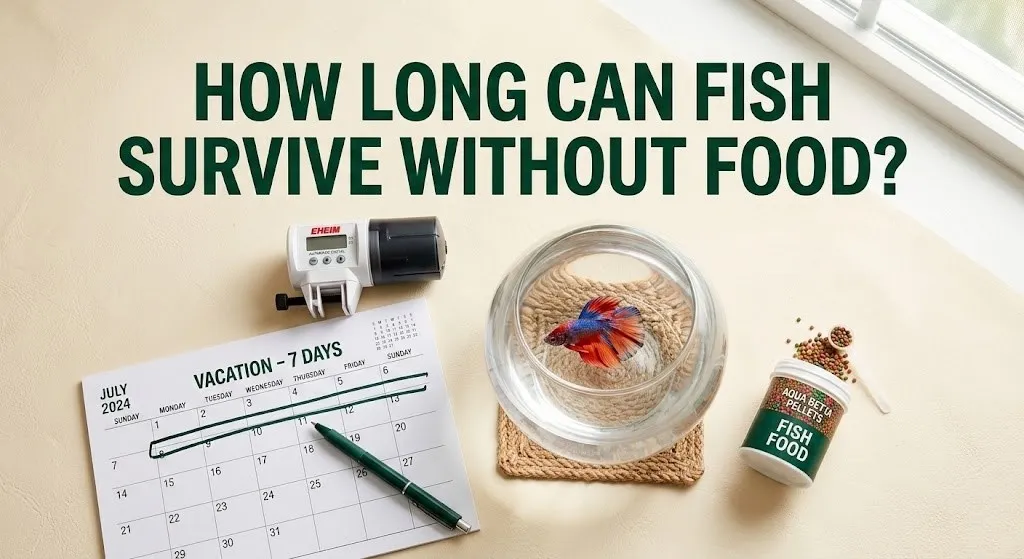
Automatic fish feeders are the gold standard. A quality automatic feeder, like the Eheim Everyday Feeder or the Fluval Auto Feeder, dispenses a precise amount of food at programmed intervals. Set the feeder to dispense once per day, and reduce the portion to half the normal amount during your absence. The fish will be fine on reduced rations, and the reduced food input protects the water quality.
Vacation feeder blocks are not recommended. These are calcium sulfate blocks that slowly dissolve and release food particles. They often release food unevenly, cloud the water, and spike ammonia levels. Many experienced aquarists return from vacation to find a tank full of dead fish and a half-dissolved white block in the corner. The risk outweighs the convenience.
To prepare your tank for a vacation:
- Perform a 25 percent water change the day before leaving.
- Feed normally for the week before. Do not overfeed.
- For trips under 4 days: No feeder needed. The fish will fast safely.
- For trips over 4 days: Use an automatic feeder set to half portions.
- Ask a pet sitter to feed only pre-portioned packets. Never let them pour freely from the container.
Key Takeaway: The automatic feeder is the best vacation investment a fish owner can make. It feeds precisely, prevents overfeeding, and keeps the fish on a routine.
Frequently Asked Questions About Fish Fasting
Can I leave my fish for a week without food?
Yes, most healthy adult fish can be left for a week without food.
Perform a water change before leaving and feed normally, not excessively, in the days before.
For tropical fish over 7 days, use an automatic feeder.
Will my fish die if I don’t feed them for 2 days?
No, a healthy fish will not die from a 2-day fast.
Fish in the wild routinely go several days without eating.
If your fish dies during a 2-day fast, it was already sick or the water quality was poor.
How do automatic fish feeders work?
Automatic feeders use a programmable timer to rotate a food drum and dispense a set amount of pellets or flakes.
Battery-powered models last for months and can be set to feed once or twice daily.
They prevent overfeeding and keep the fish on a consistent schedule.
Can fish eat vacation feeder blocks?
Vacation feeder blocks are not recommended because they dissolve unevenly and can foul the water.
The calcium sulfate base clouds the tank and can spike ammonia levels.
An automatic feeder or a pre-portioned pet sitter is safer.
How do I prepare my fish for a long fast?
Condition the fish with high-quality food for a week before the fast to build up fat reserves.
Perform a large water change the day before leaving to ensure optimal water quality.
Do not overfeed immediately before leaving, as this can cause bloating and ammonia spikes.
Your fish will survive your vacation. The anxiety you feel staring at the tank with your suitcase packed is normal. It is a sign of a responsible pet owner. The fish are more resilient than the anxiety suggests. A healthy adult fish in a clean tank can handle a week without food with no more discomfort than mild hunger.
Prepare the tank. Do a water change. Set the automatic feeder if you are gone longer than a weekend. Do not put a chalky white vacation block in the tank and hope for the best.
You will walk back through the door, drop your bags, and see your fish swimming to the glass, expecting food. They will be fine. They were fine the whole time.