Poke, pronounced “poh-kay,” is a traditional Hawaiian dish of cubed raw fish seasoned with sea salt, soy sauce, sesame oil, seaweed, and other ingredients. It is a preparation method, not a specific fish, and the style ranges from minimalist Hawaiian simplicity to elaborate mainland grain bowls.
The Academy of Nutrition and Dietetics notes that traditional fish-based dishes from island cultures often represent nutrient-dense dietary patterns built on lean protein and healthy fats. Poke fits squarely in that tradition. A basic serving of ahi poke delivers roughly 24 grams of protein, heart-healthy omega-3 fatty acids, and a flavor profile that requires no heavy sauces or frying to be deeply satisfying.
This guide explains what poke is, where it came from, what is in it, and how it changed as it moved from Hawaiian shores to mainland strip malls. You will find a full nutritional breakdown, a comparison of fish types, an honest look at the sodium content, and clear guidance on how to order or make poke that is as healthy as it is delicious.
What Is Poke Food?
Poke food is a traditional Hawaiian preparation of cubed raw fish, most commonly ahi tuna, seasoned with sea salt, soy sauce, sesame oil, seaweed, and sweet onion. The word describes the cutting technique, not the fish itself.
The defining characteristics of traditional poke are the cube cut, the raw or briefly cured state of the fish, and the relatively short list of seasonings. A classic Hawaiian poke might contain only five or six ingredients: fish, salt, seaweed, onion, and one or two seasonings. The flavor is clean, oceanic, and savory. The fish is the star.
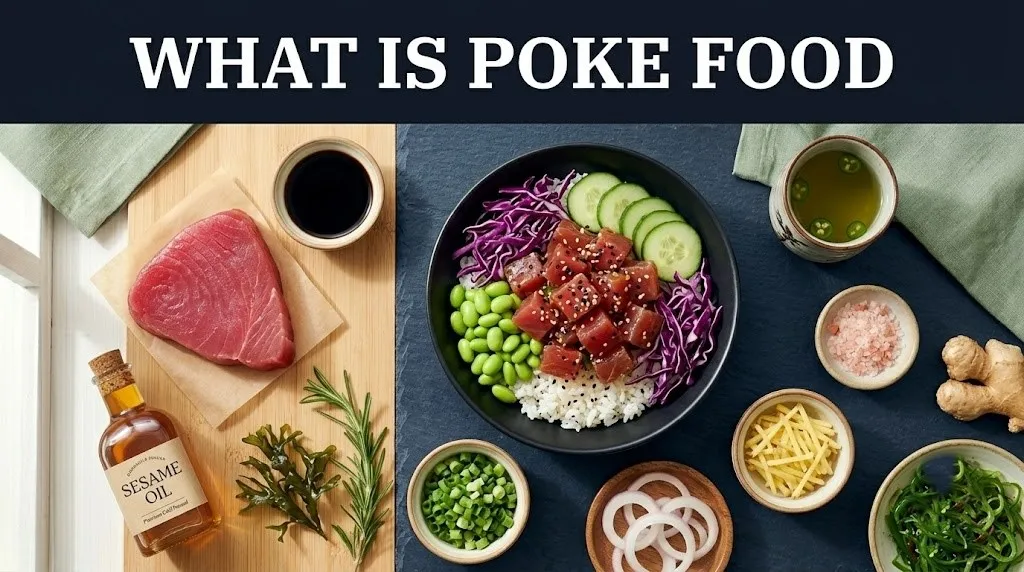
This is different from the poke bowl that has spread across the mainland United States and beyond. The mainland poke bowl is typically built on a base of rice or greens, topped with cubed fish that has been marinated in a sauce, and finished with an array of toppings like avocado, edamame, cucumber, mango, crispy onions, and multiple sauce drizzles. This is a customizable grain bowl that uses poke as a protein component. It is related to traditional poke but is its own distinct food format.
Key Takeaway: Traditional poke is cubed raw fish with a few seasonings. Mainland poke bowls are customizable grain bowls with poke fish as the protein. They share a name and an ingredient. They are not the same dish.
What Is Poke Food? Clearing Up the Spelling
The correct spelling is poke, from the Hawaiian word meaning to slice or cut crosswise into pieces. The spelling “poki” is a common misspelling, likely arising from the way the word is pronounced by people unfamiliar with Hawaiian vowel sounds.
In the Hawaiian language, every vowel is pronounced. The “o” and “e” are both sounded, making it “poh-kay” rather than “poh-kee” or “poke” like the English word for prodding. The Hawaiian alphabet contains only 13 letters, and the pronunciation rules are consistent. There is no “i” at the end of the word, which is why “poki” is always a misspelling.
The misspelling does appear in some restaurant names and online searches. This is partly because the word sounds like it could end in an “ee” sound to an English-speaking ear, and partly because of the influence of other Japanese food terms like “sashimi” and “teriyaki” that do end in that vowel sound. Correcting the spelling matters because it respects the Hawaiian origin of the dish. A food’s name is part of its cultural history.
What Does Poke Mean in Food?
Poke means “to slice” or “to cut crosswise into pieces” in the Hawaiian language. In food terms, it refers specifically to the technique of cubing raw fish into bite-sized pieces that are then seasoned and served.
The cutting technique is not arbitrary. The cubes are typically three-quarters of an inch to one inch across. This size creates a satisfying mouthfeel, a balance between surface area for seasoning contact and interior volume for tasting the fish itself. Too small, and the fish gets lost in the seasoning. Too large, and the seasoning does not penetrate.
The term poke does not specify the fish, the seasoning, or the accompaniments. It specifies the cut. This is why you see ahi poke, salmon poke, tako poke (octopus), and even non-seafood versions like tofu poke. The cube cut is the unifying element. This is comparable to how “ceviche” describes a citrus-curing technique, not a specific fish. The technique defines the dish category.
Quick Tip:
- When making poke at home, chill the fish for 15 minutes before cutting. Cold fish holds its shape better and produces cleaner cube edges.
- Use a sharp, non-serrated knife. A dull knife crushes the flesh rather than slicing it cleanly.
What Is Poke Hawaiian Food?
Poke Hawaiian food is a traditional dish with deep roots in Native Hawaiian fishing and food culture, dating back centuries before Western contact. It is not a recent fusion creation. It is an indigenous foodway.
Early Hawaiian poke was made with freshly caught reef fish, seasoned with sea salt (alaea salt) and limu (seaweed), and often finished with inamona, a condiment made from roasted, crushed kukui nut. The kukui nut, also called candlenut, is rich in oil and has a slightly nutty, earthy flavor. This combination of fresh raw fish, sea salt, seaweed, and kukui nut is the ancestral template for what the world now calls poke.
The introduction of soy sauce, sesame oil, and green onion came later, influenced by Japanese, Chinese, and Korean immigrants who arrived in Hawaii to work on sugar plantations in the 19th and early 20th centuries. These ingredients integrated into the Hawaiian poke tradition rather than replacing it. The result is a dish that is simultaneously Native Hawaiian and reflective of Hawaii’s multiethnic history.
Authentic Hawaiian poke is still found across the islands, from grocery store deli counters to dedicated poke shops to family gatherings. It is everyday food, not a special occasion dish. A Hawaiian supermarket poke counter might offer a dozen varieties, including shoyu ahi, spicy ahi, limu poke, and tako poke.
What Type of Food Is Poke?
Poke is a raw seafood salad or appetizer in Hawaiian cuisine, comparable to sashimi in Japanese cuisine or crudo in Italian cuisine. It is a cold preparation, served uncooked, and eaten as a standalone dish or as part of a larger meal.
The category of food that poke falls into is technically a raw fish salad. Unlike sashimi, which is sliced and served with a dipping sauce on the side, poke is cubed and seasoned throughout. Unlike ceviche, which is cured in citrus juice until the acid denatures the proteins, poke is seasoned and served immediately with no significant acid curing. The fish in poke remains texturally raw. The seasoning coats the surface.
In Hawaiian meals, poke functions as a protein component, similar to how grilled fish or chicken might appear on a plate. It is served alongside rice, often with a side of macaroni salad or lomi lomi salmon. On the mainland, poke is most commonly encountered as a poke bowl, where it functions as the protein topping on a grain or green base.
Key Takeaway: Poke is a raw seafood salad, distinct from sashimi (sliced, dipping sauce) and ceviche (acid-cured). The fish is cubed raw and seasoned throughout.
What Food Is Poke Exactly?
Poke is exactly cubed raw fish that has been seasoned and is ready to eat immediately. There is no cooking, no marinating for hours, and no additional preparation required after seasoning. The ingredients are mixed, and the dish is served.
The core components of any poke are the fish, the salt or salty seasoning, the fat component, and the aromatics. In the most traditional form, the fish is ahi or reef fish, the salt is alaea Hawaiian salt, the fat is kukui nut, and the aromatics are limu seaweed and onion. In the most common modern form, the fish is ahi tuna or salmon, the salty component is soy sauce, the fat is sesame oil, and the aromatics are green onion, sweet onion, and ginger.
The fish must be extremely fresh and handled with strict sanitation. The FDA Food Code requires that fish intended for raw consumption be frozen at specific temperatures and durations to kill parasites. The term “sushi-grade” or “sashimi-grade” is not a regulated FDA term. It is a marketing term used by fish suppliers to indicate that the fish has been handled appropriately for raw consumption. When buying fish for poke at home, purchase from a reputable fishmonger who can confirm the fish was previously frozen and handled for raw use.
Traditional Hawaiian Poke Explained
Traditional Hawaiian poke is simpler than most mainland versions. The ingredient list is short. The flavor is balanced but not complicated. The fish quality carries the dish.
The traditional flavoring components include alaea salt, a Hawaiian sea salt that gets its reddish-brown color from volcanic clay. It has a subtle earthy flavor beyond pure salinity. Limu, a type of seaweed, adds a briny, oceanic note and a slight crunch. Inamona, made from roasted kukui nut, contributes fat and a nutty depth that is entirely different from sesame oil. Sweet onion, often Maui onion, adds sharpness and sweetness.
Traditional poke is not served as a bowl with a grain base. It is served as a standalone dish, often as part of a plate lunch or as an appetizer at a gathering. It may be accompanied by rice, but the rice is on the side, not underneath. The transformation of poke into a grain bowl layered with a dozen toppings is a mainland innovation, not a Hawaiian tradition.
The regional variations within Hawaii are worth noting. On Oahu, shoyu ahi is the most common style. On the Big Island, spicy poke with chili pepper is more prevalent. On Kauai, limu poke with generous amounts of local seaweed is a local favorite. Poke is not a single recipe in Hawaii. It is a category with regional and family variations.
Poke Bowl Nutrition and Calories
A standard mainland poke bowl with rice, ahi tuna, mixed greens, avocado, cucumber, edamame, and a moderate amount of soy-based sauce contains roughly 500 to 700 calories, 30 to 40 grams of protein, and 15 to 25 grams of fat.
The calorie range varies dramatically based on the base, the protein portion, the toppings, and especially the sauces. A bowl built on white rice with a generous pour of spicy mayo and eel sauce can exceed 900 calories. A bowl built on mixed greens with a moderate pour of ponzu or light shoyu can stay in the 400 to 500 calorie range. The difference between the two bowls is entirely under your control as the person ordering or building.
| Poke Bowl Component | Lower Calorie Option | Higher Calorie Option |
|---|---|---|
| Base | Mixed greens, cucumber noodles | White rice, brown rice |
| Protein | Ahi tuna, salmon (3 to 4 oz) | Double protein, marinated options |
| Sauces | Ponzu, light shoyu, wasabi | Spicy mayo, eel sauce, creamy dressings |
| Toppings | Cucumber, edamame, seaweed, ginger | Avocado, crispy onions, tempura flakes |
| Extras | Sesame seeds, green onion | Macadamia nuts, wonton strips |
The protein content of a poke bowl is generally high because fish is protein-dense. A 4-ounce serving of ahi tuna delivers roughly 28 grams of protein. The fiber content depends on the base and vegetable toppings. A bowl on brown rice with edamame, cucumber, and seaweed can deliver 8 to 10 grams of fiber. A bowl on white rice with minimal vegetables may have only 2 to 3 grams.
Key Takeaway: A poke bowl ranges from 400 to 900 calories depending on your base, sauce, and topping choices. The protein is consistently high. The calorie and sodium content is what varies most.
Is Poke Healthy for You?
Poke is healthy when it is built around a moderate portion of raw fish, vegetables, and a light, soy-based sauce. It becomes less healthy when the rice portion is large, the sauce is heavy and creamy, and the toppings are fried or calorie-dense.
The health benefits of poke start with the fish. Raw tuna and salmon are rich in complete protein and omega-3 fatty acids, specifically docosahexaenoic acid (DHA) and eicosapentaenoic acid (EPA). The American Heart Association recommends eating two servings of fatty fish per week for cardiovascular health. A poke bowl with 4 ounces of salmon covers one of those servings.
The primary nutritional concern with poke is not the fish. It is the sodium. A single tablespoon of standard soy sauce contains roughly 900 milligrams of sodium. A poke bowl can contain two to three tablespoons of sauce when you account for the marinade, the dressing on the base, and any finishing drizzle. That is 1,800 to 2,700 milligrams of sodium, which is 78 to 117 percent of the American Heart Association’s ideal daily limit of 2,300 milligrams. The sodium content is the strongest argument for moderation with poke.
Pregnant women, immunocompromised individuals, and young children should exercise caution with raw fish due to the risk of foodborne illness. The Academy of Nutrition and Dietetics recommends that these groups avoid raw seafood. Cooked poke alternatives, including cooked shrimp or tofu poke, are safe options that deliver similar flavors without the raw fish risk.
Poke Fish Types and Their Differences
The fish used in poke varies in flavor, texture, fat content, and sustainability profile. Understanding the differences helps you choose based on taste, nutrition, and environmental impact.
Ahi tuna is the most traditional and most common poke fish. The term ahi refers to two species: yellowfin tuna (Thunnus albacares) and bigeye tuna (Thunnus obesus). Both are lean, firm, and deep red when raw. Yellowfin is more sustainable than bigeye, which is overfished in some regions. Ahi has a clean, meaty flavor and a firm texture that holds up well to cubing.
Salmon is the second most common poke fish, particularly on the mainland. It is fattier than tuna, with a softer, more buttery texture. The fat in salmon is predominantly unsaturated, including high levels of omega-3s. A 3-ounce serving of Atlantic salmon contains roughly 1.5 grams of combined DHA and EPA. Salmon is almost always farmed when used in poke unless specifically labeled wild.
Hamachi, also called yellowtail or Japanese amberjack (Seriola quinqueradiata), is rich, buttery, and slightly sweet. It is a premium option that appears at higher-end poke shops. Tako, or octopus, is cooked, not raw. It is chewy and mild and appears in traditional Hawaiian poke counters alongside the raw fish options.
| Fish Type | Texture | Fat Content | Omega-3s (per 3oz) | Sustainability Notes |
|---|---|---|---|---|
| Ahi (yellowfin tuna) | Firm, meaty | Low (1g) | 0.1g | Pole-caught is best choice |
| Salmon (Atlantic, farmed) | Soft, buttery | High (12g) | 1.5g | Look for ASC-certified farms |
| Hamachi (yellowtail) | Rich, firm | Moderate (5g) | 0.8g | Mostly farmed, check source |
| Tako (octopus) | Chewy, mild | Low (1g) | 0.2g | Generally sustainable |
Key Takeaway: Ahi is lean and traditional. Salmon is fatty and high in omega-3s. Hamachi is buttery and premium. Choose based on taste preference and sustainability rating.
Ahi Tuna Poke vs Salmon Poke Nutrition
Ahi tuna poke and salmon poke have distinct nutritional profiles. Tuna is leaner and higher in protein per ounce. Salmon is fattier and higher in omega-3 fatty acids and vitamin D.
A 4-ounce serving of raw ahi tuna contains roughly 145 calories, 32 grams of protein, and 1.5 grams of fat. A 4-ounce serving of raw Atlantic salmon contains roughly 240 calories, 23 grams of protein, and 16 grams of fat. The protein per calorie is higher in tuna. The omega-3 content is much higher in salmon.
| Nutrient (per 4oz raw) | Ahi Tuna | Atlantic Salmon |
|---|---|---|
| Calories | 145 | 240 |
| Protein | 32 g | 23 g |
| Total Fat | 1.5 g | 16 g |
| Saturated Fat | 0.4 g | 3 g |
| DHA and EPA Omega-3s | 0.1 g | 2.0 g |
| Vitamin D | 60 IU | 400 IU |
The choice between tuna and salmon depends on your nutritional goals. If you are prioritizing protein density and a leaner meal, tuna is the better choice. If you are prioritizing omega-3 intake and vitamin D, salmon is the better choice. Both are nutritionally excellent. The difference is in the fat profile, not in one being healthy and the other being unhealthy.
A note on mercury: Tuna, particularly bigeye tuna, accumulates more mercury than salmon. The FDA advises that adults can safely eat 2 to 3 servings of lower-mercury fish per week. Yellowfin tuna is moderate in mercury. Bigeye tuna is high in mercury. Salmon is low in mercury. Pregnant women and children should choose salmon over tuna for poke.
Poke Sauce Ingredients and Sodium Content
Poke sauce ingredients vary, but the base is almost always soy sauce or shoyu. The sodium content of the sauce is the single most important nutritional variable in a poke bowl.
Traditional shoyu poke sauce combines soy sauce, sesame oil, ginger, green onion, and occasionally a small amount of sugar or mirin. Soy sauce contains roughly 900 milligrams of sodium per tablespoon. A traditional poke recipe uses about 1 tablespoon of soy sauce per 4 to 6 ounces of fish. This keeps the sodium content reasonable, roughly 450 to 900 milligrams from the sauce alone.
Mainland poke shops often use more sauce and multiple sauces. A bowl might include shoyu marinade on the fish, a ponzu dressing on the greens, and a spicy mayo drizzle on top. Spicy mayo is a blend of mayonnaise and sriracha. Eel sauce is a sweet, thickened soy reduction. Both add significant sodium, fat, and calories.
| Sauce or Seasoning | Sodium (per 1 tbsp) | Primary Flavor |
|---|---|---|
| Soy sauce (shoyu) | 900 mg | Salty, umami |
| Tamari | 800 to 1,000 mg | Salty, wheat-free |
| Coconut aminos | 270 mg | Mildly sweet, salty |
| Ponzu | 350 to 500 mg | Citrusy, tangy |
| Spicy mayo | 100 to 150 mg | Creamy, spicy |
| Eel sauce | 400 to 600 mg | Sweet, savory |
The best strategy for managing sodium in a poke bowl is to choose one sauce, not three. Ask for light sauce if that option is available. If the fish is pre-marinated, skip the additional dressing on the base. Coconut aminos are a lower-sodium alternative to soy sauce for homemade poke, but the flavor is sweeter and less intensely savory.
Key Takeaway: Soy sauce is the main sodium source in poke. One tablespoon contains 900 milligrams. Multiple sauces can push a single bowl past 2,000 milligrams of sodium.
Raw Fish Safety and FDA Guidelines
Raw fish safety for poke follows the FDA Food Code, which requires that fish intended for raw consumption be frozen at specific temperatures to kill parasites. The safety of your poke depends on the sourcing and handling of the fish.
The FDA requires that fish served raw be frozen at negative 4 degrees Fahrenheit for 7 days or at negative 31 degrees Fahrenheit for 15 hours. This freezing kills parasites that can be present in wild-caught fish. The term “sushi-grade” is not an FDA-regulated term. It is a supplier designation that generally indicates the fish has been handled according to these raw consumption guidelines.
At a poke restaurant or grocery counter, the fish should be displayed on ice or in a refrigerated case at 41 degrees Fahrenheit or below. The staff should use clean gloves and utensils. The fish should smell like the ocean, not fishy. A fishy odor indicates bacterial breakdown and is a reason to choose a different shop.
Pregnant women, young children, older adults, and immunocompromised individuals are advised by the FDA and the Academy of Nutrition and Dietetics to avoid raw fish due to the risk of foodborne illness from bacteria like Listeria and Vibrio, which are not killed by freezing. These groups should opt for cooked seafood poke alternatives, such as cooked shrimp, cooked octopus, or tofu poke.
Quick Tip:
- Ask the poke shop when the fish was cut. Ideally, it was cut within the last few hours.
- Look for fish that appears glossy and firm, not dull or separating.
- If making poke at home, purchase fish from a reputable fishmonger and tell them you intend to eat it raw.
Sustainable Poke Fish Choices
Sustainable poke fish choices align your meal with the health of ocean ecosystems. The most common poke fish vary dramatically in their sustainability profiles.
The Monterey Bay Aquarium Seafood Watch program rates seafood based on population status, fishing or farming methods, and ecosystem impacts. For poke lovers, the best choices include pole-caught yellowfin tuna from the Pacific, farmed salmon from ASC-certified operations, and farmed hamachi from Japan. Fish to avoid for sustainability reasons include bigeye tuna, which is overfished in many regions, and bluefin tuna, which is critically depleted.
Salmon sustainability is complex. Wild Alaskan salmon is generally a best choice, but it is rarely used in poke because it is leaner and the supply chain is different from farmed Atlantic salmon. Most poke shop salmon is farmed Atlantic salmon. The sustainability of farmed salmon depends on the specific farming operation. Look for ASC or BAP certification labels.
Poke shops that prioritize sustainability often list the source of their fish on the menu or website. A shop that can tell you the species, catch method, and origin of its tuna is likely sourcing more carefully than one that simply labels everything “ahi.”
| Fish | Best Choice | Good Alternative | Avoid |
|---|---|---|---|
| Tuna | Yellowfin, pole-caught (Pacific) | Yellowfin, longline (Pacific) | Bigeye, bluefin |
| Salmon | Wild Alaskan, ASC-certified farmed | BAP-certified farmed Atlantic | Open-net pen farmed without certification |
| Hamachi | Farmed Japan (closed system) | Farmed Australia | Uncertified farmed |
How to Order a Healthy Poke Bowl
Ordering a healthy poke bowl is a matter of making intentional choices at each step of the assembly line. The bowl can swing 500 calories in either direction based on your selections.
Start with the base. Mixed greens, kale, or cucumber noodles add volume, fiber, and micronutrients with minimal calories. Brown rice or quinoa add fiber and a nuttier flavor at a similar calorie count to white rice. White rice is fine in moderation but spikes blood sugar more quickly. A half-and-half option of greens and rice is a good compromise.
Choose one protein. A standard portion of 3 to 4 ounces of fish is adequate for a satisfying bowl. Double protein doubles the cost and the calories, though most of those extra calories are from healthy protein and fat. Add at least three vegetables. Edamame adds protein and fiber. Cucumber adds crunch and hydration. Seaweed salad adds iodine and a savory contrast.
The sauce is where bowls go off the rails. Choose one sauce. Ask for it on the side if possible, or ask for a light drizzle. Avoid bowls that come with multiple pre-selected sauces. A poke bowl with shoyu, spicy mayo, and eel sauce can contain 400 to 500 calories from sauces alone.
To assemble a healthy poke bowl:
- Choose a base of mixed greens or half greens, half brown rice.
- Select one protein: ahi tuna or salmon, standard 3 to 4 ounce portion.
- Add three or more vegetable toppings: cucumber, edamame, seaweed, shredded carrot.
- Choose one light sauce: ponzu, light shoyu, or wasabi.
- Finish with a small amount of a healthy fat: avocado or a sprinkle of sesame seeds.
- Skip or go light on crispy toppings, fried elements, and creamy sauces.
Key Takeaway: Greens or half-greens base, one protein, three vegetables, one light sauce. Skip the multiple sauce drizzles and fried toppings.
How to Make Authentic Poke at Home
Making authentic poke at home is straightforward and requires few ingredients. The quality of the fish determines the quality of the final dish. There is no cooking to hide behind.
The most important step is sourcing the fish. Go to a fishmonger you trust. Tell them you are making poke and need fish that has been previously frozen and is safe for raw consumption. The fish should be kept cold on the way home and used the same day. Do not let raw fish sit in the refrigerator for multiple days before making poke.
To make traditional shoyu ahi poke:
- Purchase 1 pound of sushi-grade ahi tuna. Chill for 15 minutes before cutting.
- Cut the tuna into 3/4-inch cubes using a sharp, non-serrated knife.
- In a bowl, whisk together 2 tablespoons soy sauce, 1 teaspoon sesame oil, and 1 teaspoon grated fresh ginger.
- Thinly slice 1/4 cup sweet onion and chop 2 tablespoons green onion.
- Add the tuna to the bowl with the sauce. Add the onions. Gently fold to coat the fish evenly.
- If available, add 1 tablespoon of chopped limu or ogo seaweed and 1 teaspoon of crushed kukui nut.
- Serve immediately. Poke does not benefit from extended marinating.
This recipe makes two servings. Nutrition per serving: approximately 280 calories, 32 grams protein, 8 grams fat, 4 grams carbohydrate, 450 milligrams sodium. Use tamari instead of soy sauce for a gluten-free version.
Frequently Asked Questions About Poke Food
Is poke healthy for weight loss?
Poke can be an effective weight-loss meal when built with a greens base, a standard portion of lean tuna, and a light sauce.
A bowl with greens, 4 ounces of ahi, cucumber, edamame, and ponzu contains roughly 350 to 400 calories with 35 grams of protein.
The protein and volume keep you full while the calorie count leaves room for other meals.
Can you eat poke while pregnant?
The FDA and the Academy of Nutrition and Dietetics advise pregnant women to avoid raw seafood due to the risk of foodborne illness.
Cooked alternatives like cooked shrimp poke or tofu poke provide similar flavors without the raw fish risk.
Salmon is lower in mercury than tuna and is the safer choice if a pregnant person chooses to eat raw fish, though the official recommendation remains to avoid it.
What is the difference between poke and ceviche?
Poke is cubed raw fish seasoned with soy, sesame, and aromatics and served immediately. Ceviche is raw fish cubed and then cured in citrus juice until the acid denatures the proteins, turning the flesh opaque and firm.
Poke tastes of the fish and the seasoning. Ceviche tastes of the fish and the citrus. They are texturally and flavorfully distinct.
Is poke gluten free?
Poke is not automatically gluten free because standard soy sauce contains wheat.
Tamari is a wheat-free soy sauce alternative that makes poke gluten free.
Ask the poke shop whether their marinade uses tamari. If they use standard soy sauce, the poke contains gluten.
How long does poke last in the fridge?
Poke should be eaten within 2 hours of preparation if left at room temperature. In the refrigerator, poke should be consumed within 24 hours.
The texture of the fish degrades as it sits in the seasoning. The fish becomes softer and the flavor intensifies.
Do not eat poke that has been in the refrigerator for more than 24 hours, regardless of smell or appearance.
Poke is one of the simplest and most nutritious seafood traditions in the world. A bowl of cubed raw fish, seasoned lightly and eaten fresh, delivers protein, omega-3s, and clean, oceanic flavor in a form that requires no cooking and very few ingredients.
Next time you order poke, think about the bowl you are building. A greens base, a single lean protein, three vegetables, and one light sauce. That bowl will be delicious, satisfying, and genuinely good for you. And when you want the real thing, find a shop that understands the Hawaiian roots of the dish, the tradition of simplicity, and the respect for the fish.