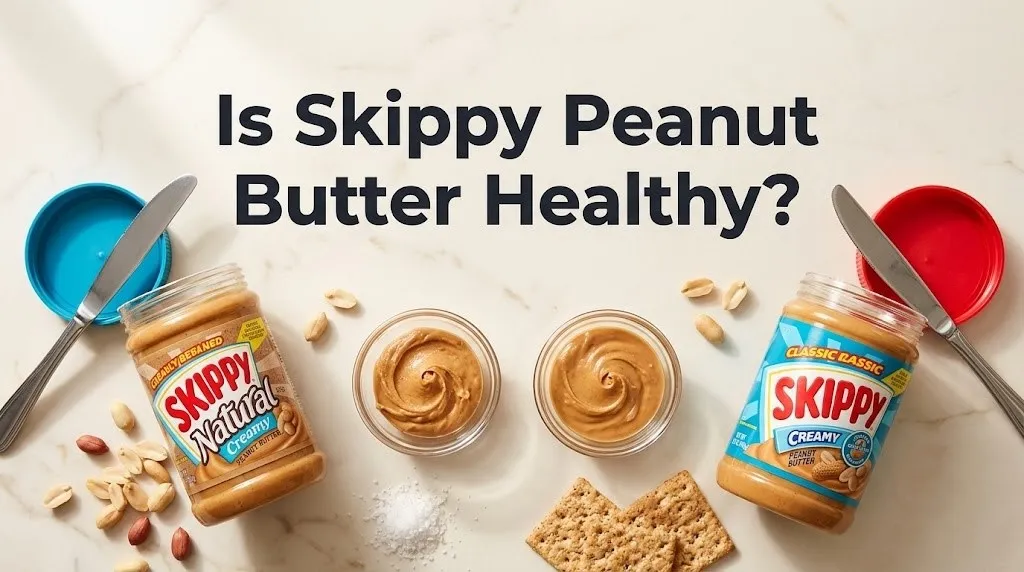
Skippy peanut butter is a calorie-dense spread that delivers healthy unsaturated fats, plant-based protein, and several vitamins and minerals, but its health value depends almost entirely on which jar you pick. The classic Skippy Creamy Peanut Butter contains added sugar and fully hydrogenated vegetable oil, which push it into processed food territory. Skippy Natural Peanut Butter contains only peanuts, sugar, palm oil, and salt. That is a far cleaner ingredient panel and a meaningfully healthier product.
Peanut butter is one of the most nutritionally interesting foods in the average American pantry. It is a legume product, not a nut, made from ground, roasted peanuts (Arachis hypogaea). Two tablespoons deliver roughly 190 calories, 7 grams of protein, 16 grams of fat, mostly monounsaturated, and 2 grams of fiber. The American Heart Association recognizes nuts and nut butters as part of a heart-healthy dietary pattern when consumed in appropriate portions. Skippy’s classic formulation adds ingredients that dilute that whole-food benefit.
This review breaks down the nutritional differences between Skippy’s product lines, analyzes the added sugar and hydrogenated oil issue, compares Skippy to competitors like Jif, Smucker’s Natural, and store-brand natural peanut butters, and identifies which Skippy products are worth buying and which are best left on the shelf. Every figure is sourced from product labels and the USDA FoodData Central database as of 2026.
Skippy Peanut Butter Nutrition Facts: A Complete Breakdown
A 2-tablespoon serving of Skippy Creamy Peanut Butter contains 190 calories, 16 grams of total fat, 3.5 grams of saturated fat, 7 grams of carbohydrate, 3 grams of sugar, 2 grams of fiber, and 7 grams of protein. The micronutrient profile includes vitamin E, niacin (vitamin B3), magnesium, phosphorus, and a small amount of potassium and calcium. The food is nutrient-dense within its calorie load, providing meaningful amounts of several vitamins and minerals alongside its primary macronutrients.
The fat profile is where Skippy earns most of its nutritional credibility. Of the 16 grams of fat per serving, roughly 8 grams are monounsaturated fat, the same heart-healthy fat found in olive oil and avocados. Another 4.5 grams are polyunsaturated fat, which includes linoleic acid, an essential omega-6 fatty acid. Only 3.5 grams are saturated fat. Research published in the Journal of the American Heart Association has consistently shown that replacing saturated fat with unsaturated fat improves blood lipid profiles and reduces cardiovascular disease risk.
The sugar content in Skippy Creamy is 3 grams per serving, about three-quarters of a teaspoon. This is not a high-sugar food by the standards of sweetened spreads and sauces. It is not zero-sugar either. The American Heart Association recommends that added sugar be limited to no more than 25 grams per day for women and 36 grams per day for men. Three grams from a peanut butter sandwich is a small fraction of that budget. The sugar is added for flavor balance and consistency, not as a primary ingredient.
The nutrition panel for the three main Skippy products:
| Nutrient (per 2 tbsp) | Skippy Creamy | Skippy Natural Creamy | Skippy Reduced Fat Creamy |
|---|---|---|---|
| Calories | 190 | 190 | 190 |
| Total Fat | 16 g | 16 g | 12 g |
| Saturated Fat | 3.5 g | 3.5 g | 2 g |
| Carbohydrates | 7 g | 6 g | 15 g |
| Sugar | 3 g | 3 g | 4 g |
| Dietary Fiber | 2 g | 2 g | 2 g |
| Protein | 7 g | 7 g | 7 g |
| Sodium | 150 mg | 125 mg | 170 mg |
Source: Skippy product nutrition labels, 2026
Skippy Reduced Fat deserves specific attention because it represents a common nutritional misunderstanding. The fat has been reduced from 16 grams to 12 grams, but the carbohydrate content has been increased from 7 grams to 15 grams through the addition of maltodextrin and corn syrup solids. The calorie count remains identical at 190 per serving. You are trading healthy unsaturated fat for processed carbohydrate fillers with no calorie savings. The Academy of Nutrition and Dietetics advises that reducing healthy fats in favor of refined carbohydrates is not a beneficial nutritional trade. Skip the reduced-fat version. It is the least healthy product in the Skippy lineup.
Skippy Peanut Butter Ingredients: What Is Actually in Each Jar?
The ingredient list for Skippy Creamy Peanut Butter reads as follows: roasted peanuts, sugar, hydrogenated vegetable oil (cottonseed, soybean, and rapeseed oil), salt. This is a short list by processed food standards, four ingredients total, but the hydrogenated vegetable oil is the ingredient that separates Skippy Creamy from a genuinely natural peanut butter.
Hydrogenated vegetable oil is added to prevent the natural oil separation that occurs in pure peanut butter. In a jar of 100 percent ground peanuts, the oil rises to the top over time and must be stirred back into the solids. Skippy adds fully hydrogenated oil, which is solid at room temperature, to lock the peanut oil into a stable emulsion that never separates. This is a texture and convenience choice, not a nutritional one. The FDA banned partially hydrogenated oils, the source of artificial trans fat, in 2018, but fully hydrogenated oils remain permitted. Fully hydrogenated oil contains no trans fat because the hydrogenation is complete, but it does add a small amount of saturated fat to the product.
Skippy Natural Creamy Peanut Butter lists these ingredients: roasted peanuts, sugar, palm oil, salt. This is also a four-ingredient list, but palm oil replaces hydrogenated vegetable oil as the stabilizer. Palm oil is naturally solid at room temperature due to its saturated fat content, and it achieves the same no-stir texture without hydrogenation. The ingredient panel is cleaner and the product is closer to a whole food. The trade-off is that palm oil cultivation has environmental consequences, including deforestation and habitat loss in Southeast Asia. The Roundtable on Sustainable Palm Oil (RSPO) certifies sustainably produced palm oil. Skippy’s parent company, Hormel Foods, has not prominently marketed RSPO certification on Skippy labels as of 2026.
Skippy No Sugar Added Peanut Butter is not part of the standard lineup but is an emerging product in 2026. Its ingredients are roasted peanuts, palm oil, salt. This is the cleanest ingredient panel in the Skippy family, three ingredients, no added sugar, no hydrogenation. It is nutritionally comparable to stir-style natural peanut butters from Smucker’s Natural or Trader Joe’s.
The ingredient comparison across the Skippy line:
| Product | Roasted Peanuts | Added Sugar | Oil Stabilizer | Additives |
|---|---|---|---|---|
| Skippy Creamy | Yes | Yes | Hydrogenated vegetable oil | Salt |
| Skippy Natural Creamy | Yes | Yes | Palm oil | Salt |
| Skippy Reduced Fat | Yes | Yes (plus corn syrup solids) | Hydrogenated vegetable oil | Maltodextrin, salt |
| Skippy No Sugar Added | Yes | No | Palm oil | Salt |
Key Takeaway: Skippy Natural is the best mainstream Skippy product for health because it uses palm oil instead of hydrogenated oil and avoids the carbohydrate fillers in the reduced-fat version. A truly natural peanut butter with only peanuts and salt is still the gold standard.
Is Skippy Natural Peanut Butter Actually Healthy?
Skippy Natural Peanut Butter is a healthy food when eaten in a reasonable portion size, defined as 2 tablespoons, within a dietary pattern that is otherwise rich in whole plant foods. It provides 190 calories, 16 grams of predominantly unsaturated fat, 7 grams of plant protein, and 2 grams of fiber from a clean ingredient panel of peanuts, sugar, palm oil, and salt. The sugar adds 3 grams per serving, a small amount that does not disqualify the product from being part of a healthy diet.
The protein in Skippy Natural is incomplete, meaning it does not contain all nine essential amino acids in the proportions the human body needs. Peanuts are low in methionine, an essential sulfur-containing amino acid. This is nutritionally irrelevant for anyone eating a varied diet because the missing amino acids are supplied by other foods eaten throughout the day. The idea that plant proteins must be combined at every meal for completeness was disproven decades ago. The body maintains an amino acid pool from which it draws. Eating peanut butter on whole-wheat bread at breakfast and lentils at dinner provides all the amino acids needed.
The fat profile is genuinely beneficial. Monounsaturated fat, the dominant fatty acid in peanut butter, is associated with improved LDL cholesterol levels and reduced cardiovascular risk when it replaces saturated fat in the diet. A 2024 meta-analysis published in Nutrients examined cohort studies and found that higher nut and peanut consumption was associated with a 13 percent lower risk of cardiovascular disease and a 15 percent lower risk of coronary heart disease. Peanut butter, because it is ground into a paste, delivers these fats in a form that is easy to digest and absorb.
The palm oil in Skippy Natural is the most legitimate nutritional concern. Palm oil is approximately 50 percent saturated fat, and it raises LDL cholesterol compared to liquid vegetable oils. The amount in a 2-tablespoon serving is small, roughly 1 to 1.5 grams of additional saturated fat beyond what the peanuts themselves contain. For a person eating peanut butter a few times a week, this is a rounding error in the context of total dietary saturated fat. For a person eating multiple peanut butter sandwiches every day, the cumulative effect matters more. A truly natural peanut butter made from only peanuts and salt has no added palm oil and no saturated fat beyond what the peanuts naturally contain.
Skippy vs. Competitors: Jif, Smucker’s Natural, and Store Brands
Skippy Creamy and Jif Creamy are nutritionally indistinguishable. Both contain 190 calories, 16 grams of fat, 7 grams of protein, 3 grams of sugar, and hydrogenated vegetable oil per 2-tablespoon serving. The ingredient lists are nearly identical. The choice between Skippy and Jif is a matter of taste preference, brand loyalty, and price. Jif often wins on flavor in blind taste tests. Skippy often wins on spreadability and a slightly less sweet profile. Neither wins on nutrition because there is no nutritional difference to measure.
Smucker’s Natural Peanut Butter is a meaningful nutritional upgrade over Skippy Creamy or Skippy Natural. The ingredients are peanuts and salt. Two ingredients. No added sugar. No added oil. No stabilizers. The oil separates and must be stirred in, which is the trade-off for a cleaner ingredient panel. The nutrition panel is nearly identical in macronutrient composition because peanuts are the dominant ingredient in both products, but Smucker’s Natural has zero added sugar and zero hydrogenated or palm oil. For a consumer who wants the healthiest widely available peanut butter, Smucker’s Natural is the answer.
Store-brand natural peanut butters from Trader Joe’s, Kirkland Signature (Costco), 365 by Whole Foods, and Great Value (Walmart) typically offer ingredients comparable to Smucker’s Natural, peanuts and salt, at a lower price. The quality is high because the ingredient list is so short that there is nothing to hide. A jar of Trader Joe’s Creamy Salted Peanut Butter made from dry roasted peanuts and salt costs roughly $2.29 for 16 ounces in 2026, compared to $3.49 to $4.49 for a comparable size of Skippy Natural. The store-brand natural peanut butter is almost always the better value for the nutritional equivalent or better.
| Brand (per 2 tbsp) | Calories | Added Sugar (g) | Oil Added | Key Ingredients |
|---|---|---|---|---|
| Skippy Creamy | 190 | 3 | Hydrogenated | Peanuts, sugar, hydrogenated oil, salt |
| Skippy Natural | 190 | 3 | Palm oil | Peanuts, sugar, palm oil, salt |
| Jif Creamy | 190 | 3 | Hydrogenated | Peanuts, sugar, hydrogenated oil, salt |
| Smucker’s Natural | 190 | 0 | None | Peanuts, salt |
| Trader Joe’s Creamy Salted | 190 | 0 | None | Dry roasted peanuts, salt |
Is Skippy Healthy for Weight Loss?
Skippy peanut butter can support weight loss when eaten in measured portions because its combination of protein, fat, and fiber promotes satiety, the feeling of fullness that prevents overeating later in the day. The calorie density at 190 calories per 2 tablespoons is high, which means portion control is not optional. A heaping tablespoon of peanut butter can contain 150 to 200 calories without looking like much on the plate.
The satiety research on nuts and nut butters is consistent. A study published in the European Journal of Clinical Nutrition found that consuming peanut butter with a meal slowed the post-meal rise in blood glucose and extended the feeling of fullness compared to a meal without nuts. The fat slows gastric emptying. The protein triggers satiety hormone release. The fiber adds bulk. These three mechanisms make a tablespoon of peanut butter on whole-grain toast a more filling breakfast than the same number of calories from white toast with jam.
The practical challenge with peanut butter and weight loss is not the food itself. It is the portion size. A standard serving is 2 tablespoons, which is roughly the size of a golf ball. Most people eating peanut butter from the jar with a spoon serve themselves two to three times that amount without measuring. At 190 calories per serving, that adds up quickly. The solution is to measure peanut butter with a tablespoon or weigh it with a kitchen scale. A 32-gram serving is the standard. Doing this even once gives you a visual reference for what a real serving looks like, and that reference improves portion estimation moving forward.
Reduced-fat peanut butter is not a weight loss tool. As shown in the nutrition table above, Skippy Reduced Fat replaces healthy unsaturated fat with refined carbohydrates while keeping the calorie count identical. The body metabolizes those added carbohydrates differently, with a faster insulin response and less satiety than the fat they replace. The Harvard T.H. Chan School of Public Health recommends full-fat nut butters over reduced-fat versions for this reason. Fat is not the enemy of weight loss. Uncontrolled calories are, and reduced-fat peanut butter does not reduce calories.
What About Aflatoxins in Skippy Peanut Butter?
Aflatoxins are naturally occurring toxins produced by certain molds, primarily Aspergillus flavus and Aspergillus parasiticus, that can grow on peanuts in the field or during storage. The FDA monitors and enforces aflatoxin limits in peanut products sold in the United States, and Skippy, as a major commercial brand, tests its peanut supply for aflatoxin contamination as part of standard food safety protocols.
The FDA action level for aflatoxins in peanut products is 20 parts per billion (ppb). Peanut butter sold in interstate commerce must not exceed this threshold. Major manufacturers like Hormel Foods, which owns Skippy, source peanuts through supply chains that include aflatoxin screening at multiple points from farm to factory. The risk of aflatoxin exposure from a jar of commercially produced peanut butter in the United States is low. The Centers for Disease Control and Prevention (CDC) has not identified domestically produced commercial peanut butter as a source of aflatoxin-related illness in the United States.
The concern about aflatoxins is more relevant for peanuts sourced from regions with less rigorous food safety enforcement or stored in conditions that promote mold growth. Long-term exposure to high levels of aflatoxins is classified as a Group 1 carcinogen by the International Agency for Research on Cancer (IARC), linked to liver cancer in populations with high dietary intake. This is a genuine global health concern. It is not a concern that should keep a U.S. consumer from eating a Skippy peanut butter sandwich.
For consumers who want to minimize aflatoxin exposure beyond what the FDA already requires, choosing valencia peanuts or peanuts grown in regions with dry climates, like New Mexico, where mold growth is naturally suppressed, can further reduce risk. Freshly ground peanut butter from a store grinder may have higher aflatoxin levels than jarred commercial brands because the turnover on the grinder and the storage conditions of the bulk peanuts are less controlled than a sealed manufacturing line.
Is Skippy Safe for Dogs? A Quick Pet Safety Note
Skippy peanut butter in small amounts is safe for most dogs, provided the product does not contain xylitol, a sugar substitute that is extremely toxic to dogs and can cause rapid hypoglycemia, seizures, and liver failure. Skippy peanut butter does not contain xylitol as of 2026. The primary sweetener in Skippy is sugar, which is not acutely toxic to dogs but provides empty calories that contribute to weight gain and pancreatitis risk.
The safety concern with peanut butter for dogs has shifted in the last several years because some brands, particularly those marketed as low-sugar or keto-friendly, have begun adding xylitol or birch sugar (which is xylitol by another name) as a sweetener. Skippy is not one of these brands. The standard and natural Skippy lines use sugar, not sugar alcohols. Always check the ingredient label before giving any peanut butter to a dog, because formulations change without warning.
Peanut butter is a useful tool for giving dogs medication or filling a Kong toy for enrichment. A thin smear is sufficient. A tablespoon of Skippy contains 95 calories, which is a meaningful fraction of a small dog’s daily energy requirement. For a 10-pound dog needing roughly 200 to 250 calories per day, a tablespoon of peanut butter represents nearly half the daily calorie budget. This is a treat, not a meal component. The American Society for the Prevention of Cruelty to Animals (ASPCA) recommends that treats make up no more than 10 percent of a dog’s daily caloric intake. A pea-sized amount of peanut butter fits that guideline. A heaping spoonful does not.
A veterinarian can provide individualized guidance on appropriate treats for your dog based on breed, weight, age, and any underlying health conditions. Dogs with pancreatitis or a history of gastrointestinal sensitivity should avoid high-fat treats including peanut butter entirely.
Frequently Asked Questions About Skippy Peanut Butter
Is Skippy peanut butter healthier than Jif?
Skippy and Jif are nutritionally nearly identical, with the same calorie, fat, protein, and sugar content per serving.
Both classic versions contain added sugar and hydrogenated vegetable oil.
The choice between them is a matter of taste, texture preference, and price, not nutritional superiority.
Does Skippy peanut butter have trans fat?
Skippy peanut butter contains zero grams of trans fat per serving as of 2026.
The hydrogenated oil used in Skippy Creamy is fully hydrogenated, which does not produce trans fats the way partially hydrogenated oils did.
The FDA banned partially hydrogenated oils in 2018, and Skippy reformulated to fully hydrogenated oil before that ban took effect.
Is Skippy Natural really natural?
Skippy Natural is closer to a natural food than Skippy Creamy because it uses palm oil instead of hydrogenated oil and avoids the maltodextrin found in the reduced-fat version.
It still contains added sugar and added oil, which a strict definition of “natural peanut butter” would exclude.
A truly natural peanut butter contains only peanuts and salt with no added sugar or stabilizing oils.
Can diabetics eat Skippy peanut butter?
People with diabetes can eat Skippy peanut butter in measured portions because its fat and protein content blunts the blood sugar response compared to a carbohydrate-only snack.
The 3 grams of added sugar per serving is modest and manageable within a diabetic eating plan.
Skippy Natural or a no-sugar-added peanut butter is the better choice for minimizing added sugar intake.
Is it OK to eat Skippy peanut butter every day?
Eating Skippy peanut butter every day is fine for most people when the portion is limited to 2 tablespoons and the rest of the diet is balanced.
The healthy fats, protein, and micronutrients in peanut butter support heart health and satiety.
Daily consumption of Skippy Natural is a better choice than daily consumption of Skippy Creamy because of the cleaner ingredient panel.
Skippy peanut butter is a split decision. Skippy Natural is a perfectly good pantry staple. The ingredient panel is clean, the fat profile is heart-healthy, the protein is useful, and the sugar content is low. Skippy Creamy is the older, less healthy sibling whose hydrogenated oil stabilizer keeps the peanut oil from separating but adds nothing of nutritional value. The difference between the two jars is the difference between a processed food and a nearly whole food with a minor stabilizer trade-off.
The most important number on a Skippy label is the serving size: 2 tablespoons, 32 grams, 190 calories. Measure it once so you know what it looks like. After that, you can probably eyeball it. Most people who think they are eating a tablespoon of peanut butter are eating two or three. That is the difference between peanut butter as a health food and peanut butter as a calorie surplus that shows up on the scale.
If you have the choice and the budget, buy a natural peanut butter that contains only peanuts and salt. Stir it when you open it, store it in the refrigerator after opening to slow oil separation, and enjoy a food that is exactly what it claims to be. If Skippy Natural is what is available and affordable, that is a good choice too. Skippy Natural is a solid, widely available, reasonably healthy peanut butter. The classic jar with the red lid is not. Now you know the difference.