Broccoli cheddar soup can be a reasonably healthy meal or a high-calorie indulgence, depending entirely on how it is made and where you get it. A homemade version with extra vegetables, reduced cheese, and milk instead of heavy cream delivers fiber, protein, and vitamins in a warm, satisfying bowl. A restaurant bread bowl version can easily exceed 1,000 calories and 2,000 milligrams of sodium in a single sitting.
The gap between the healthiest and least healthy versions of this soup is massive. Think of broccoli cheddar soup as a spectrum, not a fixed food. On one end, you have a homemade pot loaded with pureed broccoli, carrots, and onions, using sharp cheddar for maximum flavor with less cheese and thickened naturally with blended vegetables rather than a butter-and-flour roux. On the other end, you have a commercially produced version designed for shelf stability and maximum craveability, heavy on cream, salt, and melted cheese with just enough broccoli to earn its name. These two soups share a title and little else.
This guide breaks down exactly what is in your bowl, whether you are ladling from a pot on your stove, ordering at a counter, or opening a can. You will learn what broccoli actually contributes nutritionally after it has been simmered into soup, how cheddar and cream affect the saturated fat math, and the specific ingredient swaps that drop a recipe from 450 calories per serving to under 300 without turning it into thin, sad diet soup.
Is Broccoli and Cheddar Soup Healthy?
Broccoli and cheddar soup is a combination of a nutrient-dense cruciferous vegetable and a high-fat, high-sodium dairy product. Whether the final soup is healthy depends on the ratio of broccoli to cheese and cream, the cooking method, and the serving size. The broccoli brings fiber, vitamin K, vitamin C, and sulforaphane, a bioactive compound studied for its anti-inflammatory and potentially anticancer properties. The cheddar and cream bring calcium, protein, and saturated fat that, in excess, works against cardiovascular health goals.
The nutritional tension in this soup is real and worth understanding rather than dismissing. Broccoli is one of the most objectively healthy foods available. It belongs to the Brassica family of cruciferous vegetables, which also includes kale, Brussels sprouts, and cabbage. These vegetables contain glucosinolates, compounds that break down into active forms like sulforaphane when the vegetable is chopped or chewed. Research from Harvard T.H. Chan School of Public Health consistently identifies higher cruciferous vegetable intake as associated with lower risks of certain cancers and cardiovascular disease. The problem is not the broccoli. The problem is that a standard restaurant broccoli cheddar soup might contain as little as a quarter cup of broccoli per serving, drowned in a half cup of heavy cream and a quarter cup of cheese.
The cheese and cream are not empty calories in a strict sense. Cheddar cheese provides roughly 200 milligrams of calcium per ounce and about 7 grams of protein. Heavy cream provides energy density and satiety. But the saturated fat in a standard recipe, often 12 to 15 grams per serving, pushes the soup past the American Heart Association’s recommendation to limit saturated fat to 5 to 6 percent of total daily calories, roughly 13 grams for a 2,000-calorie diet. One bowl can deliver an entire day’s saturated fat budget.
Broccoli Cheddar Soup Calories Per Serving
A single one-cup serving of broccoli cheddar soup contains anywhere from 180 calories for a healthy homemade version to 360 calories for a standard restaurant version, and a bread bowl presentation can push the total meal past 1,000 calories. The calorie range is so wide that the question “how many calories” is meaningless without specifying the source.
A cup of canned broccoli cheddar soup from a brand like Campbell’s or Progresso typically falls in the 190 to 240 calorie range. A cup of Panera Bread’s broccoli cheddar soup contains approximately 230 calories for a half-portion and 360 calories for a full cup serving. A cup of homemade soup made with whole milk, a modest amount of sharp cheddar, and a butter-flour roux usually lands around 270 to 320 calories. A health-optimized homemade version using pureed vegetables for body, reduced cheese, and milk instead of cream can clock in at 180 to 220 calories per cup while still tasting rich and satisfying.
Serving size is where most people lose the calorie plot. A bowl at a restaurant is not one cup. It is typically 1.5 to 2 cups. A bread bowl holds even more soup plus the bread itself, which is a hollowed-out sourdough loaf that adds 600 to 700 calories on its own. The soup inside a bread bowl might be 360 calories, but the total meal with the bread, especially if you tear pieces off and dip them, lands north of 1,000 calories. This is not a hidden truth. It is just portion math that menu boards rarely make explicit.
Calorie Comparison by Version:
| Soup Version | Serving Size | Calories | Saturated Fat (g) | Sodium (mg) |
|---|---|---|---|---|
| Panera Bread (cup) | 1 cup (8 oz) | 360 | 13 | 1,330 |
| Panera Bread (bread bowl) | 1.5 cups soup + bread | 1,060 | 19 | 2,130 |
| Canned (Campbell’s Chunky) | 1 cup | 190 | 4 | 870 |
| Canned (Amy’s Organic) | 1 cup | 230 | 6 | 740 |
| Standard Homemade | 1 cup | 290 | 10 | 820 |
| Healthy Homemade | 1 cup | 210 | 4 | 480 |
Key Takeaway: The bread bowl, not the soup itself, is often the true calorie bomb. The soup alone is manageable. The bread vessel doubles the damage.
Broccoli Cheddar Soup Sodium and Saturated Fat Content
The primary nutritional concerns with broccoli cheddar soup are its sodium and saturated fat content, which can be extremely high in restaurant and canned versions. A single bowl from a chain restaurant can deliver more than 1,300 milligrams of sodium and 13 grams of saturated fat. For someone with hypertension or cardiovascular concerns, that is a meaningful portion of their daily limit.
Sodium in soup comes from multiple sources. Cheese is inherently salty, with cheddar containing roughly 180 milligrams of sodium per ounce. Canned and restaurant soups add additional salt during preparation, and commercial versions often rely on sodium-based preservatives and flavor enhancers like disodium phosphate and sodium citrate to maintain texture and shelf stability. The American Heart Association recommends a 2,300-milligram daily sodium cap, with an ideal limit of 1,500 milligrams for anyone with hypertension, kidney disease, or heart failure. A bowl of restaurant broccoli cheddar soup alone can consume the entire ideal daily sodium budget.
Saturated fat is the other nutritional red flag. Heavy cream and cheese are the primary sources. Heavy cream is roughly 36 to 40 percent milk fat by weight, and one tablespoon contains 3.5 grams of saturated fat. A standard restaurant recipe might use a half cup of heavy cream per serving, contributing 14 grams of saturated fat before adding the cheese. The USDA Dietary Guidelines for Americans recommend limiting saturated fat to less than 10 percent of daily calories. A single bowl of traditional broccoli cheddar soup can deliver 60 to 80 percent of that limit.
Is Panera Broccoli Cheddar Soup Healthy?
Panera Bread’s Broccoli Cheddar Soup, in a standard cup serving, is moderately high in calories, saturated fat, and sodium. It is not the least healthy item on the menu, but it is not a low-fat or low-sodium choice. The cup contains 360 calories, 13 grams of saturated fat, and 1,330 milligrams of sodium. The bread bowl version is a genuinely indulgent meal that should be treated as an occasional splurge.
Panera markets transparency in its ingredients, and the broccoli cheddar soup contains recognizable foods like broccoli, carrots, cream, and cheddar cheese, along with thickeners and stabilizers typical of large-scale food service. The ingredient list does not contain artificial colors or flavors, which is a point in its favor compared to some canned alternatives. However, the saturated fat and sodium numbers remain high by any nutritional standard. The half-portion, available through the “You Pick Two” combo, cuts the soup’s nutritional load to roughly 230 calories and 830 milligrams of sodium, which is a far more manageable number for a side or light lunch.
If you order Panera’s broccoli cheddar soup, the healthiest approach is to choose the cup, not the bread bowl, and pair it with a side salad with vinaigrette rather than a full sandwich. The salad adds fiber and volume without piling on more sodium and saturated fat. This combination turns a potential 1,000-plus calorie meal into something closer to 500 to 600 calories with a reasonable macronutrient balance.
Canned Broccoli Cheddar Soup vs Homemade Nutrition
Canned broccoli cheddar soup is typically lower in calories and saturated fat than restaurant versions but can be even higher in sodium, and it often contains stabilizers, emulsifiers, and preservatives not found in a homemade pot. Homemade soup gives you complete control over the ingredient quality and the ratios of broccoli to cheese to cream.
A can of Campbell’s Chunky Broccoli Cheese Soup contains about 190 calories and 4 grams of saturated fat per cup, which is nutritionally lighter than Panera’s version. The tradeoff is the ingredient list, which includes modified food starch, soybean oil, monosodium glutamate, and disodium phosphate. These ingredients are considered safe by the FDA, but they signal a highly processed product that bears only a distant resemblance to a soup simmered on a stove with whole broccoli, real cheese, and milk. Canned soup is convenient and calorie-controlled, which are legitimate virtues for a busy person. It is not a whole food in the way homemade soup is.
Homemade soup lets you decide where the nutritional line falls. You can use extra broccoli and carrots, reduced-fat sharp cheddar, and whole milk instead of cream. You can control the salt shaker. A pot of homemade broccoli cheddar soup takes about 45 minutes from start to finish and freezes well, making it a practical meal prep option. The flavor advantage is not subtle. Freshly grated cheese melted into a vegetable-rich base tastes different from a can that has been sitting on a shelf for six months. The nutritional advantage is equally clear. Fewer additives, less sodium, more vegetables, and the ability to adjust the fat content to your own dietary needs.
Canned vs Homemade Ingredient Comparison:
| Feature | Canned (Campbell’s Chunky) | Standard Homemade |
|---|---|---|
| Primary liquid | Water, soybean oil | Whole milk, vegetable stock |
| Thickener | Modified food starch | Butter and flour roux, or pureed vegetables |
| Cheese type | Pasteurized process cheddar | Block sharp cheddar, freshly grated |
| Preservatives | Disodium phosphate, MSG | None (refrigeration required) |
| Vegetable pieces | Small, soft | Tender, identifiable florets and dice |
| Sodium per cup | 870 mg | Adjustable, 400 to 800 mg |
What Are the Health Benefits of Broccoli in Soup?
Broccoli contributes dietary fiber, vitamin K, vitamin C, and sulforaphane precursors to soup, though the vitamin C content degrades significantly during cooking. The fiber and sulforaphane survive the cooking process, meaning broccoli cheddar soup retains meaningful nutritional value from its namesake vegetable even after simmering.
Broccoli is a cruciferous vegetable, and that designation matters. The glucosinolates in broccoli convert to sulforaphane when the plant’s cell walls are broken through chopping or chewing. Sulforaphane activates the body’s own antioxidant response pathways, specifically the Nrf2 pathway, which upregulates detoxification enzymes. Research published in the Journal of Nutrition has documented these effects. Cooking reduces sulforaphane availability because heat inactivates the myrosinase enzyme responsible for the conversion, but even cooked broccoli retains some glucosinolate content. The fiber in broccoli, roughly 2.4 grams per cup of chopped cooked broccoli, remains intact regardless of cooking method.
Vitamin K, a fat-soluble vitamin abundant in broccoli, survives cooking well. One cup of cooked broccoli provides over 100 percent of the daily recommended intake of vitamin K, which supports blood clotting and bone mineralization. The fat in the cheese and cream of the soup actually aids in the absorption of this fat-soluble vitamin. This is a genuine nutritional synergy between the broccoli and the dairy base. The soup format is not nutritionally empty. It delivers real fiber and micronutrients, just alongside a significant load of saturated fat and sodium that requires moderation.
Is Cheddar Cheese Healthy in Soup Recipes?
Cheddar cheese adds protein, calcium, and flavor to soup, but it also brings significant saturated fat and sodium. Whether cheddar is a net positive in your soup depends on the quantity you use and the rest of your dietary pattern. A modest amount of sharp cheddar can elevate a vegetable-rich soup without overwhelming its nutritional profile.
Cheese is a whole food made from milk, salt, cultures, and enzymes. It is not an ultra-processed product in the same category as processed cheese slices or shelf-stable nacho sauce. Sharp cheddar, aged longer than mild cheddar, delivers more flavor per ounce, which means you can use less of it and still get a pronounced cheesy taste. One ounce of sharp cheddar contains about 114 calories, 9 grams of fat, 7 grams of protein, and 200 milligrams of calcium. That calcium is bioavailable and contributes to the recommended daily intake of 1,000 to 1,200 milligrams for adults.
The saturated fat in cheese is the main nutritional concern. The American Heart Association notes that cheese is the second-largest source of saturated fat in the American diet, after processed meats. This does not mean cheese is unhealthy in all amounts. It means the quantity matters. A soup made with 2 ounces of sharp cheddar per serving is delivering roughly 18 grams of saturated fat just from the cheese, which is more than a full day’s recommended limit for many people. A soup made with 0.5 to 1 ounce per serving is delivering a much more manageable 4 to 9 grams. Grate the cheese yourself. Pre-shredded cheese contains anti-caking agents like potato starch and cellulose that can make the soup grainy and add unnecessary processed additives.
Key Takeaway: Sharp cheddar is a tool, not a villain. A little goes a long way, and grating your own from a block produces better flavor and texture with fewer additives.
How Does Heavy Cream Affect Soup Nutrition?
Heavy cream adds richness, body, and a significant dose of saturated fat and calories to broccoli cheddar soup without contributing meaningful protein, fiber, or micronutrients. A single cup of heavy cream contains approximately 820 calories and 55 grams of saturated fat. A standard soup recipe that serves four to six people might use a half cup to a full cup of heavy cream, distributing that fat load across the pot.
Heavy cream is an ingredient with a specific culinary purpose. It provides a silky mouthfeel and carries flavors across the palate in a way that water or broth cannot. It also adds a caloric density that makes the soup feel more satiating. The problem is that heavy cream’s nutritional contribution is almost entirely energy without the accompanying nutrients that whole foods provide. Whole milk, by comparison, contains protein and calcium alongside its fat. Heavy cream is essentially the fat separated from milk, concentrated to 36 to 40 percent. It is an ingredient to use strategically, not a base to pour freely.
Replacing heavy cream with evaporated whole milk or a mixture of whole milk and a small amount of cream cheese can cut the saturated fat by 40 to 60 percent while maintaining a creamy texture. These substitutions work because evaporated milk has had water removed, concentrating its protein and natural sugars, which creates a thicker consistency without the full fat load of cream. Adding a small amount of cream cheese, roughly 2 tablespoons for a whole pot, provides the mouth-coating richness that milk alone lacks.
Broccoli Cheddar Soup Protein Content
Broccoli cheddar soup is a moderate-protein food, typically providing 8 to 15 grams of protein per one-cup serving depending on the recipe. The protein comes primarily from the cheese and milk or cream, with a small contribution from the broccoli and any added stock. It is not a protein powerhouse, but it is not protein-devoid either.
A cup of Panera’s broccoli cheddar soup contains about 12 grams of protein. A cup of standard homemade soup made with milk and cheddar usually delivers 10 to 14 grams. A cup of canned soup often falls lower, around 5 to 8 grams, because the cheese content is lower and the base relies more on starch and oil than dairy. Protein matters in a soup because it contributes to satiety. A cup of soup that is mostly starch and fat will leave you hungry again within an hour or two. A cup with 12 grams of protein and several grams of fiber from broccoli will keep you fuller for longer.
Adding protein to broccoli cheddar soup is easy. Shredded rotisserie chicken breast, a scoop of unflavored collagen peptides stirred in off heat, or a poached egg dropped into the hot soup all boost the protein content without altering the flavor profile. A soup that delivers 20 grams of protein and 5 grams of fiber per bowl shifts from a side dish or light lunch to a genuinely complete meal.
How to Make Healthy Broccoli Cheddar Soup at Home
A healthy homemade broccoli cheddar soup uses extra vegetables, reduced-fat dairy, and pureeing techniques to create creaminess without the heavy cream load of traditional recipes. The goal is not to make a diet version that tastes like watery broccoli water. It is to make a rich, satisfying soup that happens to have a better nutritional profile.
The most effective strategy is to replace half the cream or milk with pureed vegetables. Onion, carrot, celery, and a portion of the cooked broccoli get blended with the stock before any dairy enters the pot. This creates a thick, velvety base that carries flavor and coats the spoon the way cream does, but with fiber, vitamins, and a fraction of the calories. An immersion blender makes this step fast and keeps the process contained in a single pot.
The cheese strategy matters. Use extra-sharp cheddar, grate it yourself, and add it off heat. Sharp cheddar provides more flavor per ounce, so you need less. Adding cheese off heat prevents the sauce from breaking and keeps the texture smooth. Season aggressively with black pepper, paprika, and a pinch of cayenne or dry mustard. These spices add depth that compensates for the reduced fat. Salt the soup at the end, not during the cooking process, so you can taste and adjust rather than blindly following a recipe’s teaspoon measurement.
Healthy Homemade Broccoli Cheddar Soup Steps:
- Saute 1 cup diced onion, 1 cup diced carrot, and 1 cup diced celery in 1 tablespoon olive oil until softened, roughly 5 minutes.
- Add 4 cups chopped broccoli florets and stems, peeled and diced, with 3 cups low-sodium vegetable stock and simmer until tender, roughly 15 minutes.
- Blend half the soup with an immersion blender until smooth, leaving half chunky for texture.
- Reduce heat to low. Stir in 1 cup evaporated whole milk and warm through but do not boil.
- Remove from heat and stir in 4 ounces freshly grated extra-sharp cheddar cheese until melted.
- Season with black pepper, paprika, and a pinch of cayenne. Salt to taste at the table.
Low Calorie Broccoli Cheddar Soup Recipe Swaps
The highest-impact swaps for lowering calories in broccoli cheddar soup are replacing heavy cream with evaporated milk or a milk and potato puree, reducing the cheese quantity while increasing its sharpness, and using olive oil instead of butter for the aromatic base. Each swap addresses a different nutritional variable.
Heavy cream to evaporated milk removes roughly 500 calories and 50 grams of saturated fat from a four-serving pot. Evaporated milk has a concentrated, slightly caramelized dairy flavor that works beautifully in soup. It is shelf-stable and inexpensive. If evaporated milk is not available, whole milk thickened with a small amount of pureed cooked potato or cauliflower creates a similar texture. The starch from the vegetables mimics the mouthfeel of cream without the fat.
Butter to olive oil reduces saturated fat in the initial saute step by roughly 50 percent. Olive oil also adds a small amount of monounsaturated fat, which is neutral or beneficial for cardiovascular health. The flavor difference is subtle in a soup with sharp cheddar and broccoli. Reducing the cheese from 8 ounces to 4 or 5 ounces in a pot that serves four drops the saturated fat per serving by roughly 4 to 5 grams. Using extra-sharp cheddar means you do not miss the bulk.
Swaps That Work and Swaps That Fail:
| Swap | Result | Verdict |
|---|---|---|
| Heavy cream to evaporated whole milk | Creamy, slightly sweeter, much lower fat | Works well |
| Butter to olive oil | Cleaner flavor, less saturated fat | Works well |
| Reduced-fat cheddar instead of full-fat sharp | Bland, grainy when melted | Use full-fat sharp, just less of it |
| All milk, no creamy element | Thin, watery | Add 2 tbsp cream cheese for body |
| Pureed cauliflower as cream substitute | Thick, neutral flavor, extra vegetables | Works excellently |
Dairy-Free Broccoli Soup Alternatives
Dairy-free broccoli soup can be just as creamy and satisfying as the cheddar version by using nutritional yeast, cashew cream, or blended white beans as the richness base. These alternatives eliminate the saturated fat from dairy while adding fiber and plant-based protein.
Nutritional yeast is the most direct cheese flavor substitute. It is a deactivated yeast sold as yellow flakes with a savory, nutty, distinctly cheesy flavor. It contains B vitamins, including often fortified B12, and about 3 grams of protein per tablespoon. Two to three tablespoons stirred into a pot of pureed broccoli soup provides a cheese-like depth without any dairy or saturated fat. Nutritional yeast is also naturally low in sodium, which helps keep the overall sodium count down.
Cashew cream, made by blending soaked raw cashews with water until completely smooth, adds a neutral, rich creaminess that mimics heavy cream. A quarter cup of raw cashews blended with a half cup of water yields roughly three-quarters of a cup of cashew cream. White beans, particularly cannellini beans, can be pureed directly into the soup base. They add protein, fiber, and a buttery mouthfeel. The flavor is mild enough that broccoli and garlic still dominate. This swap works for anyone avoiding dairy due to lactose intolerance, a milk allergy, a vegan eating pattern, or a desire to reduce saturated fat.
Who Should Avoid Broccoli Cheddar Soup?
Broccoli cheddar soup is a food that certain groups should approach with caution or modify significantly. People with hypertension, congestive heart failure, kidney disease, or lactose intolerance face specific issues with the standard recipe’s sodium, saturated fat, and dairy content. This does not mean these individuals can never eat broccoli cheddar soup. It means the standard restaurant or canned version is likely inappropriate without modification.
Anyone with hypertension or heart failure needs to track sodium closely. A bowl of restaurant broccoli cheddar soup with 1,300-plus milligrams of sodium can represent nearly an entire day’s allowance on a 1,500-milligram restricted diet. The homemade version with low-sodium stock, no added salt, and freshly grated cheese can be adapted to land under 500 milligrams per serving. The same dish, different kitchen, completely different cardiovascular impact.
People with lactose intolerance may react to the heavy cream and milk in traditional recipes. Cheddar cheese is naturally low in lactose because the aging process converts most of the milk sugar, but cream and milk retain their lactose content. Lactose-free whole milk is widely available and works identically in soup. Vegan versions using cashew cream and nutritional yeast eliminate the problem entirely. Anyone with a dairy allergy must avoid all versions containing milk, cream, cheese, or butter and rely on the dairy-free alternatives described earlier.
Who Should Be Cautious and What to Do:
| Condition | Concern | Modification |
|---|---|---|
| Hypertension | High sodium in restaurant and canned versions | Homemade with low-sodium stock, no added salt |
| Heart failure | Fluid and sodium load | Small portion, homemade, low sodium |
| Lactose intolerance | Cream and milk content | Lactose-free milk, aged cheddar only |
| Dairy allergy | All dairy ingredients | Vegan cashew cream and nutritional yeast version |
| GERD / acid reflux | High fat content slows gastric emptying | Lower-fat homemade version, smaller portion |
Key Takeaway: The same soup can be a problem or perfectly fine depending entirely on how it is made. The recipe, not the dish name, determines who can eat it safely.
Best Healthy Toppings for Broccoli Cheddar Soup
Healthy toppings can add texture, nutrients, and flavor contrast to broccoli cheddar soup without piling on more cheese and bacon. The right toppings turn a simple bowl of soup into a more complete meal.
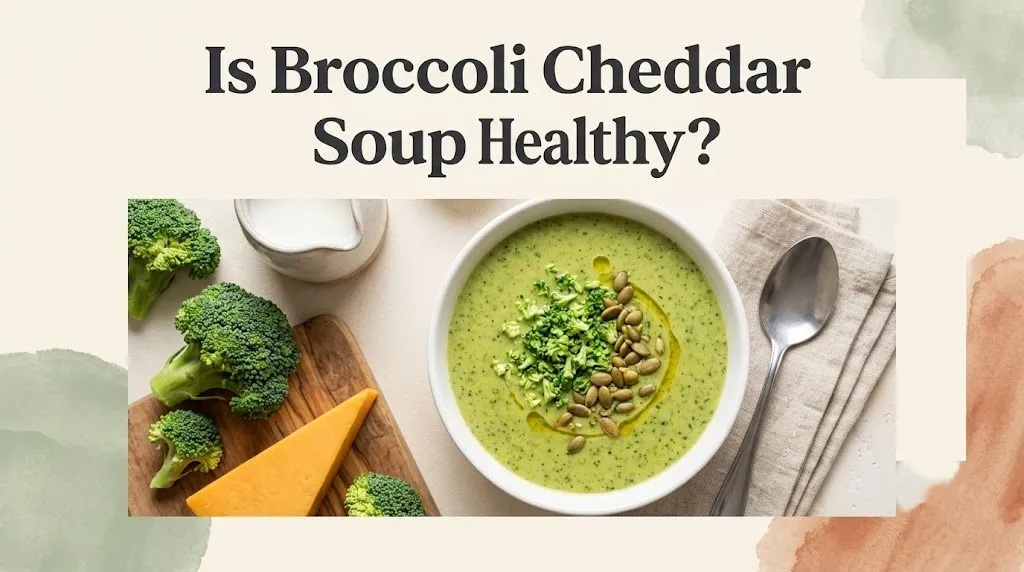
Toasted pumpkin seeds or sunflower seeds add a satisfying crunch and deliver magnesium, zinc, and healthy unsaturated fats. A tablespoon of seeds contains roughly 50 calories and adds a textural contrast that replaces the crouton or bacon bit habit. Finely chopped raw broccoli florets or shredded carrot sprinkled on top right before eating add a fresh, crisp element and a small boost of heat-sensitive vitamin C that would have been lost in the cooked soup.
A dollop of plain Greek yogurt instead of sour cream adds creaminess and roughly 3 grams of protein per tablespoon, with minimal saturated fat. Roasted chickpeas, seasoned with smoked paprika and lightly crushed, add crunch, fiber, and plant-based protein. A drizzle of good extra virgin olive oil and a crack of black pepper take five seconds and add a layer of flavor that makes the soup feel finished and intentional, not like a sad diet compromise.
Healthy Topping Ideas:
- Toasted pumpkin seeds for crunch and magnesium
- Plain Greek yogurt for creaminess and protein
- Finely chopped raw broccoli for fresh texture and vitamin C
- Roasted spiced chickpeas for fiber and crunch
- Drizzle of extra virgin olive oil and cracked black pepper
- Nutritional yeast sprinkle for extra cheesy flavor without dairy
Frequently Asked Questions About Broccoli Cheddar Soup
Is broccoli cheddar soup good for weight loss?
Broccoli cheddar soup can fit into a weight loss plan if it is a homemade, lower-calorie version eaten in a reasonable portion.
A cup of healthy homemade soup with extra vegetables and reduced cheese contains 200 to 250 calories and provides fiber and protein that support satiety.
The restaurant bread bowl version, however, can exceed 1,000 calories and should be treated as an occasional indulgence, not a weight loss food.
How much sodium is in a bowl of broccoli cheddar soup?
A standard bowl of restaurant broccoli cheddar soup contains between 1,300 and 1,500 milligrams of sodium.
Canned versions typically range from 740 to 870 milligrams per cup.
A healthy homemade version using low-sodium stock and limited salt can be kept under 500 milligrams per serving.
Can broccoli cheddar soup be part of a heart-healthy diet?
Yes, but only if it is a modified homemade version with low saturated fat and sodium.
Use evaporated milk instead of heavy cream, limit cheese to one ounce per serving, and use low-sodium stock.
The standard restaurant version delivers more than half a day’s saturated fat limit and should be eaten sparingly by anyone with cardiovascular concerns.
Is Panera Bread broccoli cheddar soup healthy?
Panera’s broccoli cheddar soup is moderately high in calories, saturated fat, and sodium.
A cup contains 360 calories, 13 grams of saturated fat, and 1,330 milligrams of sodium.
Choosing the half-portion cup reduces these numbers and makes it a reasonable side or light meal when paired with a salad.
What is the healthiest way to thicken broccoli cheddar soup?
The healthiest thickener for broccoli cheddar soup is pureed vegetables from the soup itself.
Blending a portion of the cooked broccoli, onion, carrot, and celery creates a creamy texture without adding flour, butter, or cornstarch.
An immersion blender makes this technique fast and eliminates the need for a heavy roux.
Broccoli cheddar soup is not a single food with a single nutritional verdict. It is a recipe with a dial. You can turn that dial toward heavy cream, extra cheese, and a bread bowl, or toward pureed vegetables, sharp cheese in moderation, and a smart dairy base. The soup will be comforting either way. One version will leave you with a day’s worth of saturated fat in a single bowl. The other will leave you with fiber, protein, and a solid serving of vegetables in a meal that fits into a balanced week.
The next time you want broccoli cheddar soup, make it yourself. Grate the cheese from a block. Puree half the vegetables. Use evaporated milk. Taste it before you salt it. Serve it with a handful of toasted pumpkin seeds and a side of whole-grain toast. You will have a bowl that delivers exactly what the name promises, broccoli and cheddar in a warm, creamy soup, without the nutritional hangover that comes from the versions engineered for shelf stability and maximum craveability.