Your dog does not chew his food because dogs are not biologically designed to chew the way humans do. A dog’s jaw moves only in a vertical hinge motion, up and down, for crushing and shearing. It does not move side to side for grinding. The teeth are shaped for gripping, tearing, and crushing, not for the flat, rotary mastication that humans perform with molars. A dog who inhales kibble without a single crunch is not broken. He is eating the way evolution built him to eat.
That said, the speed and completeness with which a dog swallows food whole does have practical consequences. Eating too fast increases the risk of choking, regurgitation, and a potentially life-threatening condition called gastric dilatation-volvulus (GDV), or bloat, in which the stomach fills with gas and twists on its axis. The American College of Veterinary Surgeons reports that GDV carries a mortality rate of 10 to 15 percent even with prompt surgical intervention. Large, deep-chested breeds like Great Danes, German Shepherds, Standard Poodles, and Doberman Pinschers are at the highest risk.
This article explains the biological reasons dogs swallow food whole, the medical causes that can make chewing painful, the difference between a fast eater and a dog with a problem, practical methods to slow a dog’s eating pace, and when a veterinarian should examine your dog’s mouth and digestive system. A veterinarian is the right person to evaluate your individual dog for dental disease, esophageal disorders, or other medical causes of altered eating behavior. Breed, age, and health status all affect the assessment.
Why Do Dogs Not Chew Their Food? The Evolutionary Answer
Dogs do not chew their food thoroughly because they evolved as carnivorous pack hunters who tore flesh from carcasses and swallowed it in large chunks. Their teeth and jaw structure reflect this evolutionary history. The carnassial teeth, the large fourth upper premolars and first lower molars, are built for shearing meat and crushing bone. The incisors grip and tear. The tongue pulls food to the back of the throat. The esophagus is stretchy and muscular, capable of passing large, unchewed boluses of food into the stomach, where strong hydrochloric acid digests what the teeth never broke down.
The dog’s stomach is a muscular, highly acidic organ designed to handle large pieces of food. The gastric pH of a fasted dog can drop as low as 1 to 2, which is acidic enough to denature proteins and kill most ingested bacteria. This is the physiological compensation for not chewing. A human who swallowed food whole would experience incomplete digestion, choking, and esophageal discomfort. A dog processes the same large pieces without difficulty because the stomach takes over the work that human mastication would have done in the mouth.
This evolutionary inheritance means that swallowing food whole is normal for a dog. It is not a sign of ingratitude for the meal. It is not an anxiety disorder by default. It is not bad manners that need training correction. It is a species-appropriate eating behavior that becomes a problem only when it leads to choking, regurgitation, or bloat. The goal of intervention is not to teach a dog to savor each piece of kibble. It is to slow the intake enough that the meal does not cause harm.
The difference between a fast eater and a problem eater is the presence of adverse events. A dog who eats a bowl of kibble in 30 seconds, does not choke or vomit, and goes about his day is a fast eater. A dog who regurgitates whole kibble immediately after eating, gags, retches, or has a distended abdomen after meals is a dog who needs intervention. The same behavior, speed without chewing, can be harmless in one dog and dangerous in another.
Is It Bad If My Dog Doesn’t Chew His Food?
It is not inherently bad if a dog does not chew his food, provided the dog is not choking, regurgitating, or showing signs of digestive distress. The canine digestive system is built to handle unchewed food. Most dogs who swallow kibble whole digest it without any problem. The food is already processed and formulated to break down quickly in gastric fluid. The issue is not the swallowing itself. It is the speed and volume of unchewed food entering the stomach at once.
The primary risk of not chewing is esophageal obstruction. A large piece of food, particularly a chunk of meat, a rawhide chew, or a dental treat, can lodge in the esophagus if it is too large to pass. This is a different problem than swallowing kibble whole. Kibble pieces are small and designed to be swallowed without chewing. A large, irregular piece of food or a foreign object is not. If a dog is gagging, pawing at the mouth, drooling excessively, or unable to swallow, this is an emergency that requires immediate veterinary intervention.
Regurgitation is another risk of fast, non-chewing eating. Regurgitation is different from vomiting. Regurgitation happens passively, without abdominal heaving, and the food comes back up in an undigested, tubular shape, often immediately after eating. It occurs because the esophagus is overfilled or because the dog has a condition called megaesophagus, where the esophageal muscles do not properly move food into the stomach. Dogs who regurgitate frequently should be evaluated by a veterinarian, as the condition can lead to aspiration pneumonia if food enters the lungs.
Gastric dilatation-volvulus (GDV), or bloat, is the most serious risk associated with rapid eating. The stomach fills with air, food, and fluid faster than it can empty, then twists on its axis, trapping the contents and cutting off blood supply. The American Veterinary Medical Association (AVMA) identifies rapid eating as one of several risk factors for GDV, along with breed conformation (deep, narrow chest), eating from elevated bowls, and exercising immediately after a large meal. The connection between not chewing and GDV is indirect. Fast eating causes aerophagia, swallowing air, which distends the stomach. A distended stomach is at higher risk of volvulus. The goal of slowing a dog’s eating is partly about reducing that air intake.
Key Takeaway: Swallowing kibble whole is normal. The risks come from the speed and air intake that often accompany it, not from the lack of chewing itself. A dog who eats fast without choking or regurgitating is not in immediate danger but may benefit from pacing strategies, especially if the breed is at high risk for bloat.
Medical Reasons a Dog Might Not Chew
A dog who has suddenly stopped chewing or who shows signs of discomfort while eating may have a medical issue that makes chewing painful or mechanically difficult. The most common causes are dental disease, including fractured teeth, periodontal infection, tooth root abscesses, and resorptive lesions, oral tumors, temporomandibular joint (TMJ) disorders, esophageal strictures or motility disorders, and neurological conditions that affect the muscles of mastication.
Dental disease is the most common medical cause of altered chewing behavior. The American Veterinary Dental College estimates that more than 80 percent of dogs over the age of 3 have some degree of periodontal disease. A fractured carnassial tooth from chewing on bones, antlers, or hard nylon toys can cause sharp pain when the dog bites down. A tooth root abscess, an infection at the base of the tooth, causes constant throbbing pain that makes a dog reluctant to close the mouth fully. A dog with dental pain may approach the food bowl eagerly, then flinch, drop food from the mouth, or chew only on one side. These are specific, observable signs that warrant a veterinary oral exam under sedation with dental radiographs.
Oral tumors are less common than dental disease but more dangerous. Melanoma, squamous cell carcinoma, and fibrosarcoma can develop on the gums, tongue, hard palate, or tonsils. A mass that interferes with tongue movement or occupies space in the mouth can make it physically difficult for a dog to manipulate food. A dog with an oral tumor may chew less on one side, swallow food in larger pieces, or avoid hard food entirely in favor of soft food. An oral exam during a routine veterinary visit can identify visible masses, but some tumors are hidden under the tongue or at the back of the throat and require sedation for a complete evaluation.
Esophageal disorders affect swallowing rather than chewing. Megaesophagus is a condition where the esophagus is enlarged and lacks normal muscle tone, preventing food from moving efficiently into the stomach. A dog with megaesophagus may regurgitate undigested food minutes to hours after eating. Esophageal strictures, narrowings of the esophagus caused by scar tissue from previous injury or acid reflux, can make swallowing large pieces of food uncomfortable or impossible. These are diagnosed through contrast radiography or endoscopy and are managed with dietary changes, often a lifelong switch to soft or liquid food fed in an elevated upright position.
Quick Tip: If your dog has always eaten without chewing and has no symptoms, that is normal behavior. If your dog used to chew and has stopped, or shows any sign of mouth pain, appetite change, or regurgitation, a veterinary visit is the next step. The mouth is the starting point for the exam.
How to Get Your Dog to Chew His Food: Practical Methods
You cannot teach a dog to chew the way a human chews. The jaw does not move that way. What you can do is slow the eating pace, present food in a form that encourages oral manipulation, and use feeding tools that force the dog to work for each piece. The goal is not mastication. It is pacing, safety, and engagement with the food.
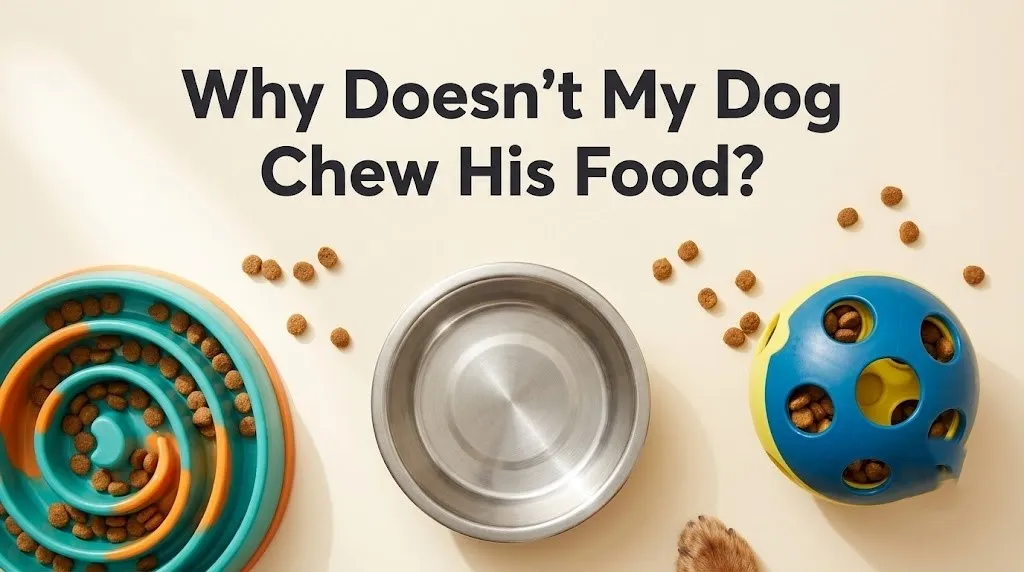
Slow-feeder bowls are the simplest and most effective intervention. These bowls have raised ridges, spirals, or maze patterns that physically block the dog from taking large mouthfuls of food. The dog must navigate the tongue and mouth around the obstacles to pick up individual pieces of kibble. A study published in the Journal of Veterinary Behavior found that slow-feeder bowls increased meal duration by 200 to 400 percent compared to standard bowls. The bowl should be sized appropriately for the dog’s face. A bowl designed for a Labrador will not slow down a Chihuahua. The ridges need to present a genuine navigational challenge, not a minor inconvenience.
Puzzle feeders and food-dispensing toys engage a dog’s brain while slowing the eating pace. The Kong Wobbler, Outward Hound puzzle toys, snuffle mats, and treat balls all require the dog to bat, nudge, or sniff out individual pieces of food. This extends a 30-second meal into a 10- to 20-minute activity. The mental stimulation is a bonus. A dog who works for food is using cognitive energy that would otherwise need an outlet. For a high-energy breed like a Border Collie or Australian Shepherd, puzzle feeding is both a pacing tool and an enrichment activity.
Moistening or softening the food is a counterintuitive but effective strategy for dogs who eat fast because they are hungry. Adding warm water to kibble and letting it soak for 10 minutes creates a softer, bulkier meal that takes more time to lap and swallow. The water adds zero calories. The food expands before it enters the stomach, which reduces the risk of post-meal gastric expansion. This is particularly useful for large, deep-chested breeds at risk for GDV.
Hand feeding is a temporary training strategy, not a long-term feeding solution. Feeding individual pieces of kibble by hand allows you to control the pace and reward the dog for taking food gently. It also reinforces the bond between handler and dog. Hand feeding is most practical for puppies learning basic impulse control or for dogs recovering from an illness where pacing and monitoring intake are important.
To incorporate these strategies:
- Start with a slow-feeder bowl. This requires no training. Pour the food in and let the design do the work.
- If the bowl loses its challenge over time, rotate in a puzzle feeder or snuffle mat for variety.
- Soak the kibble in warm water for 10 minutes before feeding. This softens the food and increases its volume.
- Feed two or three smaller meals per day instead of one large one. Smaller meals reduce the urgency and the gastric load.
- For dogs at high GDV risk, avoid exercise for at least one hour before and two hours after eating.
How to Get a Puppy to Chew His Food
Puppies often eat even faster than adult dogs, and teaching them to slow down is partly about habit formation and partly about safety. A puppy who learns at 12 weeks that food comes in a frantic, competitive rush will carry that behavior into adulthood. The same tools that work for adult dogs work for puppies, with additional attention to teething pain and food type.
Teething is a common cause of altered chewing behavior in puppies between 3 and 6 months of age. The puppy teeth, also called deciduous teeth, are loosening and falling out as adult teeth erupt. The gums are sore. Hard kibble can be uncomfortable to crunch. A puppy who previously chewed kibble and suddenly starts swallowing it whole may be experiencing teething pain. Soaking kibble in warm water until it is soft can make eating more comfortable while the adult teeth come in. This is a temporary phase. Normal chewing behavior may or may not return once the adult teeth are fully erupted. Some dogs never go back to crunching kibble after teething, and that is fine.
Feeding schedule matters more for puppies than for adults. Puppies should eat three to four small meals per day rather than one or two large ones. A puppy who is ravenously hungry between meals will eat faster when food appears. Spreading the daily food ration across more feedings reduces the urgency. The transition from puppy meal frequency to adult meal frequency should happen gradually between 6 and 12 months of age, guided by the puppy’s growth curve and the recommendation of a veterinarian.
Resource competition with littermates or other dogs in the household can accelerate eating speed. A puppy who had to compete for milk or food in a large litter may carry food anxiety into a single-dog household. Feeding this puppy separately from other dogs, in a quiet room with no competition, can gradually reduce the frantic eating pace. The puppy learns that food is reliably available and does not need to be consumed as fast as possible. This is behavioral conditioning and it takes weeks to months, not days.
Frequently Asked Questions About Dogs Not Chewing Food
Are dogs supposed to chew their food?
Dogs are not biologically designed to chew food the way humans do.
Their jaw moves vertically for crushing and shearing, not side to side for grinding.
Swallowing food without chewing is normal canine behavior and is not a problem unless it leads to choking, regurgitation, or other digestive issues.
Why does my dog swallow his food whole?
Your dog swallows food whole because canine teeth and jaws evolved for tearing and swallowing, not for chewing.
This is an inherited behavior from wild ancestors who consumed prey in large chunks.
If the behavior is new and the dog previously chewed, a dental or medical issue may be causing mouth pain.
How can I slow down my dog’s eating?
You can slow your dog’s eating by using a slow-feeder bowl with raised ridges, a puzzle feeder or snuffle mat, or by soaking kibble in warm water before serving.
Feeding multiple small meals per day instead of one large meal also reduces eating speed.
These methods increase meal duration without requiring training.
Is fast eating dangerous for dogs?
Fast eating can be dangerous because it increases the risk of choking, regurgitation, and gastric dilatation-volvulus (bloat), especially in large, deep-chested breeds.
Swallowing air during rapid eating can distend the stomach and contribute to GDV risk.
Slowing the eating pace is a preventive measure recommended by veterinary organizations.
When should I take my dog to the vet for not chewing?
Take your dog to the vet if a dog who previously chewed suddenly stops chewing, or if there are signs of mouth pain, dropping food, chewing on only one side, or refusal to eat hard food.
Regurgitation, gagging, or a distended abdomen after eating also warrant a veterinary visit.
A veterinarian can examine the mouth, teeth, and esophagus and determine whether a medical condition is causing the behavior change.
Your dog does not chew his food because he is a dog. The canine body is designed to consume large pieces of food and digest them in a highly acidic stomach that handles what the teeth never broke down. This is not a flaw, a behavioral problem, or something that needs to be trained out of him. What does need attention is the speed of intake and the volume of air swallowed alongside the food, especially in the large, deep-chested breeds that are vulnerable to bloat.
A slow-feeder bowl is the answer for most dogs. It costs roughly $10 to $20 at a pet supply store, requires no training, and increases meal time from 30 seconds to several minutes without any effort from you. Soaking the kibble in warm water is free and adds hydration while softening the food. These are practical, affordable interventions that reduce risk and cost nothing in time or effort beyond pouring water into a bowl.
If your dog has always eaten this way, is healthy, and has never choked or regurgitated, you do not have a problem. You have a dog. If the behavior has changed, if there are any signs of mouth pain, or if meals are followed by gagging or a distended abdomen, a veterinarian should look in the mouth and down the esophagus to rule out dental disease, esophageal disorders, or other medical causes. The distinction between normal and concerning is whether the pattern has changed and whether the dog is in distress. Trust your eyes. You know your dog.