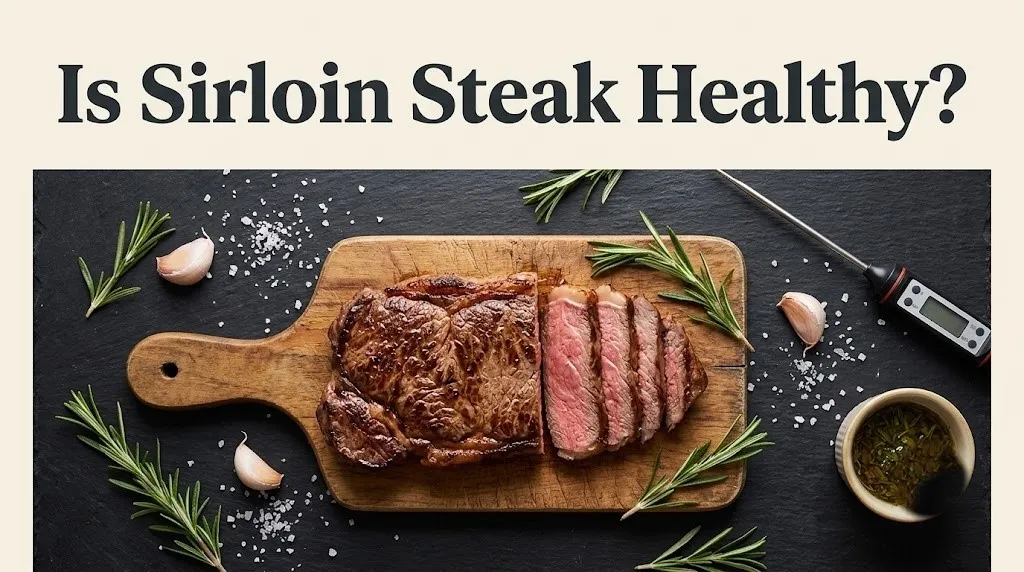
Sirloin steak is a lean, protein-dense cut of beef that fits into a healthy eating pattern when you eat it in sensible portions and cook it with methods that minimize harmful compounds. A three-ounce cooked serving delivers about 26 grams of complete protein, highly absorbable heme iron, and roughly half your daily zinc needs for under 200 calories and six grams of total fat. The key is knowing which sirloin you are buying, how much marbling it carries, and what happens to its nutritional profile when you apply high heat.
The American Heart Association and the USDA Dietary Guidelines for Americans both recognize lean beef cuts as compatible with heart-healthy dietary patterns when saturated fat intake stays below 10 percent of total daily calories. Sirloin earns its spot on the “lean” list because it contains less than 10 grams of total fat and under 4.5 grams of saturated fat per 100-gram cooked serving. That places it in the same conversation as skinless chicken thighs for fat content, with an iron and B12 profile poultry cannot match.
We walk through the exact nutritional breakdown for top and bottom sirloin, explain the USDA grading system that determines how much fat ends up on your plate, and cover the cooking science that makes the difference between a healthy protein source and a meal that introduces compounds linked to cancer risk. You will learn specific temperatures, marinade strategies, and portion guidelines that let you keep sirloin steak in your rotation without the guesswork.
Is sirloin steak healthy?
Sirloin steak is a healthy food when consumed in three to four-ounce cooked portions as part of a dietary pattern that emphasizes vegetables, whole grains, and unsaturated fats from plant sources. The cut qualifies as “lean” under USDA labeling standards, meaning it contains less than 10 grams of total fat and under 4.5 grams of saturated fat per 100-gram serving. That fat profile places it far below ribeye or T-bone and squarely within the range that major health organizations consider acceptable for regular consumption.
The health value of sirloin rests on more than its low fat content. Beef sirloin provides heme iron, the form of iron most easily absorbed by the human body. A three-ounce serving delivers about 1.5 to 2.5 milligrams of iron, roughly 10 to 15 percent of the daily value for adult women, who need more iron than men. The same serving provides about 4 to 5 milligrams of zinc, a mineral essential for immune function that is harder to obtain from plant sources. Vitamin B12 is present at levels exceeding half the daily requirement in a single portion, and B12 exists naturally only in animal foods.
Concerns about red meat and health are real and should not be dismissed. The World Health Organization’s International Agency for Research on Cancer classifies processed meat as a Group 1 carcinogen and red meat as a Group 2A probable carcinogen based primarily on colorectal cancer risk. The distinction matters here: sirloin steak is unprocessed red meat. The risk is associated with high intake levels, charred cooking methods, and overall dietary patterns low in fiber and protective plant compounds. A sirloin steak served medium-rare alongside roasted vegetables and a whole grain is not the same exposure as daily bacon or well-done grilled meat with no produce on the plate.
Sirloin steak nutrition facts
The standard nutritional data for sirloin steak comes from the USDA’s nutrient database and represents a trimmed, cooked three-ounce serving, roughly the size of a deck of cards. The figures shift slightly depending on whether you choose top sirloin or bottom sirloin, and on the grade of beef, but the baseline provides a reliable reference point for meal planning.
A three-ounce serving of broiled top sirloin with visible fat trimmed away contains approximately 180 calories, 26 grams of protein, 8 grams of total fat, and 3 grams of saturated fat. The remaining fat is primarily monounsaturated, the same type found in olive oil, with a small amount of polyunsaturated fat and naturally occurring trans fat in the form of conjugated linoleic acid. The cholesterol content sits around 75 to 80 milligrams per serving. The micronutrient density is what separates beef from many other protein sources. One serving delivers about 50 percent of the daily value for vitamin B12, 40 percent for zinc, 35 percent for niacin, and 30 percent for vitamin B6, plus meaningful amounts of phosphorus and selenium.
The numbers that matter most for health-conscious cooking are the protein-to-fat ratio and the saturated fat percentage. Sirloin delivers about 3.3 grams of protein for every gram of saturated fat, a ratio that the American Heart Association considers favorable for cardiovascular health. A fattier cut like ribeye sits closer to 1.5 grams of protein per gram of saturated fat. The protein quality is complete, meaning it contains all nine essential amino acids in proportions that match human muscle tissue requirements closely.
| Nutrient | Amount per 3 oz (85g) cooked top sirloin | % Daily Value |
|---|---|---|
| Calories | 180 | — |
| Protein | 26g | 52% |
| Total Fat | 8g | 10% |
| Saturated Fat | 3g | 15% |
| Cholesterol | 78mg | 26% |
| Iron | 1.7mg | 9% |
| Zinc | 4.5mg | 41% |
| Vitamin B12 | 1.6mcg | 67% |
| Niacin | 6.5mg | 41% |
| Vitamin B6 | 0.6mg | 35% |
Sirloin steak protein
Sirloin steak protein is considered a complete, high-biological-value protein because it contains every essential amino acid your body cannot synthesize on its own. The protein digestibility-corrected amino acid score (PDCAAS) for beef is near 1.0, the maximum possible value, meaning human digestive systems extract and use nearly all the amino acids present in the meat. That puts sirloin in the same protein quality tier as eggs, milk, and poultry.
The total protein content per serving is substantial relative to the calorie load. A three-ounce portion delivers 26 grams of protein for roughly 180 calories. To get that same protein from black beans, you would need to eat about two and a half cups, which comes with 55 grams of carbohydrate and 560 calories. This protein density is one reason sirloin works well for people managing calorie intake, following higher-protein eating patterns, or trying to preserve muscle mass during weight loss. The leucine content of beef, roughly 2.5 grams per three-ounce serving, triggers muscle protein synthesis effectively, which matters for athletes, older adults, and anyone recovering from injury or surgery.
Protein needs vary by body weight, activity level, and age. The Academy of Nutrition and Dietetics recommends that most adults get between 0.8 and 1.2 grams of protein per kilogram of body weight daily, with higher needs for athletes and older adults. A single sirloin steak portion provides roughly 35 to 45 percent of the daily protein target for a 150-pound person. Spacing protein intake across meals, with 25 to 35 grams per meal, appears optimal for muscle maintenance based on current research.
Key Takeaway: Sirloin steak delivers high-quality, complete protein with an excellent protein-to-calorie ratio, making it an efficient choice for muscle maintenance and satiety when portions are kept in the three to four-ounce range.
Sirloin steak fat content
The fat content of sirloin steak depends on the specific sub-primal cut, the USDA grade, and how carefully you trim visible fat before cooking. A trimmed top sirloin contains roughly 8 grams of total fat per three-ounce cooked serving, with about 3 grams of that coming from saturated fat. The remaining fat is mostly monounsaturated, the same heart-neutral to heart-beneficial type found in avocados and olive oil.
Saturated fat is the number health organizations and dietary guidelines focus on when evaluating red meat. The American Heart Association recommends limiting saturated fat to no more than 5 to 6 percent of total daily calories, which works out to roughly 13 grams on a 2,000-calorie eating plan. A three-ounce sirloin uses about 23 percent of that allowance, leaving room for small amounts of saturated fat from other sources like dairy, eggs, or cooking oils. A larger eight-ounce restaurant portion can consume over 60 percent of the daily saturated fat budget in a single plate, which is why portion size drives the health equation more than the choice of sirloin itself.
The marbling visible in raw sirloin is intramuscular fat, and the amount varies by grade. USDA Select sirloin contains the least marbling and the lowest fat content. USDA Choice adds moderate marbling and slightly more fat. USDA Prime sirloin, which is less common because sirloin is a lean primal, carries more marbling and a noticeably richer mouthfeel. The difference between a Select and a Choice top sirloin can be two to three grams of extra saturated fat per serving, which is not trivial if you eat steak regularly.
| Sirloin Type | Total Fat (3 oz cooked) | Saturated Fat | Protein |
|---|---|---|---|
| Top Sirloin, Select | 6g | 2.3g | 26g |
| Top Sirloin, Choice | 8g | 3g | 26g |
| Bottom Sirloin, Select | 7g | 2.5g | 25g |
| Bottom Sirloin, Choice | 9g | 3.5g | 25g |
Sirloin steak cholesterol
A three-ounce serving of cooked sirloin steak contains 75 to 80 milligrams of cholesterol, which is roughly 25 percent of the 300-milligram daily limit the American Heart Association previously recommended before shifting its focus to saturated fat as the primary dietary driver of blood cholesterol. The relationship between dietary cholesterol and blood cholesterol is now understood to be more complex than the simple input-output model that guided earlier guidelines.
The current consensus from the USDA Dietary Guidelines for Americans and the American Heart Association holds that dietary cholesterol has a smaller effect on blood LDL cholesterol for most people than saturated fat and trans fat do. The guidelines no longer specify a hard 300-milligram daily cap, but they recommend eating as little dietary cholesterol as possible within a healthy dietary pattern. Sirloin steak contributes cholesterol to your day, but the three grams of saturated fat it provides have a more pronounced effect on blood lipid levels than the 75 milligrams of cholesterol do.
Individual response to dietary cholesterol varies. About 25 percent of the population is classified as “hyper-responders,” meaning their blood cholesterol rises more noticeably when they consume cholesterol-rich foods. There is no practical way to know if you are a hyper-responder without blood work. People with diagnosed high LDL cholesterol or a family history of cardiovascular disease have reason to be more attentive to both saturated fat and dietary cholesterol intake, and limiting red meat portions to three ounces a few times per week is a reasonable precaution in that context.
Key Takeaway: The saturated fat in sirloin affects your blood cholesterol more than the cholesterol it contains, but both matter less than your overall dietary pattern and whether sirloin is replacing processed meats or adding calories on top of an already saturated-fat-heavy day.
Top sirloin vs bottom sirloin
Top sirloin and bottom sirloin come from the same beef primal but sit in different anatomical locations with different tenderness, fat distribution, and ideal cooking methods. Understanding the difference helps you buy the right cut for the meal you plan to cook and avoid the disappointment of a tough steak that was never meant for high-heat grilling.
Top sirloin sits closer to the tenderloin and short loin, the sections of the cow that produce the most naturally tender steaks. It is a single defined muscle with a tighter grain and less connective tissue. Top sirloin is the cut sold as “sirloin steak” in most supermarkets and the one you want for grilling, pan-searing, or broiling. It carries moderate marbling at the Choice grade and stays tender when cooked to medium-rare or medium. The fat cap on top sirloin is typically thin and easily trimmed.
Bottom sirloin comes from the area closer to the round primal, which does more work during the animal’s movement and develops tougher muscle fibers. Bottom sirloin breaks down further into sub-cuts like the tri-tip, ball tip, and flap meat. These cuts have looser grain structure and more connective tissue, which means they respond better to marinating, slow roasting, or braising than to quick high-heat searing. Bottom sirloin is generally less expensive per pound and has slightly more fat and connective tissue than top sirloin.
If health is the priority, top sirloin trimmed of visible fat is the leaner, more consistent choice. If you are feeding a group on a budget and can manage a lower-temperature cook, bottom sirloin tri-tip roasted whole and sliced against the grain delivers excellent flavor and reasonable leanness. The nutritional differences between the two are modest enough that cooking method and portion size matter more than which sirloin you pick.
| Factor | Top Sirloin | Bottom Sirloin |
|---|---|---|
| Tenderness | Naturally tender | Tougher; needs marinating |
| Best Cooking Method | Grill, pan-sear, broil | Roast, braise, marinate then grill |
| Typical Cost per Pound | Higher | Lower |
| Leaner Option (trimmed) | Yes, Select grade leanest | Slightly higher fat |
| Common Sub-cuts | Sirloin steak | Tri-tip, ball tip, flap meat |
Sirloin steak vs ribeye
The difference between sirloin steak and ribeye steak is visible the moment you look at the raw cuts side by side. Ribeye comes from the rib primal, a section that does minimal work and develops heavy marbling throughout the muscle. Sirloin comes from the hip area, which works harder and produces leaner muscle with less intramuscular fat. The nutritional numbers reflect this anatomical reality.
A three-ounce cooked serving of ribeye steak contains roughly 250 to 290 calories, 20 to 22 grams of protein, and 20 to 24 grams of total fat, with 8 to 10 grams of that being saturated fat. That is roughly triple the saturated fat of a Select-grade top sirloin. The ribeye protein-to-saturated-fat ratio sits below 2.5:1, compared to over 8:1 for lean sirloin. Ribeye is not an unhealthy food, but it is a fatty cut that displaces more of your daily saturated fat budget than sirloin does. If you have cardiovascular risk factors or are actively managing cholesterol, sirloin is the objectively better choice.
Flavor and texture tilt the other direction. Ribeye’s heavy marbling melts during cooking, basting the meat from within and producing the rich, buttery texture that makes it a favorite of chefs and steak enthusiasts. Sirloin has a beefier, more mineral flavor and a firmer chew. If the meal is a special occasion and you want the full steakhouse experience, a ribeye once or twice a month is a reasonable indulgence for a person with no specific health restrictions. For Tuesday-night steak dinners, sirloin keeps your weekly saturated fat average where it belongs.
| Per 3 oz Cooked | Top Sirloin | Ribeye |
|---|---|---|
| Calories | 180 | 260 |
| Protein | 26g | 21g |
| Total Fat | 8g | 22g |
| Saturated Fat | 3g | 9g |
| Protein per gram Saturated Fat | 8.7g | 2.3g |
Sirloin steak vs filet mignon
Filet mignon is the gold standard for tenderness, cut from the psoas major muscle that runs along the spine and does almost no physical work during the animal’s life. Sirloin is the practical, everyday alternative that offers better nutritional density at roughly half the price. The comparison between the two reveals an interesting nutritional trade-off.
Filet mignon is exceptionally lean. A three-ounce cooked serving contains about 180 to 200 calories, 24 to 26 grams of protein, and 7 to 9 grams of total fat, with 3 grams of saturated fat. On a pure macronutrient basis, filet and top sirloin are nearly identical. Filet has slightly less intermuscular fat and a finer grain, which is why it cuts with a fork, but the protein and saturated fat numbers are close enough that no health argument compels you to pick one over the other.
The practical differences are cost, flavor, and cooking behavior. Filet mignon costs two to three times more per pound than top sirloin. It is milder in flavor because less fat means less of the compounds that carry beef’s characteristic taste. Sirloin delivers a more pronounced beef flavor that some people prefer for everyday eating. Filet’s leanness makes it unforgiving to overcook. A filet pushed past medium becomes dry and mealy faster than a sirloin does at the same temperature. If you are comfortable cooking lean beef to a precise internal temperature, either cut works. If you want to spend less, sirloin wins.
Key Takeaway: Filet mignon and top sirloin are nutritional near-twins, but sirloin costs far less and delivers a beefier flavor, making it the smarter pick for regular healthy eating unless tenderness is your absolute priority.
Leanest cuts of beef
The USDA defines “lean” beef as any cut containing less than 10 grams of total fat, 4.5 grams or less of saturated fat, and fewer than 95 milligrams of cholesterol per 100-gram cooked serving. Sirloin qualifies, but it is not the only option. Understanding the full lean beef lineup gives you more choices for rotating proteins without exceeding saturated fat targets.
The five leanest common beef cuts, ranked from least to most fat, start with eye of round roast or steak, which contains just 4 grams of total fat and 1.5 grams of saturated fat per three-ounce serving. Top round steak follows at about 5 grams total fat and 2 grams saturated. Bottom round roast comes next with 6 grams total and 2.5 grams saturated. Top sirloin lands in the middle of the lean pack at 8 grams total and 3 grams saturated. Flank steak rounds out the top five at about 8 grams total fat with slightly higher saturated fat content due to its marbling pattern.
These cuts share a common feature: they all come from the round, loin, and flank primals where muscles work harder and accumulate less marbling. They also share a cooking challenge. Lean cuts need either fast, high-heat cooking to a precise medium-rare endpoint or slow, moist cooking methods that convert collagen to gelatin. Overcooking any of them produces a dry, tough result. Sirloin sits in the sweet spot of the lean category where it is forgiving enough for a novice cook to handle but still delivers on the health metrics that make lean beef worth choosing.
- Eye of round: 4g total fat, 1.5g saturated (leanest)
- Top round: 5g total fat, 2g saturated
- Bottom round: 6g total fat, 2.5g saturated
- Top sirloin: 8g total fat, 3g saturated
- Flank steak: 8g total fat, 3g saturated
- 95% lean ground beef: 6g total fat, 2.5g saturated
USDA beef grades for sirloin
The USDA beef grading system assigns quality grades based on marbling and animal maturity, and the grade stamped on your sirloin directly affects its nutritional profile and cooking behavior. Three grades dominate the retail market: USDA Prime, USDA Choice, and USDA Select. A fourth category, ungraded or “no roll” beef, appears at some retailers and typically falls below Select in marbling.
USDA Prime is the highest grade, assigned to beef from young cattle with abundant marbling. Prime sirloin is relatively rare because the sirloin primal is naturally lean and young cattle in the Prime program tend to be sold as ribeyes and strip steaks. When Prime sirloin appears, it carries noticeably more intramuscular fat than Choice and will taste richer. The saturated fat per serving can run 4 to 5 grams or more.
USDA Choice is the most common grade for sirloin steak in American grocery stores. It carries moderate marbling that keeps the meat reasonably juicy during cooking without pushing the fat content into indulgence territory. Choice sirloin offers the best balance of flavor, tenderness, and leanness for a health-conscious kitchen. This is the grade to look for when you want a steak that tastes like a steak without blowing your saturated fat allowance.
USDA Select is the leanest graded option. Select sirloin has slight marbling and a firmer texture. It benefits from marinades and careful temperature control because there is less intramuscular fat to provide moisture as the meat cooks. If your primary goal is minimizing saturated fat, Select sirloin is your pick. The trade-off is a narrower margin for error during cooking.
Grass-fed vs grain-fed sirloin
Grass-fed and grain-fed sirloin steaks come from cattle raised on different finishing diets, and the nutritional differences are measurable though modest within the context of a whole dietary pattern. The choice between them depends on your priorities regarding fatty acid composition, antioxidant content, environmental concerns, and budget.
Grass-fed beef, which comes from cattle that spend their entire lives on pasture, contains a more favorable fatty acid profile than grain-fed beef from feedlot-finished cattle. Grass-fed sirloin delivers roughly two to three times more conjugated linoleic acid (CLA), a type of fat that some animal studies link to reduced body fat and improved metabolic markers. It also provides a higher ratio of omega-3 to omega-6 fatty acids, though the absolute omega-3 content in beef remains low compared to fatty fish. A three-ounce serving of grass-fed sirloin might deliver 30 to 50 milligrams of omega-3s versus 10 to 20 milligrams in grain-fed, a difference too small to meet your daily needs on its own.
Grain-fed sirloin consistently has more marbling than grass-fed because the high-energy grain diet promotes intramuscular fat deposition. That marbling makes grain-fed Choice sirloin more forgiving on the grill and gives it the flavor most American consumers expect from steak. Grass-fed sirloin is leaner, with a slightly mineral, earthier flavor that some people prefer and others find unfamiliar. The vitamin and mineral differences are real but small: grass-fed beef tends to have slightly higher vitamin E and beta-carotene content.
Both grass-fed and grain-fed sirloin are lean cuts by USDA standards. The difference matters more for fattier cuts like ribeye or brisket, where grain finishing adds considerable saturated fat. For sirloin specifically, the health difference is marginal and likely matters less than what you serve alongside it and how often you eat it.
| Factor | Grass-Fed Sirloin | Grain-Fed Sirloin |
|---|---|---|
| Total Fat (3 oz) | 5–7g | 7–9g |
| Saturated Fat | 2–2.5g | 2.5–3.5g |
| Omega-3 Content | Slightly higher | Lower |
| CLA Content | 2–3x higher | Lower |
| Flavor | Earthy, mineral | Richer, buttery |
| Cost per Pound | Higher | Lower |
Key Takeaway: Grass-fed sirloin offers slightly better fatty acid quality, but grain-fed Choice sirloin is still a lean, nutrient-dense protein; the cooking method and portion size outweigh the feeding difference for your health.
Healthiest way to cook sirloin steak
The healthiest way to cook sirloin steak is any method that reaches a safe internal temperature while minimizing the formation of heterocyclic amines and polycyclic aromatic hydrocarbons, the two classes of compounds formed when muscle meat meets high heat. Pan-searing followed by a brief oven finish, sous vide cooking, and reverse searing all achieve this more effectively than direct high-heat grilling over an open flame.
The health concern with high-heat cooking is specific and well-studied. When creatine and amino acids in beef react at temperatures above 350 degrees Fahrenheit, they form heterocyclic amines (HCAs) . When fat drips onto a hot surface or open flame and creates smoke, polycyclic aromatic hydrocarbons (PAHs) form and deposit back onto the meat surface. Both compound classes are classified as probable human carcinogens by the International Agency for Research on Cancer. The risk is cumulative and tied to lifetime exposure, not a single meal.
Practical strategies reduce HCA and PAH formation without forcing you to eat boiled steak. Marinating sirloin for at least 30 minutes before cooking reduces HCA formation by up to 90 percent in some studies, likely because the antioxidant compounds in marinade ingredients block the chemical reactions. Rosemary, thyme, garlic, citrus juice, and red wine vinegar all show protective effects. Flipping the steak frequently during cooking, every 30 to 60 seconds rather than once per side, keeps surface temperatures lower and reduces HCA formation. Cooking to medium-rare rather than well-done significantly lowers compound levels because less time at high heat means fewer reactions.
Sirloin steak internal temperature
The USDA recommends cooking whole cuts of beef to a minimum internal temperature of 145 degrees Fahrenheit (63 degrees Celsius) followed by a three-minute rest time before carving or serving. This temperature achieves a log-7 reduction in common foodborne pathogens, including E. coli O157:H7 and Salmonella, which is the standard for food safety in whole muscle cuts.
Steak preferences and safety recommendations do not always align. Many chefs and home cooks prefer medium-rare sirloin, which lands at 130 to 135 degrees Fahrenheit at the center after resting. At this temperature, the meat is still pink and visibly moist, and the myoglobin proteins have not denatured enough to expel all their water content. A medium-rare sirloin is more tender and flavorful than one cooked to 145 degrees. The USDA minimum of 145 degrees produces a medium steak with a firmer, drier texture.
The food safety rationale for the USDA recommendation is conservative and designed to protect immunocompromised individuals, older adults, pregnant women, and young children. For healthy adults, the risk from a medium-rare whole-muscle steak is low because bacterial contamination exists on the surface of intact meat, not inside the muscle, and searing the exterior kills surface pathogens. Ground beef carries higher risk because grinding distributes surface bacteria throughout the meat, which is why the 160-degree recommendation for burgers should be taken more seriously than the whole-cut steak recommendation.
Quick Tip:
- Use a digital instant-read thermometer, not color or texture guessing
- Insert the probe into the thickest part of the steak, away from bone and fat
- Remove the steak from heat 5 degrees below target temperature; carryover cooking does the rest
- Rest the steak on a warm plate, not a cold one, for the full three minutes
Marinating sirloin steak
Marinating sirloin steak accomplishes two goals simultaneously: it improves the tenderness of a lean cut and significantly reduces the formation of potentially harmful cooking byproducts. A marinade that includes an acidic component, an oil, and aromatic herbs or spices delivers flavor, moisture retention, and measurable health protection.
The acid in a marinade, typically citrus juice, vinegar, wine, or yogurt, partially denatures the protein strands on the meat surface, which allows the muscle fibers to retain more moisture during cooking. This is particularly useful for Select-grade sirloin, which has minimal marbling to provide internal lubrication. The acid works slowly. A 30-minute marinade improves surface texture and flavor. A four to six-hour marinade penetrates deeper but can turn the exterior mushy if the acid is too aggressive. For lean sirloin, two to four hours in the refrigerator hits the sweet spot.
Marinade antioxidants are the mechanism behind HCA reduction. Studies from the Journal of Food Science and Food Chemistry have shown that marinades containing rosemary, thyme, oregano, garlic, onion, or red wine reduce HCA formation by 50 to 90 percent compared to unmarinated steak cooked to the same temperature. The effect is attributed to phenolic compounds that scavenge the free radicals involved in the reaction between creatine and amino acids. A simple marinade of olive oil, lemon juice, minced garlic, and chopped rosemary is one of the most effective combinations tested.
HCA and PAH reduction in steak
Reducing heterocyclic amines and polycyclic aromatic hydrocarbons during steak cooking is possible through a combination of preparation choices, cooking technique adjustments, and doneness preference. The evidence supporting these strategies comes from food chemistry and toxicology research, and the most effective interventions are straightforward enough for any home cook to adopt.
The single most effective strategy is lowering the cooking temperature. HCAs begin forming in meaningful amounts at 350 degrees Fahrenheit and accelerate rapidly above 400 degrees. Pan-searing over medium-high heat rather than maximum heat, or using a reverse-sear method that starts in a low oven and finishes with a brief pan sear, keeps total high-heat exposure time shorter. Sous vide cooking, which involves sealing the steak in a bag and cooking it in a precisely controlled water bath at 130 to 135 degrees Fahrenheit for one to two hours, produces virtually zero HCAs because the cooking temperature never approaches the formation threshold. The steak is then seared for 30 to 60 seconds per side just for crust development.
Frequent flipping is a deceptively simple intervention. Flipping the steak every 60 seconds during cooking, rather than the traditional single flip halfway through, reduces surface temperature spikes and cuts HCA formation by up to 50 percent. Trimming visible fat before cooking reduces PAH formation by limiting the amount of fat that renders and drips onto the heat source, where it creates the smoke that deposits PAHs back onto the meat. Avoiding direct flame contact matters for the same reason. A cast iron pan or a grill with a solid barrier between the meat and the flame produces fewer PAHs than open-flame grilling where fat drips directly onto hot coals or gas burners.
To reduce HCA and PAH formation on sirloin steak:
- Marinate the steak for 2 to 4 hours in a mixture containing rosemary, garlic, and an acidic component
- Trim visible external fat before cooking to minimize dripping and smoke
- Use medium-high heat, not maximum heat, or use a sous vide and quick-sear method
- Flip the steak every 60 seconds during pan-searing or grilling
- Remove the steak at medium-rare internal temperature of 130 to 135 degrees Fahrenheit before resting
Key Takeaway: The combination of marinating, moderate heat, frequent flipping, and pulling the steak at medium-rare delivers the best balance of safety, health, and the crust and juiciness that make a sirloin worth eating.
Sirloin steak serving size
A standard serving of cooked sirloin steak is three ounces, which looks roughly like a deck of playing cards or the palm of an average adult hand without fingers. This portion, not the eight to twelve-ounce steakhouse cut, is what the USDA Dietary Guidelines for Americans and the American Heart Association use when describing recommended meat intake.
Visualizing three ounces matters because most Americans significantly underestimate the size of the meat portions they eat. A typical grocery store sirloin steak weighs between eight and twelve ounces raw, which cooks down to roughly six to nine ounces after moisture and fat loss. That single steak represents two to three standard servings. Eating the whole thing is not inherently unhealthy, but understanding that you are consuming two to three portions in one sitting helps explain why red meat intake adds up faster than most people realize.
The Dietary Guidelines group meat, poultry, and eggs together in the “protein foods” category and recommend that adult women consume about five to five-and-a-half ounce-equivalents per day and adult men about five-and-a-half to six-and-a-half ounce-equivalents, depending on age and activity level. A three-ounce cooked sirloin portion represents roughly half the day’s protein food allocation. For people who eat two different protein sources across lunch and dinner, a single three-ounce sirloin at one meal fits comfortably within the guidelines.
How often can you eat sirloin steak?
The question of frequency is where the science on red meat and health gets less precise. There is no universal threshold at which sirloin steak consumption tips from neutral to harmful. The World Health Organization’s cancer risk classification for red meat is based on high intake levels, generally defined in studies as more than 500 grams (about 18 ounces) of cooked red meat per week. At three ounces per serving, that is roughly six servings.
The American Heart Association focuses its guidance on saturated fat rather than specifying meat frequency. If a three-ounce sirloin delivers three grams of saturated fat and your daily budget is 13 grams on a 2,000-calorie eating plan, you could technically eat sirloin every day and stay within the saturated fat limit if the rest of your diet is low in saturated fat from other sources. The American Institute for Cancer Research takes a more conservative stance, recommending no more than 12 to 18 ounces of cooked red meat per week, which translates to roughly four to six three-ounce servings.
A reasonable middle ground that aligns with both the cardiovascular and cancer risk guidance is three to four servings of lean red meat per week, with each serving staying in the three to four-ounce cooked range. This frequency provides the iron, zinc, and B12 benefits of beef without approaching the intake levels associated with elevated colorectal cancer risk in epidemiological studies. Rotating sirloin with poultry, fish, legumes, and eggs across the week adds dietary variety and further diversifies your nutrient intake.
Who should avoid red meat
Most people can include lean red meat like sirloin in their diet, but several specific groups have evidence-based reasons to limit or avoid it. This is not a one-size-fits-all recommendation but a set of conditions where the balance of benefit and risk shifts.
People with alpha-gal syndrome, an acquired allergy to mammalian meat triggered by a lone star tick bite, must avoid all red meat entirely. The reaction can range from hives to anaphylaxis and typically occurs three to six hours after eating beef, pork, or lamb. This is an immunologic allergy, not a dietary preference, and it requires complete avoidance of mammalian products. Individuals diagnosed with hemochromatosis, a genetic condition that causes excessive iron absorption and storage, should limit heme iron intake from red meat because their bodies cannot regulate iron uptake effectively and excess iron accumulates in organs.
People with a personal or strong family history of colorectal cancer may choose to limit red meat intake below the general population recommendations. The American Cancer Society notes that the colorectal cancer risk associated with red meat is dose-dependent, and reducing intake makes sense for those with elevated baseline risk. Individuals with established cardiovascular disease or LDL cholesterol that has not responded to dietary changes may benefit from stricter saturated fat limits that make even lean red meat a less frequent choice, replaced more often by fish, skinless poultry, or plant proteins.
The decision to avoid red meat entirely is a personal one that can be nutritionally sound with proper dietary planning. Iron, zinc, and vitamin B12 require attention on a meat-free diet. Vegetarians who eat eggs and dairy can meet B12 needs, while vegans must rely on fortified foods or supplements. Heme iron from red meat is not essential if total iron intake from plant sources, combined with vitamin C for absorption, is adequate.
Frequently Asked Questions About Sirloin Steak
Is sirloin steak good for weight loss?
Sirloin steak supports weight loss because it provides high satiety per calorie through its dense protein content.
A three-ounce cooked serving delivers 26 grams of protein for under 200 calories, which helps preserve muscle mass during a calorie deficit.
The key is portion control and avoiding heavy butter-based sauces that can triple the calorie load of the meal.
Is it safe to eat sirloin steak medium-rare?
For healthy adults, medium-rare sirloin at 130 to 135 degrees Fahrenheit carries a low food safety risk because whole muscle beef has bacteria only on the surface, which searing kills.
The USDA recommends 145 degrees Fahrenheit as the formal safe temperature, a standard designed to protect immunocompromised individuals, older adults, pregnant women, and young children.
If you are in a higher-risk group, cooking to 145 degrees and using a meat thermometer is the safest approach.
Which is healthier, sirloin or ribeye steak?
Sirloin is the healthier cut by a clear margin because it contains roughly one-third the saturated fat of ribeye per serving.
A three-ounce sirloin has about 3 grams of saturated fat compared to 9 grams in ribeye.
Ribeye is fine as an occasional indulgence, but for regular eating, sirloin aligns much better with heart-health guidance.
How much sirloin steak should I eat per week?
Three to four three-ounce servings of sirloin per week falls within both the American Heart Association’s saturated fat limits and the American Institute for Cancer Research’s red meat guidance.
This amounts to roughly 9 to 12 ounces of cooked lean beef weekly.
Rotating in poultry, fish, and plant proteins across other meals keeps your overall dietary pattern diverse.
Does grilling sirloin steak cause cancer?
Grilling itself does not cause cancer, but cooking any muscle meat at very high temperatures over an open flame forms compounds classified as probable carcinogens with cumulative, long-term risk.
You can reduce this risk significantly by marinating the steak, flipping it frequently, avoiding charring, and cooking to medium-rare rather than well-done.
The risk is tied to lifetime exposure, not a single grilled steak, and these strategies bring it down considerably.
Sirloin steak earns its place as one of the leanest, most nutrient-dense beef cuts you can put on a plate. It delivers more bioavailable iron, zinc, and B12 per calorie than almost any plant protein, and its saturated fat content sits low enough that it fits comfortably within the dietary patterns that major health organizations recommend for long-term wellness.
The health difference between a well-prepared sirloin and a potential health liability is not the steak itself. It is the portion size, the cooking temperature, the marinade, and what you serve alongside it. Keep it to three or four ounces, cook it to medium-rare with a rosemary marinade, and pair it with vegetables that bring the fiber and phytonutrients red meat lacks. That plate is good food, backed by good science, and you do not need to feel conflicted about eating it.