Breakfast cereal is one of the most fortified food categories in the American diet. According to the USDA Dietary Guidelines for Americans 2020-2025, at least half of all grain intake should come from whole grains. Frosted Mini-Wheats, made from whole grain wheat (Triticum aestivum), clears that bar. The complication is the sugar coating that gives them their name.
This guide covers the full nutritional picture: exact calories, sugar, fiber, vitamins, glycemic index, serving size realities, and how the cereal stacks up against comparable options. It also addresses who specifically benefits, who should be cautious, and what the research actually says about eating this cereal regularly.
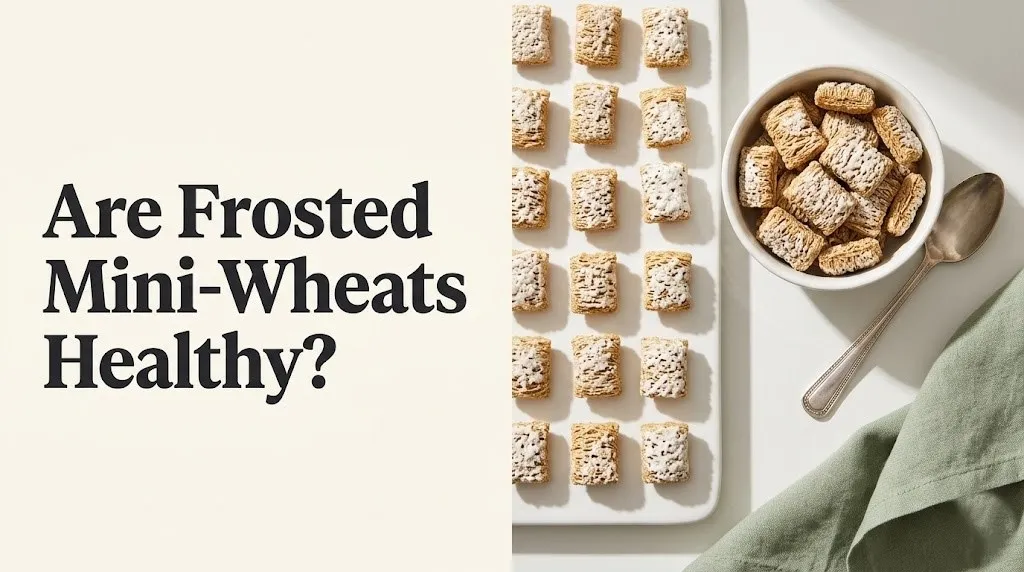
Are Frosted Mini-Wheats Healthy?
Frosted Mini-Wheats are a moderately healthy breakfast option when eaten in the labeled serving size, alongside protein and fat, and as part of a diet that is otherwise low in added sugar.
The case for them is real. They are made from whole grain wheat, which means the bran and germ remain intact. That structure preserves dietary fiber, B vitamins, and minerals that refined wheat flour loses during processing. A single standard serving delivers approximately 5 to 6 grams of dietary fiber, which is between 18% and 21% of the daily target recommended by the Academy of Nutrition and Dietetics (25g for women, 38g for men).
The case against is also real. The frosting adds approximately 11 to 12 grams of added sugar per serving. The American Heart Association (AHA) recommends women consume no more than 25 grams of added sugar daily and men no more than 36 grams. One bowl of Frosted Mini-Wheats accounts for roughly 30% to 44% of that entire daily ceiling before you have added milk or anything else to your day.
The net verdict: not a junk cereal, but not a free pass either. Context is everything.
| Factor | Assessment |
|---|---|
| Whole grain content | Yes, 100% whole grain wheat |
| Dietary fiber per serving | 5 to 6g (good) |
| Added sugar per serving | 11 to 12g (moderate concern) |
| Key vitamins and minerals | Iron, B vitamins, zinc, vitamin D |
| Suitable for daily breakfast | Yes, with protein and low-sugar context |
| Suitable for low-sugar diets | Use portion control or choose unfrosted version |
Frosted Mini-Wheats Nutrition Facts
A standard serving of Frosted Mini-Wheats (approximately 59 grams, or about 25 biscuits) contains the following nutritional profile based on current Kellogg’s labeling data:
| Nutrient | Amount per Serving | % Daily Value |
|---|---|---|
| Calories | 200 | 10% |
| Total Fat | 1g | 1% |
| Saturated Fat | 0g | 0% |
| Sodium | 5mg | 0% |
| Total Carbohydrate | 47g | 17% |
| Dietary Fiber | 6g | 21% |
| Total Sugars | 12g | N/A |
| Added Sugars | 12g | 24% |
| Protein | 6g | 12% |
| Iron | 16mg | 90% |
| Zinc | 3.8mg | 35% |
| Niacin (B3) | 6mg | 35% |
| Thiamine (B1) | 0.5mg | 40% |
| Riboflavin (B2) | 0.5mg | 40% |
| Folic Acid | 200mcg DFE | 50% |
| Vitamin D | 2mcg | 10% |
Two things stand out immediately. The iron content is striking: 90% of the daily value per serving. That’s almost entirely from fortification, meaning Kellogg’s has added iron back to the cereal rather than relying on what occurs naturally in wheat. The other standout is that added sugar accounts for 24% of the daily value in a single bowl, which is a notable proportion of daily sugar budget at breakfast.
People with wheat allergies or celiac disease should note that this product contains gluten and is not appropriate for gluten-free diets.
Frosted Mini-Wheats Calories per Serving
Frosted Mini-Wheats contain approximately 200 calories per standard serving of 59 grams (about 25 biscuits), making them a moderate-calorie breakfast option when eaten alone.
That figure changes considerably when you add milk. A half-cup of whole milk adds roughly 75 calories. A full cup adds 150 calories, bringing a complete bowl to between 275 and 350 calories depending on milk type and volume.
Compared to most American breakfast options, 200 calories for a serving of whole grain cereal is reasonable. The caloric density is not the issue. The issue, as noted in the full nutrition facts, is what those 200 calories carry with them in terms of added sugar relative to fiber and protein.
| Breakfast Combination | Approximate Calories |
|---|---|
| 25 biscuits (dry) | 200 |
| 25 biscuits + 1/2 cup whole milk | 275 |
| 25 biscuits + 1 cup whole milk | 350 |
| 25 biscuits + 1 cup skim milk | 280 |
| 25 biscuits + 1 cup unsweetened almond milk | 235 |
Quick Tip:
- Pairing with unsweetened almond milk cuts calories by about 65 to 115 compared to whole milk.
- Adding a boiled egg or a tablespoon of almond butter brings protein into the meal, which helps slow the rate at which carbohydrates raise blood glucose.
- The labeled serving is 25 biscuits. If you pour freely, you are almost certainly eating more than that.
Key Takeaway: Frosted Mini-Wheats deliver a solid nutritional package in their standard serving, particularly for fiber, B vitamins, and iron. The 12 grams of added sugar is the primary number to pay attention to, as it uses a meaningful portion of the daily recommended limit before breakfast is over.
Frosted Mini-Wheats Sugar Content
Frosted Mini-Wheats contain 12 grams of added sugar per standard 59-gram serving, all of which comes from the powdered sugar frosting applied to the outer surface of the biscuits.
Think of the frosting layer like a thin candy shell on an otherwise decent whole grain biscuit. The biscuit itself is low in naturally occurring sugars. The entire sugar load is the coating, which means if you eat plain shredded wheat (the unfrosted version), you drop to near-zero added sugar with the same whole grain wheat base.
The American Heart Association recommends limiting added sugar to 25 grams per day for women and 36 grams per day for men. One serving of Frosted Mini-Wheats uses 48% of the daily limit for women and 33% for men. That is a substantial portion of daily sugar from a single meal.
For reference, the American Academy of Pediatrics (AAP) recommends that children aged 2 to 18 consume fewer than 25 grams of added sugar per day from all sources. One serving of Frosted Mini-Wheats alone delivers nearly half of a child’s entire daily allowance.
| Population Group | Daily Added Sugar Limit | Frosted Mini-Wheats per Serving | % of Daily Limit Used |
|---|---|---|---|
| Women (adults) | 25g | 12g | 48% |
| Men (adults) | 36g | 12g | 33% |
| Children (ages 2-18) | Less than 25g | 12g | 48% or more |
| People with type 2 diabetes | Varies; generally less than 25-50g total | 12g | Significant |
Frosted Mini-Wheats Fiber Content
Frosted Mini-Wheats provide 6 grams of dietary fiber per standard serving, which comes almost entirely from the whole wheat bran layer retained during minimal processing.
Dietary fiber is not one uniform substance. Wheat bran fiber is predominantly insoluble fiber, meaning it does not dissolve in water. Insoluble fiber adds bulk to stool, speeds transit time through the digestive tract, and feeds the beneficial bacteria living in the large intestine. Think of it as the broom that keeps the intestinal floor swept.
The USDA Dietary Guidelines for Americans set adequate fiber intake at 25 grams per day for women and 38 grams per day for men, based on a 2,000-calorie diet. Research published in the Journal of Nutrition has consistently linked higher whole grain fiber intake with reduced risk of type 2 diabetes, cardiovascular disease, and colorectal cancer. One serving of Frosted Mini-Wheats delivers between 15% and 24% of that daily target in one sitting.
For adults eating a typical American diet, which averages only about 10 to 15 grams of fiber daily according to the Harvard T.H. Chan School of Public Health, a high-fiber cereal like Frosted Mini-Wheats can meaningfully contribute to closing that gap.
People who are not accustomed to eating high-fiber foods should increase intake gradually. Jumping from a low-fiber breakfast to 6 grams of wheat bran fiber overnight can cause temporary bloating, gas, or cramping. Starting with half a serving and drinking additional water is a practical adjustment approach.
Frosted Mini-Wheats Vitamins and Minerals
Frosted Mini-Wheats are heavily fortified, meaning most of the vitamins listed on the label were added back to the cereal after processing, rather than retained naturally from the whole grain.
This distinction matters. Whole grain wheat does naturally contain B vitamins and iron. However, even with whole grain processing, some nutrient loss occurs. Kellogg’s adds a concentrated vitamin and mineral blend to restore and in many cases significantly exceed the natural levels. The result is a cereal with an impressive label that is partly manufactured rather than purely intrinsic to the food.
The standout nutrients by volume are:
- Iron: 90% of the daily value per serving. The form added is typically reduced iron or ferric phosphate. These forms are absorbed less efficiently than the heme iron found in red meat, but they still contribute to daily iron intake, particularly for people eating plant-based diets or those at risk for iron deficiency.
- Folic acid: 50% of the daily value. Folic acid (the synthetic form of folate, or vitamin B9) supports DNA synthesis and cell division. It is especially important during early pregnancy.
- Thiamine (vitamin B1): 40% of the daily value. Thiamine supports energy metabolism and nerve function.
- Riboflavin (vitamin B2) and Niacin (vitamin B3): both at 35-40% of the daily value. Both support cellular energy production.
- Zinc: 35% of the daily value. Zinc supports immune function and wound healing.
- Vitamin D: 10% of the daily value. Vitamin D is one of the most commonly deficient nutrients in the American population, according to the National Institutes of Health (NIH), making any dietary source useful.
The high iron content does carry one specific note: calcium can inhibit iron absorption when consumed at the same time. If you are taking a calcium supplement, separating it from this cereal by two hours optimizes iron uptake.
Key Takeaway: The fiber in Frosted Mini-Wheats is genuinely from whole grain wheat bran and does real digestive and metabolic work. The vitamins are mostly synthetic additions, which is not harmful but is worth understanding when comparing it to less processed whole grain options.
Are Frosted Mini-Wheats a Whole Grain Cereal?
Yes, Frosted Mini-Wheats are a 100% whole grain cereal. The primary ingredient is whole grain wheat, meaning the bran, germ, and endosperm of the wheat kernel are all present.
The Whole Grain Council’s 100% Whole Grain stamp on the box confirms this. Products earning that stamp must have all grain ingredients be whole grain, with at least 16 grams of whole grain per serving. Frosted Mini-Wheats exceed that threshold.
What does “whole grain” actually mean at a biological level? The wheat kernel has three layers. The bran is the fibrous outer layer, rich in fiber, B vitamins, and minerals. The germ is the reproductive core, containing healthy fats, vitamin E, and additional B vitamins. The endosperm is the starchy center, which is what white flour is made from once the other two layers are stripped away. Whole grain products keep all three intact, delivering the full nutritional architecture of the grain.
The American Heart Association recommends that adults consume at least three servings of whole grains daily as part of a heart-healthy eating pattern. Frosted Mini-Wheats counts as one of those servings.
The sugar frosting does not negate the whole grain status of the biscuit underneath. It is an addition on top of a legitimately whole grain product, not a replacement for whole grain content. That distinction matters when comparing it to cereals that claim to contain whole grains but use refined flour as the primary base.
Frosted Mini-Wheats Glycemic Index
Frosted Mini-Wheats have an estimated glycemic index (GI) in the medium range, approximately 58 to 72, depending on the testing method and serving conditions used.
Glycemic index measures how quickly a carbohydrate-containing food raises blood glucose compared to pure glucose (GI of 100). Foods below 55 are considered low GI. Foods between 55 and 69 are medium. Foods at 70 and above are high. Frosted Mini-Wheats sit near the upper boundary of medium, largely because of the added sugar frosting layered on top of a fiber-rich whole grain base.
The glycemic load (GL), which accounts for both the GI and the actual amount of carbohydrate per serving, is more practically useful. A serving of Frosted Mini-Wheats with approximately 47 grams of total carbohydrate produces a glycemic load that is meaningfully reduced by the 6 grams of fiber slowing digestion.
Eating Frosted Mini-Wheats with whole milk, low-fat milk, or unsweetened plant milk adds protein and fat to the meal. Protein and fat slow gastric emptying, which reduces the rate at which carbohydrates enter the bloodstream. This effectively lowers the real-world glycemic impact of the bowl compared to eating the dry cereal alone.
| Eating Condition | Blood Glucose Impact |
|---|---|
| Dry cereal only | Faster glucose rise |
| With whole milk (protein + fat) | Moderate glucose rise |
| With low-fat milk + side protein | Lower glucose rise |
| Eaten in a reduced portion (half serving) | Lower glucose load overall |
People with prediabetes or type 2 diabetes should specifically speak with a registered dietitian about whether Frosted Mini-Wheats fit their individual carbohydrate targets, since blood sugar responses vary considerably between individuals.
Key Takeaway: Frosted Mini-Wheats are a whole grain product with meaningful fiber and fortified vitamins, but the added sugar and medium-to-high glycemic index mean they are best eaten with protein and fat, not alone, to moderate the blood sugar response.
Frosted Mini-Wheats Ingredients and Processing
Frosted Mini-Wheats are made from a short ingredient list dominated by whole grain wheat and sugar, with a small number of added vitamins and minerals.
The primary ingredients in order on the label are: whole grain wheat, sugar, contains 2% or less of gelatin, BHT (for freshness), and a vitamin/mineral blend. The simplicity of that list is genuinely notable. This is not a product with 30 unrecognizable ingredients. Most of what is in the box is grain and sugar.
The NOVA food classification system, developed by researchers at the University of São Paulo to categorize foods by degree of industrial processing, would classify Frosted Mini-Wheats as a NOVA Group 3 food: processed food. This means the product has been manufactured with the addition of substances (sugar, vitamins, BHT preservative) not typically used in home cooking. It is not classified as ultra-processed in the NOVA 4 sense, which would require additional industrial emulsifiers, colorings, or flavor compounds.
Gelatin is used as a binder to help the sugar frosting adhere to the biscuit surface. This makes Frosted Mini-Wheats non-vegan and non-halal or non-kosher unless the gelatin source is specifically certified. Observant consumers should verify current gelatin sourcing directly with Kellogg’s, as ingredient specifications can change.
BHT (butylated hydroxytoluene) is an antioxidant preservative approved by the FDA for use in foods. It prevents the fats in the cereal from oxidizing and going rancid. The quantities used in cereal are small, and the FDA considers it generally recognized as safe at these levels.
Frosted Mini-Wheats Serving Size and How People Actually Eat It
The labeled serving size for Frosted Mini-Wheats is approximately 25 biscuits (59 grams), but research on portion sizes consistently shows that most people pour significantly more when left to measure by eye.
A study published in the American Journal of Clinical Nutrition found that people routinely underestimate cereal portion sizes by 30% to 100%, often pouring two to three times the labeled serving. For Frosted Mini-Wheats, doubling the serving means doubling everything: 400 calories, 24 grams of added sugar, and 12 grams of fiber.
The fiber doubling is a neutral-to-positive outcome. The sugar doubling is not, particularly when you consider it against the AHA’s 25 to 36 gram daily added sugar limits.
The practical solution is specific:
- Use a kitchen scale for the first two or three servings to understand what 59 grams looks like in your actual bowl.
- After calibrating your eye, use that visual as your reference.
- If you eat a larger portion regularly, account for the additional added sugar across the rest of the day.
- Choosing a slightly smaller bowl physically limits how much you can pour, which is a simple and effective portion management tool.
Frosted Mini-Wheats biscuits are also substantially larger than many other cereals, which means 25 of them fill a bowl differently than 25 corn flakes would. The serving size in biscuits is a more intuitive measure for this product than for flake-based cereals.
Frosted Mini-Wheats With Milk: Calories and Nutrition
Adding milk to Frosted Mini-Wheats significantly improves the meal’s nutritional completeness by contributing protein, calcium, and fat that the cereal alone does not supply in substantial amounts.
The cereal provides 6 grams of protein per serving. A cup of whole milk adds another 8 grams. That brings the combined protein to 14 grams, which begins to approach the range where protein contributes meaningfully to satiety, the feeling of fullness that reduces the likelihood of snacking an hour later.
| Milk Type (1 cup) | Calories Added | Protein Added | Fat Added | Calcium Added |
|---|---|---|---|---|
| Whole milk | 150 | 8g | 8g | 280mg |
| 2% reduced-fat milk | 120 | 8g | 5g | 285mg |
| Skim milk | 85 | 8g | 0g | 300mg |
| Unsweetened soy milk | 80 | 7g | 4g | 300mg |
| Unsweetened almond milk | 35 | 1g | 2.5g | 450mg |
For people who are lactose intolerant, unsweetened soy milk is the strongest nutritional substitute. It delivers comparable protein and calcium to dairy milk. Unsweetened almond milk has very little protein and should not be used as a nutritional equivalent to dairy if protein is a dietary concern.
The combined Frosted Mini-Wheats plus a cup of 2% milk bowl comes in at approximately 320 calories, with 14 grams of protein, 6 grams of fiber, and 12 grams of added sugar. That is a reasonable breakfast for most adults.
Key Takeaway: How you eat Frosted Mini-Wheats matters as much as what’s in them. Pairing the standard 25-biscuit serving with a protein source (milk, yogurt, eggs) meaningfully improves satiety and moderates the blood sugar impact of the cereal’s carbohydrate load.
Frosted Mini-Wheats vs. Shredded Wheat
Plain shredded wheat is the closest nutritional equivalent to Frosted Mini-Wheats, with one major difference: it contains no added sugar at all.
Both products are made from 100% whole grain wheat. Both deliver very similar amounts of dietary fiber per serving (5 to 6 grams). Both share the same whole grain wheat (Triticum aestivum) base. The nutritional divergence is entirely explained by the absence of frosting on plain shredded wheat.
| Nutrient (per ~59g serving) | Frosted Mini-Wheats | Plain Shredded Wheat |
|---|---|---|
| Calories | 200 | 170 |
| Total Sugars | 12g | 0g |
| Added Sugars | 12g | 0g |
| Dietary Fiber | 6g | 6g |
| Protein | 6g | 5g |
| Iron | 90% DV | 8% DV |
| Fortified vitamins | Yes (extensive) | Minimal |
| Whole grain | Yes | Yes |
Plain shredded wheat’s iron content (approximately 8% DV) is far lower than Frosted Mini-Wheats (90% DV) because it is not heavily fortified. That tradeoff is worth understanding: if you want the fiber with zero added sugar, plain shredded wheat wins clearly. If you rely on the cereal as a significant iron source, particularly if you follow a plant-based or low-meat diet, Frosted Mini-Wheats has a measurable advantage on that specific front.
Many people find plain shredded wheat bland without added sugar. Adding sliced fruit (banana, berries, or sliced peach) delivers natural sweetness, additional fiber, and antioxidants without the refined sugar load of the frosting.
Frosted Mini-Wheats for Weight Loss
Frosted Mini-Wheats can be included in a weight-loss eating plan, but they are not a weight-loss food on their own. The fiber they contain supports satiety, which is helpful. The added sugar, if not accounted for, can silently push daily calorie and sugar totals higher than intended.
The fiber-satiety connection is the strongest nutritional argument for Frosted Mini-Wheats in a weight-management context. Research published in the Annals of Internal Medicine found that people who increased dietary fiber intake to at least 30 grams daily lost weight over a 12-month period even without making other specific dietary changes. The mechanism is primarily satiety: fiber slows gastric emptying, keeping the stomach occupied longer.
However, 200 calories of mostly simple and complex carbohydrates, with only 6 grams of protein, does not produce strong satiety on its own. The research on cereal-based breakfast and weight outcomes is mixed. Studies suggest that high-fiber, lower-sugar cereals are associated with better weight outcomes than high-sugar, low-fiber options, but the specific caloric context of the full day matters more than any single food choice.
Practical guidance for people eating Frosted Mini-Wheats while managing weight:
- Measure the serving size rather than eyeballing to avoid the 30% to 100% portion overestimation documented in research.
- Add protein to the meal (milk, Greek yogurt, eggs on the side) to extend satiety past the 60-minute mark.
- Treat the cereal as one component of breakfast, not the entirety of it.
- If weight management is a specific medical goal, consult a registered dietitian who can assess your individual caloric needs and eating patterns.
Are Frosted Mini-Wheats Good for Kids?
Frosted Mini-Wheats are not among the most suitable daily cereals for young children, primarily because the added sugar per serving approaches or reaches the American Academy of Pediatrics (AAP) recommended daily limit in a single bowl.
The AAP recommends that children aged 2 to 18 consume fewer than 25 grams of added sugar per day from all sources combined. One serving of Frosted Mini-Wheats delivers 12 grams of added sugar, which is 48% of that ceiling before lunch, a snack, or any other sweetened food has been introduced.
Children who regularly consume a high-sugar breakfast may be more likely to seek additional sweet foods throughout the day, according to research patterns reviewed in Pediatrics. A breakfast that starts the day at nearly half the daily sugar limit leaves very little room for naturally sweet foods like fruit, flavored yogurt, or a small treat later.
That said, the whole grain fiber content is genuinely beneficial for children. Whole grain intake in childhood is associated with better digestive health and has been linked in cohort studies to lower risk of weight gain over time.
The most practical approach for parents:
- Serve a smaller portion (15 to 20 biscuits instead of 25) and pair with whole milk or plain yogurt.
- Mix Frosted Mini-Wheats with plain shredded wheat at a 50/50 ratio to cut the sugar load while keeping the familiar sweetness.
- Reserve the full standard serving for occasional rather than daily use.
- For children under age 2, added sugar should be avoided entirely per current AAP guidance.
Key Takeaway: For children, the primary concern with daily Frosted Mini-Wheats consumption is the added sugar reaching a meaningful fraction of the daily recommended limit in a single serving. Smaller portions, mixing with unsweetened cereal, and pairing with protein are the most practical management strategies.
Frosted Mini-Wheats for People With Diabetes or Blood Sugar Concerns
People with type 2 diabetes or prediabetes can eat Frosted Mini-Wheats, but the carbohydrate load and added sugar require careful incorporation into a controlled daily carbohydrate budget.
The cereal contains 47 grams of total carbohydrate per standard serving, of which 12 grams are added sugar and 6 grams are fiber. Net carbohydrates (total carbohydrate minus fiber) are approximately 41 grams per serving. The American Diabetes Association (ADA) does not set a universal carbohydrate limit per meal, because individual needs vary by weight, activity level, medication, and insulin sensitivity. However, many diabetes management plans target 45 to 60 grams of carbohydrate per meal, which means a standard bowl of Frosted Mini-Wheats with milk can account for most or all of a meal’s carbohydrate allowance.
The glycemic response varies considerably between individuals with type 2 diabetes. Some may find that the fiber in Frosted Mini-Wheats slows glucose absorption enough to keep their post-meal blood glucose within their target range. Others may see a sharper rise, particularly if eaten without fat or protein.
Practical considerations for people managing blood glucose:
- Eat a smaller portion (15 biscuits, approximately 35 grams) to reduce carbohydrate load to roughly 28 grams.
- Always pair with a protein and fat source (whole milk, cheese, nuts, or eggs) to flatten the glucose curve.
- Test post-meal blood glucose two hours after eating to understand your individual response.
- If you are working with an endocrinologist or certified diabetes care educator, bring your cereal choices into that conversation as part of meal planning.
Plain shredded wheat (no frosting) is the better choice for people with blood sugar concerns who want the whole grain fiber benefit without the added sugar variable.
Frosted Mini-Wheats vs. Other Breakfast Cereals: How Does It Compare?
Among popular mainstream breakfast cereals, Frosted Mini-Wheats ranks in the upper-middle tier: better than most sugary options, but not as nutritionally clean as the least-processed whole grain alternatives.
The most useful comparison is against cereals that occupy the same morning routine. Here is how Frosted Mini-Wheats lines up against common alternatives at a standard serving:
| Cereal (per ~1 serving) | Calories | Added Sugar | Fiber | Whole Grain | Protein |
|---|---|---|---|---|---|
| Frosted Mini-Wheats | 200 | 12g | 6g | Yes | 6g |
| Plain Shredded Wheat | 170 | 0g | 6g | Yes | 5g |
| Cheerios (Original) | 140 | 1g | 4g | Yes (oat) | 5g |
| Bran Flakes | 180 | 6g | 7g | Yes | 5g |
| Frosted Flakes | 130 | 12g | 1g | Partial | 2g |
| Froot Loops | 120 | 12g | 3g | Partial | 1g |
| Steel-Cut Oatmeal (plain) | 150 | 0g | 4g | Yes | 5g |
The comparison clarifies where Frosted Mini-Wheats actually sits. It delivers more fiber than most of its competitors. Its added sugar matches Frosted Flakes gram for gram, but the fiber and whole grain base make its overall nutritional profile substantially stronger. Original Cheerios and plain oatmeal are the clearly lower-sugar whole grain alternatives if minimizing added sugar is the priority.
Frosted Flakes and Froot Loops, by contrast, deliver the same or similar added sugar with a fraction of the fiber and none of the whole grain benefits. On any nutritional comparison that includes fiber, whole grain status, protein, and vitamin content, Frosted Mini-Wheats outperforms those options clearly.
For people specifically trying to minimize processed food, plain shredded wheat or steel-cut oatmeal are the most natural alternatives with no added sugar and genuine whole grain integrity.
Frequently Asked Questions About Frosted Mini-Wheats
How much sugar is in Frosted Mini-Wheats per serving?
Frosted Mini-Wheats contain 12 grams of added sugar per standard serving of approximately 25 biscuits (59 grams).
All of that sugar comes from the frosting coating, not from naturally occurring sugars in the wheat itself.
The plain shredded wheat version of the same product contains zero grams of added sugar per serving.
Are Frosted Mini-Wheats good for weight loss?
Frosted Mini-Wheats can fit into a weight-loss eating plan when eaten in the labeled serving size alongside protein.
The 6 grams of dietary fiber per serving supports satiety, which helps reduce between-meal hunger.
However, the 12 grams of added sugar and 200 calories per serving mean portion accuracy matters, and the cereal works best as part of a protein-inclusive meal rather than as the sole breakfast item.
Can people with diabetes eat Frosted Mini-Wheats?
People with type 2 diabetes can eat Frosted Mini-Wheats, but the 47 grams of total carbohydrate per serving requires careful planning within a daily carbohydrate budget.
The 6 grams of fiber can moderate the glucose response, especially when the cereal is eaten with protein and fat.
Because individual blood sugar responses vary, testing post-meal glucose levels and working with a certified diabetes care educator is the most reliable way to determine if this cereal fits a personal diabetes meal plan.
Are Frosted Mini-Wheats healthier than Cheerios?
Frosted Mini-Wheats and Cheerios each have distinct advantages depending on what nutritional factor matters most.
Frosted Mini-Wheats provide more fiber (6g vs. 4g) and significantly more iron (90% DV vs. about 45% DV), but carry 12 grams of added sugar compared to Cheerios’ 1 gram.
If minimizing added sugar is the goal, Cheerios wins clearly. If maximizing fiber and iron intake is the goal, Frosted Mini-Wheats has the advantage.
Are Frosted Mini-Wheats okay for kids to eat every day?
Frosted Mini-Wheats are not the most suitable daily cereal for children because one standard serving delivers 12 grams of added sugar, which is nearly half of the daily limit the American Academy of Pediatrics recommends for children aged 2 to 18.
They are not harmful as an occasional breakfast and do provide whole grain fiber that benefits children’s digestive health.
Serving a smaller portion (15 to 20 biscuits), mixing with unsweetened cereal, or rotating with a lower-sugar whole grain option gives children the fiber benefit while keeping daily sugar intake within a healthier range.
The Bottom Line on Frosted Mini-Wheats
Frosted Mini-Wheats are a genuinely whole grain, high-fiber cereal with a well-fortified vitamin and mineral profile. They beat most of the breakfast cereal aisle on fiber, protein, and micronutrient density. The sugar frosting is a real and specific concern, not a vague wellness worry: 12 grams of added sugar at breakfast uses a meaningful slice of the daily recommended limit.
Eat them in the labeled serving size. Pair them with milk or a side protein. Keep the rest of the day’s added sugar low. For most adults, that context makes Frosted Mini-Wheats a reasonable, not ideal, breakfast choice.
If you want all the whole grain fiber with none of the added sugar, plain shredded wheat delivers the same biscuit with zero frosting and zero grams of added sugar. That is the cleaner version, and it is sitting right next to the frosted box on most grocery store shelves.