Healthy cream of mushroom soup delivers the same earthy, savory comfort as the classic version, with a fraction of the saturated fat and calories, and none of the processed ingredients found in canned condensed soup. The traditional recipe relies on heavy cream and butter for its velvety texture, loading each bowl with 20 to 30 grams of saturated fat. This 2026 version uses cauliflower and a touch of whole milk to create a genuinely creamy soup that contains approximately 2 to 3 grams of saturated fat per serving.
The American Heart Association recommends limiting saturated fat to 13 grams per day on a 2,000-calorie diet. A bowl of traditional cream of mushroom soup can consume an entire day’s allowance. The canned condensed version, a staple in American kitchens for casseroles and quick meals, contains 1,600 to 2,200 milligrams of sodium per can. The homemade healthy version puts you in control of the salt shaker while adding actual vegetables, cauliflower, as a functional ingredient that makes the soup creamy without cream.
This article gives you the full recipe, explains why each swap works nutritionally, compares homemade to canned and restaurant versions, and covers every dietary adaptation from dairy-free to keto. You will learn which mushrooms deliver the best flavor and nutrition, how to thicken soup without flour, and how to use this healthy version as a direct substitute in your favorite casseroles.
Healthy cream of mushroom soup
Healthy cream of mushroom soup is a from-scratch soup that replaces heavy cream with pureed vegetables and uses olive oil or a small amount of butter for richness rather than the quarter-cup of butter found in traditional recipes. The result is a soup that tastes indulgent but carries a nutritional profile closer to a vegetable soup than a cream-based indulgence. A 1-cup serving provides approximately 150 calories, 6 grams of protein, 7 grams of fat, 2 grams of saturated fat, and 3 grams of fiber.
The creaminess in a healthy version comes from three sources working together. The mushrooms themselves release glutamates during cooking, creating a savory depth that mimics the mouthfeel of fat. A portion of the soup is pureed with cooked cauliflower, which becomes silky when blended and adds body without dairy. A small amount of whole milk or cashew cream finishes the soup, providing just enough dairy richness to satisfy the expectation of cream of mushroom soup without dominating the nutritional profile.
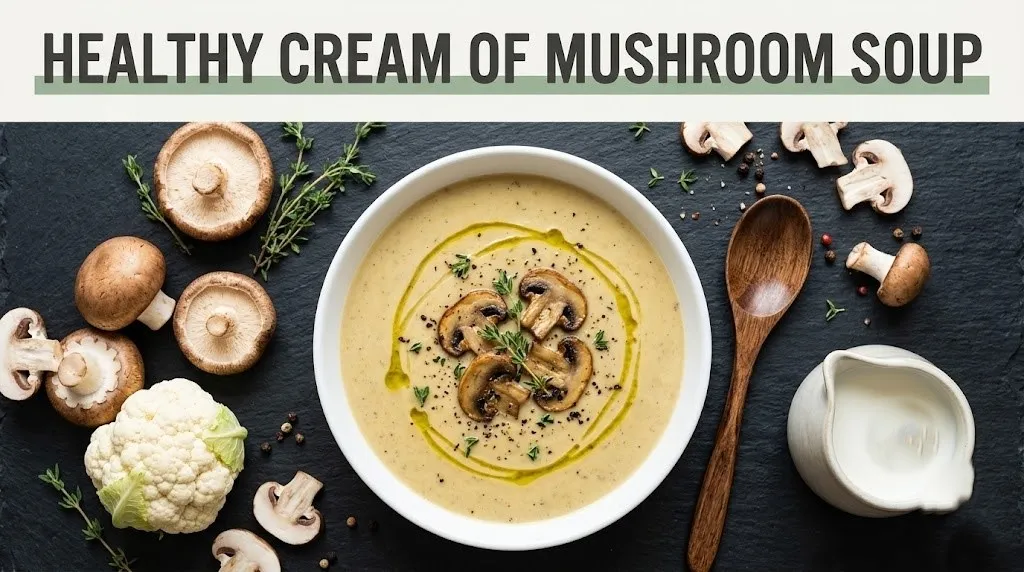
The flavor development technique is identical to the traditional version and requires no special skill beyond patience. Mushrooms must be cooked until their water evaporates and they begin to brown. This step, which takes 8 to 10 minutes over medium-high heat, is not negotiable. Mushrooms that are simmered in liquid without browning first produce a soup that tastes like boiled vegetables. Browned mushrooms produce a soup that tastes like a restaurant dish.
Key Takeaway: Healthy cream of mushroom soup replaces heavy cream with pureed cauliflower and a small amount of milk, cutting saturated fat by 80% while preserving the creamy texture and savory flavor.
Healthy mushroom soup
Healthy mushroom soup is a broader category that includes cream of mushroom soup and clear or broth-based mushroom soups that emphasize the mushrooms themselves as the primary ingredient. A simple healthy mushroom soup can be made with mushrooms, onions, garlic, broth, and herbs, pureed partially or fully for texture, with no cream or dairy at all. This approach produces a soup that is naturally low in calories and fat while being rich in the nutrients mushrooms provide.
The nutritional foundation of any healthy mushroom soup is the mushrooms themselves. A cup of cooked white button mushrooms provides approximately 40 calories, 3 grams of protein, 2 grams of fiber, and significant amounts of selenium ( 30% of the Daily Value ), riboflavin ( 20% ), niacin ( 15% ), and potassium ( 10% ). Mushrooms are one of the few non-animal food sources of vitamin D when they have been exposed to ultraviolet light during growth. UV-exposed mushrooms can provide 400 IU or more of vitamin D per serving.
Mushrooms also contain ergothioneine, a unique antioxidant and amino acid that humans obtain exclusively from dietary sources, primarily mushrooms. Research on ergothioneine is still developing, but studies suggest it concentrates in tissues with high oxidative stress, including the liver, eyes, and red blood cells. A 2023 review in the journal Nutrients identified mushrooms as the primary dietary source of ergothioneine and noted that populations with higher mushroom consumption showed lower rates of certain neurodegenerative diseases in observational studies.
Key Takeaway: Mushroom soup is healthy because mushrooms provide selenium, B vitamins, potassium, and the unique antioxidant ergothioneine for very few calories.
Mushroom soup recipe healthy
A mushroom soup recipe is healthy when it uses cooking techniques and ingredients that preserve the mushrooms’ nutrients, avoid excess saturated fat, and control sodium. The following recipe produces a healthy cream of mushroom soup that serves four and relies on cauliflower as the secret creamy ingredient. The total active cooking time is approximately 45 minutes, and the soup keeps in the refrigerator for up to 4 days or in the freezer for up to 3 months.
Ingredients for four servings:
- 1.5 pounds mixed mushrooms (cremini, shiitake, and white button), cleaned and sliced
- 1 medium onion, diced
- 3 cloves garlic, minced
- 2 cups cauliflower florets (fresh or frozen)
- 3 cups low-sodium vegetable broth
- 1/2 cup whole milk (or unsweetened cashew milk for dairy-free)
- 2 tablespoons olive oil, divided
- 1 tablespoon fresh thyme leaves (or 1 teaspoon dried)
- Salt and black pepper to taste
- Optional garnish: chopped fresh parsley, a drizzle of truffle oil, or a spoonful of Greek yogurt
To make healthy cream of mushroom soup:
- Heat 1 tablespoon of olive oil in a large pot or Dutch oven over medium-high heat. Add half the sliced mushrooms in a single layer. Do not stir for 3 minutes to allow browning. Stir and continue cooking until the mushrooms have released their liquid and the pan is nearly dry, about 8 minutes. Transfer to a bowl and repeat with the remaining oil and mushrooms.
- In the same pot, add the diced onion and cook over medium heat until translucent, about 5 minutes. Add the garlic and cook for 1 minute until fragrant.
- Return half of the cooked mushrooms to the pot. Reserve the other half for later. Add the cauliflower florets and vegetable broth. Bring to a boil, then reduce heat and simmer for 15 minutes until the cauliflower is very tender.
- Carefully transfer the soup to a blender or use an immersion blender directly in the pot. Blend until completely smooth. This is the creamy base.
- Return the pureed soup to the pot over low heat. Stir in the milk and the reserved mushrooms. Heat through without boiling. Season with salt, pepper, and fresh thyme.
- Ladle into bowls and garnish with parsley, a swirl of yogurt, or a drop of truffle oil.
Key Takeaway: The recipe uses cauliflower and a small amount of milk for creaminess, browns the mushrooms for flavor depth, and reserves half the mushrooms for texture.
Healthy creamy mushroom soup
Healthy creamy mushroom soup achieves its texture through vegetable purees, nut creams, or reduced dairy rather than the heavy cream and roux that define the traditional version. A roux, a mixture of butter and flour cooked together, adds 60 to 80 calories and 5 grams of saturated fat per tablespoon of butter, plus refined carbohydrates from the flour. Vegetable purees add fiber, vitamins, and volume for a fraction of the calories.
Cauliflower is the most effective vegetable for creating creamy soup texture because it is naturally mild in flavor and becomes velvety when pureed. A cup of cooked cauliflower contains approximately 30 calories, 2 grams of fiber, and vitamin C, and vitamin K. When blended into a soup base, it provides the mouthfeel of heavy cream without the saturated fat. Potato works similarly but is higher in starch and calories. White beans, particularly cannellini beans, provide creaminess plus protein and fiber. A half-cup of pureed white beans adds 6 grams of protein and 5 grams of fiber to a soup.
Cashew cream is the most effective dairy-free alternative for creamy mushroom soup. Soaking raw cashews in water for 4 hours or boiling them for 15 minutes, then blending them with fresh water, produces a cream that is remarkably similar to dairy cream in texture and neutral in flavor. A quarter-cup of cashew cream contains approximately 120 calories and 10 grams of unsaturated fat, predominantly monounsaturated. It is calorie-dense compared to cauliflower puree but offers a richer mouthfeel that some prefer.
Key Takeaway: Cauliflower, white beans, and cashew cream are the three most effective healthy alternatives to heavy cream in mushroom soup.
Cream of mushroom healthy
Cream of mushroom soup becomes healthy when made from scratch with controlled ingredients. The canned condensed version, which is what most Americans think of when they hear “cream of mushroom soup,” is an ultra-processed food that bears little nutritional resemblance to the homemade version. A single can of Campbell’s Condensed Cream of Mushroom Soup contains approximately 200 calories, 14 grams of fat, 3 grams of saturated fat, and 1,800 to 2,200 milligrams of sodium, according to the company’s published nutrition data. That sodium level is 75% to 95% of the American Heart Association’s daily limit of 2,300 milligrams.
The ingredient list on a can of condensed cream of mushroom soup reveals the processing gap between canned and homemade. The first ingredients are water and mushrooms, followed by vegetable oil, modified food starch, wheat flour, and less than 2% of cream, salt, and various additives including monosodium glutamate (MSG), soy protein concentrate, and flavoring. The cream content is minimal. The creamy texture comes primarily from modified starches and oil. The homemade healthy version contains recognizable whole ingredients: mushrooms, onion, garlic, broth, cauliflower, and a small amount of milk or oil.
The health difference between canned and homemade is most dramatic for sodium but extends to the overall food matrix. The homemade version provides actual vegetable content, fiber from the cauliflower, and phytonutrients from fresh mushrooms and herbs. The canned version provides calories, fat, starch, and sodium with minimal nutritional compensation. The Academy of Nutrition and Dietetics recommends cooking from scratch when possible because it allows control over the quality and quantity of ingredients.
Key Takeaway: Homemade cream of mushroom soup is substantially healthier than canned condensed soup, with 80% less sodium, recognizable ingredients, and actual vegetable content.
Cream of mushroom soup nutrition
Cream of mushroom soup nutrition varies dramatically between homemade healthy versions, traditional homemade versions, and canned condensed versions. A 1-cup serving of healthy homemade cream of mushroom soup provides approximately 150 calories, 6 grams of protein, 7 grams of fat, 2 grams of saturated fat, 15 grams of carbohydrates, 3 grams of fiber, and 400 to 600 milligrams of sodium. The same serving of traditional homemade soup made with heavy cream and butter provides approximately 350 calories, 6 grams of protein, 30 grams of fat, 18 grams of saturated fat, 15 grams of carbohydrates, 1 gram of fiber, and 600 to 800 milligrams of sodium.
The canned condensed version, when prepared with milk according to package directions, provides approximately 180 calories per cup, but the sodium remains high at 800 to 1,000 milligrams per serving. The can contains 2.5 servings, so using the full can in a casserole for four people distributes the sodium across more servings. The problem is that many people use a full can for two servings of soup, consuming 900 to 1,100 milligrams of sodium in a single bowl.
The saturated fat difference between versions is the most cardiometabolically relevant nutritional distinction. The American Heart Association’s 13-gram daily limit means the traditional version uses 138% of the daily allowance in one bowl. The healthy homemade version uses 15%. Replacing traditional cream of mushroom soup with the healthy version across all the times you eat it in a year represents one of the more impactful single-recipe swaps available to a home cook.
| Per 1 Cup | Healthy Homemade | Traditional Homemade | Canned Condensed (Prepared) |
|---|---|---|---|
| Calories | 150 | 350 | 180 |
| Protein | 6g | 6g | 4g |
| Total Fat | 7g | 30g | 12g |
| Saturated Fat | 2g | 18g | 3g |
| Carbohydrates | 15g | 15g | 16g |
| Fiber | 3g | 1g | 1g |
| Sodium | 450mg | 700mg | 900mg |
Key Takeaway: Healthy homemade cream of mushroom soup has 85% less saturated fat than traditional homemade and 50% less sodium than canned condensed.
Canned vs homemade cream of mushroom
The difference between canned and homemade cream of mushroom soup extends beyond the nutrition panel into the ingredient quality, flavor depth, and culinary versatility. Canned condensed soup is a shelf-stable, ultra-processed product designed to be a convenient ingredient for casseroles and quick meals. It serves that purpose effectively. It is not designed to be eaten as a standalone soup, which is why the label instructs adding milk or water.
Homemade cream of mushroom soup is actual food. The mushrooms are identifiable. The herbs are fragrant. The broth tastes like broth, not like a bouillon cube dissolved in water. The texture comes from vegetable puree and a small amount of dairy, not from modified starches and vegetable oil emulsified into a slurry. The flavor of homemade soup is brighter, earthier, and more complex than the canned version because fresh ingredients contain volatile aromatic compounds that do not survive the canning process.
The practical difference for cooking is that homemade soup can be used as a direct substitute for canned condensed soup in casseroles, but with some adjustments. Canned condensed soup is concentrated and thick. The healthy homemade version should be reduced by simmering uncovered for an extra 10 to 15 minutes if being used in a casserole to achieve a similar consistency. The flavor improvement in casseroles made with homemade soup is noticeable. Green bean casserole, tuna noodle casserole, and chicken and rice casserole all benefit from the swap.
Key Takeaway: Homemade cream of mushroom soup is recognizably real food with brighter flavor and better nutrition. It can replace canned in casseroles with minor thickening adjustments.
Mushroom soup benefits
Mushroom soup benefits start with the nutritional properties of mushrooms and extend to the functional role of soup in a healthy eating pattern. Mushrooms provide nutrients that are uncommon in the plant kingdom, including naturally occurring vitamin D when UV-exposed, selenium, and ergothioneine. They are one of the few savory, umami-rich foods that are also low in calories and naturally free of saturated fat and sodium.
The selenium content of mushrooms is nutritionally significant. A cup of cooked shiitake mushrooms provides approximately 36 micrograms of selenium, which is 65% of the Daily Value. Selenium functions as a cofactor for antioxidant enzymes, including glutathione peroxidase, that protect cells from oxidative damage. The USDA Dietary Guidelines identify selenium as a nutrient of public health concern for certain populations. Mushrooms are one of the most concentrated food sources.
Soup as a vehicle for nutrition has advantages that solid meals sometimes lack. The warm liquid volume of soup slows eating speed, which gives the stomach time to signal fullness to the brain. A 2022 study in the journal Appetite found that consuming a low-calorie soup before a meal reduced total calorie intake at that meal by 15% to 20%. The soup provides volume and satiety for relatively few calories. Mushroom soup, with its savory depth and creamy texture, is particularly satisfying as a first course or light meal.
Key Takeaway: Mushroom soup delivers selenium, vitamin D, and ergothioneine in a low-calorie, satiating format that may reduce overall meal calorie intake.
Cream of mushroom soup without cream
Cream of mushroom soup without cream relies on vegetable purees, nut milks, or bean purees to create the texture that heavy cream would provide. The technique is straightforward: cook a creamy vegetable alongside the mushrooms and broth, then puree it into the soup base. The vegetable disappears into the soup visually and flavor-wise, leaving behind only its creamy texture.
Cauliflower is the most neutral and effective vegetable for this purpose. When cooked until soft and blended, cauliflower develops a silky texture with no graininess and minimal flavor of its own. The soup tastes like mushrooms, not cauliflower. Potatoes work similarly but add more starch and a slightly thicker, more gluey texture if over-blended. Use Yukon Gold potatoes for the creamiest result. Parsnips add a subtle sweetness that complements the earthy mushrooms. White beans, particularly canned cannellini beans, require no cooking beyond being heated through and add protein and fiber along with creaminess.
The technique for creamless creaminess varies slightly by vegetable. For cauliflower, add the florets to the pot with the broth and simmer until very tender, 15 minutes. For potatoes, peel and dice them small so they cook quickly with the broth. For white beans, drain and rinse a can of cannellini beans and add them during the last 5 minutes of simmering before pureeing. The beans do not need to cook. They just need to be warm so they blend smoothly.
Key Takeaway: Cauliflower, potatoes, and white beans are the most effective whole-food replacements for cream in mushroom soup, each providing a different nutritional benefit.
How to thicken soup without cream
How to thicken soup without cream involves using vegetables, legumes, starches, or nut purees that add body and texture without the saturated fat that cream brings. The choice of thickener depends on the soup’s flavor profile, the desired final texture, and any dietary restrictions. For mushroom soup, which has an earthy, savory character, the thickeners that work best are those that do not compete with the mushroom flavor.
Vegetable puree is the healthiest thickener because it adds fiber and micronutrients along with texture. Beyond cauliflower and potato, roasted carrots add sweetness and a golden color that works well in mushroom soup. Cooked oatmeal blended into soup adds soluble fiber, specifically beta-glucan, that gives the soup a particularly smooth, creamy texture. A quarter-cup of rolled oats simmered in the broth for 10 minutes and then pureed thickens the soup while adding 2 grams of fiber.
For a roux-like thickening without flour, cornstarch slurry and arrowroot powder are gluten-free options. Mix 1 tablespoon of cornstarch or arrowroot with 2 tablespoons of cold water and stir into the simmering soup during the last few minutes of cooking. The soup will thicken as it heats. Arrowroot produces a clearer, glossier finish than cornstarch but breaks down if the soup is boiled after it is added or if leftovers are reheated aggressively. Xanthan gum, used in tiny amounts ( 1/8 teaspoon per cup of liquid ), creates a velvety texture in keto and low-carb soups where starch thickeners are avoided.
Key Takeaway: Vegetable purees, blended oats, cornstarch slurry, and xanthan gum thicken soup without cream, each offering different dietary benefits.
Best mushrooms for soup
The best mushrooms for soup are cremini mushrooms for all-purpose depth, shiitake mushrooms for rich umami, and a mix of wild mushrooms for complexity. White button mushrooms work in a pinch but provide the least flavor. The mushroom variety you choose affects the soup’s taste more than any other ingredient except the cream or cream substitute.
Cremini mushrooms (Agaricus bisporus), the brown version of white button mushrooms, are the best all-purpose choice for cream of mushroom soup. They have a deeper, earthier flavor than white buttons and are widely available and affordable. Portobello mushrooms are mature cremini mushrooms with an even more intense flavor. They work well in soup but turn the broth a darker brown, which may or may not be visually appealing. Shiitake mushrooms (Lentinula edodes) have a pronounced savory flavor and a meaty texture that holds up well in soup. They are more expensive than cremini but add significant flavor complexity.
Oyster mushrooms (Pleurotus ostreatus) are delicate and slightly sweet. They cook quickly and add visual interest with their pale color and fan shape. Maitake (hen of the woods) and porcini mushrooms add intense, almost meaty flavor. Dried porcini mushrooms, rehydrated in warm water for 20 minutes, contribute an concentrated umami that fresh mushrooms cannot match. The soaking liquid, strained to remove grit, becomes mushroom broth that should be added to the soup pot. A combination of fresh cremini for volume and dried porcini or fresh shiitake for flavor depth produces the best soup.
Key Takeaway: Cremini mushrooms are the best base. Shiitake, porcini, and wild mushrooms add flavor complexity. A combination of varieties produces the most interesting soup.
Low calorie cream of mushroom soup
Low calorie cream of mushroom soup uses vegetable puree and broth as the base, with no dairy, no nuts, and minimal oil, to bring a cup of soup in at approximately 80 to 100 calories. This version is essentially a pureed vegetable soup with concentrated mushroom flavor. It is the lightest version of cream of mushroom soup and is appropriate for weight loss eating plans where every calorie counts.
The low-calorie version relies entirely on cauliflower and mushrooms for texture and flavor. The recipe is identical to the standard healthy version but omits the milk and reduces the olive oil to 1 tablespoon for the entire pot. The resulting soup is thinner than the dairy or nut cream versions but still tastes creamy from the cauliflower puree. A 1-cup serving provides approximately 90 calories, 4 grams of protein, 3 grams of fat, 12 grams of carbohydrates, and 3 grams of fiber.
For weight loss, this soup works as a volumetrics strategy. A bowl of low-calorie mushroom soup before a meal adds physical volume to the stomach for minimal calories, reducing the amount of higher-calorie food consumed afterward. The protein and fiber in the mushrooms and cauliflower contribute modest satiety. The soup is not a meal replacement. It is a tool for reducing the calorie density of a meal that includes other foods. Pairing the soup with a side salad with lean protein makes a complete weight loss lunch for under 300 calories.
Key Takeaway: Low-calorie cream of mushroom soup uses only cauliflower and broth for creaminess, delivering 80 to 100 calories per cup for weight loss eating plans.
Dairy free cream of mushroom soup
Dairy-free cream of mushroom soup replaces the milk and butter in traditional recipes with plant-based alternatives. The most effective substitutes are cashew cream, canned coconut milk, or oat milk combined with a vegetable puree for body. The choice depends on the desired richness and any other dietary constraints.
Cashew cream produces the most authentic dairy-like result. Soak 1/2 cup of raw cashews in hot water for 15 minutes or cold water for 4 hours. Drain and blend with 1/2 cup of fresh water until completely smooth. This cream can be stirred into the finished soup just before serving. The cashew cream provides richness and a neutral flavor that does not compete with the mushrooms. The fat in cashews is predominantly monounsaturated, making it heart-healthier than the saturated fat in heavy cream.
Canned coconut milk, the full-fat version, produces a richer, more decadent soup that some tasters prefer to the dairy original. The coconut flavor is mild and largely masked by the mushrooms, though a sensitive palate may detect it. Light coconut milk is thinner and less effective as a cream substitute. Oat milk, particularly the “barista” or full-fat versions, works for a nut-free dairy-free option. Oat milk is thinner than cashew cream, so increase the cauliflower in the recipe to compensate for the reduced fat and body.
Key Takeaway: Cashew cream is the best dairy-free substitute for heavy cream in mushroom soup. Coconut milk and barista oat milk are alternatives for nut-free needs.
Vegan cream of mushroom soup
Vegan cream of mushroom soup eliminates all animal products, including the butter, milk, cream, and chicken broth found in traditional recipes. Olive oil replaces butter for sauteing. Vegetable broth replaces chicken broth. Cashew cream, coconut milk, or oat milk replaces dairy cream. The result is a soup that is compatible with a fully plant-based diet without sacrificing the creamy texture that defines cream of mushroom soup.
The vegan version requires one additional flavor-building technique to compensate for the missing dairy and meat-based broth. Nutritional yeast, added at 1 to 2 tablespoons during the simmering stage, provides a savory, cheese-like depth that fills the flavor gap left by the dairy. Miso paste, a fermented soybean paste, added at 1 teaspoon and dissolved into the broth, provides umami complexity. Soy sauce or tamari, added by the half-teaspoon, boosts the savory notes without tasting identifiably Asian.
The vegan version is not automatically low in calories or fat. Cashew cream is calorie-dense, and coconut milk is high in saturated fat. For a lighter vegan mushroom soup, use oat milk or a combination of cauliflower puree and a small amount of cashew cream. The vegan label indicates the absence of animal products. It does not guarantee that the soup is low-calorie, low-fat, or heart-healthy. Those attributes depend on the specific plant-based ingredients chosen.
Key Takeaway: Vegan cream of mushroom soup uses olive oil, vegetable broth, and plant-based cream substitutes. Nutritional yeast and miso replace the savory depth of dairy.
Gluten free cream of mushroom soup
Gluten-free cream of mushroom soup avoids wheat flour, the traditional thickener in cream soups, and replaces it with gluten-free alternatives that provide the same body without gluten. Traditional cream of mushroom soup is thickened with a roux made from wheat flour and butter. The gluten-free version uses cornstarch, arrowroot, rice flour, or simply relies on the pureed vegetables for thickness.
Cornstarch is the most accessible gluten-free thickener. Mix 1 tablespoon of cornstarch with 2 tablespoons of cold water to form a slurry, then stir it into the simmering soup during the last 5 minutes of cooking. Arrowroot powder works identically but produces a glossier finish. Both are neutral in flavor and effective at low concentrations. Rice flour can be used to make a gluten-free roux by cooking it with the olive oil or butter for 2 to 3 minutes before adding the broth, but the result is slightly grainier than wheat flour roux.
For a whole-food approach that avoids isolated starches entirely, the cauliflower puree method is naturally gluten-free. The pureed cauliflower provides enough body that no additional thickener is needed. If the soup is thinner than desired, a small amount of blended white beans or cooked potato can be pureed in to thicken without flour. The vegetable-thickening approach aligns with the Academy of Nutrition and Dietetics’ recommendation to choose whole-food ingredients over processed ones when possible.
Key Takeaway: Gluten-free cream of mushroom soup uses cornstarch, arrowroot, rice flour, or simply pureed vegetables as thickeners instead of wheat flour.
Keto cream of mushroom soup
Keto cream of mushroom soup eliminates the higher-carbohydrate ingredients found in some versions, particularly potatoes, flour, and milk, while emphasizing fat for creaminess and satiety. The ketogenic diet requires keeping net carbohydrates below 20 to 50 grams per day. A traditional cream of mushroom soup thickened with flour and containing milk can have 15 to 20 grams of net carbohydrates per serving. A keto version brings that down to 5 to 8 grams per serving.
The keto version relies on heavy cream or coconut cream for richness. The irony is that a keto cream of mushroom soup is closer to the traditional French version than the “healthy” versions that use cauliflower and low-fat milk. Heavy cream contains 0 grams of carbohydrates per tablespoon and provides the saturated fat that keto dieters are metabolically adapted to use for energy. The saturated fat concern that drives the standard healthy version is not a consideration within the keto framework.
Thickening for keto soup uses xanthan gum ( 1/8 to 1/4 teaspoon per cup of liquid), glucomannan, or simply reducing the soup by simmering it uncovered to concentrate the solids. Cream cheese, stirred in at the end of cooking, adds thickness and tang without carbohydrates. Cauliflower can be used in small amounts but must be tracked for net carbohydrate content. A half-cup of cauliflower contains approximately 3 grams of net carbohydrates, which is acceptable within a keto budget when distributed across servings.
Key Takeaway: Keto cream of mushroom soup uses heavy cream, cream cheese, and low-carb thickeners like xanthan gum, keeping net carbohydrates to 5 to 8 grams per serving.
Healthy substitute for cream of mushroom soup
A healthy substitute for cream of mushroom soup in casseroles and recipes can be made in advance, stored, and used exactly like the canned version. The substitute is thicker than the standard healthy homemade soup to match the condensed consistency of canned soup. To make a healthy condensed cream of mushroom soup substitute, prepare the healthy cream of mushroom soup recipe, then simmer it uncovered for an additional 15 to 20 minutes until it has reduced by roughly one-third. The reduced soup should coat the back of a spoon heavily.
One cup of this reduced soup replaces one can of condensed cream of mushroom soup in any recipe. The substitution is not a nutritional match for the canned version. It is a nutritional upgrade. The homemade substitute adds vegetables and fiber to casseroles that would otherwise contain only the processed ingredients from the can. The flavor is noticeably better, with actual mushroom taste instead of the generic savory flavor of canned soup.
To make a large batch for future casserole use, prepare a double or triple recipe, reduce it to condensed consistency, and freeze it in 1-cup portions. Each portion is equivalent to one can of condensed soup. Label the containers with the date and the words “condensed cream of mushroom.” The frozen substitute can be thawed overnight in the refrigerator or in the microwave on defrost. It may separate slightly when thawed. A quick whisk restores the texture.
Key Takeaway: Homemade cream of mushroom soup reduced by one-third is a direct, healthier substitute for one can of condensed cream of mushroom soup in any recipe.
Healthy soup for weight loss
Healthy soup for weight loss combines low calorie density, high volume, and the presence of protein or fiber to promote satiety within a calorie deficit. Cream of mushroom soup, in its low-calorie vegetable-puree version, fits this profile. A bowl provides physical fullness from liquid volume and vegetable fiber for approximately 100 calories, leaving plenty of room in the calorie budget for the rest of the meal or day.
The weight loss utility of soup is supported by research on energy density and satiety. Foods with high water content, like soups, have low energy density, meaning fewer calories per gram of food. A 2022 study in the journal Obesity found that participants who consumed a low-calorie soup before lunch ate 20% fewer total calories at the meal compared to those who did not. The soup’s water and fiber content triggered gastric stretch receptors and slowed gastric emptying, both of which signal satiety to the brain.
For cream of mushroom soup to function as a weight loss tool, the toppings and accompaniments must be chosen carefully. A swirl of heavy cream or a pile of croutons can add 100 to 200 calories and negate the calorie advantage. A dollop of plain Greek yogurt, a sprinkle of fresh herbs, or a small amount of toasted pumpkin seeds adds flavor and a small amount of protein or healthy fat for 20 to 50 calories. Pair the soup with a lean protein and a vegetable side for a complete weight loss meal.
Key Takeaway: Low-calorie cream of mushroom soup supports weight loss through high volume, low energy density, and pre-meal satiety that reduces subsequent calorie intake.
Frequently Asked Questions About Cream of Mushroom Soup
Is cream of mushroom soup healthy?
Homemade cream of mushroom soup made with vegetable puree instead of heavy cream is healthy, with 150 calories and 2 grams of saturated fat per cup.
Canned condensed cream of mushroom soup is ultra-processed and high in sodium at 1,800 to 2,200 milligrams per can.
Traditional homemade soup with heavy cream contains 18 grams of saturated fat per cup, exceeding the daily limit.
Can I make cream of mushroom soup without cream?
You can make cream of mushroom soup without cream by using pureed cauliflower, potato, or white beans for creamy texture.
Cashew cream, coconut milk, or oat milk are plant-based cream replacements.
The soup will be creamy and satisfying with any of these substitutes, though the flavor and richness vary slightly by choice.
What is a healthy substitute for canned cream of mushroom soup?
Homemade cream of mushroom soup reduced by one-third is a direct, healthier substitute for one can of condensed cream of mushroom soup.
Freeze the reduced soup in 1-cup portions for convenient future use.
The homemade version adds vegetables, fiber, and real mushroom flavor to your casseroles.
Is homemade cream of mushroom soup healthier than canned?
Homemade cream of mushroom soup is substantially healthier than canned, with 80% less sodium, recognizable whole ingredients, and actual vegetable content.
The canned version contains modified starches and additives to achieve shelf stability.
Homemade soup also tastes brighter and more mushroom-forward than the canned version.
Can I freeze healthy cream of mushroom soup?
Healthy cream of mushroom soup freezes well for up to 3 months in airtight containers.
Soups thickened with cornstarch or arrowroot may thin slightly when thawed. A quick whisk or gentle reheat restores the texture.
Soups made with dairy may separate slightly when frozen. Reheat gently and whisk to re-emulsify.
Homemade cream of mushroom soup is one of those recipes where the healthy version is genuinely better than the original, not just nutritionally superior but culinarily more interesting. The cauliflower puree that replaces the heavy cream lets the mushrooms taste like mushrooms instead of tasting like butter and dairy. The soup is lighter on the palate, which means you can eat more of it, which is the entire point of comfort food.
The most practical thing you can take from this article is the cauliflower technique. Even if you forget the recipe, remember that cooked cauliflower blended into soup creates creaminess without cream. That single technique works across dozens of soups and sauces. It is a kitchen skill that pays back every time you use it, in better nutrition and in a soup that leaves you feeling good after the meal rather than weighed down by it.