
Signs of a healthy cat include bright and clear eyes, a smooth and shiny coat, a stable body weight with visible waist definition, pink and moist gums, a consistent appetite, formed stools in the litter box, and alert, engaged behavior that includes grooming, playing, and social interaction on the cat’s own terms. A healthy cat is not just a cat that is not visibly sick. A healthy cat actively demonstrates wellbeing through predictable daily patterns and a body that looks and functions the way feline bodies are designed to.
The American Association of Feline Practitioners (AAFP) recommends that cats receive a veterinary wellness examination at least annually, with senior cats over seven years old seen every six months. Between those visits, you are the primary monitor of your cat’s health. Cats are biologically programmed to hide illness, a survival trait inherited from wild ancestors who could not afford to appear vulnerable to predators. This instinct means that by the time a cat looks obviously unwell, the underlying problem may have been developing for weeks or months.
This article gives you a structured, systematic way to assess your cat’s health at home. You will learn what to check, what normal looks like, what red flags warrant a call to your veterinarian, and how the standards for health shift across your cat’s life from kittenhood through the senior years. This is a between-visit monitoring tool. It does not replace professional veterinary care. It helps you use that care more effectively by catching changes early.
What does a healthy cat look like
A healthy cat looks alert, well-proportioned, and well-maintained, with a body that appears balanced and a coat that looks like it belongs on an animal that grooms itself regularly. The cat’s head should be carried upright with ears swiveling toward sounds. The eyes should be fully open, clear, and free of discharge. The body should have a visible waist when viewed from above and a slight abdominal tuck when viewed from the side. The cat should move without stiffness, limping, or hesitation.
The overall impression of a healthy cat is an animal that is comfortable in its own body. The coat lies flat against the body, not puffed, patchy, or greasy. The cat’s resting posture is relaxed, not hunched or tense. A healthy cat at rest may curl up tightly or sprawl openly. Both are normal. The posture that signals a problem is the hunched, feet-tucked-under, head-lowered position that cats adopt when they are in pain or feel unwell. This posture, sometimes called the “meatloaf” position when extreme, is worth noting if it persists.
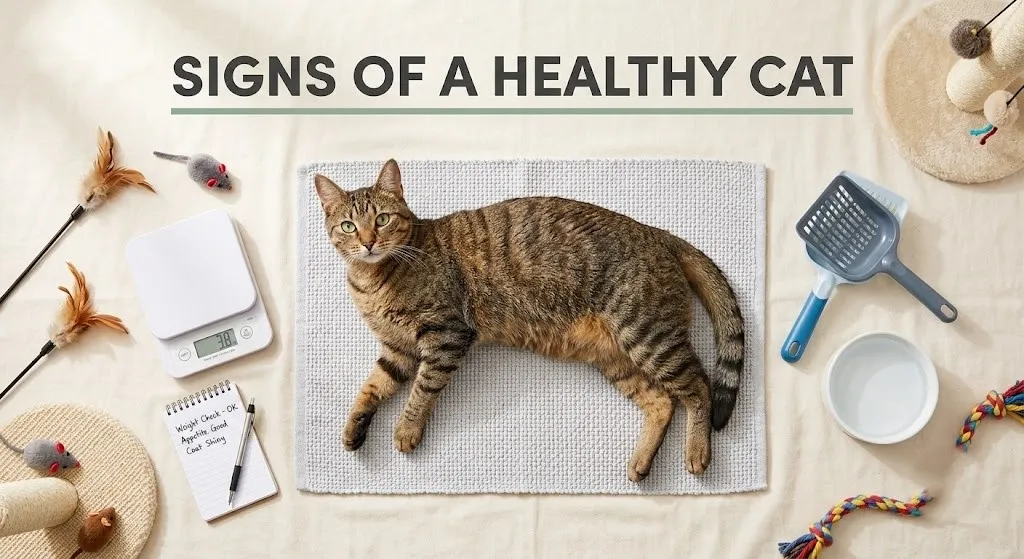
Individual variation is real and important. A healthy Persian cat will have a flatter face, rounder eyes, and a heavier, denser coat than a healthy Siamese, which will have a sleeker body, larger ears, and a finer coat. A healthy Maine Coon will be larger and more heavily boned than a healthy Singapura. The breed standard and the individual cat’s baseline appearance, documented through photos and your own familiarity, are the comparison points for health. Comparing a Persian to a Siamese standard will produce false alarms. Compare your cat to your cat’s own normal.
Key Takeaway: A healthy cat looks alert, well-groomed, and proportionate for its breed. Compare your cat to its own baseline, not to other breeds.
Signs of healthy cat
The signs of a healthy cat fall into physical, functional, and behavioral categories that together create a picture of overall feline wellness. Physical signs include clear eyes, clean ears, a shiny coat, pink gums, and a body condition that falls within the ideal weight range. Functional signs include a steady appetite, normal water intake, regular urination and defecation, and normal breathing at rest. Behavioral signs include grooming, playing, exploring, and interacting with people and other pets in ways consistent with the cat’s established personality.
A healthy cat maintains a predictable daily rhythm. Cats are crepuscular, meaning they are most active at dawn and dusk. A healthy cat will have periods of activity, usually in the morning and evening, interspersed with long periods of sleep during the day and night. Cats sleep 12 to 16 hours per day on average, with kittens and seniors sleeping more. The pattern matters more than the total hours. A cat that suddenly sleeps significantly more or significantly less than its usual pattern, or that shifts its active periods to the middle of the night when it previously slept, may be signaling a health issue.
The social behavior of a healthy cat varies enormously by individual. Some cats are lap cats. Some are “same room” cats that want to be near you but not touching. Some are independent cats that interact on their own schedule. The healthy version of each social style is consistency. A lap cat that suddenly hides under the bed for two days is communicating something. A same-room cat that suddenly becomes clingy and vocal is communicating something. The change from baseline, not the absolute level of sociability, is the health indicator.
Key Takeaway: A healthy cat shows consistent physical appearance, steady daily rhythms, and stable social behavior that matches its established personality.
How to tell if your cat is healthy
How to tell if your cat is healthy involves systematically checking the eyes, ears, mouth, coat, body condition, hydration status, appetite, elimination habits, and behavior against both general feline health standards and your individual cat’s established baseline. A quick daily scan, eyes and nose clear, posture relaxed, greeting behavior normal, takes less than a minute. A more thorough weekly check of coat, weight, mouth, and litter box output provides deeper monitoring.
The daily scan should become a habit embedded in your existing interactions with your cat. When you greet your cat in the morning, note whether the eyes are bright and fully open, whether there is any nasal discharge or sneezing, and whether the cat moves toward you with a normal gait. When you feed your cat, note whether the appetite is normal and the cat approaches the food with interest. When you scoop the litter box, note the quantity, consistency, and color of urine and feces. These observations require no additional time. They require attention.
The weekly check is a more deliberate assessment that takes five to ten minutes. Run your hands over your cat’s body from head to tail, feeling for lumps, bumps, sensitive areas, or coat texture changes. Lift the lips and check gum color. Pinch the skin between the shoulder blades gently to assess hydration. Weigh your cat on a home scale by weighing yourself holding the cat and subtracting your own weight. Record these observations in a notebook or a phone note so that you have a dated baseline to compare against. The American Veterinary Medical Association (AVMA) emphasizes that early detection of changes in these parameters is the single most effective way to catch feline health problems before they become advanced.
Key Takeaway: A daily 60-second scan and a weekly 10-minute hands-on check create a reliable home health monitoring system for your cat.
Healthy cat signs
Healthy cat signs that owners can observe at home without special equipment include nose moisture and temperature, whisker condition, and grooming completeness. A healthy cat’s nose can be wet or dry, warm or cool. Nose moisture and temperature fluctuate with the environment and are not reliable indicators of fever or illness. The myth that a dry, warm nose means a sick cat persists despite having no basis in veterinary science. Check gum color, appetite, and energy for fever assessment instead of the nose.
Whiskers on a healthy cat are intact, not broken or bent, and are held in a relaxed, slightly forward position when the cat is at rest. Whiskers that are pulled back tight against the face indicate fear, stress, or pain. Whiskers that are pushed far forward indicate curiosity or, in some cases, aggression. Broken whiskers can result from rough play or from a housemate cat over-grooming the cat. Whiskers do shed and regrow naturally, so a single broken whisker is not a health concern. Multiple broken or missing whiskers may indicate stress, nutritional deficiency, or excessive grooming by a dominant cat.
Grooming completeness is one of the most underutilized health indicators in cats. A healthy cat grooms itself regularly and thoroughly. The coat should be free of mats, dandruff, and greasy patches. A cat that stops grooming, particularly around the hindquarters, may be experiencing dental pain, arthritis, obesity that prevents reaching certain areas, or systemic illness. A cat that overgrooms, creating bald patches or irritated skin, may be experiencing allergies, parasites, or stress. Grooming is a behavior that requires both physical capability and mental wellbeing. Disruptions to grooming are always worth investigating.
Key Takeaway: Whisker condition, grooming completeness, and consistency of daily patterns are observable healthy cat signs that require no equipment to monitor.
Cat health checklist
A cat health checklist provides a structured framework for the weekly home assessment. The checklist covers the major body systems and functions that a cat owner can evaluate without veterinary equipment. The Cornell Feline Health Center recommends that owners become familiar with their cat’s normal physical condition through regular hands-on assessment so that abnormalities are recognized quickly when they appear.
The eyes should be clear, bright, and free of discharge, cloudiness, or squinting. The third eyelid, or nictitating membrane, should not be visible when the eye is open. The ears should be clean, pale pink, and free of debris, redness, swelling, or odor. A small amount of light brown wax is normal. Dark, crumbly debris may indicate ear mites. Redness, swelling, or discharge may indicate infection. The nose should be free of discharge, sneezing, or crusting.
The mouth and gums should be pink and moist. Press gently on the gum above a canine tooth and release. The color should return within 2 seconds. This is the capillary refill time, a measure of circulation. Pale, white, blue, or brick-red gums are abnormal. The teeth should be free of heavy tartar buildup, though some tartar is normal in adult cats. The breath should not be foul. The coat should be smooth, shiny, and free of mats, dandruff, bald patches, or parasites. The skin should be free of scabs, redness, or flaking.
Key Takeaway: A weekly cat health checklist covers eyes, ears, nose, mouth and gums, coat and skin, and body condition in a systematic five-minute assessment.
Healthy cat eyes
Healthy cat eyes are clear, bright, and fully open with no discharge, squinting, or visible third eyelid. The pupils should be equal in size and responsive to light, constricting when a light is shone into the eye and dilating in dim conditions. The surface of the eye should be smooth and glossy, not dull or rough. The white of the eye, the sclera, should be white with perhaps a few visible blood vessels. Yellowing of the sclera indicates jaundice, a sign of liver or red blood cell disease that requires immediate veterinary attention.
The area around the eyes should be clean and free of tear staining, crusting, or fur loss. A small amount of clear discharge that dries to a dark, crusty material at the inner corner of the eye is normal for some cats and is simply oxidized tears. Green, yellow, or thick discharge is abnormal and indicates infection or inflammation. Squinting or holding one eye partially closed indicates pain and warrants a veterinary visit within 24 hours. Eye problems in cats can progress rapidly to vision-threatening severity.
The third eyelid, a thin membrane that moves diagonally across the eye from the inner corner, should not be visible when the cat is alert and the eyes are fully open. Persistent visibility of the third eyelid, even if the cat seems otherwise well, can indicate dehydration, weight loss, intestinal parasites, or systemic illness. A third eyelid that is visible for more than a few hours is a reason to schedule a non-emergency veterinary appointment. A third eyelid that is visible along with lethargy or appetite loss is more urgent.
Key Takeaway: Healthy cat eyes are clear, fully open, and free of discharge. Persistent third eyelid visibility or any colored discharge warrants veterinary attention.
Healthy cat coat
A healthy cat coat is smooth, shiny, and free of mats, dandruff, bald patches, grease, or excessive shedding. The coat should lie flat against the body and feel soft and pliable when stroked. A healthy cat spends a significant portion of its waking hours grooming, distributing natural skin oils along the hair shafts and removing loose fur. The result of this grooming investment is a coat that looks clean and feels smooth without bathing or brushing from the owner.
The nutritional foundations of a healthy coat are dietary protein, omega-6 fatty acids, and zinc. Cats are obligate carnivores with a high protein requirement. Hair is made of keratin, a structural protein, and the amino acid building blocks for keratin come from dietary protein. A diet deficient in protein or in specific amino acids produces a dull, brittle, or slow-growing coat. Linoleic acid, an omega-6 fatty acid, is essential for the skin’s lipid barrier. Arachidonic acid, another essential fatty acid for cats, supports the inflammatory response in skin. Zinc is a cofactor for enzymes involved in cell division and protein synthesis in the skin and hair follicles. A high-quality, AAFCO-complete commercial cat food provides these nutrients in appropriate amounts.
Coat changes that signal potential health problems include the sudden appearance of mats in a cat that normally grooms effectively, which may indicate dental pain, arthritis, or obesity. Greasy fur along the spine or at the base of the tail, sometimes called “stud tail,” can result from hormonal imbalances or skin conditions. Excessive shedding outside of seasonal coat changes may indicate stress, nutritional deficiency, or skin disease. Bald patches with red, irritated skin suggest allergies, parasites like fleas or mites, or ringworm, a fungal infection that can transmit to humans.
Key Takeaway: A healthy cat coat is smooth and shiny, reflecting adequate dietary protein, omega-6 fatty acids, and zinc. Sudden coat deterioration signals either nutritional or health problems.
Healthy cat weight
A healthy cat weight is not a specific number on a scale but a body condition score that falls in the ideal range on a validated assessment scale. The most widely used tool is the 9-point body condition score (BCS) system, where 1 is emaciated, 5 is ideal, and 9 is severely obese. A cat at an ideal BCS of 4 to 5 has ribs that are easily felt with a thin layer of fat covering them, a visible waist when viewed from above, and an abdominal tuck when viewed from the side.
Assessing body condition at home involves three physical checks. First, run your hands along your cat’s ribcage with the cat standing. You should feel the individual ribs with light pressure, similar to running your fingers over the back of your hand. If you cannot feel the ribs without pressing firmly, the cat is overweight. If the ribs are visually prominent and feel sharp with no fat covering, the cat is underweight. Second, look at your cat from above. There should be a visible indentation at the waist behind the ribs. An oval or rectangular shape from above indicates overweight. Third, look at your cat from the side. The belly should tuck up behind the ribcage. A belly that hangs down or is level with the ribcage indicates overweight.
Weight trends matter more than a single weight measurement. A cat that loses 5% or more of its body weight over a few weeks without an intentional diet change warrants a veterinary investigation. Unexplained weight loss in cats can indicate hyperthyroidism, diabetes, kidney disease, or intestinal disease. A cat that gains weight steadily over months is being overfed relative to its energy expenditure. Obesity in cats is associated with diabetes, arthritis, urinary tract disease, and reduced lifespan. The Association for Pet Obesity Prevention estimates that approximately 60% of domestic cats in the United States are overweight or obese.
Key Takeaway: A healthy cat has a body condition score of 4 to 5 out of 9, with ribs easily felt, a visible waist, and an abdominal tuck.
Cat body condition score
The cat body condition score (BCS) is a standardized visual and tactile assessment tool used by veterinarians and trainable by owners to objectively evaluate a cat’s body fat and muscle condition. The 9-point scale is the most common in veterinary practice in North America. The 5-point scale, where 3 is ideal, is used in some other regions. Both scales assess the same physical parameters: rib coverage, waist definition, abdominal tuck, and the visibility of skeletal structures.
To perform a BCS assessment at home, place your cat on a non-slip surface and allow it to stand naturally. First, run both hands across the ribcage with thumbs on the spine. On a BCS 5 cat, the ribs are palpable with a thin layer of subcutaneous fat, similar to the feel of the back of your hand when it is flat. On a BCS 7 cat, the ribs are difficult to feel beneath a moderate to thick fat layer. On a BCS 3 cat, the ribs are easily visible and have no palpable fat covering. Next, stand above the cat and look down. A BCS 5 cat has a clearly visible waist behind the ribs. A BCS 7 cat has an oval silhouette with no waist definition. Finally, view the cat from the side at eye level. A BCS 5 cat has an abdominal tuck, meaning the belly slopes upward from the ribcage to the hind legs. A BCS 7 cat has a flat or pendulous belly.
Muscle condition scoring, while more subjective, adds important information to the BCS assessment. An older cat may have a normal BCS but show muscle wasting over the spine, hips, or shoulders, a condition called sarcopenia that is common in senior cats and associated with chronic disease. Palpate the muscles along the spine and over the hip bones. They should feel firm and full, not bony and atrophied. A cat that has both weight loss and muscle wasting needs veterinary evaluation even if the BCS number appears normal.
Key Takeaway: Body condition scoring uses rib palpation, waist visibility, and abdominal tuck to objectively classify a cat’s weight status on a 9-point scale.
Healthy cat gums
Healthy cat gums are bubblegum pink, moist, and smooth, with no redness, swelling, bleeding, or recession. The gum line where the teeth emerge should be cleanly attached with no red margin. When pressed with a finger, the gum should blanch white and then return to pink within 2 seconds. This capillary refill time is a quick measure of circulation and hydration. Pale, white, blue, gray, or brick-red gums are abnormal and warrant an urgent veterinary call.
Dental health is a component of gum health and one of the most commonly overlooked aspects of feline wellness. The American Veterinary Dental Society reports that 70% of cats show signs of dental disease by age three. Tartar buildup appears as yellow or brown hard material on the teeth near the gum line. Gingivitis appears as a red, swollen line along the gum margin that may bleed when touched. Stomatitis is a more severe, painful inflammation of the entire mouth that causes bright red, proliferative gum tissue and often leads to reduced appetite and weight loss.
Home dental care for cats is challenging but possible. Daily tooth brushing with a cat-specific enzymatic toothpaste is the gold standard and is most successful when introduced gradually to kittens. Dental treats and diets carry the Veterinary Oral Health Council (VOHC) seal if they have been proven to reduce tartar. Water additives are another option. Even with home care, most cats will need professional dental cleanings under anesthesia at some point in their lives. A veterinarian can assess your cat’s dental health during a wellness exam and recommend an appropriate care schedule.
Key Takeaway: Healthy cat gums are pink and moist with a 2-second capillary refill time. Red, swollen, or bleeding gums indicate dental disease requiring veterinary attention.
Healthy cat appetite
A healthy cat appetite is consistent from day to day, with the cat approaching food with interest and eating a predictable amount at predictable times. Cats are creatures of habit with feeding behavior. A cat that normally eats eagerly and suddenly walks away from its bowl, or a cat that normally grazes throughout the day and suddenly finishes every meal in one sitting, is signaling a change that may have a medical cause.
The appetite of a healthy cat reflects the cat’s energy needs. An adult cat maintaining a stable weight on a consistent diet is eating approximately the right number of calories. The AAFCO nutrient profiles provide minimum requirements, but the caloric needs of individual cats vary by age, activity level, reproductive status, and breed. A young, active Bengal will require more calories per pound than a sedentary senior Persian. The feeding guidelines on commercial cat food packages are starting points, not rigid rules. Adjust portions based on body condition score trends.
Appetite changes that warrant veterinary attention include anorexia, defined as not eating for more than 24 hours, which is a medical emergency in cats. Cats can develop hepatic lipidosis, a potentially fatal liver condition, after as little as 2 to 3 days of significantly reduced food intake. Increased appetite, or polyphagia, particularly when accompanied by weight loss, is a classic sign of hyperthyroidism, diabetes mellitus, or intestinal malabsorption. A cat that suddenly becomes ravenous despite losing weight needs blood work. A change in food preference, such as a cat that suddenly refuses dry food but eats wet food, may indicate dental pain.
Key Takeaway: A healthy cat eats consistently. Anorexia for 24 hours is an emergency. Increased appetite with weight loss suggests hyperthyroidism or diabetes.
Cat hydration test
The cat hydration test uses skin turgor and gum moisture to assess whether a cat is adequately hydrated. The skin tent test is the classic home assessment. Gently pinch a fold of skin over the cat’s shoulder blades, lift it, and release. In a well-hydrated cat, the skin snaps back into place immediately. In a dehydrated cat, the skin returns slowly, remaining tented for a moment before settling. A skin tent that persists for more than 1 to 2 seconds indicates dehydration of at least 5%.
The skin tent test has limitations. Very thin cats and senior cats with reduced skin elasticity may show a slow return even when adequately hydrated. Very obese cats may show a normal return even when dehydrated because the subcutaneous fat holds the skin’s shape. The gum moisture test provides complementary information. A well-hydrated cat’s gums feel moist and slippery to the touch. Dehydrated gums feel tacky or dry. Combine the skin tent test, the gum moisture test, and the capillary refill time for a more reliable hydration assessment than any single test alone.
A healthy cat drinking an appropriate amount of water produces urine that is pale yellow and odorless when fresh. Concentrated, dark yellow urine with a strong ammonia odor suggests the cat is not drinking enough or is losing fluid through vomiting, diarrhea, or increased urination. Increased water consumption, or polydipsia, is a significant clinical sign in cats and should always be investigated. A cat that suddenly starts drinking from the faucet, camping at the water bowl, or emptying the bowl more quickly than before may have kidney disease, diabetes, or hyperthyroidism. The Cornell Feline Health Center notes that increased thirst is one of the most common early signs of these chronic feline diseases.
Key Takeaway: Hydration can be assessed at home with the skin tent test and gum moisture check. Increased thirst is a significant clinical sign requiring veterinary investigation.
Healthy cat poop
Healthy cat poop is formed, moist, dark brown, and passed without straining. The consistency should be firm enough to hold its shape but soft enough that it deforms slightly when scooped. The ideal feline stool on a fecal scoring chart is a 2 to 3 on a 7-point scale, where 1 is hard, dry pellets and 7 is liquid. The stool should be segmented or log-shaped, not individual hard balls and not a formless pile.
The color of healthy cat feces is uniformly dark brown. The brown color comes from stercobilin, a breakdown product of bilirubin that is produced during normal red blood cell turnover. Black, tarry stool indicates digested blood from the upper gastrointestinal tract. Red-streaked stool indicates fresh blood from the colon or rectum. Pale, clay-colored stool indicates a lack of bile flow, possibly from liver or gallbladder disease. Yellow or greasy stool suggests malabsorption or pancreatic insufficiency. Any color deviation from the normal brown that persists for more than a day or two should be discussed with a veterinarian.
Litter box habits are as informative as the stool itself. A healthy cat defecates once daily on average, with a range of twice daily to once every other day falling within normal limits. Straining in the litter box, vocalizing while defecating, or producing small, hard balls suggests constipation. Increased frequency with small amounts of soft or liquid stool suggests colitis. The location of elimination matters as well. A cat that suddenly stops using the litter box and begins defecating on the floor or in a bathtub is communicating either a medical problem like arthritis making box entry painful or a behavioral problem requiring investigation.
Key Takeaway: Healthy cat poop is formed, dark brown, and passed once daily without straining. Color changes, straining, or litter box avoidance warrant investigation.
Healthy cat behavior
Healthy cat behavior encompasses a range of species-typical activities that a physically and mentally well cat performs regularly: grooming, scratching, playing, exploring, climbing, perching, and interacting with humans and other animals in accordance with the cat’s individual personality. The specific mix of behaviors varies by age, breed, and temperament. The consistent presence of these behaviors indicates health. Their absence or distortion indicates a problem.
Play behavior is a particularly sensitive health indicator because it requires physical capability, energy, and positive mental state simultaneously. A healthy adult cat engages in at least one or two play bouts per day, even if brief. A cat that has not played in several days may be experiencing pain, illness, or stress. The type of play changes with age. Kittens play frenetically. Young adults play with intensity. Seniors play with less frequency and duration but should still show interest in a wand toy or laser pointer for at least a few minutes. A senior cat that has completely stopped playing is not just “slowing down.” It may have arthritis, dental pain, or another condition that warrants evaluation.
Scratching behavior is a normal, healthy feline activity that maintains claw health, stretches the muscles of the shoulders and back, and deposits scent from the paw pads. A cat that has stopped scratching may be in too much pain to stretch. A cat that has suddenly started scratching furniture when it previously used a scratching post may be responding to stress or a change in the household. Scratching is not misbehavior. It is a biological need. Providing appropriate scratching surfaces and observing the cat’s scratching habits is part of the home health monitoring framework.
Key Takeaway: Grooming, playing, and scratching are species-typical behaviors whose consistent presence signals physical and mental wellbeing.
Cat wellness exam at home
A cat wellness exam at home is a systematic, head-to-tail physical assessment performed by the owner between veterinary visits. The exam takes approximately 10 minutes and follows a consistent sequence so that nothing is missed. The purpose is not to diagnose disease. It is to establish a detailed baseline of normal and identify changes that warrant professional evaluation.
To perform a cat wellness exam at home, follow this head-to-tail sequence:
- Observe your cat from a distance of a few feet. Note posture, gait, breathing pattern, and overall alertness. Count breaths per minute while the cat is at rest. Normal resting respiratory rate is 20 to 30 breaths per minute.
- Examine the head. Check eyes for clarity and discharge. Check ears for debris and odor. Check nose for discharge. Lift the lips and check gum color and capillary refill time.
- Palpate the body. Run your hands from the chin down the chest, along the back, and over the hips. Note any lumps, bumps, sensitive areas, or coat texture changes.
- Check the paws. Look at the paw pads and between the toes for cuts, swelling, or foreign material. Check the claws for overgrowth or abnormal thickness.
- Weigh your cat. Use a home scale or track body condition score trends.
- Check the litter box output. Note urine volume and stool consistency.
- Record your observations with the date. A notebook, phone note, or cat health app creates a searchable record.
Key Takeaway: A 10-minute home wellness exam following a head-to-tail sequence establishes a baseline of normal and catches changes early.
Kitten health signs
Kitten health signs include steady weight gain, consistent energy and playfulness, and age-appropriate developmental milestones that unfold on a predictable timeline. Kittens should gain weight every day during the first several months of life. A kitten that fails to gain weight or, worse, loses weight, requires immediate veterinary attention. The weight gain trajectory is the single most important health indicator for kittens under six months.
Healthy kitten development follows a predictable timeline. Eyes open at 7 to 10 days. Walking begins at 3 weeks. Solid food introduction starts at 4 to 5 weeks. Social play with littermates peaks at 6 to 12 weeks. Kittens should be alert, curious, and interactive by the time they are ready for adoption at 8 to 12 weeks. A kitten that is lethargic, that hides constantly, or that does not engage with toys or people may have an underlying health problem.
Vaccination and deworming are part of kitten health. Kittens receive a series of core vaccinations starting at 6 to 8 weeks and continuing every 3 to 4 weeks until 16 to 20 weeks of age. The AAFP recommends testing for feline leukemia virus (FeLV) and feline immunodeficiency virus (FIV) at the first veterinary visit. Intestinal parasites are common in kittens and may not be visible in the stool. A fecal examination by the veterinarian is the only way to confirm parasite status. A kitten that has received appropriate preventive care and continues to gain weight, play, and develop normally is likely healthy, but only a veterinarian can confirm this with a physical examination.
Key Takeaway: Steady daily weight gain is the single most important health indicator for kittens. Vaccination, deworming, and veterinary exams are essential components of kitten health.
Senior cat health signs
Senior cat health signs include maintenance of stable weight and muscle mass, normal appetite and hydration, consistent litter box habits, and mobility that allows access to all preferred locations in the home. Cats are considered senior at 7 to 10 years and geriatric at 10 to 15 years, though individual variation is significant. A well-cared-for 15-year-old cat can be healthier than a neglected 10-year-old cat. The AAFP recommends senior cats receive veterinary examinations every 6 months rather than annually.
Weight and muscle monitoring become more important in senior cats. Sarcopenia, the age-related loss of muscle mass, can occur even when body weight remains stable because fat replaces the lost muscle. A senior cat should be palpated along the spine and hips monthly to assess muscle condition. The bones of the spine and hips should not feel prominent. A cat that is losing muscle but maintaining weight needs a different nutritional and medical approach than a cat that is simply gaining fat.
Common age-related health conditions in senior cats include chronic kidney disease, hyperthyroidism, diabetes mellitus, osteoarthritis, and dental disease. The clinical signs of these conditions overlap and can be subtle. A senior cat that is drinking more water, urinating larger volumes, losing weight despite a good appetite, or showing reluctance to jump onto previously accessible surfaces should see a veterinarian. The Cornell Feline Health Center notes that 30% to 40% of cats over 10 years old have some degree of chronic kidney disease. Early detection through blood work and urinalysis allows dietary and medical interventions that slow progression and extend quality of life.
Key Takeaway: Senior cats need muscle mass monitoring, biannual veterinary exams, and proactive screening for kidney disease, hyperthyroidism, diabetes, and arthritis.
Frequently Asked Questions About Cat Health
How do I know if my cat is healthy?
A healthy cat has clear eyes, a shiny coat, pink gums, a stable weight with a visible waist, a consistent appetite, formed stools, and engaged, playful behavior.
Cats are masters at hiding illness, so knowing your cat’s individual baseline is essential for detecting subtle changes.
Any deviation from your cat’s normal that persists for more than 24 to 48 hours warrants a call to your veterinarian.
What does healthy cat poop look like?
Healthy cat poop is formed, moist, dark brown, and passed without straining.
The consistency should be firm enough to hold its shape but soft enough to deform slightly when scooped.
Black, red-streaked, pale, yellow, or persistently loose stool should be discussed with a veterinarian.
How can I check my cat for dehydration at home?
Gently pinch the skin between your cat’s shoulder blades, lift it, and release. The skin should snap back immediately.
Check the gums. They should feel moist and slippery, not tacky or dry.
A skin tent that persists or dry gums combined with lethargy or appetite loss requires urgent veterinary attention.
What is a normal weight for a healthy cat?
A healthy weight varies by breed and frame size. The body condition score is more important than a specific number on a scale.
An ideal BCS of 4 to 5 out of 9 means ribs are easily felt with light fat covering, a visible waist, and an abdominal tuck.
Your veterinarian can tell you your individual cat’s ideal weight range during a wellness exam.
Do healthy cat signs change as cats age?
Yes, healthy cat signs change with age. Kittens should gain weight daily. Adults maintain stable weight. Seniors may lose muscle even with stable weight.
Senior cats need more frequent veterinary monitoring, ideally every six months, and proactive screening for age-related diseases.
The expected activity level, play intensity, and appetite change across life stages. Know what is normal for your cat’s age.
The signs of a healthy cat are observable at home with a systematic approach. Clear eyes, a shiny coat, a body condition score of 4 to 5, pink gums, formed stool, consistent appetite, and engaged behavior. These signs together form a picture of feline wellness that you can monitor in minutes a day. The key is knowing your cat’s individual baseline and tracking changes over time.
The most practical thing you can do is start a simple health log today. Spend ten minutes doing the head-to-tail assessment described in this article. Write down what you find. Take a photo of your cat from above and from the side. Repeat this monthly. The log becomes an invaluable record for your veterinarian and an early warning system for you. Your cat cannot tell you when something feels wrong. Your observations speak for it.