Pretzels are not a strong weight loss food despite being low in fat and relatively low in calories. A one-ounce serving of hard pretzels contains approximately 110 calories and only 1 gram of fat, numbers that look good on paper. The problem is what pretzels lack. They are nearly devoid of protein, fiber, and healthy fat, the three nutrients that signal satiety to your brain. Eating pretzels for weight loss is like putting water in your gas tank and expecting the car to run. The calories are there. The satisfaction is not.
The Academy of Nutrition and Dietetics emphasizes that successful weight management depends on choosing foods that promote fullness within a calorie deficit. Foods made from refined carbohydrates, including pretzels, digest quickly and cause a blood sugar spike followed by a crash that triggers renewed hunger. A 2023 study in the American Journal of Clinical Nutrition found that snacks high in refined carbohydrates led to greater total daily calorie intake compared to protein or fiber-rich snacks with identical calorie counts. The pretzel eater was hungry again an hour later. The nut eater was not.
This article breaks down exactly what is in pretzels nutritionally, why they fail the satiety test, how different pretzel types compare, and what to eat instead if weight loss is your goal. If you love pretzels, you will learn how to pair them so they actually work within a weight loss plan rather than working against it.
Are pretzels healthy for weight loss
Pretzels are not healthy for weight loss in the way most people assume. The low-fat label creates a health halo that masks their status as a refined carbohydrate with minimal nutritional value. A 1-ounce serving, roughly 15 to 20 mini pretzels or 3 pretzel rods, delivers approximately 110 calories of nearly pure starch with 1 gram of fiber, 2 to 3 grams of protein, and 22 to 25 grams of carbohydrates. That macro profile is closer to white bread than to a genuinely filling snack.
The satiety deficit is the core problem with pretzels for weight loss. Protein, fiber, and fat slow gastric emptying and trigger the release of satiety hormones like peptide YY and cholecystokinin. Pretzels contain almost none of any of the three. The refined starch digests rapidly in the small intestine, glucose floods the bloodstream, insulin surges to clear it, and within 60 to 90 minutes, blood sugar drops below baseline. The brain interprets that drop as hunger. You reach for another snack. The calorie savings from choosing a low-fat snack disappear when the snack itself causes you to eat more later.
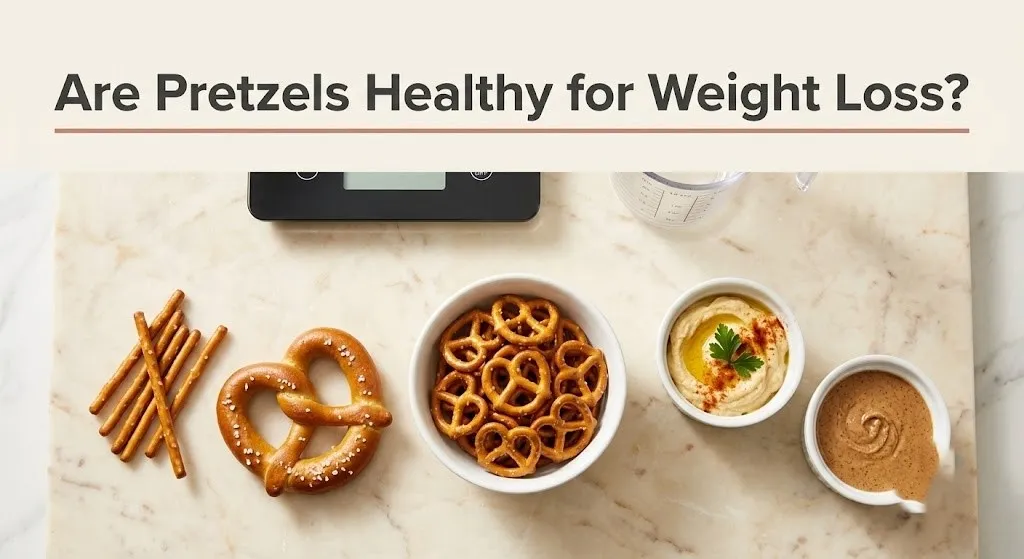
The calorie count is also misleading in practice. The serving size on a pretzel bag is 1 ounce, which is a small handful. Most people eating pretzels directly from the bag consume 2 to 4 ounces without realizing it, delivering 220 to 440 calories of refined starch. That is the caloric equivalent of a small meal but with the satiety impact of a glass of water. A weight loss snack should do the opposite: provide satiety for minimal calories. Pretzels provide minimal satiety for their calories.
Key Takeaway: Pretzels are a weight loss trap. Low fat and moderate calories mask their failure to provide satiety, leading to overconsumption and hunger-driven snacking later.
Pretzel healthy
Pretzel healthy is a misnomer for most commercial pretzels, which are baked snacks made from refined wheat flour, salt, and vegetable oil with minimal nutritional value beyond the calories they provide. The “low fat” banner on pretzel packaging is a relic of the 1990s low-fat diet era, when dietary fat was vilified and any food that avoided it was automatically considered healthy. Nutrition science has moved on. The consensus now recognizes that the quality of carbohydrates, protein, and fats matters more than simply avoiding fat. Pretzels meet the old standard and fail the new one.
Refined wheat flour, the first ingredient in most pretzels, has been stripped of the bran and germ that contain the grain’s fiber, B vitamins, and minerals. Enrichment adds back a few of those nutrients, specifically thiamin, riboflavin, niacin, folic acid, and iron, but it does not restore the fiber or the full spectrum of micronutrients present in whole wheat flour. A pretzel made from enriched flour is nutritionally similar to white bread in a crunchier shape. It is a processed carbohydrate delivery system, not a whole food.
The word “healthy” on a food label is a marketing term, not a regulated nutritional claim. A brand can call its pretzels healthy because they are low in fat or because they are baked, not fried. Neither attribute makes them supportive of weight loss or metabolic health. The Academy of Nutrition and Dietetics advises evaluating the full Nutrition Facts panel and ingredient list rather than relying on front-of-package health claims. A pretzel that calls itself healthy but lists enriched flour as the first ingredient and contains minimal protein and fiber is a processed food wearing a health halo.
Key Takeaway: Commercial pretzels are not healthy by modern nutritional standards. They are refined carbohydrates with a low-fat marketing advantage that does not translate to weight loss support.
Pretzel nutrition facts
Pretzel nutrition facts for a standard 1-ounce (28-gram) serving of hard salted pretzels, according to the USDA FoodData Central database, break down as approximately 110 calories, 1 gram of total fat, 0 grams of saturated fat, 22 to 25 grams of carbohydrates, 1 gram of fiber, 1 to 2 grams of sugar, 2 to 3 grams of protein, and 350 to 450 milligrams of sodium. The sodium range varies by brand and whether the pretzels are salted, unsalted, or flavored.
The macronutrient profile reveals the pretzel’s nutritional weakness. 90% of the calories come from carbohydrates. 10% come from protein and fat combined. There is no meaningful contribution from any of the nutrients that support weight loss. The 1 gram of fiber per serving is negligible. The USDA Dietary Guidelines recommend 25 to 30 grams of fiber per day. A serving of pretzels provides 3% to 4% of that target. A cup of raspberries provides 8 grams. A half-cup of black beans provides 7 grams.
The micronutrient content is limited to what the enrichment process adds back. A serving of enriched pretzels provides 10% to 15% of the Daily Value for iron and several B vitamins. These are not unique to pretzels. They are present in any enriched wheat product, including white bread and many breakfast cereals. There are no significant amounts of vitamin C, vitamin A, calcium, potassium, or magnesium in pretzels. The food is not empty in the way soda is empty. It is simply not nutrient-dense. The calories arrive with minimal nutritional compensation.
Key Takeaway: Pretzels provide 110 calories of refined starch with minimal fiber, protein, or naturally occurring micronutrients. The sodium content is a secondary concern.
Pretzel calories vs chips
Pretzel calories versus potato chip calories appear to give pretzels the advantage at first glance. A 1-ounce serving of hard pretzels contains approximately 110 calories. The same weight of regular potato chips contains approximately 150 to 160 calories. The 40 to 50 calorie difference per serving looks like a win for pretzels. Weight loss is about calorie deficits, so the lower-calorie option should be better.
The comparison breaks down when you examine what those calories deliver. Potato chips contain 10 grams of fat per ounce, nearly all of it unsaturated if fried in vegetable oil. That fat slows stomach emptying and contributes to satiety. The chips also contain 2 grams of protein and 1 gram of fiber, comparable to pretzels. The higher calorie count buys you a more satisfying snack that keeps you full longer. Research on the satiety index, a measure of how filling foods are per calorie, consistently ranks fatty, high-protein foods above refined carbohydrates. Potato chips rate higher on the satiety index than pretzels despite having more calories.
The practical weight loss comparison is not pretzels versus chips. It is what happens an hour after you eat either one. If 110 calories of pretzels leave you hungry and you eat an additional 200-calorie snack, your net intake is 310 calories. If 150 calories of chips satisfy you until your next meal, your net intake is 150 calories. The satiety effect of the food determines the total calories consumed over the hours that follow. Pretzels’ calorie advantage on the label disappears in the real-world eating pattern of someone who is hungry again shortly after eating them.
Key Takeaway: Pretzels have fewer calories per ounce than chips but provide less satiety. The total calorie impact over time may be higher due to post-snack hunger.
Are pretzels better than chips for weight loss
Pretzels are not better than chips for weight loss despite the calorie and fat advantage on the Nutrition Facts panel. The comparison illustrates a fundamental principle of weight management: the calorie count of a single food matters less than how that food affects your overall eating behavior over the following hours. A food that spikes blood sugar, triggers an insulin response, and leaves you hungry again shortly after eating is a poor weight loss tool regardless of its individual calorie count.
Chips, for all their nutritional shortcomings, provide fat that contributes to satiety. The fat in chips triggers the release of cholecystokinin, a hormone that slows gastric emptying and signals fullness to the brain. Pretzels, being nearly fat-free, do not trigger this response. The protein and fiber content of both snacks is similarly negligible, so the fat difference is the deciding factor in head-to-head satiety. A 2022 study in the journal Appetite compared post-snack hunger ratings across common snack foods and found that pretzels produced the fastest return of hunger among all tested snacks, faster than chips, popcorn, and nuts.
The better-than-chips framing is itself a narrow way to think about weight loss snacks. Neither pretzels nor chips are strong weight loss foods. Both are processed snack foods designed for palatability and shelf stability, not for nutritional quality or satiety. Comparing them against each other is like asking whether regular soda or diet soda is better for hydration. The answer misses the point that water is the actual solution. For weight loss, the better snack comparison is pretzels versus Greek yogurt, pretzels versus a handful of almonds, pretzels versus an apple with string cheese. Those are the comparisons where the pretzel loses decisively.
Key Takeaway: Pretzels are not better than chips for weight loss because they fail to provide the satiety that prevents overeating later. Both are inferior to protein and fiber-rich snacks.
Are pretzels low fat
Pretzels are low fat, containing approximately 1 gram of total fat per ounce and negligible saturated fat. This is the nutritional fact that gave pretzels their health halo during the low-fat diet era and that continues to attract weight-conscious consumers today. The “low fat” claim on pretzel packaging is technically true and compliant with FDA labeling regulations, which define “low fat” as 3 grams or less per serving.
The problem is that low fat does not equal weight loss friendly in the context of modern nutritional science. The low-fat dietary advice that dominated the 1980s and 1990s was based on the assumption that dietary fat translates directly to body fat and that reducing fat intake would reduce body weight. Large, long-term studies including the Women’s Health Initiative Dietary Modification Trial and the Look AHEAD trial failed to show that low-fat diets produced superior weight loss compared to other dietary patterns. The Harvard T.H. Chan School of Public Health’s review of the evidence concludes that the quality of fats and carbohydrates matters more than the total amount of either for weight management and metabolic health.
The low-fat attribute of pretzels is actually a liability for weight loss when it means the food lacks the satiety that fat provides. Fat slows digestion, triggers satiety hormones, and makes food more satisfying to eat. Removing fat from a snack and replacing it with refined starch, as pretzels do, creates a food that is lower in calories per gram but less effective at reducing subsequent food intake. The net effect on total daily calories can be negative. The low-fat pretzel eater consumes fewer calories at the moment of snacking but more calories over the full day.
Key Takeaway: Pretzels are technically low fat, but this attribute does not support weight loss because the missing fat is replaced with rapidly digested starch that fails to satisfy.
Pretzel glycemic index
The glycemic index of pretzels is high, typically falling in the range of 80 to 85 on the 100-point scale where pure glucose is 100. This places pretzels in the same glycemic category as white bread, cornflakes, and jelly beans. The glycemic index measures how quickly a food raises blood glucose compared to pure glucose. High-glycemic foods cause a rapid blood sugar spike, a corresponding insulin surge, and a subsequent blood sugar drop that triggers hunger and cravings.
The glycemic load, which accounts for both the glycemic index and the serving size, is also high for pretzels. A 1-ounce serving with 22 grams of carbohydrates and a glycemic index of 83 has a glycemic load of approximately 18, which falls in the medium to high range. A glycemic load above 20 is considered high. A standard snack serving of pretzels comes close to this threshold. Larger portions, which are common when eating directly from a bag, easily exceed it.
The blood sugar roller coaster created by high-glycemic foods is directly relevant to weight loss. When blood sugar crashes after an insulin surge, the brain detects low circulating glucose as an energy emergency and triggers hunger. The person reaches for more food, typically more carbohydrates, and the cycle repeats. This mechanism, documented in research on glycemic variability and appetite at the Harvard T.H. Chan School of Public Health, explains why high-glycemic snacks like pretzels can increase total daily calorie intake despite being low in calories themselves.
Key Takeaway: Pretzels have a high glycemic index of 80 to 85, causing rapid blood sugar spikes and crashes that trigger hunger and can increase total daily calorie consumption.
Why do pretzels have so much sodium
Pretzels have high sodium content because salt is both a structural ingredient in pretzel dough and a surface seasoning that defines the pretzel’s flavor profile. Salt strengthens the gluten network in the dough, contributing to the pretzel’s chewy texture, and the characteristic salt crystals on the surface are a defining feature of the pretzel eating experience. The sodium content of a standard 1-ounce serving of salted hard pretzels ranges from 350 to 450 milligrams, and some flavored varieties exceed 500 milligrams.
The American Heart Association recommends limiting sodium intake to 2,300 milligrams per day with an ideal limit of 1,500 milligrams for people with hypertension or cardiovascular risk factors. A single ounce of salted pretzels uses 15% to 30% of the daily limit. Most people consume 2 to 4 ounces of pretzels as a snack, delivering 700 to 1,800 milligrams of sodium in one sitting. That is 30% to 120% of the daily recommendation from a snack that provides little nutritional value in return.
Sodium matters for weight loss in a way that is not about body fat. High sodium intake causes water retention. The body holds onto extra fluid to maintain the proper sodium concentration in the blood. This fluid retention shows up on the scale as a temporary weight increase of 1 to 3 pounds. The scale fluctuation can be demoralizing for someone in a weight loss program who is doing everything right but seeing the number go up due to sodium-related water weight. Unsalted pretzels solve the sodium problem but do not solve the satiety or nutritional quality problems that make pretzels a weak weight loss food in the first place.
Key Takeaway: Pretzels are high in sodium, with 350 to 450 milligrams per ounce. This causes water retention and scale fluctuations that are discouraging during weight loss.
Are pretzel sticks healthy
Pretzel sticks are nutritionally identical to standard pretzels, with the same refined flour base, minimal fiber and protein, and high sodium content. The stick shape does not change the nutritional profile. The difference is behavioral. Pretzel sticks are easier to eat mindlessly than traditional twisted pretzels because their uniform shape allows them to be consumed like french fries, one after another without pause. The shape encourages a faster eating pace, which can lead to consuming more pretzels before the brain registers fullness signals.
A 1-ounce serving of pretzel sticks contains approximately 110 calories, 1 gram of fat, 22 grams of carbohydrates, 1 gram of fiber, and 2 to 3 grams of protein. The sodium content averages 400 to 480 milligrams, slightly higher than standard pretzels because the stick shape has more surface area relative to volume, which holds more salt. The nutritional similarity to other pretzel formats means the stick shape offers no health advantage. The behavioral difference in eating speed and portion control is a minor disadvantage.
Flavored pretzel sticks, such as honey wheat, everything seasoning, or buffalo flavor, add sugar, additional salt, and processed flavorings that increase the calorie and sodium content without adding nutritional value. The honey wheat variety sounds healthier but typically contains added sugar and may still use refined wheat flour rather than whole wheat. The word “wheat” on a pretzel package does not mean whole wheat. Enriched wheat flour is refined flour. Whole wheat flour is the ingredient that provides fiber and nutrients. Check the ingredient list to distinguish between a genuinely whole-grain pretzel and a refined pretzel with a wheat-sounding name.
Key Takeaway: Pretzel sticks are nutritionally identical to regular pretzels but may encourage faster, more mindless eating due to their shape.
Are soft pretzels healthy
Soft pretzels are less healthy than hard pretzels for weight loss because they are significantly larger, more calorie-dense per unit, and often served with high-calorie toppings. A standard 4-ounce soft pretzel from a food court or ballpark contains approximately 400 to 500 calories, 80 to 100 grams of carbohydrates, 8 to 12 grams of protein, 4 to 8 grams of fat, and 1,200 to 2,000 milligrams of sodium. The calorie count is equivalent to a meal. The sodium content can exceed an entire day’s recommended limit.
The protein content of soft pretzels appears higher than hard pretzels at 8 to 12 grams, but this is a function of the larger serving size, not a superior nutritional profile. Per ounce, soft pretzels provide similar protein to hard pretzels. The dough is the same basic formulation: refined wheat flour, water, yeast, sugar, salt, and shortening or oil. The soft pretzel is denser and contains more water than a hard pretzel, but the ingredients and the nutritional shortcomings are the same.
The toppings and accompaniments that come with soft pretzels are where the nutritional damage compounds. Cheese sauce adds 150 to 300 calories and 10 to 20 grams of fat per serving. Mustard is calorically negligible but adds sodium. Cinnamon sugar topping adds 100 to 150 calories of pure sugar. A soft pretzel with cheese sauce is a 650 to 800 calorie snack that provides refined carbohydrates and saturated fat with minimal fiber. For weight loss, a soft pretzel is not a snack. It is an indulgence meal that should be planned for and accounted for, not eaten casually between meals.
Key Takeaway: Soft pretzels are 400 to 500 calories each, with high sodium and carbohydrate content. With cheese or toppings, they become an indulgence meal, not a weight loss snack.
Are mini pretzels healthy
Mini pretzels are nutritionally equivalent to standard pretzels but present a specific portion control challenge. The smaller size creates the illusion of eating less. A handful of mini pretzels looks modest in the hand but contains 150 to 200 calories if the handful is generous. The mini format also encourages repetitive, mindless eating because the hand-to-mouth motion becomes automatic. A person watching television or working at a desk can consume 3 to 4 ounces of mini pretzels without registering the quantity.
A 1-ounce serving of mini pretzels, approximately 15 to 20 pieces depending on the brand, contains the same 110 calories, 1 gram of fat, 22 grams of carbohydrates, 1 gram of fiber, and 2 to 3 grams of protein as other pretzel formats. The nutritional sameness means mini pretzels offer no weight loss advantage. The behavioral challenge of portion control is a disadvantage. Weighing or counting mini pretzels into a small bowl rather than eating from the bag is the only way to prevent portion drift.
Some brands market mini pretzels as a “thin” or “light” option, suggesting they are lower in calories than regular pretzels. This is true only if the pretzels are thinner and therefore lighter per piece. The per-ounce nutrition remains the same. A thinner pretzel means more pretzels per ounce, which can help with the perception of abundance, you get to eat more pieces for the same calories, but the total energy intake for a given weight of pretzels is unchanged.
Key Takeaway: Mini pretzels are nutritionally identical to regular pretzels. Their small size increases the risk of mindless overeating unless portions are pre-measured.
Are unsalted pretzels healthy
Unsalted pretzels are healthier than salted pretzels in one specific way: they contain significantly less sodium, typically 30 to 80 milligrams per ounce compared to 350 to 450 milligrams in salted versions. For someone managing hypertension, fluid retention, or simply trying to stay within the American Heart Association’s sodium recommendations, unsalted pretzels solve the sodium problem. The calorie, carbohydrate, fiber, and protein content is identical to salted pretzels.
The sodium advantage of unsalted pretzels does not make them a good weight loss food. The core nutritional problems remain. Unsalted pretzels are still refined carbohydrates with minimal fiber and protein. They still have a high glycemic index. They still fail to provide satiety. They still leave you hungry an hour after eating them. Removing the salt addresses one nutritional negative but does not create any nutritional positives.
Unsalted pretzels can serve a specific role in a weight loss eating plan: a bland, crunchy vehicle for high-satiety toppings. An unsalted pretzel paired with a tablespoon of peanut butter or a piece of string cheese becomes a more balanced snack that includes protein and healthy fat. The pretzel provides the crunch and the carbohydrate energy. The topping provides the satiety. This pairing strategy turns a nutritionally weak food into a component of a reasonable snack. The key is that the pretzel is the minority partner in the pairing, not the main event.
Key Takeaway: Unsalted pretzels solve the sodium problem but not the satiety or nutritional quality problems. Use them as a crunchy base for protein and fat toppings.
Pretzels vs popcorn weight loss
Popcorn is a better weight loss snack than pretzels because air-popped popcorn provides more volume, more fiber, and more satiety for the same or fewer calories. A 3-cup serving of air-popped popcorn, which is a physically large, satisfying bowl, contains approximately 90 calories, 3 grams of protein, 1 gram of fat, 18 grams of carbohydrates, and 3 to 4 grams of fiber. A 1-ounce serving of pretzels, a small handful, contains approximately 110 calories and only 1 gram of fiber. The popcorn is more filling for fewer calories and provides three to four times the fiber.
The volume difference is the key to popcorn’s advantage. Popcorn is puffed with air during popping, which expands the kernel to many times its original size. The resulting food has a low calorie density, providing fewer calories per cup than pretzels. A person can eat a large bowl of popcorn and feel physically full. A person eating the caloric equivalent in pretzels receives a much smaller volume of food. The stretch receptors in the stomach register fullness based partly on food volume. Popcorn fills the stomach. Pretzels do not.
The popcorn advantage disappears when popcorn is prepared with large amounts of butter, oil, or sugary coatings. Movie theater popcorn can contain 400 to 600 calories for a medium bag, primarily from the coconut oil it is popped in and the butter-flavored topping added after popping. Microwave popcorn varies by brand, with some containing significant added fat and sodium. Air-popped popcorn with a light spray of oil and a sprinkle of salt is the weight loss comparison winner. Buttered movie popcorn is an indulgence comparable to soft pretzels with cheese sauce.
Key Takeaway: Air-popped popcorn beats pretzels for weight loss with more fiber, more volume, and better satiety for fewer or equal calories.
Whole wheat pretzels weight loss
Whole wheat pretzels are a marginal improvement over regular pretzels for weight loss because they provide more fiber, approximately 3 to 4 grams per ounce compared to 1 gram in refined flour pretzels. The additional fiber slows digestion slightly and improves the glycemic response modestly. Whole wheat pretzels are still predominantly refined starch, as most “whole wheat” pretzel products use a blend of whole wheat flour and enriched wheat flour rather than 100% whole grain.
The fiber increase from whole wheat pretzels is real but small in absolute terms. The USDA Dietary Guidelines recommend 25 to 30 grams of fiber per day. A serving of whole wheat pretzels at 3 to 4 grams of fiber provides 10% to 15% of the daily target. That is better than the 3% to 4% provided by regular pretzels. It is still not enough to make pretzels a high-fiber food. Raspberries, lentils, black beans, and oatmeal all provide more fiber per serving than whole wheat pretzels.
The behavioral risk of whole wheat pretzels is the upgraded health halo. A consumer who believes they are eating a healthy whole grain snack may give themselves permission to eat more than they would of regular pretzels. The “healthier” version becomes a license to overconsume. The calorie count of whole wheat pretzels is similar to regular pretzels, so larger portions cancel the fiber advantage. If you choose whole wheat pretzels for the fiber, measure the portion as carefully as you would for regular pretzels.
Key Takeaway: Whole wheat pretzels offer slightly more fiber than regular pretzels but remain a refined carbohydrate snack. The health halo can lead to overconsumption.
Healthy pretzel brands
Healthy pretzel brands differentiate themselves through higher fiber content, lower sodium, simpler ingredient lists, and the use of whole grains or alternative flours. No commercial pretzel is a nutritional powerhouse, but some brands make intentional choices that move the product from nutritionally empty to nutritionally modest. The brands that perform best on these metrics include Snack Factory Pretzel Crisps (thinner format with slightly larger serving size perception), Mary’s Gone Crackers (seed and whole grain base), Quinn (simpler ingredients, gluten-free), and FitJoy (grain-free pretzel alternative made from chickpea and lentil flours).
The ingredient list is the most reliable way to evaluate a pretzel brand. A healthier pretzel has a whole grain or alternative flour as the first ingredient, not “enriched wheat flour.” The fiber content on the Nutrition Facts panel should be 3 grams or more per serving. The sodium should be 250 milligrams or less per serving. The ingredient list should be short and recognizable, without hydrogenated oils, artificial flavors, or synthetic preservatives. Brands that meet these criteria are positioned as premium products and typically cost more than standard pretzels.
The best pretzel alternatives for weight loss are not pretzels at all. Chickpea-based snacks, lentil chips, and seed crackers provide more protein and fiber per serving while satisfying the crunch craving that draws people to pretzels. A 1-ounce serving of roasted chickpeas provides 6 grams of protein and 5 grams of fiber for approximately 120 calories. That is three times the protein and five times the fiber of pretzels for roughly the same calories.
Key Takeaway: Look for pretzels with whole grains as the first ingredient, 3+ grams of fiber, and under 250 milligrams of sodium per serving. Legume-based alternatives provide better nutrition.
How to make pretzels healthier
How to make pretzels healthier for weight loss involves pairing them with protein, healthy fat, or fiber sources that compensate for what the pretzels lack. Pretzels alone are a refined carbohydrate that spikes blood sugar and leaves you hungry. Pretzels paired with satiety-promoting foods become part of a balanced snack that can fit into a weight loss plan without the negative metabolic and hunger consequences.
Effective pretzel pairings for weight loss include:
- Pretzels with peanut butter or almond butter. One tablespoon of nut butter adds 90 to 100 calories, 3 to 4 grams of protein, and 8 grams of healthy fat. The combination provides approximately 200 calories total with improved satiety from the fat and protein.
- Pretzels with string cheese or a cheese stick. One part-skim mozzarella stick adds 80 calories and 7 grams of protein. The total snack is approximately 190 calories with a meaningful protein contribution.
- Pretzels with hummus. Two tablespoons of hummus add 70 calories, 2 grams of protein, 2 grams of fiber, and healthy fat from tahini and olive oil. The total is approximately 180 calories with improved satiety.
- Pretzels with Greek yogurt dip. A quarter-cup of plain Greek yogurt mixed with herbs provides 35 calories and 6 grams of protein. The total is approximately 145 calories.
The key principle is that the pretzel becomes the minority component of the snack plate, not the main feature. A snack of one serving of pretzels and one serving of a protein or fat source is a reasonable weight loss snack. A snack of multiple servings of pretzels alone, eaten directly from the bag, is not. The pairing strategy also forces portion awareness because you are constructing a snack rather than grazing.
Key Takeaway: Pair pretzels with nut butter, cheese, hummus, or Greek yogurt to add the protein and fat that pretzels lack and create a satiating, weight-loss-compatible snack.
Gluten free pretzels healthy
Gluten-free pretzels are not automatically healthier than wheat-based pretzels for weight loss. They are made from refined gluten-free flours such as rice flour, corn starch, potato starch, and tapioca flour, which are typically lower in protein and fiber than wheat flour and have a higher glycemic index. A 1-ounce serving of gluten-free pretzels contains approximately 110 to 130 calories, 0 to 1 gram of fiber, 1 gram of protein, and 22 to 25 grams of carbohydrates. The nutritional profile is equal to or slightly worse than standard wheat pretzels.
The gluten-free label creates a health halo similar to the low-fat label. Consumers who do not have celiac disease or gluten sensitivity sometimes choose gluten-free products believing they are healthier. For pretzels, this is not the case. Gluten-free pretzels are a processed food designed to replicate the texture of wheat pretzels without wheat. Achieving that texture with non-wheat flours requires a blend of refined starches that digest even faster than wheat flour, producing a higher glycemic response.
For individuals with celiac disease or medically diagnosed gluten sensitivity, gluten-free pretzels are the necessary choice regardless of the nutritional profile. The health benefit of avoiding an autoimmune reaction or gastrointestinal damage outweighs the nutritional shortcomings of the pretzel. For weight loss, a person who must eat gluten-free should treat gluten-free pretzels the same way as wheat pretzels: a refined carbohydrate snack to be eaten in measured portions and paired with protein or fat for satiety.
Key Takeaway: Gluten-free pretzels are not healthier for weight loss. They are made from refined starches with minimal fiber and protein. The gluten-free label is not a health halo.
Best snacks for weight loss
The best snacks for weight loss combine protein, fiber, and healthy fat in a package that provides satiety for a reasonable calorie count. These snacks keep you full between meals, prevent the blood sugar spikes and crashes that drive hunger, and contribute micronutrients rather than just energy. Snacks that meet these criteria include Greek yogurt with berries, a handful of almonds, apple slices with peanut butter, hummus with vegetable sticks, hard-boiled eggs, cottage cheese with cucumber, and air-popped popcorn with nutritional yeast.
The common thread across these snacks is the presence of at least two of the three satiety nutrients: protein, fiber, and healthy fat. Greek yogurt and hard-boiled eggs provide protein. Almonds and peanut butter provide protein and healthy fat. Hummus provides fiber and healthy fat. Vegetables and berries provide fiber and volume. None of these snacks relies on refined carbohydrates for the bulk of its calories. The snack foods that nutritionists consistently recommend for weight loss contain ingredients that slow digestion and trigger satiety hormones.
Pretzels, even when improved by pairing, do not belong in this top tier. They are an acceptable snack when paired correctly and portioned carefully. They are not an optimal snack. The difference between a weight loss snack that helps and one that hurts is not always obvious on the Nutrition Facts panel. It shows up an hour later when you either feel satisfied and can focus on your work, or feel hungry and start thinking about your next snack.
Key Takeaway: The best weight loss snacks contain protein, fiber, and healthy fat. Pretzels, even with smart pairings, are an acceptable option, not an optimal one.
Frequently Asked Questions About Pretzels and Weight Loss
Are pretzels a good snack for losing weight?
Pretzels alone are not a good weight loss snack because they lack protein, fiber, and healthy fat, leaving you hungry soon after eating.
When paired with peanut butter, cheese, or hummus, pretzels can become part of a more balanced, satiating snack.
The pairing strategy is essential. Plain pretzels eaten from the bag undermine weight loss goals.
Do pretzels cause belly fat?
Pretzels do not directly cause belly fat. No single food stores fat in a specific body region.
The high glycemic index of pretzels spikes insulin, which promotes fat storage generally when calories are in surplus.
If pretzels contribute to a calorie surplus or trigger overeating later, the excess energy is stored as body fat in a pattern determined by genetics and hormones.
Are unsalted pretzels better for weight loss?
Unsalted pretzels are better for reducing sodium intake and preventing water retention that shows up on the scale.
They do not solve the core problems of low satiety and high glycemic index that make pretzels a weak weight loss food.
Choose unsalted pretzels if you have hypertension or are bothered by scale fluctuations, but pair them with protein or fat.
How many pretzels can I eat on a diet?
A 1-ounce serving, roughly 15 to 20 mini pretzels or 3 pretzel rods, is a reasonable portion when paired with protein or fat.
Eating directly from the bag leads to overconsumption. Pre-portion pretzels into a small bowl.
If pretzels trigger cravings or overeating for you personally, limiting them or choosing a more satiating snack is the better strategy.
What should I eat with pretzels to make them healthier?
Pair pretzels with peanut butter, almond butter, string cheese, hummus, or Greek yogurt dip.
These additions provide the protein, fat, or fiber that pretzels lack, improving satiety and blood sugar response.
The pretzel should be the minority partner. One tablespoon of nut butter for every ounce of pretzels is a reasonable ratio.
Pretzels occupy a strange position in the weight loss conversation. They are low in fat, moderate in calories, and baked rather than fried. By the nutritional standards of the 1990s, they are a perfect diet food. By the standards of 2026, they are a refined carbohydrate that fails to satisfy and may increase total daily calorie intake through the hunger that follows them. The truth is that pretzels are a weight loss tool only when used deliberately, in measured portions, as a crunchy vehicle for the protein and fat that provide actual satiety.
The most practical thing you can do is stop eating pretzels as a standalone snack. Pair them. Measure them. Treat them as the crunch in a snack that includes something that will keep you full. If you cannot eat pretzels without overeating them, and many people cannot, find a snack that works with your psychology rather than against it. Air-popped popcorn, roasted chickpeas, or a handful of almonds serve the crunch craving without the metabolic consequences.