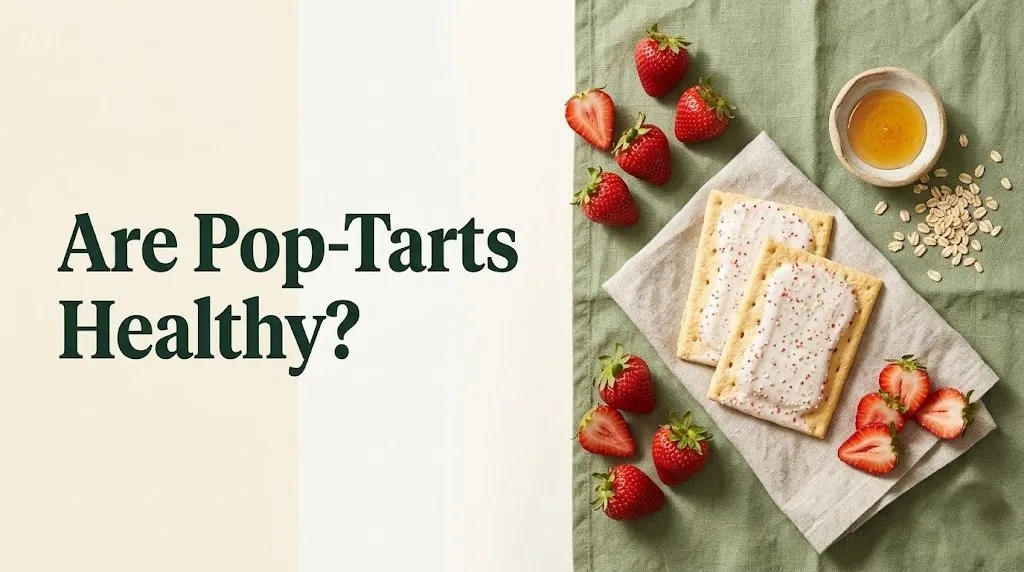
Pop-Tarts are not a healthy food for daily eating, but calling them purely “bad” misses the actual nutrition picture. They are a high-sugar, low-fiber, ultra-processed toaster pastry that can fit into an occasional treat role without derailing your diet.
The average American eats roughly 17 teaspoons of added sugar per day, well above the American Heart Association’s recommended limit of 6 teaspoons for women and 9 teaspoons for men. A single Pop-Tart contains about 14 to 18 grams of added sugar depending on the flavor, which is roughly 3.5 to 4.5 teaspoons before you’ve eaten anything else.
This guide covers every angle you actually care about: the real nutrition numbers by flavor, what the ingredients list means for your health, how Pop-Tarts compare to similar breakfast options, who should be especially careful, and what to eat instead when you need something just as fast.
Are Pop-Tarts Healthy?
Pop-Tarts are not a healthy everyday food by standard nutritional criteria. They are high in added sugars, low in protein, low in dietary fiber, and classified as an ultra-processed food under the NOVA food classification system developed by researchers at the University of São Paulo.
That said, “healthy” is a context-dependent term. A single Pop-Tart eaten occasionally as a treat, alongside a protein source, is a very different nutritional event than eating two Pop-Tarts every morning as your only breakfast. The food itself is not poison. The pattern of eating it is what matters.
The USDA Dietary Guidelines for Americans 2020-2025 recommend limiting added sugars to less than 10% of total daily calories. For a 2,000-calorie diet, that’s 50 grams of added sugar per day as an upper ceiling. Two Frosted Strawberry Pop-Tarts, a standard single-package serving, contains approximately 32 grams of added sugar. That one package uses up more than half your daily ceiling before you’ve opened anything else.
Key facts at a glance:
- One pastry (approximately 52g): 200 calories, 37g carbohydrates, 14-16g added sugar, 2g protein, 0.5g fiber
- Standard package (2 pastries): approximately 400 calories, 74g carbohydrates, 28-32g added sugar
- Fortified with reduced iron and four B vitamins at approximately 10% Daily Value each
- No whole grain content in most flavors; enriched white flour is the primary ingredient
People managing blood glucose or following a low-sugar diet should treat Pop-Tarts as a genuine occasional indulgence rather than a breakfast staple.
Pop-Tarts Nutrition Facts
A single Frosted Strawberry Pop-Tart (approximately 52 grams) contains around 200 calories, 37 grams of total carbohydrates, 16 grams of total sugars, 5 grams of total fat, 1 gram of saturated fat, 2 grams of protein, and less than 1 gram of dietary fiber.
The package sold in stores contains two pastries, which Kellogg’s lists as the standard serving size. That means most people eating “one serving” are consuming approximately 400 calories, 74 grams of carbohydrates, and 32 grams of total sugars in a single sitting.
The fortification profile is real but modest. Each pastry provides approximately 10% of the Daily Value for reduced iron, thiamine (vitamin B1), riboflavin (vitamin B2), niacin (vitamin B3), and folic acid (vitamin B9). These are added during processing to replace nutrients lost when whole grain is milled into enriched white flour.
| Nutrient | Per 1 Pastry (52g) | Per 2 Pastries (104g) |
|---|---|---|
| Calories | 200 | 400 |
| Total Carbohydrates | 37g | 74g |
| Total Sugars | 16g | 32g |
| Dietary Fiber | 0.5g | 1g |
| Total Fat | 5g | 10g |
| Saturated Fat | 1g | 2g |
| Protein | 2g | 4g |
| Sodium | 170mg | 340mg |
| Iron (% DV) | 10% | 20% |
| Thiamine (% DV) | 10% | 20% |
People with celiac disease or non-celiac gluten sensitivity cannot eat Pop-Tarts safely. All flavors are made with enriched wheat flour, which contains gluten.
Pop-Tarts Calories Per Serving
The calorie count of a Pop-Tart depends heavily on what you count as a serving. A single pastry averages 195 to 210 calories. The two-pastry package averages 390 to 420 calories total.
That calorie range places Pop-Tarts in similar territory to a medium-sized bagel or a frosted donut. The difference is that a bagel provides more protein (roughly 9 to 11 grams) and a better fiber profile if it’s whole grain, making it more filling per calorie than a Pop-Tart.
Think of caloric density the way you think about fuel efficiency. A Pop-Tart burns fast and leaves your tank empty again quickly. High sugar, low fiber, and low protein means it digests rapidly, blood glucose rises sharply, and hunger returns faster than it would after a protein- and fiber-rich breakfast.
| Breakfast Option | Calories | Protein | Fiber | Sat. Fat |
|---|---|---|---|---|
| 2 Frosted Pop-Tarts | 400 | 4g | 1g | 2g |
| 2 eggs on whole grain toast | 310 | 18g | 4g | 3g |
| Greek yogurt + fruit | 200 | 17g | 2g | 1g |
| Oatmeal with berries | 250 | 8g | 6g | 0.5g |
| Whole grain bagel + nut butter | 380 | 14g | 5g | 2g |
Active individuals who need quick carbohydrate energy before a workout may find Pop-Tarts a convenient short-term energy source. But for anyone prioritizing satiety, blood sugar stability, or overall diet quality, the calorie-to-nutrient ratio is poor.
Key Takeaway: Pop-Tarts are a calorie-dense, nutrient-sparse food. A two-pastry package delivers 400 calories but only 4 grams of protein and less than 1 gram of fiber, making them one of the least satiating ways to spend those calories at breakfast.
Pop-Tarts Sugar Content
Pop-Tarts are high in added sugar. A single Frosted Strawberry pastry contains approximately 14 to 16 grams of total sugar, nearly all of which is added sugar from sucrose and high fructose corn syrup.
The American Heart Association recommends that women consume no more than 25 grams (about 6 teaspoons) of added sugar per day, and men no more than 36 grams (about 9 teaspoons). One standard Pop-Tart package delivers 28 to 32 grams of added sugar, exceeding the entire daily recommended limit for women in a single breakfast.
Added sugar is metabolized differently from the naturally occurring sugars in whole fruit. Whole fruit comes bundled with dietary fiber, which slows glucose absorption into the bloodstream. A Pop-Tart provides almost no fiber, so the sugar hits your bloodstream quickly. This is what nutritionists mean when they refer to the glycemic load of a food: not just how much sugar is present, but how fast your body processes it.
Sugar content by major sugar source in Pop-Tarts:
- Enriched flour (refined carbohydrate that converts to glucose rapidly)
- Sucrose (table sugar), listed in the filling
- High fructose corn syrup (HFCS), used in some flavors
- Dextrose (a simple glucose sugar used in the pastry shell)
- Corn syrup (in certain flavor formulations)
People with prediabetes, type 2 diabetes, or insulin resistance should be especially mindful. The combination of high sugar and low fiber in Pop-Tarts creates a rapid blood glucose spike that can be difficult for these individuals to manage without medication or a compensating dietary strategy.
Pop-Tarts Ingredients List
The primary ingredients in most Pop-Tart flavors are enriched flour, sugar, and palm oil, in that order by weight. That ordering matters because ingredients on a food label in the United States must be listed from most to least by weight.
Standard Frosted Strawberry Pop-Tart ingredients include:
- Enriched flour (wheat flour with added thiamine mononitrate, riboflavin, niacin, reduced iron, folic acid)
- Corn syrup
- High fructose corn syrup
- Dextrose
- Sugar
- Palm oil
- Strawberry jam filling (with sugar, dried strawberries, corn syrup, citric acid, red 40)
- Frosting (sugar, palm oil, artificial color including Red 40)
- Tert-butylhydroquinone (TBHQ) as a preservative
- Natural and artificial flavors
The enrichment adds B vitamins and iron back into flour that lost those nutrients during milling. It is standard practice for white flour in the United States and required under FDA regulation. However, enrichment replaces only a fraction of the nutritional complexity present in whole grain. Dietary fiber, magnesium, zinc, and various phytocompounds found in intact wheat are not restored through enrichment.
People avoiding artificial food dyes, specifically Red 40 (Allura Red AC), Yellow 5 (Tartrazine), or Yellow 6 (Sunset Yellow FCF), will want to check the specific flavor label, as not all flavors use the same dyes. Unfrosted varieties and some specific flavors have different colorant profiles. Individuals with known dye sensitivities or who prefer to minimize artificial additives for their children should read labels carefully before purchasing.
Are Pop-Tarts Ultra-Processed?
Yes, Pop-Tarts are classified as an ultra-processed food under the NOVA food classification system. NOVA, developed by nutrition researchers at the University of São Paulo, divides foods into four groups based on the extent and purpose of processing. Ultra-processed foods (Group 4) are industrial formulations made mostly or entirely from substances extracted from foods, with little to no whole food present.
Pop-Tarts contain multiple NOVA Group 4 markers: high fructose corn syrup, TBHQ, artificial dyes, natural and artificial flavors, and emulsifiers. They have no meaningful whole food component.
Research published in The BMJ found that higher ultra-processed food intake was associated with higher risk of all-cause mortality, cardiovascular disease, type 2 diabetes, and depression in large-scale cohort studies. This does not mean any single food causes any specific disease. It means that a dietary pattern dominated by ultra-processed foods is associated with worse long-term health outcomes in population-level research.
TBHQ (tert-butylhydroquinone) deserves a specific mention here because it generates a lot of reader concern. It is a synthetic antioxidant preservative that prevents fat oxidation and extends shelf life. The FDA approves TBHQ at a maximum concentration of 0.02% of the fat content in a product. The European Food Safety Authority (EFSA) has set an acceptable daily intake (ADI) for TBHQ. At levels found in a standard Pop-Tart serving, TBHQ is within established regulatory safety thresholds. Eating one or two Pop-Tarts does not expose you to TBHQ at levels that have been shown to cause harm in humans.
Key Takeaway: Pop-Tarts are ultra-processed by formal food science classification, and a diet heavy in ultra-processed foods is linked to worse health outcomes in population research. Eating them occasionally within an otherwise varied, whole-food-rich diet is a meaningfully different health scenario than eating them daily.
Are Pop-Tarts Healthy for Breakfast?
Pop-Tarts are not a healthy breakfast choice for daily consumption. As a primary morning meal, they deliver excess added sugar and refined carbohydrates without the protein or fiber needed to sustain energy, support concentration, or manage hunger until lunch.
The USDA Dietary Guidelines for Americans recommend that breakfast include a mix of whole grains, lean protein, and fruit or vegetables. A Pop-Tart provides none of those three in meaningful amounts. The enriched flour is not a whole grain. The 2 grams of protein per pastry are far below the 15 to 25 grams that research in the American Journal of Clinical Nutrition has associated with improved morning satiety and reduced caloric intake later in the day.
That said, there is a practical argument for occasional convenience. A Pop-Tart eaten with a hard-boiled egg and a piece of fruit is a genuinely different nutritional situation than a Pop-Tart alone. Adding protein and fiber from other foods at the same meal can partially buffer the glycemic impact of the pastry.
If you are eating Pop-Tarts for breakfast, here are the honest trade-offs:
- You are starting the day with high added sugar and low fiber, which tends to produce an energy spike followed by a drop.
- You are getting very little protein, which means hunger is likely to return well before lunch.
- The fortification provides modest amounts of iron and B vitamins, which does offer some nutritional credit, but not enough to classify the food as nutritionally adequate for breakfast.
- Children and adolescents who eat Pop-Tarts as a regular breakfast are more likely to experience the energy-crash pattern than adults, because their body weight means the sugar-to-body-mass ratio is higher.
People with hypoglycemia or reactive hypoglycemia should be particularly cautious about eating Pop-Tarts without a substantial protein and fat source alongside them.
Are Strawberry Pop-Tarts Healthy?
Frosted Strawberry Pop-Tarts are among the most popular flavors and are not healthier than other flavors in any meaningful way. They contain approximately 200 calories, 37 grams of carbohydrates, 14 to 16 grams of total sugars, and less than 1 gram of dietary fiber per pastry.
The “strawberry” in the filling is real but minimal. The ingredient list shows dried strawberries appear after sugar, corn syrup, and high fructose corn syrup in the filling composition. The strawberry contribution to the nutritional profile is minimal compared to the sugar base.
Red 40 (Allura Red AC) is used in Frosted Strawberry Pop-Tarts to achieve the red and pink color in the frosting and filling. Red 40 is the most widely consumed artificial food dye in the United States, and the FDA classifies it as safe for general use. Some researchers have raised questions about potential behavioral effects in children with attention-related conditions, but the FDA’s most recent review has not found sufficient evidence to mandate label warnings in the United States. The European Union requires products containing certain artificial dyes, including Red 40, to carry an advisory statement about potential effects on children’s activity and attention.
Frosted Strawberry vs. other common flavors (per 1 pastry, approximately 52g):
| Flavor | Calories | Total Sugar | Protein | Fiber |
|---|---|---|---|---|
| Frosted Strawberry | 200 | 16g | 2g | 0.5g |
| Frosted Brown Sugar Cinnamon | 210 | 14g | 3g | 0.5g |
| Frosted S’mores | 200 | 16g | 2g | 0.5g |
| Unfrosted Strawberry | 195 | 14g | 2g | 0.5g |
| Frosted Blueberry | 200 | 15g | 2g | 0.5g |
Individuals sensitive to artificial food dyes should check their specific flavor label, as dye content varies across the Pop-Tart line.
Brown Sugar Cinnamon Pop-Tarts Nutrition
Brown Sugar Cinnamon Pop-Tarts are a slightly different nutritional case from fruit-filled flavors. They have no artificial dye-based coloring, a slightly lower sugar content per pastry, and a marginally higher fat content from the cinnamon-brown sugar filling.
A single Frosted Brown Sugar Cinnamon Pop-Tart contains approximately 210 calories, 30 grams of carbohydrates, 14 grams of total sugars, 3 grams of protein, and 6 grams of total fat. The slightly higher fat content comes from palm oil in the filling. The marginally higher protein reflects small differences in filling composition rather than any meaningful protein enrichment.
Brown Sugar Cinnamon is often considered a “cleaner” flavor because it lacks artificial fruit-flavored additives, but the core nutritional profile remains very similar to other flavors. High added sugar, low fiber, and low protein are consistent across the entire Pop-Tart product line.
What sets Brown Sugar Cinnamon apart:
- No artificial fruit dye coloring (no Red 40, Yellow 5, or Yellow 6 in most formulations)
- Slightly higher fat content from cinnamon-brown sugar filling
- Among the most popular flavors among adults, partly due to its less artificially sweet taste profile
- Still contains TBHQ as a preservative
- Still classified as an ultra-processed food under NOVA criteria
Individuals avoiding artificial food dyes for dietary or personal preference reasons will find Brown Sugar Cinnamon a preferable option, though it is not nutritionally superior in terms of the core health concerns: added sugar load and low fiber content.
Key Takeaway: Whether you choose Strawberry, Brown Sugar Cinnamon, or S’mores, the fundamental nutritional shortcomings of Pop-Tarts are consistent across flavors. High sugar and low fiber are not flavor-specific problems. They are product-wide characteristics.
Unfrosted Pop-Tarts vs. Frosted
Unfrosted Pop-Tarts are modestly lower in sugar and calories than their frosted counterparts, but the difference is smaller than most people expect. An Unfrosted Strawberry Pop-Tart contains approximately 195 calories and 14 grams of total sugar per pastry, compared to about 200 calories and 16 grams of sugar for the Frosted version.
Removing the frosting eliminates roughly 1 to 2 grams of sugar and about 5 to 10 calories per pastry. That is not a nutritional transformation. It is a minor reduction.
| Feature | Unfrosted | Frosted |
|---|---|---|
| Calories (1 pastry) | 195 | 200 |
| Total Sugar | 14g | 16g |
| Total Fat | 4g | 5g |
| Protein | 2g | 2g |
| Fiber | 0.5g | 0.5g |
| Artificial Dye | Less likely | More likely |
| TBHQ | Yes | Yes |
The unfrosted version does have one practical advantage: it is less likely to contain artificial frosting dyes. For parents who prefer to minimize artificial dye exposure in their children’s diets, unfrosted flavors are a reasonable choice.
Nutritionally, neither version should be considered a healthy daily breakfast option. The core issue (enriched white flour, high added sugar, negligible fiber, minimal protein) exists in both the frosted and unfrosted varieties.
Pop-Tarts for Kids
Pop-Tarts are widely eaten by children in the United States, but they are not a nutritionally appropriate daily breakfast for this age group. The American Heart Association recommends that children ages 2 to 18 consume less than 25 grams of added sugar per day total. One Frosted Strawberry Pop-Tart contains approximately 14 to 16 grams of added sugar, representing more than half of a child’s entire daily recommended limit.
The low protein content is particularly relevant for children and adolescents. Research consistently associates protein-rich breakfasts with better concentration, more stable energy levels, and reduced overeating later in the school day. Two grams of protein per pastry does not come close to supporting that.
There is also the artificial dye consideration. Several Pop-Tart flavors contain Red 40, Yellow 5, and Yellow 6. The FDA currently classifies these dyes as safe. However, the European Food Safety Authority requires advisory labeling on products containing these dyes due to observed associations between artificial dye consumption and increased hyperactivity in some children, particularly those with attention-related sensitivity. Parents who want to minimize this exposure should look for unfrosted flavors or dye-free alternatives.
What to consider if your child eats Pop-Tarts:
- Treat them as an occasional food rather than a daily breakfast
- Pair with a protein source (egg, Greek yogurt, cheese) to slow sugar absorption and improve satiety
- Choose unfrosted flavors to reduce artificial dye exposure
- Portion to one pastry for younger children rather than the full two-pastry package
- Do not combine with a sweetened juice or chocolate milk, which adds more sugar to an already high-sugar meal
Pop-Tarts and Diabetes
People with type 2 diabetes or prediabetes should approach Pop-Tarts with caution. The combination of high added sugar, refined carbohydrates, and negligible dietary fiber creates a high glycemic load, meaning the food causes a rapid and steep rise in blood glucose levels after eating.
For people whose bodies have impaired insulin response, that rapid spike is harder to manage. Even for people without diabetes, eating high-glycemic foods repeatedly over time is associated with increased insulin resistance in research published in the American Journal of Clinical Nutrition.
The glycemic index of white bread (enriched flour) is approximately 70 to 75. Pop-Tarts are made primarily from enriched white flour with added sugar, which places them in a high glycemic load category. This does not mean a person with diabetes can never eat a Pop-Tart. It means the food requires intentional planning: eating it alongside fat, protein, and fiber slows the glucose response. Eating it alone first thing in the morning on an empty stomach creates a sharper and harder-to-manage blood glucose excursion.
A registered dietitian who specializes in diabetes management can provide personalized guidance on how to incorporate occasional higher-sugar foods within an overall blood glucose management strategy, particularly for individuals on insulin or other glucose-modulating medications.
Pop-Tart eating context for blood sugar awareness:
| Eating Context | Blood Sugar Impact |
|---|---|
| Pop-Tart alone, empty stomach | High and rapid glucose spike |
| Pop-Tart with eggs and avocado | Slower glucose rise, more manageable |
| Pop-Tart with Greek yogurt and nuts | Moderate glucose response due to fat and protein buffer |
| Pop-Tart with juice or sweetened drink | Very high combined sugar load, steep glucose spike |
Key Takeaway: For anyone managing blood glucose, Pop-Tarts are a high-glycemic food that demands context. Pairing them with protein and fat can reduce the blood sugar impact. Eating them alone, especially on an empty stomach, is a meaningful concern for people with prediabetes or type 2 diabetes.
Are Legendary Foods Healthy?
Legendary Foods Toaster Pastries are a protein-enriched alternative to traditional Pop-Tarts, and they are considerably more nutritionally favorable for people prioritizing protein intake and blood sugar management. A standard Legendary Foods Toaster Pastry (approximately 67g) contains around 180 to 200 calories, 19 to 22 grams of protein, 22 to 25 grams of carbohydrates, and 4 to 5 grams of dietary fiber depending on flavor.
That protein and fiber profile is dramatically different from a Kellogg’s Pop-Tart. Getting 19 to 22 grams of protein from a toaster pastry-format product is a real functional difference, particularly for athletes, people following high-protein diets, or anyone trying to manage hunger and blood sugar more effectively at breakfast.
The ingredient profile of Legendary Foods products is also cleaner in terms of the NOVA ultra-processed criteria, though they are still a processed food with added ingredients rather than a whole food. They use protein isolates, chicory root fiber, and erythritol in many formulations, which some individuals may need to be aware of. Erythritol is a sugar alcohol that can cause digestive discomfort (bloating, gas, loose stool) in sensitive individuals at higher doses.
| Product | Calories | Protein | Fiber | Added Sugar |
|---|---|---|---|---|
| Kellogg’s Frosted Strawberry (1 pastry) | 200 | 2g | 0.5g | 14-16g |
| Legendary Foods Toaster Pastry (1 pastry) | 190 | 20g | 5g | 2-4g |
| Unfrosted Pop-Tart (1 pastry) | 195 | 2g | 0.5g | 14g |
Legendary Foods are not a “health food” in the sense of being a whole food. But for people who want the convenience and flavor format of a toaster pastry with a much better macro profile, they are a meaningfully superior option.
Healthier Alternatives to Pop-Tarts
Several grab-and-go breakfast options provide the same convenience as Pop-Tarts with a significantly better nutritional profile. The key is finding foods that offer more protein, more fiber, and less added sugar without requiring elaborate morning preparation.
Think of a Pop-Tart like a fast-burning fire starter. It gets things going quickly but needs real fuel behind it. The healthier alternatives below act more like a slow-burning log: they provide sustained energy rather than a rapid spike and crash.
Practical swaps by convenience level:
- Minimum prep (as fast as a Pop-Tart): Hard-boiled eggs from the fridge plus a piece of whole fruit. Approximately 200 calories, 13 grams protein, 3 grams fiber, minimal added sugar.
- One step of prep: Whole grain toaster waffle (Eggo Whole Grain or Nature’s Own Thick and Fluffy) with 1 tablespoon of natural almond butter. Approximately 200 calories, 7 grams protein, 4 grams fiber.
- Slightly more prep, made the night before: Overnight oats with rolled oats, Greek yogurt, chia seeds, and berries. Approximately 350 calories, 20 grams protein, 8 grams fiber.
- Direct product swap: Legendary Foods Toaster Pastry (same format, dramatically better macros as detailed in the section above).
- Middle ground option: RX Bar or Kind Bar with minimal added sugars. Approximately 200 calories, 10 to 12 grams protein, 3 to 5 grams fiber.
| Alternative | Calories | Protein | Fiber | Added Sugar |
|---|---|---|---|---|
| 2 hard-boiled eggs + banana | 220 | 13g | 3g | 0g |
| Whole grain toaster waffle + almond butter | 210 | 7g | 4g | 2g |
| Overnight oats (made night before) | 350 | 20g | 8g | 3g |
| Legendary Foods Toaster Pastry | 190 | 20g | 5g | 2g |
| RX Bar | 210 | 12g | 5g | 13g |
| 2 Kellogg’s Frosted Pop-Tarts | 400 | 4g | 1g | 32g |
People with nut allergies should substitute sunflower seed butter for any nut butter-based options. Most of the above alternatives are also naturally more suitable for people with prediabetes or those following lower-sugar eating patterns.
Frequently Asked Questions About Pop-Tarts
Are pop tarts healthy for you to eat every day?
Pop-Tarts are not healthy enough in nutritional terms to be a daily breakfast food.
Eaten daily, two Pop-Tarts provide 32 grams of added sugar, which exceeds the American Heart Association’s full daily added sugar recommendation for women and approaches the limit for men.
Occasional eating within an otherwise varied, whole-food-rich diet is a meaningfully different situation than using them as a daily staple.
How many calories are in one Pop-Tart?
One standard Pop-Tart pastry contains approximately 195 to 210 calories depending on the flavor.
The standard package sold in stores contains two pastries and represents the serving size Kellogg’s uses on the nutrition label, totaling approximately 390 to 420 calories.
Eating just one pastry rather than the full package cuts the caloric intake in half.
Do Pop-Tarts have any nutritional value?
Pop-Tarts do have some nutritional value through added fortification. Each pastry provides approximately 10% of the Daily Value for iron, thiamine, riboflavin, niacin, and folic acid.
These are genuine nutrients that contribute to daily requirements, though the amounts are modest.
The high added sugar and low fiber content remain the dominant nutritional concerns that offset the benefit of the fortification.
Are unfrosted Pop-Tarts healthier than frosted?
Unfrosted Pop-Tarts contain slightly less sugar and slightly fewer calories than frosted versions, but the difference is minor.
An unfrosted pastry has approximately 14 grams of total sugar versus 16 grams in the frosted version, a difference of 2 grams.
The core nutritional concerns, which are high added sugar, low protein, and negligible fiber, are present in both frosted and unfrosted varieties equally.
What is a healthier alternative to Pop-Tarts?
Legendary Foods Toaster Pastries are the most direct format-equivalent swap, offering approximately 20 grams of protein and 5 grams of fiber versus 2 grams of protein and 0.5 grams of fiber in a standard Pop-Tart.
For whole-food options, overnight oats or a hard-boiled egg with whole fruit provides far better protein and fiber for a similar or lower calorie count.
The right swap depends on your nutritional priorities, but any of these options delivers meaningfully better blood sugar stability and satiety than a standard Pop-Tart.
The Bottom Line on Pop-Tarts
Pop-Tarts are a convenient, enjoyable food that most nutrition professionals would describe as an occasional treat rather than a daily meal. The sugar content is genuinely high. The fiber and protein content is genuinely low. And the ultra-processed classification is not a label that should be dismissed.
None of that means one Pop-Tart will ruin your health. It means relying on them as a breakfast staple will leave you nutritionally under-served day after day.
If you eat them sometimes and your overall diet is built on whole grains, lean proteins, vegetables, and fruit, the occasional Pop-Tart is a non-issue. If they’re your go-to breakfast every morning, it’s worth trying one of the practical swaps in this guide for two weeks and noticing how your energy and hunger levels change.